
-
Paper Information
- Previous Paper
- Paper Submission
-
Journal Information
- About This Journal
- Editorial Board
- Current Issue
- Archive
- Author Guidelines
- Contact Us
International Journal of Genetic Engineering
p-ISSN: 2167-7239 e-ISSN: 2167-7220
2025; 13(12): 339-345
doi:10.5923/j.ijge.20251312.12
Received: Nov. 25, 2025; Accepted: Dec. 12, 2025; Published: Dec. 29, 2025

Assessment of the Vertical Distribution of Elements in the 0–30 cm Soil Layer of an Industrial Area Using SEM-EDS
 Abstract
 Reference
 Full-Text PDF
 Full-text HTML
Jabbarov Zafarjon1, Muxammadjonova Nodirabonu2
1DSc., Professor., Departmant of Soil Science, Faculty of Biology, National University of Uzbekistan, Tashkent, Uzbekistan
2Phd., Departmant of Soil Science, Faculty of Biology, National University of Uzbekistan, Tashkent, Uzbekistan
Correspondence to: Jabbarov Zafarjon, DSc., Professor., Departmant of Soil Science, Faculty of Biology, National University of Uzbekistan, Tashkent, Uzbekistan.
| Email: |  |
Copyright © 2025 The Author(s). Published by Scientific & Academic Publishing.
This work is licensed under the Creative Commons Attribution International License (CC BY).
http://creativecommons.org/licenses/by/4.0/

This investigation aims to elucidate the elemental composition and distribution within the soil profile of an industrialized zone, focusing on the upper 30 centimeters. Soil samples were systematically collected from two distinct depths: 0-15 cm (topsoil) and 15-30 cm (subsoil), and their elemental characteristics were analyzed using Scanning Electron Microscopy coupled with Energy Dispersive Spectroscopy (SEM-EDS). The findings reveal that contamination predominantly accumulates within the topsoil layer, characterized by elevated levels of anthropogenic elements, while the subsoil retains a composition more reflective of natural geogenic minerals. These insights are instrumental in understanding the extent and vertical migration of pollutants in soils impacted by industrial activities, ultimately informing ecological risk assessments and remediation strategies.
Keywords: Soil contamination, SEM–EDS, Vertical elemental distribution, Industrial pollution, Environmental assessment
Cite this paper: Jabbarov Zafarjon, Muxammadjonova Nodirabonu, Assessment of the Vertical Distribution of Elements in the 0–30 cm Soil Layer of an Industrial Area Using SEM-EDS, International Journal of Genetic Engineering, Vol. 13 No. 12, 2025, pp. 339-345. doi: 10.5923/j.ijge.20251312.12.
1. Introduction
- The rapid expansion of industrial activities over recent decades has markedly contributed to environmental contamination, with soils being particularly susceptible to anthropogenic inputs. Industries such as mining, metallurgy, and manufacturing release a variety of pollutants including dust, aerosols, and chemical residues that deposit onto soil surfaces. Over time, these pollutants can alter the physicochemical properties of soils, potentially jeopardizing ecological health and human safety.The soil’s uppermost layers are the primary recipients of atmospheric deposition, making them critical zones for detecting recent contamination. However, understanding the extent to which these pollutants penetrate deeper into the soil profile is essential for assessing long-term environmental risks. The vertical distribution of elements within the soil profile offers valuable insights into the dynamics of contaminant migration and natural attenuation processes.The rapid development of industrialization has significantly impacted the environment, particularly the contamination of soil cover [1,2]. Activities related to mining, metallurgy, and other heavy industries release dust and aerosols into the atmosphere, which subsequently deposit onto the soil surface, thereby altering its physicochemical properties [3,4]. This process is especially impactful on the upper soil layers, as contaminants tend to accumulate there and, over time, may migrate into the lower horizons [5,6].Studying the vertical distribution of elements within the soil profile is of critical importance in environmental assessment. Research indicates that the upper layers are enriched with anthropogenic contaminants, while the lower layers predominantly consist of natural geogenic elements [7,8]. Additionally, microscopic and spectral techniques such as SEM–EDS (Scanning Electron Microscopy coupled with Energy Dispersive Spectroscopy) enable rapid and accurate identification of both major and trace elements in soil samples [9,10]. The rapid development of industrialization and urbanization has significantly impacted the environment, particularly soil cover and contamination levels. Recent studies [11] emphasize that industrial activities and transportation emissions release heavy metals and chemicals into the atmosphere, which subsequently deposit onto soil surfaces, altering their chemical composition. This process predominantly affects the upper soil layers, where pollutants tend to accumulate, and over time, they can migrate into deeper layers [12].Research by Zhang [13] highlights that emissions from metallurgical and other heavy industries generate dust and aerosols that settle on the soil surface, leading to changes in physical and chemical properties. These pollutants tend to concentrate in the topsoil initially, but with continued deposition and environmental conditions, they can migrate vertically, posing ecological risks to the subsurface layers. Furthermore, Chen and Zheng [14] observed that in industrial zones, heavy metal concentrations are significantly higher in the upper layers of soil, indicating recent contamination, while the deeper layers often contain naturally occurring elements.Additionally, Li et al. focus on the migration of pollutants over time, noting that the vertical movement of harmful elements within soil profiles can cause long-term environmental hazards. Their findings suggest that understanding the vertical distribution of pollutants is crucial for assessing soil quality and developing effective remediation strategies.
2. Materials and Methods
- The study area encompasses the soils surrounding the Olmaliq Mining and Metallurgical Complex. The soil samples were collected from a location approximately 500 meters east of the complex, within the vicinity of the industrial site.Soil samples were collected from an area marked by intense industrial activity. Sampling was conducted at two depths to capture the vertical variation in elemental composition:0–15 cm (topsoil): representing the zone most impacted by atmospheric deposition and human activity;15–30 cm (subsoil): reflecting deeper, less disturbed soil layers.The samples underwent thorough preparation for SEM–EDS analysis. High-resolution imaging and elemental mapping were performed in Map Spectrum Mode, allowing for qualitative and semi-quantitative assessments of the elemental constituents. The resulting spectra were analyzed to determine the mass percentages (wt.%) of detected elements.
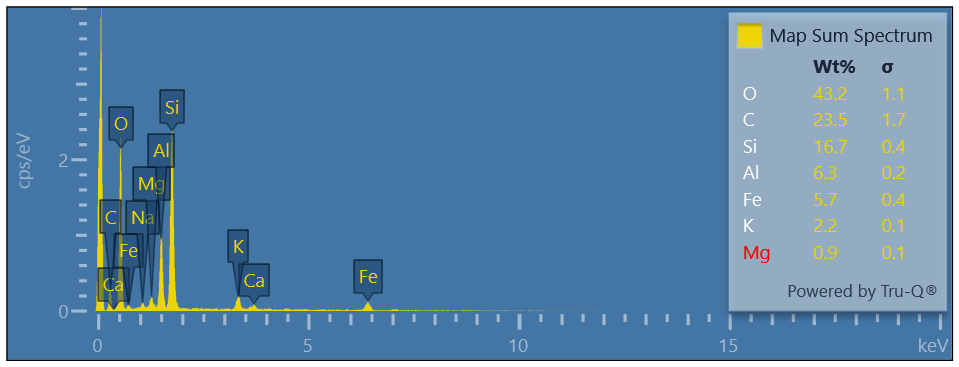 | Figure 1. Map Sum Spectrum 0-15 cm |
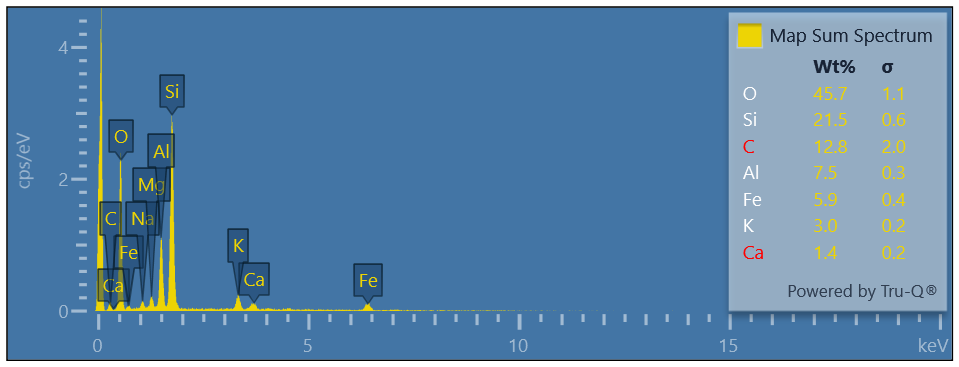 | Figure 2. Map Sum Spectrum 15-30 cm |
3. Results and Discussion
- Scientists analyzed soil samples taken from a region which showed signs of contamination at two different depth points which included the topsoil section between 0–15 cm and the subsoil section between 15–30 cm. The SEM–EDS Map Sum Spectrum method enabled researchers to determine the chemical elements present in both soil layers. The researchers studied how pollutants spread across different layers of the soil profile.Elemental composition of the 0–15 cm layer (topsoil)The 0–15 cm soil layer contained oxygen (O) at 43.24 wt.% and carbon (C) at 23.52 wt.%. The high carbon content shows that this layer contains organic matter and industrial dust from the atmosphere together with carbonate compounds. The research shows that human activities create their greatest impact on soil during the surface layer.
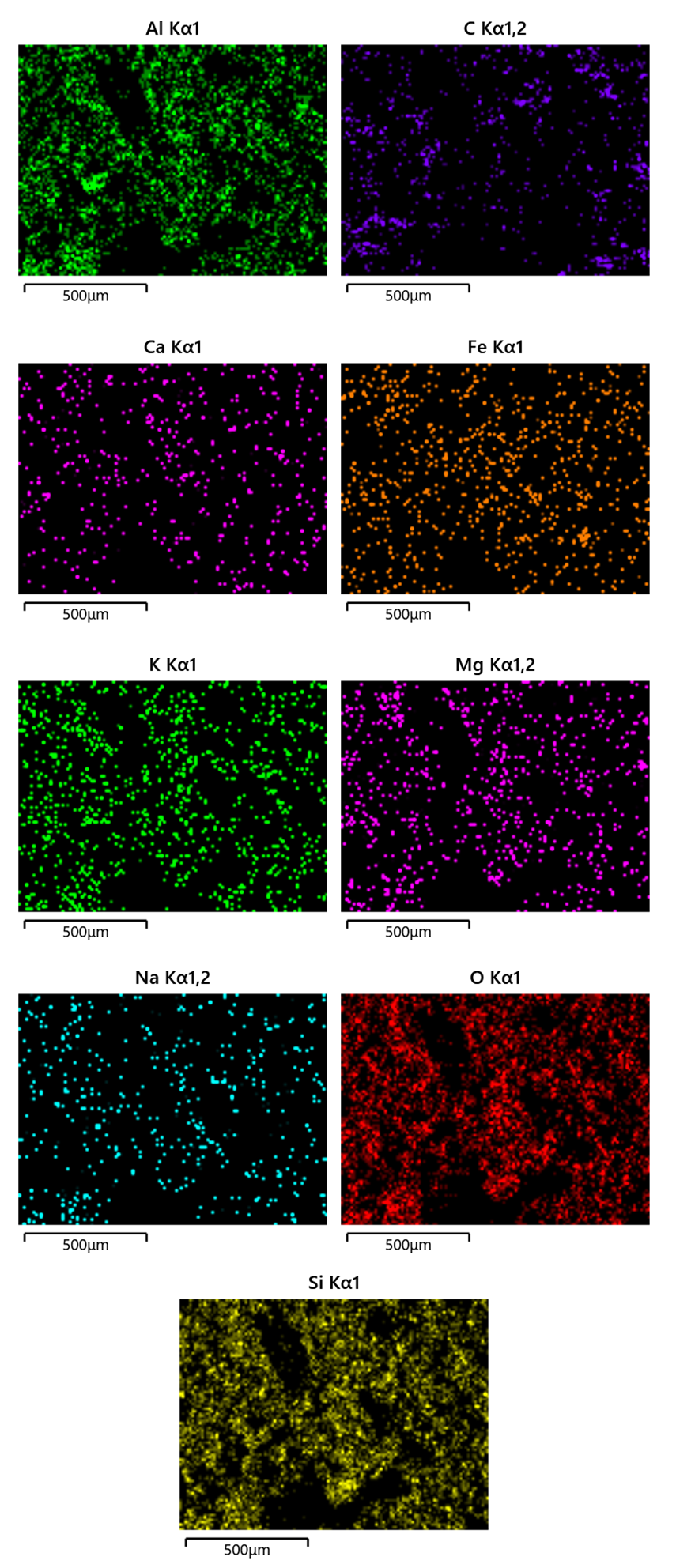 | Figure 3. Element distribution obtained from SEM–EDS analysis. 0-15 cm |
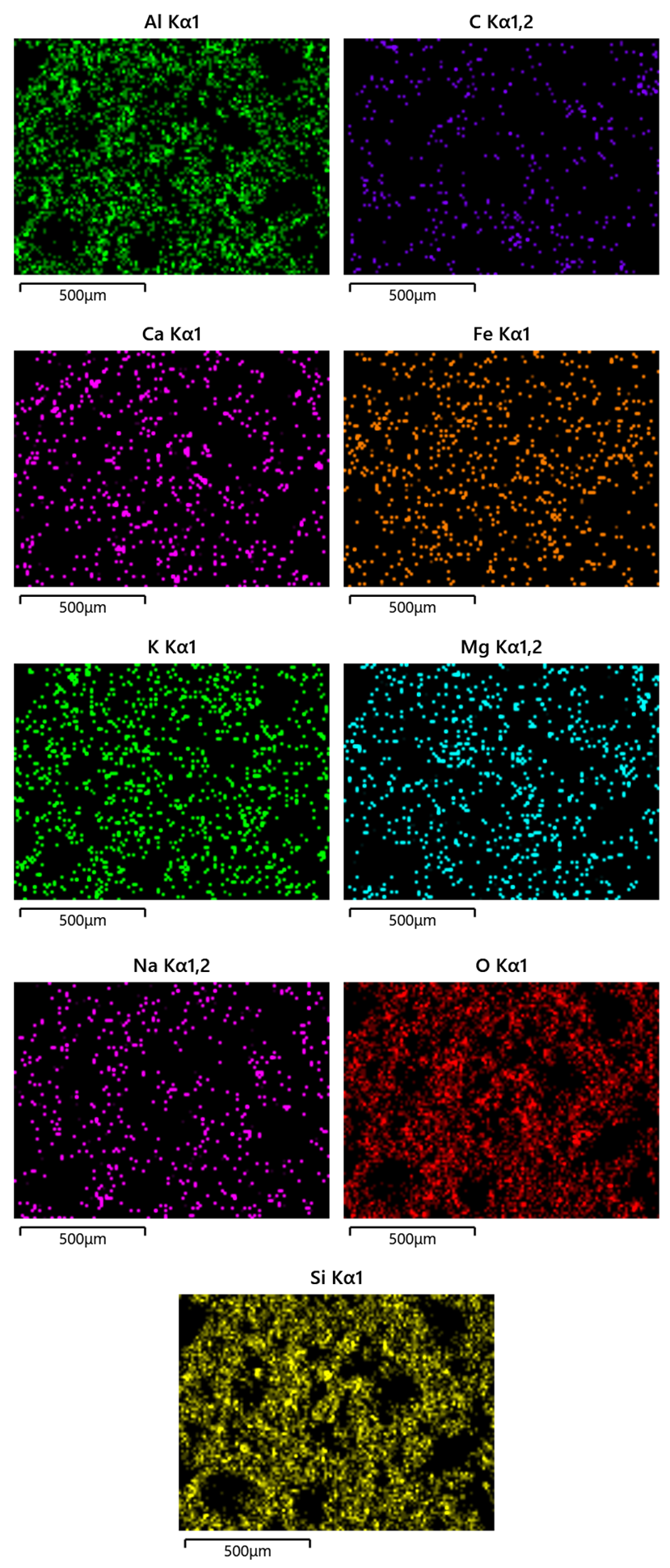 | Figure 4. Element distribution obtained from SEM–EDS analysis |
4. Conclusions
- The findings of this investigation clearly demonstrate that the highest concentration of contaminants is confined to the uppermost 15 centimeters of the soil profile within the industrial area. This topsoil layer exhibits elevated levels of elements associated with industrial emissions and anthropogenic activity, whereas the deeper 15–30 cm subsoil predominantly reflects the natural mineralogical composition typical of the region. However, the presence of certain elements within the subsoil indicates that the influence of industrial pollutants extends beyond the surface layer, suggesting a potential for long-term environmental impact. This implies that contaminants may gradually migrate downward over time, posing ongoing ecological risks. Consequently, these results underscore the importance of continuous monitoring and proactive management strategies to mitigate the sustained effects of industrial pollution on soil health and surrounding ecosystems.