Abror Otaboyev1, Ikram Abdullaev1, 2
1Khorezm Academy of Mamun, Khiva, Markaz str.1, Uzbekistan
2Urgench State University, Urgench, Khamid Alimjan str.14, Uzbekistan
Copyright © 2025 The Author(s). Published by Scientific & Academic Publishing.
This work is licensed under the Creative Commons Attribution International License (CC BY).
http://creativecommons.org/licenses/by/4.0/

Abstract
In this article, data was given on the status, systematic units, morphology, biology, and ecological characteristics of the species Spermophilus fulvus (Lichtenstein, 1823) distributed in the protected areas of Tuprokkala, Khiva districts and Karakum under the National Nature Park of the Khorezm region. In addition, their number of encounters, cases of reproduction in terms of years and months and times were studied, and its economic importance was described.
Keywords:
Landscape biotopes, Female, Embryos, Squirrel, Population, GIS, Khiva, Tuprokkala, Uzbekistan
Cite this paper: Abror Otaboyev, Ikram Abdullaev, Distribution, Biology of Yellow Ground Squirrel (Spermophilus fulvus Lichtenstein, 1832) in the Khorezm Region, International Journal of Genetic Engineering, Vol. 13 No. 12, 2025, pp. 333-338. doi: 10.5923/j.ijge.20251312.11.
1. Introduction
In the scientific and technological age, the problem of protecting wildlife is especially pressing. Humans currently have powerful levers of influence over wildlife. On the one hand, the uncontrolled increase in industrial production has a negative impact on all natural components; on the other, a scientific approach to nature conservation can save the situation if implemented at the proper level [3,17]. The fauna of Uzbekistan is diverse and, like that of other Central Asian countries, includes species characteristic of the subtropical region. The republic is home to 100 mammal species belonging to 6 orders [2,23].The history of studying the rodent fauna and ecology of the Karakum, as well as mammals belonging to other species, spans a long period of time. Especially, in studying the fauna and ecology of some vertebrates, Academician T.Z. Zakhidov’s research work is of great importance [5,6,7]. Under the leadership of N.P.Naumov [14] young scientists O.L. Rossolima [19], T.A.Kim [8] and V.G. Krivosheev [9] conducted their own research in the study of terrestrial vertebrate-rodent fauna and ecology in the Karakalpak region of Kyzylkum in the 1900 y. N.Ya. Pavlinin and others [16] studied the ecological-geographical and morphological features of the fauna of sand mice and made some new changes in their systematic status. N.V. Minin [13] carried out research on the ecological-geographical, fauna, and ecology of rodents in Central Asia.
2. Material and Methods
2.1. Study Area
The area is a lowland located in the north-western part of Uzbekistan, along the lower reaches of the Amudarya River, between 60’-61’ longitude and 41’-42’ latitude, at 113-138 m above sea level. The vegetation period of plants is 200-210 days. The climate is extremely continental, with an average annual precipitation of 80-90 mm. The average temperature in January is -5°C and in July, it is +30°C. Meadow, meadow marshy, marsh-sandy, and traditional alkali soils predominate [20]. The deserts of Kyzyl-Kum and Kara-Kum greatly influence on the climate of the oasis. The region is in the steppe zone, in the western part of the Khorezm oasis and the southern part of the Aral Sea, 100 m above sea level. The relief consists of a low plain. It is the old Amu-Darya delta and consists of river sediments. The western and southwestern parts of the region connecting with Kara-Kum are covered with sand. Some minerals include limestone, sand, clay, and other building materials. The study of the route covered all districts of the Khorezm region. The insects were collected yearly in spring, summer, autumn, and winter. As shown in Figure 1.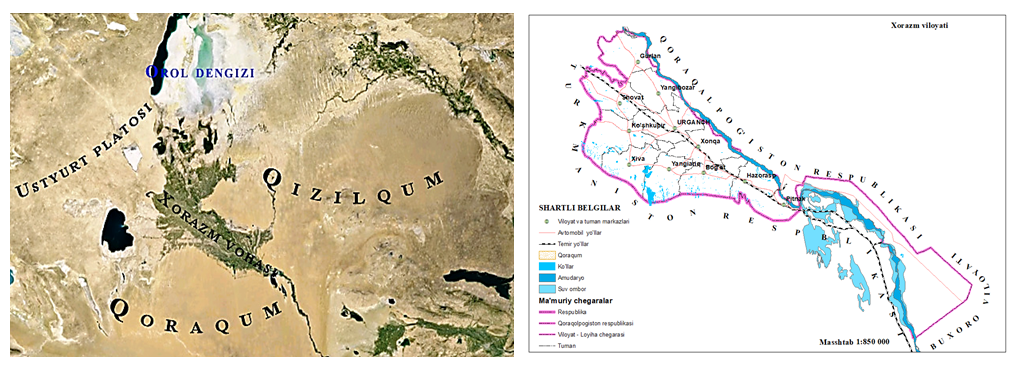 | Figure 1. Study areas of Khorezm region |
2.2. Methods
Based on the above, we conducted research in Khiva (1163 ha), Tuprokkala (19538.8 ha), Khiva (1163 ha), Tuprokkala (19538.8 ha) districts of the “Khorezm National Nature Park” to study the distribution, species composition, abundance, habitat, economic importance of the yellow ground squirrel Spermophilus fulvus (Lichtenstein, 1832) in the Khorezm region and we set tasks such as creating a GIS map of the research area and the distribution of the animal, studying its biological characteristics. We collected data during the preparation period of ground squirrels (Spermophilus fulvus) in all seasons of 2023 in the Khiva (N41°19'22.8", E61°59'07.0"), Shavat (N41°16'15.5", E60°44'48.3"), and Tuprakkala (N41°02'06.5", E60°22'59.2") districts of the Khorezm region. In this settlement, individual marking of ground squirrels has been carried out since 2001. Consequently, the age, origin, and main events of the annual cycle are known for almost all individuals (Fig. 2).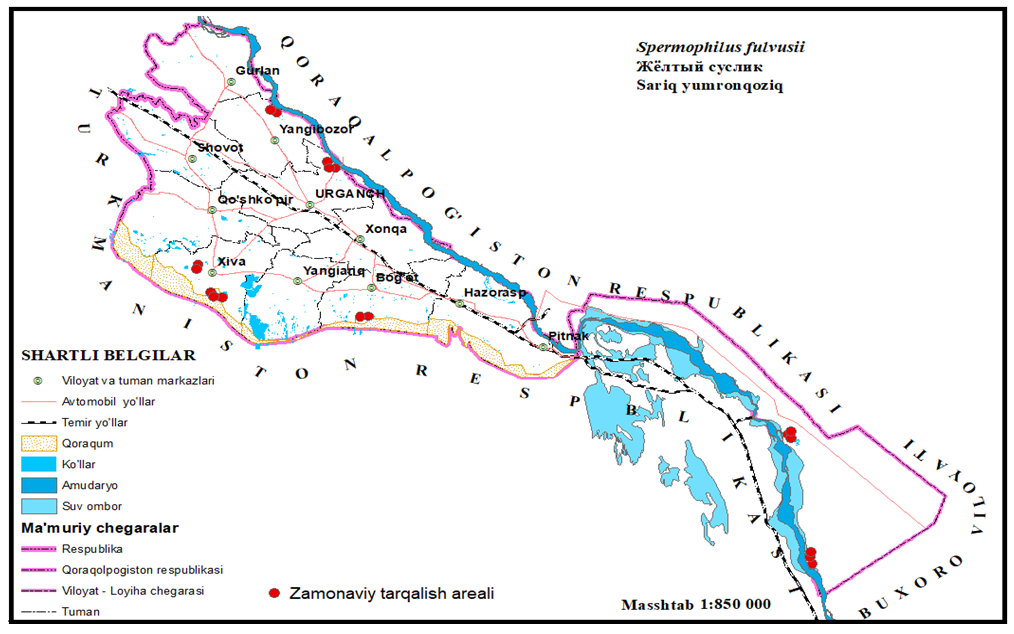 | Figure 2. Distribution of the Spermophilus fulvus in the Khorezm region |
During our research, we used tracking, route counting (on foot or by car), footprints, litter recording, 15x50 binoculars, and 60 pipes of the Viking firm. The coordinates of observation points and landmarks were recorded using Locus Map. From September 23 to October 14, 2023, data on species belonging to the genus Spermophilus were collected and counted in the territory of the national nature park of Khiva and Tuprokkala districts (see Fig. 3).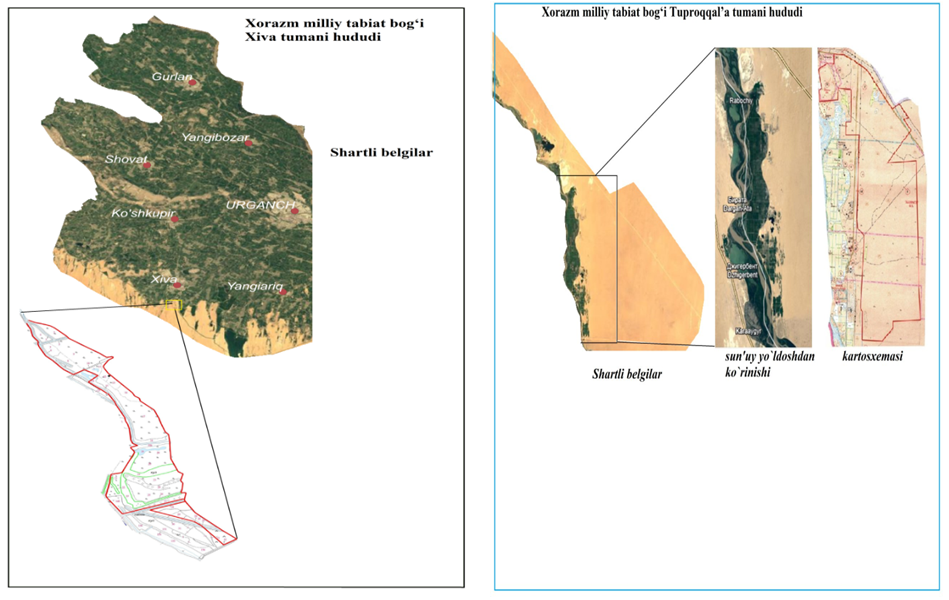 | Figure 3. Natural research areas of Khiva and Tuprakkala districts |
The species composition of teriocomplexes distributed in the Karakum area of the Khorezm region was determined by Novikov [15], using methods of field ecological investigation, and their location types were determined based on the methods of zoological cartography [22] on a large and medium scale. Special instructions, guidelines, age, sex structures, and reproduction methods were studied using established methods for a numerical calculation of each species. The methods of M.I. Leonteva [11,12] were used for the classification of colonies of the yellow ground squirrel into types. All numerical information is mathematical and statistical work [10].
3. Results
Taxonomic position: Order: Rodentia Bowdich, 1821Family: Sciuridae Fischer de Waldheim, 1817Genus: Spermophilus F.Cuvier, 1825Species: Spermophilus fulvus (Lichtenstein, 1823)Scientific name: Spermophilus fulvus (Lichtenstein, 1832), yellow ground squirrel. Status: UzR QK 4 (DD), International status: TMHI QR (LC).Distribution: The Spermophilus fulvus is widespread in the lower povolga region, Kazakhstan, and most of the Central Asian plains. In Uzbekistan, it extends as far as Karakalpakstan, Khorezm, the cities of Karshi, and Bukhara; in Turkmenistan, it is found in the lower reaches of the Amu Darya, in the Murghab and Tejen river valleys, and in the west of the country. Isolated pockets of its habitat are known in northeastern Iran and northwestern Afghanistan. In the Khorezm region, it inhabits clay and loess deserts and semi-deserts, takyrs, and solonetz soils, but avoids bare sand. It is also common in irrigated lands, where it typically settles in earthen embankments along irrigation canals, and even on the outskirts of villages and towns.Morphology: The yellow ground squirrel (Spermophilus fulvus) is a large and robust species of ground squirrel that lives in Afghanistan, China, Iran, Kazakhstan, Turkmenistan, Uzbekistan and Russia. It inhabits sandy steppes with wormwood, saltwort and tamarisk [21]. It is the largest of the ground squirrels in Uzbekistan: body length is 52-56 cm. The weight of adult animals after hibernation: males 1300-2000 g, females 6500-1000 g. The female is slightly smaller than the male, almost the same length, but weighs almost half as much. The tail length is 12-18 cm (23-39% of the body length). The cheek pouches are poorly developed. Females have 6 pairs of nipples. The yellow ground squirrel has a sandy-yellow coloration of the back, with an admixture of black guard hairs. The sides are lighter in color, while the belly is even lighter, ochre-yellowish [18]. The tail is bordered by two stripes: a light yellow outer stripe and a darker inner stripe. Young ground squirrels are distinguished by a paler, yellowish coloration mixed with brown hairs. The summer (June-July) fur coats of ground squirrels are pale, sparse, with a poorly developed underfur. The rest of the year, the fur is longer and more luxuriant, with a brighter, rusty color (Fig. 4).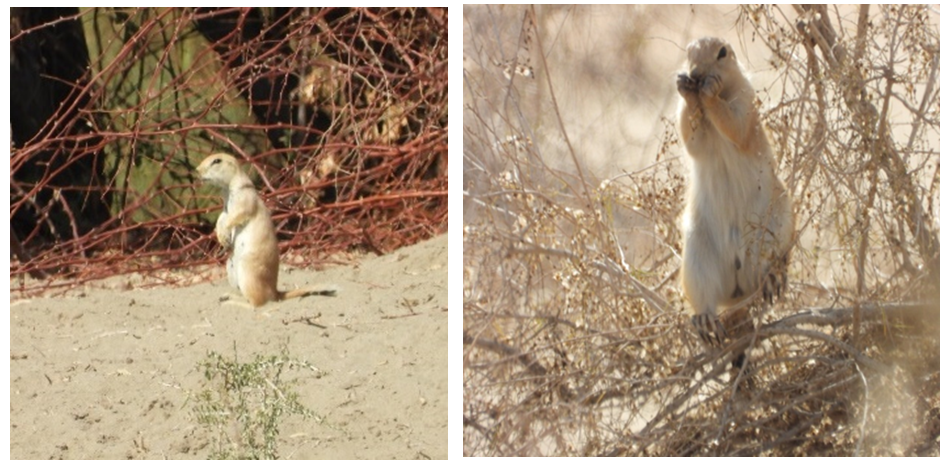 | Figure 4. Spermophilus fulvus (Lichtenstein, 1832) |
Biology and lifestyle: The yellow ground squirrel is a solitary animal, living in sparse colonies. Under favorable conditions, the population density is 8-10 individuals per hectare. Due to the mosaic nature of its primary habitats, colonies are often tens or hundreds of kilometers apart. Each adult ground squirrel occupies an individual feeding territory, which can cover up to 2-5 hectares. The boundaries of its territory are marked and defended. The forms of warning that a territory is occupied vary widely, from standing in a post on elevated surfaces to markings. One method is unusual for other ground squirrels. It involves the animal running up to a mound of soil near one of its burrows and digging several times with its front paw. This throws up soil, creating a sand fountain up to 0.5 meters high, easily visible from a distance. A territory typically includes permanent burrows, where the ground squirrel spends the winter, temporary burrows (used in spring and summer), and "rescue" burrows.The first two types of burrows have one or two passages, with a nesting chamber lined with dry leaves and stems at the back. The depth of the yellow ground squirrel's burrow is 1-3 meters, with passages up to 6-8 meters long. Rescue burrows are shallower, consisting of a simple, sloping passage. Ground squirrels sometimes occupy the burrows of great gerbils; in turn, their burrows serve as shelter for many small desert dwellers. It forms small social colonies and emits sharp, piercing calls. The hibernation period for this rodent lasts from early summer to late winter. This rodent gives birth to three to six young per year. These newborns had closed eyes and ears, were hairless, and weighed 7 grams on average. Their bodies become covered with hair at 15-20 days, and their eyes and ears open at 20-25 and 30 days, respectively. Weaning occurs at the end of the 70th day, and they become sexually mature in the fourth month.When studying their density in the regions, it was noted that the maximum density is 68 individuals/ha in Khiva Karakum National Nature Park, and the maximum density is 87 individuals/ha in Tuprokkala National Nature Park. Also, when studying the impact of limiting factors on the life activity of Spermophilus fulvus, it was noted that the decline, reduction, and disappearance of natural habitats, pollution, excessive use of biological resources, inefficient management of natural resources, and transport infrastructure.Spermophilus fulvus occurs frequently around each colony of the large gerbil in the Karakum area of the Khorezm region and equally in all landscape biotopes and is found equally in all landscape biotopes, and its number is not less than one gerbil per hectare. During the study, analysis of the reproductive organs of 164 Spermophilus fulvus (14 females, 13 males) in the Karakum region revealed that their mating period begins in the 2nd decade of February, and in some years with a favorable climate, they mate even at the end of January. Their mating was observed at 14-15°C in the cold at night and at 0°C during the day. In this case, a group of yellow ground squirrels appears and is active throughout the day. During this period, males’ gonads become larger, 32-38 mm in diameter, and their weight is 7-8 grams. In this case, mass mating continues until the end of March, after which the activity decreases, and in the months of May-June, the seed size of males is reduced to 0.001-1.0 grams.Mass pregnancy was observed from April to the end of May. It was found that the reproductive biopotential of Spermophilus fulvus in Karakum is much higher than in Kyzylkum. The annual rate of intensive reproduction (the number of embryos per 100 adult females) is from 86 to 108 in the Karakum area of the Khorezm region. The distribution of those born this year lasts from June to the end of July. In the cold season, the number of pregnant females is 33% in February, 57% in March, and 80% in April. After June, no pregnant yellow ground squirrels were found. In Spermophilus fulvus, it was observed that the average number of embryos was 3.7 copies according to Karakum, i.e., in the range of 2-7 embryos. The number of female yellow ground squirrels’ embryos with 2 embryos is 5.8%, 61.8% with 3-4 embryos, 17.4% with 5 embryos, and 15% with 6-7 embryos (Figure 5).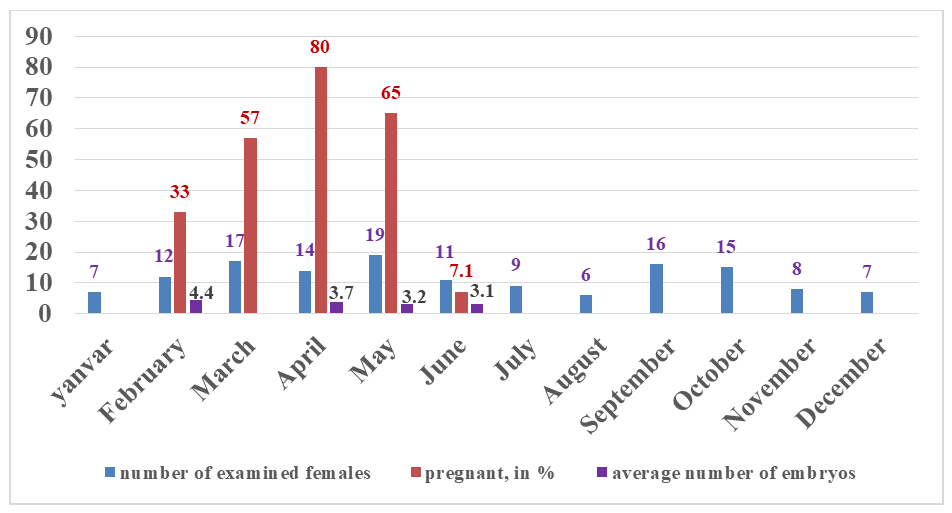 | Figure 5. Seasonal reproduction of Spermophilus fulvus in the Karakum area (2023-2025) |
Thus, as a result of our research, it was observed that the highest rate of seasonal reproduction of Spermophilus fulvus is in April and May, 80% in April and 65% in May.Diet: In most of its habitats, the yellow ground squirrel is the primary consumer of vegetation. It lives in large colonies, is strictly diurnal, and searches for food mainly in the morning when the vegetation is still damp [1]. It feeds on semi-desert and desert ephemerals, bulbs and tubers, seeds and shoots of wormwood, cereals, etc. Its diet includes up to 30 plant species. During the period of fat accumulation, ground squirrels spend almost the entire daylight hours searching for food, consuming up to 150-200 g of food. The ground squirrel does not drink water, being content with the moisture contained in its food. It does not store food [4].Economic importance: Unlike other species, the yellow ground squirrel is not considered a serious agricultural pest. It causes minor damage to melon and vegetable crops, as well as grain crops. In some parts of its range, it is involved in the transmission of plague pathogens. It is hunted for its valuable fur. Its early spring pelts are easily imitated as mink. The yellow ground squirrel's fat is edible and suitable for industrial purposes.
ACKNOWLEDGEMENTS
We are grateful to the Committee on Ecology and Environmental Protection of the Republic of Uzbekistan for its close cooperation. In addition to the team of Khorezm academy of Mamun of the Academy of Sciences of the Republic of Uzbekistan and Karakalpak state university for granting permission to use.
Conflict of Interests
The authors declare that there is no conflict of interest regarding the publication of this paper.
References
| [1] | Aulagnier S.; P. Haffner, A. J. Mitchell-Jones, F. Moutou & J. Zima (2009). Mammals of Europe, North Africa and the Middle East, A&C Black, London. |
| [2] | Bogdanov O.P. Rare animals of Uzbekistan. Encyclopedic reference. Tashkent. Editor-in-chief of encyclopedias, 1992. P. 396. |
| [3] | Bykova E.A., Esipov A.V. Rare mammals of the Ustyurt plateau, Western Uzbekistan // Proceedings of the international meeting "Theriofauna of Russia and adjacent territories". - Moscow, 2011. - P. 82. |
| [4] | Cassola, F. (2017). "Spermophilus fulvus". IUCN Red List of Threatened Species. 2017: e.T20484A22263403. doi:10.2305/IUCN.UK.2017-2.RLTS.T20484A22263403.en. Retrieved November 17, 2021. |
| [5] | Zahidov T.Z. Faunal studies of the deserts of Uzbekistan. //Ed. Academy of Sciences of the UzSSR. – Tashkent, 1950. P. 136-141. |
| [6] | Zahidov T.Z. To the study of the biotope of the Kyzylkum sandy desert. //Ed. SAGU. – Tashkent, 1958. -26 p. |
| [7] | Zahidov T.Z. Biocenoses of the Kyzylkum Desert (Experience in ecological and faunal analysis and synthesis). // Ed. "FAN". – Tashkent, 1971. 304 p. |
| [8] | Kim T.A. Materials on the ecology of the tamarisk gerbil (Meriones tamariscimis Pall.) of the Kyzylkum Desert. // Zoological Journal, Vol. XXXIX, Issue 5. 1960. Pp. 267-286. |
| [9] | Krivosheev V.G. Materials on the ecologo-geographical characteristics of the fauna of terrestrial vertebrates of the Northern Kyzylkum Desert. // Scientific Notes of the Moscow Pedagogical Institute. - 1958. Vol. 124. Issue 7. – Pp. 274-281. |
| [10] | Lakin G.F. Biometry. - Moscow, 1990. – 352 p. |
| [11] | Leontyeva M.N. On the Importance of Groundwater in the Ecology of Great Gerbils. // Uchenye zapiski Moskov. ped. institut. - 1968. Vol. 124. Issue 7. – Pp. 274-281. Leontyeva M.N. On the Importance of Groundwater in the Ecology of Great Gerbils. // Uchenye zapiski Moskov. ped. institut. - 1978. Vol. 124. Issue 7. – Pp. 274-281. Notes of Gorky. University. –Gorky. Biol. Series. 1963. Issue 63. –P. 24-26. |
| [12] | Leontyeva M.N. The Importance of Habitats with Different Groundwater Depths in Plague Epizootology. // Abstracts of Reports of the Conf. of Young Scientists of Gorky. University. –Gorky, 1966. –P. 57-60. |
| [13] | Minin. N.V. Ecological and Geographical Essay on Rodents of Central Asia. // Publishing House of Leningrad State University. –Leningrad, 1938. -185 p. |
| [14] | Naumov N.P. Types of Rodent Settlements and Their Ecological Significance. //Zool. Journal, 1954. Vol. 33, Issue 2. –P. 268-275. |
| [15] | Novikov G.A. Field studies on the ecology of terrestrial vertebrates. // Moscow. 1953. 502 p. |
| [16] | Pavlinov I.Ya., Dubrovsky Yu.A., Rossolimo O.L., Potapova E.G. Gerbils of the world fauna. // Moscow "Science", 1990. -360 p. |
| [17] | Palvaniyazov M. Mammals of the Southern Aral Sea region under the conditions of anthropogenic landscape change (on the example of carnivores). - Tashkent, "FAN" of the Uzbek SSR, 1990. -76 p. |
| [18] | Reymov R. Experience of ecological and morphophysiological analysis of the mammal fauna of the Southern Aral Sea region. Ed. S.S. Schwartz. - Nukus, 1972. - 736 p. |
| [19] | Rossolimo O.L. Features of reproduction of the great and midday gerbils. // Scientific notes of the Moscow state university. - T.X.Y. B.6. 1957 pp. 161-173. |
| [20] | Ruzmetov R., Abdullaev I., Gandjaeva L., Otaev O., Ibragimov S. Fundamentals of using Geographical Information Systems in predicting the distribution of Helicoverpa armigera (Lepidoptera: Noctuidae) // Biodiversitas, 23(6), 2022, pp. 3251-3256. doi: 10.13057/biodiv/d230653. |
| [21] | Sand squirrel and its trade // Hunting and Hunting Magazine, No. 3, 1976. pp. 16-18. |
| [22] | Tupikova N.V., Komarova L.V. Principles and Methods of Zoological Mapping. Moscow State University Press, 1979. 189 p. |
| [23] | The Republic of Uzbekistan: The History of the Wildlife of the Republic of Uzbekistan. Tashkent, 2019. 392 p. |


 Abstract
 Reference
 Full-Text PDF
 Full-text HTML