International Journal of Genetic Engineering

p-ISSN: 2167-7239    e-ISSN: 2167-7220

2025;  13(12): 326-332

doi:10.5923/j.ijge.20251312.10

Received: Nov. 17, 2025; Accepted: Dec. 12, 2025; Published: Dec. 29, 2025

 

Fauna and Zoogeographic Analysis of Blood-Sucking Mosquitoes (Diptera: Culicidae) in Northwest Uzbekistan

Muhayyo Badalova1, Ikram Abdullaev1, 2

1Urgench State University, Urgench, Khamid Alimjan str.14, Uzbekistan

2Khorezm Academy of Mamun, Khiva, Markaz str.1, Uzbekistan

Copyright © 2025 The Author(s). Published by Scientific & Academic Publishing.

This work is licensed under the Creative Commons Attribution International License (CC BY).
http://creativecommons.org/licenses/by/4.0/

Abstract

The article presents data on the zoogeographic analysis of the fauna of blood-sucking mosquitoes of North-Western Uzbekistan, including 29 species belonging to 6 orders, 11 suborders, and the species of blood-sucking mosquitoes belonging to the subfamilies Culicinae and Anophelinae.

Keywords: GBIF, Adult, Localization, Turkmenistan, Cosmopolitan, Colonize, Lepidoptera, Kazakhstan-Uzbekistan

Cite this paper: Muhayyo Badalova, Ikram Abdullaev, Fauna and Zoogeographic Analysis of Blood-Sucking Mosquitoes (Diptera: Culicidae) in Northwest Uzbekistan, International Journal of Genetic Engineering, Vol. 13 No. 12, 2025, pp. 326-332. doi: 10.5923/j.ijge.20251312.10.

1. Introduction

Mosquitoes, a monophyletic taxon of the family Culicidae of the order Diptera, are one of the most widespread groups in temperate and tropical regions of the world [5,8]. The family Culicidae (Diptera) includes at least 3531 species representing 112 genera, divided into two subfamilies: Culicidae and Anophelinae [1]. Blood-sucking mosquitoes are amphibious insects. They are an integral part of aquatic and terrestrial ecosystems, maintaining connections between water bodies and the land and participating in food chains [25]. Blood-sucking mosquitoes negatively affect human life, hindering economic activity and the development of recreational areas. Furthermore, they are of great medical importance as vectors and intermediate hosts for many infectious and invasive diseases of humans and animals [12,14,19,20,21,24,27].
The blood-sucking mosquitoes of the family Culicidae are widespread, living on all continents and islands of the world, with the exception of some polar regions. The family Culicidae is divided into three subfamilies. Anophelineae, Toxorhynchitinae, and Culicinae. The world fauna includes approximately 3,490 species [28]. In the Khorezm region, water zones suitable for the development of blood-sucking mosquitoes, lakes, the Amu Darya, and remnants of canals cover 25 percent of the total area. The formation of the urban fauna is primarily due to species from adjacent areas where breeding sites exist, as well as those developing in temporary and permanent water bodies within the city.

2 Material and Methods

2.1. Study Area

The area is lowland located in the Northwestern part of Uzbekistan, along the lower reaches of the Amudarya River, between 60’-61’ longitude and 41’-42’ latitude, at 113-138 m above sea level. The vegetation period of plants is 200–210 days. The climate is extremely continental, with an average annual precipitation of 80-90 mm. Average temperature in January is -5°C, in July + 30°C, [3,4,9]. The climate of the oasis is greatly influenced by the deserts of Kyzylkum and Karakum. The region is in the steppe zone, in the western part of the Khorezm oasis and in the southern part of the Aral Sea, 100 m above sea level. The relief consists of a low plain. It is the old Amudarya delta and consists of river sediments. The western and southwestern parts connecting with Karakum are covered with sand. Of the minerals, there are limestone, sand, clay and other building materialsn, [6,7,10]. The study of the route covered all districts of the Khorezm region (Figure 1).
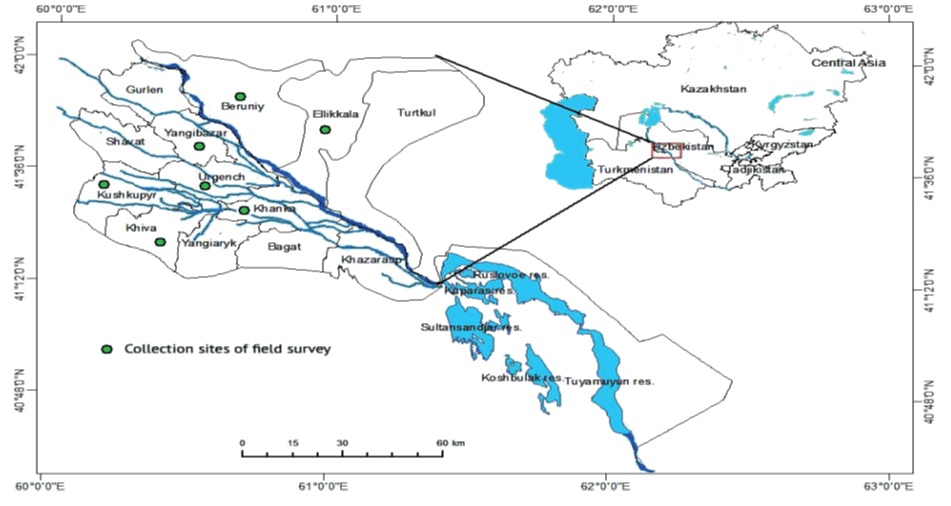
Figure 1. Study areas of Khorezm region
The geographic scope of this checklist also includes existing data on species identified in Uzbekistan, in addition to those from research in the Khorezm region. In Uzbekistan, through 2024, numerous researchers have conducted comprehensive studies on Culicidae mosquitoes, and information on each species has been gathered from the literature [15,16,17,26]. The Latin names and classification of Culicidae taxa have been revised in accordance with GBIF [29]. The names of the individual genera and the subordinate taxa within each genus were arranged alphabetically. A preliminary list of species and subspecies was compiled for each Culicidae family. All species studied and identified for Uzbekistan and its southwestern region are confirmed by the Global Biodiversity Information Facility (GBIF) [29].

2.2. Methods

Our research was based on materials collected during three spring-summer seasons, from 2022 to 2024, in all districts of the Khorezm region, as well as on synthesized literature data and materials. In the Khorezm region, during the spring (April–May), seven permanent (lakes) and temporary (ponds, marshes), natural and artificial continental water bodies, comprising reservoirs and lakes were studied. Adult mosquitoes were collected in the summer (June–July) in parks, recreational areas, groves, rice fields, near lakes, and in the most frequently visited places by people. The collected faunistic samples were processed using generally accepted methods for seasonal and daily phenology [13,18]. During larval trapping, a water trawl was used every five days, and the daily activity of the imago was studied once a week for 24 hours each day.
During the collection of adult mosquitoes, air temperature, relative humidity, atmospheric pressure (barometer BM-7), and light intensity (lux meter) were recorded, and the sky was visually recorded as clear or cloudy. Water, air temperature, and water pH were measured during the larval trapping. The coefficient of anthropogenic transformation of biotopes (CAT) was determined using the method of E.P. Prokopyev (1995) [22], the division of plant species into synanthropic and non-synanthropic was carried out according to the data of A.I. Pyak and I.E. Merzlyakova (2000) [23].
Also, mosquito trapping and collection activities were carried out from April to October during the period 2022-2025 in the northwestern part of Uzbekistan (Karakalpakstan and Khorezm). The trapping and collection of mosquitoes were carried out at 17 sites in marshes and swamps, seepage swamps, and pond waters. BG Sentinel traps, developed by the German company BG Lure™ (Biogents), were used to catch mosquitoes (Figure 2).
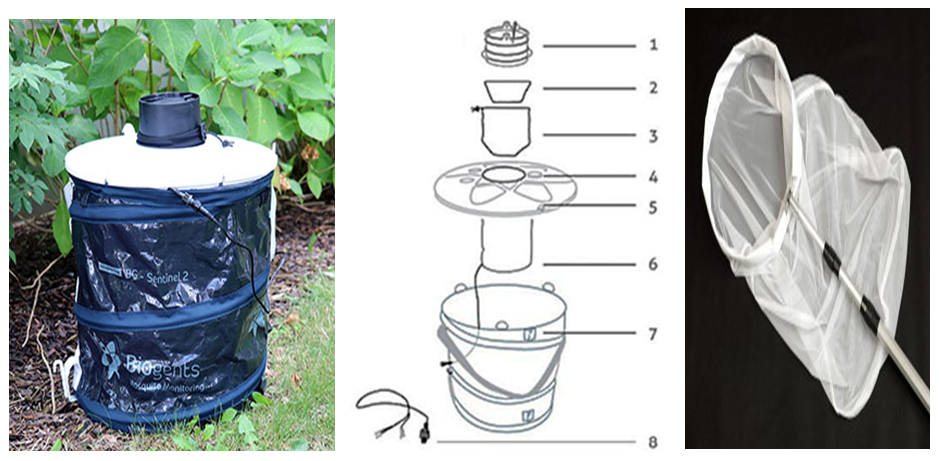
Figure 2. A. Overall view and B. parts of the BG Sentinel trap (1) Insect suction (transfer) funnel, (2) mesh funnel, (3) handle cover, (4) transfer hole for BG-Lure, (5) white cap, (6) fan, (7) (8) battery cable. C. catch net
An attractive odor from a CO2 source was used as the attractant in the trap. The trap was used day and night (24 hours) on a seasonal, intermittent basis with no set pattern. A capture net was used to catch mosquitoes in reed beds or other open areas (Figure 1). The collected materials are stored at -20°C. Schaffner (2001) and Becker (2010) identification keys were used for the morphological identification of the mosquitoes [2,11].

3. Results

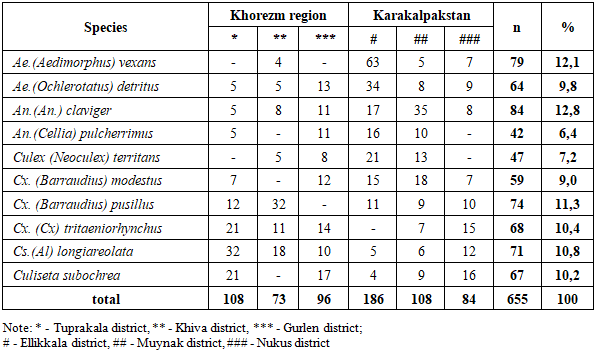
A total of 1,832 adult mosquitoes and 3,953 larvae were collected, belonging to 6 genera, 11 subgenera, and 29 species, including Aedes (Aedimorphus) vexans (Meigen), 1830, Aedes (Ochlerotatus) detritus Haliday, 1833, Anopheles (Anopheles) claviger Meigen, 1804, Anopheles (Cellia) pulcherrimus Theobald, 1902, Culex (Neoculex) territans Walker, 1856, Culex (Barraudius) modestus Ficalbi, 1889, Culex (Barraudius) pusillus Macquart, 1850, Culex (Culex) tritaeniorhynchus Giles, 1901, Culiseta (Allotheobaldia) longiareolata (Macquart, 1838), and Culiseta subochrea (Edwards, 1921). The results of collecting adult mosquitoes and larvae are presented in Tables 1 and 2. These species were collected in flat, pond, slope, and mountain areas in Karakalpakstan and Khorezm regions in six selected villages. Anopheles (Cellia) pulcherrimus was recorded for the first time in Muynak district. Culiseta (Allotheobaldia) longiareolata was collected only in the adult stage in Khiva district, Khorezm region. The number and localization of mosquito larvae at the ecological station of this territory are presented in Table 1. The larval collection included 1753 Culicidae larvae, among which the predominant ones were Anopheles (Anopheles) claviger (12.8%), Aedes (Aedimorphus) vexans (12.1%), Culex (Barraudius) pusillus (11.3%), Culiseta (Allotheobaldia) longiareolata (10.8%), Culex (Culex) tritaeniorhynchus (10.4%), and Culiseta subochrea (10.2%), followed by Aedes (Ochlerotatus) detritus (9.8%), Culex (Barraudius) modestus (9.0%), Culex (Neoculex) territans (7.2%), and Anopheles (Cellia) pulcherrimus (6.4%) (table 1).
Table 1. Composition and habitats of mosquito larvae collected in Northwestern Uzbekistan in May–July 2024
     
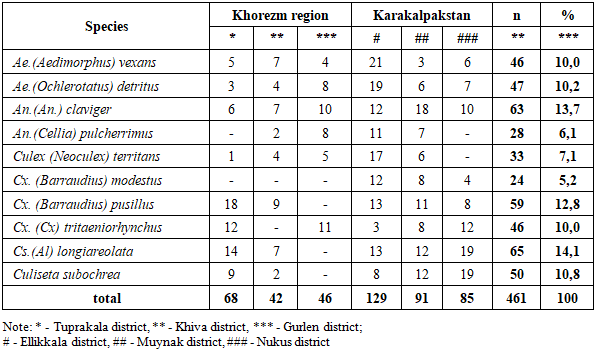
The number and prevalence of mosquitoes captured in the animal bait trap overnight are shown in Table 2. Overall, the predominant species was Culiseta (Allotheobaldia) longiareolata (14.1%), Anopheles (Anopheles) claviger (13.7%), Culex (Barraudius) pusillus (12.8%) followed by Culiseta subochrea (10.8%), Aedes (Ochlerotatus) detritus (10.2%), Aedes (Aedimorphus) vexans (10.0%), Culex (Culex) tritaeniorhynchus (10.0%), Culex (Neoculex) territans (7.1%), Anopheles (Cellia) pulcherrimus (6.1%), Culex (Barraudius) modestus (5.2%) (Table 2).
Table 2. Number and prevalence of adult Culicidae mosquitoes captured using animal-baited traps in northwestern Uzbekistan, May–July 2024
     
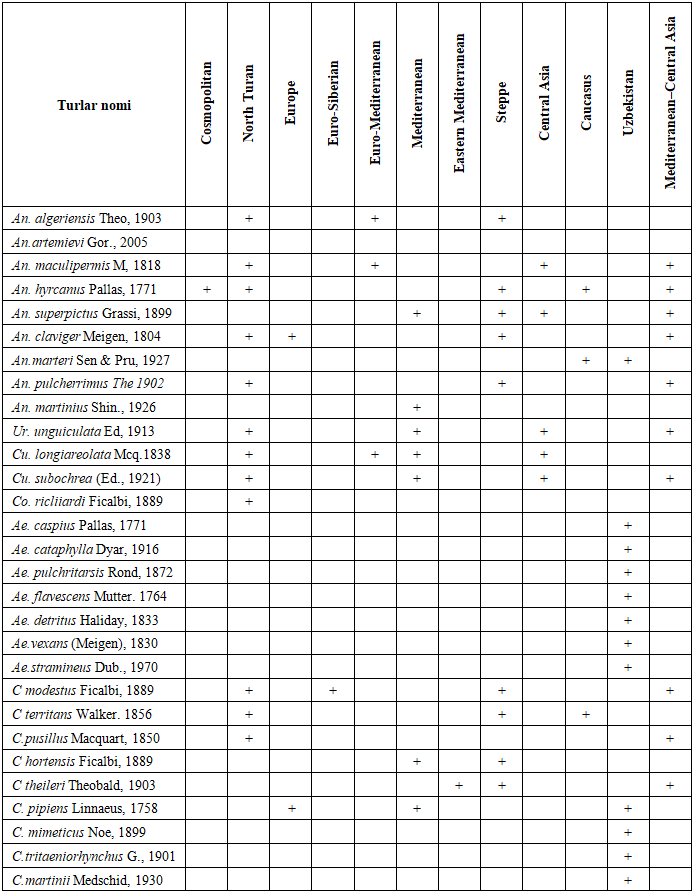
Our studies in separate landscapes examined significant differences in both age and the genetic connection of their fauna to that of neighboring regions (Turkmenistan). The range analysis of the fly species in the study area reveals the complex nature of this fauna, where a strong autochthonous endemism is overlaid by elements from Central and Western Asia, the Mediterranean, the steppes of southern European Russia, and the entire Kazakhstan-Uzbekistan forms collide (Table 3).
Table 3. Distribution of blood-sucking mosquitoes in zoogeographic groups in the territory of northwestern Uzbekistan
     
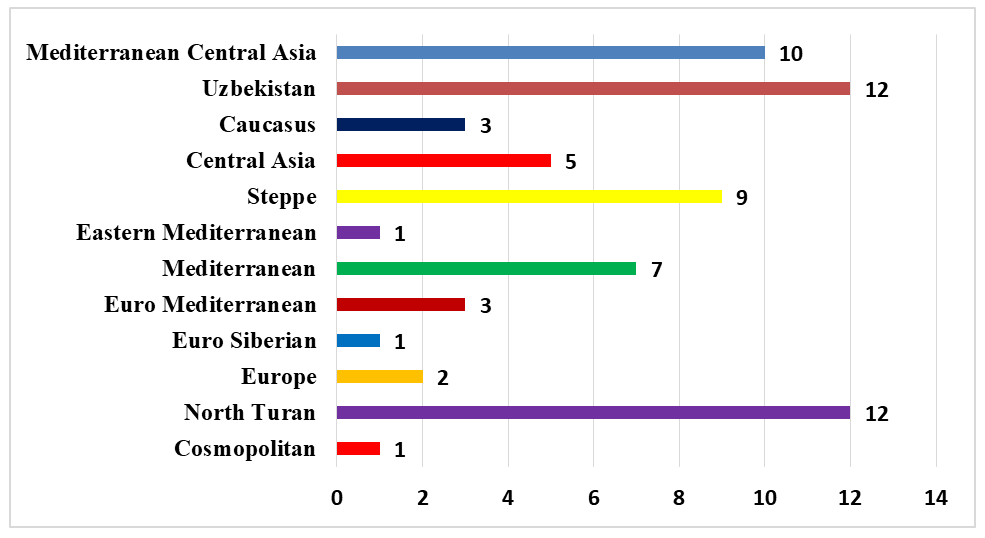
An analysis of the studied fauna's range indicates that its spectrum includes representatives of 12 zoogeographic groups. The diversity of these geographic landscapes is explained by the differences and similarities in the geological history of mountain system formation, resulting in numerous cases that are primarily of ecological nature. On the other hand, this indicates the heterogeneity of the fauna under study and the diversity of faunistic connections with neighboring zoogeographic regions. Research results show that cosmopolitan species - 1, North Turan - 12, Europe - 2, Euro-Siberian - 1, Euro-Mediterranean - 3, Mediterranean - 7, Eastern Mediterranean - 1, Steppe - 9, Central Asia - 5, Caucasus - 3, Uzbekistan - 12, and the Mediterranean-Central Asia zoogeographic region - 10 species were recorded (Figure 3).
Figure 3. Zoogeographic groups of blood-sucking mosquitoes in the territory of northwestern Uzbekistan
Figure 3 shows the zoogeographic spectrum of mosquitoes in the study area. As can be seen from the figure, the species belonging to the North Turan group and the Uzbekistan geographic group occupy the first place in distribution in the study area (41.4%), while the Mediterranean-Central Asian species (10 species - 34.5%) occupy the second place in distribution. The Steppe group accounts for 9 types (31.0%). The Central Asian group accounts for 5 types (17.2%), and the Mediterranean group accounts for 4 types (13.8%). In sixth place are the Caucasus and Euro-Mediterranean species - 3 species, which constitutes 10.3%. In seventh place, the Eastern Mediterranean, European-Siberian, and Cosmopolitan groups were recorded with one species each-3.4%.
Also, when studying the origin and distribution of the species identified in our research, it was noted that 29 species belonging to six genera are distributed throughout the world. In particular, Anopheles (9), species belonging to the genus Culex (9) are found worldwide, Coquillettidia (1) and Uranotaenia (1) in tropical regions, and species of the genera Aedes (7) and Culiseta (2) are widespread in Nearctic regions.
The clear correspondence of latitudinal zoogeographic divisions to climatic zonation schemes demonstrates the role of climate in shaping the regional fauna of mosquitoes, highlighting their dependence on temperature gradients. In the study area, differences in climatic and weather conditions are not related to geographic latitude but rather to distance from river and lake shores and to orography, i.e., the location of mountain ranges and the elevation of the mountains. Due to the plasticity of mosquitoes' life cycles, particularly, their ability to select optimal temperatures and other environmental conditions-most species in the Northwest Uzbekistan region have formed extensive areas spanning various latitudinal zones and vertical belts. This method of microclimate adaptation does not require complex morphological and physiological restoration, allowing the species to colonize the space in the fastest and most effective way.

4. Conclusions

Our observations in the study area showed that the same species can be found in two, and sometimes in all types of water bodies. Often in the southern part of the region, mosquito larvae are typically found in flowing water (slow-moving drains, irrigation canals), semi-flowing and stagnant water bodies, and moving northward, they gradually begin to disappear from running water bodies; closer to the northern border of the range, it was noted once again that they live only in stagnant water bodies. An analysis of the studied faunal range indicates that, 12 spectrums unite individuals from zoogeographic groups; this is explained in many cases, primarily by ecological factors, reflecting the great diversity of geographic landscapes and the variety of faunal connections with neighboring zoogeographic regions.

ACKNOWLEDGEMENTS

The authors would like to express their gratitude to the management of the Institute of Zoology of the Academy of Sciences of the Republic of Uzbekistan and the team of the Khorezm Mamun Academy for permission to use the collections of insect species.

Conflict of Interests

The authors declare that there is no conflict of interest regarding the publication of this paper.

References

[1]  Azari-Hamidian S, Harbach RE (2009) Keys to the adult females and fourth star larvae of the mosquitoes of Iran (Diptera: Culicidae). Zootaxa. 2078: 1-33.
[2]  Becker, N., Petric, D., Zgomba, M., Boase, C., Madon, M., Dahl, C. & Kaiser A. (2010) Mosquitoes and Their Control. Springer, Heidelberg, Dordrecht, New York, 577 pp.
[3]  Gandjaeva, Lola A., Hudayberdieva, Marifat O., Abdullaev, Ikram I., Mirzayeva, Gulnora S., Yusupboev, Erkinboy K. (2022). First record of Halyomorpha halys (Heteroptera: Pentatomidae) from Uzbekistan. Zoosystematica Rossica 329-331. https://doi.org/10.31610/zsr/2022.31.2.329.
[4]  Gandjaeva Lola, Abdullaev Ikram, Iskandarov Abdulla, Allabergenova Komila, Yusupova Saodat, Narimanova Gulkhayo, Yusupboev Erkinboy, Ibragimova Sohiba, Begliev Sanjar, Bobojonova Khulkar (2023). A zoogeographical analysis of true bugs (Insecta, Heteroptera) from Uzbekistan. Zookeys. 121–142. https://doi.org/10.3897/zookeys.1163.99414.
[5]  Harbach, R.E. & Kitching, I.J. (1998) Phylogeny and classification of the Culicidae (Diptera). Systematic Entomology, 23, 327-370.
[6]  Ibragimova Sohiba, Gandjaeva Lola, Abdullaev Ikram, Bekchanova Moxiraxon (2023). The First Record of Nematodes in Ostriches (Struthio Camelus Linnaeus, 1758) of Uzbekistan. WSEAS Transactions on Environment and Development. 393-399. https://wseas.com/journals/ead/2023/a725115-1012.pdf.
[7]  Iskandarov, A., Abdullaev, I., Gandjaeva, L., Musaev, D., Mirzayeva, G., Kholmatov, B., Jumanazarov H., Jangabaeva A., Razzakov K., Abdullaev, U. (2022). Updated Checklist of the Pentatomidea (Heteroptera: Pentatomomorpha) of Uzbekistan. WSEAS Transactions on Environment and Development 18: 1283–1295. https://doi.org/10.37394/232015.2022.18.121.
[8]  Miller, B.R., Crabtree, M.B. & Savage, H.M. (1997) Phylogenetic relationships of the Culicomorpha inferred from 18Sand 5.8S ribosomal DNA sequences (Diptera: Nematocera). Insect Molecular Biology, 6, 105-114.
[9]  Ruzmetov, R., Matyakubova, Y., Abdullaev, I. (2020). Cytosporosis diseases of apple trees (Reinette simirenkomalus) and its distribution in the lower Amudarya region. International Journal of Current Research and Review, 12(14), pp. 62-67. DOI: http://dx.doi.org/10.31782/IJCRR.2020.121413.
[10]  Ruzmetov, R., Abdullaev, I., Gandjaeva, L., Matyakubov, Z., Razzakov, K., Iskandarov, A., Otaev, O., Ibragimov, Sh. (2022). Fundamentals of using Geographical Information Systems in predicting the distribution of Helicoverpa armigera (Lepidoptera: Noctuidae). Biodiversitas, 23(6), pp. 3251–3256. 10.13057/biodiv/d230653. DOI https://doi.org/10.13057/biodiv/d230653.
[11]  Schaffner F, Angel G, Geoffrey B, Hervey JP, Rhaiem A, Brunhes J (2001) The Mosquitoes of Europe. An Identification and Training Programmed (CD-ROM). IRD Editions & EID Mediterranean, Montpellier.
[12]  Volynets L.V., Bogdanov I.I., Fedorova T.N. The role of blood-sucking mosquitoes in the transmission of arbovirus in the forest-steppe lake zone of Western Siberia // V symposium on the study of the role of migratory birds in the spread of arbovirus: abstracts of reports / Siberian Branch of the USSR Academy of Sciences. - Novosibirsk, 1969 - pp. 21-27.
[13]  Gutsevich A.V., Monchadskiy A.S., Shtakelberg A.A. Fauna of the USSR. Insects Diptera, mosquitoes of the family Culicidae. (Fauna of the USSR Vol. 3, Issue 4). -L.: Nauka, 1970.-364 p.
[14]  Derbeneva-Ukhova, V.P. Handbook of Medical Entomology / Ed. by prof. V.P. Derbeneva-Ukhova. - Moscow: Meditsina, 1974. 360-p.
[15]  Zhakhongirov Sh.M., Muminov M.S., Ponomarev I.M. Entomological situation in malaria foci of the Surkhandarya region of Uzbekistan htm-file of the article pp. 66-68.
[16]  Lebedeva N.I. Monitoring of Anopheles mosquito infection with malaria plasmodium in Uzbekistan. htm-file of the article, pp. 109-111.
[17]  Lopatin O.E., Katokhin A.V., Shevchenko A.I., Gunderina L.I., Burlak V.N., Margalith. Study of species composition of representatives of the genus Anopheles in Western Siberia, Kazakhstan and Uzbekistan using molecular genetic markers. htm-file of the article, pp. 112-113.
[18]  Masalkina T.M. Comparative assessment of methods for catching blood-sucking mosquitoes // Med. steam: and paraz. diseases. 1979. - Vol. 48, issue 3. - Pp. 47-52.
[19]  Nafeev A.A. Organization of social and hygienic monitoring of natural focal infections in the city // Siberia-East, 2006, No. 7 (July). - P. 8-10.
[20]  Pankova TF Microsporidia of blood-sucking mosquitoes in the Tomsk Ob region: Abstract of the dissertation ... candidate of biological sciences / Academy of Sciences of the Kazakh SSR. Institute of Zoology. - Alma-Ata, 1988. - 16 p.
[21]  Ponotova LV, Mikheev V.II., Loktev VB, Kononova Yu.V. On the organization of monitoring of newly emerging infections in the Novosibirsk region on the example of West Nile fever // Siberia East, 2006. - No. 11, November. - P. 31-33.
[22]  Prokopyev EP Introduction to the Study of Vegetation Cover of the Forest Zone of Western Siberia (a textbook for field practice) - Tomsk: TSU Publishing House. 19951. 96 p.
[23]  Pyak A.I., Merzlyakova I.E. Vascular Plants of Tomsk: A Textbook. Tomsk: TRU Publishing House, 2000; 80 p.
[24]  Roslavtseva S.A. Prospects for the Use of Microbiological Preparations in Mosquito Control // RET INFO, 2006. - No. 1. pp. 22 - 24.
[25]  Sazonova O.N. The Role of Blood-Sucking Mosquitoes in Ecosystems // Diptera of the Fauna of the USSR and Their Role in Ecosystems. JL: Zool. Inst. Academy of Sciences of the USSR, 1984. - Pp. 108-115.
[26]  Saifiev, Sh., Jakhongirov, Sh., Goryacheva, I., Zvantsov, A., & Fatullaeva, A. (2014). Distribution and Number of Malaria Mosquitoes (Diptera, Culicidae, Anopheles) in Uzbekistan. Russian: Zhurnal Probl. Biologii i Meditsiny (Journal of Problems of Biology and Medicine), 4, 1 (81), pp. 134–137.
[27]  Simakova A. V., Pankova T. F. Breeding sites of blood-sucking mosquitoes in reservoirs of Tomsk // Biodiversity: Proceedings of the international scientific conference dedicated to the 110th anniversary of the beginning of regular zoological research and zoological education in Siberia. Tomsk, 1998, p. 218.
[28]  Khalin A. V., Gornostaeva R. M. On the taxonomic composition of blood-sucking mosquitoes (Diptera, Culicidae) of the world fauna and the fauna of Russia // Parasitology. 2008. No. 5. pp. 360–394.
[29]  https://www.gbif.org/