U. U. Rakhimov, T. U. Rakhimov
Karshi State Technical University, Karshi, Uzbekistan
Copyright © 2025 The Author(s). Published by Scientific & Academic Publishing.
This work is licensed under the Creative Commons Attribution International License (CC BY).
http://creativecommons.org/licenses/by/4.0/

Abstract
This study is devoted to the study of the water regime of the black saxaul, Choghon, teresken and izen species of the Amaranthaceae family growing in the hills of Kamashi district. As a result of the experiments, the intensity of the plants is analyzed in terms of the amount of water in evaporation and daily water deficit. The results show that water evaporation is highest in the spring, and in July, due to drought, it sharply decreases in some species. Black saxaul and Choghon are distinguished by their economical water evaporation. The data obtained confirm that these species are well adapted to the arid conditions of pastures.
Keywords:
Amaranthaceae Juss, Water regime, Evapotranspiration, Water evaporation intensity, Daily water deficit, Tissue water content, Haloxylon aphyllum, Halothamnus subaphylla, Ceratoides ewersmanniana, Kochia prostrata, Arid ecosystems, Xerophytic adaptation, Pasture ecology, Kamashi district, Soil moisture, Drought tolerance, Seasonal dynamics
Cite this paper: U. U. Rakhimov, T. U. Rakhimov, Of Some Plant Species Belonging to the Amaranthaceae Juss Family, International Journal of Genetic Engineering, Vol. 13 No. 12, 2025, pp. 322-325. doi: 10.5923/j.ijge.20251312.09.
1. Introduction
The world population is growing rapidly, which is causing the population's needs for livestock products, along with all other needs. Natural pastures are of great importance in livestock farming, and improper use of pastures can lead to the destruction of the natural phytocenology of plants, nutrition of plants to shrink and desertification to the process reason is happening. Climate change and other a few anthropogenic factors because of to degradation encountered in the pastures plants team sparsely livestock farming stable develop for impact shows. Current on the day desertification process prevent get, plants team decreasing to degradation encountered in the pastures artificial agrocenosis build of reaching scientific and practical basics, pastures of plants bioecological, biochemical physiological, structural and genetic to the characteristics based scientific to research separately attention is being addressed.
2. Research Methods
The intensity of water evaporation of plants Ivanov L.N et al. [3] studied using the “quick measurement” method; The water content in the tissues was determined by taking samples of the plants during the flowering phase, measuring their initial weight, and drying them in a drying cabinet at a temperature of (105°C) to constant weight [1].The objects of the research were the water regime characteristics of the varieties of black saxaul (Haloxylon aphyllum) “Nortuya”, castor (Halothamnus subaphylla) “Jaykhun”, teresken (Ceratoides ewersmanniana) “Tolqin” and izen (Kochia prostrata) “Otavniy” belonging to the Amaranthaceae Juss family. The experiment was conducted in 2023 at 38 ° 46 north latitude, 65 ° 31 east longitude of the Kamashi district at an altitude of 698 m above sea level. The air temperature, relative humidity and annual precipitation in the year of the experiment are presented in the graph below.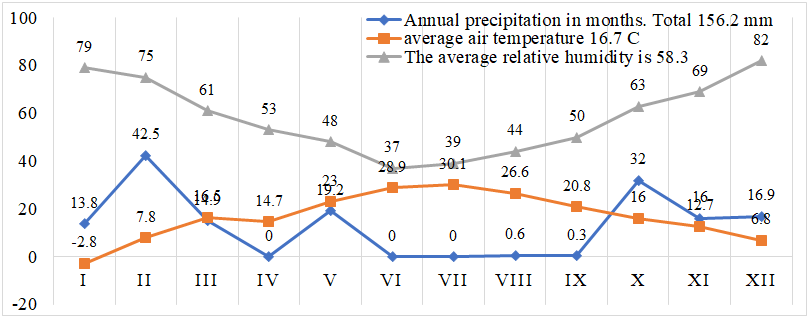 | Figure 1. Annual precipitation , air temperature, and relative humidity in Kamashi district in 2023 by month |
Plant species or biomorphs with different life forms are considered adaptive systems and exhibit high viability and productivity under certain conditions [2]. Therefore, it is important to study the ecological and physiological characteristics of promising species when implementing measures to increase pasture productivity. Some physiological characteristics of the plant species under study were studied in 3-year-old plants in the conditions of the hills of Kamashi district.The seasonal dynamics of the water evaporation intensity of plants was studied in spring, summer and late summer (August) in the morning, midday and at the end of the day, and the average daily values were determined. The results of the study showed that the studied plant species have different water evaporation intensities. All plant species have high water evaporation intensity in the spring (April) season. In April, when the average air temperature was 14.7°C and the soil moisture at a depth of 120 cm was 4.32±0.12, the highest water evaporation intensity of plants (1019.8±123.4 mg/h) was observed in the teresken plant, while the lowest, i.e. 305.2±29.5 mg/h, was recorded in the black saxaul plant. In Choghon, this indicator 409.3±36.5 mg/h, and in Izen it was 502.6±29.3 mg/h. By July, when the average monthly air temperature was 30.1°C, the average soil moisture content was 2.55±0.52. In July, when the drought was at its peak, 1.0 g of black saxaul evaporated 429.7±26.8 mg/h of water for 1 hour, which is a significant increase compared to April, while in Teresken it was 534.8±36.8 mg/h, which is almost 2 times less than in April. During the same period, in Chogon this indicator was 403.4±23.5 mg/h, which is almost equal to the indicator in April, and in Izen it was 462.6±33.6 mg/h, which is A significant decrease was found compared to the indicator in April. When this indicator was studied towards the end of August, it was found that the intensity of water evaporation had slightly decreased in all studied species (figure 2).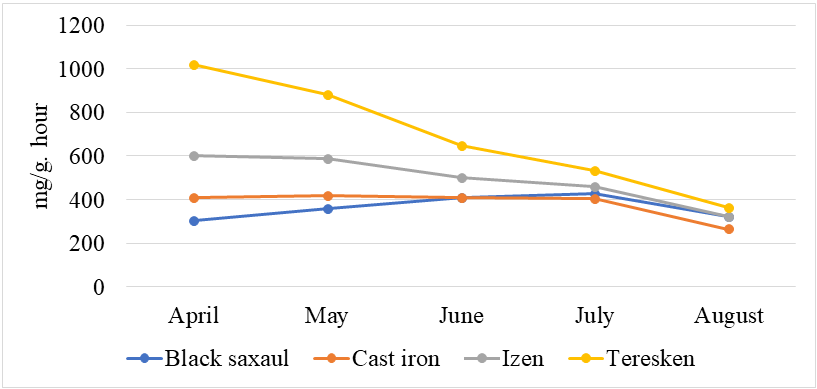 | Figure 2. Studied Seasonal dynamics of daily water evaporation intensity of varieties, mg/h |
The water evaporation intensity was 321.6±23.3 mg/h in black saxaul, 265.7±25.7 mg/h in castor, 321.6±32.1 mg/h in isen and 364.8±29.6 mg/h in teresken. Analyzing the data presented in figure 2, it can be said that all of the studied plant species, with the exception of teresken, have the property of saving water evaporation. In our opinion, the relatively high water evaporation intensity of teresken is due to the significant width of its leaf plates compared to other species. Probably, this is why, on hot summer days, this plant sheds part of its leaves, thereby adapting to external environmental conditions. Relative stability is observed in the seasonal dynamics of water evaporation intensity of black saxaul and castor plants. This indicates that they are well adapted to growing in these conditions. The Izen plant has an average rate among plant species in terms of water evaporation intensity [5].The highest indicators of water content in the tissues of the studied plant species were observed in April. Of course, during this period, the moisture content in the soil is at its maximum in the hilly conditions. During this period, the water content in the tissues of black saxaul was 87.9% of the absolute dry mass, in the castor -87.0%, in the izend -72.9%, and in the teresken -72.8% (Table 1).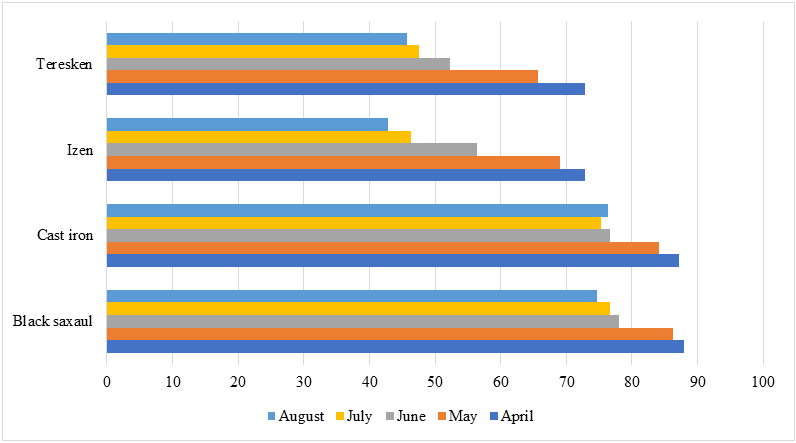 | Table 1. Water content of the studied varieties, relative to absolute dry mass, % Kamashi experimental field, 2023 (n=3) |
By July, a decrease in water content was observed in all studied plant species. A particularly strong decrease was observed in izhen and teresken plants. A slight decrease in the amount of water in their tissues was also observed in August. The decrease in the amount of water in their tissues towards autumn is also associated with the ontogenesis of plants. However, as can be seen from the table data, this indicator has stabilized significantly in black saxaul and castor plants.The daily water deficit observed in plants indicates the level of their water supply and allows us to assess the state of the water regime. According to some researchers, a water deficit of about 15-20% is a normal condition, which leads to an acceleration of photosynthesis processes [4]. Data obtained from the study of daily water deficit of the studied plant species showed that no sharp changes are observed in this indicator (Figure 3).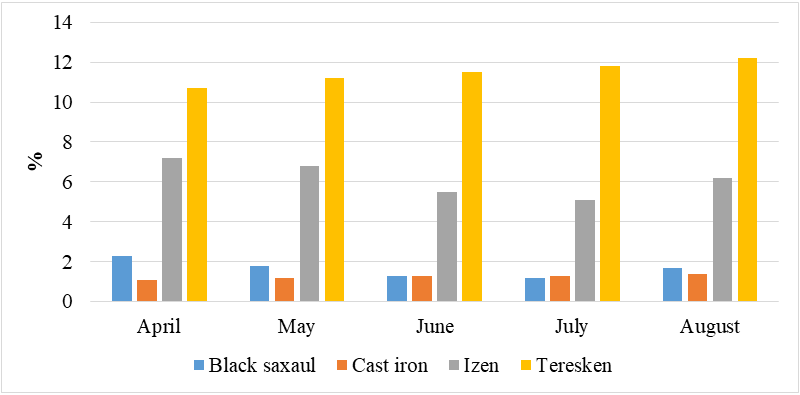 | Figure 3. Daily water deficit of plant varieties studied in hilly conditions (% of blue mass n=3) |
As can be seen from the image data, it was found that the daily water deficit of black saxaul and castor plants varied from only 1.1% to 2.3%. The highest water deficit (10.7-12.2%) was observed in the teresken plant. According to this indicator, the izen plant was found to have an intermediate indicator (5.1-7.2%) among the tested plant species.
3. Conclusions
Among the studied plant species, black saxaul and castor can be included in the water-saving evapotranspiration plants. The highest indicator of water evaporation intensity was observed in the teresken plant. Taking into account the water content in the tissues and the daily water deficit indicators, it can be said that the water regime of the studied plant species is within the range of pastures, which indicates that they are well adapted to growth in these soil-climatic conditions. Plants have adapted well from desert conditions to hill conditions.
References
| [1] | Dospekhov B.A. Methodology of field experiment. M.: "Kolos", 1979. - 350 p. |
| [2] | Granitov A.I. Guidelines for Geobotanical Survey of Natural Forage Lands in Uzbekistan. Head of Department, Chief Geobotanist, Pasture Department, Institute of Land Management "Uzgiprozem". - Tashkent, 1980. - 170 p. |
| [3] | Ivanov L.N, Selina A.L, Selniker Yu.Ya. On the rapid weighing method for determining transpiration in natural conditions // Bot. Jurn., 1950. T. 3b, No. 2. -P.171-186. |
| [4] | Bobokulov X.A. Experiences of Teresken culturalization in the conditions of the Nurota hills // Actual problems of improving the quality of steppe livestock products and steppe ecology. Proceedings of the International Scientific and Practical Conference. Samarkand, 2002. – P. 94-95. |
| [5] | Mukanov B.M, Uteshkaliev M.D. Assortment of promising breeds for fixing sands and arid zones of Kazakhstan // Arid forage production is the basis for the development of transhumance livestock breeding in desert and semi-desert zones of Kazakhstan, Shimkent, 2014. - P. 100-103. |


 Abstract
 Reference
 Full-Text PDF
 Full-text HTML