
-
Paper Information
- Next Paper
- Paper Submission
-
Journal Information
- About This Journal
- Editorial Board
- Current Issue
- Archive
- Author Guidelines
- Contact Us
International Journal of Genetic Engineering
p-ISSN: 2167-7239 e-ISSN: 2167-7220
2025; 13(12): 313-315
doi:10.5923/j.ijge.20251312.07
Received: Nov. 22, 2025; Accepted: Dec. 16, 2025; Published: Dec. 26, 2025

Supply of Macronutrients Breastfeeding Women
 Abstract
 Reference
 Full-Text PDF
 Full-text HTML
Shohimardonova Aziza Boynazar qizi
Karshi State Technical University, Uzbekistan
Correspondence to: Shohimardonova Aziza Boynazar qizi, Karshi State Technical University, Uzbekistan.
Copyright © 2025 The Author(s). Published by Scientific & Academic Publishing.
This work is licensed under the Creative Commons Attribution International License (CC BY).
http://creativecommons.org/licenses/by/4.0/

Background: This research deals with the coverage of the main nutritional components of lactating women aged 18-39 years in the Kasbi and Chiroqchi districts of the Kashkadarya region during the winter-spring period. Methods: The respondents' current consumption of food products was examined through the classical questionnaire survey method. Results: According to the results, the quantity of protein and carbohydrates received daily by lactating women aged 18-29 years is, respectively, 26.7% and 20.5% less than the norm, while this quantity for women aged 30-39 years is, respectively, 26.5% and 19.0% less than the norm. The value of the total daily energy received also remains 17.2% less than the norm. The coverage of the fats received does not differ from the norm level. Conclusions: This situation makes clear that there is a deficiency in the availability of basic nutrients for lactating women in the countryside. This can impact the health of the mother and the baby negatively.
Keywords: Lactating women, Actual nutrition, Basic nutrients, Proteins, Fats, Carbohydrates, Total calories
Cite this paper: Shohimardonova Aziza Boynazar qizi, Supply of Macronutrients Breastfeeding Women, International Journal of Genetic Engineering, Vol. 13 No. 12, 2025, pp. 313-315. doi: 10.5923/j.ijge.20251312.07.
1. Introduction
- It has been long known that a healthy lifestyle and healthy nutrition are two of the most significant factors from the external environment that characterize the state of a person’s health. This is especially important in the lifestyle of a child and a lactating woman. A healthy lifestyle and healthy nutrition provide support to the biochemical processes happening in each cell and tissue of the organism. This means that the type and quantity of the required nutrients that pass through the breast milk affect in a particular way the growth and development of a child as well as the development of the organs of the organism and its systems. In turn, this necessitates the provision of the basic nutrients: proteins, fats, carbohydrates, vitamins, and mineral substances to the lactating woman.According to World Health Organization reports, in the year 2012, the global number of recorded stunted and morbidity-ridden children under the age of five surpassed 174 million. However, the number dropped to 140 million in the year 2020, of which over half are found in the Asia region and two-firths in the Africa region. Moreover, the reduction of this number by 40% by the year 2025 has been made a prominent target [1,2]. In addition to this, approximately 40-50% of child mortality globally can be attributed to poor Nutrition. A vast number of maternal and pediatric Nutrition problems are found in low- and middle-income nations spread across the African, Asian, and Latin American regions. However, the World Health Organization insists on Breastfeeding the baby exclusively within the first six months of delivery and thereafter until the child attains the age of two years [7–9].From the above information, the significance of breastfeeding and planning proper nutritional care for lactating women plays a vital role in the proper growth and development of babies and constitutes one of the urgent tasks of physiology and medicine. This problem also receives particular state interest. In this regard, the Law of the Republic of Uzbekistan No. 574 of October 23, 2019: "On the support of breastfeeding and the requirements for food products of infants and young children" stresses the importance of supporting the work of "encouraging the practice of breastfeeding and the conduct of regular public awareness campaigns through health sector institutions as well as other entities" [3]. The daily requirement of basic and additional nutrients of lactating women according to the baby's milk consumption volume, mother’s age group, environment, and child spacing can differ [9].Taking into account the above points, the study of the real nutrition of women aged 18–39 years who are lactating and living in the countryside of Kasbi and Chiroqchi districts of the Kashkadarya region during the winter-spring period was of particular interest to us.
2. Materials and Methods
- The observations were carried out in the year 2023 in the selected group of lactating women aged 18-29 years and aged 30-39 years from the Kasbi and Chiroqchi districts of the Kashkadarya region. The first step in observing the study group was the voluntary selection of respondents according to the Helsinki declaration. In the next step, educational work and discussions about rational nutrition took place in the group of lactating women. The respondents' current consumption of food products was examined through the classical questionnaire survey method [6]. The respondents recorded their consumption of various food products over seven days in the specially designed questionnaire sheets. Checking of the questionnaires took place each day. The collected information was analyzed through the proper methodological approach. The protein, fat, and carbohydrates' content in the food products was calculated through the specially designed table [5]. The mathematical calculation and statistical treatment of the questionnaire information were carried out through the Microsoft Windows Excel software package. The results were compared with the proper norms [4].
3. Results and Discussion
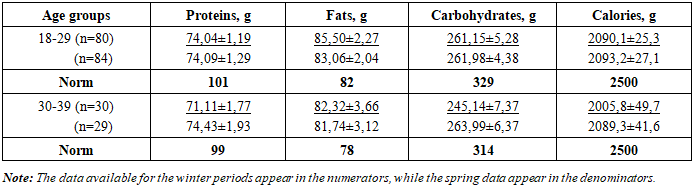
- The observations took place in the spring and in the winter of the year 2023. The quantity of basic nutrients as well as the energy value of the lactating women's daily food has been calculated. The results received will be summed up and their average value will be presented in the table below.
|
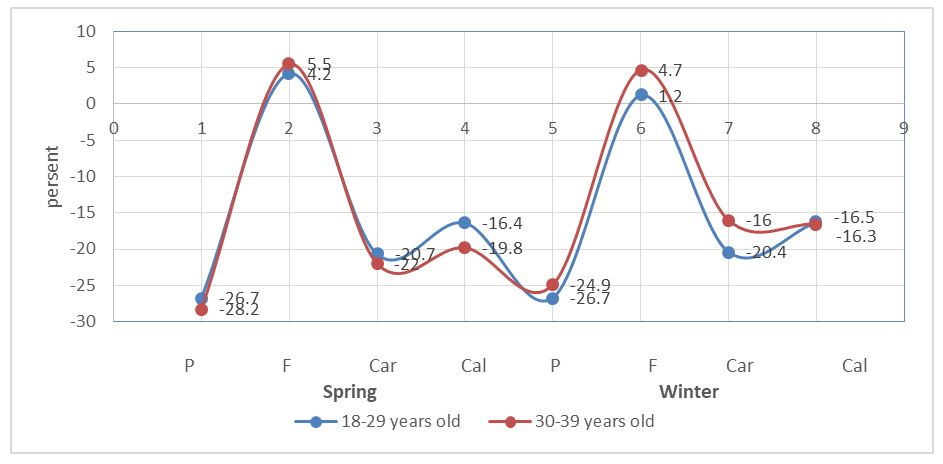 | Figure 1. Essential nutrients and total energy value in the daily diet of breastfeeding women (P-protein, F-fat, Car-carbohydrat, Cal-calories; as a percentage relative to the recommended norm) |
4. Conclusions
- In the case of lactating women aged 18–29 and 30–39 years old from the rural regions of the Kashkadarya region, the quantity of basic nutrients in the form of proteins and especially animal proteins, as well as carbohydrates, in the daily meals does not reach the standard level, while the quantity of fats comes close to the standard level. The overall energy of daily meals also does not reach the standard level. The study of the basic food product of the studied lactating women’s daily meals reveals that the quantity of animal products containing protein and the quantity of bread and flour products are not high enough. The study of protein, fats, and carbohydrates available in lactating women's diets has particular significance in maintaining and improving the health of mothers and infants. In this regard, it has immense value to conduct continuous and organized public awareness and educational work regarding the concept of healthy lifestyle and proper nutrition practices of diverse sections of society, including lactating women.