Abdullayeva M. I.
Tashkent State Medical University, Tashkent, Uzbekistan
Correspondence to: Abdullayeva M. I., Tashkent State Medical University, Tashkent, Uzbekistan.
| Email: |  |
Copyright © 2025 The Author(s). Published by Scientific & Academic Publishing.
This work is licensed under the Creative Commons Attribution International License (CC BY).
http://creativecommons.org/licenses/by/4.0/

Abstract
Experimental fatty hepatosis was modeled using a high-fat diet, and changes in the behavior and motor activity of rats were assessed dynamically using an open field test. The subjects of the study were 8-10-week-old white outbred male Wistar rats. The indicators were observed for 3 minutes after the animal was placed in the field. The results of the study showed dynamic changes in behavioral indicators and motor activity in rats with experimentally modeled fatty liver disease. Specifically, a prolongation of the latency period, a decrease in horizontal and vertical activity, a reduction in the number of grooming episodes, and a weakening of grooming movements were observed. According to the results, rats with modeled fatty hepatosis demonstrated statistically significant differences in latent period, horizontal and vertical activity, and grooming behavior, as well as a decrease in the number of grooming movements. These changes may be associated with neuropsychiatric disorders, stress conditions, and increased autonomic activity arising from chronic fatty hepatosis. Thus, fatty hepatosis negatively affects not only the liver but also the central nervous system.
Keywords:
Fatty hepatosis, Behavioral indicators, Motor activity, Open field test, High-fat diet, Horizontal activity, Vertical activity, Latent period
Cite this paper: Abdullayeva M. I., Evaluation of Behavioral Changes in Experimental Fatty Hepatosis Based on an Open Field Test, International Journal of Genetic Engineering, Vol. 13 No. 12, 2025, pp. 303-305. doi: 10.5923/j.ijge.20251312.05.
1. Introduction
Nonalcoholic fatty liver disease (NAFLD) is currently the most common type of liver disease, accounting for 70% of all liver diseases [1]. NAFLD affects approximately one-quarter of the world’s population, and is projected to reach 33.5% by 2030 [2].Recent studies have identified NAFLD as a disease that affects not only the liver but also the central nervous system, and is associated with cognitive impairment and dementia. Scientific sources suggest that dyslipidemia may be a causative or contributing factor in the development of Alzheimer’s disease. Neurological changes such as cognitive decline and memory impairment may be closely linked to NAFLD-associated conditions such as insulin resistance, hyperammonemia, vascular dysfunction, gut microbiota imbalance, and inflammation [3].NAFLD usually develops against the background of obesity. According to data, excess body weight, especially in adulthood and middle age, increases the risk of cognitive impairment and Alzheimer's disease by up to six times. Also, obesity that occurs in middle age significantly increases the risk of dementia and Alzheimer's disease compared to obesity in later life [4,5].The aim of the study was to study behavioral indicators in dynamics in a fatty liver model. To assess behavioral changes, the "Open Field Test" was conducted.The advantage of this test is its simplicity and convenience, when animals are placed in an unfamiliar open field, changes in behavior and behavior, the number and quality of movements in them are studied. In our studies, experimental rats were transferred to the central square in the "open field", and their latency period, i.e. the time to exit the square, the number of squares entered by the rats - horizontal activity (GF), the number of times the rats stood upright on their hind legs - vertical activity (VF), the number of "holes" in the square where the animal sniffed and stuck its head - exploratory activity (OF), washing movements, as well as the number of feces they secreted were counted. Self-washing of rats usually occurs when they are stressed, in which case their excretion of feces also increases, and therefore their number was recorded. According to these values, the motor activity, convulsive and vegetative reactions of the animals are evaluated. The special importance of this method is that it is convenient to describe the specific course of neurophysiological mechanisms in the study and recording of behavior. This method is effectively used in the study of the activity of the higher nervous system.
2. Materials and Methods
The study subjects were 8-10-week-old white male Wistar rats. To achieve the goal of the study, rats were given a glucose-fructose mixture instead of a high-fat diet and water, and fatty hepatosis was modeled. To assess the behavior and behavioral changes in rats on a high-fat diet, an “Open Field Test” was conducted. In these studies, experimental rats were transferred to the central square in the “open field”, and their latent period, horizontal activity (GF), vertical activity (VF), exploratory activity (O’F), washing movements, and the number of feces were calculated. The above indicators were studied for 3 minutes after the animal was transferred to the field. In the study of behavioral signs, biological indicators were determined quantitatively, and behavioral reactions were recorded during this time.
3. Results and Discussion
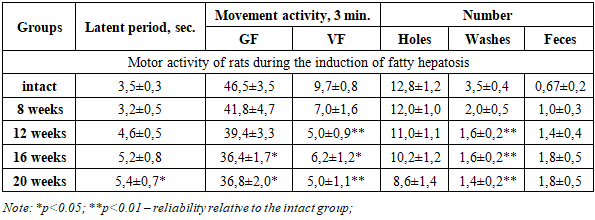
According to the results of the study, the latency period before movement of rats in the initial open field test was 3.5±0.35 seconds in healthy animals. In rats with chronic fatty hepatosis, the differences in the latency period in the open field test at 8, 12, and 16 weeks were not statistically significant compared to the animals of the intact group. However, at 20 weeks, the latency period before movement of rats increased statistically significantly by 1.5 times (p<0.05) (Table 1).Table 1. Changes in behavior and motor activity in the "open field" test of rats with experimental fatty hepatosis (M±m; n=6)
 |
| |
|
According to the results of the experiment on horizontal activity, in the intact group of animals this indicator was 46.5±3.5, and during the formation of fatty hepatosis, this activity decreased and amounted to 41.8±4.7 and 39.4±3.3 at 8, 12, weeks, respectively, but the differences compared to the intact group were not statistically significant. At 16 and 20 weeks, the obtained indicators on GF had a statistically significant difference from the intact group (p<0.05) and were found to decrease by 1.28; 1.26 times, respectively.According to the results of the experiment on vertical activity of the open field test, in healthy rats this indicator was 9.7±0.8. In the groups with fatty hepatosis, a decrease in vertical activity was observed. In particular, at 8 weeks of the study, VF decreased by 1.38 times, but the differences compared to the intact group were not statistically significant. At 12, 16, and 20 weeks of the study, VF decreased by 1.94; 1.56, and 1.94 times, respectively, with statistically significant differences compared to the intact group (p<0.01; p<0.05; p<0.01).When grooming behaviors (head insertion into holes, washing, and defecation) were studied in rats, head insertion into holes was 12.8±1.2 in healthy rats, and decreased by 12.0±1.0; 11.0±1.1; 10.2±1.2, and 8.6±1.4 at 8, 12, 16, and 20 weeks of the study, respectively. However, in the groups modeled with fatty hepatosis, no statistically significant differences were found compared to the intact group.The number of bowel movements in rats was 3.5±0.4 in the intact group, their number decreased at 8, 12, 16 and 20 weeks of the study, and the results in the 12, 16 and 20-week group of the experiment had a statistically significant difference compared to the intact group (p<0.01; p<0.01; p<0.01).When the experimental rats were studied for the number of feces, this indicator was 0.67±0.2 in the negative control group, and 1.49; 2.1; 2.69 and 2.69 times higher, but the results obtained for fecal parameters were not statistically different from the intact group.Many studies have shown that high-fat diets cause NAFLD and brain dysfunction. It has been shown that experimental animals with NAFLD experience a lack of oxygen in the brain and develop more symptoms of anxiety and depression [6,7]. These conditions affect their linear behavior.However, in another study, although there was no statistically significant difference in behavioral performance in the open field test between healthy and YYP groups, learning and memory impairment were noted in the NAFLD group in the Morris water maze test [8,9].In addition to metabolic dysfunction and liver damage, there is evidence that NAFLD causes a decrease in brain volume and the development of neuropsychiatric disorders, including cognitive dysfunction and depression [10,11]. According to these data, in NAFLD induced by YYP, not only metabolic dysfunction, including obesity, dyslipidemia, changes in glucose levels and liver damage, but also behavioral parameters such as learning and memory are altered [12]. In another study, hyperinsulinemia, especially increased serum cholesterol and triglycerides, were found to be negative factors closely related to impaired cognitive performance in rats in a novel object recognition test [13]. These results suggest a link between NAFLD and neuropsychiatric disorders.From the results of the experiment, we can conclude that when examining fatty hepatosis rats, we can see statistically significant differences in the latent period, GF and VF, washing activity, as well as a decrease in the number of grooming movements - head-into-hole insertions.
4. Conclusions
The results of the study showed a dynamic deterioration of behavioral indicators in rats modeled with experimental fatty hepatosis. In particular, an increase in the latent period, a decrease in horizontal and vertical activity, a decrease in the number of washings, and a slowdown in grooming were observed. These changes may be associated with neuropsychiatric disorders, stress states, and increased autonomic activity that occur against the background of chronic fatty hepatosis. The results obtained confirm that NAJYG has a negative effect not only on the liver, but also on the central nervous system.
References
| [1] | Yanko R.V., Chaka E.G., Zinchenko A.S., Safonov S.L., Levashov M.I. Features of modeling fatty hepatosis in rats of different ages based on a high-calorie diet // Obesity and Metabolism. 18 (4): 387-397. // Yanko R.V., Chaka Ye.G., Zinchenko A.S., Safonov S.L., Levashov M.I. Features of modeling fatty hepatosis in rats of different ages based on a high-calorie diet // Obesity and Metabolism. - 2021. - No. 18 (4): - P-387-397. |
| [2] | Basalai A.A., Kuznetsova T.E., Mityukova T.A., Polulyakh O.E., Chudilovskaya E.N., Kostyuchenko N.S., Shcherbakov Ya.V., Khrustaleva T.A., Gubkin S.V. Morphofunctional state of the liver of male Wistar rats with diet-induced obesity and its correction // Proceedings of the National Academy of Sciences of Belarus. Medical series. 19(3): 308–320. |
| [3] | Basalay A.A., Kuznetsova T.Ye., Mityukova T.A., Polulyax O.Ye., Chudilovskaya Ye.N., Kostyuchenko N.S., Sherbakov Ya.V., Xrustalyova T.A., Gubkin S.V. Morphological and functional state of the liver of Chris-samsins of the Vistar line during diet-induced obesity and its correction // Proceedings of the National Academy of Sciences of Belarus. Medical series. - 2022. - №. 19(3): - P. 308–320. |
| [4] | So Y.Ch., Juhyun S. Novel insights into non-alcoholic fatty liver disease and dementia: insulin resistance, hyperammonemia, gut dysbiosis, vascular impairment, and infammation // Cheon and Song Cell & Bioscience. - 2022. –V. 12: - P. 1-14. https://doi.org/10.1186/s13578-022-00836-0. |
| [5] | Sun Z., Wang Z.T., Sun F.R., Shen X.N., Xu W., Ma Y.H., Dong Q., Tan L., Yu J.T. Late-life obesity is a protective factor for prodromal Alzheimer’s disease: a longitudinal study // Aging (Albany. NY). -2020. – V. 12: - P. 2005–2017. https://doi.org/10.18632/aging. |
| [6] | Li X.Y., Zhang M., Xu W., Li J.Q., Cao X.P., Yu J.T., Tan L. Midlife modifiable risk factors for dementia: a systematic review and meta-analysis of 34 prospective cohort studies // Curr. Alzheimer Res. - 2019. – V. 16. – P. 1254–1268. |
| [7] | Kristoffer K., Anne C.D.M., Charlotte W.W., Lea L.G., Peter L.E., Malene F.D., Rajeshwar P.M., Hendrik V., Mette M.L., Karen L.T. Cognitive Dysfunction in Non-Alcoholic Fatty Liver Disease—Current Knowledge, Mechanisms and Perspectives // J. Clin. Med. -2021. – V. 10 (673). https://doi.org/10.3390/jcm10040673. |
| [8] | Gao X.R, Chen Z, Fang K, Xu J.X, Ge J.F. Protective effect of quercetin against the metabolic dysfunction of glucose and lipids and its associated learning and memory impairments in NAFLD rats // Lipids Health Dis. -2021. – V. 20(1): 164. doi: 10.1186/s12944-021-01590-x. |
| [9] | Chen XX, Xu YY, Wu R, Chen Z, Fang K, Han YX, Yu Y, Huang LL, Peng L, Ge JF. Resveratrol Reduces Glucolipid Metabolic Dysfunction and Learning and Memory Impairment in a NAFLD Rat Model: Involvement in Regulating the Imbalance of Nesfatin-1 Abundance and Copine 6 Expression // Front Endocrinol (Lausanne). -2019. 10: 434. doi: 10.3389/fendo.2019.00434. |
| [10] | Kim D, Yoo ER, Li AA, Tighe SP, Cholankeril G, Harrison SA. Depression is associated with non-alcoholic fatty liver disease among adults in the United States // Aliment Pharmacol Ther. -2019. –V. 50(5): - P. 590–598. https://doi.org/10.1111/apt.15395. |
| [11] | Filipovic B, Markovic O, Duric V, Filipovic B. Cognitive changes and brain volume reduction in patients with nonalcoholic fatty liver disease // Can J Gastroenterol Hepatol. -2018. 9638797–6. https://doi.org/10.1155/2018/9638797. |
| [12] | Chen Z, Xu YY, Wu R, Han YX, Yu Y, Ge JF. Impaired learning and memory in rats induced by a high-fat diet: Involvement with the imbalance of nesfatin-1 abundance and copine 6 expression // J Neuroendocrinol. -2017. –V. 29: https://doi.org/10.1111/jne.12462. |
| [13] | Lewis A.R, Singh S, Youssef F.F. Cafeteria-diet induced obesity results in impaired cognitive functioning in a rodent model // Heliyon. -2019. –V. 5(3): e01412. https://doi.org/10.1016/j.heliyon.2019.e01412. |


 Abstract
 Reference
 Full-Text PDF
 Full-text HTML