Ergasheva A. Z.1, Mirzayeva G. S.2
1National University of Uzbekistan named after Mirzo Ulugbek, Tashkent, Uzbekistan
2Institute of Zoology, Uzbekistan Academy of Sciences, Tashkent, Uzbekistan
Correspondence to: Ergasheva A. Z., National University of Uzbekistan named after Mirzo Ulugbek, Tashkent, Uzbekistan.
| Email: |  |
Copyright © 2025 The Author(s). Published by Scientific & Academic Publishing.
This work is licensed under the Creative Commons Attribution International License (CC BY).
http://creativecommons.org/licenses/by/4.0/

Abstract
Scientific research related to the fauna of Vespidae has been carried out by specialized entomologists in America, Europe, Asia, Russia, and Central Asia. Their taxonomic classifications, biology, ecology, and economic importance have been analyzed in detail. However, despite the vast area, diverse orography, and unique ecological and landscape conditions of Uzbekistan, particularly the Tashkent oasis, studies on the Vespidae fauna have been almost non-existent. Based on this, we present data and analytical results regarding the Vespidae true wasps of Uzbekistan, specifically focusing on the Tashkent oasis region.
Keywords:
Vespidae, Species, Ecosystem, Biodiversity, Euparagiinae, Masarinae, Eumeninae, Stenogastrinae, Polistinae, Vespinae, Tropical connection
Cite this paper: Ergasheva A. Z., Mirzayeva G. S., Distribution and Zoogeography of Vespidae Wasps in the Tashkent Oasis, International Journal of Genetic Engineering, Vol. 13 No. 12, 2025, pp. 296-302. doi: 10.5923/j.ijge.20251312.04.
1. Introduction
Currently, there is no unified opinion regarding the taxonomy of the class Insecta. A similar situation is also observed in the classification of the order Hymenoptera. [1] We consider it appropriate to present the results of studies on the classification of true wasps according to the classification of the order Hymenoptera accepted by entomologists of the CIS countries, including Russia, as well as Europe and the USA. [5] According to this classification, the taxonomic position of the family Vespidae is as follows:Insecta – Class InsectsHymenoptera – Order Hymenoptera (Membrane-winged insects)Apocrita – SuborderVespoidea – SuperfamilyVespidae – Family of True WaspsWasps belonging to this family are divided into groups based on their reproductive behavior and life forms — solitary and social species (Kurzenko N.V., 2012). [15]1. Euparagiinae, Masarinae, Eumeninae, Stenogastrinae, Polistinae, Vespinae (Carpenter J.M., 1981). [7]The first three groups include only solitary wasps. The last three groups represent a gradual development of social behavior, meaning they are social wasps that live in colonies. In addition, two small subfamilies are known only from photo records: Priorvespinae and Protovespinae (Antropov A.V. et al., 2009). [1]Solitary populations consist of independent female wasps that build their own nests and raise their offspring without the participation of other castes. Social wasps, on the other hand, are distinguished by their collective behavior within the colony and the clear division of labor among its members.They belong to the family Vespidae (True Wasps), which includes 6 subfamilies, 256 genera, and 5274 known species in the world fauna (Antropov A.V. et al., 2017). [2] Previously, these wasps were grouped into three subfamilies: social or paper wasps (Vespidae), pollen wasps (Masaridae), and potter wasps (Eumenidae). Today, however, all true wasps are classified under the family Vespidae, which unites six subfamilies: Euparagiinae, Masarinae, Eumeninae, Stenogastrinae, Vespinae, and Polistinae (Kurzenko N.V., 2012). [15]The first three subfamilies consist of solitary species, while the latter three include social wasps that live in colonies.In the southwestern part of the Nearctic region, there is a small relict group belonging to the subfamily Euparagiinae. This relict group is represented by a single modern genus, Euparagia (Cresson, 1879), which occurs in the southeastern part of North America and includes 10 species. The genus Euparagia (Cresson, 1879) is considered to be closely related to the genus Odynerus (Prezoto F., 2007 et al.). [16]In addition, approximately 50 species of the subfamily Stenogastrinae (family Vespidae) are distributed across the southwestern Nearctic region, East Asia, and Australia (Carpenter J.M., 1991). [8] Within the Palearctic region, 1046 species belonging to 81 genera have been identified, and in Russia, there are currently 147 species representing 31 genera (Kurzenko N.V., 1995). [13] The subfamily Masarinae includes 297 species belonging to 16 genera worldwide, 5 genera, 104 species in the Palearctic, and 2 species in Mongolia: Celonites kozlovi Kostylev, 1935 and Quartinia mongolica Morawitz, 1889 [9]. This subfamily is divided into two tribes: the Gayellini tribe, which includes 10 species belonging to 2 genera living in the Neotropical region. They are widely distributed in the warm and dry zones of the Palearctic and Afrotropical regions. In Russia, pollen wasps are found in the southern European part, as well as in the Caucasus and Central Asia.Within the subfamily Vespinae, there are 30 species belonging to 3 genera in the Palearctic region, and 11 species from 3 genera in Mongolia. The subfamily Eumeninae comprises 887 species belonging to 71 genera in the Palearctic region, and 79 species belonging to 20 genera in Mongolia. The subfamily Polistinae includes 25 species from 2 genera in the Palearctic region, and 8 species belonging to the genus Polistes in Mongolia (Buyanjargal B. et al., 2013a). [4]Among social wasps, the Polistinae subfamily is considered the most widespread. It consists of 985 species belonging to 26 genera, being most abundant in the Neotropical regions (Pickett K.M., 2010). [19] The genus Polistes (Vespidae: Polistinae) represents the most widely distributed group among true wasps, including 222 species that occur in all biogeographic regions except Antarctica. Most of these species are found in tropical countries (Carpenter J.M., 1996).Due to their wide distribution, high biodiversity, and ecological interactions with other organisms, these insects have become an important component of the Neotropical ecosystems (Silveira O.T., 2012). [18] Therefore, the Neotropical region is regarded as an area rich in the fauna and biodiversity of true wasps.Faunistic studies related to true wasps (Vespidae) in Uzbekistan were carried out between 1984 and 2015. In particular, during the 1970s–1990s, researchers such as N.V. Kurzenko (1977), who studied Eumeninae (Hymenoptera: Vespoidea), A.G. Davletshina (1979), and T.T. Kulumbetova (1999) reported the occurrence of species such as Vespula germanica, Vespa orientalis, and Eumenes laevis (Kulumbetova T.T., 1991).Later, Romankov, L. Castro, and L. Dvorak recorded the species Polistes dominula (Christ, 1791) in the Takhyakupir region of the Republic of Karakalpakstan and the Yangiabad district of Tashkent region.In Uzbekistan, the species Antepipona barrei (Radoszkowski, 1893) was first recorded in the Bobotog area of Surkhandarya region; Antepipona deflenda (Gusenleitner, 1972) in the Kaltakul area of Hissar district, Kashkadarya region (1994); and Antepipona specifica (Morawitz, 1895) in the Chinoz district of Tashkent region (2003).According to Van der Vecht and Fischer (1972) and Gusenleitner (1986), Antepipona tekensis (Kostylev, 1935) was found only rarely within Uzbekistan.In addition, Katamenes sichelii tauriae (Giordani Soika, 1960) was recorded in the Kasokar area of Bukhara region, Paragymnomerus spiricornis turanicus (Kostylev, 1940) in the Urgut district of Samarkand region, and Stenodynerus chitgarensis (Giordani Soika, 1970) in the Hissar and Kaltakul areas of Kashkadarya region, though these species were also noted to occur rarely (Castro L. et al., 2010).True wasps (Vespidae) are representatives of a diverse family belonging to the order Hymenoptera. Members of the Vespidae family are medium-sized insects, although some species can be small (2.5 mm) or large (up to 50 mm) in body length.
2. Materials and Methods
The present article is based on materials collected from various regions of the Tashkent oasis during 2024–2025, as well as on the results of conducted research and observations.In collecting materials, the methods of Golub (2012) and Moericke (1951) were used, along with traditional entomological techniques, such as Moericke’s plastic traps, sampling from shrubs, tree branches, residential and agricultural buildings, and the use of tools such as forceps, cameras, and others. [17]Species identification was carried out according to the methods proposed by V.L. Kazenas (2016). (Figure 1) 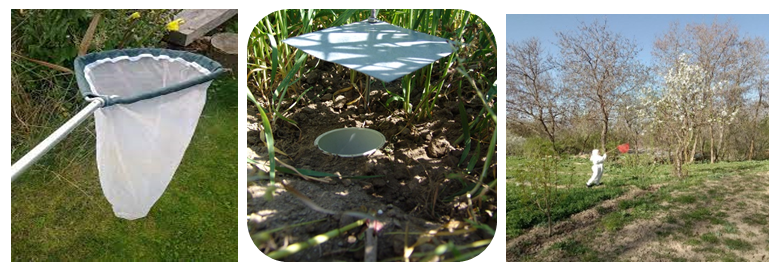 | Figure 1. Research methods |
To determine the distribution of true bees under natural and anthropogenic conditions, biomaterials were collected from various landscapes and agrocenoses of the Tashkent oasis.For softening the bodies of the collected specimens, the method of Jurzitza (1975) was used. [12] For this purpose, the captured insects were placed into a wide-mouthed container, and a piece of ordinary cotton soaked in 70% ethyl alcohol was placed on top. After 10–15 minutes, the bees became softened, allowing them to be properly positioned, fixed, and prepared as collection specimens. The prepared samples were then organized and catalogued. (Figure 2). 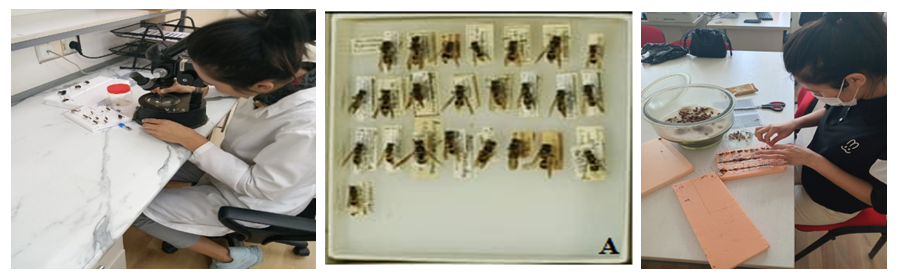 | Figure 2. Identification of species using laboratory methods |
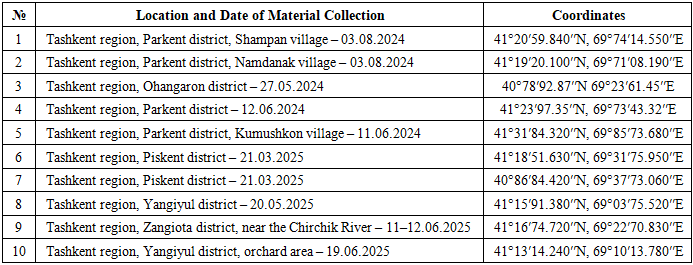
During the collection of materials, the locations were recorded using GPS coordinates, and the obtained data were entered into a database.When forming the database, the collection site and date, as well as the geographical coordinates of the area, were used as the main criteria. The list of the studied biotopes was numbered and presented accordingly (Table 1).Table 1. Coordinate point of the area where the research was conducted
 |
| |
|
Based on the database formed during the research process, GIS maps were created to illustrate the distribution areas of Vespidae species in the Tashkent oasis (Figure 3).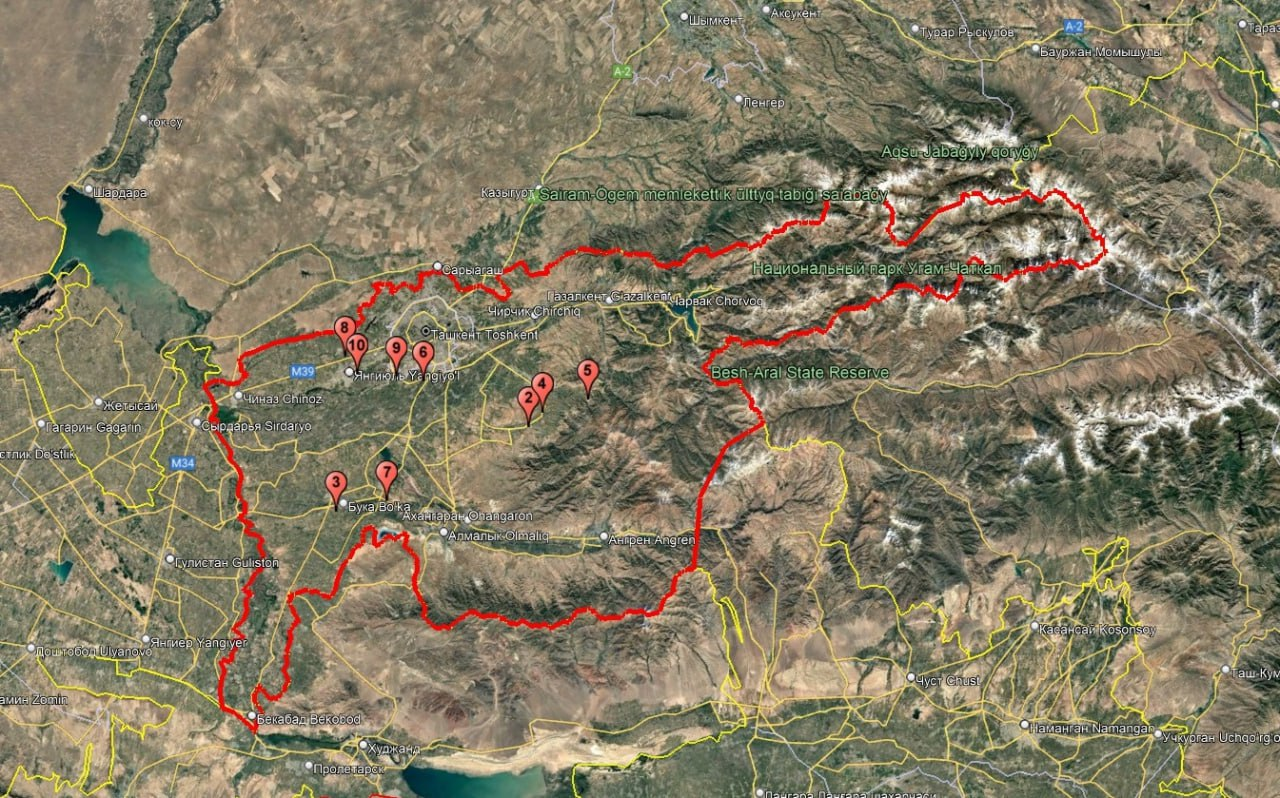 | Figure 3. Map of the area where the research was conducted |
The determination of zoogeographical regions and boundaries was carried out according to the method of F. Darlington (Darlington, F., 1966). [10]Among the 13 studied species, 7 species (60%) belong to solitary wasps (subfamily Eumeninae), while the remaining 6 species (40%) are social wasps (subfamilies Polistinae and Vespinae).Our research results include the identification and description of 13 true wasp species, along with information on their collection sites, distribution, and zoogeographical characteristics.As a result of the research conducted during the spring and summer seasons of 2024–2025, the composition of the Vespidae wasp species belonging to various subfamilies distributed in the Tashkent oasis was determined as follows:Subfamily: Eumeninae s.str.Genus: Euodynerus Dalla Torre, 19041. Species: Ancistrocerus parietum (Linnaeus, 1758)Synonyms:-Ancistrocerus tardinotus Bequard, 1925-Odynerus affinis Herrich-Schäffer, 1839-Odynerus flavipes Curtis, 1826-Odynerus geoffroyanus Spinosa, 1808-Odynerus incisoides Verhoeff, 1890-Odynerus incisus Verhoeff, 1890-Odynerus ochlerus de Saussure, 1852-Odynerus parietoides Verhoeff, 1890-Odynerus parietum (Linnaeus, 1758)-Odynerus similis Curtis, 1826Locality and collection date:Tashkent region, Parkent district, Shampan village(Coordinates: 41°20′59.840″N, 69°74′14.550″E), 3 specimens, 03.08.2024.Tashkent region, Ohangaron district(Coordinates: 40°78′92.87″N, 69°23′61.45″E), 1 specimen, 27.05.2024.Tashkent region, Zangiota district, bank of the Chirchik River(Coordinates: 41°16′74.720″N, 69°22′70.830″E), 4 specimens, 12.06.2025.Zoogeography: Europe, North Africa, Russia, Armenia, Azerbaijan, Türkiye, Iran, Uzbekistan, Kazakhstan, Mongolia, China, North America.2. Species: Antepipona specifica (Morawitz, 1895)Synonyms:-Odynerus curialis Morawitz, 1895Locality and collection date:Tashkent region, Zangiota district, bank of the Chirchik River(Coordinates: 41°16′74.720″N, 69°22′70.830″E), 2 specimens, 12.06.2025.Tashkent region, Yangiyul district, orchard area(Coordinates: 41°13′14.240″N, 69°10′13.780″E), 6 specimens, 19.06.2025.Zoogeography: Azerbaijan, Iraq, Iran, Turkmenistan, Uzbekistan, Kyrgyzstan.3. Species: Eumenes jarkandensis Blüthgen, 1938Synonyms:-Eumenes turanicus Blüthgen, 1943Locality and collection date:Tashkent region, Yangiyul district(Coordinates: 41°15′91.380″N, 69°03′75.520″E), 2 specimens, 20.05.2025.Tashkent region, Parkent district, Shampan village(Coordinates: 41°20′59.840″N, 69°74′14.550″E), 3 specimens, 03.08.2024.Tashkent region, Parkent district, Namdanak village(Coordinates: 41°19′20.100″N, 69°71′08.190″E), 1 specimen, 03.08.2024.Zoogeography: Azerbaijan, Türkiye, Iran, Turkmenistan, Tajikistan, Uzbekistan, Mongolia, China.4. Species: Eumenes papillarius (Christ, 1791)Synonyms:-Eumenes bimaculatus André, 1884-Eumenes bipunctis de Saussure, 1852-Eumenes papillosus≡ Sphex papillarius Christ, 1791Locality and collection date:Tashkent region, Piskent district(Coordinates: 40°86′84.420″N, 69°37′73.060″E), 2 specimens, 21.03.2025.Zoogeography: Europe, Azerbaijan, Türkiye, Syria, Israel, Iran, Pakistan, Uzbekistan, Turkmenistan, Kazakhstan, Mongolia.5. Species: Euodynerus rufinus (Blüthgen, 1942)Locality and collection date:Tashkent region, Parkent district, Shampan village(Coordinates: 41°20′59.840″N, 69°74′14.550″E), 3 specimens, 03.08.2024.Tashkent region, Yangiyul district(Coordinates: 41°15′91.380″N, 69°03′75.520″E), 2 specimens, 20.05.2025.Tashkent region, Zangiota district, bank of the Chirchik River(Coordinates: 41°16′74.720″N, 69°22′70.830″E), 1 specimen, 12.06.2025.Zoogeography: Azerbaijan, Syria, Kazakhstan, Uzbekistan. (Fatergya, 2023) [11]Genus: Eustenancistrocerus Blüthgen, 19386. Species: Eustenancistrocerus askhabadensis (Radoszkowski, 1886)Synonyms:-Odynerus quettaensis Cameron, 1907-Odynerus sarykorum Kostylev, 1929Locality and collection date:Tashkent region, Parkent district, Namdanak village(Coordinates: 41°19′20.100″N, 69°71′08.190″E), 1 specimen, 03.08.2024.Zoogeography: Azerbaijan, Turkmenistan, Mongolia, Uzbekistan.Genus: Katamenes Meade-Waldo, 19107. Species: Katamenes dimidiatus (Brullé, 1832)Synonyms:≡ Eumenes dimidiatus Brullé, 1832Locality and collection date:Tashkent region, Ohangaron district(Coordinates: 40°78′92.87″N, 69°23′61.45″E), 1 specimen, 27.05.2024.Tashkent region, Parkent district, Kumushkon village(Coordinates: 41°31′84.320″N, 69°85′73.680″E), 3 specimens, 11.06.2024.Zoogeography: Türkiye, Syria, Iran, Afghanistan, Central Asian countries. (Fatergya, 2023) [11]Subfamily: PolistinaeGenus: Polistes Latreille, 18028. Species: Polistes wattii (Cameron, 1900)Locality and collection date:Tashkent region, Parkent district(Coordinates: 41°23′97.35″N, 69°73′43.32″E), 17 specimens, 12.06.2024.Tashkent region, Yangiyul district(Coordinates: 41°15′91.380″N, 69°03′75.520″E), 22 specimens, 20.05.2025.Tashkent region, Zangiota district, bank of the Chirchik River(Coordinates: 41°16′74.720″N, 69°22′70.830″E), 31 specimens, 12.06.2025.Zoogeography: Iraq, Iran, Afghanistan, Pakistan, China, India, Turkmenistan, Uzbekistan, southern Kazakhstan, Tajikistan. (Fatergya, 2023) [11]9. Species: Polistes dominula (Christ, 1791)Synonyms:-Vespa dominula Christ, 1791Locality and collection date:Tashkent region, Parkent district(Coordinates: 41°23′97.35″N, 69°73′43.32″E), 11 specimens, 12.05.2024.Tashkent region, Yangiyul district(Coordinates: 41°15′91.380″N, 69°03′75.520″E), 18 specimens, 20.05.2025.Tashkent region, Piskent district(Coordinates: 40°86′84.420″N, 69°37′73.060″E), 42 specimens, 21.03.2025.Zoogeography: North Africa, Israel, Iran, Afghanistan, Pakistan, Syria, Turkmenistan, Türkiye, Uzbekistan, Northern India.Subfamily: Vespinae10. Species: Dolichovespula sylvestris (Scopoli, 1763)Synonyms:-Dolichovespula xinjiangensis Lee, 1986-Vespa anglica Leach Sm., 1843-Vespa campanaria Fowler, 1833-Vespa frontalis Latreille, 1802-Vespa holsatica Fabricius, 1793-Vespa parietum Harris, 1776-Vespa pilosella Costa, 1858-Vespa sylvestris Scopoli, 1763-Vespula sylvestris (Scopoli, 1763)Locality and collection date:Tashkent region, Piskent district(Coordinates: 40°86′84.420″N, 69°37′73.060″E), 7 specimens, 21.03.2025.Tashkent region, Ohangaron district(Coordinates: 40°78′92.87″N, 69°23′61.45″E), 3 specimens, 27.05.2024.11. Species: Vespula rufa (Linnaeus, 1758)Synonyms:-Paravespula rufa (Linnaeus, 1758)-Vespa intermedia (Buysson, 1904)-Vespa rufa Linnaeus, 1758-Vespa schrenckii (Radoszkowski), 1861-Vespa sibirica André, 1884-Vespula grahami Archer, 1981-Vespula obscura Lee, 1986Locality and collection date:Tashkent region, Piskent district(Coordinates: 41°18′51.630″N, 69°31′75.950″E), 4 specimens, 21.03.2025.Tashkent region, Ohangaron district(Coordinates: 40°78′92.87″N, 69°23′61.45″E), 11 specimens, 27.05.2024.Genus: Vespa Linnaeus, 175812. Species: Vespa orientalis (Linnaeus, 1771)Synonyms:-Vespa aegyptiaca André, 1884-Vespa aegyptiaca Vallot, 1802-Vespa fusca Christ, 1791-Vespa indica Wroughton, 1889-Vespa jurinei de Saussure, 1854-Vespa quadripunctata Forskal, 1775-Vespa turcica Drury, 1773Locality and collection date:Tashkent region, Parkent district, Kumushkon village(Coordinates: 41°31′84.320″N, 69°85′73.680″E), 22 specimens, 11.06.2024.Tashkent region, Ohangaron district(Coordinates: 40°78′92.87″N, 69°23′61.45″E), 28 specimens, 27.05.2024.Tashkent region, Piskent district(Coordinates: 40°86′84.420″N, 69°37′73.060″E), 56 specimens, 21.03.2025.Tashkent region, Ohangaron district(Coordinates: 40°78′92.87″N, 69°23′61.45″E), 21 specimens, 27.05.2024.Tashkent region, Zangiota district, bank of the Chirchik River(Coordinates: 41°16′74.720″N, 69°22′70.830″E), 14 specimens, 12.06.2025.Zoogeography: Turkmenistan, Tajikistan, Uzbekistan, Afghanistan, Pakistan, China, India, America, Germany. (Fatergya, 2023) [11]Genus: Vespula Thomson, 186913. Species: Vespula germanica (Fabricius, 1793)Synonyms:-Vespa germanica J.C. Fabricius, 1793-Vespa macularis Olivier, 1792Locality and collection date:Tashkent region, Parkent district, Kumushkon village(Coordinates: 41°31′84.320″N, 69°85′73.680″E), 9 specimens, 11.06.2024.Tashkent region, Zangiota district, bank of the Chirchik River(Coordinates: 41°16′74.720″N, 69°22′70.830″E), 11 specimens, 12.06.2025.Tashkent region, Ohangaron district(Coordinates: 40°78′92.87″N, 69°23′61.45″E), 9 specimens, 27.05.2024.Tashkent region, Yangiyul district(Coordinates: 41°15′91.380″N, 69°03′75.520″E), 10 specimens, 20.05.2025.Tashkent region, Yangiyul district, orchard area(Coordinates: 41°13′14.240″N, 69°10′13.780″E), 9 specimens, 19.06.2025.Zoogeography: Turkmenistan, Tajikistan, Uzbekistan, Iceland, New Zealand, Australia, Africa, Chile, Argentina, America, Canada.
3. Result and Discussion
Nearly 150 years of research have been devoted to compiling the taxonomic list of true wasps (Vespidae) in Uzbekistan.In the Tashkent oasis, early studies by Morawitz (1895) identified Euodynerus strigatus and Antepipona deflenda. Later, P. Blüthgen (1939–1955) recorded species such as Onychopterocheilus fausti, Odynerus melanocephalus, Pseudepipona herzi, and Pseudepipona herrichii.During 1925–1940, G. Kostylev reported Chlorodynerus arenicola and Polistes dominula. A. Giordani Soika (1970) documented Katamenes sichelii and Onychopterocheilus fausti (Morawitz, 1873).J. Van Der Vecht & Fischer (1972) studied Antepipona specifica and Eumenes sareptanus.Later, A.G. Davletshina (1979) reported Vespa orientalis and Dolichovespula sylvestris, while T.T. Kulembetova (1999) identified Polistes gallicus, Vespula rufa, and Vespa orientalis.
4. Conclusions
In conclusion, during 2024–2025 field studies, 13 species of the family Vespidae, belonging to 3 subfamilies and 7 genera, were identified in various natural and anthropogenic habitats of the Tashkent oasis.Among them, 6 species were recorded for the first time in this region.The representatives of the Vespidae family were found to be distributed almost throughout the entire oasis, with Polistes dominula, Vespa orientalis, and Vespula germanica being the most widespread species, for which collection specimens were obtained.
References
| [1] | Antropov A.V., Khrustaleva N.A. Species composition, biological features, and distribution of potentially dangerous social wasps (Insecta: Hymenoptera: Vespidae) in Russia // Issues of Applied Entomology. Pest Management. 2009a, Issue 1–2, pp. 54–61. |
| [2] | Antropov A.V., Fateryga A.V. (2017). Superfamily Vespoidea. Annotated catalog of the Hymenoptera of Russia. Volume I. Symphyta and Apocrita: Aculeata. Proceedings of the Zoological Institute RAS. Supplement 6. St. Petersburg: pp. 34–43. |
| [3] | Azimov D.A., Bekuzin A.A., Davletshina A.G., Kadyrova M.K. Insects of Uzbekistan - Tashkent.: Fan Academy of Sciences of the Republic of Uzbekistan, 1993. - 340 p. |
| [4] | Buyanjargal B., Abasheev R. Yu., Gantigmaa Ch. (2013a). Eusocial and solitary vespoid wasps (Hymenoptera: Vespidae) of Mongolia // Bulletin of the Buryat State University. V. 4. - P. 90-94. |
| [5] | Buyanjargal B. Fauna and ecology of folded-wing wasps (Hymenoptera, Vespidae) of the Orkhon-Selenga Depression of Mongolia // Dissert. Cand. of Biol. Sciences. Irkutsk - 2016. - 196 p. |
| [6] | Castro L., Dvorak L. (2010). New and noteworthy records of vespid wasps (Hymenoptera: Vespidae) from Palearctic region (III) // ActaMuseiMoraviae, Scientiae biologicae (Brno). – V. 95, No. 2. – P. 37–53. |
| [7] | Carpenter J.M. (1981). The phylogenetic relationships and natural classification of the Vespoidea (Hymenoptera) // Systematic Entomology. – V. 7. – P. 11–38. |
| [8] | Carpenter J.M. (1991). Phylogenetic relationships and the origin of social behavior in the Vespidae // The Social Biology of Wasps Ithaca, New York: Cornell University Press, – P. 7–32. |
| [9] | Carpenter J.M. (2001). Checklist of species of the subfamily Masarinae (Hymenoptera: Vespidae) // American Museum Novitates. – V. 3325. – P. 1–40. |
| [10] | Darlington F. Zoogeography. - M.: Progress, 1966. -520 p. |
| [11] | Fateryga A.V., Proshchalykin M.Y., Mokrousov M.V., Akhmedov A.G., To the knowledge of the solitary vespid wasps (Hymenoptera: Vespidae: Masarinae and Eumeninae) of Uzbekistan Zootaxa. – New Zealand, 2023. -Vol.5278. - No. 3. -P. 439-460. |
| [12] | Jurzitza G. (1975). Raster electron microscopy Understudies of the appendices and laminae mesostigmales einiger Enallagma – Arten (Odonata, Zygoptera) // II Forma et Functio. – V 8. – P. 33–48. |
| [13] | Kurzenko N.V. Family Vespidae – folded-wing wasps // Key to insects of the Russian Far East / edited by Lera P.A. – Vol. IV. Reticulates, scorpionflies, Hymenoptera. – Part 1. – St. Petersburg: Nauka, 1995. – P. 264–324. |
| [14] | Kulumbetova T.T. Insects of the Southern Aral Sea region (part 4) // Bulletin of the KKOANRUz - 1999, No. 1, pp. 62-69. |
| [15] | Kurzenko N.V., Family Vespidae - folded-wing wasps. Annotated catalog of insects of the Russian Far East. - Hymenoptera T.I. - Vladivostok: Dalnauka, 2012. - 423 p. |
| [16] | Prezoto F., Sabino J. Giannotti E. & Nascimento F.S. (2007). Between mandíbulas and ferrões: About the study of vespas' comfort. // As distant faces to comfortamento animal Campo Grande: UNIDERP. - P. 43-45. |
| [17] | Moericke, V. (1951). Eine Farbafalle zur Kontrolle des Fluges von Blattlausen, insbesondere der Pfirsichblattlaus, Myzodes persicae (Sulz.) // Nachrichtenblatt des Deutschen Pflanzenschutzdiensten. – V. 3. – P. 23–24. |
| [18] | Silveira, O.T., Silva, S.S., Pereira, J.L.G. & Tavares, I.S. (2012). Local–scale spatial variation in diversity of social wasps in an Amazonian rain forest in Caxiuanã, Pará, Brazil (Hymenoptera, Vespidae, Polistinae) // Revista Brasileira de Entomologia 56: – P. 329–346. |
| [19] | Pickett, K.M. & Carpenter, J.M. (2010). Simultaneous analysis and the origin of eusociality in the Vespidae (Insecta: Hymenoptera) // Arthropod Systematics & Phylogeny, 68: – P. 3–33. |


 Abstract
 Reference
 Full-Text PDF
 Full-text HTML