
-
Paper Information
- Next Paper
- Previous Paper
- Paper Submission
-
Journal Information
- About This Journal
- Editorial Board
- Current Issue
- Archive
- Author Guidelines
- Contact Us
International Journal of Genetic Engineering
p-ISSN: 2167-7239 e-ISSN: 2167-7220
2025; 13(12): 286-288
doi:10.5923/j.ijge.20251312.02
Received: Nov. 2, 2025; Accepted: Nov. 26, 2025; Published: Dec. 9, 2025

Soft Wheat Collection Samples: Correlation Between Total Chlorophyll and Yield
 Abstract
 Reference
 Full-Text PDF
 Full-text HTML
Z. B. Alloberganova1, M. F. Sultonov2
1PhD, Associate Professor, Urgench State University named after Abu Raykhon Beruniy, Urgench, Uzbekistan
2PhD Candidate, Khorezm Mamun Academy, Khiva, Uzbekistan
Copyright © 2025 The Author(s). Published by Scientific & Academic Publishing.
This work is licensed under the Creative Commons Attribution International License (CC BY).
http://creativecommons.org/licenses/by/4.0/

In the present article, results of an analysis of the correlation between physiological and yield indicators in soft-wheat collection samples from Central Asia and Kyrgyzstan, grown under the unique soil-climatic conditions of the Khorezm region in 2023-2025, are presented. According to the results, the strength of the correlation between total chlorophyll and yield was assessed by a linear regression equation; theoretically it is shown how an increase in total chlorophyll within a given numerical range leads to an increase in yield (g/m²).
Keywords: Genotype, Agro-ecological conditions, Yield, SPAD, Leaf area, Photosynthetic pigment, Regression coefficient, Photosynthetic potential
Cite this paper: Z. B. Alloberganova, M. F. Sultonov, Soft Wheat Collection Samples: Correlation Between Total Chlorophyll and Yield, International Journal of Genetic Engineering, Vol. 13 No. 12, 2025, pp. 286-288. doi: 10.5923/j.ijge.20251312.02.
1. Introduction
- With the rapid growth in world population, a significant increase in demand for wheat is expected. This in turn makes it imperative to optimise wheat-production efficiency: to raise wheat yield and quality, to accelerate breeding processes, refine cultivation technologies, and develop varieties adapted to climate change.Today, particularly high temperatures and sharp temperature fluctuations during grain filling pose serious problems for wheat production, increasing yield instability and posing a threat to food security. Abiotic and biotic stress factors often act individually or jointly to affect morphological, physiological, biochemical, and molecular changes in plants, and ultimately reduce yield.Temperature changes occur naturally during the growth, development and reproduction phases of plants. The rising level of risk associated with climate change is already shown to reduce crop yields globally, and heat waves remain a serious threat to future global food security. Under such complex and variable environmental conditions, to ensure stability of wheat yield there is increasing demand for varieties with high genetic potential and the flexibility to adapt to unfavourable abiotic and biotic factors (high temperature, water deficit, soil salinity, etc.). This in turn requires in-depth study of genotype, environment and genotype×environment interaction relationships in terms of plant growth, development and yield. Genotype×environment analysis allows breeders to identify genotypes that can provide stable high yield under different agro-ecological conditions.In our Republic a number of reforms have been undertaken in agriculture including creation and introduction of soft wheat varieties introduced from abroad, with high agronomic traits, resistance to diseases and pests, into production. Uzbekistan’s “New Uzbekistan Development Strategy” identifies as a task the development and introduction of new varieties of agricultural crops adapted to local soil-climatic and ecological conditions [1]. In this context, under today is complex environmental conditions, the creation and introduction of new varieties resilient to abiotic and biotic stress, adaptable to environmental conditions, is of considerable importance.In this regard the present study contributes to the implementation of the laws and decisions of the Republic of Uzbekistan, in particular the Decree of the President of the Republic of Uzbekistan dated 17 June 2019 № PF-5742, “On measures for efficient use of land and water resources in agriculture”, the Decree dated 23 October 2019 № PF-5853 “On approval of the 2020-2030 strategy for development of agriculture in the Republic of Uzbekistan”, and the Decree dated 6 March 2020 № PQ-4634 “On measures for introduction of market principles in wheat cultivation, procurement and marketing”, as well as other normative-legal documents [2] related to this activity.
2. Materials and Methods
- Taking the above into account, during 2023-2025 soft wheat collection varieties from Central Asian and Kyrgyz germplasm were grown on the field of the Khorezm Experimental Station of the Institute of Cotton-Selection, Seed Production and Cultivation Agro-Technologies, in the soil-climatic conditions specific to the Khorezm region, in order to study the interaction of genotype and environment on their physiological, morphological, quality and yield indicators. The content of chlorophyll in the plants was measured by SPAD 500 and leaf-area indicator by the LI COR 3100C device.
3. Results and Discussion
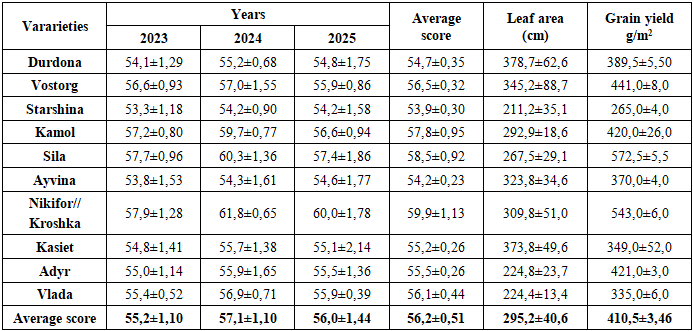
- Chlorophyll content is one of the complex genetic traits and its manifestation depends on endogenous and exogenous factors. Among the important factors for the high content of chlorophyll in plants are nitrogen-fertiliser [7] applications. Impairment of synthesis of photosynthetic pigments is caused by a number of biotic [5,6] and abiotic [3] factors. In addition to chlorophyll, plants also contain carotenoids, pigment groups that give yellow, orange and red colours, assist in light absorption and protect plants from excessive light. The aim of measuring chlorophyll is not only to determine its quantity, but also to obtain broad information on the general physiological state of the plant and its plasticity under stress conditions.This analysis serves several important aspects. Chlorophyll is the main pigment in the photosynthesis process [8]. Higher chlorophyll content indicates higher photosynthetic potential and thus higher efficiency of converting solar energy into organic matter, which in turn leads directly to higher biomass accumulation and yield. Chlorophyll content serves as a rapid indicator of plant status.Under stress factors such as drought, high temperature, salinity, nutrient deficiency or disease, the chlorophyll content can decrease. Therefore, by measuring chlorophyll the plant’s ability to resist stress can be assessed. Breeders widely use chlorophyll-content measurement to evaluate varieties photosynthetic potential at early stages, enabling selection of those with high yield potential [4].Analysis of the results showed that when chlorophyll content was analysed the differences among varieties were clearly manifested. According to the results, in 2023 the varieties overall mean was 55,2±1,10; the varieties Vostorg (56,6±0,93), Kamol (57,2±0,80), Sila (57,7±0,96) and Nikifor//Kroshka (57,9±1,28) showed higher values than the mean. (Then you list the table etc.).
|
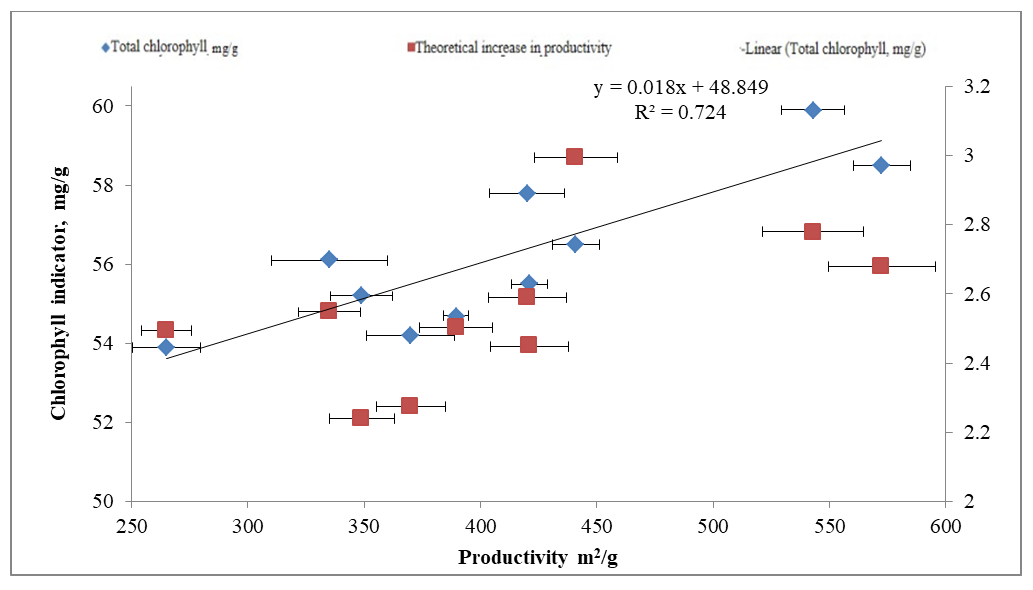 | Figure 1. The effect of total chlorophyll on productivity |
 =0,018x-48,8, the regression coefficient of 0,018 was recorded. This means that a 1 mg/g increase in total chlorophyll leads to a 0,018 % increase in yield (g/m²).Although high photosynthetic potential (chlorophyll content) forms a basis for increasing yield, in itself it is not sufficient. Other factors affecting yield, such as number of grains per m² and thousand-grain weight, must also be high. The high chlorophyll content of varieties Nikifor//Kroshka and Sila may indicate their resilience to environmental stress, yet this resilience does not guarantee high performance of all yield components.