
-
Paper Information
- Paper Submission
-
Journal Information
- About This Journal
- Editorial Board
- Current Issue
- Archive
- Author Guidelines
- Contact Us
International Journal of Genetic Engineering
p-ISSN: 2167-7239 e-ISSN: 2167-7220
2024; 12(6): 92-96
doi:10.5923/j.ijge.20241206.05
Received: Oct. 29, 2024; Accepted: Nov. 19, 2024; Published: Nov. 22, 2024

Inheritance and Variability of Economic Traits in F1-F2 Hybrids of Phaseolus Vulgaris L. Species
 Abstract
 Reference
 Full-Text PDF
 Full-text HTML
Nilufar Tursunova
Doctoral Student, Chirchik State Pedagogical University, Tashkent, Uzbekistan
Correspondence to: Nilufar Tursunova, Doctoral Student, Chirchik State Pedagogical University, Tashkent, Uzbekistan.
| Email: |  |
Copyright © 2024 The Author(s). Published by Scientific & Academic Publishing.
This work is licensed under the Creative Commons Attribution International License (CC BY).
http://creativecommons.org/licenses/by/4.0/

This paper reveals the analysis results on the inheritance and variability of the traits for seed number and seed weight per plant in the original forms and Ғ1-Ғ2 plants of Phaseolus vulgaris L. species. In the original forms, the highest indicator (121.0 ±1.0) was observed in the Belaya Fasol cultivar in terms of the number of seeds per plant, while the lowest indicator for this trait was recorded in the Vir cultivar (67.4±0.8). A high (88.8±1.2) result was observed in the studied F1 Ravot x Solnishko hybrid, which was inherited in a state of extreme negative dominance (hp=-4.8), while for the F1 Ravot x Calipso Krasnaya combination slightly lower (74.0±1.1 ) indicator was determined and inheritance was found to be in a negative dominance (hp=-1.6). In F2 plants, the range of variation in terms of the trait for number of seeds per plant constituted 6-7 classes. In particular, it was observed that there is a positive transgressive variation in the F2 Solnishko x Baby Lima combination, and the coefficient of transmission of the trait from generation to generation was from h2=80.0 to h2=88.0, which means that 80.0-88.0% of the analyzed trait is inherited under the influence of the genotype of hybrid form, and 12.0-20.0% is inherited under the influence of the external environment. According to the trait for seed weight in one plant, mostly intermediate, negative intermediate, positive and negative overdominant inheritance was noted in F1 plants. In F2 plants, the coefficient of transmission of the trait for seed weight in one plant was from h2=47.0% to h2=97.0%, which means that 47.0-97.0% of the analyzed trait is inherited due to the genotype of the hybrid form, 3.0 -53.0% is inherited due to the influence of the external environment.
Keywords: Phaseolus vulgaris, Cultivar, Hybrid, Genotype, Transgression, Pod, Heterosis, Dominance coefficient
Cite this paper: Nilufar Tursunova, Inheritance and Variability of Economic Traits in F1-F2 Hybrids of Phaseolus Vulgaris L. Species, International Journal of Genetic Engineering, Vol. 12 No. 6, 2024, pp. 92-96. doi: 10.5923/j.ijge.20241206.05.
1. Introduction
- In the world, great attention is paid to the wide use of geographically distant varietal samples in scientific research aimed at improving parameters of valuable economic traits of common beans. On the hybrids of these varietal samples, large-scale studies are conducted to determine the genetic laws of inheritance, variability, transmission from generation to generation, and correlative dependence of physiological, biochemical and morphobiological traits, in particular, valuable economic traits.Common bean is a crop grown in many countries and it is an important nutritional legume, that is, its cultivars and specimens are rich in protein, carbohydrates, minerals (iron and zinc) and essential vitamins. The first introduction of common beans from Central America to Western Europe dates back to the 16th century [1].Genetic studies conducted by scientists on common bean (Phaseolus vulgaris L.) from a practical point of view revealed that the presence or absence of purple stripes on the outer surface of the flower can serve as a morphological trait for the selection of light red and white seeds [2].Colored lines have been observed in Central American genotypic groups of beans. In contrast, South American (eg, Chile, Nueva Granada, and Peru) genotypes have been found to lack colored lines on the petals [3].The heritability of some traits (seed coat color, plant height, 100 seed weight) was analyzed in the samples belonging to Phaseolus vulgaris L.species. The color of the seed coat depends on the interaction of at least 2 loci (P and R), and the epistatic effect on R. genotypes, which are recessive for some of the Ñ genes, has been determined. It was noted that the seed coat color has monogenic control, plant length ratio is 3:1, and 100 seed weight has polygenic characteristics [4].For example, PI 527735 was obtained from the light pink color of the petal in the common bean, together with the gray-white seeds produced by the gri gene, while the interaction of the recessive allele of the pigment (P) locus with other genes was determined [5,6].In scientific research, samples of common bean that are wild and sensitive to abiotic stresses were crossbred for interspecific hybridization. The resulting hybrids were found to be cold-resistant and adaptable to regions with a short vegetation period. At the same time, the in vitro method was also used during this research, which served to successfully obtain some hybrid combinations [7].In recent years, studies have been carried out on the parameters of the traits for seed weight and seed size as the main traits that determine the productivity of common bean plant [8].Other scientific studies have evaluated the genotypic correlation of agrotechnical traits of common bean. It was observed that the genotypic correlation coefficient is superior to the phenotypic correlation. Number of seeds per plant (0.801) and grain weight (0.641) were found to have more positive effects on grain yield, suggesting direct or indirect selection for grain yield in common bean [9].
2. Research Object and Methodology
- The research was carried out at the experimental site of the Faculty of Natural Sciences of Chirchik State Pedagogical University.As research objects, Solnishko, Ravot, Baby Lima, Calipso Krasnaya, Vir, Belaya Fasol cultivars belonging to Phaseolus vulgaris L.species and F1-F2 plants were used.The following methods were used in the conducted research: One of economic traits – the number of seeds per plant trait was determined by generally accepted methods [10], the degree of dominance of traits in the first generation hybrids was determined according to S. Wright's formula presented in the works of G. E. Beil and R. E. Atkins [11]:
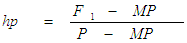 hp – dominance coefficient;F1 – the arithmetic mean of the hybrid trait;МР – the arithmetic mean of trait of both maternal and paternal forms;Р – the arithmetic mean of the best paternal or maternal form trait.hp = 0 – no dominance;0 <hp< ±1,0 – intermediate dominance;hp = ±1,0 – complete dominance;hp > ±1,0 – overdominance.In hybrids of the second generation, the indicator of transmission of the trait from generation to generation (h2) was calculated based on the formula of S.N. Warner [12]: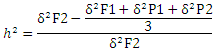
 dispersion of plants;
 dispersion of plants;
 dispersion of mother plants;
 dispersion of plants father plants;Quantitative results obtained on the basis of all practical experiments were subjected to statistical processing in large and small samples [13].
3. Research Results
- The yield of a common bean plant depends on the number of pods produced and the seed weight. Experiments have shown that the number of seeds per plant is one of the variables. A common bean plant has a very high chance of bud formation – flowering – pod formation, but its maintenance depends on the cultivar genotype and cultivation agronomics and environmental stressors. Although seed number per plant is inversely related to pod number, a variable productivity trait such as seed number per pod does not affect the yield as strongly as pod number depending on genotype. The study of the trait for the number of seeds per bush in the original forms selected for the study showed that the high indicator of this trait was determined in Belaya Fasol cultivar with an average of 121.0±1.0 pieces, while in the Vir cultivar the number of seeds per bush was low, on average 67.4± 0.8 pieces (Table 1).In F1 plants, similar results were obtained in terms of the trait for the number of seeds per plant, and in the hybrid combinations obtained as a result of crossing positive overdominance, negative overdominance and negative intermediate dominance were noted. For example, in the combination F1 Ravot x Solnishko, the parameters of the trait for the number of seeds per plant were 88.8 ± 1.2 pieces, the amplitude of variation was 84.0-105.0 pieces, and the coefficient of variation was 6.1%, and the coefficient of dominance (hp=-4.8) was inherited in the case of negative overdominance, and a low indicator of this trait was observed in the combination F1 Ravot x Calipso Krasnaya (average 74.0±1.1 pieces) and the level of dominance (hp=-1, 6) inherited in a negative overdominant state. In addition, in the F1 Baby Lima x Vir and F1 Baby Lima x Calipso Krasnaya combinations, a positive overdominant (hp=2.0, hp=2.3) inheritance was noted for the trait of the number of seeds per plant (Table 1).
|

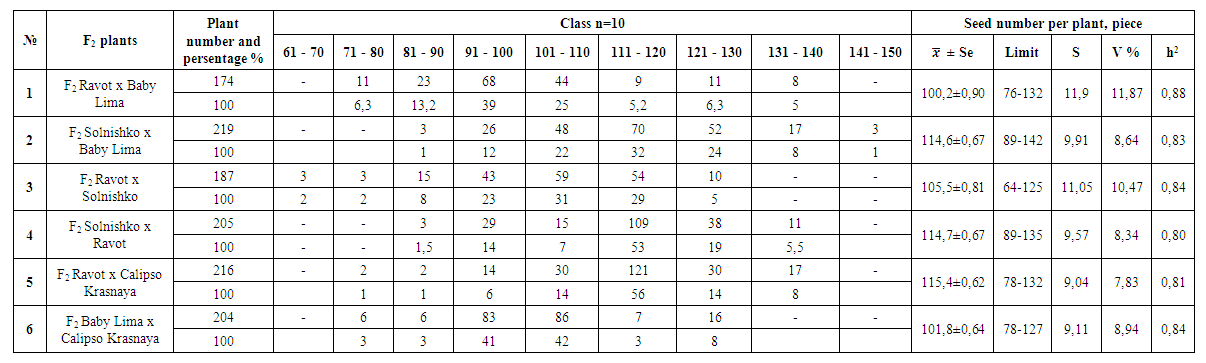 | Table 2. Inheritance and variability of the trait for seed number per plant in F2 plants |
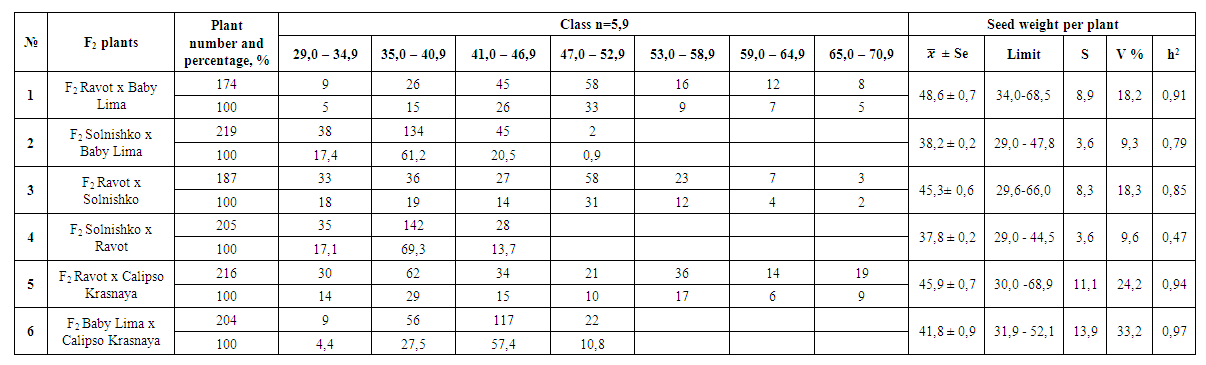 | Table 3. Inheritance and variability of the trait for seed weight per plant in the F2 plants |
4. Conclusions
- The analysis of the studies showed that the heterosis was mainly observed in the F1 plants obtained as a result of hybridization in terms of the traits for the number of seeds per plant and seed weight per plant. Recombinant forms (131-150 pieces, 59.0-70.9 grams) were isolated, taking into account the traits for the number of seeds per plant and the seed weight per plant while maintaining the state of heterosis in the studied F2 plants. It can be concluded that the use of these isolated hybrid forms with high parameters of the traits for seed number per plant and seed weight per plant can be highly effective as a valuable original form for genetic selection studies.