Eshzhanov K. Zh.1, Otenova F. T.2, Mambetullaeva S. M.3
1Department of Botany, Ecology and Teaching Methods, Nukus State Pedagogical Institute named after Ajiniyaz, Nukus, Uzbekistan
2Candidate of Biological Sciences, Associate Professor, Karakalpak State University named after Berdak, Nukus, Uzbekistan
3Karakalpak Research Institute for Natural Sciences, Karakalpakstan Branch of the Uzbekistan Academy of Sciences, Nukus, Uzbekistan
Correspondence to: Otenova F. T., Candidate of Biological Sciences, Associate Professor, Karakalpak State University named after Berdak, Nukus, Uzbekistan.
| Email: |  |
Copyright © 2024 The Author(s). Published by Scientific & Academic Publishing.
This work is licensed under the Creative Commons Attribution International License (CC BY).
http://creativecommons.org/licenses/by/4.0/

Abstract
The article examines the results of ecological analysis of the structure of small mammals by species composition and relative abundance of different species. It is shown that the specificity of the formation of the species structure of small mammal communities is primarily determined by the ecological characteristics of the species that make up a particular community. It is established that the transition from stable communities to less stable ones often occurs with a non-distinctive change in the number and rank distribution of species due to the action of destabilizing factors.
Keywords:
Small mammals, Analysis, Species composition, Communities, Categories, Structure
Cite this paper: Eshzhanov K. Zh., Otenova F. T., Mambetullaeva S. M., Ecological Analysis of the Structure of Small Mammals in the Territory of the State Reserve "Sudochie-Akpetki" in the Aral Sea Region, International Journal of Genetic Engineering, Vol. 12 No. 6, 2024, pp. 88-91. doi: 10.5923/j.ijge.20241206.04.
1. Introduction
In the current conditions of the biosphere's crisis state, the priority direction of development of science and technology is rational nature management, aimed primarily at preserving the environment-forming functions of the surrounding natural environment [1,3]. In this regard, important objects of ecological and biological monitoring are ecosystems that are continuously exposed to a whole range of anthropogenic factors that exacerbate the impact of extreme natural factors. The specificity of the formation of the species structure of small mammal communities, on the one hand, is determined by the ecological characteristics of the species that make up a particular community, and on the other hand, by the specificity of the habitat, which, as is known, is characterized by heterogeneity. Heterogeneity of habitats is especially pronounced in conditions of anthropogenic destabilization of the environment [4,6].
2. Materials and Methods
The analysis of micromammalian communities was carried out on the basis of structural characteristics: the number of species, indicators of their total abundance and the share of each species. According to the ratio of ecological groups in the small mammal community at the Sudochie site, psammophiles prevail, then ubiquists. Eusinanthropes and mesophiles are distributed in equal proportions (Fig. 1). 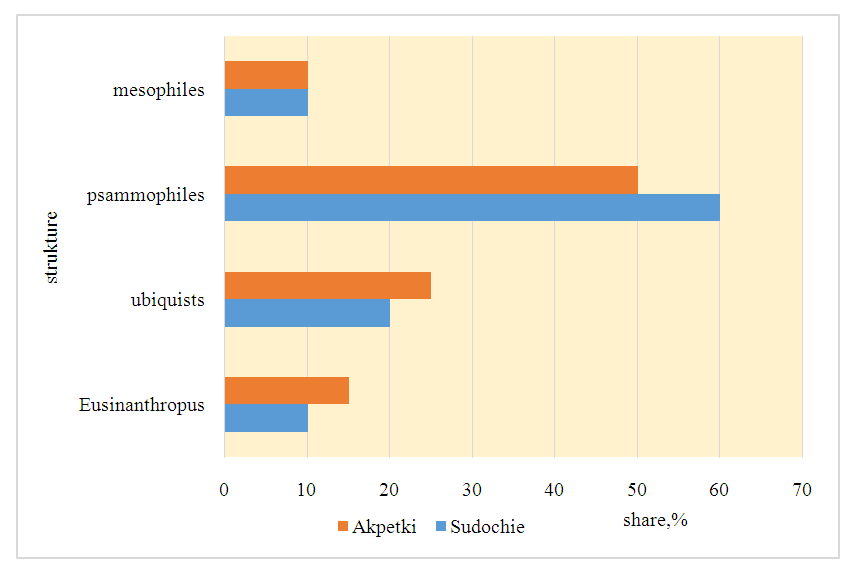 | Figure 1. Ecological structure of small mammal communities in the Sudochie-Akpetki protected area |
3. Results and Discussion
At the Akpetki site, we observe the following ratio of the ecological structure of micromammalian. The main share belongs to psammophilic rodents - up to 50%, followed by ubiquists. Their share is about 25%. The smallest percentage in the composition of rodent communities belongs to mesophilic rodent species - muskrat and Ili vole - 10%.The increase in the dominance index of the great gerbil (Rhombomysopimus) in this series is indicative - an indicator species of transformed habitats against the background of a decrease in the dominance index of small mammal species characteristic of desert communities [5,7,8]. Among the mesophilic species, the Ili vole (Microtus ilaeus) can be distinguished - as an indicator species of humid areas of the protected natural area (PNA) of the Sudochie-Akpetki State Nature Reserve. The analysis showed that the main share of pasmmophilic species in two areas of the Akpetki and Sudochie nature reserve is about 50-60%, respectively. The share of ubiquitous species for Sudochie and Akpetki is also about 20 and 25%, respectively. As for the share of mesophiles, their share is in an equal ratio - 10% (Fig. 2). 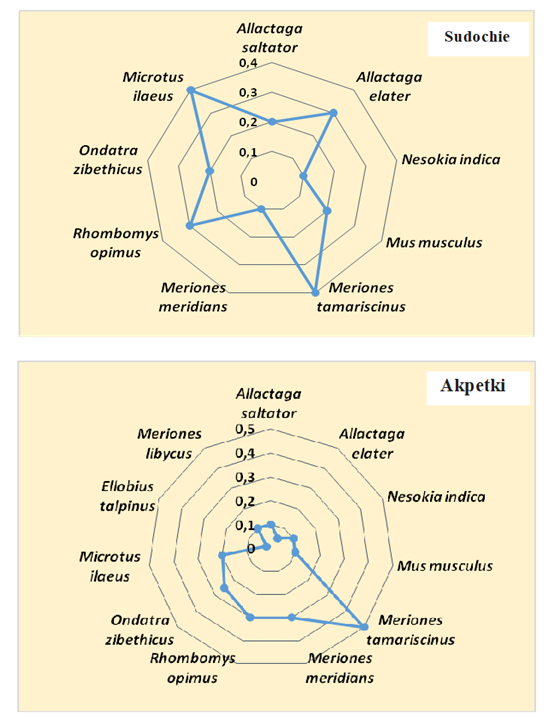 | Figure 2. The structure of small mammal communities in the protected natural area of the Sudochie-Akpetki State Nature Reserve by species composition and relative abundance |
The main representatives of psammophilic species are Rhombomysopimus, Paradipus ctenodactylus, Meriones libycus, Allactaga saltator, etc. The main representatives of ubiquitous rodents are Allactaga elater, Allactaga bobrinskii. The integrity of this structure is ensured by a certain diversity of microteriocenoses of the two areas under consideration, isolated clusters. Such a change in the structure of microteriocenoses of the studied areas of the PNT State Reserve "Sudochie-Akpetki" is well comparable with the increasing anthropogenic load on the territory.The identification of communities of living organisms in continuous habitats is currently an important section of theoretical and applied ecology. Many modern methods of multidimensional data analysis make it possible to display an ecological system defined on the basis of a set of its elements in a finite-dimensional coordinate system in continuous form [8,9,17]. However, in natural conditions we most often deal with discrete sets, which are most conveniently displayed using various classification methods.The complexity of classifying ecological communities lies in the fact that, unlike such categories as species of living organisms, they are very ambiguous formations that often exist in the general space of a continuous habitat. At the same time, when solving various research problems, one has to deal with a very specific habitat and the population of organisms inhabiting it, which is studied only for a certain period of time, i.e. with a local or private ecological space [10,13,16]. The classification process itself comes down to the formation of non-intersecting subsets of elements (classes) isolated from the general set on the basis of a certain algorithm [11,17].Cluster analysis of samples from different habitats by species composition and relative abundance of different species showed that small mammal communities of the studied areas of the PNT of the State Nature Reserve "Sudochie-Akpetki" form a single spatial structure with different structural and functional landscapes. Fig. 3. shows the change in the structure of small mammals in the direction of reducing its connection with the natural landscapes of the desert and humid zone of the PNT of the State Nature Reserve "Sudochie-Akpetki".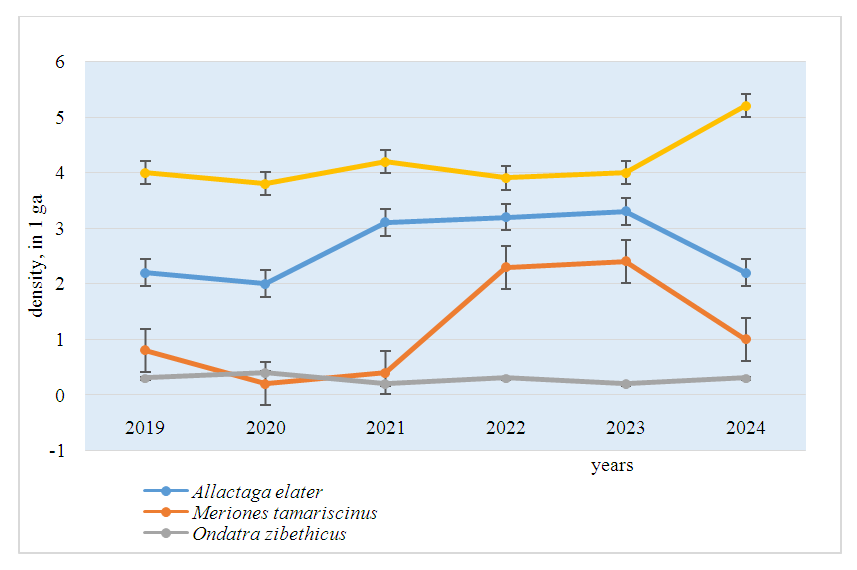 | Figure 3. Dynamics of the number of background species of rodents in the territory of the protected natural area "Sudochie - Akpetki" |
The results of the analysis of the structure and abundance of rodents showed that in the area of the protected natural area "Sudochie" the main share in abundance is occupied by such species as Allactaga elater, Meriones tamariscinus, Microtus ilaeus. In the second area of the protected natural area "Akpetki" a slightly different picture is observed. Thus, the main share in abundance of rodents falls on the populations of Rhombomysopimus, Meriones tamariscinus, Ondatra zibethicus and Mus musculus [12,14,15].Landscape transformation has a direct and indirect impact on the fauna and population of rodents, creating optimal conditions for the existence of some species and, conversely, unfavorable conditions for others. For the vast majority of rodent species in anthropogenic landscapes, the feeding conditions of biotopes are limited [2,4,11].The populations of Spermophilopsis leptodactylus, Citellus pygmaeus and some species of Dipopidae underwent significant structural changes. Being highly specialized species, they were unable to adapt to habitats of anthropogenic origin, and their natural populations were on the verge of extinction due to the reduction of the range of characteristic biotopes to minimal sizes [9,10]. The complexity of classifying ecological communities lies in the fact that, unlike such categories as species of living organisms, they are very ambiguous formations that often exist in the general space of a continuous habitat. At the same time, when solving various research problems, we have to deal with a very specific habitat and the population of organisms inhabiting it, which is studied only for a certain period of time, i.e. with a local or private ecological space [19]. The general relative abundance of small mammals in the spring period, the period we studied, was almost similar in two areas - Sudochie and Akpetki. However, in the autumn period there is an increase in the diversity index, which is reflected in the cluster analysis.The general dynamics of the rodent population in general for all biotopes of the territory of the protected natural area “Sudochie-Akpetki” is presented in Fig. 3.In the period under review from 2019-2024, various trends in the dynamics of the population of background rodent species are observed: Rhombomysopimus, Ondatra zibethicus, Meriones tamariscinus, Allactaga elater. Thus, the Rhombomysopimus population has seen an increase in numbers and a significant increase in numbers over the past 2 years.Trends in the decrease in the number of the psammophilic species Allactaga elater and the mesophilic species Meriones tamariscinus are also noted. As for the muskrat population (Ondatra zibethicus), it can be noted that the water regime of the lakes located on the territory of two sections of Sudochie-Akpetki is a limiting factor for the dynamics of the population. In this regard, the number has a stable form depending on the hydrological regime of water bodies.The main factors influencing the formation, composition and structure of the rodent community can be classified as follows:a) geographical,b) temporal (successional cyclical with different periods of cycles),The last group of factors in their influence on communities is multifaceted and can be similar to the effect of geographical (territorial) and temporal (successional) changes, since for many species there is an increase in the influence of limiting factors, similar either to the tightening of natural conditions or to their abrupt change.The complex application of diversity indices and their comprehensive analysis allow us to differentiate communities by the changes occurring in them, caused by the action of the above groups of factors.The categories of stability and sustainability of animal communities are characterized by spatiotemporal relationships of interdependent numerical characteristics of species [4,6]. It has been established that the transition from stable communities to less stable ones often occurs with an uncharacteristic change in the number and rank distribution of species due to the action of destabilizing factors [7,8,9]. The level of stability and sustainability of mouse-like rodent communities can be characterized by a change in the dominance structure [10].
4. Conclusions
Communities with uniform abundance and rank distribution of species are considered more stable, while those in which abundance and dominance structure change are considered less stable. Along with species richness and evenness, the spatial distribution of species in a community is of no small importance, depending on the landscape-ecological conditions in which the ecosystem is located.Thus, the population of small mammals and its structure are formed under the influence of a number of factors, among which the location of the territory relative to the species range and its landscape features are of great importance. Usually, in the center of the species range, the population density is higher than on its periphery [19]. This is explained by the fact that in the central part of the species range, the most optimal conditions for the existence of animals are formed. Towards the periphery of the range, the habitat becomes more extreme: the pressure of abiotic and biotic factors increases, the area of habitats suitable for life decreases, therefore the distribution of animals takes on a mosaic character, and the population density decreases significantly.
References
| [1] | Azimov D. A. Strategy for the Development of Zoological Science // Ecological Bulletin of Uzbekistan, 1995. - №1. - p. 34-36. |
| [2] | Aimuratov R., Pirzhanova R. State of Biodiversity of Ecosystems of the Southern Subregion of the Ustyurt Plateau under Technogenic and Anthropogenic Press // Bulletin of the Karakalpak br. AS UZ. - 2009. - №3. - p. 48-51. |
| [3] | Alimov A. F. Biodiversity as a Characteristic of Community Structure // Bulletin of the Academy of Sciences, Biological Series, 1998. - No. 4. - p. 434. |
| [4] | Berdyugin K. I., Bolshakov V. N. Mammals in Environmental Monitoring // Methods of Environmental Monitoring: A Large Specialized Practical Course: Textbook. manual. Ekaterinburg: Publishing house of the Ural. University, 2005. p. 236. |
| [5] | Bigon M., Harper J., Townsend K. Ecology. Individuals, populations and communities. - M.: Mir, 1989. - T. 2. - p. 477. |
| [6] | Bolshakov V. N. Ways of adaptation of small mammals to mountain conditions. - Moscow: Nauka, 1972. - p. 200. |
| [7] | Volpert Ya. L., Shadrina E. G., Danilov V. A., Shadrin D. Ya., Velichenko V. V. Communities of small mammals of anthropogenic landscapes of Western Yakutia // Science and education. - 2005. - №2 (issue 38). - p. 47-52. |
| [8] | Gashev S. N. Mammals in the system of environmental monitoring (on the example of the Tyumen region). Tyumen: Tyumen State University, 2000. p. 220 |
| [9] | Devyatkin G. V. Peculiarities of species composition and abundance of small mammals in the forest-steppe complex of the south of Central Siberia // All-Russian scientific conference "Actual problems of modern theriology". - 2012. - Novosibirsk. - p. 10. |
| [10] | Zhigalskiy O. A., Zhokusheva Z. G. Productivity of small mammals and their relationship with vegetation // Agrarian Bulletin of the Urals. - 2009. - №11 (65). - p. 95-97. |
| [11] | Litvinov Yu. N., Abramov S. A., Kovaleva V. Yu. etс. Structural and temporal organization of the rodent community of the Teletskaya taiga (Altai Mountains) // Ecology. 2007. №6. p. 444–449. |
| [12] | Mambetullaeva S. M., Bakhiev A. B., Bakhiev L. A., Begzhanova G. T., Atamuratov R. The state of flora and fauna of Karakalpakstan and species in need of urgent conservation measures // Collection of abstracts of the IV International scientific and practical conference “Problems of rational use and protection of biological resources of the Southern Aral Sea region”, 2012. - Nukus. - p. 88-89. |
| [13] | Petrov A. N. Small mammals (Insectivora, Rodentia) of transformed and undisturbed territories of the East European tundra. - St. Petersburg: Science, 2007. - p. 177. |
| [14] | Reimov R. Mammals of the Southern Aral Sea region. - Tashkent, Publishing House of the AS. - 1985. - p. 95. |
| [15] | Reimov R. Rodents of the Southern Aral Sea region (systematics, ecology and economic importance). - Tashkent, 1987. - p. 128. |
| [16] | Tikhonova G. N., Tikhonov I. A., Bogomolov P. L., Surov A.V. Distribution and species diversity of small mammals on the banks of rivers in urbanized areas // Zoological journal. 2002. №7. p. 864-870. |
| [17] | Shchvarts E. A., Demin D. V., Zamolodchikov D. G. Ecology of small mammal communities in temperate forests (using the Valdai Upland as an example). Moscow: Nauka, 1992. p. 127. |
| [18] | Bahn V., O’Connor R. J., Krohn W. B. Effect of dispersal at range edges on the structure of species ranges // Oikos. 2006. Vol. 115, №1. p. 89-96. |
| [19] | Pulliam H. R. On the relationship between niche and distribution // Ecology Letters. 3. - 2000, p. 349–361. |


 Abstract
 Reference
 Full-Text PDF
 Full-text HTML