
-
Paper Information
- Paper Submission
-
Journal Information
- About This Journal
- Editorial Board
- Current Issue
- Archive
- Author Guidelines
- Contact Us
International Journal of Genetic Engineering
p-ISSN: 2167-7239 e-ISSN: 2167-7220
2019; 7(2): 28-36
doi:10.5923/j.ijge.20190702.03

White Butterflies (Lepidoptera, Pieridae) of the Khorezm Oasis
 Abstract
 Reference
 Full-Text PDF
 Full-text HTML
Muzaffar Bekchanov
Department of Soil Science Chair, Faculty of Natural Sciences, Urgench State University, Urgench, Uzbekistan
Correspondence to: Muzaffar Bekchanov, Department of Soil Science Chair, Faculty of Natural Sciences, Urgench State University, Urgench, Uzbekistan.
| Email: |  |
Copyright © 2019 The Author(s). Published by Scientific & Academic Publishing.
This work is licensed under the Creative Commons Attribution International License (CC BY).
http://creativecommons.org/licenses/by/4.0/

The present research was conducted in different parts of the Khorezm oasis, such as Chikirchi, Tallik thicket, Karamazi, Khitay village and Miskin, clarified that the basis of white butterflies fauna (Lepidoptera, Pieridae) constitute tropically specialized species.
Keywords: Food specialization, Fauna, Habitats, Spread, Continent
Cite this paper: Muzaffar Bekchanov, White Butterflies (Lepidoptera, Pieridae) of the Khorezm Oasis, International Journal of Genetic Engineering, Vol. 7 No. 2, 2019, pp. 28-36. doi: 10.5923/j.ijge.20190702.03.
1. Introduction
- One of the most actual problems in Khorezm region is the study of the biodiversity of butterflies in various landscape-zonal conditions. White butterflies (Lepidoptera, Pieridae) – can easily be observed in nature, sensitively react to any environmental changes. Most of the butterflies are very sensitive to chemical pollution, the change in the concentration of the oxygen and the regime of the temperature. Especially, in order to save the butterfly Aporia crataegi L, we must decrease working with chemical fertilizers for the fruit trees and increase the amount of wild fruit trees. In various monitoring studies, white butterflies occupy their ecological environment, being bio-indicators of the state of the environment. The distribution of butterflies in different regions is determined by the fact that the condition if suitable for them or not. For example, the main reason for the decrease in the amount of desert butterflies is closely associated with the drainage. [12]The soil of the Khorezm oasis is very diverse. The main part of the soil cover is consisted of alluvial soils. The soil composition also includes meadow-gray soils. Slop soil cover is formed mainly of meadow-gray-earth soils, salty soils, and also sandstones.As far as we know, no literature is available about the diversity of white butterflies in Khorezm oasis region. The significance of the study can be seen in saving biodiversity and fighting against pests. In particular, Zegris pyrothoe is included in Uzbekistan’s Red Book [13].The aim of the study was to determine the fauna and biology of Lepidoptera in the territory of the Khorezm oasis.
2. Materials and Methods
- The white butterflies’ specific features of food specialization in different life forms of plants were identified and clarified in this article.Khorezm oasis is located in the lower parts of the Amudarya River. It covers the entire territory of the Khorezm region in Uzbekistan, the southern part of Karakalpakstan, which is an autonomous republic within Uzbekistan, as well as the northern and northeastern parts of the Dashoguz region of Turkmenistan. It is bordered with the Kungrad lowland on the north side, the Karakum desert on the south, the Ustyurt plateau and so-called desert on the west, the Kyzylkum desert on the east. The Amudarya, which is one of the largest and longest rivers in Central Asia, flows through the territory of the oasis.The climate of the oasis is sharply continental, with hot and dry summers and rather cold winters. The average annual temperature is +15, 0°C; the average January temperature is −4, 5°C, the average July temperature is +28, 4°C. The absolute minimu-m temperature is –32°C, the absolute maximum temperature is +54°C. On average, 80–120 mm of rainfall falls on the territory of the oasis per year (most of the precipitation occurs in spring and autumn). The growing season lasts 210-212 days. Due to the decrease in the level of the Aral Sea, the climate of the region every year becomes more and more abnormal and the summer is getting hotter and the winter is colder.The methods are based on weekly collections and observations conducted in 2009-2017 on the territory of the Khorezm oasis. The research was held in the territories of the Khorezm oasis, the nearest slopes of the Sultan Uvaistag ridge, throughout the territory of the Khorezm region, reaching the Karatau foothills, and in the flood plains of the Amudarya. A total of 2550 individuals, including imago, larvae and pupae of white butterflies were collected and processed. Comprehensive studies were carried out using traditional and new methods of catching and counting insects, with analysis of model and trial plots and using laboratory methods for the content and breeding of lepidopterans [1,9]. The species composition of white butterflies was determined with the help of the “Identifier of insects of the European part of the USSR” [11] and the determinant of Russian butterflies [7].
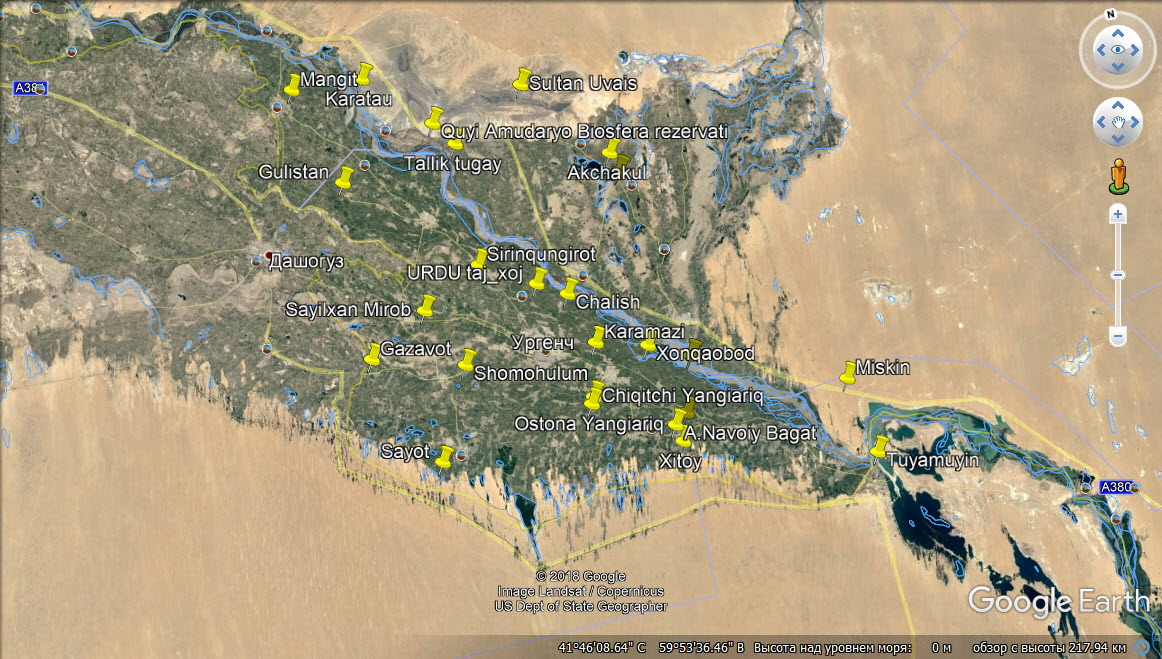 | Picture 1. The Sites of the White Butterflies |
3. Results and Their Discussion
- A list of 21 species of Lepidoptera fauna of the Khorezm oasis is given below, for the territory of Uzbekistan 6 species are recorded for the first time. For all species, information is given on the location, time of collection and the number of caught examples.We compared the fauna complexes based on the information about the different biotopes of the Khorezm region and the species of the landscapes. In order compare them, we used Jaccar coeffitcient.
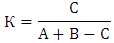 There: А – the number of species in the first biotope, B -the number of species in the second biotope, С – the number of species in both biotopes. (Chernishev, 1996). [4]According to this, the following results were determined:
 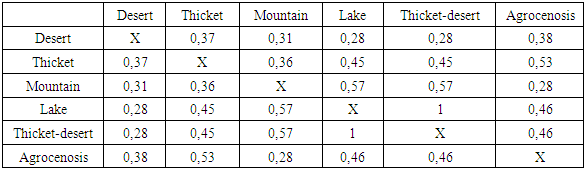 Total, 21 species were found, belonging to 8 genera and the prevalence of specialized trophic species in the fauna was revealed. The laws of the food specialization of white butterflies to different taxa and plant life forms are considered.The family (Pieridae) is a group of diurnal butterflies, mostly white or yellow, with black spots or veins on the wings, with club-shaped antennae, rounded-triangular front and ovate back wings. Their flight is also diverse. Some representatives migrate. Imago feed on nectar of flowers. Eggs are usually laid alone. Caterpillars are green, covered with sparse hairs. Some species seriously harm agricultural plants. Caterpillars develop mainly on cruciferous (Brassicaceae) and legumes (Fabaceae). Caterpillar or pupa can winter. Dark pupae with yellow spots attached to the rear end of the body and supported by a thread covering the chest. The establishment of species diversity, trophic structure of the white butterflies fauna (Pieridae) in the Khorezm oasis is an urgent problem, since lepidoptera are groups of phytophages and destructors of the components of organic substances and they are important elements of any trophic system. In this regard, having the lack of sufficient data on the fauna, biology and ecology of oasis white butterflies and other information, it became necessary to fill the gap and as a first step to investigate this large and economically important insect group of the Republic of Uzbekistan in depth.In addition, the information obtained can be used as a starting point for assessing various kinds of changes. This, in the first place, concerns the characteristics generally accepted in ecological and faunal studies: the species composition, abundance, trophic structure of dominance, and the phenological characteristics of the species inhabiting biogenesis. Based on these data, it is possible to design various models of environmental protection measures and monitoring of the state of biogenesis.The Comparative Analysis of the Pieridae family species in the natural and anthropogenic landscapes
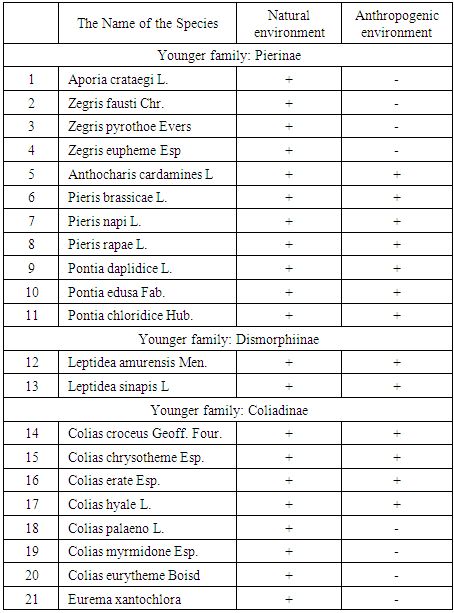 Composition of the white butterflies’ fauna of the Khorezm oasis
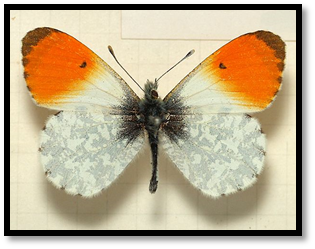 1. Anthocharis cardamines L. Sites: the Republic of Karakalpakstan: Lower- Amudarya State Biosphere Reserve 42°0'2.19"Northern latitude, 60°26'11.34"Eastern longitude. 23.06.2015. One species was analyzed.Distribution. Volga, Caucasus, Urals, Yakutia, Amur, Sakhalin, Primorsky Krai, Austria, Albania, Andorra, Belarus, Belgium, Bulgaria, Bosnia, the British Isles, France, Germany, Ireland, Spain, Italy, Cyprus, France, Latvia, Liechtenstein, Lithuania, Luxembourg, Macedonia, Norway, Poland, Portugal, Romania, Russia, Sardinia, Turkey, Ukraine, Finland, Croatia, Czech Republic, Switzerland, Sweden, Estonia [8].Biology. The famous butterfly with two large bright orange spots on the front wings of males can be found in spring and in the first half of summer. The length of the front wing is about 2.5 cm.A. cardamines flies from early April to June.Host Plants: Mixed herbs meadows, forest edges, river banks, damp forest glades, fields. In the mountains, Anthocharis cardamines reach a height of 2000 m. Larvae are produced from June to July. Forage plants - Cardamine (in particular C. Pratensis - meadow core), garlic (Alliaria), cabbage (Brassica), yellowflower (Erysimum), Dames’ Rocket (Hesperis), mustard (Sinapis), Sisymbrium, pennycress (Thlaspi), rockcress (Turritis), on Sakhalin - common colza (Barbarea vulgaris). They winter in the pupal stage [10].
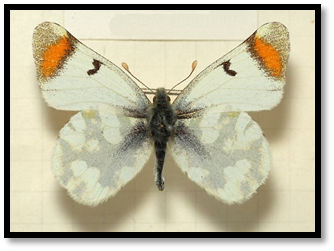 2. Zegris eupheme Esp. Sites: Khorezm region: Khitay village 41°17'50.11" Northern latitude, 60°54'48.74"Eastern longitude. 3.05.2014, One species was analyzed.Distribution. Spain, Russia, Ukraine, Kazakhstan, Central Asia, Iran, Africa [8].Biology. Butterflies feed on flowering crucifers. Eggs are laid individually by the buds of the cruciferous plants: mustard (Sinapis), Sisymbrium, yellowcone (Erеsimum) and others [10]. Pupae appear at the end of June on the stems of their fodder plants. Caterpillars are light gray with a yellowish dorsal side, in large and small black spots. In laboratory conditions, the caterpillars took 11 days to hatch from the egg and they immediately began feeding. For the year, usually white butterflies give one generation, occasionally two. The butterflies flying period was observed from April to May. They winter in the pupal stage.
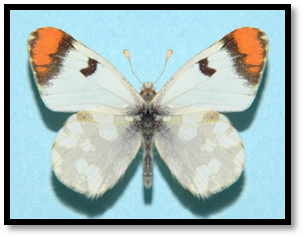 3. Zegris fausti Chris. Sites: Khorezm region: Miskin. 41°21'9.29" Northern latitude. 61°21'48.19" Eastern longitude. 30.05.2009. 21.05.2016, Two species were analyzed.Distribution. Pakistan, Afghanistan, Turkmenistan, Iraq, Iran, Kyrgyzstan, Tajikistan, Uzbekistan [7].Biology. In the year, they give only one generation. Their flying period falls on March - the beginning of May. The caterpillar feeds on wild herbaceous cruciferous plants. They winter in the pupal stage.
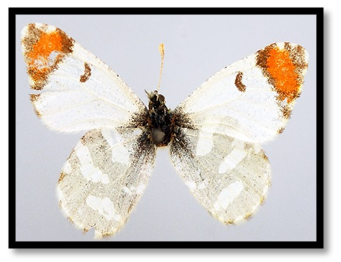 4. Zegris pyrothoe Evers. Sites: Khorezm region: Khitay village 41°17'50.11" Northern latitude. 60°54'48.74" Eastern longitude. 3.05.2015, One species was analyzed.Distribution. Uzbekistan, Kazakhstan, Turkmenistan, Kyrgyzstan, Russia, China (Sinjan) [7].Biology. Fore wing length is 16-20 mm. The wingspan of butterflies is 28-40 mm. their head is round, eyes are bare. Antennae gradually thicken towards the apex or end with a sharply detached mace. The upper side of the wings is white. The top of the front wing is black-spotted with a large reddish-orange spot in the center. For the year, this species develops in a single generation. Their flying period in the deserts of Central Asia occurs from the end of March to the first half of April. Fodder plants are Lepidium perfoliatum. Dawn fiery listed in the Red Book of Uzbekistan. They winter in the pupal stage.
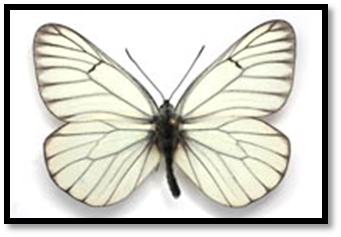 5. Aporia crataegi L. Sites: Khorezm region: Sultan Uvais Ridge 42°2'26.99" Northern latitude. 60°40'58.04"Eastern longitude. 20.05.2009, 03.06.2010, 07.06.2012, 5 species were analyzed.Distribution. Distributed throughout Europe, Russia, Ukraine, Africa, Asia [7].Biology. They are common and widespread. They inhabit steppes, meadows of various types, river banks, glades, roadsides, vacant lots, gardens and parks. Adult caterpillar is light gray or brown with wide red stripes on the sides. On the dunes, we observed the development of caterpillars on the hawthorn, willow pear (Pyrus salicifolia), and wild rose (Rosa canina) [1]. They pupate on the stalks of blades of grass low above the ground. For the year they give one generation. The flying period of butterflies is observed from May to June. Pupae are most often hilly green, but occasionally there are also yellow ones. They winter in the pupal stage.
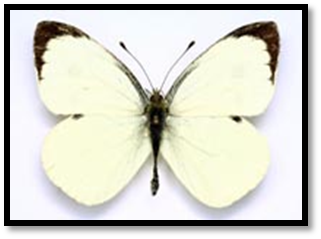 6. Pieris brassicae L. Sites: Khorezm region: Karamazi, 41°31'10.34" Northern latitude. 60°44'31.91" Eastern longitude. Astana 41°24'13.44" Northern latitude. 60°42'2.20"" Eastern longitude. 28.03.2009, 24.03.2010, 21.07.2011, 132 species were analyzed.Distribution. Africa, India, the Urals, Europe, South Sakhalin, Central Asia, Uzbekistan [7].Biology. Butterfly feeding is noted on dandelion medicinal (Taraxacum officinale L.), small alfalfa (Medicago minima L). There are caterpillars of two colors: brown or bluish-green, with black various spots and yellow longitudinal stripes on the sides and back. Caterpillars feed on P. Brassicae, prefer cabbage (Brassica), Lepidium, mustard (Sinapis), in particular wild mustard (Sinapsis arvensis), radish (Raphanus), e.g., Raphanus raphanistrum, Rorippa and others, and Reseda lutea [10]. For a year, the white butterfly develops three generations. Their flying period is observed from the beginning of April to the end of October. Eggs are yellow, conical, ribbed. Masonry located on the underside of the leaves of various forage plants. Pupae are yellowish green or whitish, with black and orange dots. They winter in the pupal stage.
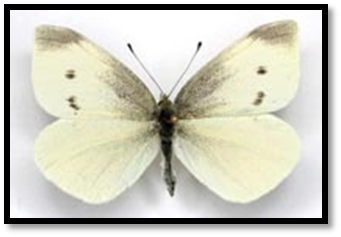 7. Pieris rapae L. Sites: Khorezm region: Chikirchi. 41°24'59.43" Northern latitude. 60°42'30.73" Eastern longitude. Tallik thicket 41°57'9.95" Northern latitude. 60°29'3.28" Eastern longitude. 15.08.2009, 25.09.2010, Karamazi, 41°31'10.34" Northern latitude. 60°44'31.91" Eastern longitude. Astana 41°24'13.44" Northern latitude. 60°42'2.20" Eastern longitude. 28.03.2009 24.03.2010, 21.07.2011. 244 species were analyzed.Distribution. Europe, North Africa, Asia Minor, North America, Russia, the Caucasus, Transcaucasia, Australia, Kazakhstan, Uzbekistan, Japan [7].Biology. Butterflies feed on the nectar of herbaceous plants, preferred by thistles. They put yellow ribbed bottle-shaped eggs. The caterpillars are dark green, with a yellow intermittent stripe on the sides, the entire surface of the body carries spotted warts with black prolapse. The pupa is greyish or greenish, ribbed, with black spots. The fodder plants are Capsella bursa-pastoris, field cabbage (Brassica campestris), garden cabbage (Brassica oleracea), Cardaria draba, wild radish (Raphanus raphanistrum), field currant (Thlaspi arvense) [10]. White butterflies develop four generations. Their flying period is observed from late March to early August. Females lay eggs one by one on the lower side of the leaves of forage plants of caterpillars. They winter in the pupal stage.8. Pieris napi L. Sites: Khorezm region: Chikirchi. 41°24'59.43" Northern latitude. 60°42'30.73" Eastern longitude. Tallik thicket 41°57'9.95" Northern latitude. 60°29'3.28" Eastern longitude. 15.08.2009, 25.09.2010, Karamazi, 41°31'10.34" Northern latitude. 60°44'31.91" Eastern longitude. Shomokhulum 41°31'33.19" Northern latitude. 60°23'55.56" Eastern longitude. 03.05.2009, 21.07.2010. 14.06.2013, 19.06.2014. 31 species were analyzed.
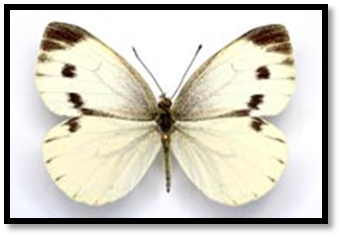 Distribution. Europe, Asia Minor and Central Asia, Uzbekistan, Kazakhstan, the Urals, Siberia, the Caucasus, China, Korea, Japan, Africa, America, Canada, Alaska [7].Biology. They produce 2 generations, in warm years, and 3 (the third is often incomplete). Adult ones can be found on the cruciferous plants and legumes, besides geraniums and dandelions. Fodder plants: Cruciferous - various species of the genus Brassica (for example, rapeseed (Brassica napus)), core (Cardamine), yellowcresses (Rorippa), tower mustard (Turritis), Arabia, garlic (Alliaria), horseradish (Armoracia), rockcress (Arabis), bittercress (Barbarea), tansymustards (Descurainia), Draba, yellowcone (Erysium), peppercress (Lepidium), radish (Raphanus), Sisymbrium, pennycress (Thlaspi) and others [10]. Female butterflies lay eggs on leaves and stalks of the forage plant, each egg is separate from the others. The caterpillars leave the eggs after 4 to 6 days. The egg is yellowish, bottle-shaped, with 14 ribs. They winter in the pupal stage.
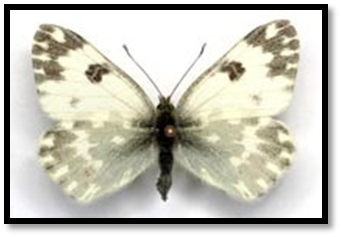 9. Pontia daplidice L. Republic of Karakalpakstan: Ellikal'a - Buston. 41°50'14.11" Northern latitude. 60°53'25.77"" Eastern longitude. Lower-Amudarya State Biosphere Reservation 42°0'2.19" Northern latitude. 60°26'11.34" Eastern longitude, 08.08.2013, 03.09.2009. 05.09.2010. 45 species were analyzed.Distribution. The Northern part of the European part of Russia, Central and Central Asia, Iran, Africa [7].Biology. The caterpillar is bluish-green, with several light green longitudinal stripes and yellow circles. Stage pupa passes on the stems and leaves. Caterpillars hatch in late summer, but begin to feed in early spring. The forage plants are various crucifers. Eggs are laid individually by the caterpillars fodder plants. For the year two to three generations develop. The flying period of butterflies occur from the end of May to the end of October. They winter in the pupal stage.
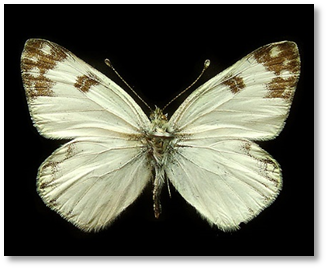 10. Pontia edusa Fabr. of the Republic of Karakalpakstan: Ellikkala-Buston: 41°50'14.11" Northern latitude. 60°53'25.77"" Eastern longitude. Lower-Amudarya State Biosphere Reservation 42° 0'2.19" Northern latitude. 60°26'11.34" Eastern longitude., 05.09.2012. 7 species were analyzed.Distribution. Europe, North Africa and Asia, the Caucasus, Transcaucasia, Ukraine and the south of the European part of Russia [8].Biology. Caterpillars are pale green in color with longitudinal white lines. Eggs are laid individually, on the leaves of forage plants of caterpillars. The caterpillars feed on various crucifers, such as: mustard (Sinapis), Sisymbrium. They feed on legumes, such as peas (Vicia), Chinas (Lathyrus) and clover (Trifolium), as well as Reseda [10]. Migrations of the species are observed. The flying period is observed from the end of April to November. They winter in the pupal stage.
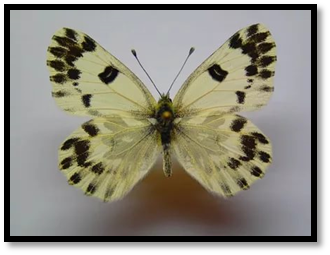 11. Pontia chloridice Hub. Khorezm region: Mangit. 42° 7'3.76" Northern latitude. 60° 5'23.28" Eastern longitude, 25.07.2013. One species was analyzed.Distribution. The southern part of the European part of Russia, Central and Central Asia, Iran [8].Biology. The caterpillars are bluish-green, with several light green longitudinal stripes and yellow circles. Stage pupa passes on the stems and leaves. Caterpillars hatch in late summer, but begin to feed in early spring. The forage plants are various crucifers. Eggs are laid individually by the caterpillars fodder plants. For the year two to three generations develop. Their flying period occurs from the end of May to the end of October.
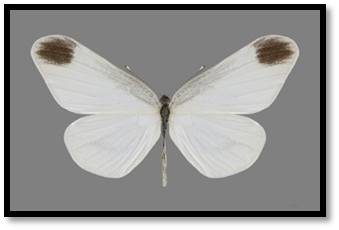 12. Leptidea amurensis Ménét. Sites: Khorezm region: Karamazi. 41°31'10.34" Northern latitude. 60°44'31.91" Eastern longitude, 22.07.2014. One species was analyzedDistribution. Japan, Central Asia [8].Biology. The front wing of the male is on top with a darker spot at the top. Butterflies of spring generation, the background of the back wing is grayish-ocher from below, in individuals of the summer generation, the background of the back wing is white. Front wing length is 21-27 mm. their flying period is the beginning of May - the beginning of August (in two generations). Caterpillar forage plant: various legumes (Hedysarum, Vicia) [10].
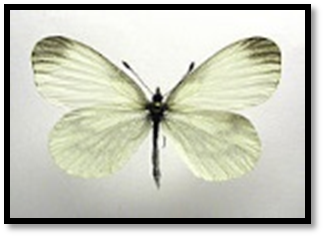 13. Leptidea sinapis L. Sites: Khorezm region: Khonkaobod. 41°29'38.90" Northern latitude, 60°52'25.80" Eastern longitude, 13.05.2016. One species was analyzed.Distribution. Albania, Austria, Belgium, Hungary, Germany, Greece, Spain, Italy, Crete, Latvia, Lithuania, Luxembourg, the Netherlands, Norway, Poland, Portugal, the European part of Turkey, France, Switzerland, Sweden, Estonia and Russia [8].Biology. The Dotty white gives 2 generations: from May to mid-June and from mid-July to August. Sometimes there is a third generation. Caterpillar - 2 generations: from August to September and February or September and June. Fodder plants Legumes - Chinas (Lathyrus), peas (Vicia), Coronilla, Lotus, in particular L. Cornicularis, Alfalfa (Medicago), Clover (Trifolum), for example, T. Arvense, as well as Astragalus [10]. The egg is cylindrical, with longitudinal ribs, very long. Coloring is yellow-white or light green. They winter in the pupa stage.
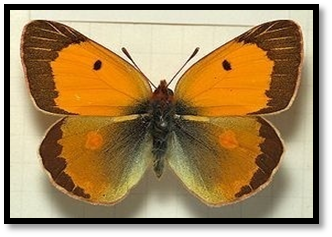 14. Colias croceus Geof in Four. Sites: Khorezm region: Khonkaobod. 41°29'38.90 " Northern latitude, 60 ° 52'25.80" Eastern longitude, Mangit: 42°7'3.76 "Northern latitude, 60°5'23.28" Eastern longitude 07.21.2009, 07.25.2013, 13.05.2016. 14 species were analyzed.Distribution. Africa, Asia, Europe, Belarus, Ukraine, Moldova, the Caucasus, Kazakhstan, Turkmenistan, Uzbekistan, Turkey, Africa, Iran [7].Biology. The first generation, a migrant, flies from late May to late June. The second generation of Saffron Yellow flies from late July to early August, there is the third generation in October, but rarely. Fodder plants are Trifolium, Medicago, Onobrychis, Lotus, Coronilla, Melilotus, Hippocrepis, Astragalus and other representatives of Fabaceae. Pupae are green, with yellow stripes on the sides. They winter in the pupae or caterpillars stage.
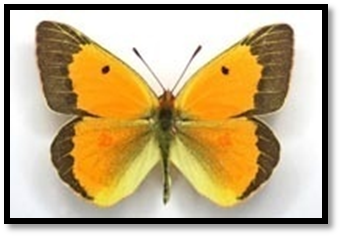 15. Colias chrysotheme Esp. Sites: Khorezm region: Navoi: 41°19'53.10" Northern latitude. 60°54'10.43" Eastern longitude, 07.12.2009. Sayilkhon Mirob: 41°38'41.55" Northern latitude, 60°19'18.82" Eastern longitude, 07.09.2010. Khitay village 41°17'50.11" Northern latitude. 60°54'48.74" Eastern longitude, 06.30.2010. Miskin 41°21'9.29" Northern latitude. 61°21'48.19" Eastern longitude. 05.21.2016. 14 species were analyzed.Distribution. Europe, Austria, Hungary, Africa, Asia, Uzbekistan [8].Biology. Their productive period is May and August (2 generations - for example, in Northern Uzbekistan). Caterpillars are in youth - dirty green, slightly pubescent. The head is blackish. After the first molt it becomes noticeably pubescent, light green, with a clear white line on the sides. After the second molt, they become yellow-green. The adult caterpillar (after the fourth molt) is juicy-green with short hairs, white spiracles; a white stripe passes around them, within which a thin dashed red line is noticeable. The caterpillar Colias chrysotheme feeds at night. Fodder plants Vicia, Astragalus, for example, A. Aksaicus - Astragalus Aksai [10]. The pupa is greenish-yellow, with a dark dotted line on the wing buds. The egg is cylindrical, greenish-white. They winter in the caterpillars stage.
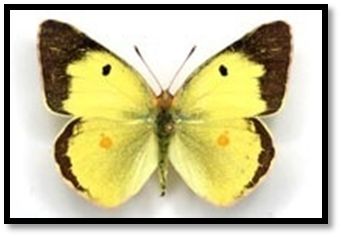 16. Colias erate Esp. Sites: Khorezm region: Karamazi 41°31'10.34" Northern latitude. 60°44'31.91" Eastern longitude, 07.21.2009. Astana 41°24'13.44" Northern latitude 60°42'2.20" Eastern longitude, 08.19.2009, 08.13.2010. Guliston 41° 55'14.38" Northern latitude, 60°10'33.65" Eastern longitude, 06 06.2010, 07.06.2012. 202 species were analyzed.Distribution. Austria, Bulgaria, Czech Republic, Turkey, Greece, Hungary, Poland, Romania, Russia, Slovakia, Ukraine, Yugoslavia, Uzbekistan, the Caucasus, Kazakhstan, Afghanistan, Somalia, Sakhalin, Japan, Altai, Iran, Mongolia [7].Biology. Caterpillar is green with light dots and short dark hairs, with a lateral longitudinal red line. The main fodder plant is alfalfa (Medicago), but also feeds on licorice (Melilotus), Astragalus, and other legumes [10]. Pupae are lilac-green. They develop 3 - 4 generations. The flying period of butterflies is observed from late April to mid-November. The female lays eggs by the piece on the upper side of the leaves, on the soil or on the litter. They winter in the pupae or caterpillars stage.
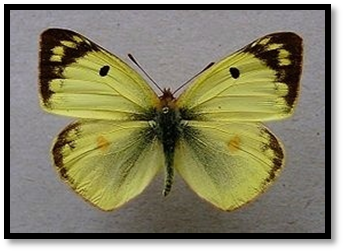 17. Colias hyale L. Sites: Khorezm region: Karamazi 41°31'10.34" Northern latitude, 60°44'31.91" Eastern longitude, 07.22.2010. Astana 41°24'13.44" Northern latitude, 60°42'2.20" Eastern longitude, 08.19.2015. Guliston 41°55'14.38" Northern latitude, 60°10'33.65" Eastern longitude, 06.06.2010. Sayilkhon Mirob 41°38'41.55" Northern latitude, 60° 19'18.82" Eastern longitude, 07.09.2011. 306 species were analyzed.Distribution. Turkey, China, Mongolia, Finland, Sweden, Europe, Belarus, Ukraine, Moldova, the Caucasus, Kazakhstan, Asia, Uzbekistan, Russia, Siberia [7].Biology. They develop 2 generations: the middle and even the beginning of May - June, the middle of July - October. In favorable years, the third generation is incomplete. Fodder plants: sweet clover (Melilotus), M. officinalis, alfalfa (Medicago), clover (Trifolium), lash (Coronilla), Vicia, Lotus and other legumes [10]. Pupae are greenish or greyish, with a yellow lateral stripe. On the rudiments of wings there are six dark points. They winter in the caterpillar stage.
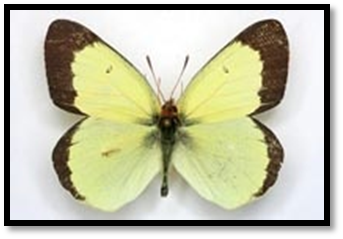 18. Colias palaeno L. Sites: Republic of Karakalpakstan: Lower-Amudarya State Biosphere Reserve 42°0'2.19" Northern latitude, 60°26'11.34" Eastern longitude, 7.07.2009, 5.07.2012. Tallik thicket 41°57'9.95" Northern latitude, 60°29'3.28" Eastern longitude, 06.20.2011. 06.25.2015. 10 species were analyzed.Distribution. Europe, Scandinavia, Finland, Siberia, Sakhalin, Japan, Central Asia and Uzbekistan [8].Biology. Their productive period is from June to July or from July to August. Fodder plants: blueberry (Vaccinium uliginosum), lingonberry (V. vitisidaea) [10]. The pupa is greenish-yellow, with a highly raised back and darker wing buds. The pupal stage lasts from one to three weeks (usually about 15 days). They winter in the caterpillar stage.
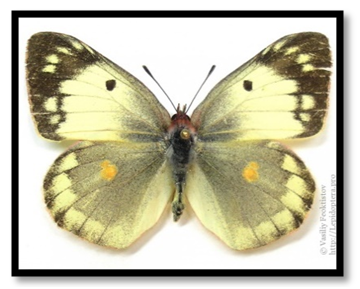 19. Colias myrmidone Esp. Sites: Khorezm region: Khonkaobod 41°29'38.90" Northern latitude. 60°52'25.80" Eastern longitude. 30.07.2009. Uzbekistan 41°21'2.67" Northern latitude. 60°56'13.66" Eastern longitude, 03.08. 2009, 10.08.2010. The Republic of Karakalpakstan: Lower-Amudarya State Biosphere Reserve 42°0'2.19" Northern latitude. 60°26'11.34" Eastern longitude, 1.09.2010, 05.09.2014. Tallik thicket 41°57'9.95" Northern latitude, 60°29'3.28" Eastern longitude. 06.25.2016, 50 species were analyzed.Distribution. Central and Eastern Europe, North-West Kazakhstan, Russia, the Caucasus, Ukraine, Poland, Hungary, Moldova, Belarus, Austria, Bavaria, the Urals, Uzbekistan [8].Biology. It gives 2 generations: from May to June and from July to October. Caterpillars are light green or yellowish in color with dark longitudinal stripes. They feed on the leaves and stalks of the Russian broom, which is Cytisus. The pupa is green, with a yellowish lateral stripe and sparse dark dots on the abdomen. There is a dolly of jaundice on large-sized herbs. The adult caterpillar or pupa winters.
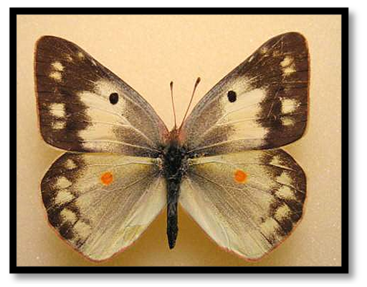 20. Colias eurytheme Bois. Sites: Khorezm region: Tuyamuyin 41°11'59.60" Northern latitude, 61°24'7.29" Eastern longitude, 08.15.2013. One species was analyzed.Distribution. Central Asia, the Caucasus, North America, Canada [8].Biology. Its biology has not been fully studied. They develop in 1 generation. Flying period of butterflies is observed in August.
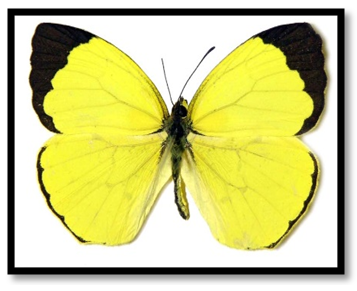 21. Eurema xantochlora Koll. Sites: Khorezm region: Tuyamuyin 41°11'59.60" Northern latitude. 61°24'7.29" Eastern longitude, 08.15.2010. One species was analyzed.Distribution. South and Central America, Africa, Asia and Australia.Biology. Their biology has not been fully studied. Flying period of butterflies is observed in August.
4. Conclusions
- The fauna of the white butterflies of the unique Khorezm oasis is very diverse. It is represented by 21 species, representing 46% of the total diversity of this family in Uzbekistan. Moreover, these are not yet final listings.The variety of trophic relationships in the white butterflies is extremely scanty. The largest number of butterflies was recorded for cruciferous plants - (47.6%), legumes - (33.3%), heather - (4.8%), pink - (4.8%) and species with unidentified trophic linkage (9.5%).All species of white caterpillars of the Khorezm oasis develop exclusively on cruciferous plants, being mostly oligophages (80%), the species abundance of polyphages is represented by 3 species (26%). Monophages are especially poor in composition - 1 species (11%).