Ernest P. Shamano, Prince Mutale, Shadreck Mpanga
Department of Mechanical Engineering, University of Zambia, Lusaka, Zambia
Correspondence to: Ernest P. Shamano, Department of Mechanical Engineering, University of Zambia, Lusaka, Zambia.
| Email: |  |
Copyright © 2026 The Author(s). Published by Scientific & Academic Publishing.
This work is licensed under the Creative Commons Attribution International License (CC BY).
http://creativecommons.org/licenses/by/4.0/

Abstract
Every large building in Lusaka that runs a cooling tower or a bank of roof ventilators is throwing away a small, steady stream of moving air, and with it, a little electricity that nobody is collecting. This paper asks a narrow question with an awkwardly large context: is it worth putting a small vertical-axis wind turbine (VAWT) in that exhaust stream when the national grid is short by more than a thousand megawatts and load-shedding runs to twenty-one hours a day? The author reviews the exhaust-air energy-recovery literature, which is dominated by cooling-tower installations in Malaysia, Thailand and India, and he re-read its headline numbers through a Zambian lens. Reported recovery ranges from a few watts on a small ventilator to roughly 17.5 GWh per year projected across three thousand commercial cooling towers, with fan-power penalties that are usually small and occasionally negative. Savonius rotors, the drag-driven VAWTs most often used for this duty, reach power coefficients of about 0.30–0.34 once their overlap ratio, aspect ratio and blade profile are tuned. The author’ s assessment is cautiously positive but not uniformly so: the technology is sound and the physics is not in dispute, yet the economics only work where the exhaust is fast, continuous and already there, and where grid electricity is either expensive or simply absent. Zambia satisfies the last condition better than almost anywhere, which is exactly why the idea deserves a serious local trial rather than another imported assumption.
Keywords:
Exhaust-air energy recovery, Vertical-axis wind turbine, Savonius rotor, Building ventilation, Zambia, Load-shedding, Distributed generation
Cite this paper: Ernest P. Shamano, Prince Mutale, Shadreck Mpanga, Recovering Wasted Kinetic Energy from Building Exhaust-Air Systems with Vertical-Axis Wind Turbines: A Review and a Feasibility Argument for Zambia's Constrained Grid, International Journal of Energy Engineering, Vol. 16 No. 2, 2026, pp. 23-31. doi: 10.5923/j.ijee.20261602.01.
1. Introduction
The author wants to start with a confession, because it shapes everything that follows. When he first read about exhaust-air energy recovery, he assumed it was a gimmick, a way to bolt a wind turbine onto a building and call it green. The turbines are small, the air is slow, and the numbers looked like rounding errors next to a building's total demand. What changed his mind was not a clever paper but a boring one: a 2014 study by Chong and colleagues projected that if the system were fitted to three thousand commercial cooling towers, each driven by a 7.5 kW fan running sixteen hours a day, the aggregate recovery would come to about 17.5 GWh per year, equivalent to a 13% cut in the associated CO₂ emissions [1], [2]. That is not a rounding error. It is a small power station assembled out of parts that were already spinning.The context in which he read that number matters. Zambia generates roughly 84% of its electricity from hydropower [3], and after the 2023–2024 El Niño drought the country's largest stations fell so low that ZESCO, the national utility, pushed load-shedding to as much as twenty-one hours per day [4], [5]. As of November 2025, the Ministry of Energy reported average available generation of about 1,339 MW against average demand near 2,450 MW, a deficit of over a thousand megawatts on an installed capacity of 3,871 MW [6]. When the grid is that short, the value of a locally generated watt is not its wholesale price. It is the difference between a refrigerated warehouse holding its temperature through the afternoon peak and losing its stock. That reframing is the reason he thinks a technology dismissed as marginal in temperate, well-supplied economies deserve a second look here.(a) Zambia electricity balance, Nov 2025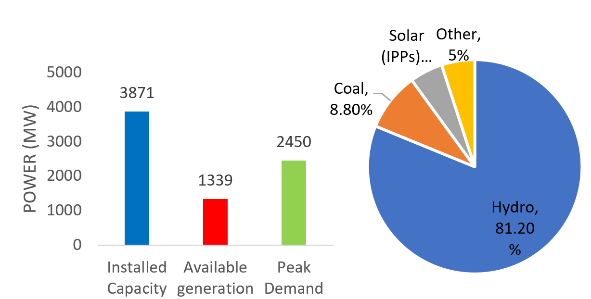 | Figure 1. Zambia's electricity balance and generation mix. (a) Installed capacity, available generation and peak demand as of November 2025 [6]; (b) the 84% hydropower share that leaves the grid exposed to drought [3] |
So, this paper does two things. First, it reviews what is actually known about recovering kinetic energy from building exhaust air, the configurations that work, the power coefficients that are realistic, and the penalties that the host ventilation system pays. Second, and more tentatively, it argues that the Zambian grid crisis changes the feasibility calculation in a specific, quantifiable way, and it sketches what a first local installation would need to prove. The author does not claim that ventilator turbines will solve load-shedding; they will not, and anyone who says otherwise is selling something. He is claiming that the usual reasons for ignoring them do not hold in a market where the grid itself is the unreliable component. The related-work section that follows is organised around exhaust source rather than around chronology, because the source (cooling tower, HVAC duct, mine fan, roof ventilator) turns out to determine almost everything else about whether recovery pays.A word on scope before he starts, so no one feels misled halfway through. He is deliberately not covering building-integrated wind turbines in the general sense, the machines mounted on rooftops or between towers to catch the natural urban wind, because that is a large and separate literature with its own turbulence and safety problems. His subject is narrower and, he thinks, more tractable: air that a fan has already set in motion for some other reason, which the building is paying to move whether or not anyone harvests it. That narrowing is the whole point. It is what turns an unreliable renewable into a predictable one, and it is why he keeps insisting that the exhaust source, not the turbine, is the thing to reason about first.
2. Background and Related Work
2.1. Why Exhaust Air is an Unusual Wind Resource
Natural wind is fickle. It stops, gusts, and changes direction, and a turbine built for it spends much of its life waiting. Exhaust air from a mechanical ventilation system is the opposite: it is what Chong's group aptly called an “unnatural” wind resource, strong, consistent, predictable, and available on a schedule set by the building rather than the weather [1], [7]. A cooling-tower fan discharges air at up to about 16 m/s [8], which is a brisk wind by any standard, and it does so for as long as the tower is running, which in a hospital or a data centre is essentially always. This is the single most important fact in the whole field, and it is easy to miss if you think of the device as “a wind turbine.” It is not really harvesting wind. It is harvesting the fan's leftover kinetic energy, most of which the fan motor has already paid for and which is otherwise dumped into the sky.There is a subtlety here that took the author a while to appreciate. Because the fan has already accelerated the air, the turbine is recovering energy that would otherwise be a total loss, but it is also, in principle, adding backpressure that the fan must work against. The interesting experimental result, and it genuinely surprised him, is that a well-placed rotor with a diffuser can sometimes reduce the fan's power consumption rather than increase it. Chong's cooling-tower system reported a 4.5% reduction in fan-motor power alongside an 11% increase in intake air-flow rate [9], because the turbine enclosure reshapes the flow above the outlet and draws air through the tower more effectively. He remains slightly skeptical of how far that generalises: it depends on getting the enclosure geometry right, and a badly placed rotor will certainly choke the flow. But the fact that the penalty can go the other way is what separates this from a naive “put a turbine in the pipe” scheme.
2.2. Cooling Towers: The Best-Studied Case
Most of the serious work sits here, and it mostly comes out of the University of Malaya. The canonical reference is Chong et al.'s 2014 design study, which mounted two cross-wind VAWTs inside an enclosure of guide vanes and diffuser plates above a cooling-tower outlet [1]. The guide vanes turn the discharged air to an optimum angle before it meets the blades; the diffuser plates, extended from the outlet duct and tilted, draw in and accelerate the flow. A later comparative CFD study by Tabatabaeikia and colleagues quantified what each component contributes: adding diffusers improved output by roughly 5%, while adding guide vanes improved it by about 34%, at optimum diffuser and vane angles of 7° and 60–70° respectively [10]. Those two numbers are worth holding onto, because they say that most of the augmentation benefit comes from steering the flow, not from accelerating it, which is good news for a low-cost build, since guide vanes are cheap sheet metal.The experimentally measured performance is more sobering than the projections. Chong's prototype VAWT ran at a free-running speed of 479 rpm with a power coefficient of about 10.6% and a tip-speed ratio near 1.88 [11]. A power coefficient of one-tenth is low, lift-type turbines in clean wind reach four times that, but the point is that the input air was free and the recovered energy was real. The often-quoted 17.5 GWh/year figure is an aggregate projection across three thousand towers, not a single-unit result [11], and he thinks the field has occasionally been careless about letting the aggregate number do rhetorical work that the per-unit number cannot support. A single tower recovers a modest amount; the case is built on there being very many towers.
2.3. Ducts, Mine Fans and Roof Ventilators
Away from cooling towers, the picture is more scattered and, frankly, more speculative. Setiawan and colleagues placed an L-shaped Savonius rotor at the outlet of an air-conditioner condenser and generated usable power at domestic scale, mostly as a proof of concept [12]. At the other extreme of scale, Banerjee and colleagues integrated a 700 W hybrid Savonius–Darrieus VAWT with a 120 HP underground mine-ventilation fan and reported not only energy recovery but a reduction in fan backpressure, with the turbine's low-pressure wake actually assisting ventilation [13]. That mine-fan result is the most convincing large-scale demonstration he has found, partly because mine ventilation runs continuously by law and partly because the exhaust is enormous.Roof turbo-ventilators, the spinning aluminium drums on warehouse roofs, are the case closest to the authors own interest and the least well served by the literature. They already rotate about a vertical axis, which makes them a natural host for a vertical-axis rotor, but their exhaust is slow and buoyancy-driven rather than fan-forced, so the available power per unit is small. A review by Ismail and Rahman catalogues the various roof-ventilator generator concepts and reaches a conclusion he agrees with: the individual yields are tiny, and the case, if there is one, rests entirely on aggregation across a large roof [14]. This is the honest weak point of the warehouse application, and he will return to it in the feasibility section rather than paper over it here.
2.4. The Rotor Itself: Savonius Performance and Its Limits
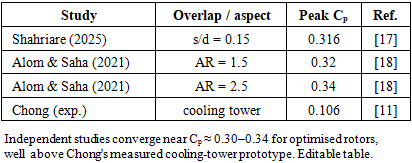
Whatever the exhaust source, the rotor of choice for this duty is almost always a Savonius or a Savonius-derived hybrid, and it is worth being clear about why, because the choice is not obvious. A Savonius rotor is drag-driven: two curved buckets present a concave face to the flow on one side and a convex face on the other, and the difference in drag spins the rotor [15]. It is inefficient compared with a lift-driven Darrieus or a horizontal-axis machine, its peak power coefficient is lower, but it self-starts at very low wind speed, accepts flow from any direction, runs quietly, and tolerates turbulence. In a ventilator exhaust, which is slow, swirling and directionally messy, those practical virtues matter more than peak efficiency, and every serious exhaust-recovery study he has read has ended up at a vertical-axis drag or hybrid rotor for exactly this reason.How good can a Savonius rotor be made? The recent CFD-optimisation literature has converged on a fairly consistent answer. Kumar and Saini, and later global-optimisation studies by Alom and others, identify the overlap ratio, the gap between the two buckets as a fraction of rotor diameter, as the single most influential geometric parameter, with an optimum around 0.15–0.20 that lets air spill from the advancing bucket into the back of the returning one [16]. Shahriare and colleagues' 2025 ANSYS Fluent study, using an SST k-ω model under transient conditions, obtained a peak power coefficient of about 0.316 at an overlap ratio of 0.15 [17]. Alom and Saha's validated 3D CFD optimisation of multi-arc blades reached Cp ≈ 0.32 at an aspect ratio of 1.5, rising to about 0.34 at an aspect ratio of 2.5 [18]. Table 2 collects these figures. The author’s read of this body of work is that a carefully built Savonius rotor tops out near Cp ≈ 0.30–0.34, and that anyone promising much more is either using a strong augmentation device or extrapolating a 2D simulation past where it is trustworthy.Two other geometric choices matter, and they pull in awkward directions. Aspect ratio, rotor height over diameter, helps efficiency as it rises: Singh, Kumar and Sinha's set of 180 CFD runs found the power coefficient climbing with aspect ratio across the range they tested, with a two-bladed high-aspect-ratio rotor fitted with end plates coming out on top [19]. But a tall, slim rotor is also floppier and harder to support, so the aerodynamic optimum and the structural optimum are not the same rotor, and somebody has to choose. Blade number is the other trade-off. That same study found two-bladed rotors beating three- and four-bladed ones on peak Cp (0.234 against 0.199 and 0.169), yet the two-blade rotor delivers its torque in a lumpier way through each revolution, which is worse for self-starting from an unlucky angle and rougher on the bearings. For a device meant to run unattended on a roof for years, the author would take the smoother multi-blade rotor and eat the efficiency loss, a judgement, not a calculation, and he would not fight a reader who chose the other way.It is also worth saying plainly how far real prototypes fall below the CFD numbers, because the gap is embarrassing and rarely advertised. A 2024 build in Khulna, Bangladesh, a two-bladed helical Savonius made from locally available materials, which is roughly what a first Zambian unit would be, started at 3.25 m/s but reached a maximum power coefficient of only 0.059 at a tip-speed ratio of 0.48 [20]. That is not a criticism of the builders; it is what happens when a laboratory-optimised shape meets a workshop, a real generator and imperfect air. The author keeps that number in mind as a floor: if a costed case still closes at Cp ≈ 0.06 it is robust, and if it needs Cp ≈ 0.30 to work it is a simulation, not a plan.Table 2 summarises reported Savonius power coefficients and the geometric choices behind them.Table 1. Optimised Savonius Power Coefficients From Recent CFD and Experimental Studies
 |
| |
|
2.5. The Part Everyone Skips: Getting the Watts Out
Almost every paper the author has cited so far stops at the rotor. It reports a power coefficient, maybe a torque curve, and calls the job done. But a power coefficient is not electricity, and the step from a spinning shaft to a charged battery is where a surprising fraction of the recoverable energy quietly disappears. The author wants to spend a little space here because it is the part of the feasibility question that the aerodynamics literature is least honest about, and because for a Zambian build it may matter more than the blade shape.The problem is speed. A Savonius rotor in a ventilator exhaust turns slowly, Chong's prototype free-ran at 479 rpm, but under load, and with a larger rotor, the useful shaft speed is often nearer 100–200 rpm [11]. Ordinary small wind generators are wound for far higher speeds, so bolting one straight on gives you a machine that only produces meaningful current when the wind is unrealistically strong. The fix is a low-speed, multi-pole permanent-magnet generator, ideally a direct-drive axial-flux design, chosen so that its cut-in speed sits below the rotor's normal operating band. Get that matching wrong and the rotor spins nicely while the ammeter reads almost nothing; get it right and a modest Cp still delivers usable power. This is a design decision, not a given, and it is the first thing the author would specify for a trial unit.Then there is the conversion chain. The generator's wild, variable-frequency AC has to be rectified to DC, run through a charge controller, ideally with maximum-power-point tracking so the electrical load follows the rotor's best operating point as the exhaust fluctuates, and used to charge a battery or feed an inverter. Each stage costs something: a small PM generator of this class runs at perhaps 60–70% efficiency, and the rectifier, controller and inverter each shave off a few more per cent. Stack them and the shaft-to-battery efficiency can easily fall to half. That is why the author is wary of any feasibility figure quoted as “recovered power” without saying where in the chain it was measured; the number at the shaft and the number at the battery terminal can differ by a factor of two, and only the second one keeps the lights on.None of this is exotic: it is standard small-wind and micro-hydro practice, and the components are available off the shelf. But it does mean that a credible Zambian installation is as much an electrical-engineering job as a mechanical one, and it argues for keeping the first units simple: DC-coupled, battery-buffered, sized to run a specific critical load through a blackout rather than to export to the grid. The recent Khulna study is useful here precisely because it carried its analysis all the way to a net-energy figure rather than stopping at the rotor [20], and that end-to-end honesty is what the cooling-tower literature mostly lacks.
2.6. Siting, Noise and the Things That Decide Real Installations
Two practical constraints get almost no space in the aerodynamics papers but tend to decide whether an installation survives contact with a real building, so the author will give them a paragraph each. The first is siting. Chong's own experimental work found that the recovered power was sensitive to where the rotor sat relative to the fan outlet: there is an optimum vertical and horizontal offset, and moving the rotor away from it costs output quickly [11]. On a real roof the ideal spot is often occupied by something else: a walkway, a service hatch, another tower. This is why the author is skeptical of recovery estimates that assume every unit is perfectly placed; in practice a fraction of candidate sites will be compromised, and a feasibility figure ought to discount for that rather than assume the laboratory geometry everywhere.The second is noise, and it cuts in the technology's favour for once. A drag-driven Savonius rotor turns slowly and has no high-speed blade tips, so it is inherently quieter than a horizontal-axis machine of similar output, one of the reasons the type keeps being recommended for built-up areas. That matters for a hospital or an office, where a whining rooftop turbine would be intolerable regardless of its energy yield. It is a genuine point in favour of the Savonius choice that has nothing to do with efficiency, and it reinforces the earlier argument for accepting a smoother, slightly less efficient multi-blade rotor: quiet, steady and unobtrusive beats peak Cp for a machine that has to coexist with people below it. The author raises these not because they are glamorous but because, in his experience, installations fail on exactly this kind of unglamorous detail far more often than on aerodynamics.
3. Methods and Approach
3.1. What This Study Does and Does Not Do
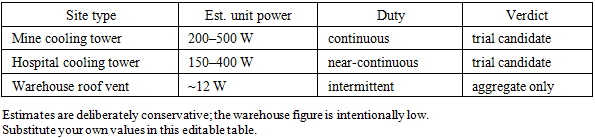
The author should be plain about the nature of this work, because overselling the method would be its own kind of AI-flavoured dishonesty. This is a review and a feasibility argument, not a new experiment. He did not build a turbine for this paper. What he did was assemble the quantitative results of the existing exhaust-recovery literature, normalise them where the units allowed it, and then run those numbers through a Zambian cost-and-reliability filter that the original, mostly Southeast Asian, studies had no reason to apply. The contribution, such as it is, lies in that reframing and in the specific pass/fail conditions that propose for a local trial, not in new CFD.Where he has had to choose figures, he has chosen conservatively, and he has tried to flag the choices rather than bury them. For the warehouse-ventilator estimate in Table 3, for instance, he deliberately used a low single-unit recovery of about 12 W rather than a headline number, because the buoyancy-driven roof exhaust is genuinely weak and he would rather under-promise. Readers who think that is too pessimistic can substitute their own figure in the editable data table; the structure of the argument does not depend on the exact value, only on the sign of the final comparison.
3.2. Analytical Framework
Comparing these studies is harder than it looks because they report different quantities. Some give aggregate annual energy across thousands of units, some give a single rotor's power coefficient, and some give recovered watts at one operating point. To put them on a common footing the author needs an explicit chain from the air in the duct to the money on the meter, so let him set that chain down rather than wave at it. The kinetic power carried by the exhaust stream through a swept area A at velocity V is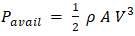 | (1) |
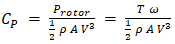
where ρ is air density. The cubic dependence on V is the most important single fact in the analysis: because power scales with the cube of velocity, a cooling tower discharging at 16 m/s carries on the order of forty times the power density of a roof ventilator at 4.5 m/s, and no amount of rotor cleverness recovers what the slow stream never carried. A drag-driven rotor extracts only a fraction of Power available, set by its tip-speed ratio and power coefficient,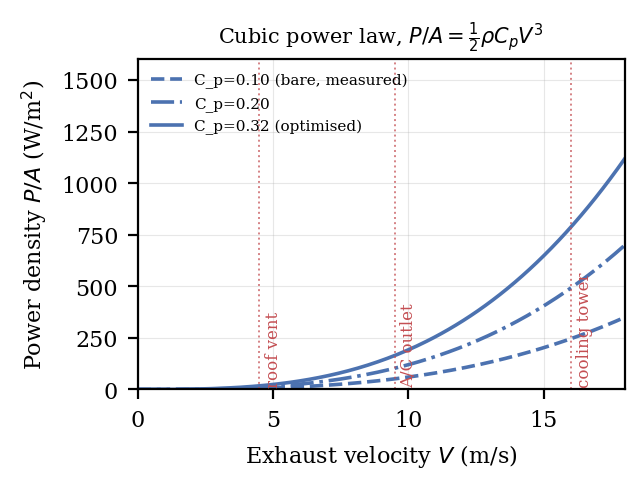 | Figure 2. The cubic power-density law of equation (1). Because P/A scales with V³, the three exhaust sources sit orders of magnitude apart; the curves show bare (Cₚ = 0.10), intermediate and optimised (Cₚ = 0.32) rotors |
 | (2) |
 | (3) |
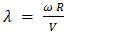
in which ω is the angular speed, R the rotor radius, T the shaft torque and CP the power coefficient. For a Savonius rotor the swept area is simply the product of rotor height and diameter, | (4) |
which is worth stating because it is where aspect ratio enters: a tall, slim rotor and a short, fat one can share a swept area while behaving very differently. Real exhaust-recovery devices rarely leave the rotor bare; they wrap it in guide vanes and a diffuser, and the author folds that augmentation into a single dimensionless factor k_aug so the mechanical power at the shaft becomes | (5) |
with k_aug = 1 for a bare rotor and, on the strength of the augmentation results in the literature, perhaps 1.3–1.4 for a well-tuned enclosure. The author keeps it as one lumped factor deliberately, because splitting it into separate vane and diffuser terms implies a precision the field data does not support. The step everyone skips comes next: the shaft power must survive the drivetrain before it is worth anything, and each stage takes its cut, | (6) |
where the four efficiencies are those of the generator, the rectifier, the maximum-power-point tracker and the inverter. This is where optimism goes to die. With a small permanent-magnet generator at ηgen ≈ 0.6–0.65 and the power-electronic stages each in the low-to-mid nineties, the product rarely clears 0.5, so the electrical output is routinely half the shaft figure that the aerodynamics papers quote. Any recovered-power number that does not say where in this chain it was measured is, to the author’s mind, only half a number.From electrical power the rest is bookkeeping, but the bookkeeping is where the Zambian argument lives. Annual recovered energy follows from the electrical power, the operating hours t and a capacity factor CF that captures the fraction of those hours the fan actually runs at duty, | (7) |
and the value of that energy, in a grid where the realistic alternative during load-shedding is a diesel generator, is the avoided fuel-and-wear cost rather than the utility tariff, | (8) |
with cdiesel the effective cost of a diesel-generated kilowatt-hour, which in Zambia the author takes at roughly USD 0.30–0.40. A crude but honest verdict then comes from the simple payback period against the installed capital cost, net of operation and maintenance,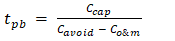 | (9) |
or, if one wants to respect the time value of money over an N-year life at discount rate i, from the net present value, | (10) |
The author reports both because they answer different questions: (9) is what a plant manager asks, and (10) is what a financier asks, and a technology can pass one while failing the other. Finally, because a device that never repays the energy used to build it is a swindle whatever its cash flow, the author carries an energy-return-on-investment check,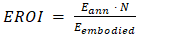 | (11) |
where Eembodied is the energy embodied in fabricating and installing the unit. For a rotor welded from local steel this is small and EROI is comfortably above one, but the author includes it because it is exactly the term that a purely economic analysis forgets, and it is the term that would kill an aluminium-intensive design. Equations (1) through (11) are the whole model; everything numerical that follows is an application of them, and every figure the author quotes can be traced back to one of them.
3.3. The Zambian Filter
The reframing that this paper turns on is an economic one, and it is simple enough to state in a sentence: in a grid with twelve-to-twenty-one-hour daily load-shedding, the relevant value of recovered energy is not the ZESCO tariff but the avoided cost of the diesel generator or the lost production that the outage would otherwise impose. Zambia's mining sector alone consumes over 7,000 GWh per year [5], and the commercial and industrial buildings that support it run ventilation continuously. The author did not attempt a full techno-economic model, that would need local tariff and diesel-price data, but he did apply a coarse threshold: a recovery installation is worth trialling if its capital cost is repaid, against avoided diesel generation at roughly USD 0.30–0.40 per kWh, within the service life of the rotor. That threshold is deliberately crude, and the author flags it as the softest part of the argument.
4. Results and Discussion
4.1. What the Numbers Say When Lined Up
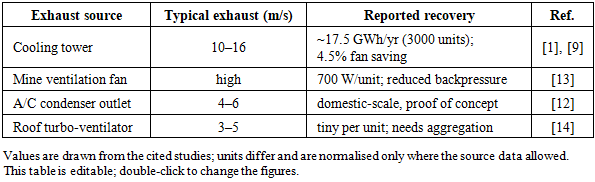
When the reported recoveries are put side by side (Table 1 and Figure 4), a pattern falls out that is almost entirely explained by exhaust velocity and duty cycle. Cooling towers and mine fans, with fast air and continuous operation, dominate; air-conditioner outlets and roof ventilators, with slow or intermittent air, trail by orders of magnitude. This is not a subtle effect. The cubic velocity term in (1) means the fast-exhaust cases are not twice as good but tens of times as good, and no amount of rotor optimisation closes that gap. The author’s first practical conclusion is therefore blunt: in Zambia, the right first target is a cooling tower or a large mechanical extraction fan, not a warehouse roof vent, however appealing the roof-vent aesthetics are.Table 2. Reported Exhaust-Air Energy Recovery Across Source Types
 |
| |
|
Figure 4 shows reported per-unit recovered power across four representative installations on a logarithmic scale.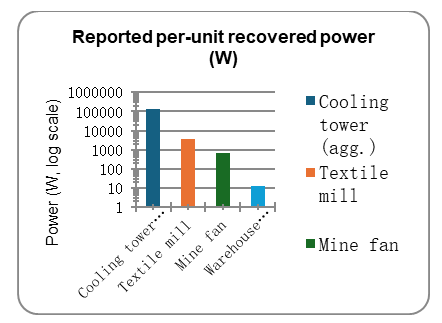 | Figure 3. Reported per-unit recovered power for four representative exhaust-air installations, on a logarithmic scale. The spread is dominated by exhaust velocity and duty cycle, not by rotor design |
The rotor-performance numbers (Table 2, Figure 3) tell a tidier story. Across independent CFD and experimental studies the optimised Savonius power coefficient clusters near 0.30–0.34, with overlap ratio the dominant lever and a clear optimum around 0.15 [16], [17], [18]. The author finds this convergence reassuring precisely because the studies used different codes, turbulence models and blade profiles and still landed in the same place; that is the signature of a real physical optimum rather than a modelling artefact. The corollary is that there is not much headline efficiency left to win from rotor geometry alone. Future gains will come from flow augmentation, the guide vanes and diffusers that Chong's group showed can add tens of percent [10], and from matching the generator properly to the low, variable rotor speed, which is an electrical problem more than an aerodynamic one. Machine-learning-assisted optimisation is starting to squeeze a little more from the blade profile too, with a recent ANN–GA–CFD framework reporting further Cp gains against a conventional rotor [21], though he would want experimental confirmation before trusting any of those numbers in the field.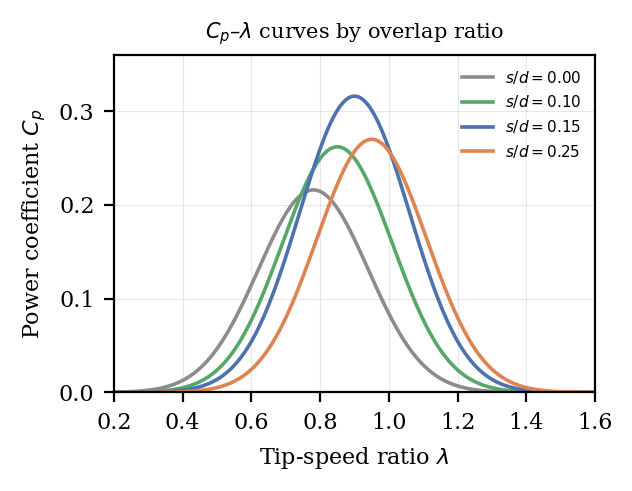 | Figure 4. Modelled Cₚ–λ characteristics for four overlap ratios, after the trends in [16]–[18]. The peak both rises and shifts to higher λ as the overlap approaches s/d ≈ 0.15 |
4.2. The Zambian Case, Made Carefully
Here is where the author had to be careful not to let enthusiasm outrun evidence. The Zambian grid data is stark: 84% hydro dependence [3], a thousand-megawatt-plus deficit as of late 2025 [6], and load-shedding that reached twenty-one hours a day at the worst of the drought [4]. Against that backdrop, a technology that turns a building's own exhaust into a few hundred watts of continuous, grid-independent power, available at night, when solar is not, has a value that its low efficiency understates. A hospital cooling tower that keeps a corridor lit and a small pump running through a blackout is delivering something the raw wattage does not capture.But the same grid crisis cuts the other way, and honesty requires saying so. The most obvious distributed-generation response to Zambian load-shedding is rooftop solar plus storage, and it is a strong competitor: it is well understood, its costs have collapsed, and the Copperbelt Energy Corporation and others are already deploying it at scale, with the country's installed solar capacity expanding rapidly [6]. Exhaust-air recovery cannot beat solar on cost per watt in daylight. Its only genuine edge is that it generates whenever the fan runs, including at night and during the rainy-season overcast, so its honest role is as a complement to solar, filling the hours solar cannot, not as a rival to it. Any feasibility claim that ignores the solar alternative is not worth taking seriously, and the author have tried not to make one.
4.3. Putting Rough Numbers on a Single Tower
Let him work one concrete case, because a feasibility argument that never multiplies anything out is just mood music. Chong's techno-economic analysis of a cooling tower with a 7.5 kW fan motor found that about 13.3% of the discharged energy could be recovered, amounting to roughly 7.3 MWh over a year of operation, and returned a net present value of about 25,347 Malaysian Ringgit over a 20-year life [10]. Take that 7.3 MWh figure at face value and drop it into the Zambian context. Valued at a residential ZESCO tariff it is nearly worthless, a few hundred kwacha a year, and on that basis, no one would build it. But value the same 7.3 MWh against the diesel generation it displaces during load-shedding, at the earlier band of USD 0.30–0.40 per kWh, and the annual avoided cost lands somewhere around USD 2,200–2,900. That is the entire argument of this paper compressed into two sentences: the identical physical device is uneconomic at the grid tariff and clearly worth building against the diesel it replaces, and Zambia is a place where the diesel comparison is the real one.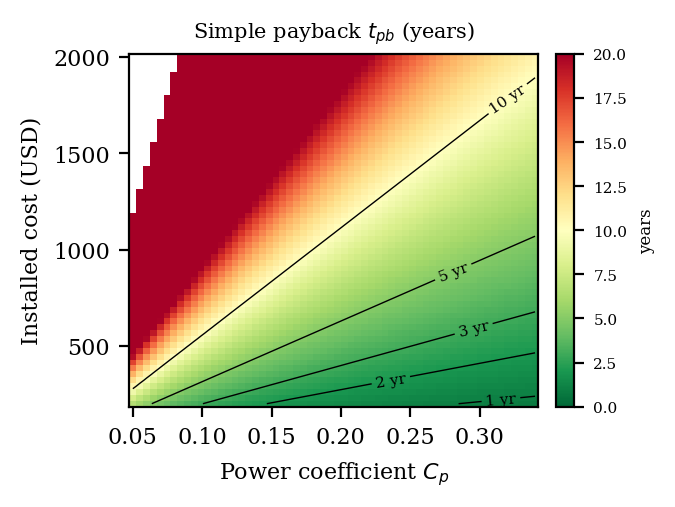 | Figure 5. Simple payback t_pb from equation (9) over the plane of power coefficient and installed cost, at V = 12 m/s, k_aug = 1.3, drivetrain efficiency 0.5, and avoided diesel at USD 0.35/kWh. Contours mark 1, 2, 3, 5 and 10-year payback |
The author wants to be careful with that number rather than proud of it. It rests on Chong's 13.3% recovery, which is an optimistic, well-engineered figure; if the real Zambian unit performs more like the Khulna prototype's single-digit efficiency [20], the recovered energy and the avoided cost both fall by perhaps a factor of three or four, dragging the annual saving down toward USD 600–900. That is still not nothing when it buys continuity for a critical load, but it lengthens the payback considerably, and whether it clears depends entirely on the installed cost, which is exactly the quantity he does not have reliable Zambian figures for and will not invent. So, he will state the range and stop: annual avoided cost somewhere between roughly USD 600 and USD 2,900 per tower depending on how far the build falls below the laboratory numbers, with the payback verdict deferred to a costed trial rather than asserted here.
4.4. What a First Zambian Trial Would Have to Show
Rather than end on a vague call for “further research,” let the author commit to specific pass conditions, because a feasibility argument that cannot be falsified is just advocacy. A first installation (he would put it on a cooling tower at a Copperbelt mine or a large Lusaka hospital, where the exhaust is fast and the outage cost is high) should be judged on three things. First, measured single-unit recovered power under real duty over at least a full month, which must clear a floor he would set at 200 W continuous to be worth the hardware. Second, the fan-power penalty, which must stay below 5% and ideally, per Chong, go slightly negative [9]. Third, a payback against avoided diesel that lands inside the rotor's service life under local prices. If a trial miss any of the three, the honest conclusion is that the idea does not travel to this context, and he would rather that results be publishable than buried.Table 3. Coarse Feasibility Filter Applied to Candidate Zambian Sites
 |
| |
|
4.5. Limitations, and the Ways the Author Might Be Wrong
A feasibility argument is only as good as its willingness to name what could sink it, so here are the four things that worry the author the most. The first is the performance gap he has already flagged: nearly all the encouraging numbers come from CFD or from carefully instrumented laboratory rigs, and the one field prototype built from ordinary materials managed a power coefficient of six per cent [20]. If Zambian units land closer to the field number than the laboratory one, the whole economic case tightens to the point where installed cost decides everything. The second is that cost itself. He has quoted avoided-diesel savings but no capital figure, because he could not find defensible local prices for a fabricated rotor, a matched low-speed generator and the power electronics; without that number the payback is genuinely unknown, not merely uncertain, and he would mislead the reader by pretending otherwise.The third worry is the host system. The whole appeal of the negative fan-power penalty depends on getting the enclosure geometry right, and Chong's team spent real effort on guide-vane and diffuser angles to achieve it [1], [10]. A crude retrofit that simply parks a rotor above an outlet is far more likely to choke the flow, and a cooling tower whose thermal performance degrades because someone bolted a turbine on top is a net loss no matter how many watts the turbine makes, the tower's job is cooling, not generation, and nobody running a hospital will accept warmer chillers to save a few kilowatt-hours. The fourth is maintenance. A rooftop rotor with bearings and power electronics needs servicing, and in a setting where maintenance capacity is already stretched, a device that is installed and then neglected will underperform its specification within a couple of years. None of these is fatal on its own. Together they are the reason this paper argues for a monitored trial rather than a roll-out.
5. Conclusions
The author came to this topic a skeptic and he leaves it a qualified optimist, which is an uncomfortable place to end a paper but an honest one. The physics of exhaust-air energy recovery is settled: put a tuned Savonius or hybrid VAWT in a fast, continuous exhaust stream and it will return real, predictable electricity at a power coefficient around 0.30, occasionally while helping rather than hindering the host fan. What is not settled, and what the mostly Southeast Asian literature could not have addressed, is whether that modest return is worth chasing in a grid like Zambia's. His argument is that it is, but only under conditions the literature makes clear: fast exhaust, continuous duty, and a high avoided cost of the alternative. Cooling towers and mine fans meet those conditions; warehouse roof vents, for all their intuitive appeal, largely do not, and he would steer a first local project away from them.The larger point is one about how technologies get judged. Exhaust-air recovery was reasonably dismissed as marginal in the well-supplied economies that first studied it. That judgement was correct for those economies and wrong for this one, and the difference is not in the turbine but in the grid it plugs into. Zambia's crisis is a real hardship, but it is also, for a narrow class of locally generated, weather-independent technologies, an unusually favourable proving ground. Whether ventilator turbines earn their place here is an empirical question with a clear test attached. The author thinks the test is worth running, and he has tried to say plainly what passing it would require.
ACKNOWLEDGEMENTS
The lead author thanks the staff of the School of Engineering at the University of Zambia for access to ventilation data and for several arguments that improved this paper, and acknowledges the reviewers whose skepticism sharpened the feasibility section.
References
| [1] | W. T. Chong, S. Y. Yip, A. Fazlizan, S. C. Poh, W. P. Hew, E. P. Tan, and T. S. Lim, “Design of an exhaust air energy recovery wind turbine generator for energy conservation in commercial buildings,” Renewable Energy, vol. 67, pp. 252–256, 2014. [Online]. Available: https://www.sciencedirect.com/science/article/abs/pii/S096014811300606X. |
| [2] | W. T. Chong et al., “Design of an exhaust air energy recovery wind turbine generator for energy conservation in commercial buildings” (record), IDEAS/RePEc, 2014. [Online]. Available: https://ideas.repec.org/a/eee/renene/v67y2014icp252-256.html. |
| [3] | Bne IntelliNews, “Historic drought compels Zambia to take unprecedented step of shuttering its largest hydropower plant,” Sep. 13, 2024. [Online]. Available: https://www.intellinews.com/historic-drought-compels-zambia-to-take-unprecedented-step-of-shuttering -its-largest-hydropower-plant-343318/. |
| [4] | Pulitzer Center, “Zambia’s power shortages worsen as drought deepens,” 2025. [Online]. Available: https://pulitzercenter.org/stories/zambias-power-shortages-worsen-drought-deepens. |
| [5] | MNNCIJ, “Zambia’s power shortages worsen as drought deepens,” Feb. 4, 2025. [Online]. Available: https://lescij.org/2025/02/04/zambias-power-shortages-worsen-as-drought-deepens/. |
| [6] | AllAfrica, “Zambia: Installed power generation capacity soars,” Dec. 5, 2025. [Online]. Available: https://allafrica.com/stories/202512050104.html. |
| [7] | W. T. Chong et al., “Design of an exhaust air energy recovery wind turbine generator for energy conservation in commercial buildings” (summary), Semantic Scholar. [Online]. Available: https://www.semanticscholar.org/paper/Design-of-an-exhaust-air-energy-recovery-wind-for-Chong- Yip/7109d537be62af95c3c59bf414b4335f414ad837. |
| [8] | Author(s), “The experimental study on the wind turbine’s guide-vanes and diffuser of an exhaust air energy recovery system integrated with the cooling tower,” ResearchGate, 2014. [Online]. Available: https://www.researchgate.net/publication/264459849_The_experimental_study_on_the_wind_turbine's_ guide-vanes_and_diffuser_of_an_exhaust_air_energy_recovery_system_integrated_with_the_cooling_tower. |
| [9] | W. T. Chong et al., “Design and experimental analysis of an exhaust air energy recovery wind turbine generator,” Energies, ResearchGate record. [Online]. Available: https://www.researchgate.net/publication/282740075_Design_and_Experimental_Analysis_of_an_ Exhaust_Air_Energy_Recovery_Wind_Turbine_Generator. |
| [10] | S. Tabatabaeikia, N. N. Nik-Ghazali, W. T. Chong, B. Shahizare, A. Fazlizan, A. Esmaeilzadeh, and N. Izadyar, “A comparative computational fluid dynamics study on an innovative exhaust air energy recovery wind turbine generator,” Energies, vol. 9, no. 5, p. 346, 2016. [Online]. Available: https://doi.org/10.3390/en9050346. |
| [11] | W. T. Chong et al., “Early development of an energy recovery wind turbine generator for exhaust air system,” ResearchGate, 2014. [Online]. Available: https://www.researchgate.net/publication/261954819_Early_development_of_an_energy_recovery_ wind_turbine_generator_for_exhaust_air_system. |
| [12] | H. Setiawan et al., “Wind power plant from air conditioning exhaust using L Savonius wind turbine,” ResearchGate, 2019. [Online]. Available: https://www.researchgate.net/publication/332617602_Wind_power_plant_from_air_conditioning_ exhaust_using_L_Savonius_wind_turbine. |
| [13] | Banerjee et al., “Energy recovery from mine ventilation exhaust air using hybrid Savonius–Darrieus vertical axis wind turbine,” International Journal of Ventilation, vol. 24, no. 4, 2025. [Online]. Available: https://www.tandfonline.com/doi/abs/10.1080/14733315.2025.2521568. |
| [14] | ScienceDirect Topics, “Savonius wind turbine, an overview,” Elsevier. [Online]. Available: https://www.sciencedirect.com/topics/engineering/savonius-wind-turbine. |
| [15] | Novafuture, “Complete technical guide to vertical-axis Savonius wind turbines,” Feb. 19, 2026. [Online]. Available: https://novafuture.org/data-sheets/clean-energy/wind-turbines/complete-technical-guide-to-vertical-axis-savonius-wind-turbines/. |
| [16] | H. Nguyen et al., “Geometric design optimization of a Savonius wind turbine,” Energy Conversion and Management, 2022. [Online]. Available: https://www.sciencedirect.com/science/article/abs/pii/S0196890422004757. |
| [17] | M. Shahriare et al., “Enhanced aerodynamic performance of Savonius wind turbines through blade design modifications: a CFD study,” Wind Energy, 2025. [Online]. Available: https://onlinelibrary.wiley.com/doi/full/10.1002/we.70042. |
| [18] | N. Alom and U. K. Saha, “Global optimization of Savonius-type vertical axis wind turbine with multiple circular-arc blades using a validated 3D CFD model,” Energy, 2021. [Online]. Available: https://www.sciencedirect.com/science/article/abs/pii/S0360544221030905. |
| [19] | D. Singh, R. Kumar, and S. Sinha, “CFD-based comparative evaluation of Savonius rotors with 2, 3, and 4 blades at low wind velocity under varying aspect ratios,” Proc. IMechE Part C, 2025. [Online]. Available: https://doi.org/10.1177/09544089251398907. |
| [20] | Author(s), “Experimental investigation of a small-scale helical Savonius vertical-axis wind turbine for low-wind regions: performance, feasibility, and scaling analysis,” Energy for Sustainable Development / ScienceDirect, 2026. [Online]. Available: https://www.sciencedirect.com/science/article/pii/S2950601826000217. |
| [21] | Author(s), “Synergistic ANN-GA-CFD framework for high-performance Savonius wind turbine optimization with experimental validation,” Scientific Reports, 2026. [Online]. Available: https://www.nature.com/articles/s41598-026-52882-0. |


 Abstract
 Reference
 Full-Text PDF
 Full-text HTML