D. Y. Dasin, N. Y. Godi, O. C. Kingsley
Department of Mechanical Engineering, Modibba Adama University of Technology, Yola, Nigeria
Correspondence to: D. Y. Dasin, Department of Mechanical Engineering, Modibba Adama University of Technology, Yola, Nigeria.
| Email: |  |
Copyright © 2015 Scientific & Academic Publishing. All Rights Reserved.
Abstract
A multipurpose passive solar food dryer which was indigenously designed in Yola-Nigeria and enhanced with a heat storage device was developed and its performance was evaluated using yam, tomatoes, pepper and fish. The performance evaluation results shows that it took 3 hours to dry 0.6kg of yam with moisture content of 58.3% wet basis in the solar dryer at a global solar radiation of 825 W/m2 while it took 8 hours to dry same mass of yam in open-air sun at the same global solar radiation. For tomatoes and pepper with moisture content of 93.3% wet basis and mass of 0.3kg, it took 2.5 hours to dry in the solar food dryer at a global solar radiation of 802 W/m2 while it took 6 hours to dry same mass in open-air sun at same solar radiation. For fish with moisture content of 68% wet basis, it took 10 hours to dry a mass of 0.25kg in the solar dryer at a global solar radiation of 532.8 W/m2 and 24 hours to dry same mass in the open-air sun at same global solar radiation. The thermal efficiency of the developed solar collector is 60% and the dryer efficiency for yam, tomatoes & pepper and fish are 33.0%, 19.3% and 6.6% respectively. The study revealed that the solar food dryer is therefore more efficient for drying of yams as against tomatoes, pepper and fish, and consumes less time when compared with open air sun drying.
Keywords:
Moisture Content, Solar Dryer, Storage Device, Solar Radiation, Absorbent Material
Cite this paper: D. Y. Dasin, N. Y. Godi, O. C. Kingsley, Experimental Investigations of the Performance of Passive Solar Food Dryer Tested in Yola – Nigeria, International Journal of Energy Engineering, Vol. 5 No. 1, 2015, pp. 9-15. doi: 10.5923/j.ijee.20150501.03.
1. Introduction
More and more people are recognizing the importance of food quality in their daily lives. The freshest, ripest, tastiest and most nutritious food comes from our own gardens or local farmers. But because these high quality fruits and vegetables are seasonal, you have access to them for only a few weeks or months each year.Solar food drying is more than a curiosity or hobby — it’s an ideal application for solar energy. Solar radiation passes through the clear glass top of a wooden dehydrator box, then the heat trapped by the box dries the food. The dryer with an absorber plate inside, which indirectly heats your food and creates a convection current of air that enters a vent at the bottom of the dryer. The cool, fresh air that enters the vent heats up, circulates through the dryer, and then exits through a vent at the top. As your food dries, moisture is carried away with the hot air.Open-air sun drying has been used since time immemorial to dry plants, seeds, fruits, meat, fish, wood and other agricultural or forest products as a means of preservation. However, this has some limitations among which are; high labour costs, large area requirement, lack of ability to control the drying process, possible degradation due to biochemical and micro-biological reactions, insect infestation and so on. Solar food dryer is a device that can be used to dry food effectively and efficiently with lesser time compared to open-air sun drying. In order to benefit from the free and environmentally friendly energy source provided by the sun, several attempts have been made in recent years to develop solar drying mainly for preserving agricultural and forest products [12]. [10], describes the design and performance of a solar fruit and vegetable dryer comprising of plastic covered plate collectors, drying chamber and thermally and acoustically insulated pipes joining the two. The experimental results suggest that, even under unfavourable full weather conditions, the unit is able to produce good quality products. However, due to the low investment required, the solar dryer is predestined for applications on small farms.[4], presented a technique for optimization of natural correction solar dryers. The optimal design was specified for the condition of Bangladesh. The optimum design was a relatively long collector, a thin grain bed and negligible chimney height. [13], carried out drying of bell-pepper using sun, solar and artificial air drying methods. The drying of bell-pepper was done in two drying rate periods, the constant drying rate period (mainly) and the following drying rate period was more pronounced in the artificial air drying method than in the other two drying methods and the drying process was also faster.[6] successfully developed and characterized a modified passive grain solar dryer using locally available material in Nigeria. The dryer can be enlarged for large-scale drying and commercial purposes by increasing the collector size and adding more number of trays. There is no need of carrying the crops inside during the nights in order to avoid rewetting since the dryer is sealed with glass and wood, to protect the samples from dew and rain.[11], has identified numerous types of solar dryers that have been designed and developed in various parts of the world, yielding varying degrees of technical performance. [5] designed and constructed a prototype solar dryer for mango slices, based on preliminary investigation under controlled conditions of drying experiments; a natural convection solar dryer was designed and constructed to dry mango slices. The results presented are as follows: a minimum of 16.8m2 solar collector area is required to dry a batch of 100kg sliced mango (195.2kg fresh mango at 51.22% pulp) in 20 hours (2 days drying period). The initial and final moisture content considered were 81.4% and 10% wet basis, respectively.[1], studied the drying tendency of parabolic concentrator dryer over improved sun drying. The drying temperature profile shows that parabolic concentrator was higher than sun drying profile.[3] developed a solar tunnel dryer with thermal storage for drying of copra. Experiments were carried out with and without the integration of heat storage materials. Sand was used as the heat storage material in the solar tunnel drier. The drier reduces the moisture content of copra from 52% (w.b) to 7.2% (w.b) in 52 hours and 78 hours respectively with and without heat storage material.In most advanced segments of the society, artificial drying has in many cases supplemented traditional sun drying in order to achieve better quality control, reduce spoilage, and in general cut down on losses. The indigenous dryer designed is more efficient as in drying as compare with the traditional dryer as revealed in the research.The design of a passive Solar Food indigenous dryer which is unique in type is different from other dryers and constructed from locally available plywood, locally source 4 mm glass, aluminium metal, hinges, stone gravels, net, nails and black paint. The passive dryer is to go a long way in alleviating the financial burden of possessing expensive dryers from the market by the low income earners in Yola-Nigeria and provide affordable, efficient and faster way of drying for the locals, thereby reducing food wastages among the market traders and village dwellers. The researchers are convinced that the Passive Solar Dryer will go into large scale production for indigenous use in Yola-Nigeria.
2. Data Analysis
2.1. Average Drying Rate for Drying the Product
The average drying rate in Kg/hr for drying the product was given by [8] as: | (1) |
Where:  mass of moisture content removed from the food,
  drying time (hrs).
2.2. Mass of Air Needed for Drying
The mass of air needed for drying was given by [8] as: | (2) |
Where:  average drying rate
 initial humidity ratio, kg H2O/kg dry air
  final humidity ratio, kg H2O/kg dry air.
2.3. Percentage of Moisture Content Present in Food
The percentage of moisture content present in the food was calculated as: | (3) |
2.4. Final or Equilibrium Relative Humidity
The final relative humidity or equilibrium relative humidity was calculated using sorption isotherms as follows: | (4) |

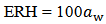 Where: ERH = equilibrium relative humidity
  water activity,
  final moisture content % wet basis
 moisture content dry basis, (Kg water/Kg solids)
2.5. Required Pressure
The pressure difference across the food bed will be solely due to density difference between the hot air inside the dryer and the ambient air. Air pressure can be determined by equation given by [9]: | (5) |
H is the pressure head (height of the hot air column from the base of the dryer to the point of air discharge from the dryer) in meters; P is the air pressure in Pascal and g is the acceleration due to gravity, 9.81m/s2;  is the ambient temperature, in ℃.
2.6. Average Drying Rate for Drying the Product
The average drying rate in Kg/hr for drying the product is given by [8] as: | (6) |
Where:  mass of moisture content removed from the food,
  drying time (hrs).
2.7. The Energy Balance
This is obtained by equating the overall heat energy received from the sun to the useful heat energy gained by the collector and the total heat energy lost by the solar collector. Therefore the total energy transmitted and absorbed is given by [2] as; | (7) |
Where: total solar radiation incident on the top surface (Wm–2);
  collector area (m2);α = solar absorptance of the absorber;τ = transmittance of the cover;
 useful energy gained by the collector (W);
 rate of conduction losses from the absorber (W);
 rate of convective losses from the absorber (W);
 rate of long wave re-radiation from the absorber (W);
 rate of reflection losses from the absorber (W).
 is considered negligible and the three heat loss terms,
  and
and  are usually combined into one term
 | (8) |
Therefore, we now have: | (9) |
 | (10) |
 is given as:
  | (11) |
Where: mass flow rate of air ( kg/s)
 specific heat capacity of air (KJKg-1K-1)∆T = change in temperature (K).Also
  is composed of different convection and radiation parts, and is presented in the following form accordingly:
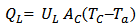 | (12) |
Where: overall heat transfer coefficient of the absorber (Wm–2K–1);
 temperature of the collector’s air (K)
 ambient air temperature. (K)Substituting equations (11) and (10) into equation (9) we have:
 | (13) |
But 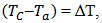 therefore substituting this into equation (7) we have:
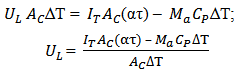 | (14) |
Substituting  into equation (6), therefore the total heat energy loss
  is given as:
 | (15) |
From Equations (9) and (11) the useful energy gained by the collector is expressed as: | (16) |
Therefore, the energy per unit area  of the collector is given as:
 | (17) |
2.8. Thermal Efficiency of the Collector
The collector heat removal factor Fr is the quality that relates the actual useful energy gained of a collector, Eqn. (5) to the useful energy gained by the air. Therefore the removal factor as given by [7] is: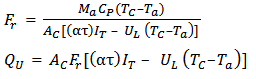 | (18) |
Where  the useful energy gained.Therefore the thermal efficiency of the collector is defined by [7] as:
 | (19) |
Where:  useful energy gained
  collector area and
  total solar radiation incident on the top surface.
2.9. Dryer Efficiency
The dryer efficiency was computed by [6] as: | (20) |
Where: M = mass of the food (Kg) L = latent heat of vapourization kJ/kgH2O.  The latent heat of vaporization is given by [14] as:
 | (21) |
Where:  product temperature.
3. Performance Testing of the Dryer
Testing was done in the month of April; the dryer was placed under the sun with the collector facing south for optimum performance. A K-type thermocouples and Kane-May (KM 330) digital temperature output instrument were used to measure the ambient temperature, the temperature of the collector, the drying chamber, and the items to be dried. Their size was such that caused less obstruction to heat and their accuracy was ± 0.1℃, when employed in conjunction with the digital temperature output meter Kane - May (KM330). Instantaneous global components of solar radiation were measured using pyranometer (CM6B model, KIPP & ZONEN DELFT Holland) and CM11/121 fitted with shadow ring measuring the instantaneous diffuse component of solar radiation. Both were calibrated as 9.63 × 10⁻⁶ V/WM-2. Temperature readings were recorded on hourly basis starting from 9:00AM – 4:00PM. The characterization of the solar food dryer was done using different kinds of food items; yam, tomatoes, and pepper and fish. The food items were sliced to aid quick drying and easy circulation of air within the drying chamber as shown in plates 1 – 8. The same quantity of the items dried in the solar food dryer were sun dried to allow for comparative analysis.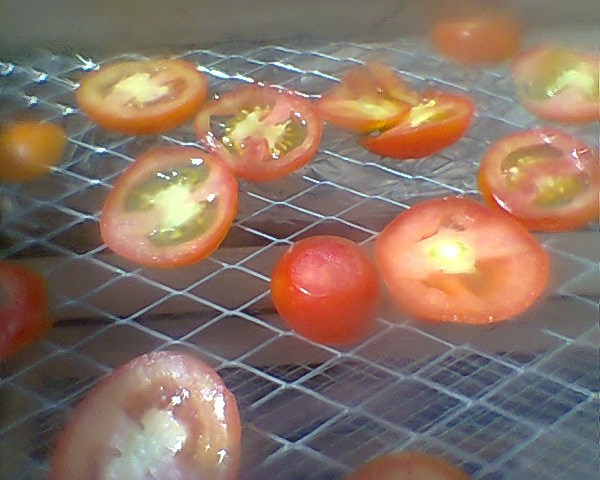 | Plate 1. Tomatoes before drying with solar dryer |
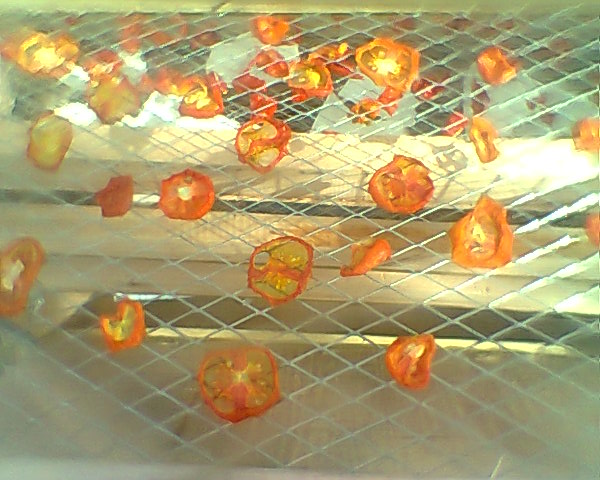 | Plate 2. Tomatoes after drying with solar dryer |
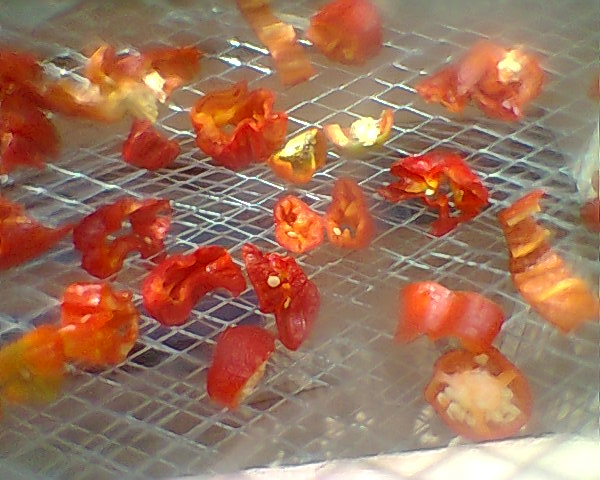 | Plate 3. Pepper before drying with solar dryer |
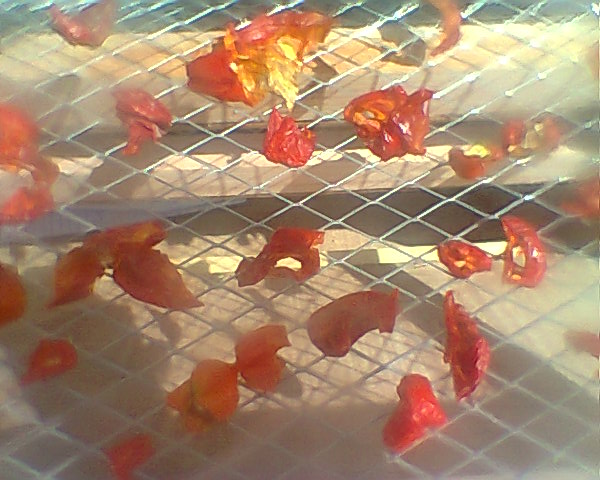 | Plate 4. Pepper after drying with solar dryer |
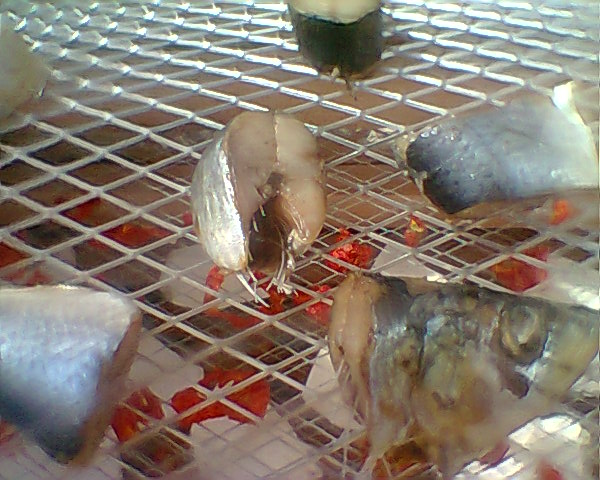 | Plate 5. Fish before drying with solar dryer |
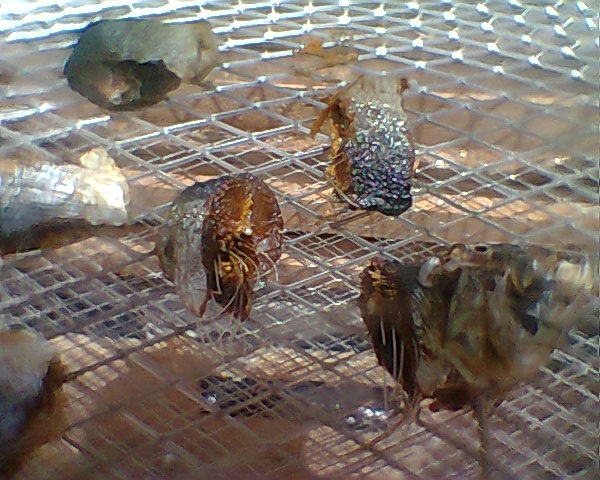 | Plate 6. Fish after drying with solar dryer |
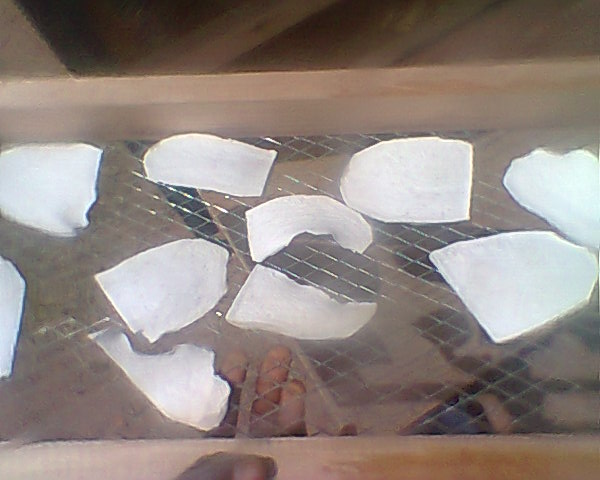 | Plate 7. Yam dried in solar food dryer |
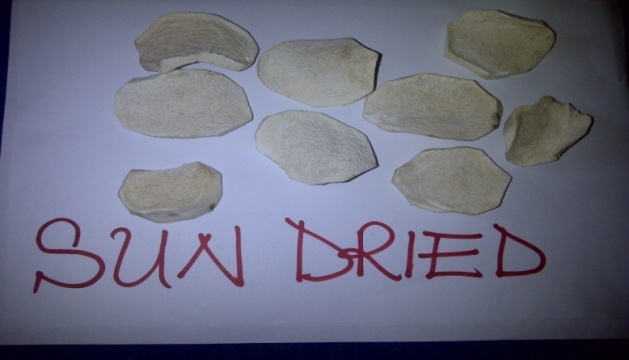 | Plate 8. Yam dried in open-air sun |
4. Discussions of the Results
The results obtained shows that the performance of the solar food dryer is dependent on the intensity of the solar radiation incident on the collector and the ambient temperature.Figure 1, was obtained for drying of yam at relative humidity of 42% and average global solar radiation of 773.8 W/m2 on 14/04/2014. The data analysis indicates that percentage moisture content present in the yam was 58.3% w.b. and the mass of moisture content removed was 0.35kg at an average drying rate of 0.12kg/hr. The efficiency of the dryer for drying of yam was determined to be 33.0%. From the figure it shows that, at 9:00AM when the ambient temperature was 29℃, the product temperature was 31℃, the collector temperature was 60℃ and the drying chamber temperature was 39℃. The temperatures increases with time and reaches its maximum value at 1:00PM when ambient temperature was 33℃, it then decreases with time and at 4:00PM when the ambient temperature was 27℃, the product temperature was 39℃, the collector temperature was 60℃ and the drying chamber temperature was 41℃. This indicates that the minimum values of temperatures for the product, collector and the drying chamber were obtained in the morning, while their maximum values were obtained at mid-day when insolation is high. 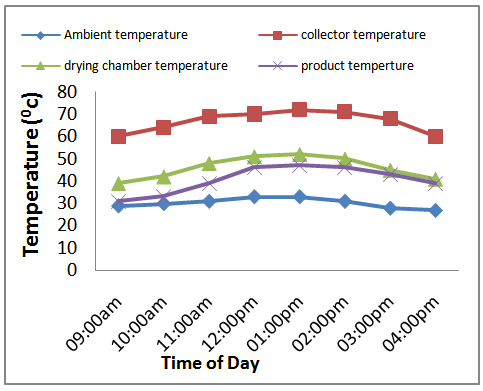 | Figure 1. Graph of temperature against time of the day for drying of yam on 14/04/2014 at relative humidity of 42% and solar radiation of 773.8 W/m2 |
Figure 2 was obtained for drying of yam at relative humidity of 39% and average global solar radiation of 825.0 W/m2 on 15/04/2014. This shows that the minimum ambient temperature was obtained at 9:00 A.M., minimum values of temperatures for the collector; product and drying chamber were also obtained at 9:00 A.M. The maximum ambient temperature and product temperature were obtained at 12:00PM and 1:00 P.M., while maximum temperature for the collector was obtained at 1:00 P.M. and that of the drying chamber was obtained at 2:00 P.M.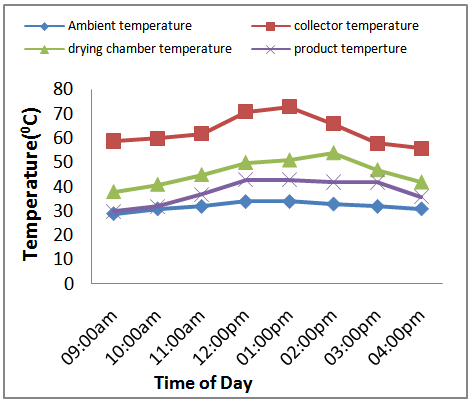 | Figure 2. Graph of temperature against time for drying of yam on 15/04/2014 at relative humidity of 39% and solar radiation of 825.0 W/m2 |
This shows that it took 3 hours to dry 0.6kg of yam with moisture content of 58.3% w.b in the solar food dryer while it took 8 hours to dry the same mass of yam in open-air sun, after drying the mass of the yam weighed 0.25kg. Also comparison done on the yam dried in the solar food dryer and the yam dried in open-air sun shows that yam dried in the solar dryer has a brighter colour than that dried in open-air sun shown in plates 7 & 8.Figure 3 is for drying of tomatoes & pepper on 16/04/2014 at relative humidity of 41% and average global solar radiation of 802.0 W/m2. From the numerical data obtained, it shows that the percentage moisture contentment present in the tomatoes and pepper was 93.3% w.b., the mass of moisture content removed from the tomatoes and pepper was 0.28kg at an average drying rate of 0.112kg/hr. The dryer efficiency for drying of this food item obtained was 19.3%. The figure shows that at 9:00AM when the ambient temperature was 29℃, the product temperature was 34℃, the collector temperature was 55℃ and the drying chamber temperature was 43℃. The temperatures increases with time and reaches maximum value at 12:00PM and 1:00PM when ambient temperature was 34℃. At 3:00PM when the ambient temperature was 28℃, there was a large decrease in the temperatures of the collector, product and drying chamber and at 4:00PM when the ambient temperature was 26℃, the product temperature was 29℃, the collector temperature was 36℃ and the drying chamber temperature was 29℃.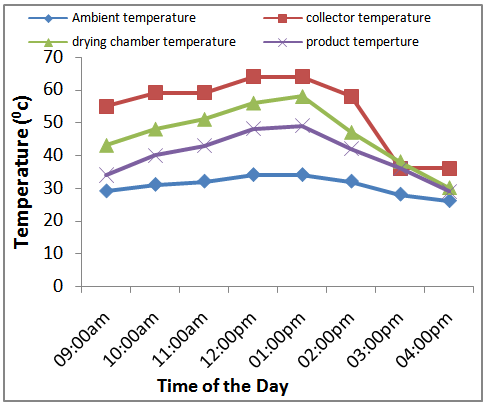 | Figure 3. Graph of temperature against time for drying of tomatoes & pepper on 16/04/2014 at relative humidity of 41% and solar radiation of 802.0 W/m2 |
From these results, it shows that minimum value of temperatures for the product, collector and the drying chamber were obtained in the evening, while their maximum values were obtained at mid-day when insolation is high. Figure 4 is for drying of tomatoes & pepper on 17/04/2014 at relative humidity of 63% and solar radiation of 503.6 W/m2. It shows that at 9:00 A.M. the ambient temperature was 23℃, while the product temperature was 25℃, the collector temperature was 33℃ and the drying chamber temperature was 29℃. The graph also shows that there was a significant increase in the temperatures of the collector, product and the drying chamber at 12:00 P.M. and 1:00 P.M. and at 4:00 P.M. the temperatures of the collector, product and the drying chamber decreases slightly.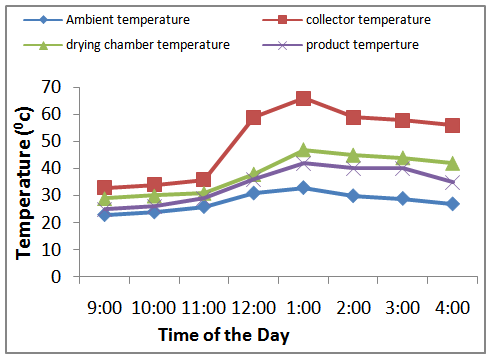 | Figure 4. Graph of temperature against time for drying of tomatoes & pepper on 17/04/2014 at relative humidity of 63% and solar radiation of 503.6 W/m2 |
The result obtained for the graph shows that minimum values of temperatures for the product, collector and the drying chamber were obtained in the morning, while there was a significant increase in temperature at mid-day.From the afore mentioned, it took 2.5 hours to dry a mass of 0.3kg of tomatoes & pepper with moisture content of 93.3% w.b, while it took 6 hours to dry same mass of tomatoes and pepper in open-air sun. After drying, the mass of the product obtained was 0.02kg.Figure 5 was obtained for drying of fish on 18/04/2014 at relative humidity of 49% and average global solar radiation of 532.8 W/m2. The data analysis indicates that percentage moisture content present in the fish was 68% w.b., the mass of moisture content removed from the food item was 0.17kg at an average drying rate of 0.017kg/hr. The efficiency of the dryer for drying of the fish was determined to be 6.6%. The figure shows that at 9:00 A.M. when the ambient temperature was 29℃, the product temperature was 31℃, the collector temperature was 60℃ and the drying chamber temperature was 39℃. The temperatures increases with time and reaches maximum value at 1:00 P.M. when ambient temperature was 33℃, it then decreases with time and at 4:00 P.M. the ambient temperature was 27℃, while the product temperature was 39℃, the collector temperature was 60℃ and the drying chamber temperature was 41℃. This then shows that minimum value of temperatures for the product, collector and the drying chamber were obtained in the morning, while their maximum values were obtained at mid-day when insolation is high. 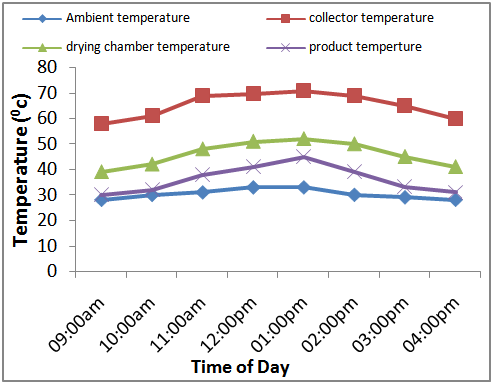 | Figure 5. Graph of temperature against time for drying of fish on 18/04/2014 at relative humidity of 49% and solar radiation of 532.8 W/m2 |
Figure 6 is for drying of fish on 19/04/2014 at relative humidity of 46% and average global solar radiation of 588.6 W/m2. It shows that the minimum ambient temperature was obtained at 9:00AM and 4:00 P.M., while minimum values of temperatures for the collector, product and drying chamber were obtained at 9:00 A.M. The maximum ambient temperature was obtained at 1:00PM and maximum product temperature obtained at 2:00 P.M., while maximum temperature for the collector was obtained at 1:00 P.M. and that of the drying chamber was also obtained at 1:00 P.M. The temperatures of the collector, product and drying chamber were shown to decrease at 4:00 P.M.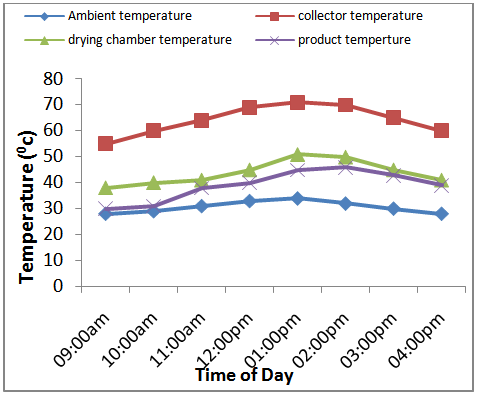 | Figure 6. Graph of temperature against time for drying of fish on 19/04/2014 at relative humidity of 46% and solar radiation of 588.6 W/m2 |
It took 10 hours to dry a mass of 0.25kg fish with moisture content of 68% w.b, while it took 24 hours to dry same mass of fish in the open-air sun. After drying the mass of fish obtained was 0.08kg.
5. Conclusions
From the results obtained, it can be deduced that the solar dryer is more efficient for drying of yam when compared with drying of tomatoes & pepper and fish. Also the performance of the solar dryer is dependent on the intensity of solar radiation incident on the collector surface and the ambient temperature. The solar food dryer performs effectively and drying time was considerably reduced when compared with open sun drying method.The thermal efficiency of the collector was determined to be 60% while the dryer efficiency for yam, tomatoes & pepper and fish are 33.0%, 19.3% and 6.6% respectively. The heat storage device can store the heat generated during sunshine hours and can effectively utilize the stored heat during off-sunshine hours.
References
| [1] | Adesina K.A., Komolaje and Badejo E.A. (2011): Studies on the drying tendency of parabolic concentrator dryer on vegetables, roots and tubers. Journal of emerging trends in engineering and applied sciences (JETEAS). Vol. 2(3): pp. 400-404. |
| [2] | Alamu O.J., Nwaokocha C.N., and Adunola O. (2010): Design and construction of a domestic passive solar food dryer. Leonardo journal of science. Vol. 1(1): pp. 71-82. |
| [3] | Ayyappan S. and Mayilsamy K. (2010): Solar tunnel dryer with thermal storage for drying of copra. Proceedings of the 37th national & 4th international conference on fluid mechanics and fluid power, India. Vol. 1(1): pp. 1-5. |
| [4] | Bala J., De-Jong K., Huang J., Vafaie H., and Wechsler H. (1995): Hybrid learning using genetic algorithms and decision trees for pattern classification. Proceedings of the International Joint Conference on Artificial Intelligence, Montreal, August. Pp. 719-724. |
| [5] | El-Amin Omda and Mohammed A. (2010): Design and construction of a solar dryer for mango slices. University of Khartoum, Sudan. Vol. 1(1): pp. 1-7. |
| [6] | Ezekoye B.A and Enebe O.M. (2006): Development and performance evaluation of modified integrated passive solar grain dryer. The Pacific Journal of Science and Technology. Vol. (2): pp. 185-190. |
| [7] | Itodo N., Obetta E. And Satimehin A. (2002): Evaluation of a solar crop dryer for rural applications in Nigeria. Botswana Journal of Technology. Vol. 11(2): pp. 58-62. |
| [8] | Jilte and Datye (2011): Design and performance analysis of solar dryer for banana slices using scheffller dish and its comparison with electrical food dryer. Institute of petroleum technology Gandhinagar, Gujarat India. Pp. 1-12. |
| [9] | Jindal V. K. and Gunasekaran S. (1982): Estimating air flow and drying rate due to natural convection in solar rice dryers. Renewable Energy Review. Vol. 4(2): pp. 1-9. |
| [10] | Sharma K., Colangelo A, and Spagna G. (1993): Experimental performance of an indirect type solar fruit and vegetable dryer. Energy Conversion and Management. Vol.34 (4): pp.293-308. |
| [11] | Sopian K, Fudholi A, Ruslan H, Algoul A, Sulaiman Y. (2009): Review of solar dryers for agricultural and marine products. Renewable and Sustainable Energy Reviews: Available online: http://www.sciencedirect.com. Accessed on 30th of May 2013. |
| [12] | Taylor and Francis (2006): Handbook of industrial drying. E-book accessed on the 30th of May 2013. |
| [13] | Tunde-Akintunde Y., Afolabi J., and Akintunde O. (2005): Influence of drying methods on drying of bell-pepper (Capsicum annuum). Journal of Food Engineering. Vol. 68 (4): pp. 439-442. |
| [14] | Youcef-Ali S., Messaoudi H., desmons J. Y., Abene A., and Le Ray M. (2001): Determination of the average coefficient of internal moisture transfer during the drying of a thin bed of potato slices. Journal of food engineering. Vol. 48(2): pp. 95-101. |

 Abstract
 Reference
 Full-Text PDF
 Full-text HTML