
-
Paper Information
- Paper Submission
-
Journal Information
- About This Journal
- Editorial Board
- Current Issue
- Archive
- Author Guidelines
- Contact Us
International Journal of Electromagnetics and Applications
p-ISSN: 2168-5037 e-ISSN: 2168-5045
2025; 14(1): 1-5
doi:10.5923/j.ijea.20251401.01
Received: Nov. 2, 2025; Accepted: Nov. 28, 2025; Published: Dec. 3, 2025

Magnetic Field Influence on Diamagnetic Susceptibility and Polarisability of a Donor Impurity in GaAs Cylindrical Quantum Dot
 Abstract
 Reference
 Full-Text PDF
 Full-text HTML
Ali Mmadi1, Malik El’houyoun Ahamadi1, Izeddine Zorkani2, Anouar Jorio2, Sanae Janati Edrissi2, Khalid Rahmani3
1Semiconductor Nanomaterials Physics Group. Laboratory of Energy and Applied Mechanics (LEMA), Faculty of Sciences and Technology, University of Comoros, Moroni-Comoros
2Groupe NanoER, L. P. S, Faculty of Sciences Dhar Mehraz, Fès-Morocco
3LIRST, Faculty Polydisciplinary, Béni Mellal –Morocco
Correspondence to: Ali Mmadi, Semiconductor Nanomaterials Physics Group. Laboratory of Energy and Applied Mechanics (LEMA), Faculty of Sciences and Technology, University of Comoros, Moroni-Comoros.
| Email: |  |
Copyright © 2025 The Author(s). Published by Scientific & Academic Publishing.
This work is licensed under the Creative Commons Attribution International License (CC BY).
http://creativecommons.org/licenses/by/4.0/

The polarizability and the diamagnetic susceptibility of a donor impurity in the cylindrical quantum dot are investigated by using a trial wave function in the framework of the effective mass approximation and infinite barrier potential. The theoretical calculations present the polarizability αP and the diamagnetic susceptibility dia as a function of the CQD radius R and the magnetic field intensity for several values of the CQD length L. Our results showed that the polarizability diminishes while the diamagnetic susceptibility increases as the applied magnetic field increases, especially for large Cylindrical Quantum Dot width. The polarizability αP and the diamagnetic susceptibility dia decrease when the length L increase.
Keywords: Cylindrical Quantum dot, Impurity donor, Polarizability, Diamagnetic susceptibility, Magnetic field
Cite this paper: Ali Mmadi, Malik El’houyoun Ahamadi, Izeddine Zorkani, Anouar Jorio, Sanae Janati Edrissi, Khalid Rahmani, Magnetic Field Influence on Diamagnetic Susceptibility and Polarisability of a Donor Impurity in GaAs Cylindrical Quantum Dot, International Journal of Electromagnetics and Applications, Vol. 14 No. 1, 2025, pp. 1-5. doi: 10.5923/j.ijea.20251401.01.
Article Outline
1. Introduction
- In the last few years, advances in crystal-growth techniques for the fabrication of quantum dot (QD) structure such as molecular-beam epitaxy (MBE) and chemical vapour deposition (MOCVD) have been reported [1-5]. Theoretical and experimental studies have been done on electronic and optical properties and impurity levels in structures such as quantum wells (QWs), quantum well wires and quantum dots [6-8]. The quantum dot systems GaAs/GaAlAs, GaN/AlGaN and InAs/GaAs are investigated in the present time [9-11]. Understand the electronic and optical properties of shallow impurities in CQD are important because these properties are strongly affected by the presence of impurities. With the developments of spintronics, several authors have studied the magnetic field induced metal–insulator transition [12-13]. El Ghazi et al studied the impurity binding energy of lowest-excited state in (In,Ga) -GaN spherical QD under electric field effect [14]. Sari et al [15] have studied the impurity-related optical response in cylindrical quantum dots with a δ-doped axial potential under an intense laser field. Akankan et al [16] have reported the spatial electric field effect on the self-polarization in GaAs/AlAs square quantum-well wires. It is found that impurity ground-state energy and self-polarization depend strongly on the axial component of the spatial electric field and on the coordinates of the impurity position. Zounoubi et al [17] have reported the magnetic fields effect on the polarizability of a shallow donor impurity placed of a cylindrical quantum dot (CQD). It found that the polarizability decreases as the dot radius R decreases and then increases as the radius becomes smaller. El Messaoudi et al [18] have studied the finite-barrier height effect on the polarizability of a shallow magneto-donor in a Quantum Box. They result see that for a higher and larger box, the effects of the magnetic field on the polarizability are predominant and the polarizability decrease with decreasing size of the box. Semiconductor–metal transition through diamagnetic susceptibility of a donor in a GaAs–(Ga,Al)As quantum well for both infinite and finite barrier models has been investigated by Nithiananthi et al [19]. They have also computed the diamagnetic susceptibility of a hydrogenic donor impurity in the low dimensional semiconducting systems like quantum well, quantum well wire and quantum dot. Several properties of the donors such as the polarizability and diamagnetic susceptibility are yet to be obtained [20-21]. The magnetic field effects on the diamagnetic susceptibility and binding energy of a magneto–donor in inhomogeneous quantum dot and in cylindrical quantum dot CQD have been investigated by Mmadi et al [22-23]. In the recently paper, Polaizability and diamagnetic susceptibility in the valley orbit split states in an intense field [24-25]. It’s found that for intense magnetic fields, the polarizability values decrease as the system behaves like a harmonic oscillator. In an electric field, the magnitude of the diamagnetic susceptibility values increases. Kaplana et al [26] worked the Impurity states and the diamagnetic susceptibility of a donor in a GaAs/AlxGa1–x As triangular quantum well under hydrostatic pressure, The results show that the diamagnetic susceptibility (χdia) of a hydrogenic donor abruptly increases at a particular pressure for 1s and 2p± states but a steady increase for 2s state as a function of applied pressure. Their results show that the diamagnetic susceptibility increases with the magnetic field and it is more important especial for larger quantum dot. Iqraoun et al [27] reported the binding energy, polarizability and diamagnetic response of shallow donor impurity in zinc blende GaN quantum dots. It’s found that for low field strength, the binding energy is always a growing function of the radius, and for large field strengths, such physical quantity grows with the radius up to a maximum and then decreases. Nevertheless, to the best of our knowledge, there is no study on the effect of a magnetic field on the polarizability and the diamagnetic susceptibility of a donor in Cylindrical Quantum Dot (CQD). In the present work, we investigate the calculation of the polarizability and the diamagnetic susceptibility of a donor impurity placed at the center of a CQD, with infinite barriers, as a function of the quantum sizes and for various values of the magnetic field. The organization of this paper is as follows: In Section 2, we present the basic theory; we deduce the expression of the polarizability and the diamagnetic susceptibility in the presence of a uniform magnetic field. The numerical results and discussions are reported in Section 3 with the application to a CQD made out of GaAs.
2. Hamiltonian and Basic theory
- An Let us consider an impurity donor located in the center of a cylindrical Quantum dot, with radius R and length L. within the effective mass approximation the interaction of an electron with a donor impurity confined CQD, In the presence of a magnetic field B and electrical field F applied along the z direction is described bay Hamiltonian:
 | (1) |
 and z are the electron coordinates:
  | (2) |
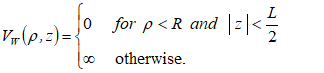 | (3) |
 and energies in the effective Rydberg
 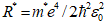 .
.  is a dimensionless measure of the electric field. We can write the Hamiltonian of the impurity in cylindrical coordinates as:
 | (4) |
 is a dimensionless measure of the magnetic field and
  the effective cyclotron frequency. Since the Schrödinger equation cannot be solved exactly, we follow the Hass variational method. The trial wave function for the calculation of the ground state energy of the system with the impurity is chosen as:
 | (5) |
 is a variational parameter (which takes into account the presence of the weak electric field) and
  is the wave function in the absence of electric field
  given by:
 | (6) |
 is its first zero, a and b are variational parameters and N0 is the normalization constant.
2.1. Donor Polarizability
- The polarizability of the donor confined in the CQD is defined in terms of the dipole moment by [20]
 | (7) |
 that minimizes the energy expression is calculated and substituted in Eq (3)
2.2. Diamagnetic Susceptibility
- The diamagnetic susceptibility of the donor impurity in CQD, in atomic unit (a.u), is given by [28]:
 | (8) |
 is the mean square distance of the electrons from the nucleus. Thus, the corresponding energy is obtained by minimization with respect to the variational parameters a and b. The ground state donor binding energy is given by:
  | (9) |
3. Numerical Results and Discussions
- We have calculated the polarizability and the diamagnetic susceptibility of a shallow donor placed at the center of a Cylindrical Quantum Dot (CQD). We use this model to CQD’s made out of GaAs surrounded by Ga1−xAlxAs. In the present study we have used R*=5.8meV, a*=98.7Ao and ε0=12,5. Our results for polarizability and diamagnetic susceptibility are obtained for a very small intensity of electric field (η=0,01). We begin with the plot of the binding energy as a function of the radius of the dot for tow values of length (L=1a* and L=3a*) and tow intensity values of a magnetic field (γ = 0 and γ =3) in Fig.1.
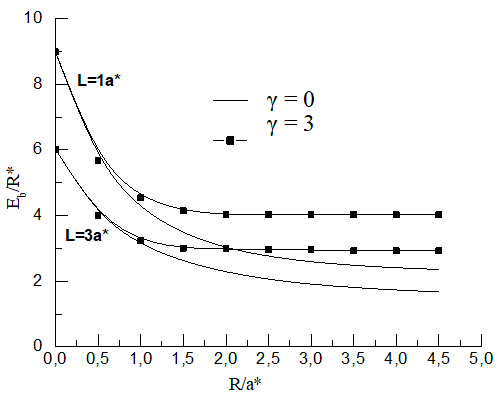 | Figure 1. The variation of the binding energy of a donor as function of the CQD radius for two values of the length (L=1a* and L=3a*) and two magnetic field values (γ=0 and γ=3) |
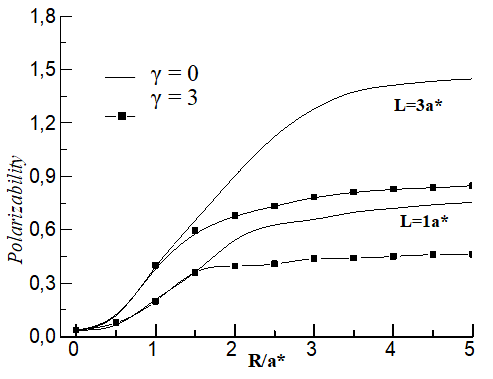 | Figure 2. The variation of the polarizability of the donor as a function of the dot radius for two magnetic field (γ=0 and γ=3) and two values of the length L=1a* and L=3a* |
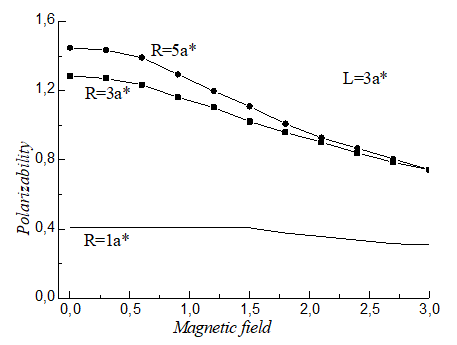 | Figure 3. Variation of the polarizability αP function of magnetic field γ for three values radius (R=1a*, R=3a* and R=5a*) with L=3a* |
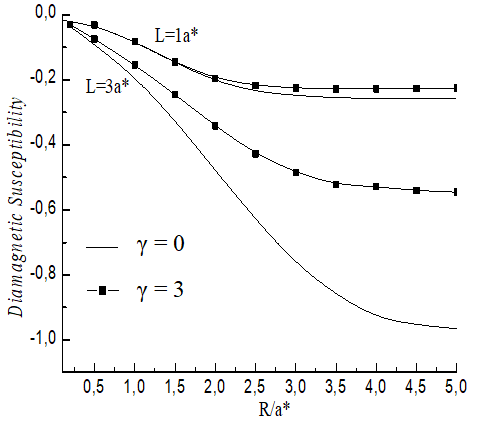 | Figure 4. The variation of the diamagnetic susceptibility as function of the CQD radius for two values of the length (L=1a* and L=3a*) and two magnetic field values (γ=0 and γ=3) |
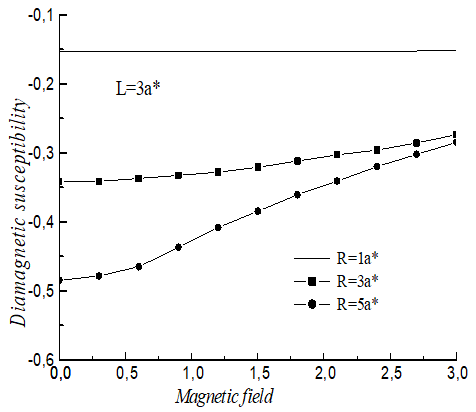 | Figure 5. Variation of the diamagnetic susceptibility χdia function of magnetic field for three values radius (R=1a*, R=3a* and R=5a*) with L=3a* |
4. Conclusions
- In this study, we have presented the magnetic field influence on the polarizability and on the diamagnetic susceptibility of a shallow donor in a GaAs Cylindrical Quantum Dot (CQD). The magnetic field effect is appreciable especially for large CQD width is. The polarizability and the diamagnetic susceptibility depend strongly on the geometrical confinement. The effects of the electron–phonon interactions on the polarizability and diamagnetic susceptibility of a magneto-donor in CQD are in progress.
ACKNOWLEDGEMENTS
- Izeddine Zorkani, and Ali Mmadi would like to thank the Abdus Salam International Centre for Theoretical Physics.