International Journal of Ecosystem

p-ISSN: 2165-8889    e-ISSN: 2165-8919

2015;  5(2): 66-74

doi:10.5923/j.ije.20150502.04

Particular Qualities of Forming of Reefs and Coral Communities in the North and Central Vietnam

Yu. Ya. Latypov

A.V. Zhirmunsky Institute of Marine Biology FEB RAS, Vladivostok, Russia

Correspondence to: Yu. Ya. Latypov, A.V. Zhirmunsky Institute of Marine Biology FEB RAS, Vladivostok, Russia.

Email:

Copyright © 2015 Scientific & Academic Publishing. All Rights Reserved.

Abstract

This article deals with the history and repeated studies of reef and coral communities of the Gulf of Tonkin and Central Vietnam of a quarter of a century ago and now, based on published and unpublished materials. The state of affairs in the study reef-building scleractinian corals and reefs of this region is represented. Revealed high riches scleractinian includes 191 species. We researched species composition the degree of substrate coverage by hermatypic and soft corals. Clear vertical zonation identified in the change of the various communities in macrobenthos. The dominance of massive Porites on almost all reefs of this region is due to their ability to survive in stressful for many corals. They predominate over other scleractinian for the productivity of organic matter, the degree of substrate coverage and species diversity. They also constitute the reef skeleton, play a significant role of the expansion of its area in the muddy bottom оexhibit high similarity in coral species composition to other regions of Vietnam, and form a single complex of species of the equatorial Indo-Pacific.

Keywords: Gulf of Thailand, Central Vietnam, Reefs, Reef-building corals, Species composition

Cite this paper: Yu. Ya. Latypov, Particular Qualities of Forming of Reefs and Coral Communities in the North and Central Vietnam, International Journal of Ecosystem, Vol. 5 No. 2, 2015, pp. 66-74. doi: 10.5923/j.ije.20150502.04.

1. Introduction

The Gulf of Tonkin, called Вас Во by the Vietnamese, cuts deep into the continent. In the west, it borders on the eastern Indo-Chinese coast; in the east, it borders on the western coast of Lai Chau Peninsula and Hai Nam Island. The shallowness of the gulf and peculiarities of its bottom relief are of special importance. The depths of the gulf and adjacent parts of the South China Sea do not exceed 100 m. The northern part of the gulf is a shallow-water area confined with a 50-m isobaths in the south. The western coast of the gulf borders on a wide water strip with a depth below 50 m.
The bottom of the gulf is plain and is covered with soft ground dominated by silts and silty sands with shell fragments and organogenous matter. The central groove of the bottom, confined with 50- to 60-m isobaths, is covered with silty and clayey ground. Due to the shallowness of the gulf, the water is rapidly warmed up to 29-32°C in summer and cooled to 16°C in winter [1, 2]. A huge continental runoff occurring via numerous rivers flowing into the gulf plays an important role in its hydrological regime. Thus, the Red River alone brings into the gulf as much as 137 billion m3 of fresh water and 116 million tons of suspended matter every year [3]. The river waters desalinate the water in the western and northwestern parts of the gulf to 26-31‰ and form a constant runoff current with a salinity of 21 - 22‰, running along the western coast southward [1]. The daily amount of matter accumulated in the water column constitutes 25-60 g/m2, while the daily amount of matter settling out onto the bottom varies between 16-100 g/m2. In typhoons, these values increase tens of times [4-6]. The Gulf of Tonkin features regular daily tides up to 3-4 m in height and strong tidal currents with a speed of 1.5-2, and sometimes three, knots.
Bays along the coast and islands of the Central Vietnam are usually open and sandy, subject to the effect of wind. Their underwater slopes are formed by rubble-lump breakdowns mostly of granite rocks, turning with depth into stony deposits and further into sandy-silty platforms. A big Bung River, bringing daily thousands of tons of fresh and highly silted water, flows into the sea opposite the Ku Lao Cham Islands. This continental outflow can be especially great in the periods of heavy floods and typhoons, under the influence of the reefs could be completely destroyed (7). Such peculiarity of coastal geomorphology and hydrology of this region has an effect on formation of its sparse reefs.
The first data on the fauna of the Gulf of Tonkin with a reference to several scleractinian and gorgonian coral species were obtained by an expedition aboard the RV "De Lanessan" [8]. In the late 1930s, Dawydoff in Ha Long Bay undertook some investigations. The results were included in Dawydoff list of bottom invertebrates of Indochina [9]. The list and general remarks on the distribution of separate animal groups gave one a clear insight into the peculiarities of the Vietnamese fauna. However, Dawydoff report, as well as that by Serene, contained limited data on the corals of the Gulf of Tonkin, namely, as few as some 20 generic and specific names from different cnidarian groups.
In the 1980-2012s, intense systematic studies of the Gulf of Tonkin and Central Vietnam coral communities were performed in the course of joint expeditions by the Institute of Marine Biology (Far East Branch of the Russian Academy of Science), Haiphong Institute of Oceanology (Vietnamese Academy of Science and Technology) and the WWF in 1992-1993. Over several years, ten expeditions were performed in which 61 reefs in different regions of the gulf were studied. In addition to studying, the marine flora and fauna composition, geomorphological, ecological, and biochemical, studies were performed addressing both the reef ecosystem as a whole and the structure of its constituent communities. The research efficiency was increased considerably due to using SCUBA diving. The results of these studies were published in a series of reports and scientific papers [10-17].

2. Materials and Methods

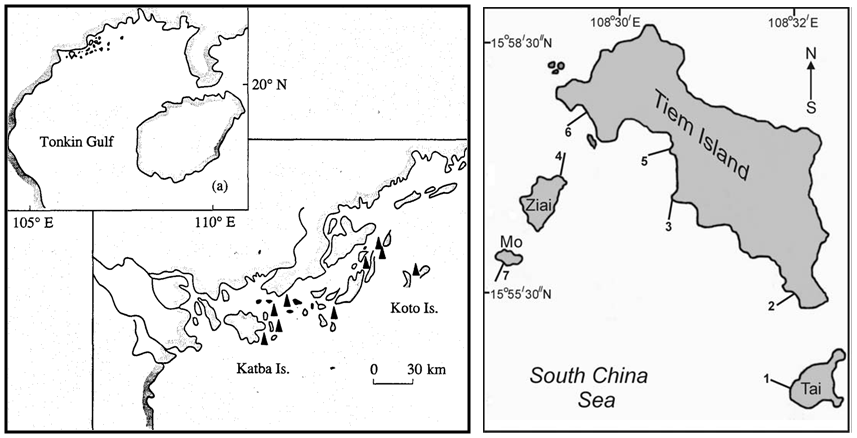
Using SCUBA, we investigated the composition, distribution of scleractinian corals and structure of communities in reef zones at seven (four studied earlier and two new control ones) sections in sandy and stony inlets and near rocky coasts (Figure 1). Investigations were carried out in accordance with the standard hydrobiological technique using quadrats and transect [18]. Abundance of branched, massive, encrusted and funnel shaped scleractinian colonies, as well as the degree of substrate cover by corals were estimated along a 100 m transect frame divided into 100 squares with the area of 10 cm2 each. Similarity level of different communities was determined by the Serensen’s similarity parameters using software program STATISTICA 6.0.Photographing of reef landscapes, and their flora and fauna was conducted. More than 500 photos by Olympus and Canon digital cameras were made for later analysis of species composition [19] and structure of community.

3. Results and Discussion

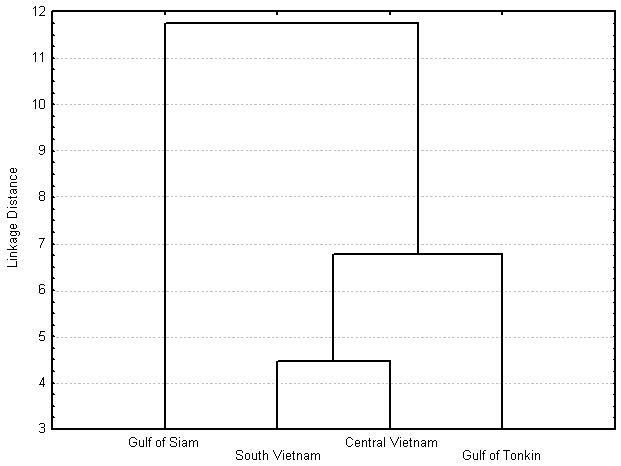
The data obtained allowed high diversity of reef-building scleractinian (see Table). This is not only indicative of the high diversity of coral species in the region studied but also enables their faunistic comparison with the reefs of other parts of the South China Sea. The studied reefs and those of the other regions of Vietnam and the South China Sea have 55-65% common species. 60, 4% corals are distributed on all reefs. The coral faunas of the Gulf of Tonkin and the Gulf of Thailand share more than two-thirds of the species (Figure 2). The high diversity of corals in these regions, as well as in the most of the Indo-Pacific reefs, is mainly due to the diversity of acroporids, comprising 28.5% of the coral species composition and forming monospecific settlements, often occupying a considerable proportion of the reef areas [20, 21].
Table 1. List of species some regions of Vietnam
     
Explanation and figures legend
Figure 1. Schematized map of the Gulf of Tonkin and Ku Lao Cham Islands (Central Vietnam), the areas surveyed triangles and 1-6 - location of transects
Figure 2. Dendorgam resulting from clasterin similalarity coefficient between species composition of corals in different reefs of the some areas Vietnam
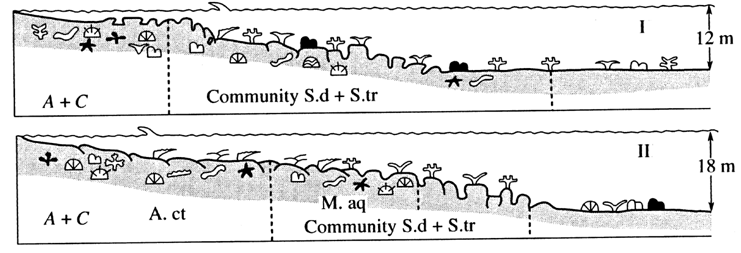
Figure 3. Major reef profiles and the distribution of common species of macrobenthos. I – enclosed bay of island, II – mainland and island capes. A + C – algal-coral community, A. ct. Acropora cytherea facies, M. aq –facies, S. d + S. tr – Sinularia dura and Sarcophyton trochelioforum soft coral community
These waters are cooled to 16-18°C, silted to 100 g/m2 per day, and freshened to 28‰. The reefs in the Gulf of Tonkin are thus exposed to conditions far from optimum for reef formation. However, the continuously arriving suspended matter does not settle out directly onto the coral settlements because of the huge integral water exchange and intense roiling [4, 5]. Water silting and eutrophication resulted in changes in the structure and composition of reef communities via the reduction or elimination of certain coral species [22]. As a result, instead of acroporids, typical for the majority of other reefs, the communities of the reefs of the Gulf of Tonkin are dominated by poritids and faviids, which form the framework of the reefs. These peculiarities make the reefs of the Gulf of Tonkin unique.
One of the peculiarities of the Gulf of Tonkin and Central Vietnam reefs is the major role massive colonies play in the formation of the reef framework. These colonies are mainly formed of Porites species, occurring throughout the littoral to reef slope zones. Different Porites species form large colonies up to 2.5 m in diameter and over 1 m in height or groups of colonies of different sizes with a coral density of 18-25 spec/m2 and projective coverage of up to 80%. As a rule, Porites species predominate in the reef flat, especially in its inner part, and in the reef slope, where they often form microatolls [23-27]. Massive Porites are observed to predominate and form continuous settlements under similar conditions off Singapore and in the Gulf of Thailand, the Great Barrier Reef (Australia), and the eastern coast of Africa [28-32].
Another peculiarity of the studied reefs is the uniqueness of their morphological zonality and the way of the formation of the organogenous reef framework. The vertical zonality of the composition and structure of a reef community is strongly pronounced; however, typical reef zones such as lagoon, reef front, and reef flat are occasionally difficult to distinguish. Reefs featuring certain classifiable geomorphological elements are called structural [33], as distinct from developing reefs, that lacking special structural features and are called coral communities, specialized settlements or unstructured reef [30].
The abundance of poritids was accounted for by their ability to secrete a firm mucous covering and start reproduction 1-2 months earlier than other coral species. These peculiarities favor their better adaptation to water eutrophication, overheating, and desalination under stressful conditions of silted shallow water [34-39]. Massive colonies of poritids and faviids-one of major bioproducents under the local conditions-not only form the reef framework but also play a considerable role in the expansion of the reef area. Both biotic and abiotic factors cause the erosion of coral colonies, resulting in the passive colonization of vacant bottom areas by colony fragments. In zone of the reef slope base, a new, now organogenesis, substrate is formed, which is subsequently inhabited by both corals and other phyto- and zoo benthos species.
These factors are important for the Gulf of Tonkin and partly for Central Vietnam, a shallow-water gulf with the predominance of soft ground and a limited availability of solid substrate off shore. As compared to other reefs of Vietnam and many reefs of the Indo-Pacific, the reefs of the Gulf of Tonkin are characterized by a peculiar composition and structure of the reef communities. These reefs develop under complex hydrobiological conditions. In addition, they are situated in a populous area and constitute constant food and, because of increasing tourism, financial sources for the local people. Thus, they may be and must be used as a model in the research on the conservation and recovery of reefs subject to stressful conditions and anthropogenic contamination.
The distinctive feature of Central Vietnam reefs is forming communities of soft corals in a large part of the reef (Figure 3). A community of soft corals Sinularia dura + Sarcophyton trochelioforum was formed at a depth of 4 - 15 m with the width of 20 - 80 m. It was typical for open capes and inlets with rocky and large-lump substrate. Dominating alcyonarian S. dura occupied up to 40% - 75% of substrate surface. Patches of combined colonies of the corals Acropora cytherea and Montipora aequituberculata with plate troche colonies up to 3 m diameter were met in shallow parts of the community. Despite domination of soft corals in substrate cover, species diversity was ensured by scleractinian distributed in all part of the community. Acroporidae and branched Poritidae were the most frequent in its shallow part.
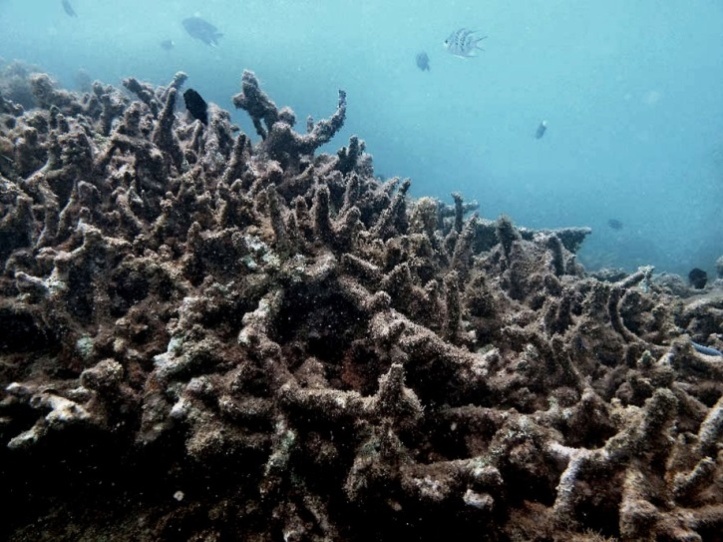
In 2010, it was established that the reefs of these islands were lost after the Sangshen typhoon and a heavy flood, which happened in 2006. As a result of these natural phenomena a significant part of coral populations was physically destroyed, and a powerful ex-port of clay substances from the nearest Vietnamese coast and from the Bung River, flowing into the sea opposite the Islands, causing abundant sedimentation and death of almost all the remaining scleractinian corals (Figure 4). Replacement of the former scleractinian-alcyonarian community by a mono- dominant alcyonarian has occurred. Patches of alcyonarian settlements with the area up to several tens of square meters are distributed on all hydrobiological sections. At some transects they form compact settlements with 100% substrate cover for hundreds of square meters (Figure 5).
Figure 4. Physical destruction and covering Acropora mono-colony with sediments
Figure 5. A mono-colony of the alcyonarian Sarcophytum trocheliophorum

4. Conclusions

The general pattern of formation of benthic communities in the investigated area is largely predictable. As a rule, these are coral populations separating into several biocoenoses (zones, facies) dominated by individual species or groups of species of alcyonacean and more rarely scleractinian. The degree of species similarity of communities is 40-70%, and it somewhat decreases in algal-coral communities. The species composition of corals from different communities shows the smallest range of values for the degree of similarity (from 60 to 76% of species in common). The greatest differences in the degree of similarity were found for macrophytes (from 13.2 to 58.7%), which were due to different habitat conditions in a calm, shallow lagoon with the richest algal community and on the reef slope with an increased wave regime. The fore-reef platform and the lagoon are characterized by a many-fold difference in depth.

ACNOWGLEMENTS

The work was a collaborative study of the Zhirmunsky Institute of Marine Biology, FEB RAS (IBM, Vladivostok) and the Institute of Technology Research and Application, Nha Trang City. The authors extend their sincere thanks to their colleagues A.G. Goloseev, Dr. N.I. Selin and Drs. V.T. Trung and Dao Tan Ho for their help in conducting the experiments. Special thanks to anonymous reviewer for the constructive comments and correction of my English.

References

[1]  Gur'yanova, E.F. 1972. Fauna of the Gulf of Tonkin and Its Environmental Conditions, In Fauna Tonkinskogo zaliva i usloviya ee sushestvovaniya (Fauna of the Gulf of Tonkin and Its Environmental Conditions). Leningrad: Nauka: pp. 22-146.
[2]  Yet, N.H. 1989. Research Results of Corals and Coral Reefs in Western Tonkin Gulf. Tay Nguen Va Moy Truong Bien. 6: pp. 35-36.
[3]  Thanh, T.D. 1999. Change in Environment and Ecosystems Relative to the Land-Sea Ineraction in the Vietnam Costal Zone. Rept. Presented, at EALOICZ Workshop. Qingdao: pp. 1-10.
[4]  Dautova, T.N. Dautov, S.Sh., Latypov, Yu.Ya. and Moshchenko, A.V. (1999) Effect of Near-bottom Physical Processes on the Shallow- water Reefs of the Baitylong Archipelago (Gulf of Tonkin, South China Sea). Biol.Morya, 25(2): pp. 104-106.
[5]  Latypov, Yu.Ya. 2000. Coral Communities of the Northern Part of the Gulf of Tonkin, South China Sea. Biol. Morya, 26(4): pp. 240-247.
[6]  Krempf, A. and Chevey, P. 1936 Les grands courant gene"raux de la mer de cjine et les secteurs hydrologiques de cotes 1'Indochine. Francaise. Saigon 29: pp. 17-22.
[7]  Serene, R. 1937. Inventaires des invertebres marine de 1'Indochine. Inst. Oceanogr. Indochine 30: pp. 3-83.
[8]  Latypov, Yu.Ya. 2013. The composition and structure of reef community at Tho Chu Island (South China Sea) after Ketsana Typhoon. Amer. J. Climate Change 2: pp. 284–291.
[9]  Dawydoff, C. 1952. Contribution a l'e"tude des invertebres de la faune marine benthiques de 1'Indochine. Bull. Biol. France Belg. 37: pp. 1-158.
[10]  Latypov, Yu. Ya. 1997. Coral Reefs of the Gulf of Tonkin. Vestn. DVO RAN 2: pp. 92-98.
[11]  Latypov, Yu.Ya. and Malyutin, A.N. 1990. New Data on the Distribution of Corals in the Reefs of the Northern Part of the Gulf of Tonkin, In Biologiya morskikh bespozvonochnykh (Marine Invertebrate Biology), Vladivostok: Inst. Biol. Morya Dal. Vost. Otd. Ross. Akad. Nauk, 16-24. (In Russian)
[12]  Khomenko, T.N. 1993. Distribution of Poritid Scleractinians on the Reefs of the Bai Thu Long Archipelago (the Bay of Tonkin). Biol. Morya 3: pp. 11-19.
[13]  Ken, L.V. 1991. Stony Corals and the Coral Reefs of Catba Islands, Marine Environment And Resources. Hanoi: Sci. Tech. Publ. House, pp. 144-151.
[14]  Latypov, Yu.Ya. 1995. Community Structure of Scleractinian Reefs in the Baitylong Archipelago (South China Sea). Asian Mar. Biol, 12: pp. 27-37.
[15]  Latypov, Yu.Ya. and Malyutin A.N. 1996. Structure of Coral Communities on the Eastern Part of Baitylong Archipelago, South China Sea. Asian Mar. Biol, 13: pp. 15-24.
[16]  WWF Vietnam Marine Conservation Southern Survey Team. 1994. Survey Report on the Biodiversity Resource Utilization and Conservation Potential of Coto Islands, Quangninh Province, N. Vietnam. Gland, Switzerland.
[17]  Yet, N.H. and Ken, L.V. 1996. Some Data on Species Composition and Distribution of Scleractinian Corals in Ha Long Bay. J. Biol. (Hanoi) 18: pp. 7-13.
[18]  Loya, Y. and Slobodkin, L.B. 1971.. The Coral Reefs of Elate (Gulf of Elate. Red Sea), J. Sampl. Zool.Soc. London, 28: pp. 117-140.
[19]  Veron, J.E.N. and Smith, M.G.S. 2004. Coral ID: An Electronic Key to the Zooxanthellate Scleractinian Corals of the World, Austral. Inst. Mar. Sci. Townswill.
[20]  Latypov, Yu.Ya. 1992. Korally skleraktinii V'etnama. P. II. Akroporidy (Scleractinian Corals of Vietnam. Ch. II. Acroporidae), Moscow: Nauka.
[21]  Latypov, Yu.Ya. 1995. Korally skleraktinii V'etnama. P.III. Faviidy, Fungiidy (Scleractinian Corals of Vietnam. Ch. III. Faviidae, Fungiidae), Moscow: Nauka,
[22]  Veron, J.E.N. 1995. Corals in Space and Time: The Biogeography and Evolution of the Scleractinia, Austral. Inst. Mar. Sci.
[23]  Loya, Y. 1976. Effects of Water Turbidity and Sedimentation on the Community Strundcture of Puerto Rican Corals. Bull. Mar. Sci, 26(4): pp. 450-466.
[24]  Latypov, Yu.Ya. and Dautova T.N. 1996. Korally skleraktinii V'etnama. P. IV. Poritidy, Dendrofilliidy (Scleractinian Corals of Vietnam. Ch. IV. Poritidae, Dendrophylliidae), Moscow: Nauka.
[25]  Latypov, Yu.Ya. 1995. Community Structure of Scleractinian Reefs in the Baitylong Archipelago (South China Sea). Asian Mar. Biol.12: pp. 27-37.
[26]  Latypov, Yu.Ya. 2001. Communities of Coral Reefs of Central Vietnam. Russian J. Mar. Biol. 27(4): pp. 197-200.
[27]  Latypov, Yu.Ya. 2015. Particular Qualities of Forming of Reefs and Coral Communities in the Gulf of Thailand. Inter. J. Ecosys. 5(1): pp. 1-8.
[28]  Chou, L.M. and Teo, Y.H. 1985. An Ecological Study On the Scleractinian Corals of Pulau Salu Reef, Singapore. Asian Mar. Biol, 2: pp. 11-20.
[29]  Hamilton, H.G.H. and Brackel, W.H. 1984. Structure and Coral Fauna of East African Reefs. Bull. Mar. Sci. 34: pp. 248- 266.
[30]  Hubbard, J.A.E.B. 1974. Scleractinian Corals Behavior in Calibrated Current Experiment: An Index to Their Distribution Patterns, Proc. 2nd Int. Coral Reef Symp. Brisbane. 2: pp. 107-126.
[31]  Potts, D.C. Done, T.H, Isdate, P.J. and Fisk, D.A, 1985. Dominance of Coral Community by the Genus Porites (Scleractinia), Mar. Ecol. Progr. Ser, 23: pp. 79-84.
[32]  Wainwright, S.A. 1965. Reef Communities Visited by the Israel South Red Expedition, 1962. Bull. Sea Fish. Res. Stn. Israel, 38: pp. 40-53.
[33]  Sakai, K. Yeemin. T. Svidvong, A. et al. 1986. Distribution and Community Structure of Hermatypic Corals in the Sichang Islands, Inner Part of the Gulf of Thailand. Galaxea.5: pp. 27-74
[34]  Ditlev, H. 1978. Zonation of Corals (Scleractinia Coelenterata) on Intertidal Reef Flats At Ko Phuket, Eastern Indian Ocean. Mar. Biol.42: pp. 29-39.
[35]  Ducklow, H.W. and Mitchell, R. 1979. Bacteria In Mucus Layers on Living Corals. Limnol. Oceanogr. 24: pp. 715-725.
[36]  Holthus, P.F., Maragos, J.E. and Evans, C.W. 1989. Coral Reef Recovery Subsequent to the Freshwater Kill of 1965 In Kaneohe Bay, Hawaii. Pacif. Sci. 43(2): pp. 122-134.
[37]  Tomascik, T. and Sander, F. 1987. Effect of Eutrophication on Reef-Building Corals. 3. Reproduction of the Reef-Building Coral Porites. Mar. Biol, 94(1): pp. 77-94.
[38]  Latypov, Yu.Ya. and Selin, N.I. 2013. Some data on spatio-temporal stability and variability of coral reefs in Khanh Hoa province (Vietnam). Envir. Ecol. & Management, 2(1): pp. 1-16.
[39]  Latypov, Yu.Ya. 2003. Reef-Building Corals and Reefs of Vietnam: 1. The Gulf of Thailand. Russian J. Mar. Biol. 29(1): pp. S22-S33.