
-
Paper Information
- Paper Submission
-
Journal Information
- About This Journal
- Editorial Board
- Current Issue
- Archive
- Author Guidelines
- Contact Us
International Journal of Ecosystem
p-ISSN: 2165-8889 e-ISSN: 2165-8919
2013; 3(4): 90-93
doi:10.5923/j.ije.20130304.05
The Individual and Mixed Effect of Heavy Metals (Cu and Cd) and Detergent (LAS) on Mortality of Daphnia Magna (Zooplankton)
 Abstract
 Reference
 Full-Text PDF
 Full-text HTML
Mansoureh Gholami1, Seyyed Mohammad Reza Fatemi1, Maryam Fallahi2, Abbas Esmaeili Sari3, Ali Mashinchian1
1Department of Marine Biology, Science and Research Branch, Islamic Azad University, Tehran, Iran
2Institute of Aquaculture, Iran
3University of Tarbiyate Modarres, Noor, Iran
Correspondence to: Mansoureh Gholami, Department of Marine Biology, Science and Research Branch, Islamic Azad University, Tehran, Iran.
| Email: |  |
Copyright © 2012 Scientific & Academic Publishing. All Rights Reserved.
In this study, the individual and mixed impacts of heavy metals (cu, cd) and detergent (LAS) on Daphnia magna. Pollutants acute toxicity (OECD) determination tests were done individually and mixedly on Daphnia, with 5 treatments, on witness and three results were Concentrations limits were determined logarithmically. At last, the achieved results were calculated with probit Analysis and the Coefficient of correlation and EC (10, 50, and 90) of the pollutants were determined individually and mixedly. The achieved results of Daphnia magna acute toxicity determination tests and the amounts of EC (10,50,90) resulted from individual impacts of heavy metals (Cu,Cd) and detergent (LAS) and (LAS +Cd) mixture and (LAS + Cu) mixture ranged as: Cd (0.14 – 0.26 – 0.05) , Cu (0.007 – 0,03 – 0,13) , LAS (1,7.8,60.6) , LAS + Cd (0.029 – 0.066 – 0.14) , LAS+Cu (0.003-0.016-0.077) and the achieved permissible limits were 0.026,0.003,0.78,0.006 and 0.0016 Mg/L with the coefficients of correlation ranged as: 88,68,84and 95 percent.
Keywords: Daphnia magna, Cu, Cd, LAS, Detergent, Toxicology
Cite this paper: Mansoureh Gholami, Seyyed Mohammad Reza Fatemi, Maryam Fallahi, Abbas Esmaeili Sari, Ali Mashinchian, The Individual and Mixed Effect of Heavy Metals (Cu and Cd) and Detergent (LAS) on Mortality of Daphnia Magna (Zooplankton), International Journal of Ecosystem, Vol. 3 No. 4, 2013, pp. 90-93. doi: 10.5923/j.ije.20130304.05.
1. Introduction
- According to the distribution of pollutants around the world and human dependency to the environment for achieving his food and other needs , a basic survey about the variety of pollutions specially waters and aquatic livings is required .On the other hand, increasing growth of the population is impossible along with the technology industry development in order to produce more regardless of environmental issues. Due to the environment constraints and the fundamental role of water which plays here, it is necessary that the environmental issues and water pollution should be considered more than this. (Omidi, 1997) Daphnia magna belongs to the category of Arthropoda and class of Crustacea and sub-class of Phyllopoda and sub –order of Cladocera and Daphnia family.More in the shallow waters of marginal regions along with the aquatic plants can be seen and its nutrition is from the plant grazing and slide into the mud or in the surface layer under the water. There are a few species observed in the deep sea and their color is a function of their location. Some species from the ground are yellow and Daphnia is more found in the shallow waters of marginal regions along with the aquatic plants. The nutrition was done from the plant gazing and they slide into the mud or into the under layer of the water and a few species are observed into the deep lakes. Their color is a function of their location and ground forms are yellow and can be observed in the red pools and marshes are seen as brown, green and black colors. Most of species are found in large amounts ad play a significant role in the fish farms for feeding the fishes. (Smaeeli, 2000) Cu is one of the metals which easily can be extracted from the solution state and about 83 percent of CU in the sea is in this recent state. And will be considered as an essential element for creatures and its most concentration is seen in Decapod crustaceans, Gastropod and Cephalopoda that their respiratory pigment includes Cu. It seems that Cd also because of being along with phosphate will be absorbed by phytoplankton.Cd has a very long half-life (13-28) and its amount of accumulation is significant with increasing the age of creatures. (Alavi. 2003).Although, Cd is not an essential element for living beings, but due to the uncertain reasons, phytoplankton photosynthesis and growth becomes more in the concentrations higher than 100 ppm, it seems that CD, due to accompaniment with phosphate, is absorbed by phytoplankton. The threshold limit of Cd was determined by the America Committee on Occupational Health Professionals about 0.1 mg per cubic meter of air and maximum of 0.1 mg per liter of water and maximum allowable concentration for aquatic creatures is 1.5 microgram per liter. Todays, the detergents are widely spread and via the municipal and industrial waste waters are released into the aquatic and terrestrial environments. In recent years, the linear Alkyl Benzene Sulfonate (ABS) are the most important anionic surfactant which were used in the household cleaning products in America. These materials caused the wide pollution to be distributed into the aquatic and terrestrial environment via the municipal and household waters. The artificial detergents are important due to their increased usage and aquatic creatures are exposed to the risk of contamination. These detergents may be decomposed by certain bacteria , but in the high concentrations ,bacteria may not be able to play their role , because the high concentrations of detergents inhibits the action of enzymes of bacteria and this enzymes are essential to decompose or decrease the detergent effect .Due to the biological decomposition of detergents in the polluted waters, the concentration of phosphate and minerals will be increased in the water. The detergents are able to break the proteins of plasma membrane and causes the heavy metals to be interred into the cells. Sometimes , the rate of detergents in an ecosystem may be less than Lc50 obtained in the laboratory , but the same concentration existed within the ecosystem may increase the percentage of mortality in the state of being mixed with the another chemical material. (Tehrani 2000)
2. Method and Materials
- Experiments was done based on the OECD method. In this project, the acute toxicity of heavy metals (Cu, Cd) and LAS detergent individually and in the mixed mode was observed and investigated upon Daphnia magna.The experiments about determination of the acute toxicity were done during 24 h and the physical and chemical factors such as temperature, water hardness and EC were measured during the experiments' time period. The number of concentrations in a logarithmic mode per heavy metal and detergents were considered 5 treatments and one control in three replications individually and in a mixed mode.Mortality rate was recorded at the end of 24 h. The water type of tape water was bleached one and its size per treatment was containers (250cc) and 10 Daphnia were kept within each container. Finally , data from the experiments by method of Probit analysis (Finny,1971) was statistically analyzed and by obtaining the slope of the regression line and its equation , Ec10,Ec50 , Ec90 and the threshold limit of them individually and in a mixed mode were computed. To calculate the regression line and correlation coefficient of data was used of Quatro Pro , Statgraphics.To realize the significant difference between data was used of Kruskal-Wallis non-parametric test and to investigate this significant difference was used of Duncan's multiple range test.
3. Results
- The effective concentration of Cd on Daphnia during the experiments based on OECD and logarithmically was between 1.58-0.03ppm. The minimum concentration of Cadmium Chloride which caused to a minimum effect upon Daphnia equals o.026 ppm.The effective concentration of Cu upon Daphnia was experimented and was between 0.25 -0.006 ppm and minimum concentration of Copper which caused to a minimum effect in Daphnia equals 0.003ppm. The effective concentration of LAS on Daphnia was experimented and during it was 1.6-40 ppm.The concentrations' limit were divided for the variety of treatments groups and the final experiments was done and the least concentration of LAS which can cause the least effect in Daphnia equals 0.78 ppm.The effective concentration of Cd+ LAS mixture based on ECs which were individually obtained from pollutants were experimented and found that are between 0.03-1.58 ppm for Cd and 1-6 ppm for LAS. The least concentration of Cadmium Chloride + LAS mixture which caused the least effect in Daphnia equals 0.0029ppm. The results from the individual effect of pollutants were tested and known that are between 0.25-0.006 ppm for Cu and 1-16 ppm for LAS. The least concentration of copper sulphate +LAS mixture which causes the least effect to be observed in Daphnia equals 0.0016ppm. (Table.1). the regression line slope equation was calculated and EC10, EC50 and EC90 was determined for pollutants. (Figs.1, 2, 3, 4, 5).According to the Kruskal-Wallis nonparametric test which was done between Cd, Cu and LAS, we observed a significant statistical difference on Daphnia. (P < 0.05). It seems that LAS rating mean differs with Cu and Cd.But on the 99% confidence level between 3 factors regarding to the effect upon Daphnia, we have not observed a significant statistical difference there. According to the Duncan's multiple range test comparing, we have not observed a significant statistical difference between Cd, Cu and LAS due to the high standard deviation of LAS. We did not observed a significant statistical difference regarding the effect on Daphnia between Cd and Cd+LAS mixture. We have not observed a significant statistical difference between Cu and Cu+LAS mixture regarding the effect of Daphnia. (P < 0.05). Also, we have not observed a significant statistical difference between Cu and Cu+LAS mixture regarding the effect on Daphnia.
|

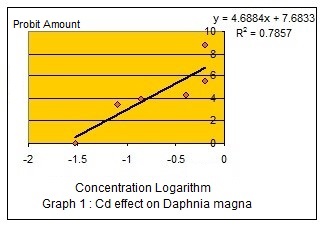 | Figure 1. Cd effect on Daphnia magna |
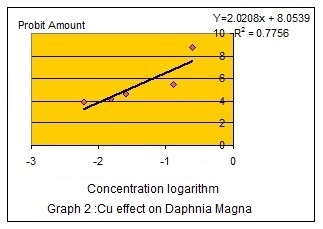 | Figure 2. Cu effect on Daphnia magna |
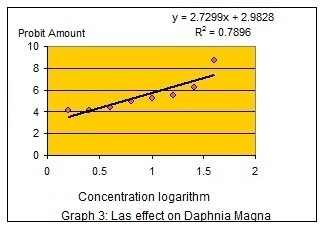 | Figure 3. Las effect on Daphnia magna |
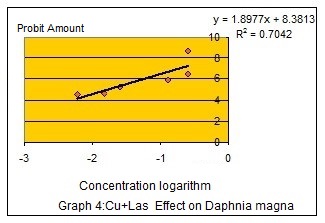 | Figure 4. Cu+ Las effect on Daphnia magna |
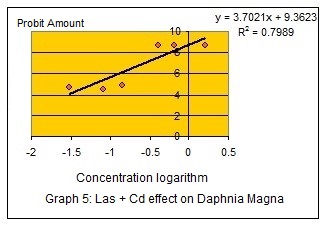 | Figure 5. Las+Cd effect on Daphnia magna |
4. Discussion and Conclusions
- The results showed that Cu effect is more on Daphnia than Cd and LAS, such that the Comparison of EC50 related to these three pollutants on Daphnia showed that the metal toxicity is 8x (8 times) more than Cd and 260x (260 times) more toxic than LAS and is based on the sensitivity of Daphnia to copper. Folt,C & et al,2004 stated that, the concentration of Cd which causes to the 5% decrease of population in Daphnia Pulex during 48h which was about 0.25 ppm and the maximum rate of Cd toxicity in Daphnia was about 2.5 ppm and the effective concentration limit of Cd on Daphnia was 0.03-1.58 ppm. Rand, 1995, declared about Daphnia Pulex in his studies that the allowed limit rate for Cd is 0.05 ppm that agrees with the results from this project. Timothys .J et al 2004 , based on the experiments which were done upon the 8 generations of Daphnia ( in an environment contaminated to the phenol ) found that the sensitivity of Daphnia versus the Cd & Cu is more than the environment where contains the phenol and the sensitivity also was observed in the adult egg-containing Daphnia .So that in the next generations, other born Daphnia, were smaller than the previous Daphnia. Rand, 1995, stated that the critical threshold of toxicity for LAS on sensitive species of aquatic invertebrates was 0.5 ppm and the long term toxicity threshold was approximately 0.2 ppm. Also , he reported EC50 rate of LAS after 48h for Daphnia about 1-10ppm .Konar and Mullick , 1991 , stated that Zinc, Copper, Lead, and Cadmium were added to Diaptomus Forbesi , its Lc50 is 11ppm, but after adding the Parnol-j detergent or Hexan-n (petroleum product) ,the toxicity effect of these metals was intensified and reached to 4 ppm. Also they showed that the heavy metals toxicity rate exposed to the other pollutants such as detergents will be increased up to 39.2 %. Therefore, the concentration of a metal lonely may not be dangerous, but its toxicity percentage will be increased in the presence of detergents or other chemical materials.Leuny and Kwok (2005) expressed some experiments which were done upon the several species of Woof Coupe and hard-shell based on the toxicity of Cu and the changes in temperature and salinity and their effects on their mortality which showed us that LC50 obtained from their experiments in Harpacticoidea equals 0.12 ppm in water hardness of 150 and 96h and Temperature of 25 °. By increasing the salinity and falling the temperature, Cu toxicity was increased. Piri and Ordag (1993) have tested the effect of two pollutants (titanium dioxide and nanoparticles )in a mixed mode on Daphnia and showed that the toxicity rate of pollutants mixture and mortality rate of Daphnia in the mixed mode were 3 times in comparison with the toxicity rate of each pollutant individually. Generally, the results obtained from this study based on the heavy metals effect (Cu, Cd) and LAS on Daphnia showed that Daphnia is more sensitive than other invertebrates to the pollutants and sensitive to Cu more than Cd and LAS. EC50 related to this metal shows us the smaller amount in comparison with EC and LAS. The pollutants affect the invertebrates' life, their respiration, reproduction and feeding rate. Also, the results showed that the toxicity rate of heavy metals and LAS had an increase about 20% in comparison with the individual effect of Cu and Cd in Daphnia and is consistent with the previous studies.