
-
Paper Information
- Paper Submission
-
Journal Information
- About This Journal
- Editorial Board
- Current Issue
- Archive
- Author Guidelines
- Contact Us
International Journal of Construction Engineering and Management
p-ISSN: 2326-1080 e-ISSN: 2326-1102
2026; 15(2): 32-41
doi:10.5923/j.ijcem.20261502.02
Received: Jul. 1, 2026; Accepted: Jul. 26, 2026; Published: Aug. 13, 2026

Assessment of the Effect of Labour Productivity Factors on Health and Safety Hazards in Building Construction Projects: Case Study in Uganda
 Abstract
 Reference
 Full-Text PDF
 Full-text HTML
Nathan Natukunda 1, Samuel Waweru 2, Bernadette Sabuni 2, Basil lro Ong’or 2
1Department of Civil and Environmental Engineering, Kyambogo University, Kampala, Kyambogo, Uganda
2Department of Civil and Structural Engineering, Masinde Muliro University of Science and Technology, Kakamega, Kenya
Correspondence to: Nathan Natukunda , Department of Civil and Environmental Engineering, Kyambogo University, Kampala, Kyambogo, Uganda.
| Email: |  |
Copyright © 2026 The Author(s). Published by Scientific & Academic Publishing.
This work is licensed under the Creative Commons Attribution International License (CC BY).
http://creativecommons.org/licenses/by/4.0/

Globally, the building construction industry has been recognized as the main contributor to economic growth and development. In Uganda, its labour intensive nature which creates employment opportunities across all skill levels to meet rising housing demand. Despite its economic importance, the industry is persistently hampered by health and safety hazards, including injuries and fatalities. Such incidents induce workers anxiety, trigger accident investigations and ultimately diminish labour productivity, leading to project delays. Nevertheless, knowledge regarding the labour productivity factors specifically linked to health and safety hazards in building construction in Uganda remains poorly documented. This study therefore assessed the effect of labour productivity factors on health and safety hazards among construction workers across four region cities in Uganda. Employing a quantitative approach, data was collected from 262 randomly selected respondents. The study examined two categories of labour productivity factors; psychophysical and technological that contribute to health and safety hazards for construction workers. Analysis was conducted using SPS, and R-Studio by employing relative importance index (RII), weighted mean (mean), correlation and regression. Findings revealed psychophysical factors as most significant (RII= 0.774, SD=0.712, Mean =3.876) which was attributed to falls from a height factors, followed by technological with (RII =0.767, SD=0.729, Mean=3.837) mainly attributed to inappropriate trench strutting and improper use of tools and equipment. Correlation analysis showed strong positive relationships, particularly for technological (r =+0.750) and psychophysical (r = +0.375) factors. Regression (adjusted  = 0.685 and p-value =1.43e-13) confirmed both as statistically significant contributors to health and safety hazards. The study recommended routine training programmes for project managers to raise awareness of psychophysical strains and proper safety technology use, thereby enhance overall site safety performance. health and safety performance on construction project sites.
Keywords: Health, Safety, Labour, Productivity, Psychophysical, Technological, Factors, Building, Construction
Cite this paper: Nathan Natukunda , Samuel Waweru , Bernadette Sabuni , Basil lro Ong’or , Assessment of the Effect of Labour Productivity Factors on Health and Safety Hazards in Building Construction Projects: Case Study in Uganda, International Journal of Construction Engineering and Management , Vol. 15 No. 2, 2026, pp. 32-41. doi: 10.5923/j.ijcem.20261502.02.
Article Outline
1. Introduction
- In developing countries, building construction industry has been known as a significant contributor of economic development. In Uganda, this industry has experienced rapid growth in recent years, largely driven by population increases that resulted in demand for housing services [19]. Building construction industry is comparatively labour intensive and creates employment opportunities for skilled and unskilled workers to meet the rising need for housing services [30,25]. However, despite its economic importance, the construction industry in Uganda continues to face significant health and safety hazards, including injuries and fatal accidents [19]. The occurrence of these incidents not only cause fear and anxiety among workers but also prompt accident investigations [22]. These investigations often lead to project delays, which in turn collectively reduce labour productivity and ultimately postpone the completion of construction projects.Nevertheless, knowledge regarding the labour productivity factors particularly linked to health and safety hazards in building construction in Uganda remains scarcely addressed in literature. There is a need to establish labour productivity factors that cause health and safety of construction workers particularly those related to hazards arising from or in connection with construction work activities. Addressing these factors would help reduce the number of incidents on construction sites, thereby improving productivity, construction projects completed on schedule and meet the demand of housing services in Uganda.Health and safety hazards are persistent obstacles and risk factors that hinder the effective protection of workers from physical harm, injury, illness and fatalities from construction activities [7]. Building construction H&S hazards is a worldwide issue especially common in developing countries. The study by [8] highlighted that construction is one of the most dangerous industries faced with challenges of H&S hazards for construction workers. It is estimated that at least 108,000 construction workers are killed on site globally each year accounting for about 30% of all occupational fatalities. The findings of [28] indicate that construction accidents in Kampala, Uganda, the estimated annual fatality rate among construction workers is 84 deaths per 100,000 workers.Health and safety hazards in construction ranges from physical and psychosocial hazards that workers face during construction activities [25]. These are commonly attributed to falls from heights, struck by moving objects, electrocution and collapsing structures [17]. Subsequently result in injuries, illnesses and fatalities of workers. Such consequences result in increased absenteeism, medical leave and decreased workforce morale among affected workers [14]. In turn, these outcomes hinder overall productivity and subsequently lead to delayed construction project completion. This pattern has been linked to several labour productivity factors [18].
2. Labour Productivity Factors
- According to [19] and [3] indicate that labour productivity factors are the primary cause of H&S hazards in building construction industry in Uganda. Poor safety management characterized by inadequate training, lack of management commitment, insufficient safety equipment among others contributes to workplace accidents and injuries, this declines the productivity of workforce [3].According to [27] and [26], labour productivity refers to the quantity of work produced per person within a given period. They further argued that construction productivity depends on the collective effort of the entire construction team working together. However, [24] indicate that labour productivity is the units of work produced per man-hour, emphasizing that productivity measures how an individual utilize resources to transform inputs into outputs. Therefore, construction productivity relies on both workforce effort and individual performance on the construction project. Also [3] argue that the disruptions of work force due to safety related incidents reduce overall project efficiency and work stoppages, which in turn affect project completion time line.Over time, a significant number of studies have examined the labour productivity factors linked to H&S hazards in the construction industry [8]. These factors are inherently unstable and erratic, which persistently result in occurrence of physical and psychosocial hazards to construction workers [25]. Such health and safety hazards result in decline in construction project completion time line and significant financial losses of the construction projects.Researchers have identified a range of specific causes and broader groups of factors that collectively influence the H&S hazards of construction workers [34]. For instance, human factors such as fatigue, cognitive overload, miscommunication may trigger absenteeism, rework and subsequently delay the scheduled completion of construction projects [30].Literature reviewed indicates categorization of the various labour productivity factors influence the health and safety of construction workers into groups of up to eleven (11) groups. These include external related, supervision related, psychophysical related, manpower related, technological related, material related, leadership related, project related, management related, motivation related and work condition related factors, among others [8, 34]. This study re-classified these factors into four (4) overarching groups: Management, Technological, worksite condition and Psychophysical related factors. However, among these factors, the study focused on psychophysical and technological labour productivity factors as they were established through the findings as the most significant contributor to project H&S hazards for construction workers.
2.1. Technological Labour Productivity Related Factors
- Various studies have consistently highlighted in the literature that, technological related factors are significantly contributors to H&S hazards for construction workers. In the study by [15] in U.S assert that technological factors such as poor strutting of trench excavation sides, attributed to skills of supervision team, depth of trench to be excavated, bearing capacity of soil to be excavated, poor design of strutting system greatly influence H&S hazards for construction workers. Collectively, these technological deficiencies expose workers to fatal risks including cave-in and crush injuries. The study by [14] indicates that, inappropriate use of tools and equipment which are attributed to skills of equipment operator, training on the usage of equipment, skills of site supervisor are the main cause of H&S hazards of construction workers. The studies by [1] and [11] in Indonesia identified technological factors especially the ineffective support of scaffold work platforms stand out as the primary contributor to H&S hazards among construction workers. It is driven by poor design of scaffold supports such as inadequate load bearing capacity and missing bracing which creates inherent instability. This make platforms prone to swaying and collapse under normal use. Subsequently result in injuries and fatal accidents. Additionally, [1] in Malaysia indicates that poor methods of handling material, improper assembly of scaffold platforms and non-adherence to scaffold safety standards together create an unpredictable working environment, ultimately lead to scaffold support failure and a decline in worker safety. However, most evidences on technological labour productivity factors and H&S hazards for construction workers come from several countries other than Uganda. Therefore, a research gap exits in understanding which specific technological labour productivity factors most influence H&S hazards for construction workers in Uganda.
2.2. Psychophysical Labour Productivity Related Factors
- Psychophysical related factors especially fall from height risks, individual poor attitude, mental fatigue, cognitive overload, salary increment stagnation, demotivation and health corporate policies have been identified in the literature as primary causes that influence H&S hazards for workers on construction projects. In the study by [35] indicates that falls from height risks pose the most significant threat to construction workers, leading to severe physical consequences such as spinal cord fractures, traumatic brain injuries and death. These fall related incidents create labour shortage when skilled workers are impacted and cause unplanned work stoppages, consequently lead to construction project delays. These incidents are primarily attributed to poor fall protection systems, inadequate installation of guardrails, unsafe working environment on elevated platform and unstable scaffolding systems [11]. Similarly, [18] and [33] in their studies contend that, individual poor attitude, mental fatigue, cognitive overload, salary increment stagnation, demotivation and health corporate policies significantly undermine the H&S hazards for construction workers. Poor attitude characterized by overconfidence create workers to ignore required protective equipment and result in safety incidents ranging from minor to serious injuries. Although studies have persistently indicated that psychophysical labour productivity factors such as cognitive overload, mental fatigue, poor communication and falls from a height significantly contribute to H&S hazards for construction workers, limited research has been conducted to validate these findings within construction industry in Uganda.
2.3. Objectives of the Study
- The main objective of the study was to examine labour productivity factors that influence health and safety hazards for construction workers in the building construction industry in Uganda. The study was informed by the following specific objectives.• To establish the psychophysical labour productivity factors that affect health and safety hazards for construction workers,• To determine the technological labour productivity factors that influence health and safety hazards for construction workers.
2.3.1. Research Hypotheses
- •
 : Psychophysical labour productivity factors do not significantly contribute to H&S hazards for construction workers in the building construction industry?•
  : Psychophysical labour productivity factors significantly contribute to H&S hazards for construction workers in the building construction industry?•
  : Technological labour productivity factors do not significantly contribute to H&S hazards for construction workers in the building construction industry?•
  : Technological labour productivity factors significantly contribute to H&S hazards for construction workers in the building construction industry?
3. Methodologies
3.1. Research Approach and Design
- The research employed a cross-sectional design that utilized quantitative research approach. Data was collected using a five-point Likert scale questionnaire from respondents, focused on running building construction projects being managed by local construction companies.
3.2. Study Population and Sample
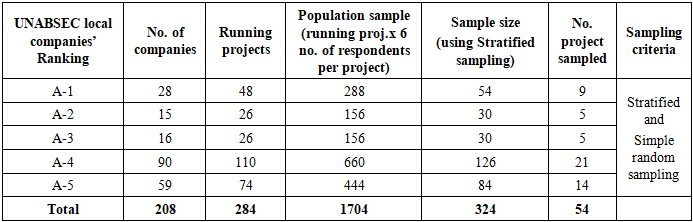
- Local construction companies were registered with the Uganda National Association of Builders, Suppliers and Engineering Contractors (UNABSEC), ranked from A-1 through A-5 in descending order based on their annual financial capacity for contracts. A list of local construction companies including contractors’ contact details, was obtained from UNABSEC, which facilitated the identification of five categories of local companies under the association. Category A-1 was made up of 28 companies, A-2 consisted of 15 companies, A-3 had16 companies, while A-4 composed of 90 firms and the last category A-5 comprised of 59 local companies, giving a total of 208. Regarding geographical distribution, 81%were located in the central region (Kampala metropolitan), 7.7% in northern (Gulu city), 8.3% in the western region (Mbarara city) and 3% in the eastern region (Mbale city). To minimize researcher bias and enhance equal participation opportunities, the researcher contacted contractors within each category to identify ongoing building construction projects.
|
3.3. Study Location
- The study was conducted in four regional cities of Uganda. The selection of these locations was based on the following factors: first, these cities host a high number of construction projects undertaken by local construction companies for both government and private developers in compared to other parts of the country; secondly, construction projects managed by local companies in these cities frequently experience health and safety hazards of construction workers; Third, these cities offer diverse geographical representation of Uganda broader context of construction projects, thereby enhancing the generalizability of the study findings [19,7].
3.4. Sample Selection Criterion
- Simple random sampling was used to select the number of local construction companies with running projects, as this technique helps generalize findings and reduce bias [10,32]. Stratified sampling was employed to draw respondents from different strata of local construction companies, which were grouped as A-1 through A-5. Finally, within each stratum, respondents were randomly selected based on the assumption that they possessed the construction knowledge and skills relevant to study in the building construction projects.
3.5. Pilot of the Tools for Validity and Reliability
- The validity test was conducted to assess the clarity and precision of the questions, this strengthens the credibility of the data collected. To establish content validity of the questionnaire items. The content validity index (CVI) was computed by dividing the number questionnaire items declared valid by the experts and the total number of items on the questionnaire. The overall CVI of 0.88 was obtained, which exceeded the recommended threshold of 0.70 [13]. Before performing a reliability test, a pilot study of the questionnaire was first conducted on a small sample drawn from the target population, excluding those who would later participate in the main survey. The purpose was to identify ambiguous and redundant items before full deployment. The reliability of the instrument was performed using Cronbach’s Alpha coefficient using SPSS to assess internal consistency of responses across items. The instrument achieved an overall internal consistency reliability coefficient of 0.872 which was above the acceptable threshold of 0.7 [4].
3.6. Data Management and Data Analysis
- The effect of labour productivity factors on H&S hazards among construction workers in building construction projects was established through a series of steps; a literature review was conducted to identify labour productivity factors influence H&S hazards. From this review, the following labour productivity factors were identified: technological, and psychophysical factors. Prior to data collection, these factors were validated previous using questionnaires administered to various experts in the study area. Based on their feedback, appropriate modifications were made to the factors. Thereafter, a questionnaire constructed on a five-point Likert scale was administered to respondents. They were asked to assess each labour productivity factor based on its degree of importance in causing H&S hazards to construction workers. The scale used for this assessment was as follows: 5-strongly agree, 4-agree, 3-neutral, 2-disagree and 1-strongly disagree. Inaddition, the impact of labour Productivity factors on H&S hazards was evaluated using a separate questionnaire scale, where: 5- very severe impact on H&S ,4-severe impact, 3-moderate impact, 2-minor impact and 1-insignificant impact.
3.7. Data Analysis
- All collected data were analyzed using Statistical Package for Social Science (SPSS). The relative importance index (RII) and weighted average index (Mean) for each factor were determined using equation 1 &2 from [20], after which the factors were ranked. An average relative importance index (ARII) of 0.763, Weighted mean score (mean) of 3.816 and standard deviation (SD) of 0.744 were computed and adopted as the threshold. Factors with RII and Mean values above this average were considered significant and most influential on the H&S hazards of workers in the building construction projects, as presented in tables 5&6. To validate these findings, correlation coefficients were employed to test the strength of the relationship between H&S and labour productivity factors. Finally, regression analysis focusing on the significant factors, was conducted using R-studio software to evaluate the effect of LP group factors on H&S hazards faced by workers in the building construction industry.
 | (1) |
 is the sum of weights given to each factor by the respondents and ranges from 1 to 5, (where 1 is strongly disagree and 5 is strongly agree);A-is the highest weight (in this case 5) and;N-is the total number of respondents.
 | (2) |
 is the sum of weights given to each factor by the respondents and ranges from 1 to 5, (where 1 is strongly disagree and 5 is strongly agree) and;N-is the total number of respondents.
 | (3) |
 = Weight for each of the values of the data point
 = the mean of
4. Results and Discussion
4.1. Respondents Demographic
- The study presented various demographic attributes of the respondents, such as their education level, professional title, years of experience in construction industry and the response rate achieved. A total of 324 questionnaires were distributed, 262 participants responded representing an 81% response rate. According to [4,5,16], a response rate exceeding 70 percent is deemed statistically significant, as it indicates low nonresponse bias and strengthens the generalizability of the sample to the target population [13].
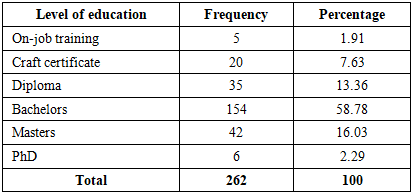
4.2. Level of Education
- Table 2 presents the respondents’ level of education, which was analyzed to determine the extent to which education influence H&S hazards on construction projects. The findings indicate that the majority of respondents had attained a significant level of education, with only 1.91% possessed no formal qualifications. This distribution suggests that the project site personnel were generally qualified to provide reliable information regarding to the labour productivity factors that contribute to H&S hazards. This finding aligns with the argument by [3], who assert that workers with low level of education tend not to understand safety signs and safety operating procedures which significantly influence the H&S hazards of workers on construction projects.
|
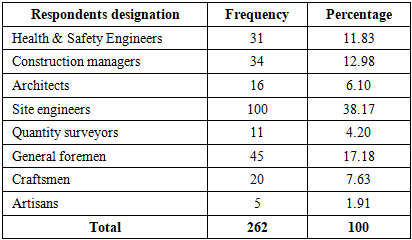
4.3. Respondents Designation
- Table 3 presents designation held by respondents. The findings indicate that the majority held critical roles on the project sites such as site engineers, general foremen, construction managers, health and safety engineers among others. This level of responsibility enabled them to understand and offer informed opinions on the ground challenges that influence H&S hazards in the building construction projects across regional cities of Uganda. These findings are in line with the study by [8], which note that effective site management is a core role of site engineers who are positioned to recognize the supervisory lapses that contribute to H&S hazards.
|
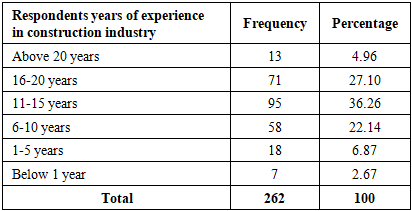
4.4. Respondents Work Experience
- Table 4 represents findings on respondents years of experience in the construction industry. Findings indicate that, the majority 95respondents (36.26%) had between 11 to 15years of experience, closely followed by 71respondents (27.10%) with 16 to 20 years in the field. This distribution suggests that most respondents possessed a substantial level of industry exposure, which likely enhanced their understanding of the factors influence H&S hazards for construction workers in the building construction industry.
|
4.5. Ranking of Labour Productivity Factors that Influence H&S Hazards
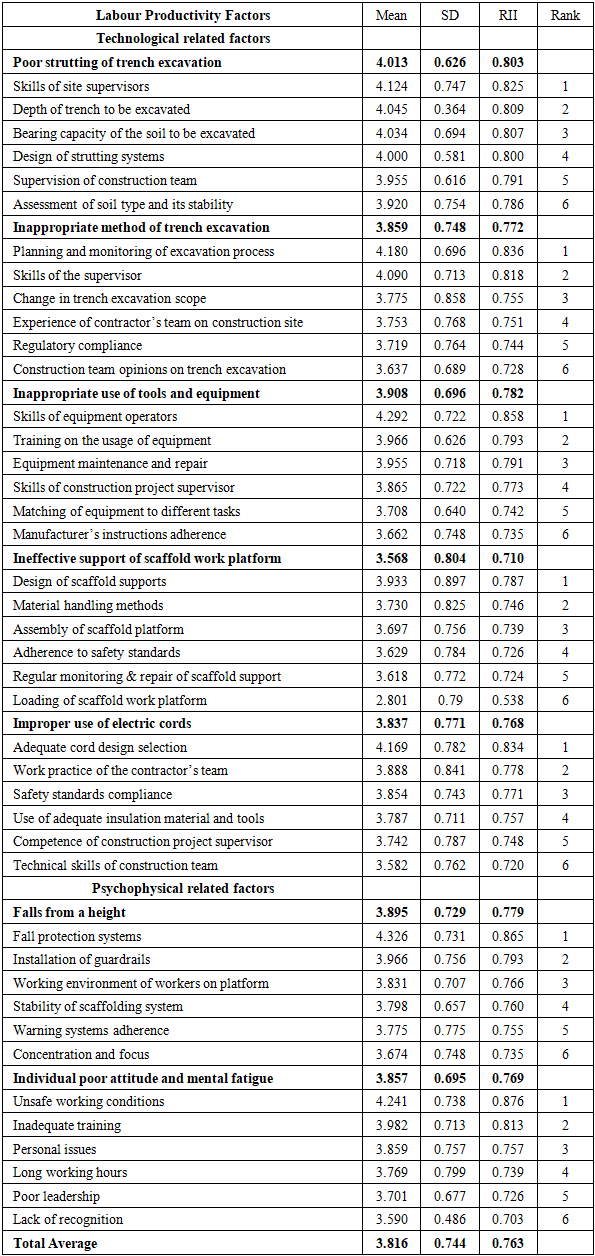
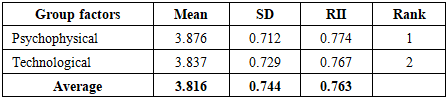
- The study identified various labour productivity factors that influence H&S hazards on the building construction projects in Uganda as presented in Table 5. To determine their relative significance, the analysis employed the Relative Importance Index (RII), supported by the Weighted mean score (Mean) and Standard Deviation (SD). Factors with a relative importance index (RII) above the overall average RII of 0.765 and a mean score above 3.816 were considered significant, while those falling below these thresholds were deemed less significant. The average standard deviation (SD) across all factors was 0.744; factors with values below this indicate strong consensus among respondents’ perceptions, while values above it suggests divergence in opinion.As indicated in Tables 5 & 6, the Psychophysical related labour productivity group factor with (Mean =3.876, SD=0.712 & RII=0.774) ranked first as the most influential factor that contribute to H&S hazards. This was attributed to falls from a height with (Mean=3.895, SD=0.729 & RII=0.779), this suggest that fall protection systems, installation of guardrails on platform, working environment of workers on platform and stability of scaffolding system were perceived as the main drivers of H&S hazards. Additional contributing factor was individual poor attitude and mental fatigue with (Mean =3.857, SD=0.695 &RII=0.769), this also suggest that, unsafe working conditions, inadequate training of workforce and personal issues are the contributors of H&S hazards to construction workers in the industry. The relatively low SD of 0.712 indicates a strong consensus among the respondents. This finding aligns with the study [33] in Iran contend that, individual poor attitude, mental fatigue and cognitive overload significantly undermine the H&S of construction workers.
|
|
4.6. Relationships Between Labour Productivity Factors and H&S Hazards
4.6.1. Correlation Analysis
- The results presented in Table 7 examines the relationship between identified labour productivity group factors and Health & Safety (H&S) hazards using Spearman’s rank correlation coefficient. The results reveal that technological factors have a strong, positive and statistically significant correlation with H&S hazards (r=0.750, p=0.000) for the construction workers. This suggests that technological group factors including Poor strutting of trench excavation, inappropriate use of tools and equipment, ineffective support of scaffold work platform among others, increase H&S hazards trend of the construction workers.
|

4.6.2. Regression Analysis
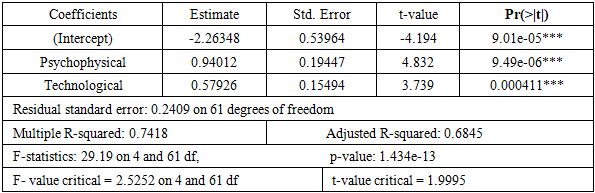
- Regression analysis was conducted to determine the effect of labour productivity factors on H&S hazards in building construction projects. The results of analysis are presented in Table 8. The significant labour productivity factors identified were considered in the analysis and a multiple linear regression analysis was performed in R-studio. Health and safety (H&S) was treated as dependent variable (Y), whereas Psychophysical and, technological group factors that influence H&S hazards of construction workers were taken as independent variables (x). Equation of the multiple regression analysis for the health and safety (H&S) from Table 8 is given by,
 | (4) |
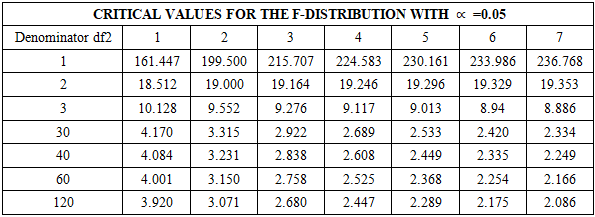
 value was 0.684, which indicate that the variation of 68 percent is attributed to these labour productivity factors included in the model. This demonstrates strong model generalizability and only 32 percent of the total variation remains unexplained. Therefore, the model would serve as a good predictor of H&S hazards in building construction projects in Uganda.(i). Model VerificationThe verification of the model was conducted using both the F-statistic and p-value criterion. As shown in Table 8, the observed F- statistic value of 29.19 exceeded the critical F- statistic value of 2.525 obtained from F-distribution Table 9, which indicate that the model explains a substantial amount of variation in the dependent variable relative to error. This finding is supported by the associated p-value of 1.434e-13. Considering the large F-statistic (29.19) with the small p-value (less than 0.05), it was concluded that the regression model is statistically significant at the 95% confidence level. This suggest a significant relationship between labour productivity factors (Psychophysical and technological) and H&S hazards in the building construction projects in Uganda. This finding a aligns with the study by [29], who argued that labour productivity factors ought to be accorded high priority by those working in construction to minimise H&S hazards of construction workers and execute projects in line with the predefined plan.
|
|
5. Conclusions
- The main objective of this investigation was to assess the influence of labour productivity factors on H&S hazards for construction workers in the building construction industry in Uganda. The relative importance index (RII) was computed for each factor and the resulting values were ranked to identify those with the greatest significance. Psychophysical factors emerged as the most influential, ranked first, followed by technological factors. These findings are supported by correlation coefficient analysis for each factor which revealed that Psychophysical and technological factors, had a strong positive correlation with H&S hazards on the construction workers in the building construction projects. Additionally, the regression analysis considered only the significant factors, from which a multiple linear regression was developed. Results found out that psychophysical and technological factors had a statistically significant impact on H&S hazards for construction workers. The effect of these factors is reflected in the adjusted R-squared value of 0.684, which indicates that 68 % of the variation in H&S model is attributed to labour productivity factors. The study concluded that, there is significant relationship between H&S risks and labour productivity factors in the building construction industry in Uganda. This study focused on technological and psychophysical labour productivity related factors that influence H&S hazards among construction workers. Regarding psychophysical aspects, the research concentrated on falls from a height, poor individual attitudes and mental fatigue. However, the findings suggest that future research should place emphasis on psychophysical labour productivity factors that contribute to H&S hazards such as salary increments, worker motivation and health corporate policies.