
-
Paper Information
- Paper Submission
-
Journal Information
- About This Journal
- Editorial Board
- Current Issue
- Archive
- Author Guidelines
- Contact Us
International Journal of Construction Engineering and Management
p-ISSN: 2326-1080 e-ISSN: 2326-1102
2026; 15(2): 19-31
doi:10.5923/j.ijcem.20261502.01
Received: Jun. 16, 2026; Accepted: Jun. 29, 2026; Published: Jul. 4, 2026

Solar Energy Solutions for Off-Grid Residential Communities in Ikorodu, Lagos State, Nigeria: Determinants of Household Adoption and Their Implications for Sustainable Infrastructure Development
 Abstract
 Reference
 Full-Text PDF
 Full-text HTML
Elizabeth O. Abosede, Joseph A. Oche, Micheal C. Okolo, Oreoluwa J. Ukah, Opeyemi A. Asaju, Obafemi A. Ibitoye
Department of Architecture, Caleb University, Lagos, Nigeria
Correspondence to: Elizabeth O. Abosede, Department of Architecture, Caleb University, Lagos, Nigeria.
| Email: |  |
Copyright © 2026 The Author(s). Published by Scientific & Academic Publishing.
This work is licensed under the Creative Commons Attribution International License (CC BY).
http://creativecommons.org/licenses/by/4.0/

Access to reliable electricity remains a major challenge in many off-grid communities in Nigeria, limiting residential development and sustainable infrastructure delivery. This study examined the determinants of household adoption of solar energy solutions and their implications for sustainable infrastructure development in the off-grid communities of Maya and Adamo, Ikorodu, Lagos State. A quantitative research design was adopted using a structured questionnaire administered to 200 households selected through purposive and convenience sampling techniques. Data were analysed using descriptive statistics, the Relative Importance Index (RII), Pearson correlation analysis, and regression analysis. The findings revealed that reliability (RII = 0.824), perceived benefits (RII = 0.808), and awareness (RII = 0.799) were the most influential determinants of solar energy adoption, whereas high installation cost (RII = 0.872) and limited access to financing (RII = 0.847) were identified as the principal barriers. The results further indicated that households perceived solar energy adoption as contributing positively to improved living standards, productivity, infrastructure quality, community development, and resilience. Correlation analysis showed a strong positive relationship between reliability and adoption intention (r = 0.694), while linear regression analysis established that adoption intention was a statistically significant positive predictor of sustainable infrastructure development (β = 0.458, R² = 0.289, p < 0.001). The study concludes that improving the affordability and accessibility of solar energy systems while enhancing their reliability can accelerate household adoption and support sustainable infrastructure development in off-grid residential communities. It recommends the integration of renewable energy solutions into residential planning, financing programmes, and infrastructure development strategies to promote resilient and sustainable settlements.
Keywords: Solar energy adoption, Sustainable infrastructure development, Off-grid communities, Residential development, Renewable energy, Ikorodu, Nigeria
Cite this paper: Elizabeth O. Abosede, Joseph A. Oche, Micheal C. Okolo, Oreoluwa J. Ukah, Opeyemi A. Asaju, Obafemi A. Ibitoye, Solar Energy Solutions for Off-Grid Residential Communities in Ikorodu, Lagos State, Nigeria: Determinants of Household Adoption and Their Implications for Sustainable Infrastructure Development, International Journal of Construction Engineering and Management , Vol. 15 No. 2, 2026, pp. 19-31. doi: 10.5923/j.ijcem.20261502.01.
Article Outline
1. Introduction
- Access to reliable, affordable, and sustainable energy remains one of the most important prerequisites for economic growth, social development, and improved living standards. Modern energy services support virtually every aspect of human activity, including industrial production, education, healthcare delivery, communication, transportation, and household welfare. Consequently, access to electricity has become a key indicator of development and an essential requirement for achieving sustainable economic and social progress. Despite considerable improvements in global electrification over recent decades, significant disparities in energy access persist, particularly across developing countries where millions of people continue to lack reliable electricity services. Recognizing the central role of energy in sustainable development, the United Nations incorporated energy access into Sustainable Development Goal 7 (SDG 7), which seeks to ensure universal access to affordable, reliable, sustainable, and modern energy for all by 2030. However, achieving this objective remains a major challenge in many parts of Sub-Saharan Africa where inadequate electricity infrastructure continues to constrain development outcomes. Nnaji et al. [1] observed that insufficient electricity supply remains one of the major obstacles to socio-economic development in many African countries, limiting opportunities for poverty reduction, industrial growth, and improved quality of life.The challenge of energy access is closely linked to the issues of energy poverty and energy security. Energy poverty occurs when households are unable to obtain adequate modern energy services required for basic living conditions, while energy security refers to the availability of sufficient energy resources at affordable and stable prices. In many developing countries, poor electricity infrastructure, inadequate investment, and increasing energy demand have contributed to persistent energy poverty among households and businesses. Monyei et al. [2] argued that improving access to reliable electricity is critical for reducing poverty, enhancing productivity, and promoting sustainable development. Consequently, governments and development organizations have increasingly prioritized energy access initiatives as part of broader efforts to achieve economic growth and social inclusion.Nigeria presents one of the most significant examples of the energy access challenge in Sub-Saharan Africa. Although the country possesses abundant fossil fuel resources and considerable renewable energy potential, electricity supply remains inadequate for a large proportion of the population. Aliyu et al. [3] attributed this situation to longstanding challenges within the electricity sector, including insufficient generation capacity, transmission constraints, distribution inefficiencies, and poor infrastructure maintenance. These challenges have resulted in frequent power outages and unreliable electricity supply across both urban and rural areas. Oseni [4] noted that the persistent inability of the national grid to meet electricity demand has compelled many households and businesses to depend heavily on self-generation through diesel and petrol generators. While generators provide an alternative source of electricity, they are associated with high operating costs, environmental pollution, greenhouse gas emissions, and noise-related health concerns. According to Monyei et al. [2], the continued dependence on generators reflects the severity of Nigeria's electricity deficit and highlights the urgent need for alternative energy solutions capable of improving access to reliable power.In response to these challenges, renewable energy technologies have increasingly attracted attention as viable alternatives for improving electricity access. Among the available renewable energy options, solar energy has emerged as one of the most promising due to its abundance, environmental sustainability, and suitability for decentralized electricity generation. Nigeria is located within a region of high solar irradiation and possesses substantial solar energy resources that can support widespread deployment of photovoltaic technologies. Ohunakin et al. [5] emphasized that Nigeria's geographical location provides favourable conditions for year-round solar energy generation. Similarly, Okoye et al. [6] identified solar photovoltaic systems as practical solutions for addressing electricity shortages, particularly in communities where grid extension is technically difficult or economically unviable. More recently, Chanchangi et al. [7] highlighted the strategic importance of solar energy in supporting Nigeria's energy transition objectives, improving energy security, and reducing dependence on conventional fossil-fuel-based energy systems.The growing recognition of solar energy's potential has encouraged the deployment of Solar Home Systems (SHSs), rooftop photovoltaic systems, and solar mini-grids across many developing countries. These decentralized energy systems are particularly valuable because they can provide electricity to households and communities that are underserved by conventional grid infrastructure. Barrie and Cruickshank [8] demonstrated that decentralized solar technologies can significantly improve energy access and support socio-economic development in underserved communities. Pelizan et al. [9] further reported that solar-based electrification programmes have contributed positively to improved living standards, enhanced educational opportunities, and increased economic activities within off-grid settlements. Within Nigeria, Audu and Adamu [10] observed increasing interest in Solar Home Systems among households seeking reliable alternatives to erratic grid electricity and expensive generator use. These developments indicate that solar technologies have considerable potential to complement conventional electricity systems and contribute to improved energy access.Despite the increasing availability of solar technologies and their recognized benefits, adoption rates remain relatively low compared with the country's technical solar energy potential. The existence of abundant solar resources does not automatically translate into widespread adoption of solar energy systems. Existing studies suggest that adoption decisions are influenced by a combination of economic, social, technical, institutional, and behavioural factors. Ali et al. [11] argued that awareness, perceived usefulness, ease of use, economic considerations, and social influences play important roles in shaping renewable energy adoption behaviour. Audu and Adamu [10] identified affordability as a major determinant of Solar Home System adoption among households in Nigeria, while Barrie and Cruickshank [8] emphasized the importance of financing mechanisms in improving access to renewable energy technologies. Pelizan et al. [9] similarly demonstrated that flexible financing arrangements can enhance solar energy adoption among low-income households. Durodola et al. [12] further maintained that successful deployment of decentralized renewable energy technologies depends not only on technological availability but also on users' willingness and capacity to adopt and sustain such technologies over time.Beyond addressing electricity access challenges, solar energy adoption has broader implications for sustainable infrastructure development. Energy is a critical component of infrastructure systems because it supports the operation of residential buildings, healthcare facilities, educational institutions, water supply systems, and commercial activities. Elusakin et al. [13] observed that renewable energy technologies can contribute significantly to rural and community development by improving access to essential services and reducing infrastructure deficits. Babalola et al. [14] further argued that investments in renewable energy infrastructure contribute to sustainable development by enhancing economic productivity, environmental sustainability, and social inclusion. Consequently, the adoption of solar energy technologies has implications that extend beyond household electricity supply to encompass broader issues of community resilience, infrastructure performance, and sustainable development.Although numerous studies have examined renewable energy adoption, off-grid electrification, affordability, financing mechanisms, and the socio-economic impacts of solar energy technologies, important knowledge gaps remain. Much of the existing literature has focused on rural communities, national-level energy policies, or the technical performance of renewable energy systems. Comparatively fewer studies have investigated the determinants of individual solar energy adoption within rapidly developing peri-urban communities experiencing persistent electricity supply challenges. Furthermore, limited empirical evidence exists regarding how household-level solar energy adoption contributes to sustainable infrastructure development within specific local contexts.This gap is particularly evident in Ikorodu, Lagos State, where growing residential development continues to place increasing pressure on existing electricity infrastructure. Despite the area's strategic importance within Lagos State, many communities continue to experience varying levels of electricity supply inadequacy, creating interest in alternative energy solutions such as solar power systems. However, limited evidence exists regarding the factors that influence household adoption decisions within these communities and the implications of such adoption for sustainable infrastructure development.This study therefore investigates the determinants of household adoption of solar energy solutions among residents of Maya and Adamo communities in Ikorodu, Lagos State, Nigeria. Specifically, the study examines household energy access characteristics, determines the level of solar energy adoption, identifies the key determinants and challenges influencing adoption decisions, and assesses the implications of solar energy adoption for sustainable infrastructure development. The findings are expected to contribute to the growing body of knowledge on renewable energy adoption while providing evidence-based insights for policymakers, renewable energy developers, infrastructure planners, and community stakeholders seeking to promote sustainable energy access and sustainable infrastructure development in Nigeria.
2. Literature Review
2.1. Solar Energy Solutions and Determinants of Adoption
- Solar energy has emerged as one of the most viable renewable energy solutions for improving electricity access in communities affected by inadequate or unreliable grid supply. Common residential applications include Solar Home Systems (SHSs), rooftop photovoltaic systems, and solar mini-grids. These technologies provide households with alternative sources of electricity for lighting, communication, refrigeration, and other domestic activities while reducing dependence on conventional energy sources. Azimoh et al. [18] observed that solar technologies have contributed significantly to improved energy access in underserved communities, while also supporting broader socio-economic development objectives.The increasing deployment of solar technologies has been driven by their environmental and economic benefits. Babajide and Brito [19] noted that solar photovoltaic systems provide cleaner and more sustainable alternatives to widespread generator dependence, particularly in countries experiencing persistent electricity supply challenges. In addition to reducing greenhouse gas emissions and fuel consumption, solar technologies offer opportunities for improved energy security and long-term cost savings.Despite these advantages, adoption rates remain uneven across households and communities. Existing studies indicate that solar energy adoption is influenced by a combination of socio-economic, behavioural, and institutional factors. Ali et al. [11] emphasized that awareness, knowledge, and perceptions of technology play important roles in shaping adoption decisions. Households that understand the benefits and operation of solar technologies are generally more willing to invest in and utilize such systems.Affordability remains one of the most significant determinants of adoption. Audu and Adamu [10] found that although households often demonstrate positive attitudes towards solar technologies, high acquisition costs can limit adoption, particularly among low-income groups. Similar concerns have been reported regarding installation expenses, maintenance costs, and the financial capacity of potential users to invest in renewable energy systems.Access to financing has also been identified as a critical factor influencing solar energy uptake. Barrie and Cruickshank [8] demonstrated that innovative financing models can reduce upfront investment barriers and improve access to solar technologies among low-income households. Likewise, Pelizan et al. [9] showed that flexible payment arrangements can significantly enhance affordability and increase adoption rates where conventional financing options are limited.Perceived benefits and system reliability further influence household decisions regarding solar energy adoption. Anagbakwu [20] reported that households are more likely to adopt solar technologies when they perceive improvements in electricity reliability, reduced energy expenditure, and enhanced quality of life. Durodola et al. [12] similarly argued that successful adoption depends not only on the availability of technology but also on users' confidence in its performance and long-term value.Collectively, the literature suggests that awareness, affordability, financing opportunities, perceived benefits, and reliability are among the most important factors shaping solar energy adoption. Understanding the influence of these determinants is therefore essential for designing interventions capable of increasing renewable energy uptake and improving energy access in electricity-deficient communities.
2.2. Sustainable Infrastructure Development
- Sustainable infrastructure development refers to the planning, provision, and management of infrastructure systems in ways that support economic growth, social well-being, and environmental sustainability. It emphasizes the delivery of infrastructure that meets present needs while maintaining the capacity to support future development. Energy infrastructure is a critical component of this process because reliable energy services underpin the functioning of residential buildings, healthcare facilities, educational institutions, water systems, and commercial activities (Nnaji et al. [1]).Access to reliable electricity contributes significantly to improved living standards and enhanced infrastructure performance. Elusakin et al. [13] observed that renewable energy technologies can address infrastructure deficits by improving access to essential services and supporting community development. By reducing dependence on unreliable conventional electricity sources, decentralized renewable energy systems can enhance the functionality and resilience of residential communities.The contribution of renewable energy extends beyond electricity provision to broader socio-economic outcomes. Babalola et al. [14] argued that investments in renewable energy infrastructure promote economic productivity, environmental sustainability, and social inclusion while strengthening community resilience. Consequently, the adoption of solar energy technologies can support sustainable infrastructure development by improving energy access, enhancing residential welfare, and contributing to long-term community sustainability.Given the important relationship between energy and infrastructure, understanding the factors that influence solar energy adoption is essential for developing strategies that promote both improved electricity access and sustainable infrastructure development in electricity-deficient communities.
2.3. Diffusion of Innovation Theory
- This study is anchored on the Diffusion of Innovation (DOI) Theory developed by Rogers [21]. The theory explains how new ideas, technologies, and innovations spread within a social system over time and why some individuals adopt innovations more readily than others. According to the theory, the adoption process involves awareness, evaluation, trial, and eventual acceptance or rejection of an innovation. The theory has been widely applied in studies examining the adoption of technological innovations, including renewable energy technologies and solar energy systems.The Diffusion of Innovation Theory identifies five major characteristics that influence adoption decisions. These include relative advantage, which refers to the extent to which an innovation is perceived as better than existing alternatives; compatibility, which describes how consistent the innovation is with users' needs, values, and experiences; complexity, which relates to the ease of understanding and using the innovation; trialability, which reflects the opportunity to test an innovation before full adoption; and observability, which concerns the visibility of the benefits derived from the innovation. Rogers [21] argued that innovations possessing favourable attributes across these dimensions are more likely to achieve widespread acceptance.The theory is particularly relevant to solar energy adoption because household decisions are often influenced by perceptions of costs, benefits, reliability, and ease of use. Potential users are more likely to adopt solar technologies when they perceive clear advantages over conventional electricity sources, understand how the systems operate, and have confidence in their ability to provide reliable energy services. Conversely, limited awareness, affordability constraints, and uncertainty regarding system performance may discourage adoption. As a result, the theory provides a useful framework for understanding the behavioural and socio-economic factors that influence renewable energy adoption.The relevance of the Diffusion of Innovation Theory to this study lies in its ability to explain the determinants of solar energy adoption among residents of electricity-deficient communities in Ikorodu, Lagos State. Variables examined in this study, including awareness, income, affordability, financing opportunities, perceived benefits, and reliability, influence how potential users perceive and evaluate solar energy technologies. The theory therefore provides an appropriate foundation for examining household adoption behaviour and understanding how increased adoption of solar energy solutions can contribute to sustainable infrastructure development.
2.4. Empirical Evidence on Solar Energy Adoption
- Empirical studies on solar energy adoption have identified several factors that influence households' decisions to adopt renewable energy technologies. These factors generally include affordability, financing opportunities, awareness, perceived benefits, reliability, and broader socio-economic conditions. Existing studies also demonstrate that solar energy adoption contributes not only to improved electricity access but also to wider developmental outcomes such as economic productivity, household welfare, and community resilience.A significant body of literature emphasizes the role of affordability in shaping solar energy adoption. Audu and Adamu [10] investigated the adoption of Solar Home Systems among households in off-grid communities in Kwara State, Nigeria, and found that although respondents expressed positive attitudes toward solar technologies, affordability remained a major constraint. The study revealed that many households were willing to adopt solar systems but lacked the financial capacity to meet prevailing market prices. Similarly, Pelizan et al. [9] reported that affordability significantly influences the adoption of solar technologies among rural households, particularly in developing economies where income levels remain relatively low. These findings suggest that reducing the cost burden associated with solar technologies is critical for expanding adoption among underserved populations.Closely related to affordability is the issue of financing. Barrie and Cruickshank [8] examined the role of Pay-As-You-Go financing models in promoting Solar Home System adoption and found that flexible payment arrangements can substantially improve access to renewable energy technologies. By reducing upfront investment requirements, such financing mechanisms enable households with limited financial resources to adopt solar energy systems. The study highlighted the importance of innovative financing strategies in accelerating renewable energy uptake, particularly in low-income communities where conventional credit facilities may be inaccessible.Beyond economic considerations, behavioural factors have also been identified as important determinants of solar energy adoption. Ali et al. [11] found that awareness, perceived usefulness, and social influences significantly affect household decisions regarding renewable energy technologies. The study demonstrated that individuals are more likely to adopt solar technologies when they possess adequate knowledge of their benefits and operation. Durodola et al. [12] similarly argued that successful deployment of decentralized renewable energy systems depends not only on technological availability but also on users' willingness to embrace and sustain their use. These findings reinforce the importance of awareness creation and public education programmes in promoting renewable energy adoption.Perceptions regarding the benefits and performance of solar technologies also influence adoption decisions. Anagbakwu [20] found that households were more inclined to adopt Solar Home Systems when they perceived improvements in electricity reliability, reduced energy expenditure, and enhanced living conditions. The study demonstrated that positive user experiences and confidence in system performance contribute significantly to increased adoption. Reliability therefore remains an important consideration, particularly in areas where households seek alternatives to unstable grid electricity and expensive generator use.Several studies have further examined the developmental impacts associated with solar energy adoption. Babajide and Brito [19] assessed the potential of residential solar photovoltaic systems as alternatives to widespread generator dependence in Nigeria and concluded that solar technologies provide cleaner, more sustainable, and economically viable energy solutions. Their findings highlighted the role of solar energy in improving household energy security while reducing environmental impacts associated with fossil-fuel-based electricity generation.At the community level, Babalola et al. [14] investigated the socio-economic impacts of off-grid energy systems in Southwest Nigeria and found that access to decentralized energy technologies contributes positively to business performance, income generation, local economic development, productivity, employment opportunities, and overall community welfare. These findings suggest that the benefits of solar energy adoption extend beyond individual households and contribute to broader socio-economic and development outcomes.Collectively, the empirical literature demonstrates that solar energy adoption is influenced by a combination of affordability, financing opportunities, awareness, perceived benefits, and reliability considerations. The literature also establishes that renewable energy technologies contribute significantly to improved energy access, household welfare, economic productivity, and community development. However, despite these contributions, limited empirical evidence exists regarding how these determinants interact to influence household adoption decisions within electricity-deficient communities in Ikorodu, Lagos State. This gap underscores the need for context-specific investigations capable of informing policies and strategies for expanding solar energy adoption and promoting sustainable infrastructure development.
2.5. Research Gap
- Existing studies have established the potential of solar energy technologies to improve electricity access, reduce energy poverty, and support socio-economic development through decentralized electrification systems. Previous research has examined issues such as affordability, financing mechanisms, behavioural determinants, renewable energy policy, and the developmental impacts of off-grid electrification. Audu and Adamu [10] highlighted affordability constraints in Solar Home System adoption, while Babajide and Brito [19] emphasized the role of solar technologies as alternatives to generator dependence. Ali et al. [11] examined behavioural factors influencing adoption decisions, and Babalola et al. [14] demonstrated the contribution of decentralized energy systems to community development. Collectively, these studies confirm the importance of solar energy in improving household welfare and expanding energy access.Despite these contributions, important gaps remain. Much of the existing literature focuses on rural communities, national-level assessments, or individual adoption determinants such as affordability, financing, awareness, and technical feasibility, with limited attention given to how these factors interact to influence household adoption decisions. In addition, although previous studies have reported positive socio-economic outcomes associated with renewable energy systems, limited empirical evidence exists on the relationship between household solar energy adoption and sustainable infrastructure development, particularly within electricity-deficient residential communities in Ikorodu, Lagos State. This study addresses this geographical and thematic gap by examining the determinants of individual solar energy adoption and their implications for sustainable infrastructure development in Maya and Adamo communities, thereby providing context-specific evidence for policy and planning.
3. Methodology
- This study adopted a quantitative cross-sectional survey design to investigate the determinants of household solar energy adoption and their implications for sustainable infrastructure development in selected off-grid communities in Ikorodu, Lagos State, Nigeria. The study was conducted in Maya and Adamo communities, which were purposively selected due to persistent electricity supply challenges and the growing need for alternative energy solutions.The target population comprised adult residents who were knowledgeable about household energy use and electricity supply conditions. The sample size was determined using Cochran’s [22] formula for large populations, yielding approximately 196 respondents. To improve representation and facilitate data collection, the sample size was rounded up to 200 respondents, consisting of 100 respondents each from Maya and Adamo communities. A purposive sampling technique was first employed to select the Maya and Adamo communities due to their persistent electricity supply challenges and relevance to the study objectives. Thereafter, convenience sampling was used to select eligible households and respondents who were available and willing to participate in the survey, with one adult respondent selected from each household.Primary data were collected using a structured questionnaire designed to obtain information on respondents’ socio-economic characteristics, household energy access conditions, determinants of solar energy adoption, adoption intention, perceived challenges, and perceptions of sustainable infrastructure development. The questionnaire was subjected to expert review to ensure content validity, while a pilot survey was conducted to evaluate its reliability. In addition, the internal consistency of the study constructs was assessed using Cronbach’s Alpha coefficient.The study measured key constructs including awareness, affordability, financing, perceived benefits, reliability, adoption intention, and sustainable infrastructure development, while respondents’ socio-economic characteristics such as education and income were also captured. Data were analysed using the Statistical Package for the Social Sciences (SPSS). Descriptive statistics, including frequencies, percentages, mean scores, and standard deviations, were used to summarise respondents’ characteristics and perceptions. The Relative Importance Index (RII) was employed to rank the determinants and challenges of solar energy adoption. Cronbach’s Alpha was used to assess the reliability of the measurement scales, while Pearson correlation analysis examined the relationships among the principal study constructs. Finally, linear regression analysis was performed to evaluate the influence of adoption intention on sustainable infrastructure development, thereby providing empirical evidence on the implications of household solar energy adoption for infrastructure sustainability in the study area.Participation was voluntary, respondents provided informed consent, and all responses were treated confidentially and used solely for academic research purposes.
4. Results and Discussion
4.1. Socio-Economic Characteristics of Respondents
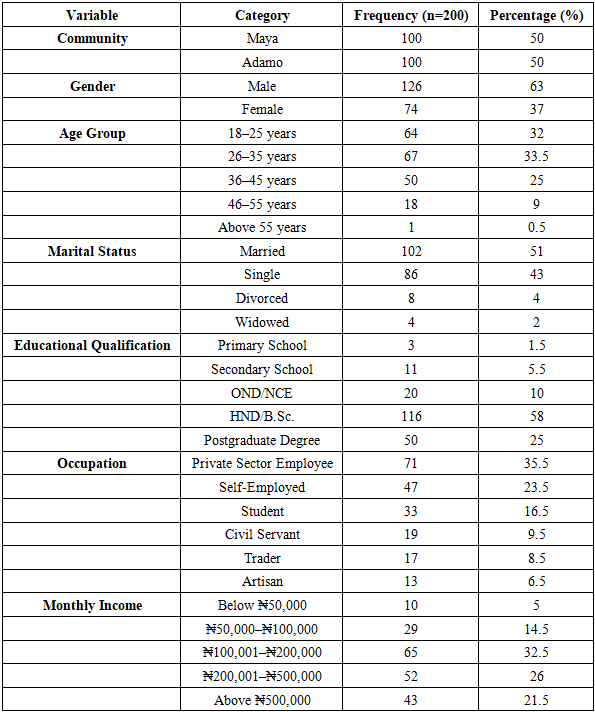
- The socio-economic characteristics of the respondents were examined to provide an understanding of the demographic and economic profile of households participating in the study. The variables considered include gender, age, educational attainment, occupation, monthly household income, and community of residence. The results are presented in Table 1.
|
4.2. Household Energy Access Characteristics
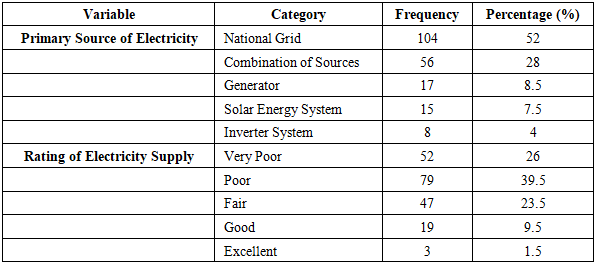
- Household energy access characteristics were examined to provide insight into the electricity supply conditions and energy-use patterns of respondents in the study area. The results are presented in Table 2.
|
4.3. Level of Solar Energy Adoption
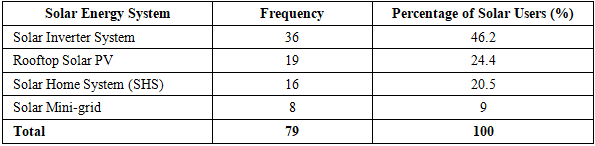
- The level of solar energy adoption among households was assessed to determine the extent to which respondents have embraced solar technologies as part of their residential energy supply. The results are presented in Table 3.
|

|
4.4. Determinants of Solar Energy Adoption
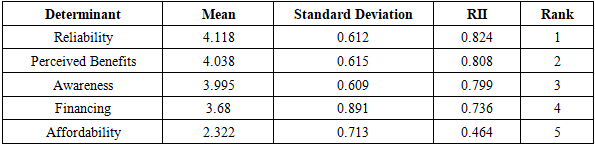
- Table 5 presents the composite mean scores, standard deviations, Relative Importance Index (RII), and rankings of the major determinants influencing household adoption of solar energy solutions in the off-grid residential communities of Maya and Adamo, Ikorodu, Lagos State.
|
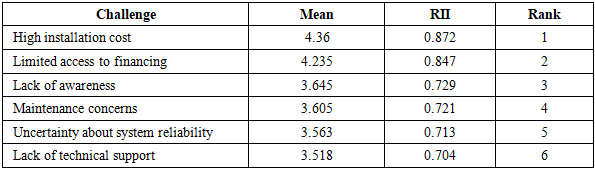
4.5. Challenges of Solar Energy Adoption
- Table 6 presents the major challenges affecting household adoption of solar energy solutions in the study area based on the composite mean scores and Relative Importance Index (RII).
|
4.6. Sustainable Infrastructure Development
- The perceived contribution of solar energy adoption to sustainable infrastructure development was assessed using five indicators: improved living standards, enhanced productivity, improved infrastructure quality, community development, and resilience against electricity outages. The composite results are presented in Table 7.
|

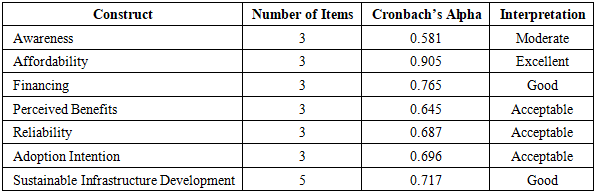
4.7. Reliability Assessment
- The internal consistency of the study constructs was assessed using Cronbach’s Alpha, and the results are presented in Table 8.
|
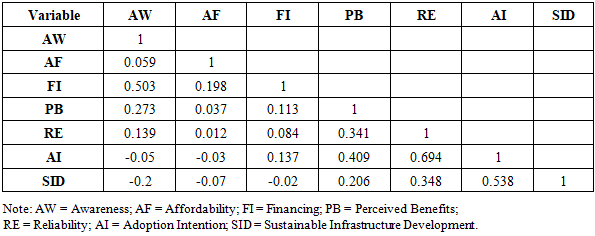
4.8. Correlation Analysis
- Pearson correlation analysis was conducted to examine the relationships among the principal constructs included in the study.
|
4.9. Regression Analysis
- To further examine the relationship between solar energy adoption and sustainable infrastructure development, a simple linear regression analysis was performed using Adoption Intention as the independent variable and Sustainable Infrastructure Development as the dependent variable. The results are presented in Table 10.
|

4.10. Implications for Construction and Infrastructure Management
- The findings of this study have important implications for construction engineering, residential development, and infrastructure management in off-grid communities. The identification of reliability and perceived benefits as the strongest drivers of solar energy adoption, alongside high installation costs and financing constraints as the major barriers, indicates that sustainable energy planning should be integrated into residential infrastructure development rather than treated as a separate intervention.For residential development, developers and housing providers should incorporate solar photovoltaic systems into project planning and design to improve energy security and reduce dependence on unreliable grid electricity. Early integration of renewable energy infrastructure can enhance the long-term functionality and resilience of housing developments.For infrastructure planning, the positive relationship between adoption intention and sustainable infrastructure development suggests that decentralised energy systems should be considered an essential component of community infrastructure. Integrating renewable energy into planning frameworks can improve service delivery and strengthen the resilience of rapidly growing settlements.The findings also have implications for community development and sustainable housing. Improved access to reliable solar energy can support household productivity, enhance living standards, and reduce reliance on costly alternative energy sources. Consequently, housing policies should promote renewable energy integration as part of broader sustainability objectives rather than as an optional feature.Finally, the study supports the concept of energy-integrated settlements, where energy infrastructure is planned alongside residential and community facilities. Such an approach can contribute to more resilient neighbourhoods, improve infrastructure performance, and support the transition towards sustainable urban development in off-grid communities.
5. Conclusions
- This study examined the determinants of household adoption of solar energy solutions and their implications for sustainable infrastructure development in the off-grid communities of Maya and Adamo, Ikorodu, Lagos State. The findings revealed that reliability, perceived benefits, and awareness are the principal factors influencing adoption, while high installation costs and limited access to financing remain the most significant barriers. The study also established that households generally perceive solar energy as contributing positively to improved living standards, productivity, infrastructure quality, community development, and resilience.Furthermore, the regression analysis demonstrated a positive and statistically significant relationship between adoption intention and sustainable infrastructure development, indicating that greater willingness to adopt solar energy is associated with more favourable infrastructure outcomes. These findings highlight the potential importance of integrating renewable energy solutions into residential development and infrastructure planning as a strategy for enhancing energy security and supporting sustainable community development in off-grid settlements.The study contributes to existing knowledge by providing empirical evidence on the determinants of household solar energy adoption within the context of off-grid residential communities in Ikorodu, Lagos State. Unlike many previous studies that examined affordability, financing, or awareness as separate determinants, this research integrates household adoption determinants with sustainable infrastructure development outcomes and presents a ranked assessment of the key drivers and barriers to adoption using the Relative Importance Index. It further demonstrates a positive and statistically significant relationship between adoption intention and sustainable infrastructure development, thereby extending the understanding of the association between household renewable energy adoption and infrastructure resilience and community well-being.Although this study provides valuable insights into the determinants of household solar energy adoption in the Maya and Adamo communities, its findings should be interpreted in light of certain limitations. The use of convenience sampling may introduce selection bias and limit the generalisability of the findings beyond the study area, as respondents were selected based on their availability and willingness to participate. In addition, the study was confined to two off-grid communities in Ikorodu, Lagos State, and employed a cross-sectional research design, which captures respondents’ perceptions at a single point in time and does not account for changes in adoption behaviour over time. Consequently, the findings should be interpreted within the context of the study area and research design. Future research should consider probability-based sampling techniques, adopt longitudinal approaches where feasible, and include a wider range of communities to improve the representativeness and generalisability of the findings.Based on these findings, it is recommended that government agencies introduce targeted financing mechanisms, including low-interest loans and subsidies, to reduce the financial burden associated with residential solar energy systems. Financial institutions and renewable energy providers should expand flexible payment models, such as pay-as-you-go schemes, to improve household access to solar technologies. Policymakers and infrastructure planners should integrate renewable energy systems into residential development policies and community infrastructure planning, particularly in underserved and off-grid areas. In addition, public awareness campaigns should be strengthened to improve understanding of the long-term economic and environmental benefits of solar energy adoption, while technical training programmes and local maintenance support services should be expanded to improve user confidence and ensure the long-term sustainability of installed solar energy systems.