
-
Paper Information
- Paper Submission
-
Journal Information
- About This Journal
- Editorial Board
- Current Issue
- Archive
- Author Guidelines
- Contact Us
International Journal of Construction Engineering and Management
p-ISSN: 2326-1080 e-ISSN: 2326-1102
2026; 15(1): 13-18
doi:10.5923/j.ijcem.20261501.03
Received: Jan. 19, 2026; Accepted: Feb. 16, 2026; Published: Mar. 31, 2026

Study and Analysis on the Suitability of Optimized Architectural Design for Data Centers in Southeast Asia
 Abstract
 Reference
 Full-Text PDF
 Full-text HTML
Fu Xian-Jun
China State Construction Engineering (M) SDN.BHD. 201301030805(1060634-X)
Correspondence to: Fu Xian-Jun, China State Construction Engineering (M) SDN.BHD. 201301030805(1060634-X).
| Email: |  |
Copyright © 2026 The Author(s). Published by Scientific & Academic Publishing.
This work is licensed under the Creative Commons Attribution International License (CC BY).
http://creativecommons.org/licenses/by/4.0/

The rapid expansion of digital infrastructure has positioned data centers as a critical component of economic and technological development in Southeast Asia. Compared with conventional industrial buildings, data centers are characterized by high power density, stringent environmental control requirements, and compressed project delivery schedules, which collectively impose complex challenges on architectural and structural design. This study examines the suitability of optimized architectural and structural design strategies for data center projects in Southeast Asia through a comprehensive analysis that integrates structural system selection, modular and prefabricated construction approaches, construction cycle performance, and energy-efficiency considerations. Drawing upon regional industry data, published research, and representative project case studies, the performance and applicability of reinforced concrete structures, steel structural systems, and modularized solutions are comparatively evaluated. The results indicate that steel structural systems combined with modular and prefabricated construction techniques demonstrate clear advantages in reducing construction duration, enhancing spatial flexibility, and supporting future capacity expansion. Furthermore, the integration of optimized enclosure systems and advanced cooling technologies contributes to significant improvements in overall energy efficiency. The findings of this study provide practical and evidence-based guidance for owners, designers, and EPC contractors in selecting appropriate architectural and structural strategies for data center development under tropical climatic conditions and fast-track delivery requirements.
Keywords: Data Center, Steel Structure, Large Cantilever, Classification
Cite this paper: Fu Xian-Jun, Study and Analysis on the Suitability of Optimized Architectural Design for Data Centers in Southeast Asia, International Journal of Construction Engineering and Management , Vol. 15 No. 1, 2026, pp. 13-18. doi: 10.5923/j.ijcem.20261501.03.
Article Outline
1. Introduction
- In the era of rapid development of digitalization and informatization, digital infrastructure has emerged as a new engineering field, among which data centers have become the core infrastructure supporting technologies such as 5G Internet, big data, and artificial intelligence (AI). With the popularization of cloud computing, the Internet of Things (IoT), and edge computing, the scale and quantity of data centers have experienced explosive growth as well as the basic functional requirements of conventional buildings.However, the current architectural design of data centers is confronted with numerous challenges: 1. High energy consumption issue: Data centers consume enormous amounts of energy. The demands of their cooling systems and power supply require architectural designs to prioritize energy conservation and environmental protection, while exploring ways to reduce PUE (Power Usage Effectiveness). Calculations based on PUE and data from the Global Data Center Survey 2024 show that the average PUE of data centers has decreased from 1.67 in 2019 to 1.56 in 2025. This indicates that a relatively high proportion of energy consumption (other than that from IT equipment) still comes from cooling and lighting systems. Nevertheless, for large-scale data centers operated by leading hyperscalers—such as Google, AWS, Microsoft, and ByteDance—this indicator has been reduced to the range of 1.10-1.30.2. Special load requirements: The concentrated arrangement of server equipment generates high static loads and dynamic loads, which impose strict demands on structural design. Due to the rapid iterative development of GPUs, the weight of supporting server racks has been continuously increasing. According to the latest public data on the Cheval Group - Open Rack v3 (ORv3), its weight will reach 1,600 kg.3. Demand for rapid construction: Faced with the rapid growth of data demand, the design and construction cycles of data center projects need to be significantly shortened, which promotes the application of new technologies such as modular and prefabricated construction.4. Environmental adaptability and sustainable development: The site selection of data centers often involves diverse geographical and climatic conditions. Therefore, design schemes need to be tailored to local conditions and minimize negative impacts on the environment.Against this backdrop, optimized design has gradually become a crucial direction in the architectural and structural design of data centers. By introducing methods such as parametric design, optimization algorithms, and simulation analysis, it is possible to achieve design economy and environmental friendliness while meeting technical performance requirements. This not only enhances the suitability of building structures but also provides innovative solutions for the industry.
2. Significance of the Research
- This paper takes the architectural and structural design of data center projects as the research object, integrates multi-dimensional requirements including technology, economy, and environment, and explores suitable optimized design methods. The research results will provide a theoretical basis and practical reference for the construction of high-efficiency and low-energy-consumption data centers, while promoting the in-depth application of green building concepts in the data center industry, thus possessing important academic value and engineering significance.The development of data centers began in the mid-to-late 20th century. The earliest data center originated from its primitive form: the ENIAC Computing Center (1946), which featured a reinforced concrete structural machine room. It weighed over 27 tons, occupied an area of 1,800 square feet, and consumed 150 kilowatts of electricity. It remained in operation until 1957. Subsequently, it evolved into a mature prototype: the SAGE Data Center (1950s). The commercialization and standardization of data centers started with the IBM System/360 Data Processing Center (1960s), which was widely used for large-scale data processing in enterprises and governments (see Figure 1). The equipment occupied an area of approximately one acre; the basement control room was filled with pipelines, valves, instruments, water pumps and water tanks, while a large cooling tower was installed upstairs, releasing 500,000 British thermal units (BTUs) into the atmosphere per hour. The computer rooms built for such equipment began to feature standardized characteristics such as rack layout, environmental control, and UPS systems, gradually forming the form of what we now call a "data center". Most of these buildings were mainly constructed with concrete structures and equipped with dedicated rooms for various types of equipment. It can be said that the focus of data center architecture design and optimization is to serve the use and maintenance of equipment, create a good and stable spatial environment, and ensure the stable operation of all types of equipment.
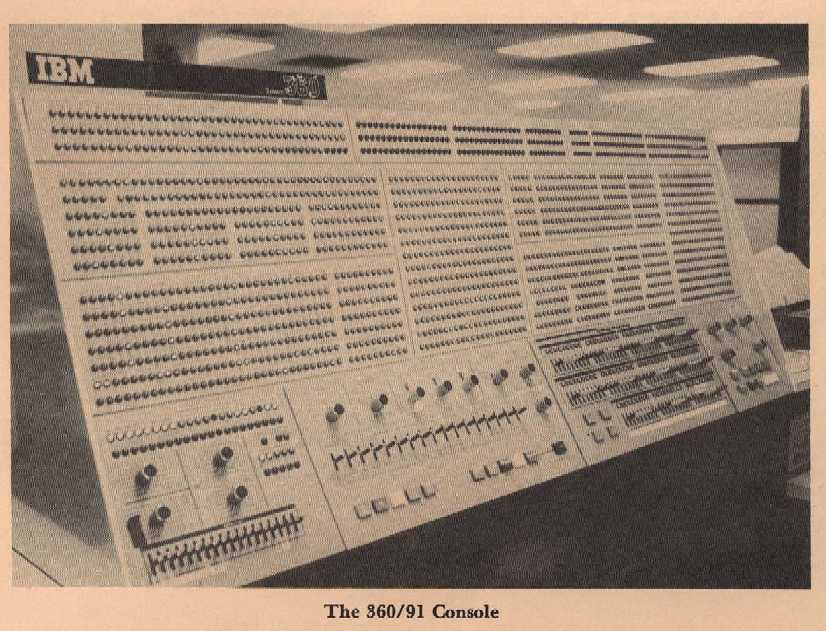 | Figure 1. IBM System/360 Data Processing Center (1960s) |
3. Characteristics and Requirements of Data Centers
- With the rapid development of the information society, data centers have become key infrastructure for undertaking data storage, computing, and transmission. Unlike traditional buildings, data centers feature a high degree of technological integration and operational sensitivity, requiring their architectural structures to meet a series of specific performance needs and engineering conditions.(1) Functional RequirementsHigh stability: Equipment in machine rooms is highly sensitive to factors such as vibration and temperature-humidity fluctuations. Therefore, architectural structures must minimize physical disturbances and environmental variations to the greatest extent.Flexibility and scalability: Data centers usually need to replace equipment and expand capacity in line with business development. Architectural structures should have a certain degree of spatial flexibility and load redundancy.(2) Special RequirementsIntegration of heat dissipation and ventilation systems: High-density IT equipment generates a large amount of heat. Architectural structures must be co-designed with HVAC (Heating, Ventilation, and Air Conditioning) systems to support methods such as hot-cold aisle containment, underfloor air supply, and overhead heat exhaust.Seismic performance: In earthquake-prone areas, the architectural structures of data centers must specifically consider seismic fortification and enhance the seismic grade of key areas.Load control: Heavy equipment such as server racks and UPS batteries impose much higher floor load requirements than ordinary office buildings. Architectural structure design must arrange load-bearing components reasonably to avoid local overloading.Electromagnetic and fire safety: Structural materials and spatial layout must take into account safety elements such as electromagnetic shielding and fire compartmentation.In response to the above special requirements, the optimized design of data center architectural structures should be guided by the balance of "function-performance-cost" and establish a complete theoretical framework for optimized design.Architectural structure optimization design refers to the process of finding optimal solutions in terms of structural layout, component dimensions, and material selection through mathematical modeling, computational analysis, and scheme comparison, on the premise of meeting functional requirements and safety standards. Its core objectives typically include:Optimal performance (e.g., higher structural stiffness, seismic capacity);Minimum cost (including initial construction cost and life-cycle cost);Maximized resource utilization (e.g., material efficiency, space utilization).
4. Current Status and Problem Analysis of Data Center Architectural Structure Optimization Design
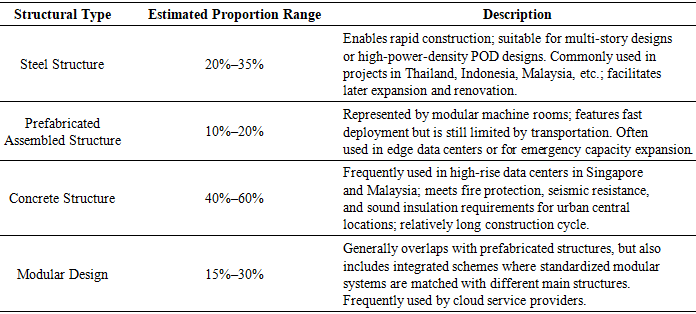
- Currently, for data centers constructed in Southeast Asia (including Singapore, Malaysia, Thailand, Indonesia, Vietnam, and other countries), the types and adoption ratios of their architectural structures are influenced by multiple factors, such as land resources, construction cycles, operation and maintenance costs, seismic requirements, and local labor conditions. The following are estimated data on the proportion of structure types, compiled based on public information, industry research reports (e.g., from Uptime Institute, Arup, AECOM), and project release information from major manufacturers (e.g., Google, AWS, Microsoft, Tencent, Alibaba Cloud):Singapore: Concrete structures dominate (with a high number of high-rise data centers, such as Facebook Tanjong Kling and Google Jurong). Due to scarce land resources and structural safety considerations, multi-story designs are more common. Malaysia: In recent years, steel structures with prefabricated exterior wall panels have been widely adopted (e.g., projects by Bridge DC, Yondr, GDS). This type is suitable for rapid deployment and areas with low seismic activity. Thailand/Indonesia/Vietnam: The acceptance of modular structures and steel structures is on the rise, especially in suburban areas or industrial parks, where construction cycles and logistics are prioritized factors. Common design schemes and adopted optimization methods (e.g., modularization, lightweight design) are as follows:
|
5. Modular Design and Prefabricated Production
- Modular design is an efficient construction method widely adopted in current data center development. This approach involves dividing the data center into standardized modules (such as IT POD, Power POD, and Cooling POD), which are prefabricated in factories before being transported to the construction site for rapid assembly. This significantly reduces on-site construction time—shortening the overall construction cycle by approximately 40%–60%—while reducing reliance on on-site labor and lowering the complexity of construction organization. Additionally, modular design facilitates standardized quality control, offers excellent scalability and replicability, and is particularly suitable for large-scale, multi-node data center deployments. This model has been widely applied in various international projects: for instance, the overseas modular data centers of Huawei and Alibaba Cloud; the partial mechanical and electrical modular deployments of Google and AWS in Malaysia and Singapore; and the "Shell + Core + Modular Fit-out" strategy promoted by Yondr Group. All these cases demonstrate high construction efficiency and robust engineering quality control.In terms of structural systems, equipment inside data centers (such as server racks, UPS, and battery systems) is located in high-density load areas, where the static load typically reaches 12–25 kN/m². Although traditional concrete structures have good load-bearing capacity, their heavy self-weight is detrimental to efficient space utilization and structural economy. Therefore, lightweight structural design has become a key optimization focus. Optimization strategies include:Using high-strength steel and profiled steel composite beams to reduce structural self-weight;Introducing steel-concrete composite structures to improve mechanical performance and construction convenience;Controlling floor thickness, reducing non-structural walls, and using lightweight materials (e.g., lightweight concrete, magnesium oxide boards, and ALC panels) in local areas.These measures reduce the total self-weight of the building by approximately 8%–15%, which not only helps reduce foundation loads and save foundation costs but also improves the dynamic response speed and cyclic performance of the structural system, enhancing overall operational efficiency.To further improve construction efficiency and reduce construction uncertainties, factory-based prefabrication technology has gradually been promoted in data center construction. This technology covers prefabricated structural components (such as precast floor slabs, steel beams, precast fair-faced walls, and assembled enclosure walls), as well as modular units for mechanical and electrical systems (such as cooling water pump rooms and CDU integrated modules) and fully assembled delivery equipment (such as UPS and power distribution cabinets). By completing the assembly of most structures and systems in factories, on-site wet work (e.g., concrete pouring) can be effectively avoided, reducing the impact of high-temperature, high-humidity environments or rainy seasons on construction schedules. For example, Keppel DC in Singapore adopted PPVC (Prefabricated Prefinished Volumetric Construction) technology, significantly improving construction speed while ensuring quality; the GDS Johor project achieved rapid deployment through modularization and plug-in installation of the cooling water system. These practices prove that factory-based prefabrication is not only an effective means to improve construction efficiency but also provides reliable support for the high-quality delivery of data centers in complex environments.
6. Suitability Analysis Methods for Architectural Optimization Design
6.1. Measurement Method for Construction Cycle
- In data center construction, the length of the construction cycle has become a key factor affecting project decision-making and economic benefits. Due to the fierce competition in the data computing service market and the accelerated pace of business deployment, data center projects usually face the challenges of tight schedules and heavy tasks. Taking a data center with a single-unit capacity of 20MW as an example: If a traditional concrete structure and plug-in equipment are adopted, the construction cycle is usually 18–22 months; If a prefabricated structure and block-type equipment are used, the construction period can be shortened to 16–18 months; If a steel structure is combined with modular equipment, the construction can be completed in only about 12 months, saving approximately 6 months. It can be seen that the adoption of advanced construction methods has significant value in improving construction efficiency and shortening the project cycle.Modular construction technology is the core means to achieve rapid delivery, which is mainly reflected in three aspects: Structural modular construction: By optimizing joint design, steel beams and columns are produced in a standardized manner to improve component processing and on-site hoisting efficiency; full bolt connection is adopted to reduce the impact of rainy seasons on construction. Modular M&E (Mechanical and Electrical) design: It can flexibly configure capacity according to customers’ business needs, facilitating later capacity expansion or adjustment, and reducing initial investment and resource waste. Modular equipment installation: Power, supply, and refrigeration system equipment are integrated into standardized modules respectively. After completing integration testing in the factory, the modules are transported to the project site as a whole, which greatly reduces on-site assembly and cable connection work and improves construction quality and efficiency.
6.2. Key Refrigeration Technologies
- In terms of refrigeration systems, new-generation data centers are gradually moving away from the traditional "chiller + air wall" refrigeration mode and turning to the "magnetic levitation phase-change cooling + room-level air wall" technology. This technology can control the supply and return air temperature between 24°C and 36°C, maximizing the refrigeration performance and energy-saving potential of air-cooled systems.In tropical regions, this system can operate at low power consumption for approximately 70% of the year. If a combined air-cooling and liquid-cooling scheme with a ratio of 2:8 is further adopted, the low-energy operation time can be extended to 90% of the year, significantly improving energy utilization efficiency.
6.3. Adaptability of Diversified Data Center Design
- To meet diversified business needs, data center design must have high flexibility in terms of cooling, power supply, space, and load arrangement: Cooling system: It needs to be compatible with multiple technical paths such as air cooling, plate-type liquid cooling, and immersion liquid cooling, so as to flexibly upgrade according to different rack power and customer requirements. Power system: The design of the Single-Line Diagram (SLD) should support ring network power distribution under the 2N architecture and have maintainability under single-point fault conditions. For the diesel power generation system, it is recommended to adopt a medium-voltage generator module combined with an ATS (Automatic Transfer Switch) switching ring network design to reduce failure rates while ensuring economy. Power module integration: By integrating IT loads and power loads into a unified power module, the economy and reliability of the power supply and distribution system can be improved. Space layout: Adopting reasonable space layout strategies, such as same-floor power distribution and optimized planar load arrangement, is not only conducive to minimizing the path of the M&E system but also helps improve the operational efficiency and scalability of the building structure.
7. Case Study on Optimization Design
- Taking Phase V of Qinhuai Data Center as an example, the load design optimization mainly focuses on three aspects: rational layout of live loads, material optimization, and column load optimization. In the initial design stage, the owner usually sets the live load of the entire floor slab conservatively at 15KN/m². After obtaining the conceptual design, we divided the functional rooms into different zones to achieve a more reasonable distribution of live loads. In terms of material optimization, on the premise of ensuring the safety of structural simulation calculations, we replaced the material of some steel beams from S355 to S275, which effectively reduced the amount of steel used. The optimized area is the part marked in yellow in the figure below.For column load optimization, the cross-sectional dimensions of steel structure columns were optimized according to the different load requirements of each floor. The cross-sectional area of the upper steel columns was reduced by 36% compared with that of the lower steel columns.The second part is the optimization of internal wall design. By using new lightweight partition boards to replace traditional brick walls, we not only met the room division requirements but also achieved the 2-hour fire protection standard. Compared with the traditional masonry structure, the construction period was shortened by two months.The third part is the optimization of external wall design. Traditional concrete external wall panels were replaced with new polyurethane-edged rock wool composite panels. This new type of external wall panel does not require plastering or real stone paint spraying, enabling rapid modular construction. Its convenient disassembly reserves space for future reconstruction, and it also has multiple performances such as fire resistance, heat insulation, sound insulation, waterproofing, and air tightness. Compared with traditional building external walls, it shortens the construction period, and the external wall panels can be completely disassembled and reinstalled during future upgrading and reconstruction, providing great flexibility for reconstruction.The fourth part is the energy efficiency optimization of refrigeration technology. Currently, the Power Usage Effectiveness (PUE) of data centers is the most important indicator to measure energy efficiency. The PUE value is equal to the total energy consumption of the data center divided by the energy consumption of IT equipment; the closer it is to 1, the higher the power utilization rate. According to the latest statistics from the Uptime Institute, the average PUE of global data centers is 1.56.So how to improve the effective energy utilization rate? It can be seen that the energy consumption of the air conditioning system accounts for about 80% of the non-IT equipment energy consumption; therefore, the air conditioning system is the focus of optimization. For example, in Phase V of Qinhuai Data Center, we adopted magnetic levitation phase-change refrigeration technology, reducing the PUE to 1.2, and the system operates at low power for 70% of the whole year. In Phase II of Qinhuai Data Center, the PUE was further reduced to 1.05 by using immersion cooling technology, and the system runs at low power for 90% of the whole year.The fifth part is the optimization and efficiency improvement of the power distribution structure. First, the 2N architecture was transformed into a more efficient 4DR architecture. There are 4 power supply paths (A, B, C, D), and each IT cabinet is connected to two of them (e.g., A+C or B+D). Although each path usually cannot bear the load of the entire computer room independently, it can form a redundant coverage area. Redundancy is achieved through path dispersion, and at the same time, the number of transformers, UPS + battery packs, low-voltage power distribution systems, and PDs (Power Distribution Units) is reduced. Through multi-path interleaved redundancy, the 4DR architecture not only improves fault isolation capability but also optimizes the allocation of power resources. Compared with the traditional 2N design, it can significantly reduce the cost of the power distribution structure.
8. Conclusions and Prospects
- This study demonstrates that the suitability of architectural and structural design for data centers in Southeast Asia is closely related to construction cycle requirements, energy efficiency targets, and long-term operational flexibility. Through comparative analysis and project-based validation, it is shown that steel structural systems combined with modular and prefabricated construction methods can effectively shorten construction periods while maintaining structural safety and adaptability to high-density IT loads.From an engineering practice perspective, the findings suggest that steel and modular solutions are particularly suitable for hyperscale and rapid-deployment data center projects in tropical regions, whereas reinforced concrete structures remain advantageous for high-rise or urban-constrained developments. The proposed optimization strategies provide practical references for EPC contractors in balancing cost, schedule, and performance under Design–Build or EPC delivery modes.Looking forward, with the increasing adoption of liquid cooling technologies and high-power server racks, future data center design will place greater emphasis on integrated architectural–MEP optimization and life-cycle performance. The methodology and conclusions presented in this study can serve as a reference framework for future data center projects and related research in emerging markets.