
-
Paper Information
- Paper Submission
-
Journal Information
- About This Journal
- Editorial Board
- Current Issue
- Archive
- Author Guidelines
- Contact Us
International Journal of Construction Engineering and Management
p-ISSN: 2326-1080 e-ISSN: 2326-1102
2026; 15(1): 7-12
doi:10.5923/j.ijcem.20261501.02
Received: Feb. 19, 2026; Accepted: Mar. 3, 2026; Published: Mar. 9, 2026

Implementation Analysis of Building Information Modeling in Planning Consultant Firms
 Abstract
 Reference
 Full-Text PDF
 Full-text HTML
Hafnidar A. Rani1, Muhammad Reza Fahlevi1, Fatimah Azzahra2
1Department of Civil Engineering, Universitas Muhammadiyah Aceh, Banda Aceh, Indonesia
2Department of Architecture, Universitas Muhammadiyah Aceh, Banda Aceh, Indonesia
Correspondence to: Hafnidar A. Rani, Department of Civil Engineering, Universitas Muhammadiyah Aceh, Banda Aceh, Indonesia.
| Email: |  |
Copyright © 2026 The Author(s). Published by Scientific & Academic Publishing.
This work is licensed under the Creative Commons Attribution International License (CC BY).
http://creativecommons.org/licenses/by/4.0/

Building Information Modeling (BIM) has transformed construction practices globally; however, its adoption in developing countries remains uneven. This study investigates the level of BIM implementation among planning consultant firms in Indonesia and identifies key barriers affecting its integration. A quantitative descriptive approach was applied using survey data from 40 consultant firms. Descriptive statistics and exploratory factor analysis were employed to evaluate adoption levels and influencing factors. Results show that 65% of firms have adopted BIM, predominantly at the 3D modeling level (43%), while only 22% utilize advanced functionalities such as 4D scheduling and 5D cost estimation. Major barriers include high implementation costs, limited skilled professionals, and inadequate regulatory enforcement. Larger firms demonstrate significantly higher adoption rates compared to SMEs. The findings highlight the urgent need for structured policy mandates, financial incentives, and workforce development programs to accelerate BIM integration in Indonesia’s construction sector.
Keywords: Building Information Modeling, BIM adoption, Planning consultants, Construction industry, Digital construction
Cite this paper: Hafnidar A. Rani, Muhammad Reza Fahlevi, Fatimah Azzahra, Implementation Analysis of Building Information Modeling in Planning Consultant Firms, International Journal of Construction Engineering and Management , Vol. 15 No. 1, 2026, pp. 7-12. doi: 10.5923/j.ijcem.20261501.02.
Article Outline
1. Introduction
- Beyond its technological function, BIM represents a paradigm shift in construction project delivery. Rather than serving solely as a digital modeling tool, BIM integrates data-driven collaboration across multiple project stakeholders, enabling real-time coordination, lifecycle analysis, and performance optimization [1,2]. The transition from traditional 2D-based workflows to BIM-based integrated systems fundamentally alters decision-making processes, contractual arrangements, and information transparency within the supply chain. Consequently, BIM adoption is increasingly associated not only with operational efficiency but also with long-term strategic competitiveness in the global construction market [3,4].Globally, the acceleration of BIM implementation has been strongly influenced by institutional intervention. Countries with structured regulatory frameworks demonstrate higher levels of standardization and digital maturity, particularly where BIM mandates are enforced for public infrastructure projects [5,6]. These policies have contributed to measurable improvements in cost control, risk management, and sustainability performance [7,8]. In contrast, nations relying on voluntary adoption often experience fragmented implementation patterns, particularly among small and medium-sized enterprises (SMEs) with limited financial and technical capacity [9,10].In developing economies, digital transformation within construction industries is frequently constrained by structural challenges. Financial limitations, limited access to skilled professionals, and weak institutional enforcement mechanisms collectively slow the diffusion of innovation [11,12]. These constraints are particularly significant in markets characterized by high SME participation, where firms often operate on narrow profit margins and limited technological infrastructure [13]. As a result, BIM adoption becomes uneven, with larger firms advancing more rapidly than smaller counterparts.Indonesia reflects many of these structural conditions. Although national guidelines for BIM implementation have been introduced by the Ministry of Public Works and Housing (PUPR) [8], the absence of legally binding mandates has limited systematic industry-wide adoption [14]. Planning consultant firms, which play a central role in early-stage project planning, cost estimation, and design coordination, are critical actors in this transformation process. However, empirical evidence focusing specifically on BIM adoption within this segment remains limited [12,13].Given the strategic position of planning consultants in shaping project workflows and digital integration, assessing their level of BIM maturity provides valuable insight into Indonesia’s broader construction digitalization trajectory. Therefore, this study aims to analyze adoption patterns, identify dominant implementation barriers, and evaluate structural factors influencing BIM integration among Indonesian planning consultant firms.
2. Literature Review
2.1. BIM and Digital Transformation
- BIM has evolved from a three-dimensional modeling tool into a comprehensive digital platform supporting lifecycle project management. Beyond visualization, BIM integrates scheduling (4D), cost estimation (5D), risk management, and sustainability analysis into a unified information environment [3,7,15,16]. Such multidimensional integration enhances coordination accuracy, reduces design conflicts, and improves overall project efficiency.The integration of BIM with emerging technologies, including artificial intelligence, digital twins, and Internet of Things (IoT) systems, further expands its transformative potential [17-20]. These technological convergences enable predictive maintenance, real-time monitoring, and data-driven decision-making across the construction lifecycle. Systematic reviews consistently demonstrate that BIM adoption contributes to improved project performance, reduced delays, enhanced collaboration, and better risk mitigation [4,8,21].However, digital transformation extends beyond technological deployment. Successful BIM integration requires organizational restructuring, workflow redefinition, and strategic alignment across project stakeholders [2,11]. Firms that treat BIM merely as software adoption often fail to achieve higher maturity levels, remaining confined to basic 3D modeling without fully leveraging collaborative and data-centric capabilities [22].
2.2. BIM Maturity and Implementation Levels
- BIM implementation is frequently assessed through maturity levels reflecting the depth of digital integration within an organization. Early-stage adoption typically focuses on 3D modeling for visualization and clash detection, while more advanced levels incorporate 4D scheduling, 5D cost control, and lifecycle asset management [3,7]. Higher maturity levels are associated with improved interoperability, standardized information exchange, and enhanced decision support systems [4,8].Achieving advanced BIM maturity requires not only financial investment but also organizational readiness and institutional support [2,22]. In many developing countries, firms remain at partial adoption stages due to limited technical expertise, resource constraints, and insufficient regulatory enforcement [9,10]. This uneven progression creates a digital maturity gap within the industry, where larger firms advance more rapidly than SMEs.
2.3. Factors Affecting BIM Adoption
- Previous research identifies four dominant determinants influencing BIM adoption: financial capability, technical competence, regulatory enforcement, and organizational culture [9,10]. High software licensing costs, infrastructure upgrades, and training investments represent substantial barriers, particularly for SMEs operating with constrained budgets [12,13].Institutional influence significantly shapes adoption trajectories. Countries with mandatory BIM regulations demonstrate more consistent implementation across public projects and supply chains [4,5]. In contrast, voluntary frameworks often result in fragmented uptake, with adoption driven primarily by market demand rather than policy enforcement [14,22].Comprehensive reviews further confirm that successful BIM integration depends on coordinated policy instruments, structured training systems, and sustained institutional support mechanisms [16]. Without these enabling conditions, adoption remains uneven and maturity levels stagnate.
2.4. BIM Adoption in Indonesia
- In Indonesia, BIM adoption remains divided across firm categories. Larger firms and multinational companies are more likely to integrate BIM into their workflows, while SMEs continue relying on traditional 2D CAD systems [9,12,23]. Financial limitations, workforce shortages, and unclear regulatory frameworks remain dominant barriers [10,13].Although national BIM guidelines have been introduced [14], the absence of legally binding mandates has resulted in inconsistent implementation across consultant firms. The limited enforcement of compliance standards and monitoring mechanisms further contributes to uneven adoption patterns. Consequently, BIM integration within Indonesia’s planning consultant sector reflects broader structural challenges in achieving systematic digital transformation.
3. Methodology
- A quantitative descriptive approach was employed using structured questionnaires distributed to 40 planning consultant firms. The survey measured BIM usage level (3D, 4D, 5D), perceived benefits, perceived barriers, and organizational readiness related to BIM implementation.The collected data were analyzed using descriptive statistical techniques, including frequency distribution and percentage analysis, to identify adoption patterns and dominant implementation barriers. This approach enables a systematic representation of BIM maturity levels and challenges experienced by consultant firms within the Indonesian construction context.The descriptive analysis focuses on identifying trends and comparative patterns across firm categories, particularly between small and medium-sized enterprises (SMEs) and larger firms. The results are presented through graphical and tabular visualization to support interpretative discussion of BIM adoption levels and structural constraints.
4. Results and Discussion
4.1. BIM Adoption Levels Among Planning Consultant Firms
- The results indicate that 65% of surveyed firms have adopted BIM in their workflows. Of these, 43% primarily utilize BIM for 3D modeling and visualization, while only 22% have integrated advanced functionalities such as 4D scheduling and 5D cost estimation. This pattern suggests that BIM maturity among consultant firms remains at an intermediate level.As illustrated in Figure 1, BIM implementation is still concentrated at the 3D stage, with limited transition toward higher-dimensional integration.
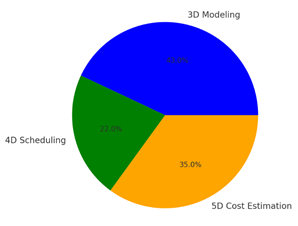 | Figure 1. BIM usage distribution |
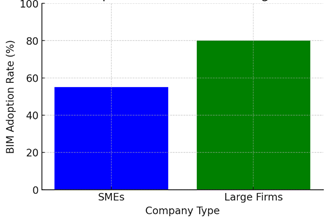 | Figure 2. BIM adoption rate: SMEs vs large firms |
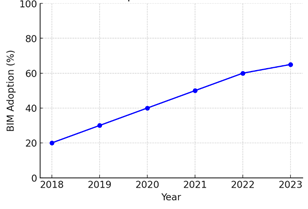 | Figure 3. BIM adoption trend over time |
4.2. Barriers to BIM Implementation
- High initial investment costs emerged as the most significant barrier, cited by 78% of respondents. The financial burden of software licensing, hardware upgrades, and training programs particularly affects SMEs [10,12,13].In addition, 65% of firms reported a shortage of skilled BIM professionals, while 58% identified regulatory ambiguity as a critical obstacle [4,9]. Resistance to organizational change (50%) and interoperability challenges (47%) further constrain effective implementation.As shown in Figure 4, financial and institutional barriers dominate the implementation landscape, reinforcing the need for structured policy intervention and workforce development programs [10,22].
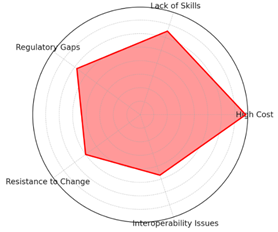 | Figure 4. Barriers to BIM adaption |
4.3. Comparative Analysis with International BIM Adoption
- A comparison with international practices highlights the influence of regulatory enforcement on BIM adoption. Countries such as the United Kingdom and Singapore have accelerated implementation through legally binding mandates and structured support mechanisms [5,6]. The UK’s BIM Level 2 mandate (since 2016) significantly increased public-sector compliance, supported by SME training programs and financial incentives. Similarly, Singapore’s Building and Construction Authority (BCA) enforces BIM e-submission requirements, ensuring sector-wide standardization [9].In contrast, Indonesia relies on voluntary guidelines [14], resulting in uneven implementation, particularly among SMEs lacking financial and technical capacity [2,8]. These findings underscore the importance of policy reform combining regulatory mandates, financial support, and human resource development to achieve consistent national adoption [24].
4.4. Policy Recommendations for Enhancing BIM Adoption in Indonesia
- Based on these findings, several strategic interventions are proposed. First, the government should introduce mandatory BIM requirements for publicly funded projects, following successful models in Singapore and the UK [5,9]. Second, financial mechanisms such as tax incentives, grants, and low-interest loans are essential to reduce entry barriers for SMEs [14]. Third, universities and technical institutions must integrate BIM into core curricula and certification systems to strengthen workforce readiness [11,14].Furthermore, establishing BIM compliance monitoring bodies and promoting collaboration among government agencies, industry associations, and technology providers would enhance standardization and innovation [8,21]. Through coordinated regulatory and institutional reform, Indonesia can bridge the gap between policy and practice and strengthen digital competitiveness [10].In addition, mandatory BIM adoption supported by government-led training programs is essential to ensure that both large firms and SMEs can effectively implement advanced BIM technologies.
4.5. Discussion
- This study confirms that BIM adoption among Indonesian planning consultant firms remains uneven, with a significant gap between large firms and SMEs [2,9]. Consistent with international research, firm size strongly correlates with adoption due to differences in financial capacity, skilled personnel, and access to international standards [5,6,18].Beyond organizational size, the findings also reveal a broader digital maturity gap within the Indonesian construction sector. Firms that have partially adopted BIM often remain at an operational level without fully integrating collaborative workflows or data-driven decision-making processes. This indicates that BIM implementation is not merely a technological transition but a systemic organizational transformation requiring cultural adaptation and strategic alignment.The absence of a legally binding national mandate remains a central structural barrier. Countries with strong enforcement frameworks demonstrate faster and more uniform BIM integration across public and private sectors [5,7]. Indonesia’s voluntary approach contributes to fragmented implementation and investment hesitation among smaller firms [2,8].The absence of an enforceable BIM roadmap further limits institutional readiness at the national level. While guidelines exist, implementation lacks standardized monitoring mechanisms and measurable performance benchmarks. International experiences suggest that regulatory clarity combined with phased implementation strategies significantly accelerates adoption consistency across the supply chain.Financial constraints are particularly critical, as software, hardware, and training investments can represent a substantial cost burden [25]. Successful BIM economies mitigate these barriers through tax incentives, subsidies, and public-private partnerships [6,21]. Workforce shortages further constrain adoption, emphasizing the need for integrated educational ecosystems aligned with industry requirements [11,14].Overall, BIM adoption in Indonesia requires coordinated regulatory enforcement, financial assistance, and structured capacity-building initiatives to ensure broader and more equitable industry transformation [24].In the long term, limited BIM maturity may affect Indonesia’s competitiveness in attracting foreign investment and participating in cross-border infrastructure projects. As global construction increasingly adopts digital compliance standards, firms operating without structured BIM integration may face reduced competitiveness and interoperability challenges.
4.6. Future Implications and Strategic Directions
- Accelerating BIM adoption in Indonesia demands a multi-stakeholder ecosystem involving government, academia, and industry. Legally binding mandates for public infrastructure projects remain the most decisive policy instrument, as demonstrated by Singapore and the UK [9].Complementary financial support mechanisms, including grants and soft loans are necessary to support SMEs [24]. Simultaneously, embedding BIM education within university curricula and expanding professional certification pathways would strengthen long-term workforce readiness [11,14].Investment in national BIM research hubs and knowledge-sharing platforms can further sustain innovation and standardization, as practiced in several advanced digital construction economies [4,21]. Such integrated measures would position Indonesia to achieve sustainable digital transformation and regional competitiveness.
5. Conclusions
- This study demonstrates that BIM adoption among planning consultant firms in Indonesia remains at an early and uneven stage. Although a majority of firms have begun implementing BIM, its application is largely limited to basic 3D modeling, while advanced functionalities such as 4D scheduling and 5D cost estimation remain underutilized.Firm size plays a decisive role in adoption levels. Larger firms exhibit higher integration due to stronger financial capacity, better access to skilled personnel, and greater exposure to international project standards. In contrast, small and medium-sized enterprises continue to face significant financial, technical, and organizational barriers that slow their transition toward digital workflows.The absence of a legally binding national BIM mandate further contributes to fragmented implementation across the industry. Without structured regulatory enforcement and targeted financial support, BIM adoption is likely to remain concentrated among larger firms.Despite these challenges, the study confirms that BIM offers substantial benefits in improving coordination, efficiency, and overall project performance. To achieve broader digital transformation, Indonesia must prioritize mandatory BIM policies for public projects, financial support mechanisms for SMEs, and systematic workforce development initiatives.By aligning regulatory frameworks, industry readiness, and educational capacity, Indonesia can accelerate BIM maturity and strengthen its competitiveness within the global construction landscape.
ACKNOWLEDGEMENTS
- The authors would like to thank all planning consultant firms who participated in this study and provided valuable insights regarding BIM implementation practices.