
-
Paper Information
- Paper Submission
-
Journal Information
- About This Journal
- Editorial Board
- Current Issue
- Archive
- Author Guidelines
- Contact Us
International Journal of Construction Engineering and Management
p-ISSN: 2326-1080 e-ISSN: 2326-1102
2026; 15(1): 1-6
doi:10.5923/j.ijcem.20261501.01
Received: Jan. 27, 2026; Accepted: Feb. 22, 2026; Published: Feb. 26, 2026

Bond Behavior of Micro- and Nanoparticles Modifies Epoxy Resin Coated Basalt Fiber Sheets and Strands Embedded in Cement Concrete Composites
 Abstract
 Reference
 Full-Text PDF
 Full-text HTML
Vijay K. Srivastava1, Sergej Rempel2, Vincent Mack2
1Department of Mechanical Engineering, Indian Institute of Technology (BHU), Varanasi, India
2Faculty of Architecture and Civil Engineering, Technical University of Augsburg, Germany
Correspondence to: Vijay K. Srivastava, Department of Mechanical Engineering, Indian Institute of Technology (BHU), Varanasi, India.
| Email: |  |
Copyright © 2026 The Author(s). Published by Scientific & Academic Publishing.
This work is licensed under the Creative Commons Attribution International License (CC BY).
http://creativecommons.org/licenses/by/4.0/

This study aimed to assess the bonding strength between cement concrete and basalt fiber strands and sheets coated with the 1% multiwall carbon nanotubes (MWCNTs)-epoxy resin mixture, 1% graphene nanoplates (GnPs)-epoxy resin mixture, and 1% silica-epoxy resin mixture. The fiber pull-out test was used to measure the bonding strength between cement concrete and coated basalt fiber strands and sheets with the modified epoxy resin. The results show that the bonding strength increased after the coating with modified epoxy resin with 1% MWCNTs, GnPs, and silica particles because nanoparticles penetrate the basalt fiber sheet/strand, and concrete -cement along with the epoxy resin. The bonding strength of the GnPs-epoxy resin mixture, MWCNTs-epoxy resin mixture, and silica-epoxy resin mixture coated basalt fiber sheet and strand is higher than the uncoated specimens because the CNTs coating creates a rough, multi-scale surface architecture on the smooth basalt fiber, which promotes strong mechanical interlocking with the polymer matrix and increases the bonding strength of the coated basalt fiber sheet/strand.
Keywords: Basalt fiber, Multiwalled carbon nanotubes, Graphene nanoplates, Epoxy resin, Cement, Concrete, Bonding strength
Cite this paper: Vijay K. Srivastava, Sergej Rempel, Vincent Mack, Bond Behavior of Micro- and Nanoparticles Modifies Epoxy Resin Coated Basalt Fiber Sheets and Strands Embedded in Cement Concrete Composites, International Journal of Construction Engineering and Management , Vol. 15 No. 1, 2026, pp. 1-6. doi: 10.5923/j.ijcem.20261501.01.
Article Outline
1. Introduction
- The low tensile capacity of concrete often results in brittle failure without any warning. The drawbacks of steel fibers included reduce workability, and corrosion. Therefore, fiber-reinforced polymer (FRP) sheet has been widely used as strengthening materials for reinforced concrete (RC) structures because of excellent durability and high tensile strength. FRP sheets are most commonly bonded onto concrete surfaces through externally bonded reinforcement on account of convenience of construction [1-3]. In recent years, basalt fibers (BFs) embedded in concrete as compared to a variety of other type of fiber, have attracted the attention of researchers due to improve elastic properties and tensile strength. However, basalt fiber still needed to improve bonding behaviour in between basalt fiber and cement concrete [4-7]. The uncured epoxy resin initially has less mechanical, chemical properties, where three-dimensional cross-linked thermosetting structures can be obtained after blended with an appropriate curing hardener. Therefore, the cured epoxy resin is brittle and less resistant to crack growth owing to its large cross-linking density, despite its high modulus and excellent adhesion. However, epoxy resins can be modified by adding various kinds of nanofillers to enhance the mechanical performances. Carbon nanotubes (CNTs), as a type of nanomaterials, have attracted extensive interest owing to their outstanding physical properties and mechanical properties, and they can enhance the mechanical properties of epoxy resins at low concentrations [8]. In addition, epoxy resins modified by CNTs have been used in impregnating kinds of fibers to enhance the mechanical properties of FRP sheets including tensile strength, interlaminar shear strength (ILSS) and so on [9-10]. Korayem et al. [11] indicated that the bond strength between steel and carbon fiber-reinforced polymer (CFRP) laminates increased two fold by MWCNTs modified epoxy resin compared with neat epoxy resin. Still, there aren't enough studies on the bond behavior of the FRP sheet-concrete joints using GnPs and MWCNTs-modified epoxy, such as the failure mode, bond strength, ultimate global displacement, BFRP strain distribution, bond stress-displacement relationship, and so on. Changchun Shi et al [12] indicated that the MWCNTs-modified epoxy resin improves the bonding strength of BF reinforced cement concrete due to the uniform dispersion of MWCNTs in epoxy resin, which penetrates concrete to a certain depth through the concrete pores along with epoxy resin and effectively enhances the adhesion between BFRP sheets and concrete. To our knowledge, there are few studies conducted on carbon nanotubes-modified epoxy coating of basalt fiber strand and sheets to improve the bonding between basalt fiber sheets or strands and concrete.Therefore, the main objective of the present research program is to coat the basalt fiber strands and sheets with a mixture of 1% MWCNTs-epoxy resin, 1% GnPs-epoxy resin, and 1% silica-epoxy resin. After coating the basalt fiber strands and sheets, one end of the coated basalt fiber strand/ sheet was embedded in the cement-concrete, and the other end was kept free to measure the pullout strength of the embedded portion of the coated length of the basalt fiber strand and sheet.
2. Materials
2.1. Basalt Fibers, Nano and Cement-Concrete
- Basalt fiber grid (Material, lengthwise: Basalt 2400 Tex / density: 2,75 g/cm3, Binding thread: PES 167 dtex) and fibers are available from the HITEXBAU, Bruckensanierung, Czech Republic. Epoxy HARTZ (UN-3082, Classic-A, PFI: DT5U-X6GP-2N5U-1E4V) and Hardener (UN-372, Classic-B, PFI: F662-DN5A-QrQW) were mixed in the ratio of 2:1 to prepare a modify mixture of epoxy resin; Multiwalled carbon nanotubes (MWCNTs, 9 nm, 99% purity), Graphene nanoplates (GnPs, 10 nm, 98.7% purity) were obtained from ITA, RWTH, Aachen. Micro Silica (10 µm) powder was obtained from Bau Stoff Laboratory, Faculty of Architecture and Civil Engg., Technical University Augsburg. The nano and micro powders were used for coating of basalt fiber strands and sheets; Casting was made with the concrete grade of Kie-418, in which the largest diameter of coarse aggregate is 4-8 mm, sand-0/4, cement CEM II/C-M (S-LL) 42.5, sand 0/4, and Glenium Sky 219. The weight ratios of cement, concrete, sand, glenium, and water were used to mix each other in the rotating mixture machine.
3. Methodology
- Below are procedures which were followed:
3.1. Preparation of Coated Specimens
- First, thebasalt fibers twisted five basalt fiber sheets together to form a circular strand (diameter 1.5 mm); after that, the basalt fiber strand and basalt fiber sheets (width 3.25 mm) and strands were coated with the silica-epoxy resin, MWCNTs-epoxy resin, and GnPs-epoxy resin for the fiber pull-out test. In order to achieve a homogeneous dispersion of Silica, MWCNTs and GnPs in the epoxy-resin matrix, the micro/nano particles were mixed properly to reduce the resin viscosity. The modified epoxy resin mixtures were prepared with the 1% silica-epoxy resin mixture, 1% MWCNTs-epoxy resin mixture and 1% GnPs-epoxy resin mixture for the thin coating of basalt fiber strand and sheet. After coating the basalt fiber strand and sheets with the modified epoxy resin mixture, the size changes (basalt fiber strand diameter 2.0 mm), and the basalt fiber sheet (width 3.5 mm) and uncoated basalt fiber sheets and strands were fixed under tension in the wooden molding box (Fig.1a), and then a mixture of cement, concrete, sand, Glenium, and water was slowly poured on the top of the uncoated and coated basalt fiber strand and sheet as shown in Fig.1b.
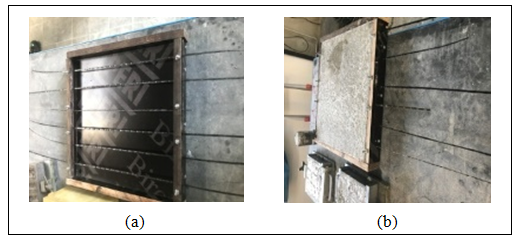 | Figure 1. Photograph shows that (a). coated and uncoated basalt fiber strands/sheets under tension in the mold, and (b). concrete, sand and cement mixture poured in molding box. |
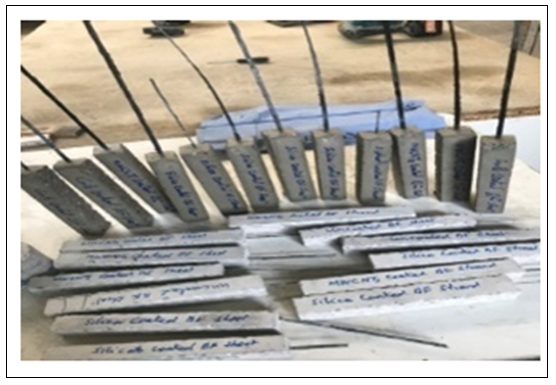 | Figure 2. Coated and uncoated basalt fiber strand and sheet specimens |
3.2. Preparation of Fiber Pullout Test
- The cemented part of the silica and nano mixtures coated basalt fiber strand/sheet was fixed on the universal testing machine (ZWICK/Roell 1445 Zmart, RRO), and pull-out force F was applied from the free end of the coated basalt fiber strand/sheet as shown in Fig. 3a-b.To ensure a uniform load distribution and prevent any irregularities on the concrete surface from affecting the test results, a thick pad was placed on both sides of the free end of the coated basalt fiber strand/sheet for the pullout specimen.
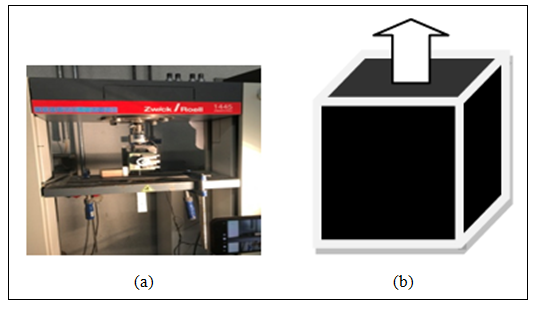 | Figure 3. Figure indicates that (a), experiment setup of fiber pull-out test and (b) one end of coated basalt fiber strand/sheet cemented and other end is free to applied pull-out force F.  |
 | (1) |
 | (2) |
4. Results and Discussion
4.1. Load versus Displacement
- The load-displacement relationship is the key manifestation of the bonding behavior between concrete and basalt fiber sheet/strand. The load versus displacement results in Fig. 4 & 5 of the coated/uncoated basalt fiber sheets and strands show that the load increases with an increase in displacement and fractures from the mid-length of the non embedded fiber, not completely pulled out from the embedded cement and concrete base, as shown in Fig. 6(a), due to perfect interface bonding between the basalt fiber strand/sheet and cement-concrete. Figs. 4 indicates that the load and displacement diagram of the GnPs-coated basalt fiber sheet is better than the MWCNTs and silica-coated basalt fiber sheet under the pull-out test. Whereas the uncoated basalt fiber sheet resulted in lower values than the coated BF sheet, as shown in Figs. 4 (a, b, c & d). In general, the load linearly increased in the beginning and then remained constant until debonding failure occurred. As seen in Figs. 4&5 (a, b, c & d), the stiffness of specimens employing GnPs, MWCNTs, and silica-coated basalt fiber sheets was significantly increased compared to uncoated basalt fiber sheets and strands due to GnPs, MWCNTs, and silica particles dispersing uniformly in the epoxy resin, which increases the interface bonding between the basalt fiber sheet/strand and the modified epoxy resin. GnPs and MWCNTs-modified epoxy resin-coated specimens showed an increase in the ultimate loaded displacement when compared to the silica coated and uncoated specimen, which was attributed to the larger surface areas of the CNTs, and increased the adhesion between the concrete/modified epoxy resin and basalt fiber/epoxy resin, thereby improving load transfer within the interface.
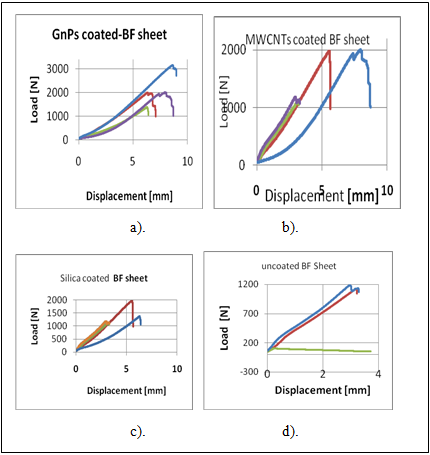 | Figure 4. Variation of load with displacement of basalt fiber sheet under pullout test (a). coated with GnPs, (b). coated with MWCNTs, (c) coated with Silica, and (d) uncoated |
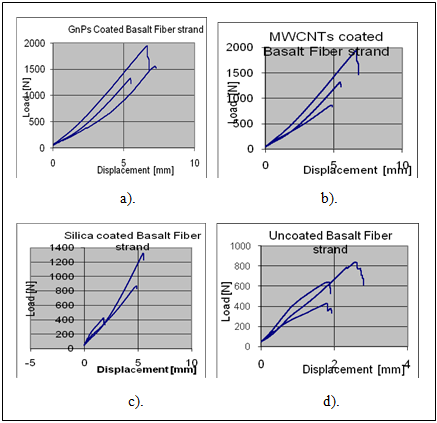 | Figure 5. Variation of Load with Displacement of Basalt Fiber Strand under pull out test (a) coated with GnPs, (b) Coated with MWNT, (c) coated with Silica, and (d) uncoated basalt fiber |
5. Descriptions
- The pull-out load of GnPs-epoxy resin-coated basalt fiber sheet is higher than the MWCNTs-epoxy resin and silica-epoxy resin-coated basalt fiber sheets due to perfect interface bonding between the basalt fiber sheet and GnPs-epoxy resin mixture. The fracture of the non-embedded basalt fiber sheet clearly indicates that the fibers are debonded and broken from each fibers even after coating with the modified epoxy resin mixture as shown in Fig.6 (b). However, the load versus displacement results of coated and uncoated basalt fiber strands have inferior behavior compared to coated and uncoated basalt fiber sheets because the basalt fibers do not perfectly interact with each other in strands.
5.1. Coated/Uncoated Bonding Strength under Pullout Test
- The GnPs and MWCNTs particles were obtained from the manufacturer via ITA, RWTH Aachen University, Aachen, Germany, for this study. The particles of 1% GnPs, 1% MWCNTs, and 1% silica by weight were used to modify the epoxy resin and were dispersed uniformly within it. The pullout test specimens clearly indicate that the pullout load increases with the increase of deformation of the specimens and splits into two from the uncoated length of basalt fiber sheet/strand due to debonding of fibers and high bonding strength of coated basalt fibers embedded in the cement concrete bar, as depicted in Fig. 6(a-b). The maximum pull-out force of coated and uncoated specimens was obtained from the load-displacement diagram to calculate the bonding strength of basalt fiber sheet and strand from equations 1 & 2. The bonding strength of basalt fiber sheet was obtained with the average value of maximum fractured force of four specimens of each type of coated and uncoated specimen. Whereas the bonding strength of basalt fiber strand was calculated based on the average value of three specimens of each type of coated and uncoated basalt fiber strand.
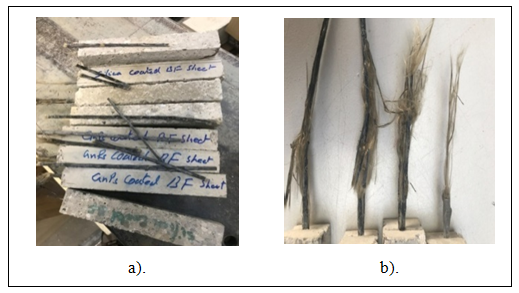 | Figure 6. Under the pull-out test, coated basalt fiber broken from mid-length, and (b) fibers debonded, fiber pull-out from each others |
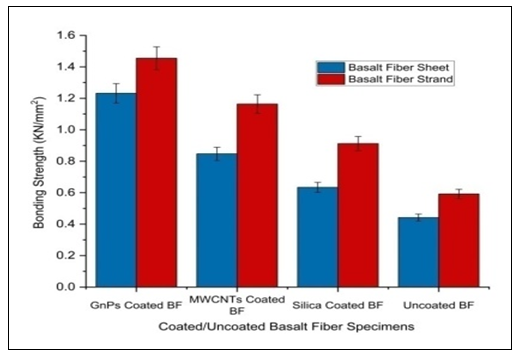 | Figure 7. Variation of bonding strength of coated and uncoated basalt fiber sheet and strand with the change of coating mixtures under pull out test |
6. Conclusions
- The influence of multiwall carbon nanotubes (MWCNTs), graphene nanoplates (GnPs), and silica-modified epoxy resin-coated basalt fiber sheets and strands embedded in cement-concrete bars on the bond behavior of all specimens was experimentally investigated using the pullout test. The bonding strength of coated basalt fiber sheet and strand with the mixtures of GnPs-epoxy resin and MWCNTs-epoxy resin was higher than that of the silica-epoxy resin mixture-coated and uncoated basalt fiber sheet/strand because nanoparticles have a high aspect ratio and a large specific surface area, which improves bonding strength. The bonding strength of coated basalt fiber strands is greater than that of coated basalt fiber sheets due to the strong interface interaction of the basalt fiber strands and the fact that they contain five layers of basalt fiber sheets twisted together to form a circular shape, which is referred to as a basalt fiber strand. Therefore, GnPs and MWCNTs modified epoxy resin coatings significantly increase the bonding strength of basalt fiber by improving the interfacial adhesion between the basalt fiber and the modified epoxy resin matrix through mechanisms like crack bridging and pull-out.
ACKNOWLEGEMENTS
- The authors are grateful to the technical staff of the Faculty of Architecture and Civil Engineering, Technical University of Augsburg, Germany and Mr. Chiranjeet Desai, HITEXBAU, Bruckensanierung, Czech Republic, for providing Basalt fibers Grids and fibers for their support. One of the co-authors (V. K. Srivastava) is the recipient of a DFG visiting fellowship to carry out excessive experimental work under the supervision of Prof. Sergej Rempel.
Author Contribution
- Based on the original experimental results manuscript is prepared and agreed to submit for the publication the original version of the manuscript.
Declaration of Conflicting Interests
- The authors declared no potential conflict of interest with respect to the research, authorship and /or publication of this article.