
-
Paper Information
- Previous Paper
- Paper Submission
-
Journal Information
- About This Journal
- Editorial Board
- Current Issue
- Archive
- Author Guidelines
- Contact Us
International Journal of Applied Sociology
p-ISSN: 2169-9704 e-ISSN: 2169-9739
2014; 4(1): 23-29
doi:10.5923/j.ijas.20140401.03
A Structuration Analysis on the Implementation of Good Governance Agendas in Term of Retail Market Competition in Malang Municipality
 Abstract
 Reference
 Full-Text PDF
 Full-text HTML
Badrudin Kurniawan, Andy Fefta Wijaya
Department of Public Administration, Faculty of Administrative Science, University of Brawijaya, Malang, 65145, Indonesia
Correspondence to: Badrudin Kurniawan, Department of Public Administration, Faculty of Administrative Science, University of Brawijaya, Malang, 65145, Indonesia.
| Email: |  |
Copyright © 2014 Scientific & Academic Publishing. All Rights Reserved.
The implementation of good governance agendas in Malang Municipality has resulted the rapid growth of modern retail. The existence of traditional traders was threatened. In a competitive retail market, traditional traders get less protection from the Government of Malang Municipality. Massive demonstrations conducted by traditional traders along with other society elements unable to stem the rapid growth of modern retail. The author uses descriptive-analytic method with a qualitative approach in this work. In discussion part, structuration analysis was used. The result showed the relationship between space and time, structure duality with the agent in retail market competition contributes in producing injustice. In fact, those practices which indicate implementation of bad governance capable for realizing the goal of good governance agendas, namely market liberalization.
Keywords: Structuration Analysis, Good Governance, Retail Market Competition
Cite this paper: Badrudin Kurniawan, Andy Fefta Wijaya, A Structuration Analysis on the Implementation of Good Governance Agendas in Term of Retail Market Competition in Malang Municipality, International Journal of Applied Sociology, Vol. 4 No. 1, 2014, pp. 23-29. doi: 10.5923/j.ijas.20140401.03.
Article Outline
1. Introduction
1.1. Research Background
- Approximately in these last two decades, good governance agendas are implemented in the third world countries. In the beginning of 1980’s, for the first time good governance agendas held by the African countries as a consequence of the assistance provided by the International Monetary Fund (IMF), World Bank and Western countries. Meanwhile, in Asia, the agendas of good governance more aggressively offered by international donors in the latter half of the 1990’s [1]. In essence, the good governance agenda calls for change in the political structure of a country to guarantee the sustainability of the free market mechanism.One result of the implementation of good governance agendas is the proliferation of foreign supermarkets in the country, includes Indonesia. The arrival of foreign supermarkets contributed on the rapid growth of modern retail in Indonesia. Not only in the capital cities, but they are almost in every city in Indonesia. Malang Municipality has experienced a higher economic growth than economic growth in national or provincial level. In 2008, the economic growth of Malang Municipality reached 6.7%, while in the national level reached 6.4% and in the provincial level reached 6.3%. According Peni Suparto, Mayor of Malang Municipality, high rates of economic growth is caused by the rapid growth of supermarkets and malls in Malang Municipality [2].Ironically, the high economic growth became a disaster for traditional traders. Modern retail presence threatens the existence of the traditional traders. One of Legal Aid Organization (LAO) activist said that in the early 2000’s, traditional traders along with number of society elements had conducted large-scale demonstration. They refused to be relocated to the second floor while Matahari Department Store (Britain owned) would be relocated to the first floor. In the same period, in the early 2000’s, many traditional traders in Kemirahan Region conducted big protest against the rapid growth of minimarket. In addition, in 2010 massive demonstration was happened also. These demonstrations conducted by Dinoyo and Blimbing Traditional Market Traders. They oppose if their working place will be located at behind the mall after the renovation finished. One of traditional traders also said that the location of local supermarket, such as Grosir Utama, is too near with Klojen traditional market. Besides, Grosir Utama also sales it’s commodities with cheaper prize than traditional market’s commodities. Thus, customers prefer to buy in Grosir Utama than in Klojen traditional market.The massive demonstrations by various society elements appeared to not having any effect on the rapid growth of modern retail in Malang Municipality. After the demonstration subsided, the numbers of minimarkets, supermarkets and malls grow rapidly while the growth of traditional markets almost never happened. This has led to the concerns of traditional traders. Seeing the condition of retail market competition in Malang Municipality, the author is interested to use structuration theory to identify problems that occurred. The author has an assumption that good governance implementation should give a benefit to the society.
1.2. Research Question and Research Objectives
- Based on the research background explained above, the author wants to answer two research questions include, (1) how to identify the problems of retail market competition in Malang Municipality using structuration analysis method? (2) Is good governance agenda in term of retail market competition actually implemented by the Government of Malang Municipality? The research objectives answer those the research questions, namely (1) to identify the problem of retail market competition in Malang Municipality using structuration analysis method and (2) to find out the implementation of good governance agenda in term of retail market competition by Malang Municipality Government.
1.3. Theoretical Review
1.3.1. Governance: No More Unilateral Decision Making
- Governance is a term used by Nicholas Henry to describe the fifth paradigms of public administration. In the fifth paradigm, Henry stated that public service and development agendas are no longer held by the government only. "The role of government" held by the other actors as well, such as profit and non-profit institutions. According to him, these changes were triggered by the growth of globalization. Multinational companies, international trade, global environmental problems and internet, either intentionally or unintentionally, lead the government to delegate its authorities to other actors [3].In line with what has been stated by Henry, Farazmand declared that since the term governance echoed recent decades, this term catches many attentions and become the subject of many studies. The appearance of various terms indicates that governance has been studied from various viewpoints. Those terms include good governance, participatory governance, regulatory governance, interactive governance, collaborative governance and so on. According to Farazmand, all those governance concepts have a similarity; refuse the authoritative governance and unilateral decision making [4]. A policy should be made based on a consensus.
1.3.2. Good Governance: Law Reform to Guarantee Market Liberalization
- Out of many studies about governance, good governance is one of the concepts which caught attention of many parties. Government, business owners, academicians or NGO’s activists all have been familiar with this term. Good governance is not only made as a debated or studied concept, but further good governance is considered as a development agenda in almost all third world countries.Good governance agendas were introduced by international institutions such as World Bank, World Trade Organization (WTO) and International Monetary Fund (IMF) as a prescription to solve the crisis in the third world countries. These agendas should be held by the third world as a requirement to be able to obtain grants from those international organizations. Moreover, the principles of good governance also become as criteria to assess "good" or "bad" a country management [5].Although the principles of good governance such as accountability, rule of law, transparency and public participation are in line with the reformation spirit of Indonesian, however, good governance agendas keep hidden agendas of multinational companies and developed countries. Actually, the main intention of good governance agendas is to guarantee the existence of global capitalism. Good governance agenda is more similar to the internalization tool of neoliberal ideology at global scale. The implementation of those agendas tends to create political stability and economic development which is useful for market liberalization. Political stability and market liberalization require legal protection. An examples of laws and regulations in Indonesia as a result of good governance project include Act No. 2 Year 2004 concerning Industrial Relations Dispute Settlement, Law of Water Resources (Act No. 7 Year 2004), Employment Law (Act No. 13 Year 2013) and Investment Law (Act No. 25 Year 2007) [1].
1.3.3. Structuration Theory
- Based on structuration theory, the domain of social science is social practices are repeated and patterned across space and time. The term structuration itself refers t a process where social structures are produced, reproduced, and transformed in and through practice. There are three important components which need to be paid attention in these theory. Those three components include space and time, duality structure and agent. Those three components are interrelated and influence each other just like a system.
1.3.3.1. Space and Time
- Heiddegger ever stated that human is not only in time but also take an action toward the time, in the context of human relations to the past, present and future. It inspired Giddens that social practices are intimately associated with space and time. Space and time create a meaning of produced social practices [6]. In addition, Giddens also stated that space and time take part in creating action and community organization. The understood meaning of social practices will become a foundation by the agent to act.
1.3.3.2. Structure Duality
- The concept of structure duality provides an understanding that the structure is considered limiting the agent’s action as well as allowing them to reproduce or modify the structure itself. The structure has three dimensions, including legitimacy, dominance and significance / meaning. Legitimacy and significance are including the rules (informal, implicit and routine/habit). While the dominance including control/allocation of resources [7]. Resources are the “material equipment” and “organizational capacities” of agent to get things done. Those who have resources can mobilize power, although power itself is not a resource but the result of possessing material and organizational facilities. Rules and resources are “transformational”. They can be created, changed, and recombined into different forms. Besides they are mediating. They can be used by agent to tie social relation [8].
1.3.3.3. Agent
- A person or a group of people considered as agents when they act intentionally and have a goal from what they do. Agent has three internal dimensions including discursive consciousness, practical consciousness and unconsciousness. Both discursive and practical consciousness has function as a device to observe the prevailing structure. Discursive consciousness refers to the agent’s capacity in providing any rationalization or reason on what they do. While the practical consciousness refers to the agent’s capacity in understanding what other agents do and adjusting to the applied structure. The third dimension refers to the agent’s belief upon the truth of applied social practices [8].
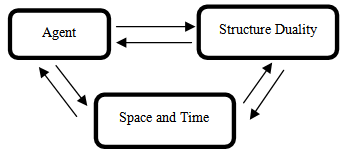 | Figure 1. The relation between space and time, structure with agent |
2. Research Methods
- This research uses the descriptive analysis method with qualitative approach. Consequently, the data was generated from interview, observation, and documentary analysis. In order to collect data by interviews, researcher determined several key informants. Accordingly, interviews were held in April and September 2012 with some key informants such as The Officer of The Secretariat of Local Investment, The Officer of The Local Department of Market, The Officer of The Integrated Licensing Service Agency (ILSA), The Officer of The Local Department of Industry and Trade (LDIT), The Members of Regional People’s Representatives Council, Giant Supermarket Personnel Manager, The Member of Klojen and Dinoyo Traditional Market Association, The Member of Malang Corruption Watch (MCW), The Member of Legal Aid Organization, The Executive Director of Regional Autonomy Studies. The researcher developed and used an interview guide that contained a list of questions and topics for interviewing. In documentary analysis, the researcher collected materials from various sources, such as book reports, research results, reference books, and other written documents related to the research focus.
3. Result and Discussion
3.1. The Relation between Space and Time, Structure Duality with Agent in the Local Retail Market Competition
- In this part, author will attempt analyse the problems in the Malang Municipality regarding to the local retail market competition. The implementation of good governance agenda has had a legal umbrella. It means that formal structure protects the sustainability of the retail market competition both at national level and at local level. Act Number 25 Year 2007 concerning Investment requires efficiency with justice principle in market competition mechanism (article 3, paragraph 1). Although this act requires efficiency with justice principle, but the reality of retail market competition in Malang Municipality still fosters injustice. The author thinks that the use of structuration theory as an analysis device will provide quite interesting viewpoints and generate alternative solutions for these problems. The three main components in structuration theory, namely space and time, structure duality and agent are used as discussion focus. These three components have a reciprocal relationship with each other.
3.1.1. Space and Time
- In the dimension of local autonomy, Malang Municipality society should have had great authorities in managing their own households. The society becomes the development subject. They have an important role in planning and organizing the development. However, reality is not always in line with expectations. The fact actually is that in line with the opinion of Marxist. They state that decentralization led to the state at local level. They place decentralization as an object of the dialectical relationship between the governments at any level and alleged decentralization will not create democratic conditions at local level. Decentralization will generate local capitalists. In the end the local capitalists will dominate local government agencies [9].Development agendas in Malang Municipality seem to follow the taste of the capital owners and the society has become the object of development. The growth of traditional markets has been stopped since the early 2000’s. Traditional market’s infrastructure also received less attention from the government. Of 27 traditional markets, it is estimated 17 out of them having inadequate infrastructure [10]. Meanwhile, modern retails grow rapidly. Based on the data from ILSA, between 2009 up to 2012, the numbers of minimarket increased to 117 outlets and the numbers of supermarkets increased to 8 outlets.In the history of traditional markets growth, traditional traders are always dependent upon the government related to the development and the maintenance of traditional market infrastructure. During the Dutch colonial period, traditional markets in Malang Municipality were first built by the Dutch government in 1924. Traditional market development spent the budget of Dutch government and donations from Arabian and Chinese groups [11]. After colonial periods, the development and the maintenance of traditional markets use the Indonesian government budget as well. Besides, the presence of government affects greatly the traditional market safety. Based on the confessions from several traditional traders, the fire of Besar Traditional Market in the early 2000’s was suspected as an intentional action from the local government. This is because the fire of Besar Traditional Market coincided with the refusal of traditional traders to be placed on the second floor.
3.1.2. Structure Duality
- Structuration theory focuses more on informal structure as the crux of matter. Anthony Giddens assumed that informal structure has more capability to encourage a social practice rather than formal structures. Informal structure can be defined as a pattern of behavior, customs or traditions of agent [7]. Therefore, although the Act No. 25 Year 2007 has emphasized the principles of efficiency with justice, injustice is still very likely to happen.Political elite interests greatly influenced the direction of policy in Malang Municipality. Political elites possess immense power to violate the rules they have made. The result of interviews with the managers of private radio stations and Malang Corruption Watch (MCW) activists revealed that the development of Malang Town Square (Matos) had violated the rule of Local Spatial Zoning Plan (LSZP) of Malang Municipality. Even the amendment of LSZP was adjusted to the violations they have done. Although local government had been determined make a fault in a State Administrative Court, the construction of Matos still underway. In the case of Blimbing and Dinoyo Market renovation, one of the members of the Regional Representative Council stated that there was political lobbying. The results of discussion between the party factions mentioned that the renovation did not involve any investor. However, then Mayor of Malang Municipality practiced lobbying with many members of parliament and finally they did voting. The most votes supported the renovation of traditional markets involving investors.The violations of the rules are not only done by the political elites. Several local officers also violate the rules in granting trading licenses to modern retail. Under Mayor Regulation Number 28 Year 2009, ILSA should ask for a recommendation from LDIT before issuing trading licenses either for company branch or main company. In fact this rule was violated by ILSA. One of the LDIT officers admitted that for the meantime, ILSA never asked for any recommendation for modern retail company either supermarkets or minimarkets. Not only the government who provides the opportunity of modern retail to grow. Several communities were also permissive to the growth of modern retail. Although the growth of modern retail threatens the sustainability of traditional traders, on other hand, modern retail also provide new jobs. According to the Head of Dinoyo Youth Association, modern retail investors will be given permission to set up a business by the community on the condition that local people will be given the opportunity to work as the employees or as the parking men in the modern retail outlets. Besides, in the process of development of modern retail also employs the workforce from the local people.Non-Governmental Organizations such as MCW and Legal Aid Organization provide accompaniment to the traditional traders. The relationship between NGO’s and traditional traders is equal. No party dominates the other. The traditional traders explain what they really feel as a problem and what they want. Meanwhile those two NGOs provide insight regarding the position of traditional traders in the prevailing law and facilitate them to do negotiation with the government. Both NGOs did not dictate what kind of aspirations that should be delivered to the government. Both NGOs only do mediation between traditional traders and the government.
3.1.3. Agent
- The implementation of local autonomy is not exactly success. Malang Municipality Governments does not function as a civil servant. Government’s act seems like a little king who is able to impose their desire to the society. The dependence of traditional traders regarding the market’s infrastructure development and maintenance seems to give an impression that traditional traders are weak facing the government. Besides, traditional trader’s fear regarding traditional market fire seems to be interpreted as the legitimacy of any government action. Such conditions provide consciousness to local governments that they are not a servant but a ruler. This consciousness prompted the government to break the rules that they have made, to do the political lobbying even government also create a new rule that "legalize" the violation they ever done.Traditional traders realize that their business sustainability depends on the government. This consciousness makes them could not resist what is desired by the government. They are afraid about the consequences when they rejected the government's wants. They are worried if the governments will burn the traditional market where they work. It only makes their lives in the future become more difficult. Therefore they let the government continue to build mall or other modern retail types, but they also want to be given the opportunity to negotiate. Perhaps the government policy is not too detrimental to the traditional traders.In guidance, NGO activists do not dictate what should be fought by traditional traders. They realize if they dictate traditional traders, traditional traders will be dependant to them. NGO activists do not want to be trapped as the party that actually controls the "freedom" of traditional traders. NGO activists only mediate between traditional traders and the government.The principle of efficiency with justice listed in Act No. 25 of 2007 was not realized in the retail market competition in Malang Municipality. Government should act as an enforcer of justice. Factually, government become the party that creates injustice. Figure 2, The Relation between Space and Time, Structure with Agent indicates that the growth of modern retail is likely to continue to grow rapidly while traditional market infrastructure is still less attention. In addition, the number of traditional markets has a little chance to grow. The ability of the traditional traders are limited only to negotiate with the government in order the modern retail growth is not too detrimental for them. They do not have the ability to stem the growth of modern retail. Malang Municipality Government seems more interested in increasing the number of modern retail because of the high rate of economic growth is able to be achieved by doing so. Even the Malang Municipality Government will have to break the rules to guarantee the rapid growth of modern retail. NGOs as mediators only seek opportunities for traditional traders to negotiate with the government. The traditional traders may not deny the development of modern retail because they assume the government can commit violence against them. A violence which is done by local government would make the lives of traditional traders in the future more difficult.
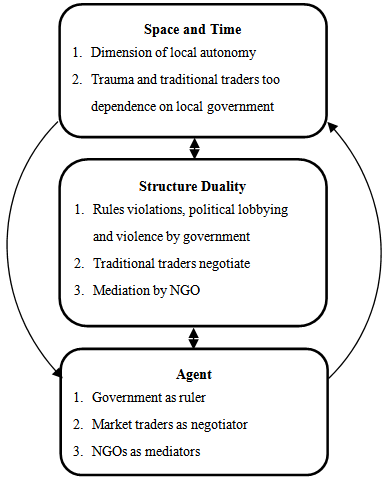 | Figure 2. The relation between space and time, structure with agent in the local retail market competition |
3.2. Achieving Goals of Good Governance Agendas through the Implementation of Bad Governance
- As previous explanation that the core of good governance agendas being implemented to guarantee the sustainability of market liberalization. Sustainability of market liberalization calls for political stability. Political stability is realized by conducting legal reform and the government which is accountable, transparent, participatory and obey the law. In the context of retail market competition, the government enacted Act No. 25 Year 2007 about Investment. This act guarantees the sustainability of the retail market competition. The government could not hinder the sustainability of retail market competition. But based on Act No. 25 of 2007, the government can intervene upon the market competition to apply the principle of efficiency with justice. In Article 16, paragraph C stipulated that each investor's responsibility to create a business climate of fair competition, prevent monopolistic practices, and other things that harm the state. The government has the authority to protect the existence of traditional traders.Good governance recipes require that the governments which are accountable, transparent, participatory and obey the law to achieve market liberalization. Logically, if the government does not use the recipe so market liberalization will not be realized. But the fact violates the logic. The Malang Municipality Governments violate the rules, did the violence and did the political lobbying to conduct retail market liberalization. So the modern retail is growing rapidly. What did the government do indeed lead to a demonstration of some elements of society but this condition still can be controlled by the government. Society did not anarchy. Society is still obeying the law to bring their cases to The State Administrative Court. In addition, society works hard to negotiate with the government as well. In fact the implementation of bad governance would be able to realize the objectives of the agenda of good governance, namely market liberalization.
3.3. Alternative Solution: Traditional Traders should be More Autonomous
- The main point of governance is a consensus and good governance requires participatory principle. If traditional traders are still have trauma/fear and are too dependence on government, so there are no consensus and no participatory in discussion. Discussion results only a quasi consensus and a quasi participation. Traditional traders should solve their trauma and minimize their dependency.Giddens stated that the rules and resources can be used by agent to tie social relation [8]. It means they can be used by agent to make looser social relation as well. Each agent should be more autonomous to loosen social relation and minimize their dependence. Thus, each agent should have more resources (material equipment and organizational capacities) and new rules (new pattern behavior).Traditional traders can make an association or a cooperative which have mission to make them more autonomous. This association/cooperative does not include only one traditional market but all (or almost all) traditional traders in Malang Municipality. Perhaps it can accumulate the number of money to renovate their traditional market/place where they work. Accumulation money can be done by gathering retribution or borrowing some money from member’s savings. In addition, it can give a loan for traditional traders who need it. Even it can make new traditional market and it can own the land. By making this association, traditional traders are not weak facing the government also. If the governments want to launch new regulation, traditional traders have more bargaining power. Perhaps, consensus and participation will be achieved.
4. Conclusions
- Structuration analysis highlights the relationship between space and time, structure with agent in producing the injustice practice of Malang Municipality Government. It seems that this injustice will continue to be created. The growth of modern retail is likely to continue to grow rapidly while traditional market infrastructure is still less attention. In addition, the number of traditional markets has a little chance to grow. The ability of the traditional traders are limited only to negotiate with the government in order the modern retail growth is not too detrimental for them. They do not have the ability to stem the growth of modern retail. Malang Municipality Government seems more interested in increasing the number of modern retail because of the high rate of economic growth is able to be achieved by doing so. Even the Malang Municipality Government will have to break the rules to guarantee the rapid growth of modern retail. NGOs as mediators only seek opportunities for traditional traders to negotiate with the government. The traditional traders may not deny the development of modern retail because they assume the government can commit violence against them. A violence which is done by local government would make the lives of traditional traders in the future more difficult.The implementation of good governance agendas require that the governments which are accountable, transparent, participatory and obey the law to achieve market liberalization. Logically, if the government does not use the recipe so market liberalization will not be realized. But the fact violates the logic. The Malang Municipality Governments violate the rules, did the violence and did the political lobbying to conduct retail market liberalization. So the modern retail is growing rapidly. What did the government do indeed lead to a demonstration of some elements of society but this condition still can be controlled by the government. Society did not anarchy. Society is still obeying the law to bring their cases to The State Administrative Court. In addition, society works hard to negotiate with the government as well. In fact the implementation of bad governance would be able to realize the objectives of the agenda of good governance, namely market liberalization.Related to alternative solution has been suggested by author, author has recommendation to the next researcher. Governance and good governance require consensus and participation. One agent which is too dependence will be weak facing other agent. High lameness condition could not achieve consensus and participation. So, autonomous agent should be created. The next researcher can research about how to become the autonomous agent or what are make agent become more autonomous.
ACKNOWLEDGEMENTS
- The authors have been able to finish writing the journal, entitled "A Structuration Analysis of Good Governance in Terms of Local Retail Market Competition". The author would like to thank to the parents author, Sudarto and Umi Hanik, the author's brother and sister, Ferry Raharjo and Nuning Fitriana, to Mr. Fefta Andy Wijaya, MDA, Ph.D as an author’s mentors, to Mentari Wulandari, to author’s friends at Research Study Club (RSC) and to all those who may not mention all. The authors would like to thank for all assistance either, substancial, financial or motivation to the author.