
-
Paper Information
- Paper Submission
-
Journal Information
- About This Journal
- Editorial Board
- Current Issue
- Archive
- Author Guidelines
- Contact Us
International Journal of Applied Psychology
p-ISSN: 2168-5010 e-ISSN: 2168-5029
2014; 4(6): 209-213
doi:10.5923/j.ijap.20140406.01
Eliminating Stress-Induced Functional Disorders of Human Operator Using Double Feedback from EEG Oscillators of the Subject
 Abstract
 Reference
 Full-Text PDF
 Full-text HTML
Sang Joon Oh
Department of Biomedical Engineering, Bauman Moscow State Technical University, Moscow, Brigadirsky lane, Russian Federation
Correspondence to: Sang Joon Oh, Department of Biomedical Engineering, Bauman Moscow State Technical University, Moscow, Brigadirsky lane, Russian Federation.
| Email: |  |
Copyright © 2014 Scientific & Academic Publishing. All Rights Reserved.
The results of experimental testing of the original technology of stress-induced functional disorder correction in a human operator are presented. In this technology, the narrow-band frequency (0.4-0.6 Hz) EEG oscillators specific to each patient and revealed in real-time, are simultaneously used in two independent feedback loops. It was found that utilization of the narrow-band EEG oscillators and the insertion of additional feedback loop based on automatic modulation of sensory influences by own rhythmical EEG components of the patient increase the effectiveness of stress-eliminating EEG biofeedback procedures. As a result of the treatment, the desired EEG shifts were accompanied by positive changes in the levels of self-assessment of patient’s health and mood. The developed method can be used in a wide range of rehabilitation procedures for correction of various functional disorders arising in human operator in the course of professional activities.
Keywords: Reliability of human operator, Biofeedback, Electroencephalogram (EEG), EEG narrow frequency oscillators, Correction of functional state
Cite this paper: Sang Joon Oh, Eliminating Stress-Induced Functional Disorders of Human Operator Using Double Feedback from EEG Oscillators of the Subject, International Journal of Applied Psychology, Vol. 4 No. 6, 2014, pp. 209-213. doi: 10.5923/j.ijap.20140406.01.
Article Outline
1. Introduction
- One of the most important trends of modern psychological research is the problem of the mechanisms of human interaction with technical devices in the course of employment. The main objective of these studies is to ensure the reliability of a human operator interacting with a variety of engineering systems. According to modern concepts, the reliability of a human operator is a complex psychophysical feature, expressed under its behavior, activity, health and standards of professional requirements, allowing him to carry out assigned tasks. There are personal, professional and functional components of the reliability of a human operator [1-3].From the standpoint of modern science, the human body is considered as a sum of multiple information-management systems, which "failure" leads to disruption of homeostasis and the formation of pathological conditions and disease [4]. The reason for such "faults" is often an abundance of conflict and emergency situations in the modern world, as well as experience of stress as a result of terrorist attacks, economic crisis, natural and man-made disasters, accidents, violence, and other factors [5]. The literature emphasizes that an extremely negative consequence of interactions in the "man-machine" systems that reduces the reliability of a human operator and requires prompt treatment, there is the development of occupational stress [6]. These factors are known to form in human operator the so-called "uncomfortable syndromes" [7], and in chronic complex action they may lead to a breach of adaptation mechanisms, failure of protective systems and disease. Pharmacological correction of pathological states inevitably impairs cognitive function of the operator and is often accompanied by side effects and addiction [8], which makes drug treatment a futile path. Therefore, extremely popular there are the non-drug technologies of health promotion, aimed at the timely recovery of the body to an optimal state.To date, among such tools the most developed seems to be biofeedback (BFB) training technology based on the electroencephalogram (EEG). EEG-BFB technology is a complex procedure in which a person through various technical means receives the feedback information about the current state of his body and his brain waves. In accordance with the EEG rhythm power a patient is presented with certain acoustic (e.g., music) or photic (e.g., light flashes) feedback signals. The purpose of the method is to teach people to regulate by "will power" their own brain waves to achieve desired effects by focusing on the perceived light or sound signals [9]. With the help of EEG-BFB it is possible to treat personality disorders [10], to correct states of stress [11] and anxiety [12], to improve attention and memory [13], as well as to treat a wide spectrum of functional disorders of the central nervous system [14].Despite the obvious advantages and widespread, conventional methods of EEG-BFB have significant limitation due to the necessity of conscious perception of feedback signals. This limitation is associated with the presence of a certain threshold between the consciousness of the subject and central regulatory mechanisms, which makes it difficult for many people to develop the skills of voluntary control of physiological states and requires long-term (up to 20 sessions) learning [15]. In addition, a serious drawback of the method that significantly limits its effectiveness is the use of pre-designed traditional EEG rhythms [16]. According to the literature, EEG rhythms actually represent a composition of several narrow-band and dynamic EEG oscillators with different functional characteristics [17].For non-drug correction of stress-induced functional disorders the principle has been proposed [18] and original technology of resonance EEG-BFB with a double feedback from the patient's EEG oscillators has been developed [19]. The technology overcomes the aforementioned limitations of existing EEG-BFB methods by two unique innovations. First, instead of predetermined and unnecessarily broad-band (4-6 Hz) traditional EEG rhythms it uses real-time revealed, specific and meaningful for the individual narrow-band frequency (0.4-0.6 Hz) EEG oscillators. Second, the developed method is putting into operation an additional feedback contour, i.e. the contour of resonance stimulation (Fig. 1).
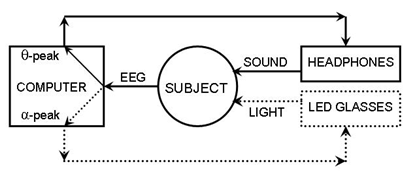 | Figure 1. The main elements of resonance EEG-BFB with a double feedback from the patient's EEG oscillators |
2. Materials and Methods
- Subjects for this pilot study were recruited from the staff of Pushchino Scientific Center who had sought help from the medical service because of the state of psycho-emotional stress. All subjects participated voluntarily in 2-4 treatment sessions. The study complies with the Declaration of Helsinki (the Declaration was passed in Helsinki, Finland, June, 1964, and revised in October, 2000, Edinburgh, Scotland) and was performed following approval by the ethic committee of the Institute of Cell Biophysics of RAS. Written informed consent was obtained from every patient.A total of 14 subjects participated, 8 males and 6 females, with a range of ages between 18 and 58 years. Prior to treatment they were evaluated by the physician. Subjects were tested individually in an acoustically isolated room. Before and after each treatment they carried out standard Russian visual analog scale (VAS)-like test “SAN” [21]. The test consisted of 30 questions. Answering to them, a subject makes decisions about own current level (by 7-point scale) of health, arousal and mood. Test reliability and validity is proved in a number of studies [19, 23].A monopolar technique was used with both earlobes serving as reference with the active located at Cz based upon the International 10-20 system. The Cz area and both earlobes were cleansed to reach Ag-AgCl electrode impedance below 10 K ohms. Raw EEG was inputted through pre-amplifier with band pass filters set to 0.5-30 Hz, digitized at a sampling rate of 128 samples per second and recorded on hard disc of an IBM compatible 486 computer. Current amplitude values in microvolt (mcV) were obtained by real time Fast Fourier transform (FFT) for the most pronounced narrow peaks of the subject’s EEG from the theta (4-8 Hz) and alpha (8-13 Hz) EEG bands. These values were used to generate sound feedback signals (theta oscillator) and light stimulation (alpha oscillator). After attachment of EEG electrodes, headphones and glasses, the subjects were instructed to remain still and quiet during the treatment and to keep their eyes closed throughout the whole treatment procedure. They were explained that the goal of the training sessions is to gradually decrease the production of 4-8 Hz EEG activity represented by sound, so her/his task is to minimize the pitch and intensity of sound. Nothing was said about light pulses emitted by the glasses and producing distinct patterns on the subject's closed eye lids, since light stimulation should act without subject’s conscious control. Following 10-minute treatment and data collection, EEG was analyzed off-line using previously described [19] dynamic modification of FFT spectral analysis. The software allows one to observe the dynamics of short-term EEG spectra during the whole experimental procedure.After the experiment the subjects were asked about the perceived effects and repeatedly performed the self-evaluations of own functional state using test SAN. Statistical analysis of the results was performed by Student's t test using the software package "Origin 6.0".
3. Results and Discussion
- During treatment, a marked restructuring in the rhythmic structure of the EEG has been observed (Fig. 2).
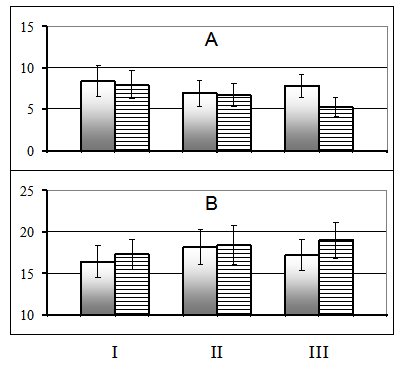 | Figure 2. Dynamics of power (in relative units) of theta (A) and alpha (B) EEG rhythms before (solid background) and after treatment (shading) in the first (I), second (II) and third (III) sessions |
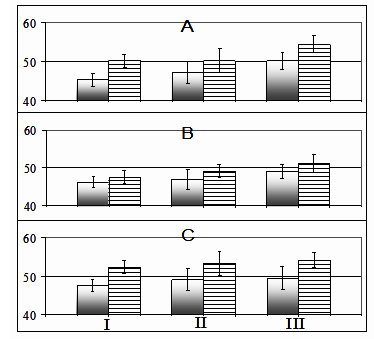 | Figure 3. Dynamics of subjective indicators (points) of health (A), activity (B), and mood (C) before (solid background) and after treatment (shading) in the first (I), second (II) and third (III) sessions |
4. Conclusions
- The results obtained in our pilot study clearly demonstrate the advantages of proposed resonance biofeedback technology. All participants expressed appreciation to the treatment procedure and reported about post-treatment reduction of tension and stress. Significant positive shifts in self-ratings of own health and mood were accompanied by significant enhancement of alpha EEG amplitude as a result of treatment. The utilization of narrow-band EEG oscillators of the patient and putting into operation an additional feedback loop that automatically modulates the parameters of sensory stimulation by own EEG rhythms of the patient are supposed to be the main factors increasing the effectiveness of EEG biofeedback procedures for the correction of disorders caused by stress. The developed method can be used in a wide range of rehabilitation procedures for correction of various functional disorders arising in human operator under professional activity. Possible applications of the developed approach can be psychology of work, engineering psychology, ergonomics, as well as correction and rehabilitation of functional state of controllers and operators in the military, transportation, aviation, nuclear and thermal power stations.
ACKNOWLEDGEMENTS
- The author would like to thank Alexander Fedotchev for the help and the opportunity to work on this topic. This work was supported by the Russian Foundation for Humanities, grant RFH 12-06-00198.