
-
Paper Information
- Paper Submission
-
Journal Information
- About This Journal
- Editorial Board
- Current Issue
- Archive
- Author Guidelines
- Contact Us
International Journal of Agriculture and Forestry
p-ISSN: 2165-882X e-ISSN: 2165-8846
2026; 15(1): 1-6
doi:10.5923/j.ijaf.20261501.01
Received: Mar. 6, 2026; Accepted: Mar. 23, 2026; Published: Mar. 27, 2026

Enhancing Maize Productivity: The Role of Spiritual Blessing Energy Treatment (SBET)
 Abstract
 Reference
 Full-Text PDF
 Full-text HTML
Alice Branton1, Nikhil Rajendra Phutankar2, Tejas Bapu Gaikwad2, Vivek Dattaram Kadam2, Sambhu Mondal3, Snehasis Jana3
1Trivedi Global, Inc., Research and Development, Henderson, Nevada, USA
2Shree Angarsiddha Shikshan Prasarak Mandal’s College of Agriculture, Dept. of Horticulture, Sangulwadi, Mohitewadi, Maharashtra, India
3Trivedi Science Research Laboratory Pvt. Ltd., Research and Development, Thane (W), Maharashtra, India
Correspondence to: Snehasis Jana, Trivedi Science Research Laboratory Pvt. Ltd., Research and Development, Thane (W), Maharashtra, India.
| Email: |  |
Copyright © 2026 The Author(s). Published by Scientific & Academic Publishing.
This work is licensed under the Creative Commons Attribution International License (CC BY).
http://creativecommons.org/licenses/by/4.0/

Background: Maize (Zea mays) is a vital crop that remains a cornerstone of global food security. Yet, its high sensitivity to environmental fluctuations significantly compromises vegetative growth, photosynthetic efficiency, and grain quality. As the agricultural sector seeks sustainable and holistic alternatives, unconventional subtle energy interventions have gained interest. Objective: The objective of this study was to evaluate the efficacy of Spiritual Blessing Energy Treatment (SBET) in enhancing the growth parameters and yield of maize. Methods: A controlled experimental trial was conducted using a randomized complete block design. Maize (corn) seeds were divided into two groups: A control corn group (CONCORG) received standard cultivation and an SBET Group (BTCORG) receiving periodic spiritual remote/distant blessing treatment by an experienced practitioner. Both groups were maintained under identical environmental conditions (soil quality, irrigation, and light), collected data and analyzed. Results: Phenological traits such as stem diameter was significantly (p ≤ 0.001) increased by 39.07% in the BTCORG than CONCORG. Reproductive traits like tassel branching was significantly (p = 0.005) increased by 43.56% in the BTCORG compared to the CONCORG. Yield-related parameters such as fruit pedicel length, number of kernels per row, and kernels per plant were significantly (p ≤ 0.001) increased by 40.99%, 62.05%, and 126.54%, respectively, in the BTCORG compared to the CONCORG. The terminal productivity in terms of grain yield and straw yield (ton per hectare) were increased by 142.04% and 74.53%, respectively, compared to the CONCORG. Conclusion: Overall, these results indicate that BTCORG is a highly effective strategy for maximizing productivity, offering a viable pathway for enhancing food security. Therefore, SBET positioning as a superior treatment approach for achieving high-intensity yields within the parameters of the study.
Keywords: Spiritual blessing, Non-pharmacological intervention, Remote blessing, Growth enhancers, Corn farming, Prayer, Morphology, Phenology, Yield
Cite this paper: Alice Branton, Nikhil Rajendra Phutankar, Tejas Bapu Gaikwad, Vivek Dattaram Kadam, Sambhu Mondal, Snehasis Jana, Enhancing Maize Productivity: The Role of Spiritual Blessing Energy Treatment (SBET), International Journal of Agriculture and Forestry, Vol. 15 No. 1, 2026, pp. 1-6. doi: 10.5923/j.ijaf.20261501.01.
Article Outline
1. Introduction
- The global demand for maize/corn (Zea mays L.), a cornerstone of food security and industrial applications, continues to escalate amid challenges posed by climate change and soil degradation [1]. To meet these increasing requirements, researchers are exploring innovative cultivation measures, such as the application of plant growth regulators (PGRs) to optimize canopy structure and delay leaf senescence [2]. Furthermore, integrated crop and soil management strategies are being rigorously tested to enhance the resilience of cereal production systems to environmental stressors [1]. Despite the success of conventional genetic modifications and chemical interventions in improving technical efficiency, significant barriers such as high seed costs and biosafety concerns persist [3]. This has led to an increased scientific interest in alternative, non-toxic, and sustainable agricultural technologies that can effectively regulate endogenous hormones and physiological metabolism [2]. Among these emerging paradigms is the utilization of biofield energy therapies, often referred to as "Blessing Energy Treatments" or "Spiritual Blessing Energy Treatments" (SBET), which involve the transmission of life force or "prana" to the biological system [4].Recent evidence suggests that such unconventional treatments can significantly influence the morphological and phenological attributes of various crops. For instance, studies on ridge gourd have demonstrated that pranic agricultural techniques can lead to a 38% increase in root length and an 8% increase in stem girth compared to untreated controls [4]. Similarly, pilot-scale testing of biofield energy treatment in livestock has revealed substantial improvements in nutritional quality, including significant increases in essential minerals and fatty acids [5]. These findings underscore the potential of SBET to transcend traditional biological boundaries and enhance the overall productivity and quality of essential food crops like maize.
2. Materials and Methods
2.1. Study Site and Environmental Condition
- The field investigation was conducted between February and May 2025 at an experimental agricultural site in Bhandarwadi, Sindhudurg, situated within the Konkan coastal tract of Maharashtra, India (15° 37’ - 16° 40’ N; 73° 19’ - 74° 13’ E). The study site was characterized by a low-lying topography at an elevation of 26 m above mean sea level. The regional climatic regime is typically tropical, featuring a pronounced thermal gradient; during the study period, mean maximum temperatures peaked at 40°C during the pre-monsoon phase (April–May). Historical temperature profiles for the region indicate winter minima ranging from 8°C to 25°C (December–February).
2.2. Materials and Study Design
- Zea mays L. seeds (Hybrid: Rise 202/SHINE™; Lot: NRSM-270624; 95% purity) were obtained from Rise Agro Infra Pvt. Ltd., India. The experimental design utilized a randomized complete block design (RCBD), with seeds divided into two cohorts: an untreated control and a treatment group subjected to a Spiritual Blessing (Biofield) Energy Treatment (SBET). Both plots were managed using standardized agronomic protocols, including synchronized irrigation, uniform fertilization, and integrated pest management. Morphological development and yield-contributing parameters were systematically evaluated to quantify the treatment's efficacy. The experimental site, covering a total area of 70.0 m², was partitioned into three blocks to mitigate potential spatial heterogeneity. Within each block, treatments were randomly allocated to 9.0 m² plots (3.0 m × 3.0 m). To minimize the edge effects and potential cross-treatment interference, 0.5 m buffer zones were established between replications and adjacent plots. Prior to sowing, the site was mechanically cleared and amended with a basal fertilizer application of 50, 100, and 50 kg ha⁻¹ of N, P, and K, respectively, which was incorporated into the soil profile.
2.3. Spiritual Blessing (Biofield) Energy Treatment Strategy
- The control group of corn seeds and plots (CONCORG) did not receive any treatment. The treated group (corn seeds and land), referred to as BTCORG, received a spiritual blessing (biofield) energy treatment (SBET) by a spiritual practitioner with over 12 years of experience, Ms. Alice Branton, via remote/distance mode of web-conference platform from Florida, USA, for approximately 4 minutes. The blessing involved the healer performing the laying on of hands and reciting prayers from USA, under conditions of 28 ± 2°C temperature and 65 ± 5% relative humidity to the corn seeds and land. During this procedure, the healer sought to channel divine energy from the Universe to the treated seeds and land.
2.4. Soil Characterization
- Topsoil samples were collected from the upper 30 cm of each experimental plot using five-point sampling system. To obtain the fine earth fraction, samples were air-dried, homogenized, and passed through a 2-mm stainless steel sieve before being stored at 4°C. Soil textural classes were determined using the qualitative hand feel method [6]. Potentiometric pH was quantified in a 1:2 (w/v) soil-to-deionized water suspension using a glass electrode pH meter, calibrated with standard buffer solutions (pH 4.0, 7.0, and 10.0) prior to analysis.
2.5. Plantation and Crop Management
- To ensure uniform germination, the seeds were directly sown to the selected plots with manual watering for first 9 days. After that, an automatic irrigation system was applied using a pressure-compensating drip system (3 L h⁻¹ discharge rate; 0.5 m emitter spacing). Standard fertilization consisted of 50:100:50 kg ha⁻¹ N:P:K, supplied through urea, single superphosphate (SSP), and muriate of potash (MOP). The full doses of SSP and MOP, along with 50% of the nitrogen (as urea), were incorporated pre-sowing; the remaining nitrogen was applied as a top-dressing at day 21. To mitigate biotic stress, a standardized pest management protocol was implemented across all treatments using a chlorpyrifos (50%) and cypermethrin (5%) formulation (Hamla 550, Gharda Chemicals Ltd., India) at a concentration of 2 mL L⁻¹ at 21 and 49 days. At 80 days, growth and yield parameters were evaluated by sampling five representative plants per plot, selected via a simple random sampling technique to minimize bias.
2.6. Morphological and Agronomic Phenotyping
- To systematically characterize crop phenology, a comprehensive suite of qualitative and quantitative traits was evaluated. Qualitative vegetative morphology including growth habit, phyllotaxy, and foliar characteristics (pubescence, pigmentation, and lamina architecture) was documented. Moreover, reproductive morphology focusing on tassel glume pigmentation, silk emergence, and spathaceous bract (husk) integrity. Upon reaching physiological maturity (R6 stage), components of grain yield were quantified using representative ear subsamples (n = 5 per experimental unit). Additionally, grain quality descriptors such as kernel colour and row arrangement, grain size/shape/texture were assessed.
2.7. Data Analysis
- Statistical significance was determined using Student’s t-test for independent groups, with data expressed as mean ± SEM. Analyses were performed in SigmaPlot (v14.0), and results were considered significant at p < 0.05.
3. Results
3.1. Analysis of Soil Properties
- Initial characterization of the experimental soil across both control and treatment plots identified a sandy loam texture with a strongly acidic profile (pH 5.01). This baseline acidity was associated with restricted cation exchange capacity (CEC) and diminished nutrient bioavailability. Post-harvest analysis revealed that the plots subjected to Spiritual Blessing (Biofield) Energy Treatment (SBET) exhibited a significant shift in soil pH to 5.16, transitioning the classification from strongly acidic to moderately acidic. These findings suggest that the intervention may modulate soil chemical properties, potentially by enhancing the buffering capacity or altering ionic concentrations within the soil matrix (Data not shown).
3.2. Morphology of Corn Plants
- The morphological ontogeny of maize (Zea mays L.) was characterized through high-resolution longitudinal observations across critical phenological transitions. Morphogenesis was documented from initial radicle emergence and seedling establishment through the chronological vegetative (V) stages. The study culminated in the reproductive phases, specifically anthesis, caryopsis development, and the attainment of physiological maturity (R6), as illustrated in Figure 1.
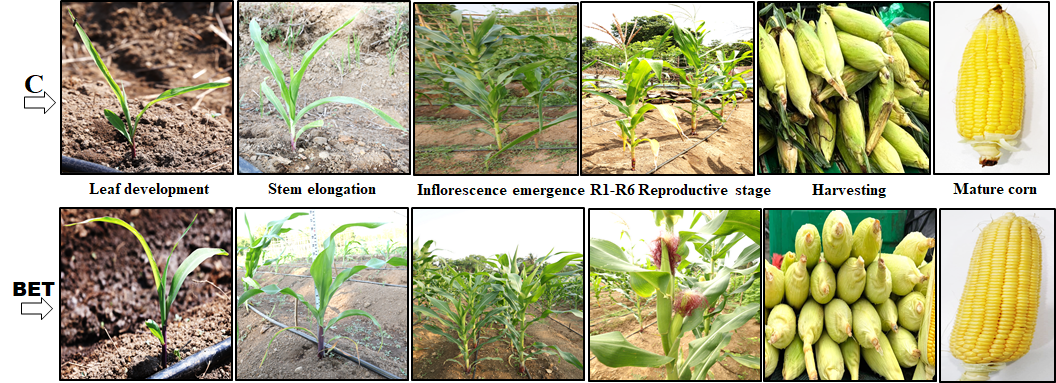 | Figure 1. Representative photographs illustrating the comparative vegetative growth characteristics of maize (Zea mays L.) across distinct developmental stages. (C) Control group; (BET) Biofield energy treatment group |
|
3.3. Phenology and Yield Traits
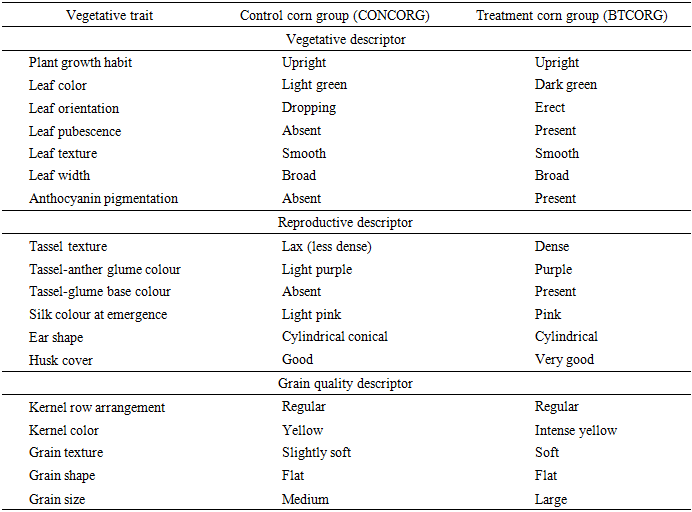
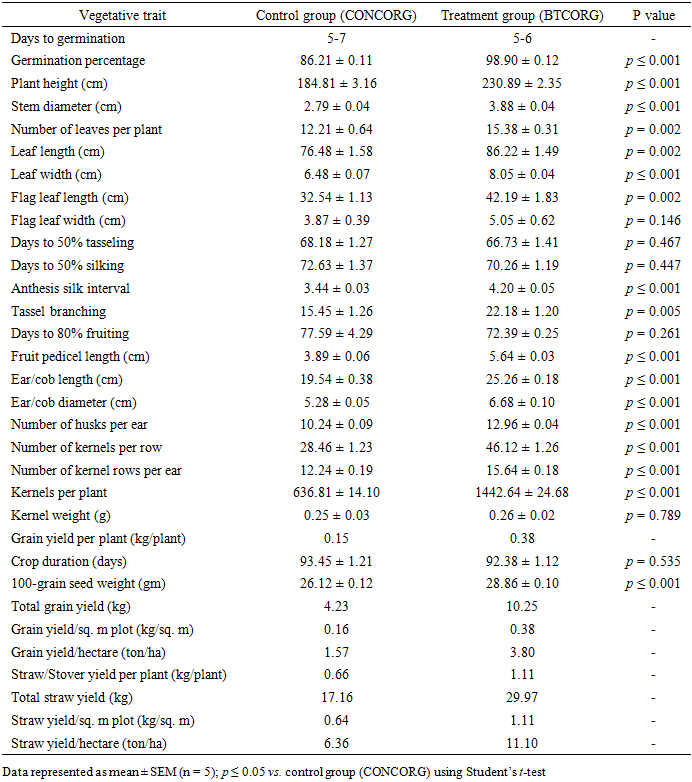
- The phenological and yield-related outcomes are shown in Table 2. The germination percentage, plant height, leaf width, and stem diameter were significantly (p ≤ 0.001) increased by 14.72%, 24.93%, 24.23%, and 39.07%, respectively, in the BTCORG with respect to the CONCORG. The number of leaves per plant, leaf length, and flag leaf length were significantly (p = 0.002) increased by 25.96%, 12.74%, and 29.66%, respectively, in the BTCORG compared to the CONCORG. Reproductive and phenological traits like anthesis silk interval increased by 22.09% (p ≤ 0.001) in the BTCORG compared to the CONCORG. There was a 43.56% (p = 0.005) increase in tassel branching in BTCORG compared to the CONCORG. Yield components like fruit pedicel length, ear/cob length, ear/cob diameter, number of husks per ear, number of kernels per row, number of kernels rows per ear, kernels per plant, and 100-grain seed weight were significantly (p ≤ 0.001) increased by 40.99%, 29.27%, 26.52%, 26.56%, 62.05%, 27.78%, 126.54%, and 10.49%, respectively in the BTCORG compared to the CONCORG. The final productivity in terms of grain yield and straw yield (ton per hectare) in the BTCORG was increased by 142.04% and 74.53%, respectively, compared to the CONCORG. Developmental timing traits like days to 50% tasselling, 50% silking, and 80% fruiting showed an alteration, but none were statistically significant (p > 0.05).
|
4. Discussion
- The findings of the present study suggest that Spiritual Blessing Energy Treatment (SBET), also referred to in literature as Biofield Energy Healing or The Trivedi Effect®, significantly influences the morpho-physiological characteristics and yield potential of maize. This observation aligns with existing research indicating that biofield energy can produce healthier plants and statistically higher yields by modulating physiological processes even in the absence of traditional chemical intensifiers [7]. The increase in grain yield and 100-grain weight observed in SBET-treated plots mirrors the productivity gains typically seen with high-input scientific methods, such as the adoption of hybrid varieties and improved packages of practices [8]. Furthermore, the data indicates that SBET might mitigate abiotic stressors such as drought or nutrient deficiency, similar to the effects of precision nitrogen and water management in conservation agriculture [9]. While traditional biostimulants like seaweed extracts or rhizospheric microorganisms improve plant fitness by fine-tuning metabolism and reducing oxidative stress, SBET appears to act as a metaphysical biostimulant that enhances the "vitality" or "prana" of the soil-plant system [10].The observed improvements in germination rates and seedling vigor under SBET are consistent with double-blind studies on meditative intent, which show that focused human consciousness can modulate the biological markers of germinating seeds [11]. By integrating these spiritual treatments with sustainable agricultural practices, maize productivity can be optimized in a cost-effective and environmentally friendly manner, potentially reducing the heavy reliance on mineral fertilizers that often leads to soil acidification and water eutrophication [12].The dramatic enhancement in phenological and yield traits under the exposure of spiritual blessing energy treatment group (BTCORG), suggests a superior synchronization between nutrient release and crop phenological demand. The significant increase in stem diameter is a critical physiological marker; thicker stems often correlate with expanded vascular bundles (xylem and phloem), facilitating more efficient transport of water and photosynthesates from source to sink. This structural reinforcement likely provided the physical support necessary for the massive 142.04% increase in terminal grain yield [13]. The significant expansion in reproductive architecture, specifically the 43.56% increase in tassel branching, indicates an upgraded hormonal status during the transition from vegetative to reproductive phases. Increased branching is often a proxy for elevated levels of endogenous auxins and cytokinins, which promote cell division in floral meristems [14]. This robust reproductive framework likely ensured higher pollen viability and silk receptivity, contributing to the 62.05% increase in kernels per row.The most profound physiological shift occurred in the yield-related parameters, particularly the 126.54% increase in kernels per plant. This suggests that the BTCORG significantly reduced kernel abortion rates a common physiological bottleneck in cereals. By providing a more stable supply of nitrogen and micronutrients during the "critical period" around anthesis, BTCORG allowed for the maintenance of high photosynthetic rates, ensuring that the carbon supply met the demand of the developing kernels [15].Furthermore, the 40.99% increase in fruit pedicel length likely enhanced the sink strength by increasing the surface area for nutrient unloading into the developing grain. The concurrent increase in straw yield (74.53%) demonstrates that BTCORG does not just favor harvest index, but boosts total biological productivity (total biomass). This indicates a highly efficient photosynthetic apparatus, potentially due to higher chlorophyll density and delayed leaf senescence (stay-green trait), which are typical responses to optimized organic mineralization [16].
5. Conclusions
- Study findings suggest that the SBET group (BTCORG) exhibited significant improvements in vegetative and yield-related traits compared to the control (CONCORG). While the mechanism of "energy transfer" remains elusive within traditional biophysical frameworks, the results indicate that SBET may serve as a low-cost, sustainable adjunct to traditional farming. Further large-scale, double-blind studies are recommended to validate these effects and explore the potential for integrating subtle energy practices into holistic agricultural management.
Abbreviations
- CONCORG: control corn group; NPK: nitrogen phosphorus potassium; BTCORG: biofield energy-treated corn group; SBET: spiritual blessing energy treatment; MOP: muriate of potash; SSP: single super phosphate
ACKNOWLEDGEMENTS
- The authors would like to express their gratitude to the Divine Connection Foundation for their valuable assistance and support throughout the duration of this study.
Conflict of Interests
- Author AB was employed by Trivedi Global, Inc. NRP, TBG, and VDK, were employed by Shree Angarsiddha Shikshan Prasarak Mandal’s College of Agriculture, Sangulwadi, Mohitewadi, Maharashtra, India. Authors SM and SJ were employed by Trivedi Science Research Laboratory Pvt. Ltd. The authors do not have any commercial interests on the objectivity of the research.
Funding
- The authors declare that no funds, grants, or other support were received during the preparation of this manuscript.