
-
Paper Information
- Paper Submission
-
Journal Information
- About This Journal
- Editorial Board
- Current Issue
- Archive
- Author Guidelines
- Contact Us
International Journal of Agriculture and Forestry
p-ISSN: 2165-882X e-ISSN: 2165-8846
2016; 6(2): 86-92
doi:10.5923/j.ijaf.20160602.05

African Smallholders and Agricultural Hybridization
 Abstract
 Reference
 Full-Text PDF
 Full-text HTML
Jake D. Dan-Azumi
National Institute for Legislative Studies, Abuja, Nigeria
Correspondence to: Jake D. Dan-Azumi , National Institute for Legislative Studies, Abuja, Nigeria.
| Email: |  |
Copyright © 2016 Scientific & Academic Publishing. All Rights Reserved.
This work is licensed under the Creative Commons Attribution International License (CC BY).
http://creativecommons.org/licenses/by/4.0/

A study of smallholder agriculture in Africa reveal a delicate interaction and negotiation across the formal and informal boundaries where traditional agricultural practices, based on an understanding of the particular physical reality and exploitation of natural synergies, are combined with inputs typical of conventional agriculture. African agriculture thus stands poised at crossroads; whether to abandon tradition in favour of entirely ‘modern’ methods and export markets as often advocated for in certain circles or depend on time tested indigenous knowledge systems and grassroots-defined development vision which combines popular livelihoods with respect for nature’s systems. Drawing on Bruno Latour, the metaphor of ‘hybridisation’ is used to justify a negotiated compromise between official discourses, which promote the use of chemicals and grassroots reality which relies on nature’s systems. Agroecology is offered as a model to overcome this agricultural dualism (inputs vs. tradition) through combining compatible elements of the two systems for greater productivity and sustainability.
Keywords: Agriculture, Hybridization, Agroecology, African smallholders, Development
Cite this paper: Jake D. Dan-Azumi , African Smallholders and Agricultural Hybridization, International Journal of Agriculture and Forestry, Vol. 6 No. 2, 2016, pp. 86-92. doi: 10.5923/j.ijaf.20160602.05.
Article Outline
1. Introduction
- Much of African agriculture has been shaped by the quest for resource extraction rather than sustainability. Similarly, agricultural policies were largely based on outside expert knowledge meant at modernising the agricultural sector so as to achieve improved productivity of mainly cash crops for export. Both the state-led and market-driven phases of agricultural development in Africa largely proved to be unsuccessful in making significant contribution to poverty reduction and sustainable rural development. Modern agriculture’s solution to the challenge of meeting global food needs has proved largely untenable and unsustainable. With its focus on high external input and monoculture, conventional agriculture negates the relationship that should exists between the soil, crops and animals, ignores the natural cycles of nutrient, water and energy, increases the tendency and susceptibility of agroecosystems to pests by reducing the effectiveness of natural predators, increases the need for chemical control and erodes crop variety and biodiversity (Altieri, 2000, (Gliessman, 2001, Kimbrell, 2002)).Yet, agriculture remains the economic base for majority of rural poor Africans. Its contribution to the GDP of many countries is significant. The bulk of agricultural production in developing countries comes from smallholders who produce mainly for staple food for immediate consumption and/or sale. This makes smallholder agriculture the key to ensuring food security in developing countries not just because it provides the bulk of the food for poor people but also because of its multiplier effect on other aspects of the economy and rural livelihood in general. Increasingly, there is movement towards re-establishing smallholder agriculture and indigenous knowledge systems as viable and sustainable alternatives to the largely unsuccessful conventional agricultural paradigms.The dilemma confronting African farmers is both an important and under-researched topic in its own right, and a microcosm of the wider contradictions underlying the global food security crisis: on the one hand, there are the survivals of a traditional low-input system which work 'with nature and like nature'; on the other, a 'modern' approach, heavily pushed by official agendas, which claims to improve productivity through a high level of artificial inputs.Agroecology generally explores the issues around increasing agricultural productivity, ecological soundness and social equity. It is a participatory and multidisciplinary approach to ‘sustainable development’ that takes indigenous models of sustainability and other theories, such as post-development and post-structural theory into account (Escobar, 1995; Gibson-Graham et al., 2001). Whatever strategy that improves small farm productivity and stability should be embraced. As argued by Barrett et al. (2002), complementarities should be reinforced instead of the divide between ‘modern’ and ‘agro-ecological’ methods. ‘Real progress can only come from a synthesis of the best of the past, eliminating practices that cause damage to environments and human health, and using the best of knowledge and technologies available to us today’ (Pretty, 2002, p. xiii).
2. Towards a Post-Impasse Development Theory
- Much of the discourse and counter discourse in development studies over the last few decades has centred on the search for a paradigm – for instance, modernisation, dependency, development, post-development and/or alternative development. Development, for the most part evolved from ‘orientalism’ and anthropology both of which studied non-Western societies (which were considered and referred to as ‘primitive’ and ‘backward’). Thus, development theories often understood and explained both development and underdevelopment in reductionistic terms (often the market) and offered universal solutions (Amuwo, 2005). Poststructural critique of development, on the other hand, unsettled development and cast serious doubts on its feasibility. It exposed its universalistic and Western orientation and showed how it has become a tool for control of ‘distant others’ (Escobar, 2000). Post-development’s rejects development on the basis of its fundamental premises and equates it with westernization (Nederveen Pieterse, 2000). Since the 80s, a vacuum was created in development theory due to this impasse. This impasse was the result of several factors which include: the widening and seemingly unbridgeable gap between the rich and poor countries, the environmental cost of economic development, the decline of socialism as the solution to underdevelopment and the loss of popularity of “the great narratives.” Alternative theories have sought to bridge this divide by advocating for a development that is counter to the dominant model (Arce and Long, 2000), or that which is critical and practicable (Babbington, 2000), or that which starts with concrete issues of livelihood. Yet, in the last few decades, the anthropology of development has stagnated, seemingly incapable of moving beyond the post-structural critique of development. Using the ideas of Bruno Latour, this chapter suggests a possible path out of the structural impasse of development anthropology. Firstly, the roots of modernity (within which the development discourse is based) are examined. Secondly, an attempt is made to dispel modernity’s claim to be a separate age/phase from pre-modern, a claim which post-modernism essentially reacts and gives credence to in its own critique. Born in 1947 in Beaune, Burgundy, Bruno Latour first trained in philosophy of religion and then anthropology. A great part of his academic career was spent analyzing scientists and engineers at work in Africa (Ivory Coast) and California. His work covers areas ranging from philosophy, history, sociology, anthropology of science, science policy and research management. Generally, Latour’s works straddle the science-society divide. Principal among Latour’s contribution to the sociology of science regards the scientific method in which, contrary to actual laboratory practice, the results of a single experiment determine the validity of theories. Together with Michel Callon and John Law, Latour is credited with the initiation and spread of actor-network theory (ANT), which is a distinctive approach to social theory that attempts to understand and explain processes of technological innovation and scientific knowledge in terms of the infrastructure of actor-network. The Actor-Network Theory controversially integrates both humans and non-humans into the same conceptual framework and assigns them equal agency. In the book, We’ve Never Been Modern (1993), Latour offers a dialectical critique not just of post-modernity but indeed of modernity itself. Since much of development theory is situated within a modernist discourse, Latour’s critique of modernity will be taken to be an equally valid critique of development theories which compartmentalized the processes of growth into neat categories while ignoring the abiding connectivities inherent in them.Latour debunks the ‘myth’ of modernity and argues against the prevalent notion that the rise of science has irrevocably changed the world and separated us ‘the modern’ from our predecessors, ‘the premodern.’ This position stems from what Latour considers to be a dual set of practice involving ‘translation’ and ‘purification.’ ‘Translation’ “creates mixtures between entirely two types of beings, hybrids of nature and culture,” whereas ‘purification’, “creates two entirely distinct ontological zones: that of human beings on the one hand; that of nonhumans on the other. Without the first set, the practices of purification would be fruitless or pointless. Without the second, the work of translation would be slowed down, limited, or even ruled out” (Latour, 1993). What this means is that modernity has tried to polarize and classify ideas into ‘Nature’ and ‘Culture,’ ‘Science’ and ‘Social,’ ‘Human’ and ‘Thing’. By their proclivity for “purification”, the so-called moderns have neglected networks, the imbroglios of quasi-objects and quasi-subjects, and thereby "drained [the modern world] of its mysteries" (p. 128). This condition argues Latour is maintained by the four bases for modernist critique: "naturalization, sociologization, discursivization, and finally the forgetting of Being" (pp. 67, 88)It is the inconvenient ‘intermediaries,’ the ‘networks’ that exist between the two categories (‘premodern’ and ‘modern’), and which have been dismissed by modernity, that Latour refers to as the ‘middle kingdom.’ Ironically, it is within this sphere, where systems are constructed and ideas crossbred, that much of the discourses on the modern world actually take place. In this third sector, politics, science, technology, and nature are constantly mixed, making the distinction between nature and culture (with each in a separate mental chamber) illusory and difficult to maintain. Thus, modernism both purifies and hybridizes but separately and never admits to doing so nor acknowledges the interstices of nature and society in an all-encompassing reality (Figure 1). The moment modernism acknowledges this "middle kingdom" between society and nature, it will cease to be modern and collapse back into "premodern" in-differentiation.
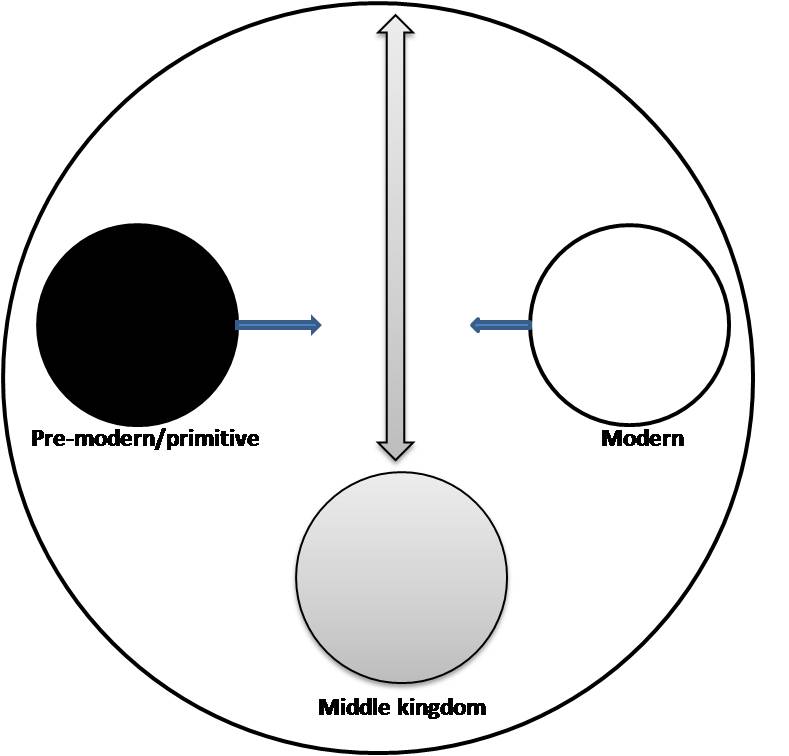 | Figure 1. The great divide in modernization discourse |
3. Modern Agriculture and the Process of ‘Compartmentalization’
- A holistic approach (like Latour’s) can help shed light on impasse of the current global food system. From its very foundations the scientific basis of ‘modern’/‘scientific’ / conventional agriculture ignored the connection between nature and culture and production and the environment. Modern agriculture typifies the false separation and isolation of science from society typical of modernism. As such, the complex web of translations and interactions that join these two have been completely ignored for the most part leading to the promotion of a system that exploits nature’s resources without consideration of consequences on society and the environment.Modernity’s critical stance which divides and conquers hybrids through the process of purification and disciplinary ghettoization has shaped much of modern agriculture in which the delicate network that exists in nature and between nature and society (typical of traditional agricultural systems) are ignored through tidy compartmentalization. Modernism encourages us not to mix up knowledge, interest, justice and power (Hicks, 1994). Thus, monoculture sums up modern agriculture’s tendency not to mix. Yet, as argued by Latour, the so-called premodern cultures thought and acted through hybrids. Traditional agricultural systems relied on the interrelationships that exist in the natural ecosystem and worked in line with such synergies and not counter to them. For them, the distinction between nature and culture was non-existent. Instead, there is a continuous and inter-dependent relationship between them. Conventional agriculture has pursued a modernist agenda in focussing mainly on technical innovation and the use of external non-renewable energy sources and inputs for the sake of economic gain. Agricultural industrialization and commercialization ignored the social and ecological dimensions of agriculture. Rather than conceptualizing agriculture as multifunctional, extending beyond simply food production and economic gain, modernism construed agriculture as unifunctional and so discounted the interconnections between those multiple dimensions.Instead of anatomizing ideas and reality, therefore, agriculture needs to explore and elaborate the relationships between them in what Latour describes as an ethnographic habit that deals calmly with the seamless fabric of ‘nature-culture.’ Thus, instead of being ghettoized and compartmentalized, useful elements of both indigenous knowledge systems and elements of modern science can be collected, sorted, elaborated and followed such that they benefit each other. This will amount to cessation of our modern posture and the dawn of a new nonmodern constitution and a new democracy which allows us to hybridize and connect the complex but valid aspects of our lives and relation to means of production such as land and water. Latour’s concept of hybridization has epistemological implications. Traditional societies and indigenous knowledge systems (IKS) have been side-lined and termed ‘premodern’ – an antithesis of the ‘modern’ West’s pure science. This resulted in the ascendency of ‘epistemological monoculture.’ IKS became a ‘missing mass’ which was ignored socially, politically and philosophically. However, when construed in Latourian terms, this divide ceases to exist and the two knowledge systems meet in a middle discourse. Thus, the ‘Us’ and the ‘Them’ divide collapses under the ‘principle of symmetry’ which overlooks the differences between these two human constructs. Through the application of this principle, the focus shifts from pure forms (premodern and modern), which do not exist anyway, to the complex interactions of the ‘collectives’ (the entanglement of humans and non-humans) (Latour, 1993). The ‘principle of symmetry’ eliminates the antagonism and dualism between modern knowledge / agriculture and traditional knowledge/agriculture and redistributes competencies – modern science and traditional science inhabiting the same collective (Pottage, 2001). However, this is not equivalent to relativism because in spite of its name, the principle is deeply asymmetrical putting “all the explanatory weight on society and none on nature. It doesn’t give proper weight to non-social things and processes, or acknowledges their contribution to our social arrangements” (Bloor, 1999). This means that one knowledge system (IK) is not explained in terms of modern scientific knowledge and vice versa, nor is knowledge seen as a mixture: rather, these two knowledge systems (like society and nature) must be explained at once, in terms of a third process. Thus, IKS and modern science, society and nature are ‘coproduced’ (Latour, 1992).Furthermore, hybridization has implications on our understanding of truth and power. Traditionally, truth (Greek = Aletheia) has been predicated on having real knowledge or science. However, truth and history are not a reflection of an ever greater human consciousness as thought by Hegel and Kant but an attempt to accumulate and control time and space and those who achieve this achieve power. Hence, science has become a legitimizing tool for the pursuit of power. It has achieved this through oversimplification of large numbers of events and harder facts and the silencing of dissent. Thus, knowledge systems alien to the science and those not amenable to its neat system are ignored or ‘reduced’ to allow for control. Modern science and technology, therefore, have been instrumental in achieving political and economic hegemony over non-Western communities. However, the realization that this kind of thinking is harming the universe is what has inspired the debate for the democratization of knowledge and the construction of alternatives that are more sustainable that the ‘monoculture’ of modern science.
4. Achieving ‘Hybridization’ in African Agriculture
- In bridging the great divide in agriculture and development studies, Latour’s caution on saving the best of modernity should serve as a guiding principle. Agricultural hybridization can happen at several levels but this needs to be done dialectically. Firstly, there can be a hybridization of institutions whereby traditional institutions such as the ones in the fadama communities and hybridized with formal institutions. Traditional institutions are custodians of sustainable resource management practices and indigenous knowledge that could contribute in building more stable global food systems. Thus, ‘modern’/formal actors / institutions and customary institutions can result in a collaborative system of resource management in fadama areas. Traditional institutions that have been side-lined in the making of policy that affects smallholders in rural communities can play a vital part in the new system of multiple stakeholders advocated where both institutions shape the collective destiny of the people and the environment through judicious resource management.Equally, traditional institutions can benefit from the ‘modern’ scientific knowledge of the changing environment/climate change and changes in ecology while the latter can also draw from former’s repertoire of sustainable farming practices. For long, ignoring traditional institutions has resulted in the promotion of agricultural policies that are ineffective in resource management and the imposition of inappropriate development policies, both of which have negatively impacted the environment and the people’s livelihoods (Bromley, 1991, Crook, 2005). Many of these institutions have survived both colonialism and the post-colonial state and have been reinvigorated in light of increasing social pressures and the failures of many modern institutions. It is these institutions that hybrid agriculture seeks to incorporate in resource management. Modern institutions can benefit from the presence and knowledge of rural communities and their institutions. On the other hand, customary institutions can also develop reflexivity and abandon certain anachronistic elements (such as land rights for women) that characterize them. Secondly, there can be a hybridization of knowledge such that IK and modern scientific knowledge can draw from what is good and valuable in both systems. For instance, African agriculture has been known to be very flexible and adaptable as reflected in the adoption and success of the variety of crops that have been introduced onto the continent. Similarly, many traditional farmers not only experiment with new breeds but also combine breeds purposely to develop new strains (Richards, 1985). The production of non-traditional fruits and vegetables has intensified since they introduced to several African countries in the last few decades (Jaffee, 1995, Barrett et al., 1997). However, care must be taken in ensuring that commercial and export crops do not take the place of food crops. Crop diffusion should be encouraged where socio-economic benefits are apparent but crops introduced to smallholders in developing countries should find ‘their niche’ and not replace previously cultivated traditional crops (Blaut, 1977). American Maize (Zea mays) and Asian rice (Oryza sativa) varieties have been such successful crop. According to Richards (1996) the practice of introducing new cultivars into existing traditional cropping systems is a ‘repertoire enhancement’ and a technique that can lead to local cultivars like millet taking on new roles (from staple food to specialized beer ingredient) within an emergent cropping system (pp. 312-313). For instance, in many parts of Africa (including Nigeria) maize has replaced sorghum and millet as staple food which have become crops for beer brewing (Byerlee and Heisey, 1997, Smith et al., 1997). Similarly, the International Institute of Tropical Agriculture (IITA) has recorded successes in developing new and better yielding banana and plantain cultivars (Musa crops) through improved breeding techniques (IITA, 2008). In addition, African smallholder agriculture can benefit from technical innovation such as sustainable technologies for better efficiency. In addition to sustainable technology, traditional agricultural systems can benefit from sound agricultural extension on sustainable farming methods. Through such methods and consistent agroecological principles, smallholder traditional agriculture will be able to compete with agri-business. On the other hand, modern agriculture can draw from indigenous production systems and management strategies for natural resources (soil and water). In some instance, certain traditional knowledge systems and farming practices themselves need reforming. Traditional knowledge, which has been confined and restricted can be studied in-depth and made global such that it benefits other communities and it is equally enriched in the process. Other reformations encouraged in certain cycles include the use of bio-fertilizers and bio-pesticides alongside compost/manures and biological/cultural methods of pest control. Similarly, traditional agriculture could draw from certain management methods used in modern agriculture.Thirdly, there is the possibility of the hybridization of methods. This is perhaps the most problematic in the sense that many aspects of the methods of modern agriculture such as the use of agrochemicals are significantly in conflict with the principles of agroecology and sustainability. The effects of modern farming methods have resulted in water pollution, proliferation of susceptible species, increased use of pesticides and soil depletion among others. These effects are undesirable and are therefore incompatible with sustainable agricultural practices. Hence, there is the need for more research in this area on the possibility of combining amenable methods of modern farming with sustainable ones not only to increase food quality and output, but also to encourage a more sustainable use of non-renewable resources, protect soil fertility, reduce pollution, ensure economic viability and exploit natural cycles. Finally, there can be a cross-hybridization of hybrids where, for instance, modern farming methods can benefit from traditional knowledge systems. Aspects of traditional farming such as the focus on stability and risk reduction, system diversity and trophic complexity of natural systems can be valuable to modern agriculture in achieving sustainability. Similar, agroecology is generally high in net energy yield due to the fact that external energy inputs are relatively low. A careful study of these knowledge systems which are built and modified over centuries, can help in redesigning the food production systems in industrial countries and correct some of the deficiencies that characterize modern agriculture.
5. Conclusions
- In order to overcome the impasse in development, the targets of development intervention must be carefully studied in order to understand IKS and how indigenous people construct meaning. Also, it is important to understand how targets of development intervention perceive development. Often, smallholders understanding of development/agricultural intervention in developing countries does not fit into the dichotomous, bipolar logical of development and post-development theories. Similarly, they do not always completely share the radical democratic, anti-authoritarian, anti-capitalist and anti-imperialist concerns and agendas of post-development theorists (Nederveen Pieterse, 1998). Instead, they balance the two and negotiate meaning when faced with development interventions.Indigenous people adapt and recast their dependencies on modern means of production in order to reconstitute and reproduce their own cultural ideas and practices (Sahlins, 1992). Through their participation in non-governmental organisations (NGO) and donor-driven projects, indigenous groups draw on the modern institutions and resources of a global civil society to reconstitute themselves as a ‘traditional community’. Increasingly, systems such as fadama agriculture, employ the tools of modern technology and politics but at other times reject or modify the paradigm altogether. In an extensive study of different communities in the Northern Cape and Northern Provinces of South Africa, (Robins, 2003) showed how indigenous peoples critically engage with development intervention and recast it depending on specific content and context. This process has been referred to as the ‘indigenization of modernity’ (Robins, 2003).The ‘agency’ exercised by traditional societies in negotiating modernity and the fact that they inhabit a ‘middle kingdom’ (between pre-modern and modern) have largely been ignored both by development theories and policy makers. Development theory has operated on the basis of the dichotomy between ‘modern’ and ‘traditional’. Similarly, critics of mainstream development have fallen victim to this categorization. Both development (mainstream) and post-development theories “assume a taken-for-granted stance that development discourses and bureaucratic state practices are in fact the all-powerful and uncontested discursive conduits for the spread of Western modernity, global capitalism and neo-liberalism” (Robins, 2003). Thus, they both not only ‘over-emphasize the reach and capacities of both the state and development’ but they also ‘seriously underestimate the capacity of beneficiaries and citizens to strategically engage with the state and development’ (Robins, 2003).This position totally discounts the hybrid nature of reality of life in postcolonial Africa. Local communities embrace, reject or modify the development discourse to suite their local context and history. In fact, the failure of mainstream development intervention in many developing countries cannot be totally disengaged from this agency exercised by traditional societies in their rejection, resistance and/or modification of ‘development,’ especially elements they consider to be too much extraneous and contradictory to their accumulated knowledge systems. The hybrid character of many indigenous societies makes the dichotomy between ‘modern’ and ‘traditional’ redundant as it is impossible in most cases to speak of strictly ‘modern’ or ‘traditional’ societies. The so called ‘traditional societies’ transcend these two epistemological categories because of their hybrid nature. Not only do many smallholder farmers in developing countries use machines and external inputs such as agrochemicals, their access to modern instruments such as mobile phones defies the pure categories claimed in development discourse. If the divide between ‘modernity’ and ‘tradition’ as claimed in much of development discourse is exaggerated, and if practices of traditional farming communities do not fit into the pure categories supposed in theories, then it is the sphere of interaction and connectivities (the middle kingdom) that need careful studying. It is presumptuous to talk of closed farming systems as interaction and influences of outsiders always causes some differences in the resource base of farmers and this often results in transformation of their farming systems. Hybrid research, therefore, aims to strike a balance by providing a common ground on which post-development and the neo-populist paradigm of development practice can converge and benefit from mutual engagement. In agriculture, hybrid development will strive for systems where limited and sustainable external material inputs are combined with local knowledge resulting in an exchange of local knowledge and external know-how. Hybrid development, which is the synthesis that stems from this engagement, brings together the two epistemologically conflicting and divergent views in a critical way to produce a midterm discourse, that is, a meeting point of minds ‘where the grassroots and official society come together and gradually develop a more general social project’ (Biel, 2000). One such sphere of dialogue, for instance, can be in the area of technology blending as shown above. Development experts should work towards understanding this dynamic while being careful to overcome an ‘unbiased glorification of communities and ‘the local’ at the expense of a differentiated, radical view of development processes” (Müller, 2006).