
-
Paper Information
- Paper Submission
-
Journal Information
- About This Journal
- Editorial Board
- Current Issue
- Archive
- Author Guidelines
- Contact Us
Human Resource Management Research
p-ISSN: 2169-9607 e-ISSN: 2169-9666
2015; 5(3): 58-72
doi:10.5923/j.hrmr.20150503.02
Incentive to Get Nuclear Science Specialists as Part of Human Resources Planning. A Case of Tanzania Atomic Energy Commission (TAEC) Arusha Tanzania
 Abstract
 Reference
 Full-Text PDF
 Full-text HTML
1Department of Health systems Management, Mzumbe University, Tanzania
2Pharmacy department, KCMC Hospital, Moshi, Tanzania
Correspondence to: Sylvia Minde, Pharmacy department, KCMC Hospital, Moshi, Tanzania.
| Email: |  |
Copyright © 2015 Scientific & Academic Publishing. All Rights Reserved.
This study aimed at assessing the practice and process of Human resources planning as well incentive to get nuclear science specialists/experts at the Tanzania Atomic Energy Commission Arusha Tanzania and found that although various activities concerning Human resources planning are carried out at the commission the findings revealed that Human Resources Planning (HRP) and its process was ineffective. Furthermore, it was found that the inadequate financial resources and acute shortage of human resources allocated to the commission cannot accommodate all the activities planned. This makes it difficult to conduct HRP as well as provision of incentive to get nuclear science experts. It was revealed that the current training programme is not adhered to due to lack of enough funds for training as well as, low salaries that lead to staff dissatisfaction. It was further found that the problem of aging is also significant not only at TAEC but also in other developing and developed countries. As seen in chapter two of the theory, that some students see nuclear science as an “old technology” – They want to be IT specialist and the like. This may lead to shortage of people who would like to join the field. Moreover it is important to mention here that the recent nuclear accident in Fukushima Japan may render the nuclear science unpopular and that this may prevent people from joining the field. The disaster has ignited debate over the prospects for the Japanese economy and has significant implications for the future of nuclear power/science and technology in Japan and around the world. The study recommends for provision of Salary top-ups, bonuses, and risk allowances because of the risk involved in handling radiation materials. Moreover provision of special salaries for TAEC staff and guaranteed opportunities for further career development may be of help. Enriching existing programmes at all Universities in science and engineering with nuclear science and technology, as well as developing a double major programme with nuclear as the second major, may also redress the situation. Introduction of fully fledged graduate degree programmes in nuclear science and technology, for instance MSc. in Nuclear science/Engineering. Partnering with institutions abroad to train and retrain nuclear science academics and researchers at all levels from BSc to PhD degrees.
Keywords: HRP, Human Resources, TAEC, Nuclear
Cite this paper: Richard Ngowi, Sylvia Minde, Incentive to Get Nuclear Science Specialists as Part of Human Resources Planning. A Case of Tanzania Atomic Energy Commission (TAEC) Arusha Tanzania, Human Resource Management Research, Vol. 5 No. 3, 2015, pp. 58-72. doi: 10.5923/j.hrmr.20150503.02.
Article Outline
1. Introduction
- In Tanzania, little is known about the Human Resources Planning for nuclear Science and Technology. The success of an organization depends largely on the quantity and quality of its human resources. No organization can be successful in the long run without having the right number and the right kind of people doing the right jobs at the right time. The critical importance of Human Resources to the effective and efficient performance of work organization is obvious, since manpower is the critical resource upon which a country’s development depends. Hence, effective organization planning for harnessing and utilization of human resources for nuclear science is highly important.The Government of Tanzania, through the ongoing reforms is now giving due concern on the availability of manpower database, both at the organizational and national levels, example through the National Bureau of statistics and Integrated Human Resource and Pay Roll System Software.Furthermore due to discovery of Uranium in Tanzania the government needs to be aware on how best it could plan for the need and increased demand of qualified and experienced Human resources in the fields of nuclear science. On top of that there is need for safe use of Uranium, its products and waste which could be dangerous if improperly handled or misused.In order to assess the magnitude of the problem of incentive to get, as well as HRP for Nuclear science, I undertook a survey on Human resources planning and development in terms of supply and demand, level of education and qualifications, as well incentive to get, utilize and retain the staff for nuclear science at TAEC and thereafter give recommendations to the government of the URT on the problems that will be found the HR Planning. Available reports say that uranium mineralization was first identified in Tanzania in 1978-1982 by Uranerzbergbau GmbH (UEB). The firm identified airborne radiometric anomalies during this period, leading to the discovery of two uranium deposits at Mkuju in Ruvuma and Mdaba Dodoma regions in southern and central Tanzania, respectively.Recently, there have been efforts to carry out explorations for various minerals. Among these minerals, Uranium is one of them and there are companies, which have been carrying out the explorations in various parts of Tanzania including the Mkuju River Project (MRP), which is under the Mantra Resources Limited. According to the MRP, it has about forty-four point four (44.4) million pounds of U3O8 (type of uranium compound) in an area of 100 km2. Mantra Resources Limited is planning to start mining and processing of uranium at Mkuju in the year 2012, with an estimated annual production of 2.5 million pounds per year.Other exploration estimates indicate the country has about 53.9 million pounds of uranium oxide (U3O8) deposits that, at current prices of $41 per pound, is worth $2.2 billion.The coming on stream of uranium will make it the most dependable export, after gold -- Tanzania is the third largest gold producer after Ghana and South Africa -- which in 2009 earned the country a total of $1,076.1 million.It is estimated that at this production rate, Tanzania will be among the top five producers of uranium ore in the world. Furthermore, it is confirmed that the uranium deposit at Mkuju River Project will remain potential for the next ten years. Nevertheless, it is well known that Uranium mines are associated with a risk of radiation exposure to the workers, public and cause environmental radioactivity contamination. By virtue of this fact, there has been increasing regulatory concern all over the world to protect the safety of workers, public and the environment, prior to mining.According to daily Newspaper (Daily News February 2010) the main exposure pathways to public and workers in uranium mines include; direct exposure due to gamma radiation from the mine rocks, tailings and/or attachment of radio nuclides, to aerosols and inhalation of radionuclide’s airborne dust containing uranium, thorium and its radioactive daughter progeny. Radio nuclides are often referred to by chemists and health physicists as radioactive isotopes or radioisotopes, and play an important part in the technologies that provide us with food, water and good health.
1.1. Background to TAEC
- The Tanzania Atomic Energy Commission (TAEC) was established by the Atomic Energy Act as a sole regulatory body responsible for atomic energy matters in the URT. TAEC was reconstituted from the NRC following the coming into effect of the Atomic Energy Act No 7 of 2003 on 1st July 2004; and subsequent demise of the NRC. TAEC has been empowered to regulate and supervise the safe and peaceful utilization of atomic energy and nuclear technology so as to protect workers, patients, the public and the environment from harmful effects of both ionizing and non-ionizing radiation. Further to this, TAEC has been mandated to provide radiation protection services and coordinate and facilitate the promotion of nuclear technology and the safe and peaceful utilization of atomic energy.The Commission is currently under the Ministry of Communication, Science and Technology, and is headed by the Board, whose Chairperson is appointed by the president of the URT. The membership of the board as per Atomic Energy Act is made up of 15 members including representatives from the Ministries responsible for science and technology, health, energy and minerals, agriculture and livestock development. The day-to-day activities of the Commission are managed by the Director General (DG) who also serves as the Secretary to the Board of directors. Under the DG, there are three directorates and two units. The Radiation Control Directorate consists of two departments, one with responsibility for ionizing radiation practices, and the other for non-ionizing radiation practices. Each department constitutes two sections; one is the Authorization and Regulations section and the other is Inspection and Enforcement section. The radiation protection services such as individual monitoring of occupationally exposed personnel, calibration of radiation detection instruments, radioactivity analysis, waste management and repair of nuclear instruments are under the Directorate of Nuclear Technology. The following chapter explains in details the different directorates of TAEC.
1.1.1. Finance and Administration Directorate
- The Finance and Administration Directorate, FAD of the Tanzania Atomic Energy Commission provides the necessary administrative support in running the activities of the Commission. The Directorate consists of two departments and six sections namely: Personnel and Administration Department, Finance Department, as well as Personnel, Administration and Public relation sections. Others are Accounts and Planning Sections.
1.1.2. Radiation Control Directorate
- The Radiation Control Directorate (RCD) at the Tanzania Atomic Energy Commission, TAEC performs the major regulatory functions of the Commission. Some of those activities are performed and coordinated by different departments and sections.The different Sections are charged with the responsibility of developing different regulations, code of practices, procedures and guidelines in implementing the Atomic Energy Act No. 7 of 2003. The sections are further responsible for authorization and so giving licenses/permits for all types of radiation emitting devices and radiation sources imported, exported and possessed by different clients, companies, etc.
1.1.3. Nuclear Technology Directorate
- Nuclear Technology Directorate, NTD at the Tanzania Atomic Energy Commission, TAEC serves as a promotional wing of the Commission. It is made of different Sections and Units as follows: Dosimetry and Calibration Section; Radioactive and Environmental Management Section, Nuclear Instrumentation and Maintenance Section; Information and Coordination Unit; International Nuclear Information Systems – INIS; XRF & XRD Unit; Radioactive Waste Management Unit.
2. Statement of the Problem
- It is believed that in Tanzania most of the people do not want to take science subjects in school. Most of the students think that the science subjects like Physics, Chemistry and Mathematics are the most difficult of all other subjects. Further it has been calculated that these are basic subjects needed for specialization in nuclear science but unfortunately only very few students enroll in these subjects. Regarding the explanations above one can conclude that this is the reason why we have very few specialists in nuclear science. However these reasons affect not just the field of nuclear science – also medicine, health and health services management physics, chemistry, pharmacology etc tec. Furthermore for about three decades now, TAEC has been facing staff problems which made it understaffed and in many cases incapable of performing the mandated functions. On top of that, it has been difficult to attract qualified nuclear science specialists to the commission because of the low salaries with low motivations and incentives.Moreover, Tanzania’s efforts to embrace nuclear technology may take much longer than anticipated because the country does not have enough nuclear scientists, it is said that those currently handling nuclear applications were engineers, medical specialists and other experts who had not been purposely trained in nuclear science.It has been reported that it would take at least 15 years to get the required scientists even if courses in nuclear science were introduced now. There is no college in the country offering nuclear science courses as super specializations. (The Citizen Newspaper 22.11.2009)The citizen newspaper Report further shows that 20-plus experts working at TAEC were mainly engineers and scientists who had undergone short courses abroad, but who cannot meet the country's needs in nuclear science in future.Other studies show that the situation is not very different in many sub-Saharan African countries Only South Africa, Egypt and other states in North Africa have qualified scientists to handle their nuclear reactors and other related fields.According to the explanations above it shows that Tanzania needs to have qualified experts if it was intent on advancing in nuclear science. Therefore Tanzania needs more preparations, including formulating a nuclear science policy.TAEC has been operating on government bursaries and budget, which offers minimum financial resources. Some minimum fees paid by the clients and stakeholders have been supplementing the efforts to meet its requirements, although it has been insufficient.Yanko, Y says “with the forthcoming high growth of nuclear industry worldwide maintaining nuclear competencies both industry and nuclear regulatory authorities will be the most critical challenge in the near future. However the Knowledge issues, like aging of nuclear personnel, retirement, Loss of valuable nuclear knowledge, Degradation in technology skills and know- how should be of great concern.”
2.1. The Nuclear Accident in Japan
- In addition to the above the recent nuclear accident in Japan requires a mention. On March 11th, 2011, the largest earthquake on record SHOOK Japan and generated a thirty-foot tsunami that inundated the country's northeast coast. The death toll is estimated at over thirteen thousand with thousands more missing, and the country is grappling with power shortages, search and rescue efforts, and the need to provide shelter and other services for victims. The disaster caused some catastrophic events at the Fukushima Daiichi nuclear POWER plant. Over one hundred thousand people have been evacuated in the area surrounding the plant; some are already suffering from radiation exposure. Several powerful aftershocks have complicated search and rescue efforts and hampered official efforts at bringing the nuclear situation under control. The triple-fold crisis has ignited debate over the prospects for the Japanese economy and has significant implications for the future of nuclear power in Japan and around the world.
3. Objectives
- The general objective of this study was to assess the practice of HRP at TAEC taking into consideration the incentives to get nuclear science specialists.The specific objectives are:1. To determine the reasons why suitably qualified people/specialists are not attracted to the nuclear science field in Tanzania.2. To find out what incentives would motivate the specialists at TAEC after they have taken their employment.3. To determine and recommend on the current and future levels of staffing, in Tanzania in terms of education and specialization in nuclear science.4. To evaluate the process of Human Resources Planning and development at TAEC and establish recommendations on problems/factors/challenges that will be found as hindering its proper implementation.
4. Literature Review
- It is the opinion of the researcher that in order to ensure supply and attraction of Human resources for nuclear science there is a need for government using its universities to plan for the numbers of those who will be enrolled in the field of nuclear science. It has been documented that those who graduate from nuclear science are fewer than the demand in the job market. This argument is supported by IAEA (2004:17) as it has reported that maintaining competences in the nuclear industry and nuclear regulatory authorities will be one of the most critical challenges in the near future. The ability of universities to attract top quality students to nuclear programmes, to meet the future staffing requirements of the nuclear industry and conduct leading edge research in nuclear topics is becoming seriously compromised in the industrialized and developing countries. National studies undertaken by several member countries of the OECD have shown that in spite of several initiatives undertaken by them, more engineers and scientists with nuclear knowledge are required than are graduating.Different theoretical literature reviews show that the number of those graduating from universities in nuclear science field is falling. This argument is justified by (IAEA 2004) that the continuing antipathy of students in many countries towards science, engineering and technology subjects has meant that the proportion of graduates in these areas has been falling in recent years. As a consequence, the competition for them is increasing and the signs are that the nuclear industry is losing out. Thus an additional concern to the nuclear industry is that even the approach of hiring non-nuclear technical graduates and training them in house is adversely impacted. The major causes for this situation include the following: the decreasing number and dilution of nuclear programmes; consolidation of the nuclear industry; staff reduction and lack of fresh recruitment, the decreasing number of students taking nuclear subjects; the lack of young faculty members to replace ageing and retiring faculty members; ageing research facilities that are being closed and not replaced; and the significant fraction of nuclear graduates not entering the nuclear industry.In the West, another reason is that the nuclear power industry has a negative image – as something that is potentially dangerous. For young graduates, the industry is ‘not cool’.Moreover, IAEA (2004) points out that currently, the key themes in organizations include rapid response, a flexible employment structure and development of individualism. Consequently, employers are becoming increasingly dependent on the skills, flexibility and commitment of their employees. At the same time the trend is against a lifelong employment in a single company; for example, in the United States of America the average worker is estimated to change his or her employer every five years. This situation is not conducive to promoting company loyalty in employees and has an adverse impact on transfer of nuclear knowledge from retiring staff members to successors.What IAEA tells us here is that this problem is exacerbated by a situation in which nuclear organizations are losing knowledge workers not only to other nuclear organizations but increasingly to non-nuclear industries. Now that it cannot afford any further reduction in existing competences and needs to develop new ones in the areas of decommissioning and clean up, attracting young blood, retaining staff and attracting experts from other sectors in the face of competition from industries perceived as more attractive is proving problematic in many countries.As a consequence, the average age of the nuclear workforce has been gradually rising for the past several years, a phenomenon commonly referred to as the ageing of the workforce. These workers, including scientists, engineers, technicians and other specialists, have worked in the nuclear industry since its inception and carry with them a vast amount of knowledge and experience that could be lost as they retire in large numbers over the next few years Table 1.0.
4.1. Developing the Required Manpower for Nuclear Science
- Prof. Ilham Al Qaradaw, Professor of Physics University of Qatar supports the argument in previous sections by identifying Human resources development as the main challenge in establishing a Nuclear Research and training Centre in Qatar. According to him, despite several agreements and treaties which need to be signed, the required very demanding infrastructure and update of legislations, the Human resources development is a main issue in establishing Nuclear Qatar.Hon. Prof Makame Mbarawa (MP) Tanzania’s Minister for Communication, Science and Technology in his meeting with TAEC staff recently was quoted as saying that Tanzania is planning, to establish a Nuclear Power plant. From the above, it is therefore envisaged that in the future Tanzania will establish an NPP. The NPP is very important for Tanzania due to the unreliability of Hydro electric Power as well as frequent power cuts due low volumes of water in HEP Dams of Mtera, Kidatu and Nyumba Ya Mungu. Due to this reason the government has initiated a process of establishing a Nuclear Power Plant. From the explanations above the URT needs to plan well ahead of time the manpower requirement for the Proposed NPP and TNRC. B.J. Csik et al: (IAEA bulletin-vol.21, No 2/3:65) supports the explanation above that, the availability of adequately qualified manpower is one of the essential conditions of success for any nuclear power project or programme. In addition to the above and as explained in chapter one, the URT will soon exploit it’s Uranium which need super specialties in nuclear science.Without qualified manpower no nuclear power plant can be planned, built or operated properly, and there can be no assurance of nuclear safety and reliability of power production. The amounts and qualification of manpower required for a successful nuclear power programme are usually underestimated and the resulting shortage of manpower is a limiting factor in the development and transfer of nuclear technology in developing countries.B.J. Csik, further points out those accidents like that of Three Mile Island nuclear plant has reaffirmed the importance of qualified manpower for safe operation of nuclear power plants. Although a combination of several factors contributed to this accident, human errors played an important role in its development and in its ill-control. Adequate actions required to prevent an accident can only be ensured by operator skill and proficiency, achieved through appropriate education, training, experience and systematic measures for maintenance of proficiency.What B.J. Csik tries to tell us is that essential role of skilled and qualified people in preventing accidents or handling them correctly if they do occur has been confirmed. We all know that Nuclear power is a demanding technology which requires specific knowledge and excellence in human performance. Education and training takes time and effort, and a nuclear manpower development programme must be planned a long time in advance to be effective.There is a fundamental need therefore for a country embarking on a nuclear power programme to provide for the establishment and implementation of a manpower development programme. This programme should cover all aspects of manpower development including determination of needs, both in respect of manpower qualification and numbers, a programme of education, programmes of specialized training and qualification through experience.According to him we can conclude that developing the required manpower before embarking on its first nuclear power project, it will be necessary for a developing country like Tanzania to determine its real manpower needs in the framework of the envisaged nuclear power programme and to evaluate the existing organizational, educational and industrial capabilities for meeting these needs. Manpower development for domestic participation in the nuclear power programme should be considered within the broad context of the national industrial development strategy and its overall manpower requirements.Furthermore B.J. Csik says that, specialized training and qualification in nuclear disciplines or in those conventional disciplines required by the nuclear industry are usually unavailable in developing countries. Such training consists both of specialized instruction and on-the-job training directly related to the performance of specific tasks. According to him the construction of a nuclear power plant requires at present 12—15 million man-hours. This includes project engineering, construction work management, work of tradesmen during construction and installation, control and surveillance activities, etc. In addition, a single plant requires 150—200 well trained staff for operations, health physics, maintenance and other technical services.Before and during power plant construction, commissioning and operation, several hundreds of technical personnel should pass through a training programme, in addition to having general education at various levels. Most of them should also be trained on the job to acquire the proficiencies needed for correct performance of specific tasks.
4.2. The Aging of Nuclear Science Specialists/Experts
- KELVIN LN (2004:2) Says that a projected shortfall in sufficiently educated radiation safety professionals has placed a burden on industries using radiation to support the nations, energy, security and health needs. This national shortage is primarily due to a lack of funding of academic research and educational health physics programs. He further says that another concern is the anticipated large number of radiation safety personnel reaching retirement age in the near future.Another study in the USA found that certain federal agencies with radiation safety responsibilities face a huge challenge with the number of radiation protection staff reaching retirement age in the near future. Some studies have defined HRP as a process including forecasting, development, implementing and controlling by which a firm ensure the it has the right number and right kind of people, at the right place, doing things for which they are economically most suitable (Geisher as quoted by Prasad, 2001:127). Prasad argues that this definition of Human Resource planning serves the purpose adequately and most the definitions are based on this.Decenzo and Robbins (2002:79) defines Human Resource planning as the process by which an organization ensures that it has right number and kind of people at the right place, at the right time, capable of effectively and efficiently completing those tasks that will help them achieve its overall objectives.Prasad (2002:127) identifies the features of Human Resource planning as the process that includes various aspects through which an organization tries to ensure that the right people, at the right place, and the right time are available. Secondly it involves the determination of the future needs of human resource in the right organizational planning and structure. Therefore it depends heavily on these factors. Determination of Human Resource needs in advance facilities management to take up necessary actions. And thirdly, it takes into account the human resource availability at a future period in the development in the organization.It indicates what actions can be taken to make existing Human Resources suitable for future managerial positions and how the gap needed and available human process can be fulfilled.Prasad also argues that Human Resource planning is of primary nature, and therefore it precedes all other Human Resource Management functions. Without human resource planning, no other function can be undertaken in any meaningful way. Human resource planning translates the organizational objects and the number and kind of human resources needed to achieve those objectives.Without a clear cut planning, estimation of the organization’s human resource need is reduced to mere guesswork.
4.3. The Concept and Purpose of Human Resource Planning in Nuclear Science
- Armstrong (2003:24) provides that human resource planning is based on the understanding that the people in the organization are its most important strategic resource t is generally concerned with matching resources to business needs in the longer term, through requirements. It addresses human resources in quantitative term. Further, human resource planning also looks at broader issues relating to the ways in which people are employed in order to improve organizational infectiveness. It can therefore play an important part strategic human resources management.Braham (1940) argues that there is a big distinction between the terms “manpower planning” and “human resource planning”. He argues that “manpower planning” is essentially quantitative in nature and is concerned with forecasting the demand and supply of labour, while “human resource planning”. This has far wider meaning, including plans made across the whole range of personnel and development activity. These development activities include soft issues such as motivation, employee attitudes and organizational culture.According to Braham (1994) it was during the 1980s that, “manpower” was broadly termed “human resource planning” and widely established as a staff activity in major business and governmental organizations. The term “human resource planning” implied a scope broader than just supply- demand balancing or quantitative forecast. Human resource planning shifted focus from being a quantitative approach, although recognizing its.
5. Methodology
5.1. Research Design
- Research design used for this study was case study design. The case study was chosen because of its viability and flexibility in terms of data collection and methods of analysis. This enabled the researcher to do in depth study on the incentive to get nuclear science specialists as part of HR Planning at TAEC.
5.2. Study Population and Sampling
- As seen in the previous chapters TAEC is divided into three Directorates, and has an establishment of about 90 staff. Of the 90 staff about 48 of them are nuclear science specialists the rest being Administrative staff. The sample was derived from all the three directorates of the commission namely DRC, FAD and RCD. Two methods of sampling were used i.e. purposive sampling and simple random sampling. Purposive sampling was used and according to Ndunguru (2004) and Kothari (2000) argued that purposive sampling is considered as representatives of the population for the case study research. Thus this study purposely selected officials who are directly involved with Human resource planning function within the Commission and in this case the so called Senior Management Employees. A purposive sampling technique was used for Directors, and all other Senior Management Employees who are involved directly in the management as well as corporate decision making.The purposive sampling technique was used for these officials because of the researcher’s views, that they possess the most factual data possible and they have a good insight into the subject matter.In addition to the above, Simple Random sampling technique was used to sample out Commissions Nuclear science employees. Twenty 25 which is about 50% randomly sampled Nuclear Science employees were selected from the different sections, units, departments, and directorates at the Commission.This study used were interviews and , questionnaires, to collect data where in Secondary Source of Data the researcher examined various documents which were relevant in human resource planning as well as incentive to get HR for nuclear science including documentaries, IAEA Publications, guidelines and policies.Data analysis was done using both qualitative and Quantitative manner. SPSS was used to analyze the quantitative data.
6. Results and Discussion
6.1. Existing Staff Capacity and Staff Establishement
- Since the establishment of TAEC in July 2004, there has been an increase in the number of staff from 16 in 1985 to 90 as of April 2011. Out of 90 staff, 46 are scientific and technical/Nuclear Laboratory staff out of whom 3 are PhD holders and 9 scientific staff have Masters Degrees. Moreover seven 7 administration/operational staff have masters degrees/ and/or CPA (T); 24 scientific staff and 9 administrative members of staff have Bachelor degrees and/or Advanced Diplomas. 8 scientific and Administration staff have diplomas; while the rest have certificates. In addition, out of 46 scientific and technical staff, five are females. Table 2 below shows the current staff profile in terms qualifications for technical and Administrative staff. In terms of age profile, almost half of the TAEC staff is within the Age group of 31 – 40; few are within 40-50, while 9 are above 50 of TAEC corporate Strategic Action Plan, the Commission expects to have about 199 staff with relevant qualifications by the year 2017. With this projection, the Commission will be required to recruit a total of 109 additional staff and train the existing staff and those who will be recruited to reach a level that they will be of full potential. The following were the main research findings according to questionnaire distributed to both senior Management employees’ as well nuclear science specialists.
6.2. Human Resources Planning Process at TAEC
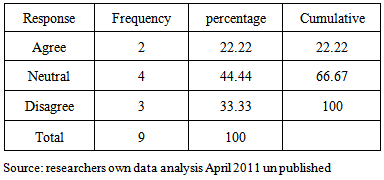
- The response from the questionnaire analysis revealed that the Human resources Planning system in not effective at TAEC. The results show that about 33% of the nuclear science specialists disagreed that there is effective HR Planning system at commission. Surprisingly about 45% of them said nothing or were neutral on the question. On the other hand, 22% of those who answered the question agreed that there are effective Human resources planning system at TAEC. (Table 1) This may be because of lack of knowledge on HRP. The researcher’s observation on this revealed that, what is actually done at TAEC in this exercise is looking at the post/cadre which its establishment is sought for the following year. The designation is preceded by the salary scale of that particular post. If there is a change in scheme of service of that cadre/designation, new scheme and salary scale proposed should as well be shown. Establishment (number of posts) of the previous year and of the coming year will as well be shown. In case there is a discrepancy, reasons should be given as to why there is such a difference (either increase or decrease). The new establishment sought will be equated by the actual strength (existing number) and that is where the variation can be realized (either plus or minus). In case there is an increase in establishment, reasons should be given under the remarks column. The increase of establishment can sometimes happen because may be the commission wants to promote its employees who are in that designation or sometimes could be because it wants to recruit more employees in that designation.All these particulars are filled in a Personal Emolument (P.E) form. In order to crosscheck the actual strength put down under the personal emolument form. It indicates names and check numbers of the employees which was reflected in numbers under the schedule of personal emolument. That is where also annual salary without increment, annual increment and promotion are shown to every employee.The mathematical aggregate of all these bring the total PE of that particular financial year. In this exercise every head of department, sections and units in collaboration with their senior staff work in their respective sections and units.Thereafter the head of Human resources SHRMO and administrative staff compiles the collected data from different sections/units/departments so as to complete the information needed on the PE for the whole organization.Such exercise is done in every financial year mainly for the purpose of financial (salary allocation by the Ministry of Finance and Economic affairs and for controlling unnecessary increase of Government payroll.In as far as HR planning is concerned, personal emolument exercise helps a lot in the control the Government payroll/expenditure as it restricts recruitment without the permission from the President’s Office Public Service Management PSM.
|
6.3. Incentives Currently Provided to Nuclear Science Experts
- The response from the questionnaire show that currently there are no special incentives provided specifically to nuclear science specialists. What is actually happening at TAEC is that the incentives like housing allowances, transport assistance, lunch, overtime, and medical coverage are provided to all staff both scientists and non scientists. The findings show that 65% of respondents i.e. the nuclear science specialists said that the commission does not provide special incentives for nuclear scientists. There is need for the commission to consider provision of special incentives to the nuclear specialists. On the other hand only 10% agreed that there are special incentives for nuclear scientists (Fig. 1 & 2).Moreover the findings show that 50% of respondents said that they were not satisfied with incentives currently provided by the commission. The other 25% were neutral on the question. (Fig 3)
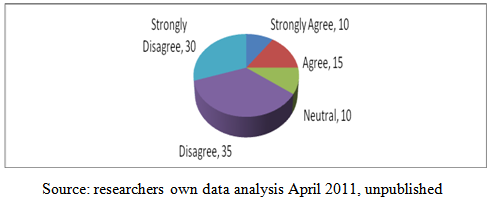 | Figure 1. Percentage distribution of respondents according to incentives provided by Commission |
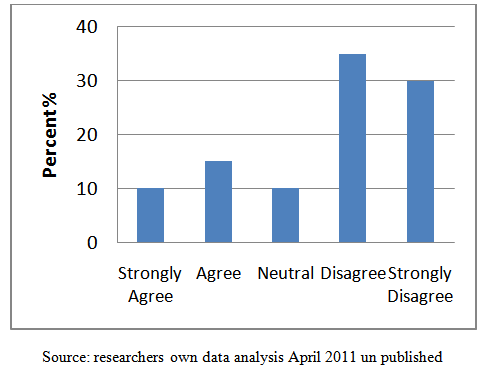 | Figure 2. Percentage distribution of respondents on special incentives provided by Commission |
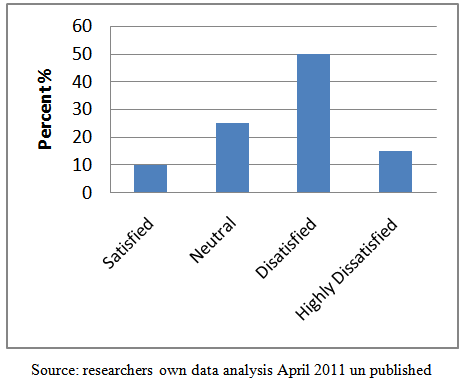 | Figure 3. Percentage distribution of respondents on satisfaction by incentives provided by Commission |
6.4. Job Security
- Job security is very important for staff Motivation. When the respondents were asked on the job security 75% of the nuclear science specialists agreed that job security is very high in the commission. This may be because the commission provides permanent contracts of employment that ensures high job security. On the other hand 5% of them disagreed that there is job security at the commission Fig 4.
 | Figure 4. Percentage Distribution of respondents according to their feeling about job security at the Commission |
6.5. Influence of Incentives Provided on Performance at TAEC
- It was found that incentives currently provided by the commission have a major influence on staff performance. 95% of nuclear experts who were asked this question answered yes. When the staff were asked about incentives that motivate them more 15% said that training and development is most motivating incentive. Fig.5. In addition to this promotion and housing were preferred by about 14% of respondents, furthermore the frequency shows that these are the most motivating incentives followed by Performance awards, Education subsidy and medical coverage Fig.6.
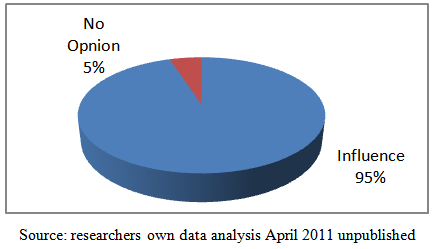 | Figure 5. Influence and motivation of incentive provided on performance |
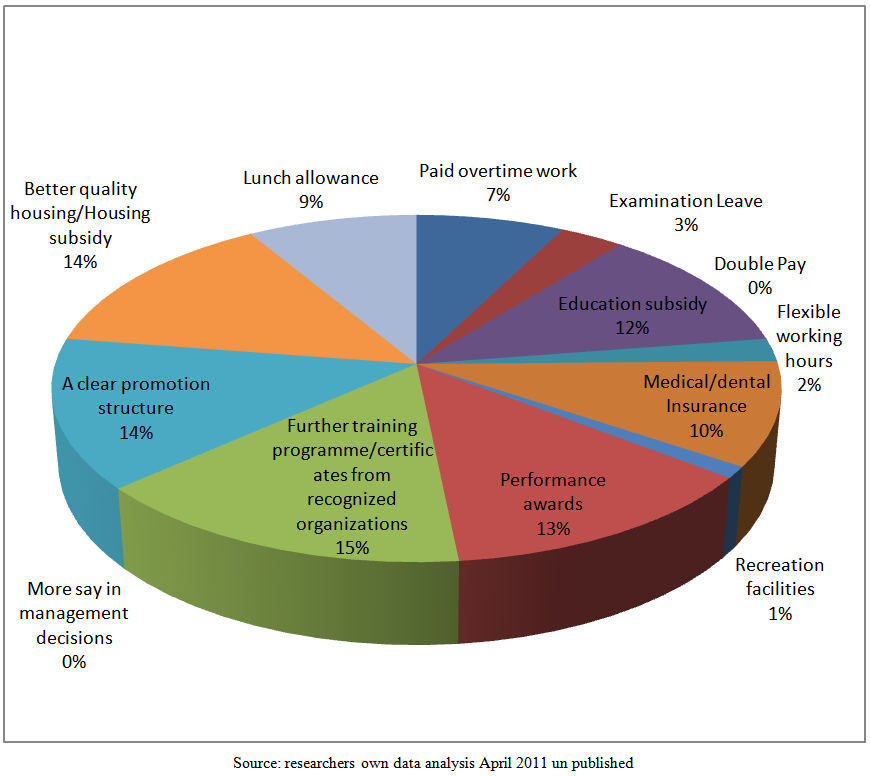 | Figure 6. Percentage distribution of respondents on incentives that motivates them more |
6.6. Incentive to Get/Attract Nuclear Science Specialists
- From the questionnaire responses it was found that the following are the incentives to attract and increase the number of graduates and experts in the field of nuclear science. Firstly, changing curriculum at universities in Tanzania to include nuclear science super specializations. As we saw in chapter one currently no university in Tanzania provide degrees with specialties in nuclear science.Secondly, encouragement of nuclear science subjects in schools, as well as formulation of Nuclear Policy that will include strategy for training of nuclear experts.Thirdly Provision of better working environment, Motivation, and financial assistance for training of nuclear experts particularly outside the country. 75% of senior management employees mentioned formulation of nuclear policy as a very good incentive to attract people in the nuclear science field. It should be noted that Tanzania has no nuclear policy and it is now under pipeline with a team of experts working on it.Fourthly, other incentives to attract nuclear science specialists were as follows: Provision of better working environment (about 30% of respondents), Changing university curriculum to include nuclear science subjects, (about 50% of respondents) provision of scholarships/ financial assistance for training (about 50% of respondents), and encouragement of nuclear science subjects in Tanzanian schools and motivation (about 40% and 25% of respondents respectively).
6.7. Performance Management and Promotion/Rewarding System
- Open Performance Review and Appraisal System OPRAS for the public service were introduced in 2004 with plans for rollout of to cover all public servants. OPRAS at TAEC is done on yearly basis to evaluate staff performance. At TAEC the forms are distributed to all who fill the form for self grading. After that the supervisor or head of section meets the staff and agree on grading mark/score. After the OPRAS forms are filled the appointment and disciplinary committee meets to discuss the score on OPRAS where decision on promotion is made.In addition to the above the questionnaire findings show that there are effective promotional opportunities at TAEC. It shows that 67% of Senior Management employees agreed that there are effective promotional opportunities at the Commission. Only 22% did not agree with this. This means we are on the right track regarding promotions that there are effective promotional opportunities at TAEC. This means that we have to strengthen performance appraisal system at the commission. 11% were neutral (Fig. 7).On the other hand more than 50% of respondents i.e. Senior Management employees agreed that Commissions management is really interested with motivating the employees. Surprisingly 26% of respondents were neutral or said nothing on this question (Fig 8).
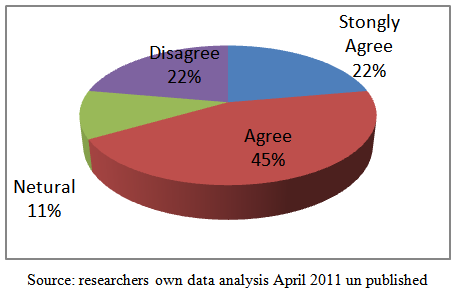 | Figure 7. Percentage Distribution of Senior Management employees on effective promotional opportunities |
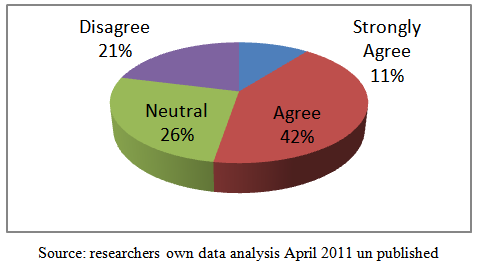 | Figure 8. Management is really interested with Motivation of the employees |
6.8. External and Internal Influences on HRP
- According to TAEC staff there is some factors both internal and external that influence the way they conduct HRP. The goal is to have the right number of employees with the right competencies, and personnel composition that is required to achieve the vision of the commission and accomplish its mission. Fig, 9. However there is a need for the commission to consider internal and external factors during HRP process.Another question was on the internal and external influences on HRP. 60% of the respondents from senior management employees were of the view that external factors which have effect on HRP were lack of institutional programmes at Universities that could provide specializations in nuclear science. This is because as we saw earlier on no universities in Tanzania that provide degrees with specializations in nuclear and that those who are currently working at TAEC had attended some kind of diplomas abroad.Other factors mentioned so frequently by senior management employees were motivation, low salaries, nuclear policy as well as training development.
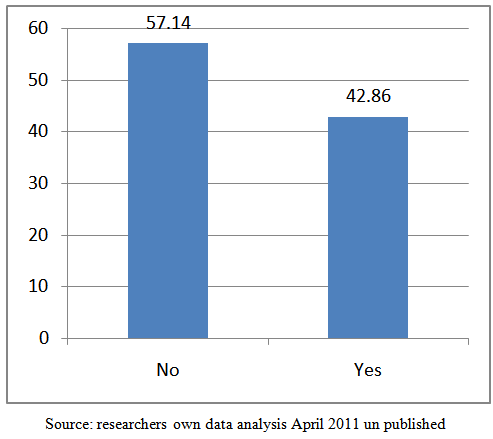 | Figure 9. Percentage distribution of respondents on Internal and external demand factors on HRP |
6.9. Human Resource Planning Challenges at TAEC
- Successful human resource management depends on the effectiveness of human resource planning. However, there are some challenges/problems internal or external, to the organization that affect the effectiveness of human resource planning negatively. The researcher was able to identify the challenges of human resource planning at the Commission as explained hereunder.
6.10. Shortage of Human Resources and Staff Turnover
- A question was asked about whether there is shortage of Human Resources at TAEC or not. The findings show that there is acute shortage of Human resources for nuclear science. 80% of Senior Management employees said yes to this question. This means something has to be done. Fig 10.On the other hand the study revealed there is no staff turnover at TAEC. It was found that there is no staff turnover at TAEC, all 100% respondents’ i.e. senior management employees said no to this question when they were asked if there is staff turnover at the commission.In addition to the above the study also found that the there are inadequate Human resources with the required skills at the commission. Fig. 11. This was explained earlier in chapter one that those who were working at TAEC had no specialization in nuclear but rather people who had done some natural science subject at university. When this people come to TAEC they undergo some short courses in nuclear science.
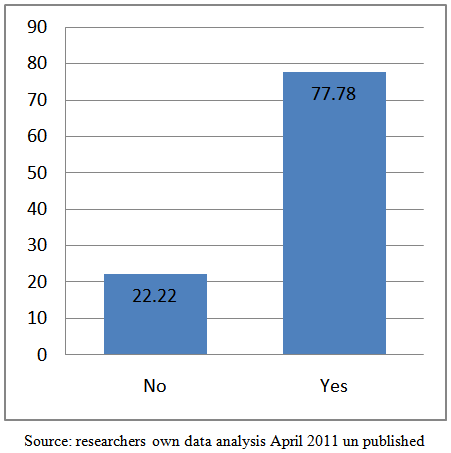 | Figure 10. Percentage distribution of respondents on shortage of Human resources for nuclear science at TAEC |
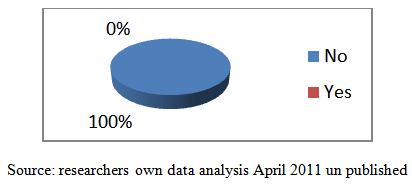 | Figure 11. Does the commission have adequate Human resources with the required skills? |
6.11. Low Salaries for Nuclear Experts
- The findings show that there is no satisfaction from salary at TAEC. This is because about 65% agreed that the salary they get is not enough. This may be because the commission provides salaries based on the Government salary scales which are basically very low. The remaining 25% are satisfied by their salary Fig. 12. When asked if they would leave the commission just in case they got a better paid job the findings show a surprise that about 40% were neutral on the question while 40% of respondents agreed that they will leave the commission if there is a better opportunity Fig.13.
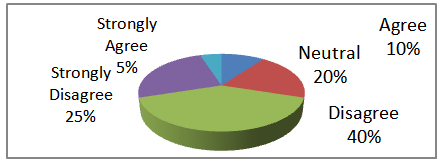 | Figure 12. Percentage Distribution of respondents according to satisfaction by their salary |
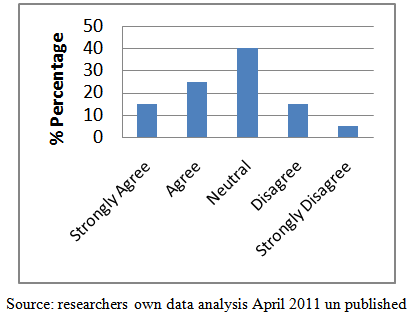 | Figure 13. I will consider if there is another job with better salary than TAEC |
6.12. Staff Training and Development
- Training and development is very important for performance improvement and motivation of individual staff. The findings show that about 56% of respondents agreed that the commission has Training and development Programme for its staff, while 44% said no to this question. This may be because the plan is yet to be completed. There is need to have this Plan so as to decide on the staff training based on it. Fig. 14. What is actually happening at TAEC is that since the training programme is yet to be completed those who were going for further were only selected at random. When a particular individual staff secures a scholarship somewhere present the matter in the Training committee and decision is made without using the Training Plan/Programme.
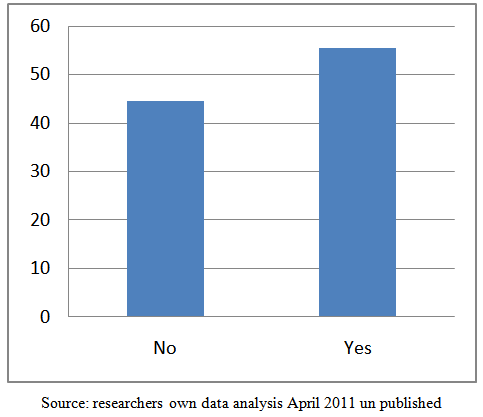 | Figure 14. Does the commission have Training and development Programme? |
6.13. Lack of University Curriculum on Nuclear Science
- The other limitation to HRP at the TAEC as noted by the senior management employees was lack of curriculum in nuclear science at Tanzanian Universities. 65% of respondents mentioned curriculum as lacking in Tanzanian Universities. There is a need for universities in Tanzania to provide degrees with specialization in nuclear science and engineering. 50% of senior management employees said that lack of training and development as well motivation to nuclear scientists is a challenge to effective Human resources planning at TAEC.
7. Conclusions and Recommendations
7.1. Incentive to Get/Attract Nuclear Science Specialists
- The research found that the following are the incentives to attract and increase the number of graduates and experts in the field of nuclear science. Changing curriculum at universities in Tanzania to include nuclear science super specializations. Encouragement of science subjects in schools, as well as formulation.
7.2. Acute Shortage of Human and Financial Resources
- TAEC as a Government institution solely depends on the government funds which are not enough to suffice the requirements. That means, the little financial resources allocated to the Commission cannot accommodate all activities planned including conducting HRP. To add salt on the wound, the senior management Employees said that TAEC does not have enough personnel specialized in the field of nuclear science and technology. Even those who currently work at the commission their background is not directly related to nuclear science.In addition to the above it has been difficult to attract well trained brains of nuclear science experts due to inadequate financial resources. This is because the budget allocated by the government does not match the requirements of TAEC. The research noted actual funds allocated to the commission by the government are less than what was budgeted or requested from the government.
7.3. Poor Implementation and Ineffectiveness of HRP Practices
- The research findings revealed that HRP practice and its processes is not effective enough at TAEC. The research findings revealed that there are some shortfalls in the practice of HRP at the TAEC due to the following reasons. The researcher noted that the concept of human resource planning was still foreign to members of the commission. Hence taking human resources, as the most important asset in the organization was not in consideration.The study found that what was theoretically put down on the HR plan was not what was actually practiced. Example the HR guidelines for the current performance evaluation system (OPRAS) are not done on timely manner. This leaves a gap of an appraisal mechanism for workers. The delay in the performance evaluation leads to delayed staff promotions, confirmations and salary increments that may lead to poor performance.
7.4. Inadequate Training Programme in Terms of Identification and Implementation
- The research found out that without effective HRP, the Commission will not achieve its objectives and it will be difficult to realize its mission. At the moment the Training programme is not yet complete and that people were released to go for further studies without taking into consideration the training programme. In addition to this the plan is difficult to implement since the government budget is not enough to fund those members of staff who are enrolled to enrolled to Universities. It is the commission objectives to train its members of staff to at least a PhD level. This has been difficult to implement since there are no enough funds. It should be noted here that one PhD would cost a maximum of USD 70,000 per annumn. It would be a good idea to mention here that this year’s 2011/2012 Budget to the commission has been cut by about 30% compared to last years.
7.5. Incentives Currently Provided to Nuclear Science Experts
- It was found that currently there are no special incentives provided specifically to nuclear science specialists. The incentives currently provided are housing allowances, transport assistance, lunch, overtime, and medical coverage, however these incentives are provided to all staff both scientists and non scientists. It is the view of the researcher that the commission provides special incentives for nuclear scientists.
7.6. Low Salaries for Nuclear Experts
- The findings show that there is no satisfaction from salary at TAEC. This may be because the commission provides salaries based on the Government salary scales which are basically very low.
7.7. Internal and Ecternal Influnces on HRP
- The study found that there are factors which have effect on HRP like lack of institutional programmers at Universities in Tanzania that could provide specializations in nuclear science. This is because as we saw earlier on that no universities in Tanzania that provide degrees with specializations in nuclear science and that those who are currently working at TAEC had attended some kind of short courses related to nuclear science abroad.It was also found that the commission does not consider internal and external factor for HRP. There is need for the commission to consider these factors as they are very important for proper human Resources planning.
7.8. Performance Management and Promotion/Rewarding System
- The study found that there are effective promotional opportunities at TAEC. This means that we are on the right track regarding promotions. This means that we have to strengthen performance appraisal system at the commission.
8. Recruitment Challenges
8.1. Aging of the Nuclear Experts
- As explained earlier in previous chapters, the aging of nuclear science specialist has to be taken seriously. The study found that the problem of aging is also significant at TAEC. When those who have enough experience retire the country will need to replace them. This may take a long time, and can involve high costs of training and in turn lead to poor performance of the nuclear sector if HR Planners do not consider this well ahead of time.
8.2. Nuclear Science as an Old Technology
- It should not be forgotten that, about the fact that some students see nuclear as an “old technology” – They want to be IT specialist and the like. This may lead to shortage of people who would like to join the nuclear science field. This is well explained in chapter two of literature/theoretical review.
8.3. The Recent Nuclear Accident in Japan
- As we saw in chapter one, this conclusion cannot be perfect without mentioning this disaster. It is important to mention it here since it is researcher’s opinion that the accident has rendered the nuclear science unpopular. We hear in the news that in Germany and other developed countries that they would like to rethink their idea of investment in nuclear science and technology. As a result this may reduce the number of those who would like to join the nuclear science profession not only in Europe but also in Africa and Tanzania and other low income countries in particular.
9. Recommendations
- What can be Done?Workforce planning is an important component for HR management. However, limited resources hamper Human resources for nuclear science planning from levels of the Government to the TAEC. Efforts should also be taken to strengthen HR planning capacity and development of succession plans at TAEC in terms of skills and knowledge through the use of technology and improved working environment.TAEC staff should be encouraged to realize their maximum potential through the provision of professional development and opportunities. Continuous education both short and long term is highly needed.The strategic plan should be dedicated in improving HRM for the purpose of ensuring that members of staff know what they are supposed to do, get timely feedback, feel valued and respected, and have opportunities to learn and grow on the job.
9.1. Incentive to Get Nuclear Science Specialists Strategy
- Incentive to attract nuclear expert’s strategy should be developed that will take into account the following:Improve performance management and Performance appraisal (OPRAS) and reward system, such as differential incentive packages special for nuclear science specialists which may include:• Provision of Salary top-ups, bonuses, and risk allowances because of the risk involved in handling radiation materials. • Provide special salaries for TAEC staff and guaranteed opportunities for further career development.• Introduce workplace programs as well as Investment in workers involvement in different credit facilities in collaboration with financial institutions like banks.• Ensure HRM skills development at all levels.• Strong political will and top management commitment taking Human resources as the most valued assets of the commission/organization through which nuclear science field can achieve competitive advantage.• While thinking and planning about establishing a Nuclear Tanzania, Human resources for the same should be at the top of agenda. It should be noted that Tanzania has to invest in Human resources who will transform other resources in the implementation of nuclear projects.• Government through the Ministry of Finance and Economic affairs provide enough funds in line with the Submitted budget by the commission.• Prepare a national Human Resource strategic Plan For Nuclear and Allied science and if need be use of HR consultants.• The newly developed Tanzania Nuclear science and technology development policy should include issues on how to get nuclear science experts.
9.2. Education and Training Strategey
- • Enriching existing programmes at all Universities in science and engineering with nuclear science and technology.• Where possible, developing double major programme with nuclear as the second major.• Introduction of fully fledged graduate degree programmes in nuclear science and technology, for instance MSc. in Nuclear science/Engineering. TAEC could do this in collaborations with universities in Tanzania which teach natural science subjects.• Partnering with institutions abroad to train and retrain nuclear science academics and researchers at all levels from BSc to PhD degrees. It should also be noted here that both short and long term training in nuclear science is of vital importance.• Regional cooperation and Integration in terms of HR for nuclear science Training and Development, for instance using the EAC where exchange of knowledge could take place between member countries.
9.3. Provision of Incentives
- • Work out Competitive salary regime.• Service conditions to reflect the risks, safety and national security implications inherent in the nuclear industry.• Career opportunities for continuous training and retraining as well as professional development to sustain a workforce that would be competent in conformity with international best practice.• TAEC and MCST should acknowledge the need of engaging all stakeholders, including non nuclear science specialists abroad, IAEA, WHO and other bilateral and multilateral groups. Areas for mutual collaboration include strategies to attract people to nuclear science field, training and development of human resource, service delivery, information and evidence, retention, planning and policy formulation.• Donor’s involvement is also an option for financial assistance in HR planning for nuclear science as well as implementation. Without sound financial capability, it is difficult to have an effective HRP.• Top management commitment on Human resources Management and development should of vital importance.• Develop a training programme and solicit funds for its proper implementation.