Abdul-Aziz Ibn Musah1, Zakaria Abdulai2, Mohammed Dawuni1, Abdulai Abdul-Hanan1
1Department of Statistics Mathematics & Science, Tamale Polytechnic, Ghana
2C/o Zakaria Meri, School of Hygiene, Tamale
Correspondence to: Abdul-Aziz Ibn Musah, Department of Statistics Mathematics & Science, Tamale Polytechnic, Ghana.
| Email: |  |
Copyright © 2015 Scientific & Academic Publishing. All Rights Reserved.
Abstract
Birth and death registration is one of the most widely used national and local data for identifying and addressing major public health concerns. This study evaluated the effect of birth and death registration on health service delivery. The study was conducted in the Tolon District where the District Births and Deaths Registry, the Planning Unit of the District Assembly and the District Health Directorate were selected for the study from March to July 2014. The study employed the survey research design where questionnaire administration was used for data collection. Stratified random sampling was used to identify the various sample points. Preliminary data exploration was used with the Statistical Software SPSS for windows (version 21) to analyse the data generated from the questionnaire. Multiple response analysis was used to generate frequencies to determine the combined effect of responses. The study made use of percentages, means and ranking. Descriptive statistics was used to present diagrams, tables and charts. The objectives of the study were: factors influencing birth and death registration, contribution of birth and death registration to health service delivery, challenges associated with birth and death registration and strategies for enhancing birth and death registration. It was found out that 86.9% of responses showed that education, distance, future employment, school enrollment, voting, obtaining a passport, cause of death, insurance benefits, settlement of pension claims and the calculation of death rate influence birth and death registration. Also, 80.0% of the responses showed that birth registration contributes to vaccination, family planning interventions and that death registration contributes to measuring and monitoring child and maternal mortality rates, calculation of death rate and determination of cause of death. Beside, 84.3% of the responses confirmed that cost, children born to nomads, lack of support from the District Assembly and distance are challenges to birth and death registration. Finally, 86.0% of the responses point to the fact that tying registration to health care, public awareness campaign, the use of mobile phones for registration and building partnerships with other organizations are strategies for birth and death registration. The study recommended that the District Births and Deaths Registry, the District Education Directorate, the District Health Directorate and the District Assembly collaborates to improve birth and death registration for enhanced health service delivery.
Keywords:
Evaluation, Birth and Death registration, Health service delivery
Cite this paper: Abdul-Aziz Ibn Musah, Zakaria Abdulai, Mohammed Dawuni, Abdulai Abdul-Hanan, Evaluation of the Effect of Birth and Death Registration on Health Service Delivery (A Case of Tolon District of Ghana), Journal of Health Science, Vol. 5 No. 2, 2015, pp. 32-41. doi: 10.5923/j.health.20150502.02.
1. Introduction
Every district in Ghana needs to know how many of its people are born and die each year and the main causes of their deaths to have a well - functioning health system. Birth and death registration is very crucial to health service delivery. This is because when deaths go unaccounted and the causes of death are not documented, districts cannot design effective public health policies or measure their impact. In the Tolon District, there is a misconception about the relevance of birth and death registration. It is in light of this that the study was undertaken to evaluate the effect of birth and death registration on health service delivery in the district.The importance of accurate (or near accurate) population figures in every district in Ghana under-pins the delivery of its health services. The outcome of this study revealed the effect of birth and death registration on health service delivery in the Tolon District of Ghana. The study also revealed factors influencing birth and death registration and the contribution of birth and death registration to health service delivery in the Tolon District. The study also identified challenges associated with birth and death registration and strategies that will enhances birth and death registration in the district. The outcome of the study will go a long way to add to the existing body of knowledge in the subject matter studied.
2. Material Studied
2.1. Factors Influencing Birth and Death Registration
Birth and death registration is very important to every person since it is a human right.In the first place, according to WHO (2013), birth and death registration brings multiple benefits. An individual's right to be counted at both extremes of life is fundamental to social inclusion. Without insurance or inheritance, death registration and certification are often required prerequisites for burial, remarriage, or the resolution of criminal cases.In the second place, according to UNICEF (2013), registering children at birth is the first step in securing their recognition before the law, safeguarding their rights, and ensuring that any violation of these rights does not go unnoticed. Birth registration also serves a statistical purpose. Universal birth registration is an essential part of a system of vital statistics, which tracks the major milestones in a person's life - from birth to marriage and death. Such data are essential for planning and carrying out development policies and programmes, particularly in health, education, housing, water and sanitation, employment, agriculture and industrial production. In 2002, the General Assembly resolution 'A World Fit for Children' reaffirmed governments' commitment to ensure the registration of all children at birth and to invest in, care for, educate and protect them from harm and exploitation. To achieve these goals, governments must have accurate data from which they can plan. Birth registration is not only a fundamental right in itself but also a key to ensuring the fulfillment of other rights.A variety of factors including; government commitment, a country's legislative framework and whether existing infrastructure can support the logistical aspects of birth registration, influence birth registration levels, especially in remote areas.Mothers with some education are more likely to know how to register a child than their uneducated peers, and the proportion of registered children is highest between those whose mothers have a secondary education. In Nigeria, for example, data show that 21 per cent of children whose mothers have no education, 42 per cent of children whose mothers have a primary education, and 67 per cent of children whose mothers have a secondary education are registered. Likewise for India, birth registration levels increase with a mother's education, at 24 per cent, 47 per cent and 63 percent, respectively. In Ethiopia, where national birth registration is only 7%, birth registration levels increase substantially as a mother's education level rises - from no schooling (4 percent of children registered) to primary education (7 per cent registered) to secondary education or higher (33 per cent registered).The disparities persist even as national levels of birth registration rise. In Cameroon, where 61 per cent of children under five is registered, children whose mothers have a primary education are more than twice as likely to be registered as those whose mothers are uneducated.In the third place, according to UN (2012), birth and death registration is an integrated information system that primarily generates legal, administrative and statistical information that benefits individuals, households, communities, government institutions and non-governmental, regional and international organizations engaged in various socio-economic and other human development endeavours. Every nation, whether developed or developing, has built such a system or is striving to build one as an integral part of their efforts for human development. In Africa, some countries have histories of birth and death registration dating back over 100 years. However, in most cases, the system intended to serve the interests of the colonizers. In Some instances, birth and death registration served as an instrument aimed at controlling the movement of people and a source of information for managing the people under colonial rule.
2.2. Contribution of Birth and Death Registration to Health Service Delivery
According to WHO (2012), decision-makers in the health sector - including managers and practitioners such as physicians and others - require an up-to-date understanding of levels and causes of mortality. This information is essential for monitoring trends, evaluating the impact and effectiveness of health programmes, and forecasting the burden of disease. Planners and managers need to be able to report reliably on key indicators and targets set out in national health-sector and poverty-reduction plans, including reporting on progress towards the Millennium Development Goals (MDGs). They also need to be able to understand emerging health challenges, such as the prevention and management of non-communicable diseases. The data produced by facility-based information systems can help to meet these information needs, but such systems are insufficient as they only generate data on the users of health-care services, not on those who need but do not use them. For example, data on mortality and causes of death are mainly drawn from hospital records, but in settings where many deaths occur outside hospitals these data are not representative of the whole population.Also, Isabel and Ruth (2008) show that the third Global Partners Forum (GPF) meeting in 2006 was convened to provide input into the United Nations General Assembly Special Session on HIV/AIDS (UNGASS) review of achieving universal access to prevention, treatment, care and support for children affected by HIV and AIDS. The GPF identified birth and death, and particularly birth registration to be one strategic area of importance to building a comprehensive response for children affected by HIV and AIDS.Isabel (2008) contends that birth and death registration is a significant statistical and legal tool as it helps policy and decision-makers meet the challenges of HIV and AIDS by monitoring the number of AIDS related deaths, HIV infected adults and children, and the number of orphaned and other children made vulnerable by HIV and AIDS. This help States and donors to design, plan and programme for effective interventions, including allocating appropriate funds and effectively distributing prevention, treatment, care and support services for both adults and children. The data compiled by birth and death registrations further provides the foundation for achieving the Millennium Development Goals, such as MDG 4, reducing child mortality, and MDG 6, combating HIV and AIDS.
2.3. Challenges Associated with Birth and Death Registration
Furthermore, according to WHO (2013), many barriers prevent people from registering births and deaths. Many countries do not have the necessary laws or infrastructure to make it obligatory to register births and deaths. In some countries, only people who live in cities have access to registration services.Also, according to UNICEF (2013), a significant barrier to birth registration is the distance to the nearest registration facility. Distance is influenced by location and terrain, existing infrastructure and the availability of transportation. The greater the distance to the registration centre, the higher the financial and opportunity costs for the family. Urban populations are less subject to such constraints, as confirmed by the differences in urban and rural registration rates for almost all regions. Globally, children living in urban areas are one and a half times more likely to be registered than their rural counterparts.Beside, Kingsley (2009) contends that major challenges associated with birth and death registration include: Low utilization of vital statistics for policy decisions, limited access to registration facilities, low public knowledge about importance of registration, inadequate staff and inability to attract and retain highly qualified personnel due to low pay and poor service conditions. Also, inadequate funding for the Registry in Ghana, difficulty in motivating registration volunteers, lack of logistics such as accommodation, vehicles, required statistical software and programmes, absence of training opportunities for sector staff and weak monitoring and supervision mechanisms all hamper effective birth and death registration.
2.4. Strategies that will Enhances Birth and Death Registration
According to the WHO (2013), one campaign strategy has been to tie registration more closely to the; provision of health care. For instance, midwives and health workers were instructed to register children during child health campaigns.Also, according to UNICEF (2013). In Bangladesh, the rate of registration of children under five increased dramatically - from 12 per cent in 2006 to 31 per cent in 2011. This improvement was prompted by a range of advocacy and programmatic actions, from the development of a legislative framework to a national birth registration campaign and the strengthening of institutions. The 2004 Birth and Death Registration Act, which came into force in 2006, provides a legal basis for the use of a birth certificate as proof of age to gain access to services, including passport applications, school admissions and marriage registration. It also mandates that the registration structure be established within the country's decentralized government administration and obliges service providers, particularly in health and education, to ease birth registration. The 2004 Act was amended in 2013 to expedite the establishment of a permanent structure within the government to oversee birth registration. And in 2009, an online Birth Registration Information System was put in place, enabling local registrars and embassies abroad to register births and deaths and issue official certificates through a web-based application. All birth and death records are transmitted to and securely stored in a central database.According to UNICEF (2013). National birth registration rates have also improved steadily in Brazil, increasing from 64 per cent in 2000 to 93 per cent in 2011. A birth certificate is the first step towards citizenship in Brazil: It is only with this document that one obtain other important papers, apply for social protection or graduate from school. Legal reforms, including national legislation guaranteeing the right to birth registration, were enacted in 1997, making it free of charge. And in 2002, the Ministry of Health began providing a financial incentive to all maternity hospitals that kept an advanced birth registration post on their premises, allowing new parents to start the registration process before going home. The following year, the Human Rights Secretariat began partnering with civil society to raise awareness of the issue. The first National Birth Registration Mobilization Day was established, a campaign that became permanent and marked the beginning of a national movement. In 2007, a national policy was established to promote collaboration between birth and death registration authorities and the health sector, and a long-term budget was allocated. Subsequently, birth and death registration services in public hospitals went online, with information fed into a national database. The greatest improvements have been observed in underserved northern states, partially as a result of outreach registration programmes. In 2007, the Brazilian government committed itself to achieving birth registration rates of 95 per cent in all 27 states by 2011, although some areas are still falling behind.In recent years, the Government of Benin has made important advancements in refining its birth and death registration system, which helped boost birth registration levels from 60 per cent in 2006 to 80 per cent in 2011-2012. For example, public awareness campaigns and training for civil servants have been established, along with the computerization of birth and death registration systems in some municipalities. The primary reason for the rise, however, is an increase in the number of attended births. Trained midwives and other health personnel now have a legal obligation to complete and forward a birth sheet to a civil status centre for every child delivered in a birthing centre.In Senegal, the percentage of children under five whose birth is registered grew from 55 per cent to 75 per cent between 2005 and 2010-2011. Many different initiatives were introduced by the Senegalese government and its partners during those years, including mass campaigns on the importance of birth registration, the reduction of fees to obtain a birth certificate, and the creation of new registration offices throughout the country. These initiatives have been consolidated in a national strategy and action plan that is expected to be carried out in 2014.According to UNICEF (2013). South Africa has seen a spectacular rise in birth registration within the first year of life, increasing from 24 per cent in 1991 to 50 per cent in 2001, 75 per cent in 2005 and 95 per cent in 2012. The government has focused its efforts on addressing the needs of rural communities by establishing fixed service centres as well as hospital registration points, mobile units and Multi-Purpose Community Centres. A major incentive to early registration is the requirement that a birth certificate be presented to obtain social protection grants, including a Child Support Grant.In Uganda, national birth registration rose from 21 per cent in 2006 to 30 per cent in 2011. The increase can be attributed in part to collaborative efforts between government and its partners to extend coverage. A new approach, recently launched, is enabling trained personnel to capture birth declarations submitted by parents on mobile phones or computers and transmit the information directly into the birth and death registry. In the United Republic of Tanzania, the registration of children under five doubled between 1999 and 2010 - from 6% to 16 % - but the proportion of those with a birth certificate remained unchanged. In the past, parents would have to travel to district headquarters to collect the certificate 90 days after registering a birth. For most families, travel costs as well as the fee for a birth certificate made registration prohibitively expensive. The fact that a birth certificate was not required to gain access services contributed to the low rates of certification. To address these challenges, the government piloted a new birth registration system in 2012 in the country's mainland. Assistant registrars were trained at ward levels, in local government offices as well as in hospitals and health clinics, allowing children to be registered at birth or at the same time as immunization. The process was also simplified: In one step, parents are able to register their child and receive a birth certificate, which is now free of charge for children under five. Birth registration data are transmitted instantaneously to a centralized system through SMS (text messaging) and can be continuously monitored. Following a successful pilot, the new system was launched in 2013 in one region and is now in the process of being rolled out countrywide.The World Day of Prayer and Action for Children has a universal and free birth registration as one of its advocacy goals, and encourages religious leaders to work with their congregations to promote birth registration and to support its members in the process. In Belize, a communication for development approach was used to inform community leaders and families about birth registration, using group discussion and radio shows. In Paraguay, football games were used to draw attention to non-registration, while in Nicaragua, a 'crowd-sourcing' challenge, a social medium tool, had as its aim an increase in demand for birth registration among indigenous families. Realizing every child's right to birth registration - despite sometimes overwhelming obstacles - have to be at the core of every country's policy. Several programmatic actions are available to achieve this: Legislative review can ensure that births registration is free, universal, and confidential and incorporated into the birth and death registry. Communication for development efforts that work with community leaders and parliamentarians can promote a broader understanding of the process. Mobile and digital technology can be used to obtain timely, accurate and permanent records. And working through programmes in other sectors can ease broader reach of the system. Many of these strategies are now being adopted in Yemen, with support from UNICEF and the European Union, to raise low birth registration levels, ease glaring disparities, and help the country recovers from recent civil unrest.
3. Method
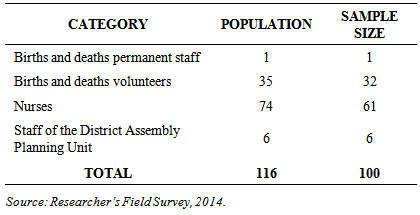
This study adopted the case study approach. The study used the survey research design since the focus was on the staff and volunteers of the District Births and Deaths Registry, nurses under the District Health Directorate and staff of the Planning Unit of the District Assembly. A questionnaire was administered to the staff and volunteers of the District Births and Deaths Registry, nurses working in the district's health facilities, and staff of the Planning Unit of the District Assembly.
3.1. Area of Study
The study concentrated on the Tolon District of the Northern Region of Ghana. Tolon District (formally Tolon/Kumbungu) was carved out of the then Western Dagomba District in 1998. Tolon is the administrative capital of the Tolon District. The district share borders with North Gonja to the West, Kumbungu District to the North, Central Gonja to the South and to the East with Tamale Metropolis.The study specifically focused on staff and volunteers of the District Births and Deaths Registry, nurses in the district's health facilities and staff of the Planning Unit of the District Assembly.
3.2. Population for the Study
Population for the study included: the District Births and Deaths Officer, births and deaths volunteers, nurses and the District Planning Officers. Table 1 below is a summary of the population for the study.Table 1. Staff category, population and sample size
 |
| |
|
3.3. Sampling Method
Stratified random sampling was used in the study. This is where the population was divided into sub-groups based on their unique characteristics and randomly selection was made from each group.
3.4. Sample Size Determination
The method used for sample size determination is as follows:  where n = sample size, N = total population and e = error.
3.5. Data Collection Techniques
The study used the survey method for data collection, specifically questionnaire administration. This method helped gather primary data while online materials and consultation of archives and databases offered secondary data for a healthy analysis in this study.
3.6. Data Analysis
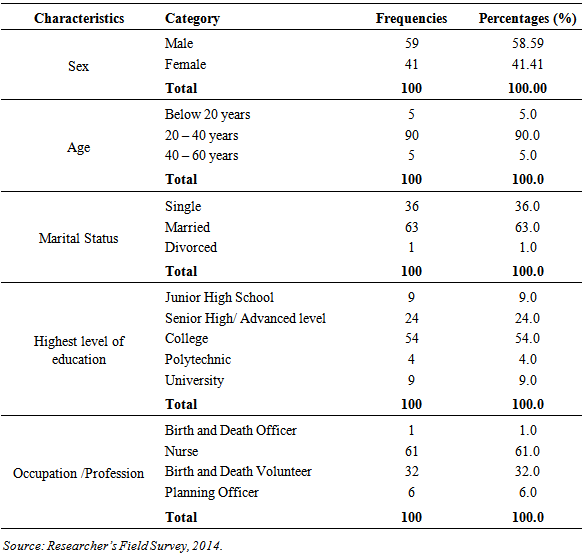
The statistical software SPSS for windows (Version 21) was used to analyse the data generated from the questionnaire. Preliminary data exploration was employed in the data analysis. Multiple response analysis was used to generate frequencies to determine the combined effect of responses. The study made use of percentages, means and ranking. Descriptive statistics was employed using diagrams, tables, and charts. Table 2. Demographic Information of Respondents
 |
| |
|
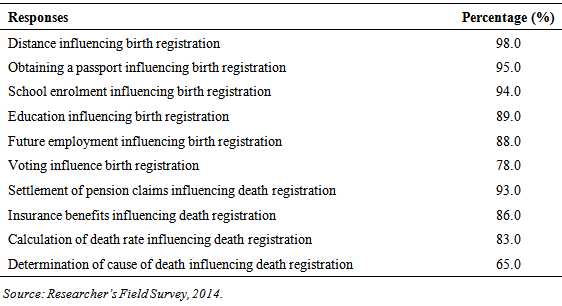
Table 3. Factors influencing births and deaths registration with their percentages of response
 |
| |
|
4. Results
Out of 100 respondents, 58.59% of them were males while 41.41% were females. This indicates that more males were reached than females. Out of 100 respondents, 5.0% of them were below 20 years of age, 90.0% were between the ages of 20 and 40, and 5.0% were also between 40 and 60 years of age. Thirty six per cent (36.0%) of the respondents were single, 63.0% were married and 1.0% divorced. Most of the respondents were married. Nine per cent (9.0%) of the respondents completed Junior High School, 24.0% Senior High School/Advanced level, 54.0% completed College, 4.0% completed Polytechnic and 9.0% have a University education. This shows that most of the respondents completed college. One person was a births and deaths officer representing 1.0%, 61.0% of the respondents were nurses, 32.0% were births and deaths volunteers and 6.0% represented planning officers in the District Assembly. This shows that most of the respondents were nurses.It was found out that the following factors influence birth registration: 98.0% said distance, 95.0% said obtaining a passport, 94.0% said school enrolments, 89.0% said education, 88.0% said future employment and 78.0% said voting. For factors influencing death registration: 93.0% said settlement of pension claims, 86.0% said insurance benefits, 83.0% said calculation of death rate and 65.0% said determination of cause of death.Table 4. Factors influencing births and deaths registration with their means and rankings
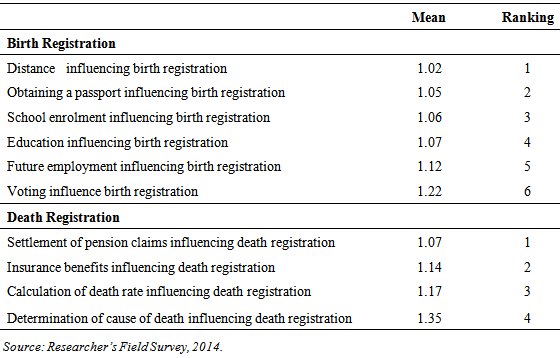 |
| |
|
Table 5. Contribution of birth and death registration to health service delivery with their percentages of response
 |
| |
|
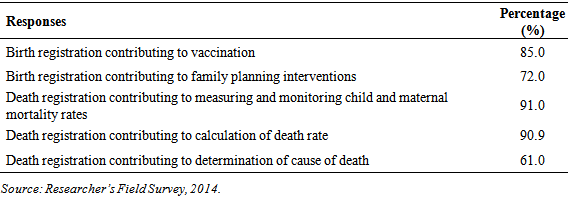
Respondents ranked distance as the highest factor influencing birth registration followed by obtaining a passport, school enrolments, education, future employment and voting. For death registration, settlement of pension claims was ranked highest followed by insurance benefits, calculation of death rate whiles determination of cause of death was ranked the lowest factor as showed by the table 4 above. Eighty five per cent (85.0%) of the respondents said birth registration contributes to vaccination, 72.0% said birth registration contributes to family planning interventions, 91.0% said death registration contributes to measuring and monitoring child and maternal mortality rates, 90.9% said death registration contributes to calculation of death rate and 61.0% said death registration contributes to determination of cause of death. This means that the above contribute to health service delivery. Table 6. Combined effects of responses regarding factors influencing birth and death registration
 |
| |
|
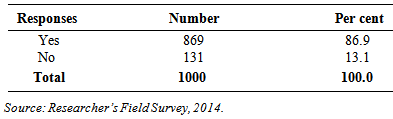
The combined effect of the responses shows that out of 869 responses, 86.9% point to the fact that education, distance, future employment, school enrolments, voting and obtaining a passport influence birth registration. Determination of cause of death, insurance benefits, settlement of pension claims, and calculation of death rate also influence death registration. Table 7. Responses regarding contribution of birth and death registration to health service delivery with their means and rankings
 |
| |
|
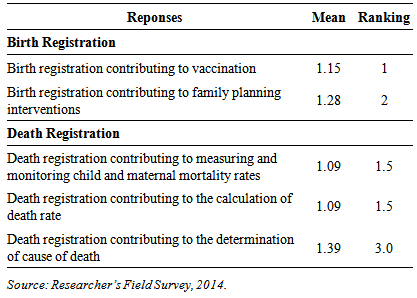
Respondents ranked birth registration contributing to vaccination as the highest followed by birth registration contributing to family planning interventions. Death registration contributing to measuring and monitoring of child and maternal mortality rates and calculation of death rate was ranked equally while death registration contributing to determination of cause of death was ranked lowest as showed by the table above.Table 8. Overall effects of responses regarding the contribution of birth and death registration to health service delivery
 |
| |
|
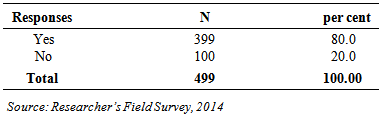
The overall effect of the responses regarding the contribution of birth and death registration to health service delivery shows that 80.0% agreed that birth and death registration contributes to health service delivery.Table 9. Challenges associated with birth and death registration with their percentages of response
 |
| |
|
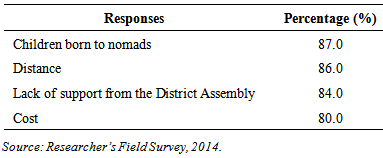
Eighty seven (87.0%) of the respondents said children born to nomads is a challenge to birth and death registration, 86.0% said distance is a challenge, 84.0% said lack of support from the District Assembly is a challenge whiles 80.0% mentioned cost. Table 10. Overall effects of responses regarding the contribution of birth and death registration to health service delivery
 |
| |
|
Table 11. Challenges associated with birth and death registration with their means and rankings
 |
| |
|
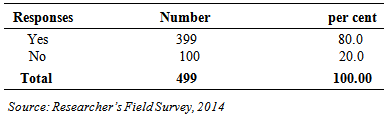
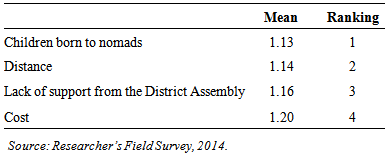
The overall effect of the responses regarding the contribution of birth and death registration to health service delivery shows that 80.0% agreed that birth and death registration contributes to health service delivery. Respondents ranked children born to nomads as the most serious challenge, followed by distance and then lack of support from the District Assembly. Cost was however ranked as a less serious challenge. Table 12. Overall effects of responses regarding challenges associated with birth and death registration
 |
| |
|
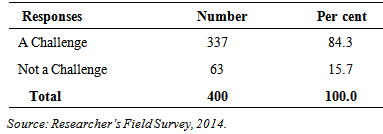
The overall effect of responses regarding challenges associated with birth and death registration shows that 84.3% agreed that cost, children born nomads, lack of support from the District Assembly and distance are challenges.Table 13. Responses regarding Strategies for birth and death registration with their percentages of response
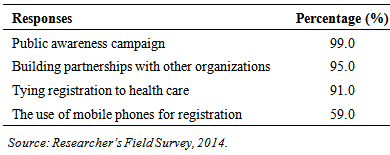 |
| |
|
Ninety nine (99.0%) said public awareness campaign is a strategy, 95.0% said building partnerships with other organizations, is a strategy, 91.0% of the respondents said tying registration to health care is a strategy whiles 59.0% said the use of mobile phones for registration is a strategy for birth and death registration.Table 14. Responses regarding Strategies for birth and death registration with their means and rankings
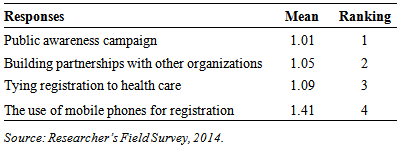 |
| |
|
Respondents ranked public awareness campaign as the most effective strategy for birth and death registration followed by building partnerships with other organisations and then tying registration to health care. The use of mobile phones for registration was however ranked as a less effective strategy.The overall effect of responses regarding strategies for birth and death registration shows that 86.0% saw tying registration to health care, public awareness campaign, the use of mobile phones for registration and building partnerships with other organizations as strategies for birth and death registration.Table 15. Overall effects of responses regarding strategies for birth and death registration
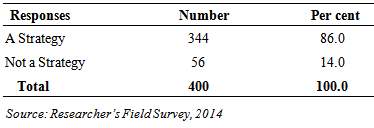 |
| |
|
5. Discussion
It was found out that the following factors influence birth registration: 98.0% said distance. Distance is linked with location and terrain. The longer the distance to the registration centre, the lower the motivation for parents to get the births of their children registered. This is attested to by UNICEF (2013) the greater the distance to the registration centre, the higher the financial and opportunity costs for the family. Urban populations are less subject to such constraints, as confirmed by the differences in urban and rural registration rates for almost all regions. Globally, children living in urban areas are one and a half times more likely to be registered than their rural counterparts. Ninety five (95.0%) said obtaining a passport. This is because many parents register the births of their children in order that the children can obtain passports to travel overseas. The reason is that, presentation of a birth certificate is a basic requirement for passport processing in Ghana. This fact is supported by Assefa (2005) that birth registration is fundamental to the realisation of several rights and practicable needs such as a child's right to a nationality and a passport. Seventy eighty (78.0%) said voting. This is because many parents in Ghana register the births of their children so that the children can get the opportunity to cast their ballots in democratic elections. This is again attested to by Assefa (2005) that in 2002, Somaliland held municipal elections and subsequently, in 2003, presidential elections. The voting age was set at 18 years old, but the absence of birth registration made the voting process problematic. Many young people, both male and female, participated in the elections, but the lack of proper age certification made it difficult to decide who was eligible to vote. Ultimately, this could jeopardise the very integrity of the elections.For factors influencing death registration: 93.0% said settlement of pension claims. A significant number of people in Ghana register their deaths to make the settlement of pension claims possible. This is supported by Centres for Disease Control and Prevention (2004) that the death certificate provides important information about: the decedent (such as age, sex, race, education, date of death, his or her parents, and, if married, the name of the spouse), the circumstances and cause of death, and final disposition. This information is used in the application for insurance benefits, settlement of pension claims, and transfer of title of real and personal property. Sixty five (65.0%) said determination of cause of death. This is because a greater number of people register their dead to determine the cause of death. This is again supported by Centres for Disease Control and Prevention (2004) that the death certificate provides important information about: the decedent (such as age, sex, race, education, date of death, his or her parents, and, if married, the name of the spouse), the circumstances and cause of death, and final disposition.Ninety one (91.0%) said death registration contributes to measuring and monitoring child and maternal mortality rates. This is because government of Ghana requires families register their dead in order that such data can be included in the formulation of heath policies. This is supported by Rao, et al (2004) that information on child and adult mortality rates and causes of death is clearly important to inform regional and national health policies, and to monitor the impact of interventions and progress towards goals such as the Millennium Development Goals. Eighty five per cent (85.0%) of the respondents said birth registration contributes to vaccination. This is because a greater number of parents register the births of their children to make it easier for the children to be vaccinated against diseases such as polio and measles. This is again attested to by Assefa (2005) that in some countries, a child without proof of citizenship will also be denied access to free or subsidized vaccination programs.Eighty seven (87.0%) of the respondents said children born to nomads is a challenge to birth and death registration. This is because nomadic people move from place to place in search of feed and water for their animals and as a result does not consider registration very relevant even though registration of births and deaths is mandatory in Ghana. This is as well supported by Assefa (2005) that many children are born to nomads, far from hospitals. This means that many births and deaths go unregistered. Eighty 80.0% mentioned cost as a challenge. This is because registration of children under one year is free of charge in Ghana but registration of children above one year attracts a fee. This is again confirmed by Assefa (2005) that registration may be costly for poor parents, either because there is a fee associated with it or because there is a cost involved in travelling long distances to register a birth.Ninety nine (99.0%) said public awareness campaign is a strategy for birth and death registration. This is because for instance, during Child Health Promotion Campaigns and Integrated Maternal and Child Health Programmes in Ghana, parent are encouraged in the media to register the births of their children. This is further supported by Rao, et al (2004) that in South Africa, there has been attempts to develop an unofficial notified system involving midwives, nurses, graveyard attendants, school teachers and religious officials, which would increase community participation through increasing awareness and enabling people to become part of the registration process. In many countries, media campaign use news-papers, radio and television to promote public awareness of and responsibilities towards registration of births and deaths. Fifty nine (59.0%) said the use of mobile phones for registration is a strategy for birth and death registration. This is because some community based volunteers in the Tolon District of Ghana have been given mobile phones by the Noguchi Memorial Institute for Medical Research to ease registration of births and deaths in their communities. This is as well attested to by UNICEF (2013) that in Uganda, national birth registration rose from 21 per cent in 2006 to 30 per cent in 2011. The increase can be attributed in part to collaborative efforts between government and its partners to extend coverage. A new approach, recently launched, is enabling trained personnel to capture birth declarations submitted by parents on mobile phones or computers and transmit the information directly into the civil registry.
6. Conclusions
Eighty six 86.9% of responses showed that education, distance, future employment, school enrollments, voting, obtaining a passport, determination of cause of death, insurance benefits, settlement of pension claims and calculation of death rate influence birth and death registration. Also, eighty( 80.0%) of the responses show that births registration contributes to vaccination, family planning interventions and that death registration contributes to measuring and monitoring child and maternal mortality rates, calculation of death rate and determination of cause of death. Beside, 84.3% of the responses confirmed that cost, children born to nomads, lack of support from the District Assembly and distance are challenges to birth and death registration. Finally, eighty six (86.0%) of the responses point to the fact that tying registration to health care, public awareness campaign, the use of mobile phones for registration and building partnerships with other organizations are strategies for birth and death registration.
ACKNOWLEDGEMENTS
Many thanks go to Hajia Sophia Mahama, District Director of Health Services - Tolon, Madam Alice Kuulonno, District Officer of the Births and Deaths Registry - Tolon and to the nurses, planning officers and births and deaths volunteers who made time to respond to the questionnaire.
References
| [1] | Assefa, B (2005). Universal Birth Registration: The challenge in Africa. Retrieved March 26, 2014, from: http://www/riatt-esa.org/sites/default/files/get_file_8f4ife7.pdf <http://www/riatt-esa.%20org/sites/default/files/get_file _8f4ife7.pdf>. |
| [2] | Centre for Disease Control and Prevention (2004).Funeral Directors' Handbook on Death Registration and fetal Death Reporting. |
| [3] | Isabel, B.C (2008). Birth and death registration in the context of HIV and AIDS in Eastern and Southern Africa: Human's first and last right. Pretoria. Centre for the Study of Aids. |
| [4] | Isabel, B.C and Ruth, M. (2008). Strategic analysis on birth and death registration and children in the context of HIV and AIDS. Retrieved March 28, 2014, from: <http://www.unicef.org/Birth_registration_in_the_context_of_Hiv_and_Aids.pdf>. |
| [5] | Kinsley, A.A (2009). The Birth and death registration System in Ghana/Coordination among the Registration, Statistics and Health Sectors. Retrieved March 28, 2014, from:http:siteresources.worldsbank.org//060909TheCivilRegistrationSystemGhana.pdf. |
| [6] | Mehta, D.C and Assie, J.B (1979). A programme for Measurement of Life and Death in Ghana. Accra. Central Registry. |
| [7] | Rao, C., Bradshaw and Mathers, C.D. (2004). Improving death registration and Statistics in developing Countries: Lessons from Sub-Saharan Africa. Retrieved April 8, 2014, from:http://www.commerce.uct.ac.za/organisations/Demography. |
| [8] | United Nations (2012): Reforming and Improving Birth and death registration and Vital Statistics Systems in Africa. Second conference of African Ministers Responsible for Birth and death registration, Durban. |
| [9] | UNICEF (2013). A passport to protection: a guide to birth registration programming. Retrieved April 10, 2014, from: http://www.unicef.org/World Health Organization (2003). Address to WHO staff. Retrieved April 8, 2014, from: <http://www.unicef.org/esaro/Technical-pepers-low-res-pdf>. |
| [10] | World Health Organization (2013). Birth registration and access to health care: an assessment of Ghana's. |
| [11] | Campaign success. Retrieved March 20, 2014, from: http://www.who.int/mediacentre/factsheets/fs324/en. |
| [12] | World Health Organization (2013). Birth and death registration: why counting births and deaths is important. Retrieved April 4, 2014 from:http://www.who.int/mediacentre/factsheets/fs324/en/. |
| [13] | World Health Organization (2012).Strengthening birth and death registration and vital statistics for births, deaths and causes of death: resource kit. Retrieve April 8, 2014, from: http://www.who.int/en/. |

 Abstract
 Reference
 Full-Text PDF
 Full-text HTML