
-
Paper Information
- Paper Submission
-
Journal Information
- About This Journal
- Editorial Board
- Current Issue
- Archive
- Author Guidelines
- Contact Us
Food and Public Health
p-ISSN: 2162-9412 e-ISSN: 2162-8440
2026; 16(1): 1-5
doi:10.5923/j.fph.20261601.01
Received: May 22, 2026; Accepted: Jun. 6, 2026; Published: Jun. 9, 2026

Virulence Potential (Staphylococcal Enterotoxins: SEA, SEB, SEC, SED and SEE) of Staphylococcus Aureus Isolated from Food and Food Handlers in Abidjan, Côte d'Ivoire
 Abstract
 Reference
 Full-Text PDF
 Full-text HTML
Oussou N’goran Jean-Marc1, 2, Sika Emmanuelle Andrée1, Tiekoura K. Bertin2, Konan Fernique2, Kippré Guede Martin2, Rose Koffi Nevry1, Nathalie Kouadio Guessend2
1Université Nangui Abrogoua, Abidjan (Côte d’Ivoire) Biotechnology and Food Microbiology Laboratory, 02 BP801 Abidjan 02 Côte d’Ivoire
2Institut Pasteur of Côte d’Ivoire, 08 BP 1563 Abidjan 08, Côte d’Ivoire
Correspondence to: Oussou N’goran Jean-Marc, Université Nangui Abrogoua, Abidjan (Côte d’Ivoire) Biotechnology and Food Microbiology Laboratory, 02 BP801 Abidjan 02 Côte d’Ivoire.
| Email: |  |
Copyright © 2026 The Author(s). Published by Scientific & Academic Publishing.
This work is licensed under the Creative Commons Attribution International License (CC BY).
http://creativecommons.org/licenses/by/4.0/

This study, intended to investigate the occurrence of enterotoxin genes of Staphylococcus aureus isolated from food and food handlers. The virulence of Staphylococcus aureus isolates was perfommed by multiplex PCR testing for genes coding for staphylococcal enterotoxins A, B, C, D and E (sea, seb, sec, sed and see). The result showed that, of the 113 S. aureus, 77% were positive for one or more enterotoxins genes. The human strains of S. aureus (88.9%) were higher than for strains isolated in food (62%). In the human positive strains, 33.9% were for sea only; (37.5%) were common of sea and seb genes; (16.1%) sea, seb, sec and sed and (12.5%) sea, seb, sed. For the positive strains in food, (29%) detected to sea gene; (42%) sea and seb; (12.9%) sea, seb, sec, sed and (16.1%) sea, seb, and sed. Of the five genes, four (sea, seb, sec and sed) were detected; no strain possessed the see gene. These strains of Staphylococcus aureus are able to staphylococcal toxins A, B, C and D producing. Their presence in food represents a major health risk for consumers. Some strains found in food could originate from food handlers, given the similarity between the genes of human and food strains.
Keywords: Staphylococcus aureus, Enterotoxins, Food and food handlers
Cite this paper: Oussou N’goran Jean-Marc, Sika Emmanuelle Andrée, Tiekoura K. Bertin, Konan Fernique, Kippré Guede Martin, Rose Koffi Nevry, Nathalie Kouadio Guessend, Virulence Potential (Staphylococcal Enterotoxins: SEA, SEB, SEC, SED and SEE) of Staphylococcus Aureus Isolated from Food and Food Handlers in Abidjan, Côte d'Ivoire, Food and Public Health, Vol. 16 No. 1, 2026, pp. 1-5. doi: 10.5923/j.fph.20261601.01.
Article Outline
1. Introduction
- Whether in schools, hospitals or companies, and because of the volume of the public it serves, contract catering occupies a strategic position in the food system. However, a lack of hygiene during preparation and distribution can lead to contamination of meals by microorganisms such as Escherichia coli, Salmonella, Listeria and Staphylococcus aureus, which can cause collective food poisoning [18, 25]. Food poisoning is either intoxication or infection resulting from the consumption of food contaminated by the presence of micro-organisms or toxins produced by specific micro-organisms. Staphylococcus aureus is an opportunistic pathogenic bacterium responsible for a wide range of infections, from simple skin lesions to severe septicemia [23]. The natural ecological niches of this bacterium are the nasopharynx and the skin of warm-blooded animals [23]. From these sites of carriage, S. aureus can colonize cutaneous territories, particularly moist areas (armpits, perineum), constituting a vector for food contamination [9]. Staphylococcus aureus is capable of producing staphylococcal enterotoxins (SE), which have become a major public health concern [5,15]. These toxins are associated with a number of pathologies, the most common of which is food poisoning due to ingestion of one or more staphylococcal enterotoxins previously developed in the food [15,11]. Staphylococcal enterotoxins are proteins with superantigenic and emetic activity that can cause gastroenteritis nausea such as vomiting, abdominal pain and diarrhea [4,21,29]. Staphylococcal enterotoxins are a major cause of food poisoning [19,20,26]. The aim of this study is to identify the genes responsible for the synthesis of staphylococcal enterotoxins in strains of Staphylococcus aureus, isolated from food and food handlers.
2. Material and Method
2.1. Phenotypic Characterization
- Staphylococcus aureus was isolated from different samples, including nasal, hand swabs and stool of food handlers, different foods, the restaurant of privates’ companies and public health establishments. S. aureus strains were isolated on Chapman agar. The isolates were phenotypically characterized using various cultural, morphological, and biochemical tests such as tube coagulase, catalase test, and sugar fermentation. The strains of S. aureus were further by confirmation by MALDI-TOF.
2.2. Virulence Determinants Investigation
2.2.1. DNA Extraction
- Chromosomal DNA of the isolates was prepared as described by [2] with some modification. DNA extraction was performed using the CTAB method. Bacteria were grown in LB medium for 24h at 37 °C, and the cultures were centrifuged at 16,000 rpm for 5 minutes to pellet the cells. The pellet was resuspended in 1.5 mL of CTAB1 extraction buffer (20 g/L CTAB, 1.4 mol/L NaCl, 0.1 mol/L Tris, 0.02 mol/L Na-EDTA, and a pH of 8.0) and 5 μL of RNAse (20 mg/mL), and incubated at 60°C for 30 minutes. 10 μL of Proteinase K (20 mg/mL) was added during the incubation. After a new round of centrifugation, 900 μL of the supernatant was mixed with chloroform (1:1). The mixture was centrifuged at 15, 000 g for 15 minutes and 650 μL of supernatant was mixed with 1.3 mL of CTAB2 buffer and stand at room temperature for 60 minutes. The DNA pellet was washed with a CTAB3/NaCl solution (700 μL of CTAB3), after centrifugation and purified with chloroform. DNA was precipitated with isopropanol (for 30 minutes at room temperature), washed in 70% ethanol, and suspended in 30µl of TE buffer.
2.2.2. Genes Amplification Conditions (SEA, SEB, SEC, SED and SEE)
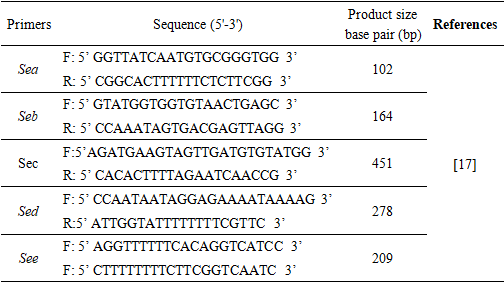
- The virulence determinants investigated using the oligonucleotide primers included the genes encoding sea, seb, sec, sed and see. The primers used to detect sea to see were those described by Mehrotra et al., [17]. Their nucleotide sequences are listed in Table 1. The amplification was performed in an automated thermal cycler (Eppendorf Mastercycler Gradient). The PCR mixture was prepared as following: 4 µL of 5X FIREPol Master Mix, 10 µL of primers (2 μl of each primer) and 2 μl of DNA. The final volume was adjusted to 20 µl by adding sterile PCR grade water. The amplification program as following: initial denaturation at 94°C for 5 minutes, followed by 35 cycles of amplification (denaturation at 94°C for 30 s, hybridization at 56°C for 30 s and extension at 72°C 30 s with a final extension for 10 min at 72°C). PCR products were separated by gel electrophoresis 1.2%.
|
3. Results and Discussion
3.1. Results
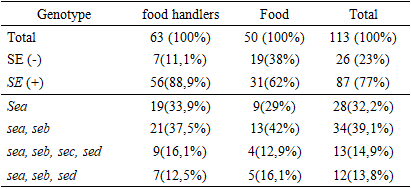
- Multiplex PCR were performed for the staphylococcal enterotoxin genes sea, seb, sec, sed and see in S. aureus originated from food and food handlers. The results of the multiplex PCR analysis for all 113 S. aureus isolates are summarized in Table 2. Overall, 87 (77%) S. aureus isolates were found to be positive for one or more enterotoxins genes. Enterotoxin genes were detected in 56 (88.9%) out of 63 S. aureus isolates from food handlers’ samples and 31(62%) out of 50 S. aureus isolates (42.86%) from food samples. sea and seb genes were detected in most S. aureus isolates. Among the 56 S. aureus positive for se genes, originated from food handlers, 19(33.9%) isolates were positive for sea only, 21(37.5%) for SEA and SEB; 9(16.1%) for SEA, SEB, SEC and SED; and 7(12.5%) for SEA, SEB, SED. On the 31 S. aureus positive for se genes, isolated from food, 9(29%) possessed only sea gene only, 13(42%) had SEA and SEB, 4(12.9%) had SEA, SEB, SEC, SED and 5(16.1%) had SEA, SEB, and SED. SEE gene is not detected in any S. aureus isolates from food and food handlers.
|
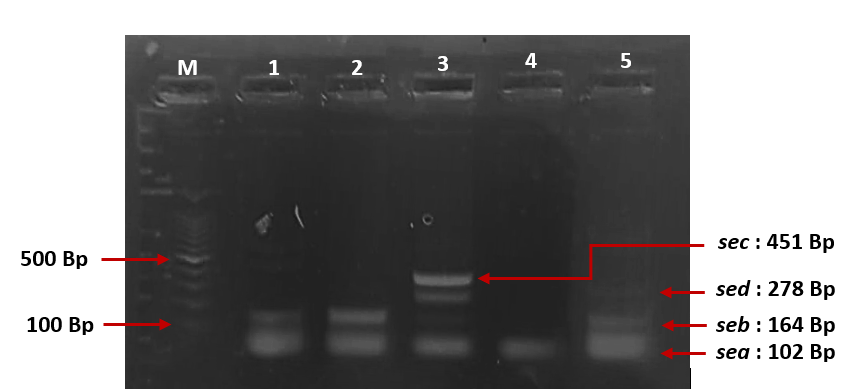 | Figure 1. Agarose gel electrophoresis of multiplex PCR products for S. aureus enterotoxin genes. M, DNA molecular size Marker (100 bp scale; UNIVERS BIO-MEDICAL, BF); lanes 1 and 2, positive isolate for (sea and seb); lane 3 positive isolate for (sea, seb, sec and sed); lane 4 positive isolate for (sea); lane 5 (sea, seb and sed). Positive and negative controls were performed during PCR |
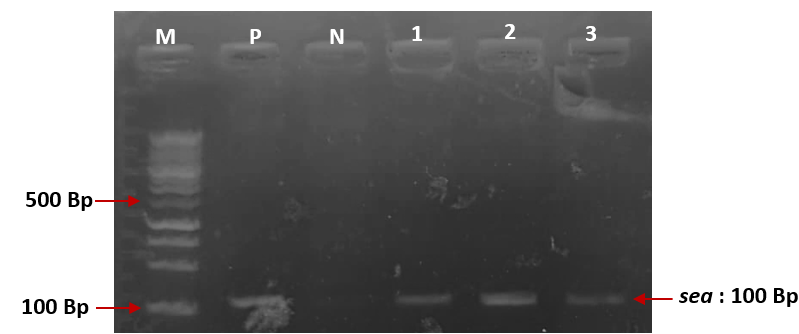 | Figure 2. Agarose gel electrophoresis of PCR products for S. aureus sea gene. Lane M, DNA molecular size Marker (100 bp scale; UNIVERS BIO-MEDICAL, BF). P: positive control; N: negative control. Lane 1, 2, 3: positive isolates for sea |
3.2. Discussion
- Staphylococcus aureus are able to produce enterotoxins which pose a risk factor on public health. In the present study, 113 strains of S. aureus isolated from food and food handlers were molecular tested for the detection of genes encoding the toxins SEA, SEB, SEC, SED and SEE. Of the 113 strains of S. aureus tested, 87 (77%) were positive for one or more SE genes. Lower rate of enterotoxigenic S. aureus was reported by Lim et al., (24.9%) in Food and Food Contact Surfaces in Singapore [14], Hassanien and Abdel-Aziz, (51.3%), 2017, in Egypt [1]. The results showed that enterotoxins genes were detected in 31(62%) of S. aureus isolated from food samples. Katreen et al., in Egypt [13] and Bianchi et al., in Italy [6], reported a similar situation to our data, which detected (53.33%) and (53%) of enterotoxigenic S. aureus in milk and dairy products samples, respectively. However, Rahimi and Alian, in Iran [26], report a higher percentage (75%), of enterotoxigenic S. aureus cow and sheep raw milk samples. For S. aureus isolated from food handlers, 56(88,9%) were positive for enterotoxins genes in our study. This occurrence is high compared to Da Silva et al. [27], who reported an occurrence rate of 50% of enterotoxin genes for S. aureus isolated from food handlers at a university restaurant in the city of Natal, Northeast Brazil. Moreover, Çakıcı et al. [22]; Obaid [31], report lower rate, 33.6% and 46,93% of food handlers enterotoxigenic S. aureus in Turkey and Iraq, respectively. The prevalence of enterotoxin for S. aureus in food samples is lower than that isolated from food handlers, similar to study conducted in Singapore [14]., where from food and food contact surfaces, hand swabs had the highest incidence of the SEA gene. In Egypt, Hassanien and Abdel-Aziz [1], report a similarly rate of enterotoxigenic S. aureus in food (≈53%) and food handlers swabs (52,2%). However, of the food and food contact surfaces, meat dishes had the highest incidence of enterotoxin SEB [25]. For the S. aureus strains isolated in the present study, the SEA gene was the most commonly found, followed by the SEB gene, similar with previous findings, where SEA gene was predominant, Italy [20], France [11], Iraq [3], Iran [16], and Singapore [14]. In contrast, it was found, the highest prevalence rates of staphylococcal enterotoxin (SE) genes detected in S. aureus isolates from retail chicken meat in India were SEB followed by SEG, SEI, SEC, SED and SEJ either alone or in combination [28]. The classical SEA and SED genes were a common concern in cases of Staphylococcal food poisoning [19,30]. However, none of the isolates contained the SEE gene. This absence of SEE or its low detection vas reported by other authors in previous studies in Egypt [10,13], Spain [13] and Iraq [3,24]. In contrast, Staphylococcal enterotoxin type E (SEE) was identified and quantified in the soft cheese made from unpasteurised milk in France [24]. These strains are able to produce staphylococcal enterotoxins A, B, C and D. Our results are confirming the report of Tamarapu et al. [30], such us most foods containing starch and protein, such as meat, poultry products and milk, are contaminated with staphylococcus aureus possessing staphylococcal enterotoxin genes. Therefore, the presence of S. aureus which have enterotoxigenic potential in food, may be a source of food poisoning. The presence of these strains in food is a potential health risk for consumers. Food handlers should therefore avoid exposing food to room temperature for long periods. Indeed, these temperatures favor the expression of these genes, the production of the various toxins [12]. However, gene ownership and expression (toxin secretion) are independent factors. Immunological methods exist for verifying toxin secretion by a strain. These food-borne strains could in part originate from food handlers, given the similarity between the genes of human and food-borne strains. Indeed, according to Greig et al., [8], around 20% of cases involve contamination by a pathogen-infected food handler. Recent studies in the USA, Canada and Europe have identified the following means of pathogen transmission to food: fecal and oral routes (contaminated hands after using the toilet, vomiting) from sick, convalescent or colonized people; staphylococcal contamination, due to nasal or oral secretions, and skin infections [8,7]. The specific primers used for multiplex PCR enabled detection of the target genes. These primers can therefore be used as part of an epidemiological study involving Staphylococcus sp. in cases of food poisoning. Gene identification by PCR offers a highly specific, sensitive, relatively rapid and inexpensive method, unlike immunological tests which are both tedious and costly.
4. Conclusions
- This study identified strains able to staphylococcal enterotoxins genes producing. The presence of these strains in food is a potential health risk for consumers, particularly for patients in public health establishments, their vulnerability. Food handler will avoid exposing food for long time at room temperature. They must also observe basic hygiene rules.