
-
Paper Information
- Previous Paper
- Paper Submission
-
Journal Information
- About This Journal
- Editorial Board
- Current Issue
- Archive
- Author Guidelines
- Contact Us
Food and Public Health
p-ISSN: 2162-9412 e-ISSN: 2162-8440
2016; 6(2): 38-43
doi:10.5923/j.fph.20160602.02

Food Consumption in Students of the Health Area of a Brazilian Public University
 Abstract
 Reference
 Full-Text PDF
 Full-text HTML
Dalila Pinto de Souza Fernandes, Lisiane Lopes da Conceição, Eliana Carla Gomes de Souza, Andréia Queiroz Ribeiro, Maria Sônia Lopes Duarte
Departament of Nutrition and Health, Universidade Federal de Viçosa, Viçosa, MG, Brazil
Correspondence to: Eliana Carla Gomes de Souza, Departament of Nutrition and Health, Universidade Federal de Viçosa, Viçosa, MG, Brazil.
| Email: |  |
Copyright © 2016 Scientific & Academic Publishing. All Rights Reserved.
This work is licensed under the Creative Commons Attribution International License (CC BY).
http://creativecommons.org/licenses/by/4.0/

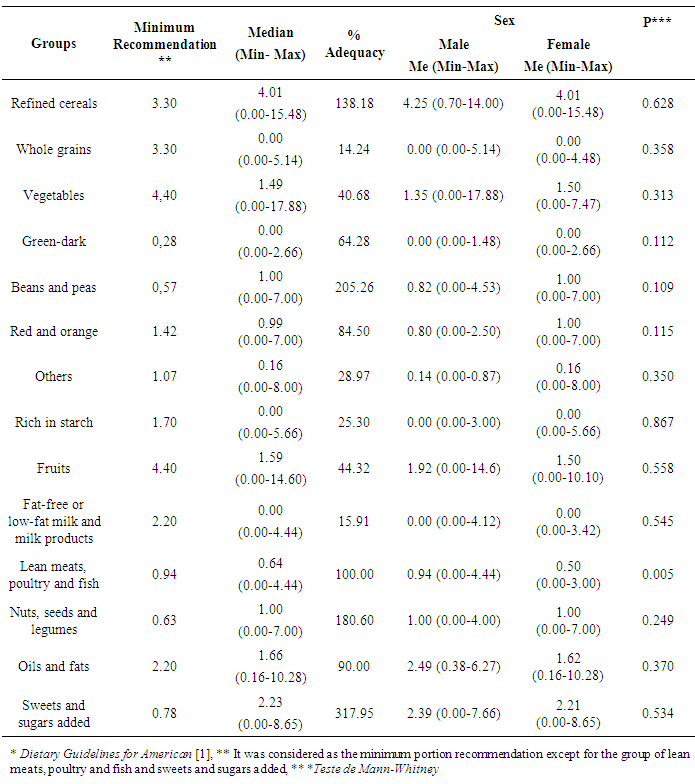
Unhealthy lifestyle among university students is due to physiological and emotional factors. The objective was characterizing the eating habits of area health students of a public university. Was administered a habitual dietary recall. The portions of each food ingested were grouped according to the Dietary Guidelines for Americans 2010. Habitual food intake was characterized by high intake of sweets, added sugars and high fat meats and low intake of whole grains, vegetables and fruits. The students evaluated exhibit inadequate eating habits, which was not expected because will be disseminators of healthy lifestyle.
Keywords: Food guide, Students, Eating habits
Cite this paper: Dalila Pinto de Souza Fernandes, Lisiane Lopes da Conceição, Eliana Carla Gomes de Souza, Andréia Queiroz Ribeiro, Maria Sônia Lopes Duarte, Food Consumption in Students of the Health Area of a Brazilian Public University, Food and Public Health, Vol. 6 No. 2, 2016, pp. 38-43. doi: 10.5923/j.fph.20160602.02.
1. Introduction
- Food consumption assessment can be performed by following dietary guidelines and nutrient recommendations. The assessment of intake by the Dietary Guidelines for Americans [1] provides a thorough review as the vegetables, fruits and cereals groups are divided according to the nutrient content of the subgroups. Therefore, focusing on eating a variety in the vegetable group is crucial, as it could provide a more balanced nutrient intake.The dietary intake of the university students is vulnerable by the transition to university, which can pose a real challenge to healthy eating; this is because some students have difficulty with accepting responsibilities with reference to purchasing and preparing their own meals and management of new schedules to include food [2].Often too, the unhealthy lifestyle is precipitated by changes influenced by physiological and emotional factors, including those of lack of time to prepare meals due to academic activities, lack of regular physical activity, the academic environment and new social relations [3]. Stressors related to the new academic environment also are positively linked with the ingestion of foods high in calories and with high fat content. All these changes can affect the students' nutritional status, putting their health at risk [4].University students are an ideal group to promote healthy lifestyle [5] and health care. This becomes even more relevant because they will in turn become protagonists of appropriate practices to promote healthier lifestyles in the future as they acquire greater knowledge on healthy diet habits. However, some studies [6-8] revealed that area health university students showed feeding behavior similar to that of university students from other areas. Due to the lack of research on food practices in such student groups, this study aims to evaluate food intake in this population.
2. Materials and Methods
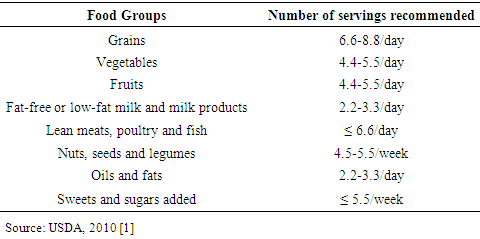
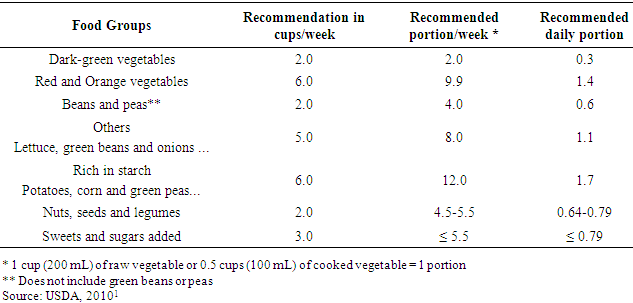
- The present work is a cross-sectional study, involving students of both genders, 17 to 45 years of age, of Nursing, Medicine and Nutrition courses, Universidade Federal de Viçosa (UFV), Campus Viçosa, Minas Gerais. The population comprised 313 students; the study period was from August 2011 to February 2013. The invitation to participate in the research was made via telephone, e-mails and classroom visits. The final sample comprised 244 (77.9%) student participants.Data collection occurred in a single sitting using the habitual dietary recall application [9]. Data collection was performed by four well-trained researchers.The habitual dietary recall method was used to assess the dietary intakes, in which the participants mention the size and portion of the food usually consumed, supported by photographic album [10, 11], besides reporting the product mark and the preparation method.The habitual dietary recall method was applied using the 'multiple passes' technique which stimulates the subject to recall the foods consumed, and it was structured in 3 steps: step 1 identified which foods are usually consumed. The finalized list was obtained in detail regarding the preparation and type of food mentioned in step 2. In the last step all the foods listed were summarized with the details mentioned by the respondent, and any incomplete data were rectified [12]. The portion size of each foods ingested were calculated based on the calorie count of each food item. The following foods were grouped according to stipulations of the Dietary Guidelines for Americans [1], to assess the food intake and portion sizes recommended for each food group, with the correction for the average Estimate of Energy Requirements (EER) found in the population studied (2275.17 ± 368,24 Kcal) (Table 1).
|
3. Results
- The sample (n = 244) was mainly composed of women (85.7%). All participants were, on average, 21.39 ± 3.27 years of age, with the majority between 20 and 30 years of age.
|
|
|
4. Discussion
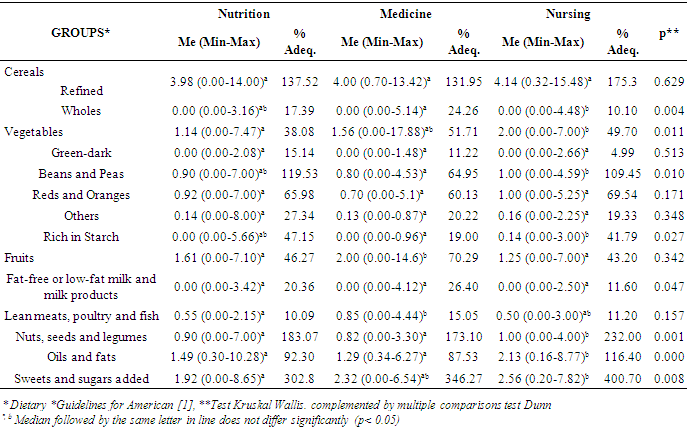
- The majority of the sample included women, which was expected as this is a common occurrence in many healthcare courses such as nutrition and nursing, among others. This finding was also reported in studies done among students in the healtharea by Petribú, Cabral, Arruda [14] and Souza et al. [6].The inadequacies in the intake of all the food groups recommended by the Dietary Guidelines for Americans [1], in this study, revealed unhealthy habitual dietary consumption characterized by high intake of sweets, added sugars and meats high in fat and a low intake of whole grains, vegetables and fruits. According to Souza [7], the feeding habits may be influenced by new behaviors and social relations on entry into the university.In the vegetable group, the beans and peas subgroup revealed high intake (205.26% adequacy), which reflected the Brazilian dietary habits, in which bean was a food consumed daily [13, 15]. The eating habits inappropriate similar to the results of this study was found in other studies [16, 17, 18] at national and international levels.Most of the students of the Lebanese American University (LAU) evaluated by Yahia et al. [19] consumed fried foods more than thrice per week and less than 40% consumed fruits and vegetables daily. Similar results were recorded by Ansari, Stock, Mikolajczyk [20], where less than 50% and 40% of the European universities reported regular consumption of fruit and vegetables, respectively.Maciel et al. [18] in his study on the dietary intake of the Brazilian university community in the interior of São Paulo, found that the average daily consumption of servings of vegetables, fruits and fats and oils was lower than that found in this study, although the average consumption of vegetables and whole grains was higher.Brown et al., [16] also demonstrated in a study of the US West College, a lack to adherence to the Dietary Guidelines for American 2005. They showed that the intake of fruits, vegetables, whole grains and low-fat dairy products was low and the average daily intake of servings of fruits and vegetables was lower than that found in the present study. The consumption of skimmed milk and low-fat dairy products and whole grains was higher when compared with this study.Abdel-Megeid, Abdelkarem and El-Fetouh [17] observed that the ingestion of fruits, vegetables, beans and cereals was inadequate, while the consumption of foods rich in fats was high among the university students in Saudi Arabia. The daily consumption of vegetables, fruits, beans and sugar were 23.9%, 16.6%, 5.5%, 41.1%, respectively.The percentile inadequacy recorded in the study by Feitosa et al. [21] conducted in a university in Brazil, revealed a lower inadequacy value for the fruit (67.7%) and vegetables group (84.4%) and higher for the legumes group (24%) compared with the present study.Although Brazil ranks among the major producer of the world's fruits [22], the data from the Pesquisa de Orçamento Familiar (POF) conducted by the Instituto Brasileiro de Geografia e Estatística (IBGE) in 2008/2009 [15] indicated a rise in the acquisition of industrial products and a reduction in the fresh food intake by the Brazilian families. These have a high consumption of foods rich in sugar, especially sodas, low intake of fruits and vegetables and an increase in the number of meals eaten outside the home, particularly in the southeast of Brazil.Magalhães et al. [23], Toral et al. [24] and Alves and Boog [25] proposed that a daily consumption below the recommended value for fruit and vegetables is one of the risk factors for constipation and other future chronic diseases among university students.Diets rich in vegetables and fruits are related to the treatment and prevention of obesity, cardiovascular disease, dyslipidemia, diabetes mellitus, hypertension, osteoporosis and cancer, among the other diseases [26-29]. The intake of whole grains is associated with reduced body weight and lower risk of cardiovascular disease and the incidence of type 2 diabetes and cancers [30].Regarding the differences in food intake between the genders, it was observed that the results of the current study was different from those of Brown et al. [16], in which men consumed more red meat; however, it matches the consumption of most fats and oils for males. Ansari, Stock, Mikolajczyk [20], in their study on universities in four European countries found a higher consumption of meat and fish in males.The evaluation of the subgroups limited the comparison with other studies, because cross-sectional studies are still lacking in the scientific literature. One limitation observed in the Dietary Guidelines for Americans 2010 [1] is the absence of including the consumption of meat with high fat content; therefore, in this study we used the recommendation of the Food Guide for the Brazilian Population 2006 [13]. Also the assessment of the impact of eating habits was limited by the nature of the study as well as by the lack of food consumption data. It should also be recognized that this survey was conducted in a single university in Brazil and therefore, cannot be generalized for all Brazilian universities.The highlights of this study include the size and representativeness of the study sample involved. On comparing the 244 students who participated in the study from a total of 313 who had enrolled in health courses, the differences in eating habits could be distinctly observed. However, according to the Dietary Guidelines for Americans1 the evaluation enabled a more detailed assessment of the dietary intake of the specific food groups.
5. Conclusions
- University students in the health area, of the courses evaluated, reveal eating habits very similar to others described in other countries, with low intake of fruits, vegetables, whole grains, lean meats, milk and low-fat milk products and a high intake of sugar and sweets. This population should behave as a prototype of healthy eating, because they have enrolled themselves in health courses and in the future they can be expected to be disseminators of good eating habits and/or a healthy lifestyle.It is noteworthy, that the eating pattern found may be related to chronic diseases, including obesity, diabetes and cardiovascular diseases, among others, in the future. In this approach, research regarding eating habits are crucial in improving the understanding of the determinants of diet, and guide the development of disease prevention and health promotion strategies among university students.