
-
Paper Information
- Paper Submission
-
Journal Information
- About This Journal
- Editorial Board
- Current Issue
- Archive
- Author Guidelines
- Contact Us
Food and Public Health
p-ISSN: 2162-9412 e-ISSN: 2162-8440
2015; 5(2): 29-37
doi:10.5923/j.fph.20150502.01
Coastal Area Public Health Problem (A Case Study in the City of Manado North Sulawesi Indonesia)
 Abstract
 Reference
 Full-Text PDF
 Full-text HTML
Ronald Immanuel Ottay 1, Oksfriani Jufri Sumampouw 2, 3, Jeini Esther Nelwan 2, 3
1Faculty of Medicine, University of Sam Ratulangi, Indonesia
2Faculty of Public Health, University of Sam Ratulangi, Indonesia
3Doctoral Program of Environmental Assessment UB's Graduate Program, Indonesia
Correspondence to: Oksfriani Jufri Sumampouw , Faculty of Public Health, University of Sam Ratulangi, Indonesia.
| Email: |  |
Copyright © 2015 Scientific & Academic Publishing. All Rights Reserved.
Background: The coastal area is the junction between land and sea. The process of salt water intrusion and sedimentation caused by human activities such as deforestation and environmental pollution. This can cause problems, especially in the field of public health. Objective: This study was conducted to explore on public health problems that occur in the city of Manado in North Sulawesi as one of the coastal cities in Indonesia. Results: This study is an exploratory study conducted through field observations and literature searches. The results showed there was a lot of health problems in the coastal city which can be divided into three major parts, namely the determinant environmental, and social behavior. Conclusions: determinants of environmental, social and behavioral health problem in the city of Manado.
Keywords: The coastal area, Explore on public health problems
Cite this paper: Ronald Immanuel Ottay , Oksfriani Jufri Sumampouw , Jeini Esther Nelwan , Coastal Area Public Health Problem (A Case Study in the City of Manado North Sulawesi Indonesia), Food and Public Health, Vol. 5 No. 2, 2015, pp. 29-37. doi: 10.5923/j.fph.20150502.01.
Article Outline
1. Introduction
- Many people think that the sea including the coastal region is ideal dumpster. Vast sea is expected to destroy or dissolve any materials dumped into the ocean. In fact, the sea is an ecological system that has limited the ability of decomposition. This is related to the increasing human activities in an effort to meet their needs. This activity resulted in products that are necessary for life and produce waste which may be contaminants (pollutants). Sooner or later most of the pollutants it will be up to the coastal and marine areas. This can cause problems in environmental and public health problems, especially coastal communities and marine (Supriharyono, 2002; Misran, 2002). Health problem is a very complex problem. It is intertwined with other problems outside the health. Similarly, solving public health problems, not only in terms of their own health but must be viewed from all the existing terms of its influence on the issue of "healthy-sick". Many factors affect the health of both the health of the individual and public health. Hendrik L. Blum an expert in the field of preventive medicine said that the health status of communities affected by four things: environmental, behavioral, health services and genetic (hereditary) (Notoatmodjo, 2011).These factors, the direct effect on the health and mutually influence each other. Health status can be optimally achieved if all four of these factors together have optimal conditions. One factor alone is in a state that is disturbed (not optimal), the health status can be shifted in the direction under optimal circumstances (Sarudji, 2006). Research on global environmental pollution has been done. Some of them are studies about global warming caused by greenhouse gas emissions (GRK) emissions and mitigation efforts. Prevention efforts conducted through GRK restrictions on more than 100 countries. In addition, conducted a study of the impact of global warming on the environment such as the Pacific ocean in tropical areas such as the El Nino and ocean acidification (Meinshausen et al, 2009; Collins et al, 2010).There have been many studies that evaluate the quality of the environment in Indonesia. Several studies were conducted to evaluate water pollution problems in particular on the source and countermeasures conducted in Jakarta. Furthermore, to determine the level of contamination of river water in the village Awang Bangkal nutrition value coefficient. Other studies have also been carried out and found the pollution in rivers and ponds in Jakarta (Yudo and Said, 2011; Rahman & Kairoh, 2012; Hendrawan, 2010).Further monitoring of environmental pollution in North Sulawesi has been done by several researchers. Lensun and Tumembow (2013) to monitor pollution in river water Tondano find any contamination of river water in the Village of Ternate Baru Manado City especially for parameters Biological Oxygen Demand (BOD) and turbidity. Research of Tatangindatu et al (2013) in Lake Tondano find any contamination by physical and chemical parameters of water in the lake Tondano Minahasa namely phosphorus content and BOD. The purpose of this study is to identify health problems in one of the coastal cities of developing countries of Southeast Asia (case study in the city of Manado in North Sulawesi, Indonesia).
2. Research Method
- This type of research: This study is an exploratory study through field observations and literature searches.Research Location: The location of research is in the city of Manado which lies between 1º. 30'- 1 [B1]º. 40' north latitude and 124º 40'- 126 [B2]º50' east longitude, and is bordered to the north by sub district Wori (District Minahasa) and Manado Bay, to the east by Sub district Dimembe, south of the Sub district of Pineleng and west by the Bay Manado/ Sulawesi Sea. Administratively, the city of Manado is divided into nine sub districts and eighty-seven urban/rural. Manado city has an area of 157.26 km2, which Mapanget sub district has the largest area of 58.21 km2 (37%), Bunaken by 28.35 km2 (28%) and the smallest area of 1.75 km2 (2%) in sub district Sario (Figure 1).
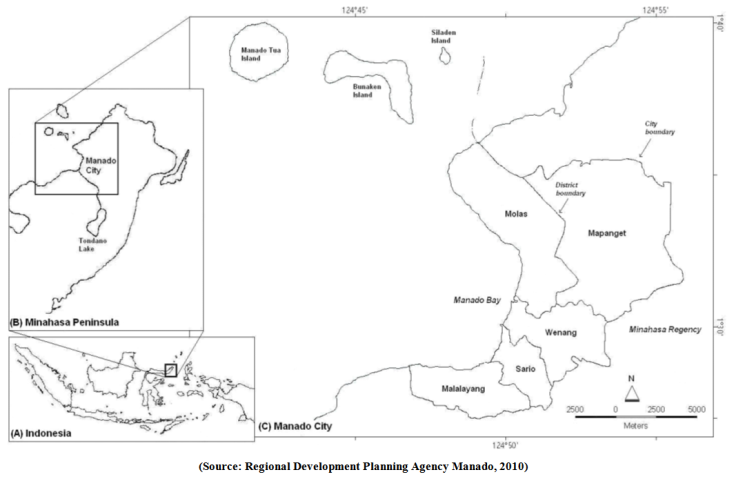 | Figure 1. Location of the study |
3. Results and Discussion
- Manado city is a coastal city that threatened the quality of the environment. This is due to the discharge of wastewater into rivers and waterways city of Manado. On the other hand, the city of Manado has a population of more than 20 thousand people and the population continues to increase because of the public have easy access to natural areas (beaches, rivers and islands), ease of access to services and employment and housing availability. The rapid growth of the coastal city since last 10 years followed by health problems.According to data Regulatory regional development agency (BAPPEDA) Manado (2010), the state of the land in Manado 37.95% choppy and sloping plains of 40.16% of the total area. The rest is in a state of wavy hilly and mountainous land. In addition, at 92.15% of the area of the city of Manado is located at an altitude of 0-240 from sea level. This is due to the natural texture of Manado City bordering the beach and the undulating contours of the land and hilly. This shows that the city of Manado mostly consists of coastal areas and islands.In addition, the number of residents in Manado is increasing. For the year 2010 based on the results of population census the population of the city of Manado as many as 439 660 people. The largest population is found in the sub district Tikala much as 72 537 inhabitants, Malalayang as much as 64 172 inhabitants and found at least as much as 22 007 inhabitants Bunaken sub district.The population density in the city of Manado is quite high. With an area of 157,26 km2, mean density of population reaches 2.796 inhabitants/km2. The highest density is in the sub district of Sario as much as 14.401 inhabitants/km2, Sub district Tuminting as much as 12.833 inhabitants/km2 and the most narrow is in the sub district of Bunaken 776 inhabitants/km2. The third sub district is a sub district that is located in the coastal town of Manado and one of the islands.Based on data obtained from Manado city Health Department in 2008 and 2009 there were five diseases associated with poor environmental quality, namely malaria, leprosy, tuberculosis (TB), dengue hemorrhagic fever (DHF) and the high prevalence of diarrhea (Figure 2).
 | Figure 2. Prevalence of environmentally based disease in the city of Manado |
3.1. Determinants Environment
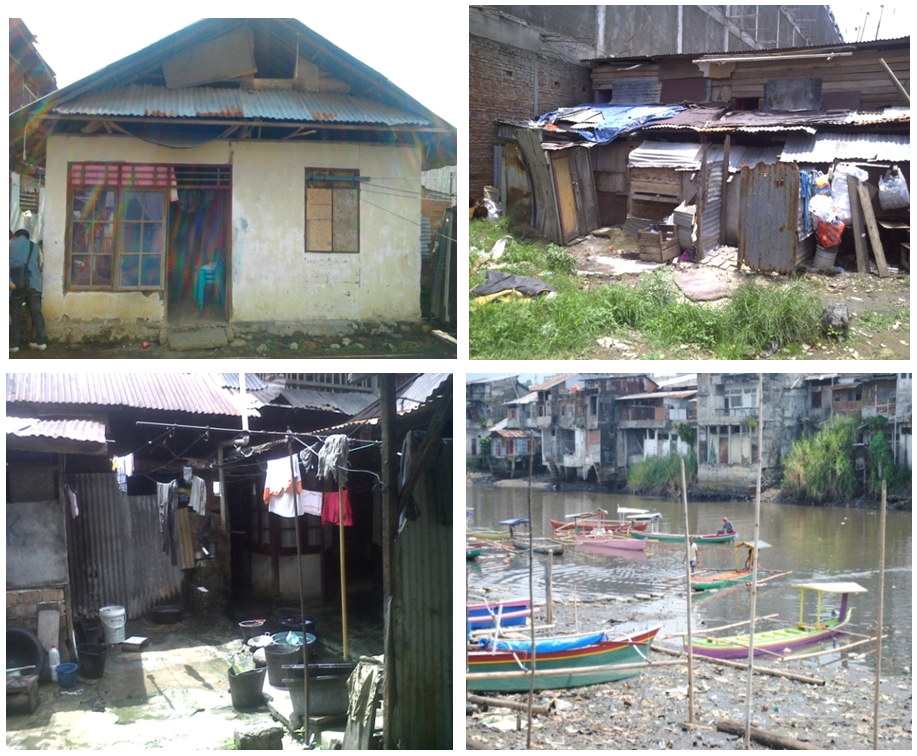
- The most important environmental problems in the city of Manado, is floods. In March 2009 there was a flood when water levels flooded hundreds of homes in the Village Bailang, Sub district Bunaken, and in the Village Mahawu, Sub district Tuminting, reaching 1 meter or waist-high adults. This happens also in December 2010 in which a number of areas which sank is Dendengan Dalam, Kampung Ternate, Wonasa, Komo Luar in Sub district Tikala. Subsequently, in December 2011 there was a flood in which as many as 30 homes in the Village of Ternate Tanjung, Sub district Singkil inundated by Tondano River rose as high as 160 cm Continuous heavy rain Manado. Floods worsen in 2013. Until now Manado has 2 times the flooding which in February 2013 that hit six sub districts, namely Malalayang, Tuminting, Sario, Wenang, Tikala and Singkil with 1000 homes inundated and 3873 affected soul. Furthermore, in July 2013 floods, although only a small scale (Indosiar, 2009; SCTV, 2010; Tribune Manado, 2011; VoA, 2013; Compass, 2013).Results of preliminary observations of the authors in the coastal area of Manado look portrait of environmental health status (basic sanitation) is low as the home state does not meet the health requirements, high density houses, minimal clean water, latrines directly to the beach/river, and other.Research conducted by Sumampouw (2008) on the level of pollution indicator bacteria contamination in the coastal area of Manado shows that the lowest distribution Coliform levels obtained in Mega Mall (80 MPN/100 ml) and the highest was found in Malalayang II (4.7 x 10³ MPN/100 ml). Meanwhile, the lowest total of E. coli is 10 MPN / 100 ml in Mega Mall and Malalayang III and the highest value is 80 MPN/100ml found in Tondano River. Maunsada (2010) found that the content of E.coli in water wells used by the people in the village Tuminting exceed water quality standards in accordance with the Regulation of the Minister of Health No. 416/MENKES/PER/IX/1990 and drinking water in accordance with the Decree of the Minister Health No. 907/MENKES/SK/VII/2002. This study found that there is a significant relationship between the distance of ….with septic tanks and wells dug construction containing E.coli. According Sumampouw and Risjani (2014), the bacteria is one of the indicators of environmental pollution.Lasut et al (2005) found that the water quality of the river in the city of Manado has been polluted due to the disposal of waste water originating from residential city and from agricultural areas Minahasa regency. This suggests that the absence of domestic wastewater treatment in the city of Manado so that wastewater must be discharged into the river. The observations in the field is seen that the disposal of domestic wastewater into rivers and waterways city of Manado. This causes pollution of river water and sea water in the coastal city of Manado, thereby allegedly causing environmental disturbances such as disrupt food webs in rivers and coastal ecosystems. High population densities. This causes the carrying capacity of the environment on people's lives to be reduced, such as the availability of clean water, air quality, and other. Density of population cause faster environtmentally based disease transmission and wider environment. Coastal environmental contamination with household waste. This can happen because based on initial observations, it appears the number of household waste as the rest of the washing water, animal waste, human waste and the other in the river water, soil, coastal waters and residential area. Some bacteria that could be an indicator that the group Coliform contamination.The results are consistent with several studies that have been conducted as research from Tilaar (2008) who found that the high number of E.coli has a correlation with human and animal fecal discharge that is in the water source (in this case the river water Ranoyapo). E.coli is a bacteria that inhabit the intestinal tract of humans and animals, and these bacteria can cause a disease known as traveler's diarrhea. Thus in most cases of poisoning, these bacteria often give problems for travelers who shelter in that place. Furthermore, the content of E.coli has close links with the content of coliform. Regions that have the highest number of coliforms tend to show an increase in E.coli. The results obtained have the same trends as reported by Ijong (2004) concerning the monitoring of coliforms and E.coli in coastal waters of Bunaken.Athena et al (2004) who conducted study on the content of coliforms and E.coli in drinking water from the drinking water refill depot in Jakarta, Tangerang and Bekasi showed that the content of the two types of bacteria reaching 1,600 MPN/100 mL so that is not in accordance with the standards for drinking water. The study conducted by Marwati et al (2007) on the quality of water wells in terms of physical environments and behavior of people in the South Denpasar Health Center indicate that the content of total coliforms have exceeded the existing so as to consume as drinking water must first be cooked with true.
3.2. Determinants of Behavior
- Research from Lasut (2010) showed that the level of public knowledge in the sub district Wenang at the 'intermediate' (49%) and sub district Molas on the degree of 'low' (27.3%) in the issue of the environment and pollution. Public knowledge about the 'why the toilet should be used?' found that the level of public knowledge in the sub district Wenang and Molas at the level of 'high'. This means that the people in the two sub districts are out to use the toilet as a loose them. In addition, the level of public knowledge about the 'environmental issues relating to waste' is at the level of the 'high' of 88.8% and 80.0% for Wenang to Molas. However, knowledge about the impact on drinking water waste water entering at the level of the 'intermediate' (44.7%) for Wenang and 'low' (29.7%) to Molas.Other results also found that people in the city of Manado has a perception on the level of 'moderate' in an effort to improve the management of existing wastewater, but the participation of the community to prevent and mitigate any problems that arise liquid waste is 'less'. This study recommends that the government's role is indispensable in order to increase community involvement (Lasut, 2010).The low total community-based sanitation measures (STBM) in the city of Manado. North Sulawesi based Riskesdas 2010 looks that as many as 11.8% of households have difficulty accessing clean water during the dry season, 8.5% physical quality of drinking water is still below standard, 41.9% of household sources water without bottled water (still using sources of groundwater and tap), 28.1% of households still lack access to good quality drinking water. In addition, it appears that 12.5% of households do not have a facility to defecate and 13.6% still do excreta disposal in vain. Furthermore, for residential health was found to be 64.0% of households have less healthy home (Ministry of Health 2010). Based on the data above shows there are still many problems of environmental health in North Sulawesi. Based on data obtained from the Secretariat STBM Indonesia, North Sulawesi province ranks third lowest in the number of villages / urban neighborhoods implement STBM. According to Minister of Health Decree No. 852/2008, STBM an approach to changing behavior of hygiene and sanitation through community empowerment by triggering method.The low public behavior, especially relating to STBM based on output indicators, namely:a. Individuals and communities have access to basic sanitation (latrines).b. Each household has implemented the management of drinking water and safe food in the household.c. Each household and public service facilities in a community (such as schools, offices, restaurants, health centers, markets, terminal) available hand washing facilities (water, soap, hand-washing facilities), so that everyone wash their hands properly.d. Every household to manage their waste properly.e. Every household to manage their waste properlyThis study is in line with other research which states that there is significant correlation between the behavior of healthy living and quality of water resources with the incidence of diarrhea (Efriani 2008). Subagijo (2006) to obtain the result that the behavior of people who are not good 3.5 times greater risk of diarrhea than those who behave in a clean and healthy living good. Sinthamurniwaty (2006) showed that hand washing with soap after defecation is a protective factor diarrhea.Several studies have been conducted to evaluate the total sanitation program and community-based applications (STBM). This program is only available in Indonesia as a product of the Ministry of Health of the Republic of Indonesia in 2008 and began to be applied to the present. Dunggio (2012), which conducts research on the factors that affect people's behavior on the use of latrines in the village modelomo Sub district of Kabila Bone - Bone Bolango, found that the level of knowledge "low", latrine use "low", the respondents' attitudes toward the use of latrine "bad" and the condition of latrines "bad". Furthermore, Badu (2012), which conducts research on basic sanitation picture in fishing communities in village Pohe Sub district Hulonthalangi of Gorontalo city in 2012 found that the basic sanitation qualified ie a means of providing clean water, household toilets and wastewater disposal, while not qualify namely garbage disposal facilities.Siregar (2010) found that community care is done through a form of public behavior that is always responsible and consider the interests of others, the role and actions involved in the 8 process improvement of environmental sanitation and public awareness pioneer motivated by the role that provides an understanding of the community in the improvement of environmental sanitation slums The Village Matahalasan Tanjungbalai. Budiman et al (2011) found no significant association with the implementation STBM diarrhea incidence.Gaffar (2010) found that the factors that affect the response/attitude of the community in the provision of sanitation facilities (MCK) in the residential area of the fishing village Takatidung Polewali Mandar namely knowledge, satisfaction, community involvement (maintenance, management, contribution). Yudo (2005) found that community-based management of drinking water from stage identfication, construction, management and maintenance involves the active participation of local communities.Jauhar (2012) says that half of the head of the family in his study behave less in the use of latrines and entire families use latrines that do not meet health requirements after triggering method. Pebriani et al (2013) found that knowledge, attitudes and conditions associated with the use of pit latrines and the incidence of diarrhea in the village Tualang Sembilar Bambel Sub district of Southeast Aceh Regency. According Masli (2010) that there is a relationship between knowledge, attitudes and income with the participation of education while not associated with participation.Research from Sitepu (2007) on factors related to the perception of firefighters to remain procedure fire prevention and control building of the Ministry of Health in 2005 found that the training, knowledge, level of education and length of employment associated with perception. Semenza et al (2008) on the public perception of climate change found that individuals with high attention, higher education levels and younger dealing with public perceptions about climate change.Ha-Duong et al (2009) in his research on the public perception of Carbon Capture & Storage (CCS) in France found that age, gender, occupation and education is important to correlate with the public perception of CCS. Connor (2010) conducted a study aimed to examine the factors that influence people's perception of gene technology, where the data come from a survey using email on the German-speaking regions in Switzerland (N = 830). The results showed that three different types of knowledge that substantially affect the perception of risk or perceived benefits of gene technology. The overall results showed that the knowledge and experience that determine people's perception of gene technology.Doria (2010), which discusses the perception of the quality of drinking water from a variety of factors which found that water managers and policy makers must consider factors such as 1) aesthetic in this case everything related to the organoleptic (sensory such as taste, smell and hearing) often plays a major role and must be managed carefully. 2) previous experience should be considered when planning changes in the supply system and developing quality standards. 3) communication strategy designed to caution should be used to communicate with consumers, particularly with regard to forecast changes in the supply of and during the event disturbing. Kellens et al (2011) who conducted research on public perception of the risk of flooding in coastal areas Belgium found that knowledge about the public perception of risk is considered as an important aspect of modern flood risk management as directing the development of flood mitigation strategies are effective and efficient. In addition, respondent characteristics such as age, gender, and previous experience with flooding affecting the perception of the risk of flooding.Tilburt et al (2011) which identified 1,928 titles on cancer risk perception that found 53 articles met the criteria. Most (92%) using the observational design and focused on women (70%) with a family history or genetic test ponder for breast cancer. Of the 53 studies, 36 focused on patients who do not have genetic testing for cancer risk, including 17 studies of patients who have undergone genetic testing for cancer risk. Family history of cancer, previous prophylactic tests and treatments, and younger age is associated with cancer risk perception.Wang and Ha (2011) who conducted research to examine the factors that influence perceptions of pre-service education (PE) teachers Physics of Teaching Games for Understanding (TGfU) in Hong Kong. Individual factors such as knowledge of the game, the confidence of teachers, teaching and learning experiences and social factors, including government policies, support teachers and professional culture was identified as a major influence in the teachers' perceptions about TGfU. Tura (2012), which conducts research on patients' perception of the quality of service of General Medical Center health center with high traffic and low traffic in the city of Jambi find that there is a relationship between age, education and sources of financing with the perception of service quality.Hamzah (2013) conducted a study of the factors related to patients' perceptions of the nurse caring behaviors in Nurse Installation of Massenrempulu Enrekang Hospital found that the relationship between the level of education, duration of treatment, and economic factors of patients with patient perception. Supriyanto (2012) conducted a study of the factors associated with the level of public perception of the use of emergency services Hajj Hospital Jakarta found that the relationship between human resources and the environment with perception.Individual perception is influenced by functional and structural factors. Functional factors are factors that are personal. For example, the needs of the individual, age, past experience, personality, gender, and other things that are subjective. Structural factors are beyond individual factors, such as environmental, cultural, and social norms influence on someone in perceiving (Hamka 2002). From the above description can be drawn a conclusion, that perception is influenced by several internal and external factors, ie factors perceiver, the perceived object and context of the situation perception is done. Some research has been done on the factors that influence perception.Noviansyah et al (2006) says that education, knowledge, experience, motivation and socialization associated with public perception of the Health Insurance Program for the Poor. Febrianti et al (2007) on the analysis of the expectations and perceptions of consumers to the website dimension five star hotel in Surabaya found that consumer perceptions related to the information received.
3.3. Social Determinants
- One of the indicators of the social determinants of the level of income. High income level determines the low level of poverty. According to central bureau of statistics (BPS) Manado (2010), the level of poverty in coastal areas and islands of the city of Manado is high, it is seen in the sub district Bunaken found as many as 1,353 poor households, or approximately 23.8% of the households in these sub districts.The high number of poor families. Poverty is also one of the problems in the coastal city of Manado. Some literature states that the assessment of the health status of the community one of them judged by the level of income. This is due to the high level of income then access to excellent health services to be easily obtained. In addition, the high income can make people modify the home and surrounding environment (including latrines and wells) so that in accordance with the terms specified.Socio-economic Determinants of health are the conditions that underlie social and economic life of a, which affect health. Branch epidemiologic study this is a social epidemiology. Social epidemiology study the specific characteristics of social conditions and mechanisms of the social conditions in influencing health. Social epidemiology studies the role of the variables at the individual level, for example, gender, age, education, occupation, social class, social status, position in the social hierarchy. In addition, social epidemiology also study the role of social variables, such as working conditions, absolute income regions, the distribution of income, income inequality, housing, food security, social capital, social exclusion, social isolation, health policy on the provision of health services (eg, universal access to health care), and financing of health care (for example, the availability of social safety nets) (Murti, 2010).Social determinants of health, such as poverty, lack of access to health services, lack of access to education, stigma, racism, gender biases, are some of the important factors that underlie and contribute to the occurrence of health inequality. For example, a public policy that is not pro-poor, inequality in access to education, and lack of health insurance scheme that protects the financial risk of catastrophic health expenditures, the social factors that lead to macro-level structural families experiencing poverty. Poverty will then force the poor to live in a bad neighborhood, sober living environments and unhealthy living environment that increases the risk of disease (Solar & Irwin, 2007).Miller et al (2007) who conducted study on the public perception of carbon sequestration in Australia found that gender, education level, age and income affect public perception. It is seen that compared to men, women are less accepting of Carbon Capture and Storage (CCS) and more concerned about safety, risk and effectiveness. But there are things that are behind this case that women are more often abstain from giving opinions. Furthermore, factors influencing the perception that education level is obtained that more respondents with higher education, more aware of greenhouse gases and support CCS. Age factors also influence public perception that younger respondents more confident that the information provider is telling the truth about CCS. Furthermore, the type of job or position affects the perception of the respondents. It looks at respondents who held executive positions or intellectual work more often supporting technology compared to other job categories. This also applies to respondents by income level where respondents with the highest income level more frequently to support the technology compared to other job categories.Study of Macedo et al (2012) on the public perception of the environment-based sustainable tourism aims to analyze the human factors that affect the success or failure of urban planning for sustainable tourism in the Polo Costa das Dunas is located in Rio Grande do Norte (Brazil). The results showed that the positive political influence through greater involvement of city officials, flexibility for city mayor could affect public perception to achieve and maintain effective continuity of sustainable tourism.Vignola et al (2013) who conducted study on the public perception of climate change that represent the community of Costa Rica stated that the majority of respondents (> 85%) are very concerned about climate change in general and feel the impact more worrying for those furthest (eg in developed countries or countries in the next generation). At the local level, respondents felt that there is a shortage of food (10.5%) and water (16.1%), poverty (11.3%) and heat waves (11.7%) is the most known effects of climate change. In this study also found that the understanding of climate change affects their perception.
4. Conclusions
- Health problems in the city of Manado as one of the coastal cities in Indonesia can be divided into three major parts, namely the determinant environmental, social and behavior. This suggests that the need for government participation and community empowerment in an effort to overcome the problem of public health.