Madalitso Solochi, Mabvuto Mwanza, Prince Mutale
Department of Mechanical Engineering, University of Zambia, Lusaka, Zambia
Correspondence to: Madalitso Solochi, Department of Mechanical Engineering, University of Zambia, Lusaka, Zambia.
| Email: |  |
Copyright © 2026 The Author(s). Published by Scientific & Academic Publishing.
This work is licensed under the Creative Commons Attribution International License (CC BY).
http://creativecommons.org/licenses/by/4.0/

Abstract
Zambia's economy, particularly in Lusaka, is constrained by a persistent energy deficit driven by unreliable hydropower supply and an accelerating climate crisis. In 2024, the country experienced up to 21 hours of daily load shedding as Lake Kariba fell to just 10.28% usable storage capacity. This study conducts a comprehensive techno-economic assessment of integrating solar photovoltaic (PV) systems at major energy consumer terminals — industrial, commercial, and institutional entities — in Lusaka. Using HOMER Pro simulation software, 142 scenarios across six system configurations are evaluated: Grid-Only, Grid+PV, Grid+PV+Battery, Grid+PV+Battery+Diesel, PV+Battery, and PV+Battery+Diesel. Key performance indicators include Net Present Cost (NPC), Levelized Cost of Energy (LCOE), Renewable Fraction, and carbon dioxide emissions. The Grid+PV configuration emerges as the optimal solution, achieving an LCOE of K0.16/kWh (a 30.4% reduction from baseline) with a renewable fraction of 34.81% and an NPC of K5,545.2 million — substantially lower than battery-inclusive systems. Annual CO₂ emissions are reduced by 42.4%, equivalent to over 2,200 tonnes per year. The study concludes that strategic grid-tied solar PV integration represents the most economically viable pathway for mitigating Lusaka's energy crisis, reducing operational expenditures, and advancing Zambia's Sustainable Development Goals.
Keywords:
Solar photovoltaic, Techno-economic analysis, HOMER Pro, Zambia, Load shedding, LCOE, Renewable energy, Energy security, Hybrid energy systems
Cite this paper: Madalitso Solochi, Mabvuto Mwanza, Prince Mutale, Techno-Economic Impact of Integrating Solar PV Systems at Major Energy Consumer Terminals: A Case Study of Lusaka, Zambia, Energy and Power, Vol. 15 No. 1, 2026, pp. 4-11. doi: 10.5923/j.ep.20261501.02.
1. Introduction
Energy is the fundamental enabler of socio-economic development, sitting at the nexus of water, food, and industrial productivity. For nations like Zambia, where the industrial sector alone consumed 73,553 terajoules in 2020 [1], access to reliable, affordable power is not aspirational — it is existential. Yet Zambia finds itself in a deepening crisis that the government formally declared a National Disaster in February 2024, when El Niño-induced drought slashed hydropower generation from 3,777 MW to barely 1,040 MW against a peak demand of 2,400 MW [2], [3].The consequences have been staggering. At its worst, load shedding reached 21 hours daily, with communities reporting stretches of 48 consecutive hours without power. The national utility ZESCO estimated monthly revenue losses of approximately USD 35 million from curtailed grid operations, while the broader economic toll has been estimated at 5% of GDP [4], [5]. Lake Kariba recorded only 10.28% usable storage in August 2024 compared to 28.98% a year earlier [3].Solar photovoltaic technology has emerged as the principal candidate to break this dependency cycle. Zambia sits in the African sunbelt, receiving an average of 5.5 kWh/m²/day of solar irradiance across 2,000–3,000 sunshine hours annually [6]. The global weighted-average LCOE for utility-scale solar PV fell by 88% between 2010 and 2021 [7], and Zambia's government has responded: by late 2024, multiple utility-scale plants were commissioned or under construction, including a 100 MW facility in Chisamba and a 60 MW plant in Kitwe [2], [8].Despite this momentum, a critical evidence gap persists at the level of major energy consumers. This paper reports on a HOMER Pro-based techno-economic analysis evaluating six distinct energy system configurations for representative major consumers in Lusaka, offering data-driven comparative metrics across NPC, LCOE, renewable fraction, and emissions.
2. Literature Review
2.1. The Global Energy Transition and Developing Nations
The transition from fossil fuel-based energy systems towards renewables is reshaping global economics and geopolitics simultaneously. The International Renewable Energy Agency projects the transition could add a cumulative USD 19 trillion to global GDP by 2050 [9]. Solar PV is now the cheapest form of new electricity generation in most of the world [7]. For Sub-Saharan Africa, the region holds an estimated 60% of the world's best solar resources yet accounts for a disproportionately small share of global solar deployment [10].
2.2. The Zambian Energy System
Zambia's electricity sector is a canonical case study in single-source dependency. Hydropower has historically supplied over 83% of national generation capacity. The 2024 crisis triggered emergency power imports from South Africa, Zimbabwe, and Mozambique at enormous cost to public finances [11], [5]. ZESCO launched its Net Metering Programme in August 2024 under the Electricity (Net Metering) Regulations signed into law in July 2024, enabling prosumers to sell surplus generation back to the grid [3].
2.3. Solar PV Techno-Economic Analysis: Existing Studies
Khalil et al. [12] validated HOMER Pro's optimization capabilities for complex hybrid systems. For East Africa, Katche et al. [13] found that a solar PV/grid system without battery storage was optimal for Moi University in Kenya. Adedoja et al. [14] found LCOE values of USD 0.336–0.410/kWh for rural facilities in Sub-Saharan Africa. Lai and McCulloch [15] provided the canonical treatment of battery storage economics, demonstrating that battery arbitrage value depends critically on peak-to-off-peak tariff differentials — a finding directly applicable to Zambia's multi-part tariff structure.What the literature lacks is a study that simultaneously focuses on major commercial and industrial urban consumers, evaluates all six viable hybrid permutations, uses primary load profile data from real Zambian consumers, and validates results against actual billing data. This study fills all four gaps.
3. Methodology
3.1. Research Design
A multi-phase, mixed-methods feasibility study was adopted, grounded in a case study of major energy consumer terminals in Lusaka. Phase 1 (Energy Profiling) established baseline consumption characteristics from primary and secondary data. Phase 2 (System Design and Simulation) modelled six energy system configurations in HOMER Pro. Phase 3 (Techno-Economic Analysis) compared performance across standardised KPIs. The study evaluated a total of 142 distinct simulation runs.
3.2. Load Profile Data
The industrial load profile is characterised by high, stable consumption (average 287,988 kWh/day) and a load factor of 0.35. The commercial/institutional profile has lower average daily consumption of 152,253 kWh/day but peak demand reaching 65,045 kW, yielding an extremely low load factor of 0.10. Day-to-day variability of 50.7% and timestep variability of 77.1% reflect intermittent, high-draw characteristics of HVAC systems, elevators, and variable occupancy.
3.3. System Configurations
Six principal configurations were evaluated: (1) Grid-Only (25 simulations): baseline, 100% ZESCO grid reliance. (2) Grid+PV (22 simulations): AC-coupled grid-tied solar without storage. (3) PV+Battery (23 simulations): fully off-grid solar and BESS. (4) PV+Battery+Diesel (25 simulations): off-grid tri-hybrid with diesel backup. (5) Grid+PV+Battery (22 simulations): grid-tied hybrid with BESS. (6) Grid+PV+Battery+Diesel (25 simulations): maximum-resilience configuration with all sources.The PV system (SolarMax 500RX) carries rated capacity of 499.95 kW, 17.3% efficiency, and capital cost of K3,000/kW. The diesel generator (Generic 500kW) has capital cost K150,000. Battery storage uses the BAE PVV 140, a 2 V lead-acid cell at K190/unit with 20-year calendar life. The bidirectional converter (Sinexcel 500kW) operates at 97.67% efficiency at K90,000 capital cost.
3.4. Economic and Environmental Parameters
Macroeconomic assumptions: 25-year project lifetime, 8% nominal discount rate, 6% inflation rate. Diesel fuel priced at K26.20/litre. Grid emissions intensity: 0.7 kgCO₂/kWh. Diesel combustion: 2.67 kgCO₂/litre. Solar irradiance data (5.5 kWh/m²/day GHI) was sourced from the NASA POWER database [16].
3.5. Mathematical Formulations
The Net Present Cost (NPC) captures all system costs over its lifetime, discounted to present value: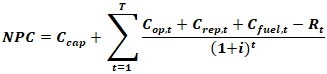 | (1) |
Where:•  : Initial capital cost.•
  : Operations and maintenance cost in year
  .•
.•  : Replacement cost in year
  .•
.•  : Fuel cost in year
  .•
.•  : Salvage value or revenue in year
  .•
.•  : Real discount rate.•
  : Project lifetime (years).The Levelized Cost of Energy (LCOE) annualizes the NPC using the Capital Recovery Factor (CRF):
 | (2) |
Where  is total energy served over the lifetime (kWh).The Renewable Fraction (RF) measures renewable energy contribution:
 | (3) |
CO₂ emissions are estimated from grid and diesel consumption: | (4) |
(kg CO₂; assumes 0.7 kg/kWh for Zambian grid and 2.67 kg/L for diesel.)
4. Results and Discussion
4.1. Baseline Validation
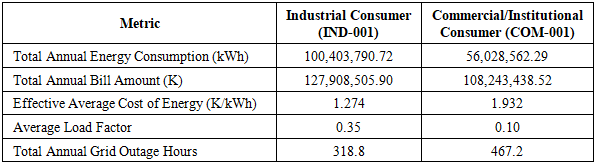
Before evaluating hybrid configurations, the Grid-Only base case was validated against historical billing data from two representative consumers monitored over 2024. Table 4.1 summarises the validation data.Table 4.1. Historical Electricity Billing Data Summary for Validation Consumers (2024)
 |
| |
|
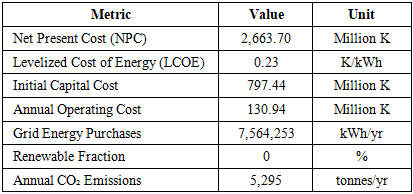
The stark difference between the two consumers — K0.66/kWh — is attributable to the commercial consumer's low load factor (0.10 vs 0.35). Under ZESCO's multi-part MD1/MD2 tariff structure, demand charges penalise consumers whose consumption is concentrated in short, high-intensity bursts. The HOMER Pro baseline returned an LCOE of K0.23/kWh. When compared against actual effective costs of K1.27–1.93/kWh, any hybrid system delivering electricity below these real-world costs represents a compelling value proposition.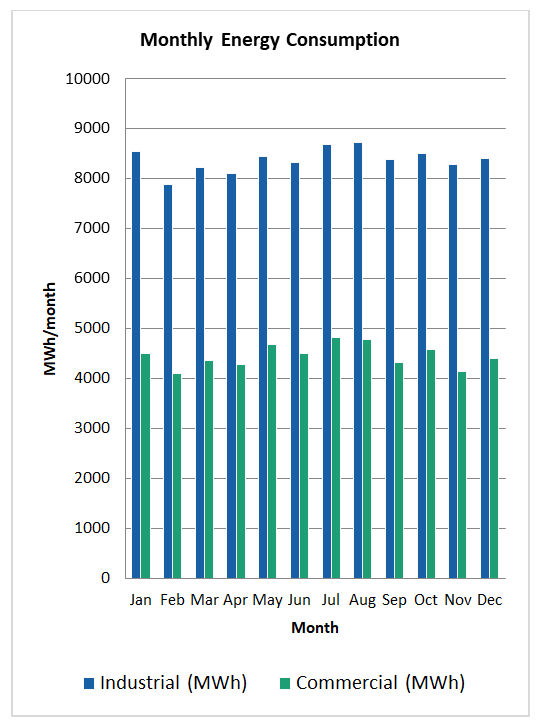 | Figure 4.1. Monthly Energy Consumption Patterns for Representative Consumers [5] |
Figure 4.2 illustrates the severity of the reliability problem. IND-001 recorded 318.8 annual grid outage hours while COM-001 experienced 467.2 — corroborating that commercial operators bear disproportionate reliability costs.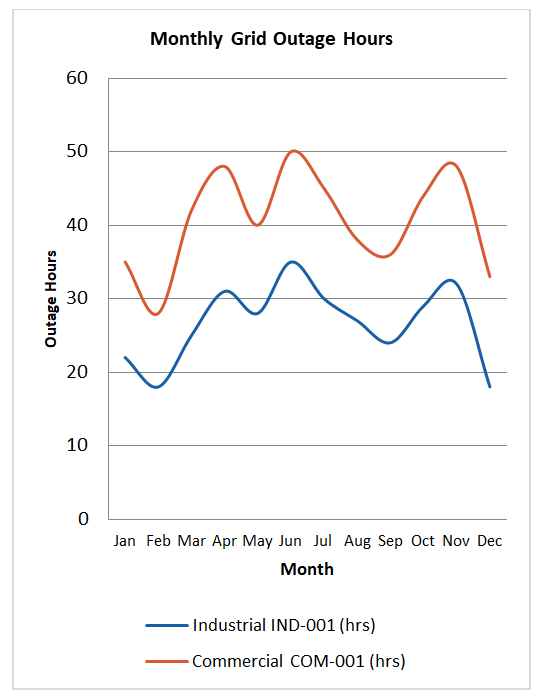 | Figure 4.2. Monthly Grid Outage Hours by Consumer Type [5] |
4.2. System Configuration Results
This section systematically presents the technical and economic outputs for each of the six evaluated system configurations, derived from the 142 simulation runs performed in HOMER Pro.
4.2.1. Grid-Only System (Baseline)
The Grid-Only configuration represents the baseline scenario. This system is 100% reliant on ZESCO for all electricity needs. Table 4.2 summarises the performance metrics based on 25 dedicated simulation runs.Table 4.2. Economic and Technical Performance Metrics for the Baseline Grid-Only Scenario
 |
| |
|
4.2.2. Grid+PV System
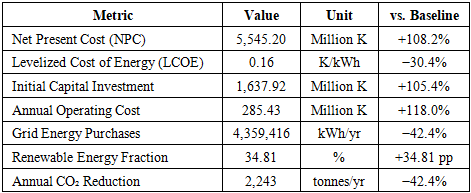
The Grid+PV configuration introduces a grid-tied solar PV array without battery storage. During daylight hours the PV system generates electricity that directly serves the consumer's load. Table 4.3 presents the KPIs based on 22 simulation runs.Table 4.3. Economic and Technical Performance Metrics for the Grid+PV Configuration
 |
| |
|
4.2.3. PV+Battery System (Off-Grid)
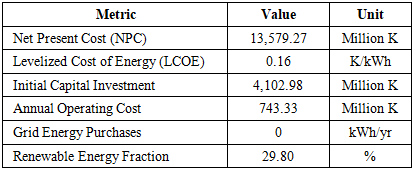
The PV+Battery configuration operates entirely off-grid, relying solely on solar PV and a Battery Energy Storage System (BESS). Table 4.4 presents the KPIs based on 23 simulation runs.Table 4.4. Economic and Technical Performance Metrics for the PV+Battery Off-Grid Scenario
 |
| |
|
4.2.4. PV+Battery+Diesel System
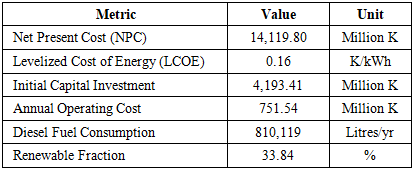
This tri-hybrid architecture introduces a diesel generator as backup. Table 4.5 presents the KPIs based on 25 simulation runs.Table 4.5. Economic and Technical Performance Metrics for the PV+Battery+Diesel Configuration
 |
| |
|
4.2.5. Grid+PV+Battery System
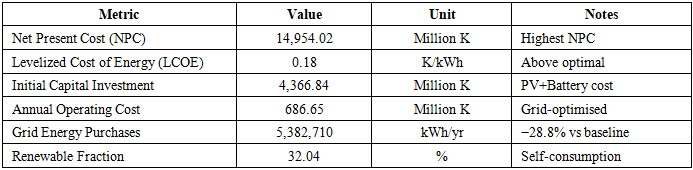
This grid-tied hybrid combines solar generation with battery storage for grid optimization. Table 4.6 presents the KPIs based on 22 simulation runs.Table 4.6. Economic and Technical Performance Metrics for the Grid+PV+Battery Configuration
 |
| |
|
4.2.6. Grid+PV+Battery+Diesel System
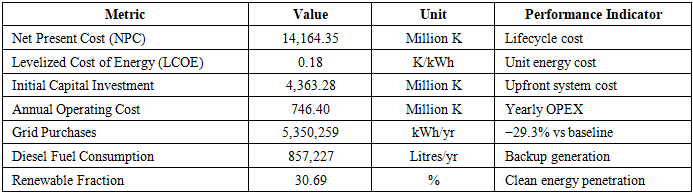
This configuration combines all four energy sources for maximum resilience. Table 4.7 presents the KPIs based on 25 simulation runs.Table 4.7. Economic and Technical Performance Metrics for the Grid+PV+Battery+Diesel Configuration
 |
| |
|
4.3. Comparative Techno-Economic Analysis
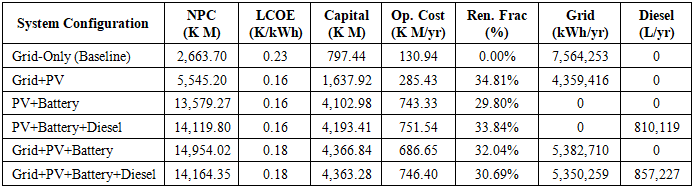
This section provides a systematic cross-configuration comparison to identify the optimal energy solutions for major consumers in Lusaka. Table 4.8 summarises all six configurations.Table 4.8. Comparative Performance Metrics of All Evaluated Energy System Architectures
 |
| |
|
4.3.1. Economic Performance Comparison
The LCOE provides the most direct comparison. The Grid-Only baseline has a simulated LCOE of K0.23/kWh. Three hybrid configurations — Grid+PV, PV+Battery, and PV+Battery+Diesel — all achieve an optimal LCOE of K0.16/kWh, a 30.4% reduction. When compared to the actual effective grid cost of K1.27–K1.93/kWh, the economic case for solar becomes overwhelming. The Grid+PV system stands out as it achieves this low LCOE with the lowest NPC among all hybrid options. Figure 4.3 illustrates the LCOE comparison across all configurations.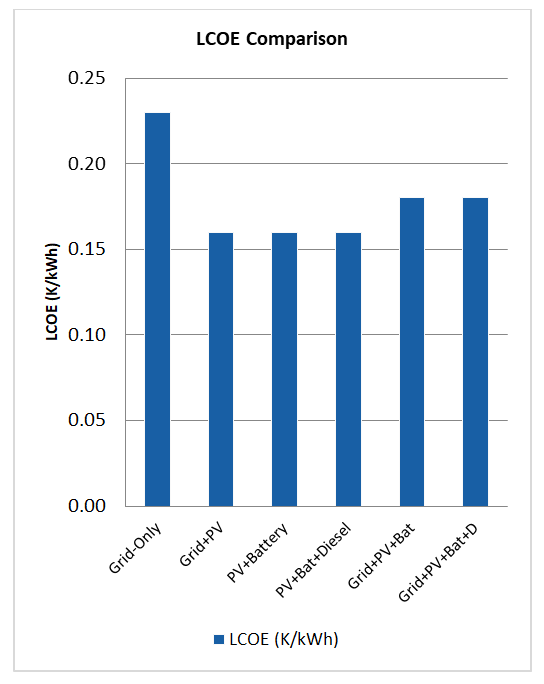 | Figure 4.3. Comparative Levelized Cost of Energy (LCOE) Across System Configurations |
Initial capital costs range from K797.4 million for the baseline to K4,366.8 million for the Grid+PV+Battery system. Any configuration involving a battery bank immediately pushes the required initial capital to over K4,100 million, presenting a formidable financial hurdle. Figure 4.4 compares Net Present Cost across all configurations.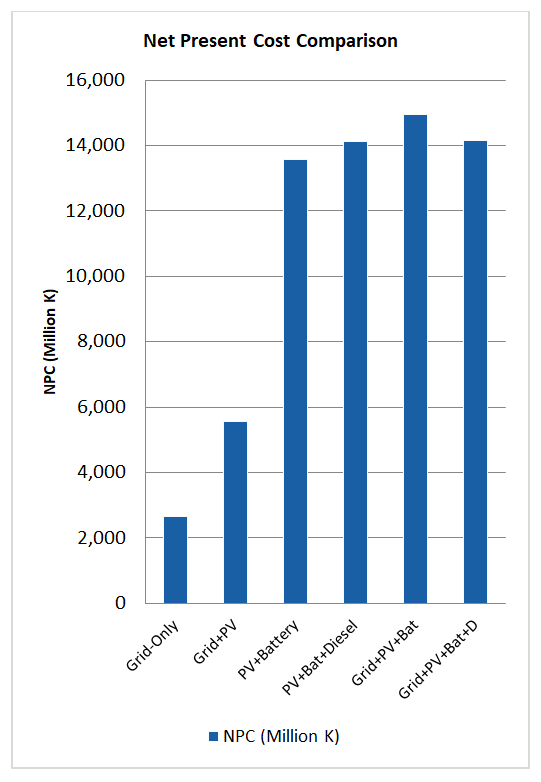 | Figure 4.4. Net Present Cost (NPC) Comparison Across System Configurations |
4.3.2. Environmental Impact Assessment
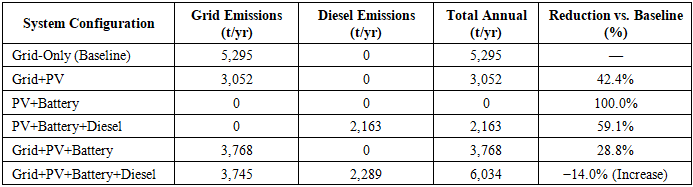
The environmental performance is assessed primarily by CO₂ emission reductions versus the Grid-Only baseline (5,295 tonnes/yr). Table 4.9 summarises the results.Table 4.9. Annual CO₂ Emissions Summary by System Configuration
 |
| |
|
The Grid+PV system stands out as the most effective solution for emissions reduction, cutting annual CO₂ by approximately 2,243 tonnes — a 42.4% reduction — with no new local sources of fossil fuel combustion. Counterintuitively, the Grid+PV+Battery+Diesel system is the worst environmental performer, with total emissions exceeding the baseline due to heavy diesel dispatch for economic optimization.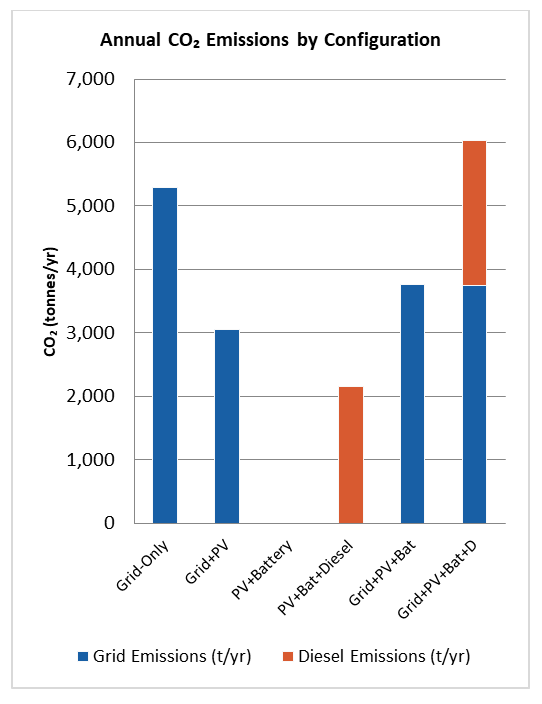 | Figure 4.5. Annual CO₂ Emissions by System Configuration (tonnes/yr) |
4.4. Sensitivity Analysis
A sensitivity analysis tested the robustness of conclusions across five critical variables.Diesel Fuel Price: A 30% increase in diesel price would add over K6.3 million to the annual operating cost of the PV+Battery+Diesel system, substantially increasing its NPC and reinforcing the attractiveness of non-diesel configurations.Component Costs: A 50–60% reduction in battery capital costs — within the range of projections for lithium-ion technology by 2030 — would render the Grid+PV+Battery system competitive with Grid+PV. This suggests a phased investment logic: deploy Grid+PV now, plan for battery retrofitting as costs decline.Grid Tariff Sensitivity: Any increase in ZESCO tariffs would directly strengthen the economic case for solar. Conversely, the introduction of time-of-use pricing would unlock the economic value of battery storage, potentially rendering battery-inclusive systems competitive.Discount Rate: Increasing the discount rate from 8% to 12% increases the NPC of capital-intensive battery systems more than the simpler Grid+PV system, further reinforcing the attractiveness of the Grid+PV option under high-cost-of-capital conditions.
5. Conclusions
Based on 142 HOMER Pro simulations across six configurations, the answer is unambiguous: Grid+PV, with an LCOE of K0.16/kWh, a 34.81% renewable fraction, and an NPC of K5,545.2 million, is the dominant strategy for current market conditions. The study provides the first comprehensive, simulation-based comparison of all six viable configurations for major urban consumers in Zambia. It validates simulation results against primary billing data, demonstrating that the effective grid cost of K1.27–1.93/kWh — far exceeding the modelled LCOE of K0.23/kWh — means the economic case for solar is even stronger than headline HOMER outputs suggest.The critical barrier is not economic viability over the project lifetime but the initial capital requirement. Solving this — through net metering frameworks, green financing facilities, and PPA structures — is where policy energy is most productively directed.
6. Policy Implications and Recommendations
For the Zambian government and the Energy Regulation Board, the most urgent priorities are: (1) developing transparent, commercially attractive net metering tariffs for industrial and commercial consumers; (2) establishing dedicated green finance facilities — potentially backed by sovereign guarantees — to overcome the K1.64 billion initial capital barrier; and (3) preparing the regulatory environment for time-of-use pricing that would begin to justify battery storage investment at scale.For major energy consumers, the evidence supports a phased adoption strategy. Phase 1 should be Grid+PV deployment, financed through Power Purchase Agreements with third-party developers. Phase 2, once battery costs fall below the tipping point identified in the sensitivity analysis, should add grid-connected battery storage. Mission-critical facilities — hospitals, water utilities, mining operations — may need to consider the full Grid+PV+Battery+Diesel architecture from Phase 1.
ACKNOWLEDGEMENTS
The author acknowledges the supervision of Dr. Mabvuto Mwanza, Department of Mechanic Engineering, University of Zambia, and thanks the participating facilities for providing anonymised billing data under NDA. Solar irradiance data was obtained from the NASA POWER database. Simulation was conducted using HOMER Pro software licenced to the University of Zambia.
References
| [1] | IRENA (2023). Renewable Energy Statistics 2023. International Renewable Energy Agency. |
| [2] | Phiri, K. and Clayton, F. (2024). As drought shrivels hydro, this African nation pivots to solar. Yale Environment 360. |
| [3] | ESI-Africa (2024). Zambia: Imports, generators and solar to address energy crisis. ESI Africa. |
| [4] | CUTS-Lusaka (2015). The energy crisis and its impact on the economy. Lusaka: CUTS International. |
| [5] | ZESCO (2024). Press statement on the electricity situation in Zambia. Lusaka: ZESCO. |
| [6] | Bowa, C. and Mwanza, M. (2017). Solar photovoltaic energy progress in Zambia: A review. SAUPEC 2017, 25th Southern African Universities Power Engineering Conference. |
| [7] | Omer, A.M. (2023). Cost, environmental impact, and resilience of renewable energy sources. Environmental Challenges, 11, 100741. |
| [8] | Zambian Observer (2025). Power returns, grid expands: Tracking Zambia's energy rebuild. |
| [9] | IRENA (2017). Renewable energy benefits: Understanding the socio-economics. Abu Dhabi: IRENA. |
| [10] | Global Solar Council (2025). Africa Market Outlook for Solar PV 2025–2028. |
| [11] | Bayliss, K. and Pollen, G. (2021). The power paradigm in practice: A critical review of developments in the Zambian electricity sector. World Development, 140, 105358. |
| [12] | Khalil, L. et al. (2021). Optimization and designing of hybrid power system using HOMER Pro. Materials Today: Proceedings, 47, pp. S110–S115. |
| [13] | Katche, M.L., Makokha, A.B., Zachary, S.O. and Adaramola, M.S. (2024). Techno-economic assessment of solar-grid-battery hybrid energy systems for grid-connected university campuses in Kenya. Electricity, 5(1), pp. 61–74. |
| [14] | Adedoja, O.S., Sadiku, E.R. and Hamam, Y. (2024). A techno-economic assessment of the viability of a PV-wind-battery storage-hydrogen energy system for electrifying primary healthcare in Sub-Saharan Africa. Energy Conversion and Management: X, 23, 100643. |
| [15] | Lai, C.S. and McCulloch, M.D. (2017). Levelized cost of electricity for solar photovoltaic and electrical energy storage. Applied Energy, 190, pp. 191–203. |
| [16] | Kumar, S., Sethuraman, C.P. and Gopi, C. (2021). Sizing optimization and techno-economic analysis of a hybrid renewable energy system using HOMER Pro simulation. Journal of Scientific & Industrial Research, 80(04), pp. 354–362. |
| [17] | Ahmed, I. and Ahmed, I. (2021). Why Zambia's system of energy provision did not prevent the power outages of 2015 and 2016. The Political Economy of Hydropower Dependent Nations: A Case Study of Zambia, pp. 145–206. |
| [18] | IRENA (2024). Sub-Saharan Africa: Policies and finance for renewable energy. Abu Dhabi: IRENA. |
| [19] | Kaela, P. (2018). Zambia's energy mix by the year 2050. Doctoral dissertation, University of Zambia. |
| [20] | Koçak, E. and Şarkgüneşi, A. (2020). The effect of renewable energy consumption on economic growth. Energy, 207, 118162. |
| [21] | Mehmood, A. et al. (2023). Achieving energy sustainability by using solar PV: System modelling and techno-economic-environmental analysis. Energy Strategy Reviews, 49, 101126. |
| [22] | Mwanza, M. and Mapfumo, K. (2023). Techno-economic studies of integration of solar PV technology in telecommunications sector. Journal of Energy Research and Reviews, 13(4), pp. 9–30. |
| [23] | Rashid, M.U. et al. (2022). Techno-economic analysis of grid-connected hybrid renewable energy system using HOMER Pro. Journal of Electrical Engineering & Technology, 17(3), pp. 1563–1581. |
| [24] | Singh, P. et al. (2025). Optimization and techno-economic-environmental analysis of a grid-tied solar PV power plant for a university building. Clean Technologies and Recycling, 4(1), pp. 1–20. |
| [25] | Spalding-Fecher, R. et al. (2016). The vulnerability of hydropower production in the Zambezi River Basin. Mitigation and Adaptation Strategies for Global Change, 21, pp. 721–742. |


 Abstract
 Reference
 Full-Text PDF
 Full-text HTML