
-
Paper Information
- Paper Submission
-
Journal Information
- About This Journal
- Editorial Board
- Current Issue
- Archive
- Author Guidelines
- Contact Us
World Environment
p-ISSN: 2163-1573 e-ISSN: 2163-1581
2014; 4(4): 168-171
doi:10.5923/j.env.20140404.02
Determination of Copper (Cu) Levels for Rivers in Tunceli, Turkey
 Abstract
 Reference
 Full-Text PDF
 Full-text HTML
1Department of Environmental Engineering, , Faculty of Engineering, Ardahan University, 75000, Ardahan ,Turkey
2Department of Basic Sciences, Faculty of Fishery, Tunceli University, 62000, Tunceli, Turkey
Correspondence to: Sebahat Şeker, Department of Environmental Engineering, , Faculty of Engineering, Ardahan University, 75000, Ardahan ,Turkey.
| Email: |  |
Copyright © 2014 Scientific & Academic Publishing. All Rights Reserved.
The objective of this study was to determine the amount of Copper (Cu) pollution and understand the possible sources of pollutants into rivers which are residential area of many unique life forms. In this study, Copper, Zinc (Zn) and Iron (Fe) were measured from 2007 to 2010 in Munzur and Pulumur Rivers. Heavy metal contents of water samples were measured by ICP from 2007 to 2010. The Copper content was distinguished more than the other heavy metals. The amounts of Copper were 0.16 to 0.95 mg /l for Munzur and 0.12 to 1.37 for Pulumur River.
Keywords: Heavy Metal, Copper, River Pollution
Cite this paper: Sebahat Şeker, Banu Kutlu, Determination of Copper (Cu) Levels for Rivers in Tunceli, Turkey, World Environment, Vol. 4 No. 4, 2014, pp. 168-171. doi: 10.5923/j.env.20140404.02.
1. Introdution
- Water consumption is increasing parallel to the world's population day by day, so the need of the fresh water resources has been increasing [1]. The most important criteria of the preferred areas of life for the selection of the settlement are need for fresh water resources for centuries. Rivers and basins where water is used as a source of activities such as agriculture and industry were chosen as most suitable living area [2], [3], [4]. Natural rivers are used for needs and water requirements in the daily lives of people [5], [9]. The quality of water and soils of rivers and basins are the most important factor affecting all the creatures living in the same ecosystems. Because of anthropogenic activities considerable amounts of polluting matters, which will influence aquatic environments discharge to the fresh water environments. Pollution of surface and underground water systems is one of the most important environmental problems which numerous studies revealed in developing countries [6]. Rivers are the most important fresh water resources which polluted by the pollution due to the natural and anthropogenic influences where pour into the open seas [7]. Wastes of industrial activities has been disposed of predominantly by dumping without any treatment into rivers, lakes, the sea and even underground in the 250 years since the Industrial Revolution [8]. Especially in terms of the pollution load, rivers should be examined and investigated because the quantities of pollutants increased into receiving water environments with rapid industrial development for last century. Indeed a dangerous increase in pollutants in aquatic ecosystems is a global problem which revealed by many researchers [9]. Discharges of many pollutants from various industrial, agricultural and municipal sources have been resulted in permanently contaminated water polluted sediments which can transfer to the food chain [10]. Heavy metals can be found easily in water environments because of natural sources and those due to the anthropogenic causes [2]. Heavy metals are the most important pollutants which affect water, soil, and air quality. Especially presence of heavy metal creates permanent affects to living organisms that participate in the food chain which can cause many diseases, including cancer [11], [12]. Determination of heavy metals should be established for all water environments to understand the most probable source if natural or anthropogenic. Thus, identify and eliminate sources of pollutants are vital works can be done meticulously because of burden of pollution of aquatic ecosystems. A large part of heavy metal gets into the water and goes deep because of the molecular weight which resulted pollution of sediment mix in rivers [9]. Many creatures that inhabit the rivers are suffered by these metals, as a part of the absorption of these organisms in food chain. There are many studies about absorption of heavy metals in aquatic animals including crayfish, fishes [13]. Heavy metals accumulate by living things, while some of these entered back again with the water environment. Most rivers pass through from residential areas which have intense human activity so sediment becomes polluted by heavy metals [14].These heavy metals are carried up through the rivers to the open seas together with polluted both sediments and water [7], [15], [16]. Recently many scientists studied on the pollution of rivers by heavy metal pollution and the results of most of them showed anthropogenic activities such as industrial and domestic wastes [10]. Even though Turkey is surrounded by three seas, fresh water resources such as rivers and lakes are not sufficient regarding with drinking and domestic usage capacity of fresh water resources. Environmental pollution by heavy metals affects all living things by involving in food chain from simple to complex life forms. River ecosystem is most affected areas while industrial disposal and domestic waste waters discharge directly or indirect to the water body and dispersed in matrix. Nowadays the anthropogenic pollution affects can be observed from bottom sediment to the surface water in different levels and assessment of the monitoring of this pollution is possible. Likewise all over the world heavy metal pollution is one of the most important subjects together with developing industry and technology. Monitoring of the heavy metal pollution is an important subject while river water is first resource for drinking, agricultural activities, irrigation and fishing in province of Tunceli. Especially Munzur River is the living area of many unique life form such as endemic plants and species of fishes (trout with red spotted).
2. Materials and Methods
- This study was carried out on Munzur and Pulumur Rivers in province of Tunceli in Turkey during the period of 4 years. The concentrations of changes in many parameters were observed. The rivers were shown at the Figure 1. The point of sample stations was selected as represent of the nature of the river ecosystems which has been close to the residential areas with the consideration of the factors of the pollution sources. The coordinates were; X (East) 43 31 687, Y (North) 37 592 802 for Munzur River and X (East) 43 29 028, Y (North) 37 553 184 for Pulumur River. Approximately 7000 Interface Photometer values were determined by measuring with a spectrophotometer device brand as seasonal samples from January 2007 to November 2010. The water quality parameters has been measured in three-months periods (February, May, August and November) as determination of seasonal impacts on the river ecosystems. Physicochemical properties of the water samples, such as temperature, pH, Dissolved Oxygen (DO), Potassium (K), sulfate (SO4), sulphite (SO3-2), ammonium, nitrate, nitrite, phosphate and chloride analyzed by multi meter with the conduction of the Provincial Directorate of Agriculture in Tunceli. Heavy metals were determined by ICP (with optic emission spectrophotometer) Method according to governmental standards.
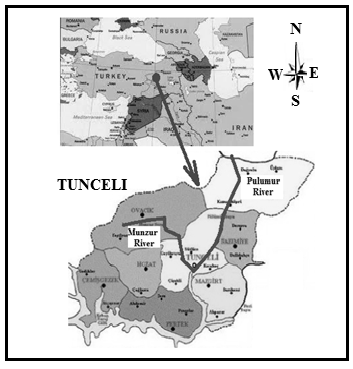 | Figure 1. The sampling stations of Munzur and Pulumur River in Province of Tunceli in Turkey |
3. Results and Discussion
- Physico-chemical parameters measured in water samples did not show the particular sources of pollution between 2007-2010. Quality monitoring results obtained that the average of surface water temperature was between 18.20℃ to 5.20℃ with the highest value of 18.2℃. The amount of Dissolved Oxygen showed the highest value as 11.67 mg /l in February 2007, and the lowest value in August 2007 (8.42 mg /l). The highest amount of Copper (Cu) ion was 0.95 mg /l in February 2008, and the lowest value was in August 2007. Nitrite, nitrate and ammonium nitrogen-containing compounds such as water quality criteria levels were found to be appropriate in Pulumur and Munzur Rivers. Sulfate inhibits the growth of phytoplankton and plants and it is an indicator of pollution caused by industrial wastes, agricultural activities and domestic waste in a variety of aquatic environments. If Sulfate content more than 250 mg /l, it indicates that contamination is more. As well as Rozan and Benoit showed that geochemical factors can affect the Cu Concentration we observed physicochemical parameters could affect the Cu concentration [17]. The value of copper (Cu) was 0.01 mg /l which 1:37 in the summer of 2009 mg /l have been analyzed. Zinc (Zn) and iron (Fe) were much lower than the measured values. The detected values of Cu were given in Figure 2 with seasonal variations. The possible cause of the increase and pollutant factors of soil, sediment, and living examples of analysis needs to be done to determine the exact reason of the Cu Pollution. Currently, work is ongoing on analysis of these heavy metals in selected rivers. Human activities such as mining activities and settlements could be possible reason. In terms of the seasonal decline in the quantity of heavy metals in the winter due to the heat of chemical reactions and less into the cause. In order to detect the accuracy of these estimates bottom sediment and living organisms could be analyzed. In addition Munzur and Pulumur Rivers should be under the protection for natural stocks of fish and other living groups for natural ecological balance.
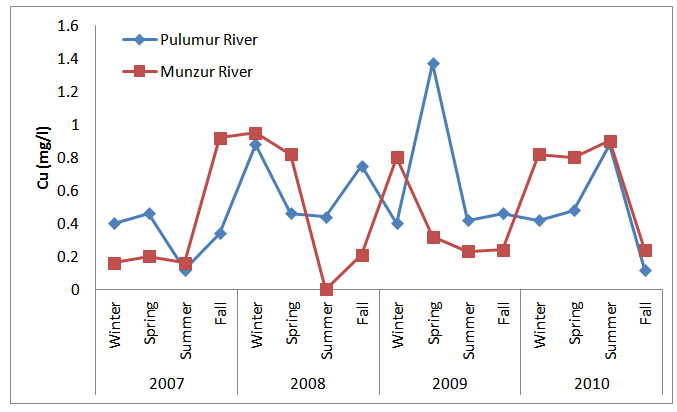 | Figure 2. The Copper (Cu) Concentration of Munzur and Pulumur Rivers between 2007-2010 |
ACKNOWLEDGEMENTS
- The authors are deeply thankful to Provincial Directorate of Agriculture of Tunceli to provide assistance and support for research.