
-
Paper Information
- Paper Submission
-
Journal Information
- About This Journal
- Editorial Board
- Current Issue
- Archive
- Author Guidelines
- Contact Us
World Environment
p-ISSN: 2163-1573 e-ISSN: 2163-1581
2014; 4(1): 33-41
doi:10.5923/j.env.20140401.04
Militancy Crises and the Challenge of Rural Development in Post Amnesty Rivers State, Nigeria
 Abstract
 Reference
 Full-Text PDF
 Full-text HTML
Kio-Lawson D, Dekor J. B
Department of Geography and Environmental Management, University of Port Harcourt, Nigeria
Correspondence to: Kio-Lawson D, Department of Geography and Environmental Management, University of Port Harcourt, Nigeria.
| Email: |  |
Copyright © 2012 Scientific & Academic Publishing. All Rights Reserved.
The issue of ecological constraint to the development of Rivers State, south of Nigeria has been a concern to every development scholar and every successive government in the country. While we all endlessly strive for answer to this problem, another phenomenon suddenly emerged in the literature of underdevelopment of rural Rivers State; the issue of the emergence of ethnic militias and the availability and the use of small arms and light weapons. The activities of these militants which had ran like a virus across the State is not without its own effect on rural development efforts. In this light, a research of this nature has become inevitable to see how militancy crises had affected developmental efforts intended to improve the quality of life in rural Rivers State. Secondly, the paper shall also make suggestions as to “what is to be done” in the post amnesty era to develop rural Rivers State. Previous studies from notable scholars of rural development had established that underdevelopment of rural Rivers State was the primary factor responsible for the birth and geographical spread of militancy in the State. It is therefore suggested in this paper that since the failure of our past rural development programmes had given birth to militancy, we can also use rural development as an effective tool to curb the menace of militancy in the State. This work was made possible after intense days of field research. Inputs from previous scholars were also helpful. Primary data was collected through face-to-face interview with some ex-militants, community leaders, rural dwellers and government agencies involved in rural development.
Keywords: Militancy, Crises, Amnesty, Development, Niger Delta, Rivers State
Cite this paper: Kio-Lawson D, Dekor J. B, Militancy Crises and the Challenge of Rural Development in Post Amnesty Rivers State, Nigeria, World Environment, Vol. 4 No. 1, 2014, pp. 33-41. doi: 10.5923/j.env.20140401.04.
Article Outline
1. Introduction
- Development policies of Nigeria in the past decades were mostly characterized by strategies that greatly favoured the major urban areas at the expense of the rural areas. This is greatly responsible for the sharp disparities in living condition between the urban and rural areas. The bottom line of the problem is the picture of poverty and underdevelopment in rural Nigeria. The question of what is to be done to reduce the level of poverty and bring result oriented development to the grass root has surfaced on the lips of every successive government in the country. The search for an answer has resulted into the birth of several policy options on the part of government. However, a question mark has been placed on the level of performance of such policies. It has been stated that the policies and objectives of each successive government to develop the rural areas never endured beyond the government that initiated it[1],[2]. The failure on the part of the Nigeria government explains the reason why the rural areas which constitute 80% of the entire population of the country had been less attractive for social economic investment[3]. Rivers State, a one city state geographically located in the Deltaic region of southern Nigeria with her enormous richness in oil has a long history of neglect by the Nigerian state just like the other deltaic States of Bayelsa and Delta. Her rural communities present a picture of deprivation, non availability of essential social amenities and services. The significance of Rivers State to the Nigeria economy cannot be denied or underestimated. From 1958 when oil was found in commercial quantity in Oloibiri, in present day Bayelsa State to the present, both the federal government and the multi-national oil companies doing business in the state had reaped enormous benefit. Despite her salient contribution to the Nigerian economy, a large proportion of her people remain predominately cut off from the basic amenities of descent existence. The people of the state had on several occasions expressed their resentment to the rapacious tendencies of the state through non violent method that yielded no appreciable result[4]. The age long Ogoni struggle that resulted into the hanging of Ken Saro Wiwa and his eight brothers in 1995 was one among several cases. While we are not denying the issue of ecological constraint to the development of the state which has become a major concern to every successive government, the latest phenomenon that has caught our attention in the picture of underdevelopment of the state is the issue of the emergence of ethic militias. This recent phenomenon has made Rivers State one of the most devastated states in the Niger Delta, resulting into several humanitarian and economic tragedy[4]. The formation of such ethnic militia and armed gangs was to fight the injustice meted out against them by the Nigeria State and the multi-national oil companies doing business in the state. This recent phenomenon has once made the Nigerian State and the international community to draw a conclusion designating the state as one of the most dangerous and insecure places to dwell or invest, a place inhabited by criminals and restive youths. This conclusion provided cover for the Nigerian government for the militarization of the state to protect the business of oil exploration. The action of the Nigerian government simply shows that it had considered the disruption of Nigeria oil production as the most complex consequences arising from the activities of ethnic militia. It could also be interpreted to mean indirectly denying the underlying factor that gave rise to it as well as their consequences or implication for rural development.
2. Method and Technique
- Rivers State, one of the Deltaic States is geographically located south of Nigeria. It is one of the most industrialized cities in the country. Its capital, Port Harcourt popularly referred to as the “Garden City” has the highest agglomeration of oil companies in the country. It is made up of twenty three local councils. The entire state is geographically divided along two zones; the Upland and Riverine, each with peculiar geographical characteristics. In our attempt to get a picture of the geographical spread of militancy in the state, this study was made to cover the entire state. This was necessary since we intend to find out how militancy crises had affected rural development efforts in the state. To effectively achieve this, our target population was defined. The target population here refers to persons, households, organization and other identifiable units for which this research is directed at as to derive the necessary information. Those in this bracket in our research study are ex-militants, community leaders, rural dwellers, public and private agencies involved in the business of rural development and multinational oil companies. While personal interview and observation contributed greatly to the success of this research, attempt was also made to reach out to the works of other scholars relevant to this research. Information from the Nigerian police and press also helped greatly.
3. Rivers State and the Geography of Underdevelopment
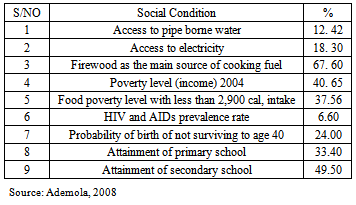
- Rivers state was part of the oil Rivers Protectorate from 1885 till 1893 when it became part of the Niger Coast Protectorate. In 1900 the region was merged with the chartered territories of the Royal Niger Company to form the colony of Southern Nigeria. The State was among the twelve States created on May 27, 1967 by the regime of Gen. Yakubu Gowon with the dissolution of the old regional structure. Until then, Rivers State was part of the Eastern Region of Nigeria. In 1996, another State, Bayelsa was carved out from it. The people of Rivers State are farmers and fishermen with little or no other occupation. With the discovery of oil in the region in 1958, the geographical area became of interest to both the Nigerian state and Western multinational companies both of whom pursued a very narrow focused economic agenda based on maximizing the exploitation of the bounties of the area without giving out anything in return[5]. Despite the economic benefit arising from the land to both the oil companies and the Nigerian State nothing was done to preserve and protect their resources (land, soil, water, crops, and animals). The degradation of their natural environment became the price to pay for allowing the oil companies the use of their land. From 1970-1999, oil has generated almost $231 billion in rent for the Nigerian economy[6]. Rivers State a major contributor in the region is a picture of total ‘nakedness’ in the area of infrastructural development. The activities of the oil companies had also seriously resulted into the destruction of fish ponds, hectares of cropped lands, trees etc. Though it is often claimed that compensation were usually paid to the rural communities, such compensations were hardly enough when compared with the economic tragedy suffered by the people[7]. Studies had shown that the rural communities in Rivers State lacked basic infrastructure; potable water, electricity, communication, roads to link them with the outside world for commerce and social interaction. They drink from rivers and rivulets which have been polluted by petroleum extracts[8]. At the same time, access to education which could have helped to remedy some of the social problems in the state lags abysmally when compared to other parts of the country. There is also a high level of youth unemployment with its attendant level of frustration[9],[10].
|
4. The Struggle Against Underdevelopment
4.1. The Civil Approach
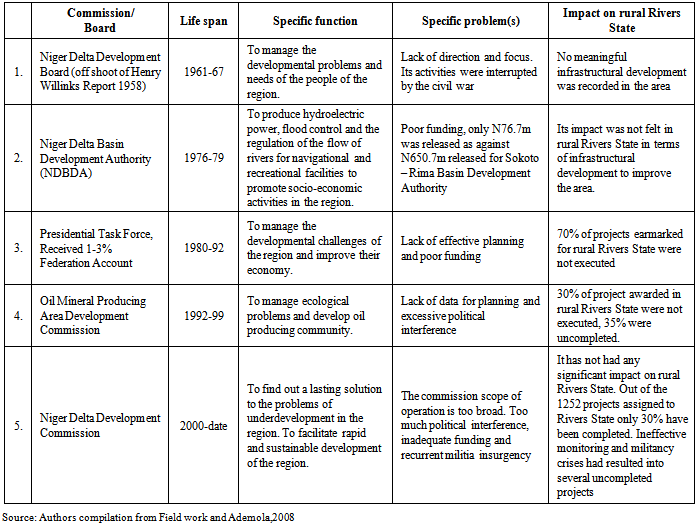
- When the oil companies first came to this geographical region for the business of oil exploration, relationship between them and the locals was very cordial. The current president of the Federal Republic of Nigeria, Dr. Goodluck Jonathan has stated that as a little boy then he had observed that there was no need to “protect or guard anything as the local people were very friendly and even freely offered their houses to the oil workers”[12]. According to the former President of the country, Olusegun Obasanjo, the people he met when he visited the area in 1969 were “a people of reasonableness, of discussion, a people that see themselves as an integral part of Nigeria, a people that stood against violence or secession”[12]. The submission of these two noble citizens of the country shows clearly that oil exploration at the beginning was carried out in an atmosphere of peace. This also accounts for the reason why the area today is infested with an array of oil companies. While the Nigerian state and the oil companies increasingly generates more revenue for themselves for the use of the people’s land and resources, the local people gets nothing to show for their kindness and hospitality. For allowing strangers to use their land and resources, what they get in return is the degradation of their means of livelihood; farming and fishing grounds were devastated and marine lives in several areas destroyed. The locals now saw their very existence threatened and felt that if nothing was done, they were sure there will be no future for the next generation. The people therefore felt the need to protect their environment as well as their economic rights from dying.The first step taken by the people to demonstrate their resentment to the rapacious tendencies of the state, inadequacy of essential infrastructure, preponderance of unskilled youths, high unemployment, and environmental degradation was the adoption of non-violent methods. The Movement for the Survival of the Ogoni People (MOSOP) and the Ijaw National Congress (INC) were among the front liners in this civil protest. The earliest community protest involved sending petitions or community delegations to register their complaints to the oil companies and the Nigerian State. Some other steps taken occasionally, involved demonstration by the locals, boycotts and picketing of government and oil locations[13]. This non-violent method failed to yield any positive result; rather it gave birth to outright hostility and indignation on the part of the Nigerian government and oil companies towards the host communities. The government expression of her indignation came in the form of arrest, detention and trials of the leading elites in the region on trump charges, and in some cases execution all geared towards intimidating the people and allowing the oil business to continue unhindered. The execution of the nine Ogoni sons in November, 1995 was part of the strategy adopted by the government to shut the mouth of the people.
|
4.2. Militant Approach
- The reality of contributing to the oil that oils the economy of the country yet looking helpless in the face of ramifying impoverishment was too much for the youths of the area to bear. Being conscious of the fact that the peaceful or non-violent means adopted by their political leaders yielded little result, the youths excitedly took up arms to protest against the oil companies and the Nigerian State in respect of the marginalization and developmental deficit associated with the area. The strategy adopted was a massive attack on oil installations and taking of oil workers as hostages. The Oil market in the country became very jittery. In early 2005, political representatives from the oil producing region walked out of a national conference on matters relating to the distribution of oil revenue. Few months later the Obasanjo government arrested a Niger Delta militant on charges of treason. This action escalated the violence across oil field in the region resulting into several humanitarian and economic tragedy[14]. Between 1998 and 2003, there were four hundred vandalization of oil company facilities yearly across the Niger Delta. This number increased to 581 between January and September 2004[13]. The emergence of two ethnic militia from Rivers State led by Ateke Tom (Niger Delta Vigilante) and Alhaji Asari Dokubo of the Niger Delta People’s Volunteer Force heightened the war against the oil companies and the Nigerian State. Both men angered by the marginalization, economic as well as developmental backwardness of their people asked both the Nigerian State and oil companies to leave their oil and land alone. This provoked President Obasanjo who ordered for the militarization of the state to stop ethnic militia and to protect the business of oil exploration. The action of the president rather than quelling the storm angered the people. It was therefore not surprising the emergence of more ethnic militia after the president’s declaration of Rivers State as one of the volatile breeding ground for militant groups that must be crushed. Three things worked against the Federal Police of President Obasanjo from recording success against the militants; (1) The geography of the state, an army of creeks and swamps, and the absence of effective transportation and communication infrastructure denied the president’s policemen access to the interior of the state. (2) The ethnic militia were already reaping enormous wealth from the business of oil bunkering and were therefore able to raise the needed resources to oil their machinery of warfare against President Obasanjo’s policemen. (3) Some of the president’s policemen commissioned to crush the ethnic militia could not resist the carrot coming from the business of oil bunkering. With poor condition of service in the profession, some of them saw it as an avenue to fight their ways out of poverty. A romance with the ethnic militia therefore was inevitable. These militant groups operated outside the control of traditional governance institutions, and soon grew into a strong voice requesting for total control of the God given resources at their backyard. With arms in hand and easy access to crude from pipelines and flow stations, the youths discovered a new avenue to fight their ways out of poverty.
5. Rural Development in the Face of Militancy Crisis
- The level of sophistication in brutality and violence practiced by the ethnic militia soon made them the “bride” of the political class in the state who see politics as a form of war; those not willing to respect electoral principles guiding party politics. These ethnic militants became ready made tools in the hand of politicians to suppress their political opponents and establish their dominance in their respective locality. Before the end of the first tenure of Dr. Peter Odili, the drum for his second term aspiration was very high in the state but his popularity had diminished. Those beating the drum for him in the ruling PDP knew very well it was not going to come through the ballot box. The profile of those opposed to the second term agenda led by Dr. Marshall Harry was steadily rising daily in the state and the hand writing was very clear to Odili and his men. Murder, intimidation, arson, kidnapping, bribery, etc became the readily available tools to fight those opposed to the governor’s second term agenda. The Niger Delta People’s Volunteer Force led by Mujahid Dokubo Asari was one of the several groups that were intensely patronized by the governor and his men to help him in his second term ambition[12]. The strategy paid off and the governor returned to the Brick house for his second missionary journey. Soon after the election, Asari’s criticism of President Obasanjo policies towards the Niger Delta pitched him against Odili. Asari’s romance with the “Brick House” came to an end. On September 27, 2004 he formally declared a war against the Nigerian government. The government response was to chase Asari and his boys into the creek while a new romance with a rival group, the Niger Delta Vigilante led by Ateke Tom was activated. This singular act on the part of the government was the beginning of new era of hostility between the two groups in the state. While Ateke had the support of “Brick House”, Asari was backed up by those within and outside the state opposed to the governor’s style of leadership. The financial prowess of both men made them very popular among other militant and youth groups in the state and it was therefore not very long when the militant groups in the state were divided between these two powerful militant groups. The entire geography of the state soon became under the sway of these two militant groups. Soon it was clear to point out which group controls which geographical area in the state. In some geographical areas, the words of these militant groups became law. Traditional institutions not having the support of the political godfathers of these militants were either sacked or driven into self exile. With sophisticated weapons and an act of brutality, these boys succeeded in building an atmosphere of fear in the state especially in the rural areas. It was reported that on August 15, 2004, “several armed local militia men mainly of Ataba extraction in collaboration with recruited mercenaries from neighboring communities, launched an aggressive attack on Ataba, a remote riverine community in Andoni Local Council of Rivers State. The resultant killings and wanton destruction of properties indicated that their mission was primarily to annihilate or drive out from the community persons perceived to be opposed to one of the persons involved in a local chieftaincy dispute. In the process, over sixty persons were gruesomely murdered in cold blood, many houses were razed and reduced to rubbles, and properties worth millions of naira were destroyed. Those who survived the attack were maimed and several of them sent on self exile”[15]. The picture of violence recorded in Ataba was not different from what was reported in the other local councils in the state especially in the riverine communities. There were frequent cases of attack and counter-attack by the two powerful militant groups to establish dominance. In Buguma, in the Asari Toru Council, those opposed to the installation of Professor Princewill as the king of the Kalabari people got the services of the Niger Delta Vigilante (NDV) and attacked the King’s palace. The king was able to escape but his personal secretary, Prince Adolphus Amachree was not that lucky; he was abducted and beheaded. He was not the only casualty; two mobile police officers attached to the residence of the king also lost their lives. In addition, properties of those believed to be in the king’s camp were either burnt or destroyed. After the attack, the Niger Delta Vigilante became the police of the town. The Rivers State government was accused of masterminding the attack because of the involvement of some key powerful officers in the Odili cabinet from the area in the tussle for political leadership, though the government denied involvement. Asari however regarded the policing of Buguma his home town by the Niger Delta Vigilante led by Ateke, a stranger, an Okrika son as an insult. On November 22, 2003, Asari taking advantage of his leadership position in the Ijaw Youth Council mobilized his forces and launched an offensive against Ateke and his men. After that bloody attack that left several persons dead, Asari and his boys liberated Buguma from the hands of the Niger Delta Vigilante while Ateke collaborators went on self exile. These attacks and counter attacks released an atmosphere of fear and insecurity across the rural communities in the state. In some rural communities it was common to see armed gangs levying market women, mourners at funeral, oil bunkers, petroleum product distributors, commercial motorcyclist and all manner of businesses[14]. The rural economy recorded a major set back. The usual bubbling weekend life for which the rural communities were noted for in the state occasioned by burials, marriages, chieftaincy installation, cultural festivals etc. gradually disappeared; families were no longer interested in burying their dead in the village. Even those who were courageous enough to take their dead relatives to the village for burial settled for day vigil on Saturdays. The usual traditional Friday all night vigil to honour the dead gradually eroded. Even then, they were made to pay some fees to the boys before the dead could be brought into the town or taken to the cemetery for burial. Mr. Johnson Solomon, owner of a popular beer palour in Okrika, a riverine community in the state, stated that “before the crisis, it was usual to see every beer parlour crowded with men and women on Friday night drinking and eating into the early hours of Saturday morning. Our people are noted for weekend enjoyment, it is our own way of relaxation after the busy working days in the city but all that changed when the militant war started. These boys have no respect for anybody; they could attack you even without provocation and empty your pocket. People became scared; they were like terror in the day and night.” Mr. Somina Golden, a former bar attendant with one of the famous hotels in Buguma, a riverine community, about thirty kilometers from the state capital, added his own story “On one fateful Friday night, some of these boys raided our hotel like bees in the pretense that an enemy was lodging in our hotel. They banged into every room searchingly, disposing lodgers of some of their personal items. At the end of the search they left with two men and some girls, the girls were raped but for the men, we never heard about them again. After that incident, hotel business collapsed completely in the town.” Observation had shown that the three famous hotels in that community; Atiri, Brooklyn and Land of Canaan hotels are still out of business. The Atere hotel today is being used to provide shelter for soldiers posted to the community by the government to secure the town. The creeks and rivers were not safe either; fishermen were often intercepted at the middle of the sea and made to part compulsorily with their biggest catch. Women who went to pick firewood or seafood in the creeks were most often raped or made to pay dues to the boys. Mr. Jonathan, a fifty-three year old carpenter from Buguma explained that his thirty-two years old wife one day joined other women to travel to Ogbakiri by sea for the traditional periodic market but never came back. None of the other women were seen either. It was assumed that they must have been murdered after being disposed of their money. There was total chaos in rural Rivers State. The same militant groups who were fighting the Nigerian State for selling the oil at their backyard while leaving them in poverty now turned their weapon against the same people they claimed they were fighting for. Most construction companies or agencies assigned with the responsibility of executing one projects or the other intended to improve the living standard of the people were forced to abandon their projects for either fear of risking the lives of their workers or inability to meet up with the stringent conditions put forward by these boys. Benson George, a building engineer who secured a construction job with the Niger Delta Development Commission (NDDC), stretching over three local councils in the state explained his ordeal “Madness is one word that can be used to describe the attitude of these boys. For you to effectively execute a project in the state you will have to pay through your nose. There was this madness about “community boys” that must be settled first before you even mobilize to site. Then for you to land your equipment or construction materials on the site, you must pay such things as marching ground, development levy, security fee, etc. It was so frustrating because provisions were not made for such expenses in the project cost. Worst, they will also insist that certain percentage of your labour force must be given to them. The implication is that most of them are not educated and lack the expertise or discipline needed. But in all, I could not help feeling sorry for them because they are indeed hungry youths.” The multi-national oil companies operating in the areas were not left out. These companies determined to remain in business were compelled to make cash payment to the militant groups for access to their facilities or to ensure the security of their staff and business operations[4]. The security agencies were helpless because of the involvement of key officers of the ruling government in the militancy crisis in the state. In the face of such gross insecurity that bedeviled the state, the geographical area was branded as an area where business could not strive, spatial development impossible and violence very lucrative.
6. Rural Development in the Post Amnesty Era
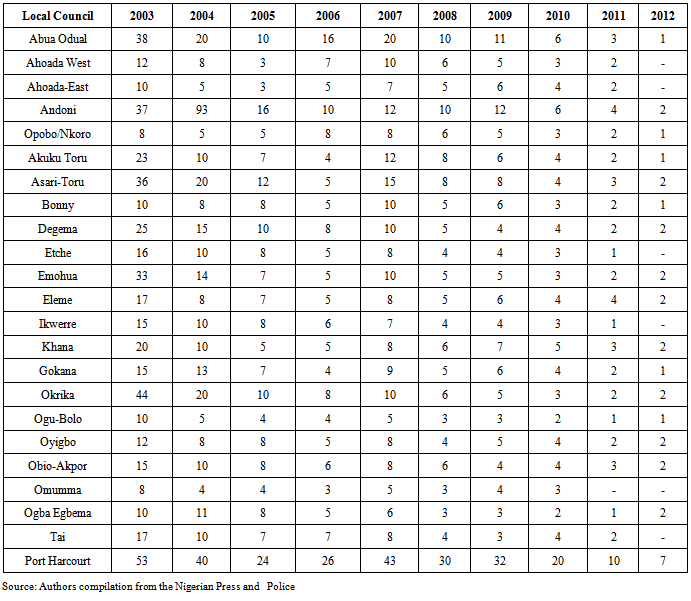
- The current Amnesty programme initiated by the late president of Nigeria, Alhaji Musa Yar’adua started on the 25th June, 2009. The underlying objectives were (1) To stop the raging restiveness in the crisis ridden Niger Delta Region(2) Engage the ex-militants in gainful employment as well as other meaningful activities that could improve their living conditions(3) Help considerably in the social economic development of the region[16].At the end of the deadline given to the militants to surrender their arms and grab the carrot of Amnesty, 20,192 persons came out from various camps in the Niger Delta led by leaders like Chief Tompolo, Chief Ateke Tom, Boy Loaf, Fara Dagogo, etc. By October that same year, another additional 6,166 persons were added bringing the total to 26,358 at the end of December 2010. The acceptance of the Amnesty offer was voluntary and the government entered into a contract with those who surrendered their arms by promising a proper and non forceful Disarmament, Demobilization, Rehabilitation and Reintegration (DDR). A five year Amnesty programme was planned; 2010 – 2015. By October 2013, the programme has gulped $16 billion on the training of youths at various institutions in Ghana, South Africa, the Philippines, Russia, Ukraine and India[16]. The prominent leaders amongst them were awarded oil pipeline protection contract worth billions of naira transforming them into billionaires overnight.Mr. Kingsley Kuku the presidential adviser on Niger Delta and current chairman of the programme has made his boast that the programme has been a success. How? Over 30,000 ex-militants had been trained in various vocational and technical skills. Secondly, relative peace has returned to Rivers State just like the other Niger Delta states; there is a gross reduction in human tragedy arising from militancy crises (Table 3). The excuse of inability of the various contractors from various federal ministries and agencies to execute project for fear that they were going to be kidnapped or pay royalties to the militants had been grossly reduced. In addition, oil production which was as low as 680,000 barrel per day during the militancy crises had shot up tremendously. Though we may not disagree with Mr. Kuku on the positive distance the PAP has covered but in terms of cost-benefit analysis, there is no doubt the programme has incurred more cost than benefit. As rural development scholars certain questions we will not fail to ask is; how has rural development fared in this post-amnesty era? Will the masquerading problem of militancy be finally nailed to the bud by the end of the programme in 2015? Mr. Kuku has boastfully told us that about 30,000 ex-militants had graduated from the various vocational and technical programmes introduced by the PAP but he has failed to explain to us how the said ex-militants can be meaningfully engaged in income yielding activities that could put food on their tables and settle their bills. Mr. Kuku and the federal government are also yet to give us an explanation as to how the non-militant youths in rural Rivers State could come out from their shell of poverty and deprivation. We are yet to see any meaningful blueprint on the part of the Nigerian State or development agencies to timely address the issues for which Alhaji Asari and Ateke Tom rolled out their guns to fight the Nigerian state, the reason for which the oil pipelines were vandalized. Before the militants in the state acceded to the Amnesty offer the long issue of agitation in rural Rivers State was the development of their land, save them from environmental pollution, exercise of right to the resources in their own compound, building of roads to link the coastal areas, bring infrastructure to the place etc. The East-West road which gives access to the state capital from most of the rural communities in the state is still a dead-trap, recently claiming the life of the mother of the first lady of Nigeria. Despite the fact that relative peace has returned to the state, project assigned to improve the living conditions of the people through the different ministries or agencies are either moving at an epileptic speed or still on paper. During a recent inspection of the Igbiri-Abbibo-Oba road and bridge linking Port Harcourt to Okrika Local Council Area by the senate committee, Dr. Christian Oboh of the Niger Delta Development Commission has stated this, “We have seen that the contractor is not working, the next thing that they will do is to ask for variation using powerful Nigerian to mount pressure on us, meanwhile the communities are suffering.” This is just one of the several on-going projects in the state. Where such variations are not met, the communities are bound to see such projects abandon as had been the tradition in the Nigerian State. Health services are still far from the people. The effort of the PDP government of Amaechi to take health services to the rural areas is commendable. His beautiful edifice called “Health Centre” scattered all over the state shows the character of a man who understands the health needs of his people. But the governor’s effort is handicapped by the poor geography of the state and the absence of public infrastructure in most of the rural areas; a factor responsible for the unwillingness of medical personnel to work in the rural areas. In the area of education, Governor Amaechi has once told the board of the Niger Delta Development Commission that paid him a courtesy visit that the era of “six classroom blocks” for primary and secondary schools for his people is over. The beautiful structures which his government has erected all over the state for primary and secondary school pupils are demonstration of his words. The recruitment of 13,000 teachers recently to help the educational sector had received the applause of his people. But even in the face of such applause one may still be tempted to ask how far the governor’s health and educational reform programmes can go in a state that is characterized by so much developmental deficiency in her geography and history. The governor himself acknowledged this when the board of the Niger Delta Development Commission visited him; “Rivers State has sufficient power, what we don’t have is distribution, power distribution is still a problem in Rivers State”[17]. This is just one among several problems still living with the people. For Mr. Joe Numene, a 69 year old community leader from Ogoni kingdom, “The question we are asking today is how long can the government sustain the degree of peace we are presently enjoying? As I speak to you the conditions that made these young people to steal oil from the pipelines in our backyard, that made them chase us away from the communities with guns because we did not support them are still there. We were told the government had trained them but we still see them everyday with hunger written all over their faces.” Mr. Jacob George, a youth leader from Soku, an oil producing community in Rivers State stated; “I use to follow my father to the sea several years back and we used to make excellent catches but there is frustration today. I go to the sea and there is nothing to catch because some strangers we allowed into our backyard to tap our God given resources had made our sea barren and when we complain that we are hungry and that they should help us, they say we are lazy people, they say we are criminals that must be crushed but they are the real criminals, stealing our oil without paying for it.”
|
- For Nimitein Ala, an ex-militant from Buguma community “It was not that some of us enjoyed carrying guns but we saw those that started carrying guns before us making good living out of it, we had no choice but to join them. They told us it was a way of coming out of poverty. And while it lasted, some of us made good money out of the trade and has something profitable to show for it. Now we have dropped our guns, we have gone through their training. Only time will tell how sincere the government is. Some of us have been employed to watch over their pipelines. But my fear is that with a government that is not ready to help our people in the village, I don’t know how they are going to stop the next generation of youths from seeing what we saw that made us to carry guns to fight injustice and poverty.”
7. Conclusions and Recommendations
- Rivers State is predominantly rural settlement with small and scattered hamlets comprising of 80% of the population living in largely rural communities within disperse and linear village settlements grossly underdeveloped. Investigation has revealed that these rural people had been completely cut off from the basic necessity of descent living. Secondly, their basic traditional means of livelihood is constantly under attack from the activities of oil exploration. The decision to protest against this injustice through non-violent means had not produced any positive result. Propelled by the desire to protect their environment from continuous degradation and fight their way out of poverty, the youths in the area had resorted into criminality thus turning the state into an area unsafe to live or do business. This had greatly affected the development of rural Rivers State. The current Amnesty programme of the federal government has succeeded in reducing the level of criminality in the state and brought a measurable amount of peace. To sustain or improve on the degree of peace we had achieved so far and to ensure that we do not go back to the crisis point we once found ourselves, we must introduce policies that will improve the living standard of rural Rivers State. Rural Rivers State is still a picture of frustration; the socio-economic problems are still living with the people. The youths involved in criminality are still asking “what do you want us to do? We have to survive”.The current Amnesty programme had succeeded in training thousands of ex-militants but the question on how to engage those trained in gainful employment is still far from being answered. To enhance the capacity of the youths we must also involve them in oil services and infrastructure. Recently, contract to protect oil pipelines had been awarded to some ex-militants in the state but investigation has revealed that only the prominent leaders had benefited from it while those left out are already grumbling. Our rural development programmes should accommodate the issue of needs of the people as a basis for project allocation rather than political influences. Projects should be based on human skill acquisition, agricultural, ecological and infrastructural development in the state as to ensure sustainable development. Rural Rivers State are mainly farmers and fishermen, therefore, for rural development programmes to have the desired effect, it must be ready to protect and preserve the resources of the people; land, soil, water, crops and mainly animals. Such programmes should also consider the development of infrastructure serving agriculture. This will provide incentives for more production by our local farmers and fishermen and at the same time make agriculture attractive as a business for the youths. The state legislature must also help in ensuring that agencies and institutions shouldered with the responsibility of infrastructural development of rural Rivers State and provision of social amenities performs without compromising moral integrity and honesty. The number of uncompleted projects in the state indicates that there is no effective monitoring of government projects. Another area we may be interested in carrying out a research study in the future is in the area of intra communal crises and their implications in the development of rural Rivers State.
ACKNOWLEDGEMENTS
- I am sincerely grateful to Jacob George, Nimiteim Ala, Somin Golden, Jeo Numene, Jonathan Douglas and Johnson Solomon for their support, encouragement and contributions.