
-
Paper Information
- Paper Submission
-
Journal Information
- About This Journal
- Editorial Board
- Current Issue
- Archive
- Author Guidelines
- Contact Us
Electrical and Electronic Engineering
p-ISSN: 2162-9455 e-ISSN: 2162-8459
2013; 3(6): 178-183
doi:10.5923/j.eee.20130306.06
Next-generation Optical Access Technologies
 Abstract
 Reference
 Full-Text PDF
 Full-text HTML
Mohammad Syuhaimi A-b Rahman, Ibrahim M M Mohamed
Spectrum Technology Research Group (SPECTECH), Department of Electrical, Electronics and Systems Engineering, Faculty of Engineering and Built Environment, Universiti Kebangsaan Malaysia 43600 UKM Bangi, Selangor, Malaysia
Correspondence to: Ibrahim M M Mohamed, Spectrum Technology Research Group (SPECTECH), Department of Electrical, Electronics and Systems Engineering, Faculty of Engineering and Built Environment, Universiti Kebangsaan Malaysia 43600 UKM Bangi, Selangor, Malaysia.
| Email: |  |
Copyright © 2012 Scientific & Academic Publishing. All Rights Reserved.
The development of new bandwidth-hungry services creates a rapid increase for broader bandwidth per user. Consequently, this demand for more bandwidth necessitates the need to evolve from the currently deployed time division multiplexing passive optical networks (TDM-PONs) to next-generation optical access networks (NG-OANs). Beside the need for broader bandwidth per user, further specifications are required in the NG-OANs such as, the need to: longer range, higher capacity, and unrestricted mobility. Different architectures were proposed in the literature for creating a NG-OAN that is able to satisfy one of the aforementioned requirements. Long-reach optical access network (LR-OANs) were proposed to fulfil the longer range, higher capacity requirements. In addition to fulfilling these requirements, the LR-OANs offer a cost effective solution in which the access and metro segments of the telecommunication network are combined into one backhaul segment. In this cost effective solution, many central offices are consolidated in one trunk exchange. In this paper, we first provide a quick review of different potential technologies, proposed for next-generation optical access. We then provide a review of different stat-of-the-art LR-OAN architectures including opportunities and challenges in each one.
Keywords: Next-generation optical access networks (NG-OANs), long-reach optical access networks (LR-OANs), fiber-to-the-home (FTTH)
Cite this paper: Mohammad Syuhaimi A-b Rahman, Ibrahim M M Mohamed, Next-generation Optical Access Technologies, Electrical and Electronic Engineering, Vol. 3 No. 6, 2013, pp. 178-183. doi: 10.5923/j.eee.20130306.06.
Article Outline
1. Introduction
- The gigabit-class TDM-PONs (Ethernet PON[EPON] and gigabit PON[GPON]) in which a point-to-multipoint P2MP connection is established between one optical line terminal (OLT) and several optical network terminals (ONUs) are envisioned as an ultimate solution to the bandwidth demand crisis because of their wider bandwidth compared with the copper-based access networks, however their capacity is going to be exhausted once more bandwidth-hungry services such as, high-definition television (HDTV), and 3D television (3D-TV) become available in the near future. For example, the HDTV service requires in the order of 8 Mbps/channel, making the minimum bit rate required to simultaneously supporting a single channel of HDTV plus data and voice is 10 Mbps. Therefore, an evolution from the currently adopted gigabit-class TDM-PON to the NG-OANs becomes inevitable. Besides fulfilling the higher bit rate requirement, a further increase in the split ratio and an extension in the range are required in the NG-OANs. Long-Reach Optical Access Networks (LR-OANs) is one of the potential candidate technologies for the next-generation optical access (NGOA). They pose a cost-effective approach in which the capital and the operational costs are reduced. In this cost effective approach, the number of the central office sites are consolidated through combining both the access and the metro segments of the telecommunication network in one extended back-haul segment. A basic telecommunication network and its corresponding LR-OAN are illustrated in figures 1(a) and 1(b). The LR-OANs were initially proposed based on time division multiplexing (TDM) technology Later, they were proposed based on hybrid time division multiplexing (TDM)/coarse wavelength division multiplexing (CWDM) and hybrid time division multiplexing (TDM)/dense wavelength division multiplexing (DWDM) technologies.
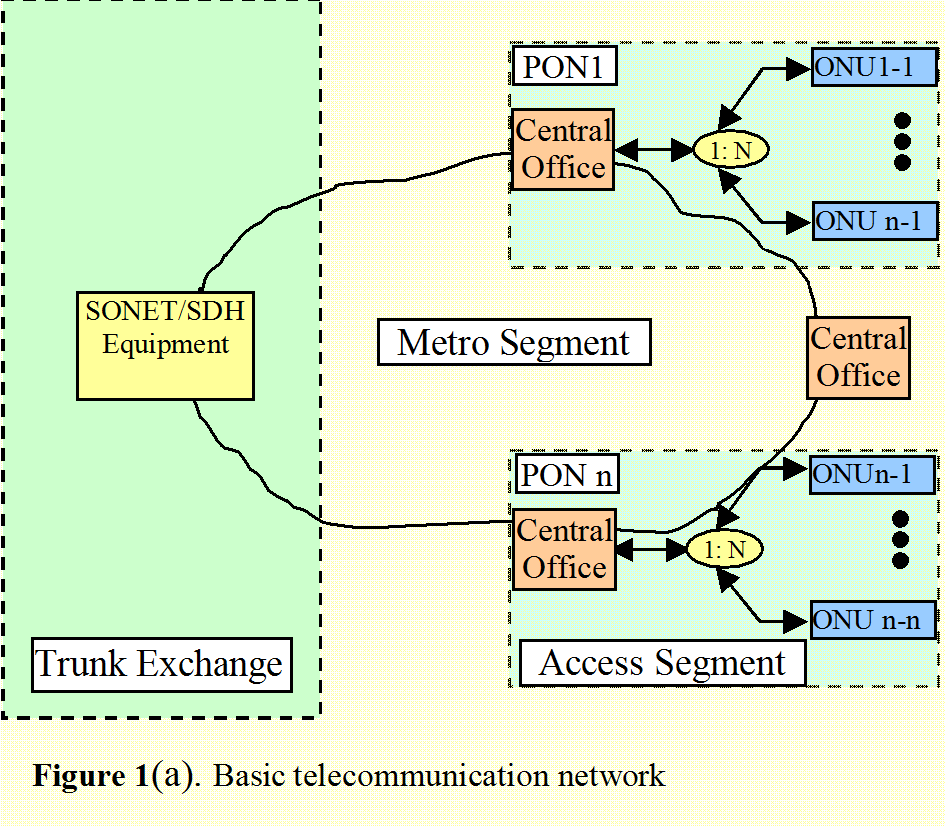 | Figure 1(a). Basic telecommunication network |
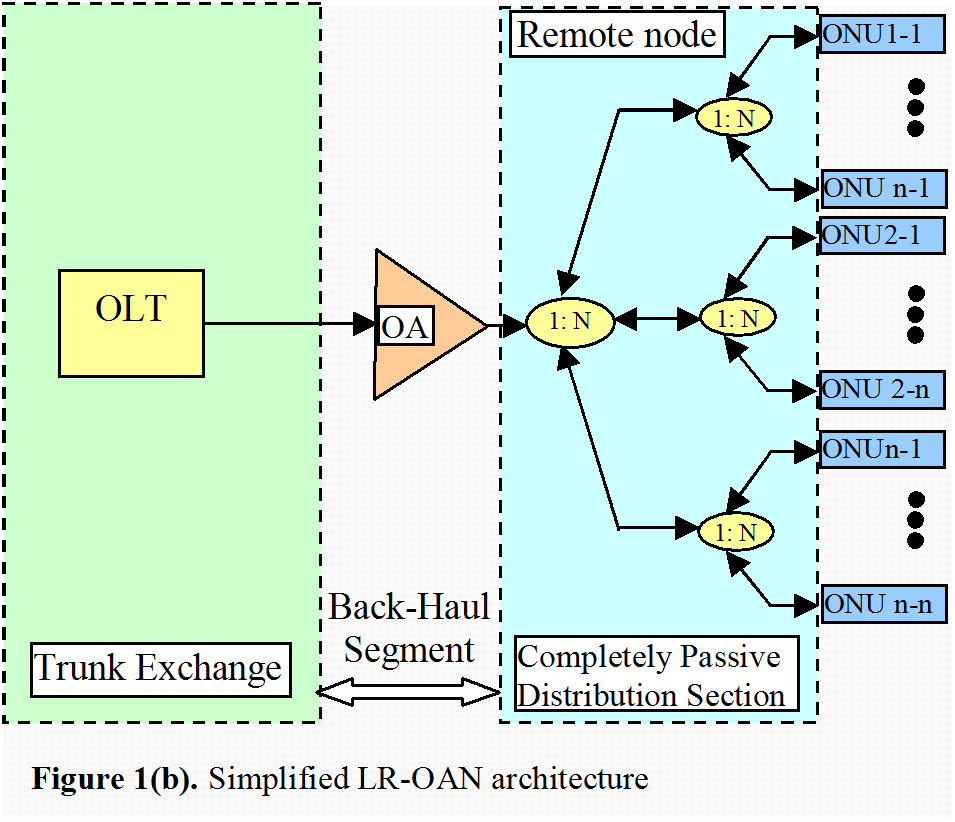 | Figure 1(b). Simplified LR-OAN architecture |
2. Options for Next-generation Optical Access
- The options for next-generation optical access are the outcome of several interesting research studies. Following is a summary of these options:
2.1. The High Data Rate Time-division Multiplexing PONs
- The Institute of Electrical and Electronics Engineers (IEEE), and the International Telecommunications Union’s Telecommunication Standardization Sector (ITU-T) ratified their standards (IEEE803.av,[10GEPON], and ITU-T.987, [XG-PON]) in 2009 and 2010 respectively[1][2]. 10GEPON specifies symmetric transmission, 10-Gbps for the downstream and upstream, and asymmetric transmission, 10-Gbps for the downstream and 1-Gbps for the upstream. XG-PON also specifies symmetric 10-Gbps for both the downstream and the upstream. However, it specifies asymmetric 10-Gbps for downstream and 2.5-Gbps for upstream. Both standards recommend the use of forward error correction (FEC) codes for losses compensation due to the increased bit rate.
2.2. The Wavelength-division Multiplexing PONs
- The wavelength division multiplexing PONs (WDM-PONs) were proposed to increase the capacity in PON systems by exploiting the large count of wavelengths available in the fiber (its virtual unlimited bandwidth). The WDM-PONs ensure more privacy and security by allocating a dedicated pair of wavelength for each user. Additionally, they allows coexistence in an open access environment among different network operators where new operators can share the same optical distribution network (ODN) with legacy ones. However, the need for extra filters, which are used for wavelength separation in WDM-PON systems, increases the cost. Consequently, each ONU in a WDM-PON system is required to handle data traffic via a stable wavelength to ensure a successful filtering process, which further increases the cost. To reduce the cost of WDM-PON systems, it is recommended to unify the design of the ONU (i.e., colourless ONU). A review of different WDM-PON architectures is provided in[3].
2.3. The hybrid time-division Multiplexing/wavelength-division Multiplexing PONs
- The hybrid TDM/WDM-PONs were proposed for increasing the bit rate and the capacity in PON systems by exploiting the high data rate provided by the TDM-PONs and the large count of wavelengths offered by the WDM-PONs. According to the wavelength grid used, a hybrid TDM/WDM-PON can be categorized either as TDM/CWDM PON, in which 20 nm is used for wavelength spacing or TDM/DWDM PON in which 0.8 nm or 0.4 nm is used for wavelength spacing. A hybrid TDM/WDM-PON can also be categorized as either a static TDM/WDM-PON in which a dedicated pair of wavelength is allocated for each ONU or dynamic TDM/WDM-PON in which wavelengths are allocated dynamically during communication. Although a dynamic TDM/WDM-PON provides additional benefits such as, load balancing, resilience and power saving, it requires the use of burst mode receivers because of the frequent change in the wavelengths. The first commercial colorless gigabit TDM/WDM-PON using a remote protocol terminator was proposed and experimentally demonstrated in[4]. It has been used by Korea Telecom since March 2009. The system was able to provide a high speed fiber-to-the-home service and supporting up to 512 users over a single feeder fiber. Mohammad Syuhaimi and Ibrahim Mohamed proposed a scalable and flexible hybrid TDM/DWDM scheme in[5] based on frequency re-use approach. The system was able to allow different bit rate OLTs (622-Mbps, 1G-bps, 2.5-Gbps, and 10-Gbps) to use the same frequency band, and transmit their services over a 24-km shared feeder to 16 passive remote terminals (PRTs) with 16 ONU group for each. Each group can accommodate up to 16 ONU, total of 256 ONU/PRT, resulting in overall system capacity 4096 ONU.
2.4. The long-reach Optical Access Networks LR-OANs
- The long-reach optical access networks LR-OANs were mainly proposed to overcome the limitation of TDM-PONs and WDM-PONs, such as their low splitting ratio and limited range. They are basically based on employing the optical amplifiers in the field rather than using the conventional repeaters. While the LR-OANs offer many opportunities, they introduce new challenges. A review of the important architectures that have been proposed to create a long-reach optical access network and their common opportunities and challenges are provided in section 3 and section 4 respectively.
2.5. The Fiber Wireless Networks (FiWi)
- FiWi networks are mainly developed based on a combined architecture of both an optical and a wireless access networks in which the huge capacity provided by the optical network and the mobility offered by the wireless network are converged in one hybrid in order to enable providing quad-play services (video, data, voice and mobility). Generally, FiWi networks can be classified as either radio over fiber networks (RoF) or radio and fiber networks (R & F). In RoF networks, an optical carrier is modulated by a radio frequency (RF) signal in a central office before being sent over an optical fiber to a remote antenna unit (RAU) where it is being sent again over air. Although RoF networks offer a cost-effective solution because signals are processed in a centralized location, they impose undesirable extra propagation delay to users who communicate solely in wireless medium, which limits the performance. To overcome this limitation, an approach based on emerging discrete optical and wireless networks each with its own medium access control (MAC) protocol into one single integrated network was proposed. This approach led to radio and fiber networks (R & F networks). In R&F networks, the wireless users can communicate directly through their medium rather than being propagated over the optical network. Moreover, the system resilience is increased because wireless traffic can be maintained even when connectivity with the optical part of the network is lost. A survey on FiWi architectures could be found in[6].
2.6. The Advanced Modulation Techniques
- Due to the continuous and ever-increasing demand for higher data rate over the dispersive optical medium, PONs based on deploying an advanced modulation technique, such as optical code division multiple access (OCDMA) or optical orthogonal frequency division multiplexing (OOFDM) would be of great importance in the near future because these techniques show better resistance to chromatic dispersion effect. They also add a new dimension in which a suppressed dynamic range PON can be achieved. Moreover, they lead to increase the spectral efficiency, which in turn increase the capacity in the PONs. While details on these techniques are not provided in this paper, a review on them could be found in[7] and[8].
3. Long-reach Optical Access Architectures
- As stated above, the long-reach optical access networks LR-OANs were mainly proposed to overcome the limitation of TDM-PONs and WDM-PONs, such as their low splitting ratio and limited range. They were initially proposed based on TDM technology where a single wavelength is shared by a large number of optical network units ONUs. Later, they were proposed based on hybrid TDM)/ CWDM and hybrid TDM/ DWDM technologies.
3.1. The TDM-based LR-OANs
- The architecture shown in figure 2[9] is the super passive optical network (SuperPON). It was proposed in the photonic local access network project (PLANET) in mid 1990s as a cost-effective and full service access network. The architecture was developed by investigating a potential upgrade to the G.983 architecture (broad band PON,[BPON]) including the following: increased split ration (2048), longer range (100-km), and higher bit rates (2.5-Gbps downstream and 311-Mbps upstream). As shown in figure 2, SuperPON was based on three stages of optical amplification. The first stage was intended to extend the range, and the final two stages were assigned to increase the split ratio.
 | Figure 2. The SuperPON architecture |
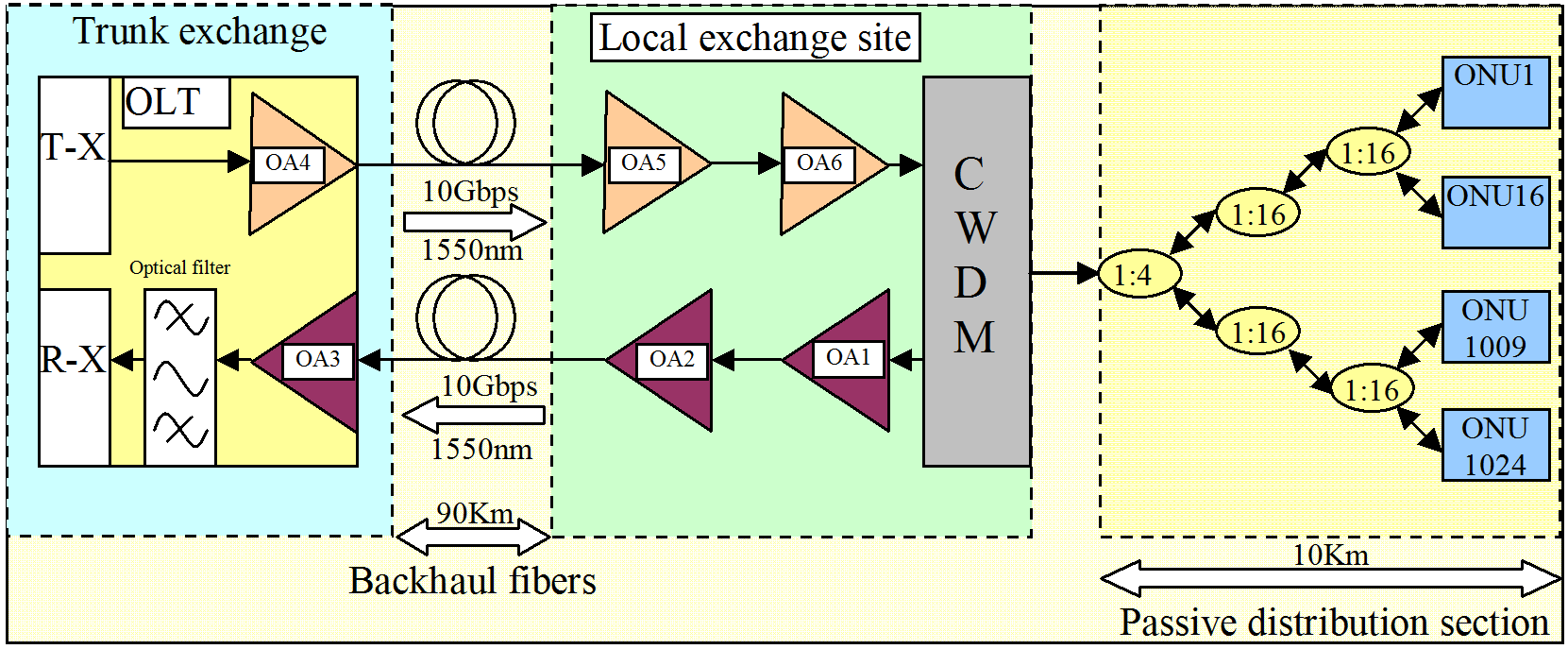 | Figure 3. The Long-reach PON architecture |
3.2. The TDM/CWDM-based LR-OANs
- In coarse wavelength division multiplexing (CWDM), a 20 nm is used as wavelength spacing, which allows simultaneous transmission over an optical fiber such that the number of transmitted wavelength is fewer than that specified in the dense wavelength division multiplexing (DWDM) but more than that specified in the standard wavelength division multiplexing (WDM). This relatively large spacing offers a more tolerance for wavelength drift, and thus allowing the use of the low-cost, uncooled lasers. A Hybrid TDM/CWDM-LR-OAN was proposed in[11]. The architecture shown in figure 4 enables a simultaneous transmission where four TDM-PONs were combined using CWDM grid to be sent over a 60-km of shared backhaul fiber. The architecture was able to support up to 128 user by incorporating a remote node unit RNU that contains two SOA-Raman hybrid amplifiers and two CWDM couplers followed by 4 (2x2) splitters and 2 (1x16) splitters as shown in figure 4. The main challenge in this configuration was the necessity to perform a wideband optical amplification due to the relatively large CWDM grid used. For example, a typical 4 channel CWDM system requires a 70 nm bandwidth. To this end, a SOA-Raman hybrid amplifier was used for signal amplification in both directions. The SOA-Raman hybrid amplifier that offers a wider bandwidth than the standalone SOA amplifier was proposed in[12][13].
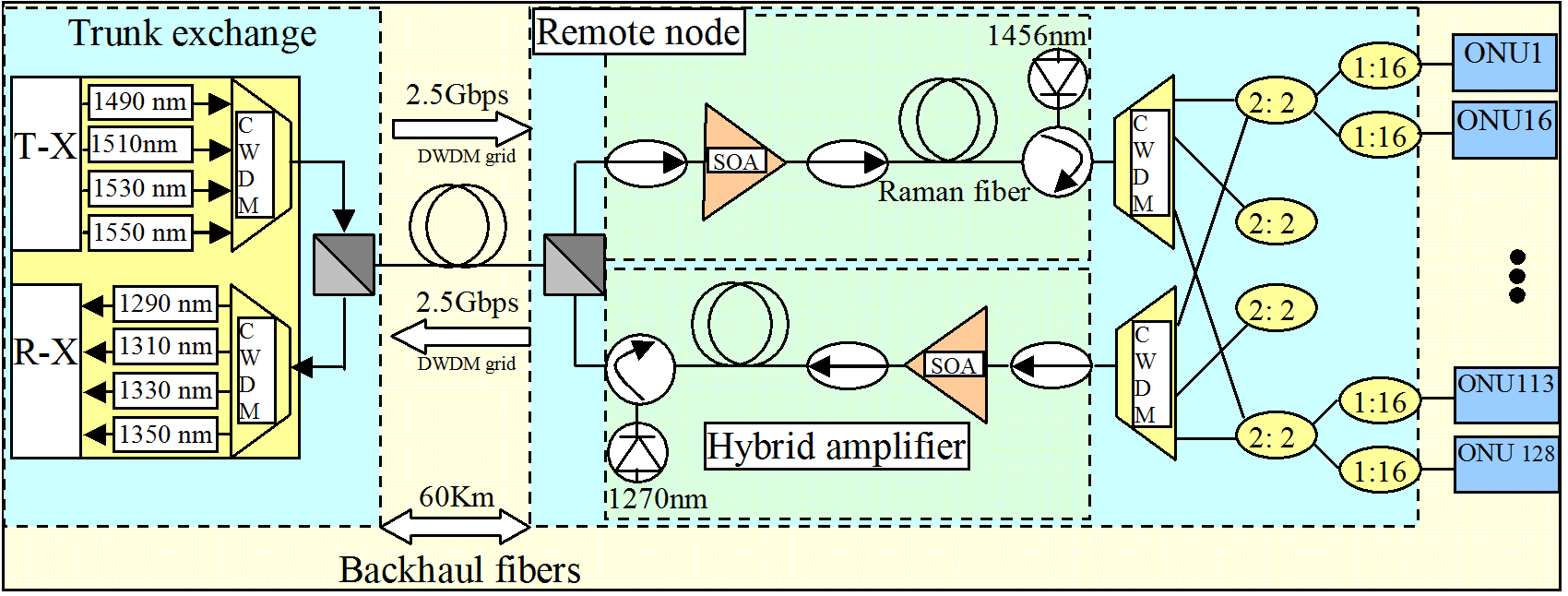 | Figure 4. TDM/CWDM-based LR-OAN architecture |
3.3. The TDM/DWDM-based LR-OANs
- To avoid the potential high cost associated with the use of fixed wavelength lasers in the ONU, the hybrid TDM/DWDM-LR-OAN proposed in[14] was based on the employment of a centralized optical carrier distribution and wavelength-independent remote modulation schemes. The transmitter was based on using an electro-absorption modulator (EAM) integrated with two semiconductor optical amplifiers SOAs. The centralized optical carrier received at the ONU input is amplified by the first SOA, modulated by the EAM modulator, amplified again by the second SOA, and then be transmitted over the fiber. The C-band was separated by 5 nm guard band, and allocated for both directions such that the wavelength range from 1529 nm to 1541.6 nm was allocated for the downstream traffic while the wavelength range from 1547.2 nm to 1560.1 nm was allocated for the upstream traffic. The architecture shown in figure 5 was able to combine 17 TDM-PONs, each of which has 10Gbps data rate using the DWDM grid (0.8 nm), and transmit their traffic over a 100 km. A dispersion compensating fiber (DCF) was incorporated at the core exchange to reduce the power penalty expected at the increased bit rate (10Gbps). The DCF fiber is shared by both the upstream and the downstream traffic before being separated using a circulator.
 | Figure 5. The centralized optical carrier TDM/DWDM-LR-OAN |
4. Opportunities and Challenges in LR-OANs
- Following is a summary of the common opportunities offered by the LR-OANs: The LR-OANs improve the cost-sharing and the efficiency in the access system by supporting large number of users over a common physical medium. Moreover, they offer a cost-effective solution in which the number of the central office sites is consolidated by combining both the access and the metro segments of the telecommunication network in one extended back-haul segment. In the LR-OANs, optical amplifiers are used instead of the conventional repeaters, which avoid performing complex and expensive processes, such as photon-to-electron conversion, retiming, reshaping, electrical amplification and electron-to-photon conversion. Additionally, unlike conventional repeaters, optical amplifiers are transparent to the bit rate changes and the data format used. While the LR-OANs offer the aforementioned opportunities, they introduce the following challenges: The long-reach optical access networks should be able to overcome the so called amplified spontaneous emission (ASE) noise introduced by the optical amplifiers. Additionally, they should be able to support the upstream burs-mode transmission. Moreover, they should be able to allow wideband optical amplification if coarse wavelength division multiplexing (CWDM) grid is used. A further challenge in the long-reach optical access networks is to decrease the propagation delay time. For example, a 100-km loop would lead to an increased the round trip time (RTT) from 0.2 msec in a 20-km loop to 1 msec, which would degrade the receiver sensitivity performance. Finally, because the LROA aims to support a large number of users over a common physical medium, further issues relevant to security improvement and reliability in the optical access systems, which might not have been addressed previously, would be of great importance.
5. Conclusions
- A review of the various potential candidate technologies for next-generation optical access was provided. One of these technologies is the long-reach optical access networks. A review of different stat-of-the-art long-reach optical access architectures including opportunities and challenges of each one was provided. We conclude that the long-reach optical access networks have attracted a significant deal of attention because of their cost-effective solution that reduces the overall cost by combining both the access and metro segments of the telecommunication network into one extended backhaul segment, which ensures that a significant number of end users can be connected directly to the core network without the need for conversion through intermediate switching stages.