Mohd Rihan1, Mukhtar Ahmad1, M. Salim Beg2
1Electrical Engineering Department, Aligarh Muslim University, Aligarh, 202002, India
2Electronics Engineering Department, Aligarh Muslim University, Aligarh, 202002, India
Correspondence to: Mohd Rihan, Electrical Engineering Department, Aligarh Muslim University, Aligarh, 202002, India.
| Email: |  |
Copyright © 2012 Scientific & Academic Publishing. All Rights Reserved.
Abstract
Phasor measurement units (PMUs) are being deployed by the utilities in their power networks throughout the world for better monitoring of dynamic operating conditions. Installation of a sufficient number of PMUs will convert the non- linear iterative state estimation problem into a linear non iterative state measurement problem. However the power networks are huge networks and this minimum number of PMUs may still be too high to be installed in one stage. Therefore the placement of PMUs has to be scheduled in multiple stages. Earlier work on multistage scheduling assumed an infinite channel capacity of PMUs available. However, in practice PMUs are manufactured with limited number of channels and it may happen that on a particular bus the number of branches connected is more than the channel capacity of PMUs. Under this condition some criterion should be devised to identify the branches to be monitored by the PMUs or the branches to be monitored in the initial stages of PMU installation. In the present work ‘Branch Vulnerability Index’ has been defined as the criterion to be used for this purpose. The algorithm has been applied on IEEE 14 bus system and a practical power network of the Indian grid.
Keywords:
PMU Placement, Phasing of PMUs, Smart Grid, Phasor Measurement
Cite this paper: Mohd Rihan, Mukhtar Ahmad, M. Salim Beg, Optimal Multistage Placement of PMUs with Limited Channel Capacity for a Smart Grid, Electrical and Electronic Engineering, Vol. 3 No. 5, 2013, pp. 133-138. doi: 10.5923/j.eee.20130305.03.
1. Introduction
Power grid is a highly interconnected and huge network experiencing continuous interaction of a large number of dynamic phenomena. Accurate and continuous monitoring of these phenomena is integral to the vision of a smart grid[1]. Phasor measurement units (PMUs) are being deployed by the utilities in their power networks throughout the world for this purpose[2]. PMUs provide measurement of voltage phasor and current phasor at a fast rate and these measurements are synchronized accurately by the GPS clock. Since PMU data can be reported at rates as high as 60 times a second, a truly dynamic estimate would be available. Such an arrangement will make the grid more aware of its operating state. Moreover, installation of sufficient number of PMUs will convert the non-linear iterative state estimation problem into a linear non-iterative state measurement problem[3]. Therefore utilities are working on implementing a PMU based unified real-time dynamic state measurement system[4].Despite the above mentioned advantages associated with deployment of PMUs in the power grid, it may not be feasible to install a PMU at every bus of the system. High cost of PMU as well as technical and economic requirements of the associated communication circuitry limits their installation. However it is still possible to derive the benefits of PMU installation if some of the buses are monitored directly by installation of PMU and some are monitored indirectly, by the PMUs installed on connected buses. Determining a minimum number of PMUs to make the system observable is often referred to as Optimal PMU Placement (OPP) problem.The OPP problem is a well researched problem. A number of algorithms/methods have been reported in literature for placement of a minimum number of PMUs to make the system observable. An extensive review of PMU placement methodologies is reported in[5]. The solution of OPP problem provides the minimum number of PMUs required to make the system observable. Power grids are huge networks and even the minimum number of PMUs may still be too high to be installed in one stage. Moreover, if the PMU placement scheme has to be made robust against failure of a PMU or outage of a branch, the number of PMUs required will further increase. It may not be feasible for a utility to install the large number of required PMUs in a single stage. The scheduling of PMU placement in multiple stages is known as optimal multistage placement or multistage phasing of PMUs. A practical multistage scheduling scheme should satisfy the following two conditions: i) Maximum benefits of PMU installation should be derived at each stageii) The total number of PMUs installed at the end of last stage should not exceed the optimal number of PMUs required for observability. To the best of the authors’ knowledge, the problem of optimal multistage placement of PMUs was first addressed in[6]. The concept of depth of observability was introduced to propose an optimal PMU phasing scheme such as to allow for a maximum utilization of data through a staged deployment of a monitoring system for full observability. The proposed method resulted in more number of PMUs in phasing compared to one stage placement. Another approach for multistage scheduling was presented in[7]. The authors formulated the multistage scheduling as a linear problem and utilized integer linear programming to maximize the number of observed buses at each stage. The PMU scheduling schemes were designed in such a way that at each stage maximum number of buses are observable. The algorithm presented has a bias towards buses connected to more lines. Since buses connected with more lines are likely to cover more buses, they tend to have higher priority in the initial stages. If all such buses in a system are close to each other then the installation of PMUs in the initial stages may be concentrated to some pockets of the system and buses away from it will not benefit at all.Another approach for multistage placement of PMUs was presented in[8]. The authors developed a multi-criteria decision making approach for placement of PMUs in stages. In addition to observability of maximum number of buses at each stage, two other criteria; voltage control area observability and tie line observability were proposed. Another method for multistage PMU placement based on bus importance was proposed in[9]. The authors assumed PMUs on all the buses initially. Then the PMUs from less important buses were eliminated in two stages. Priority bus locations were determined and the PMUs were retained on all such buses in the third stage. The multistage PMU scheduling has also been addressed using probabilistic analysis in[10]. Here the staging of PMUs was done by incorporating probabilistic indices in the algorithm. The objective was to maximize the average probability of observability at each stage.All the above mentioned methods of multistage PMU placement are based on the unrealistic assumption of infinite channel capacity of the PMUs available. This means that a PMU can measure current through all branches incident on the bus in addition to voltage of the bus at which it is installed. However in practice the PMUs are manufactured with a limited channel capacity. In fact recently some of the researchers have addressed the availability of limited channel capacity PMUs. An important outcome of these studies is that it is not economical to install PMUs having more than 3 or 4 channels[11, 12].When PMUs with limited number of channels are to be installed in the power network, it may happen that the bus at which a PMU has to be installed has more number of lines connected to it than the number of PMU channels available. Under this condition a decision has to be made for selection of the branches to be monitored by the installed PMU. Therefore some criterion should be devised for selecting these branches. Moreover, if the required number of PMUs cannot be installed in one stage due to financial or technical constraints then the branches should be ranked according to their importance based on some criterion.The present work addresses the multistage PMU placement problem when the PMUs available have limited channel capacity. To keep this investigation general, it is assumed that the PMU available can monitor only one voltage phasor and one current phasor. Some of the large utilities in the world have deployed these two phasor PMUs in their power networks[13]. Therefore when installing these PMUs in the power network, at every bus one branch has to be identified that would be monitored by the installed PMU. The authors propose the use of ‘Branch Vulnerability Index’ as the criterion for selecting that branch. Section 2 of the paper describes the algorithm used for determining the minimum number of PMUs to be installed for the IEEE 14 bus system. Then section 3 discusses the ranking of branches based on BVI for multistage placement of these PMUS. A case study on a practical power network in the Indian power grid is presented in section 4. The conclusions drawn are presented in the last section of the paper.
2. Optimal Placement of PMUs
A power system is said to be completely observable if the system state can be determined with the help of available measurements and the network structure. In conventional power grid the power system observability is examined by formulating a measurement Jacobian matrix. If the Jacobian has a full rank then the system is observable. The techniques applying this approach are called numerical techniques. The other approach is based on graph theory according to which a power network is observable if a full spanning tree may be determined for the network graph. Topological methods are more suitable for large systems. The solution of OPP by topological methods was first addressed in[14] and the following general rules were proposed for optimal placement of PMUs:i. One voltage phasor measurement is assigned to a bus where a PMU has been installed.ii. A current phasor measurement is assigned to each of the branches incident on a PMU installed bus.iii. A current measurement is assigned to a branch connecting two observed buses. This measurement will be called pseudo-measurement.iv. If all the branches connected to an observed bus are observed except one, then a pseudo-current measurement will be assigned to this branch based on KCL.v. Rule number (iv) is applicable to a bus even if no PMU is installed on the bus but it is a zero injection bus.Binary Integer Linear Programming (BILP) is the most commonly used tool for solving an OPP problem. Therefore the same technique has been utilized in the present work.Consider the IEEE 14 bus system shown in fig.1. The objective is to find an optimal location set for two phasor PMUs which makes the system observable. Since the installed PMU will be associated with a branch, the branches in the IEEE 14 bus system have been numbered arbitrarily.The optimal PMU placement problem for a power network having m branches can be defined as[13]: | (1) |
where is the number of branches in the system
 is the cost of installation of a PMU for monitoring branch j
 is a vector of dimension m and has binary values defined as:
 | (2) |
subjected to the following constraints: | (3) |
 | (4) |
 | (5) |
 | (6) |
 | (7) |
 | (8) |
 | (9) |
 | (10) |
 | (11) |
 | (12) |
 | (13) |
 | (14) |
 | (15) |
 | (16) |
The constraint equations 3-16 will ensure that the system is observable. These constraints may also be expressed as | (17) |
A is called the bus to branch connectivity matrix defined as; | (18) |
b is a vector having all its elements equal to 1.Solving the optimal placement problem using BILP, the branches to be monitored for an optimal number of PMUs for the IEEE 14 bus system are given in table 1.Table 1. Branches to be Monitored for Observability of IEEE 14 Bus System
 |
| |
|
Here it may be noted that the number of PMUs required for complete observability of the system may reduce in the presence of conventional measurements and zero injection buses. However, since in the present work the main objective is to devise a criterion for multistage PMU placement, these measurements and zero injection buses have not been considered.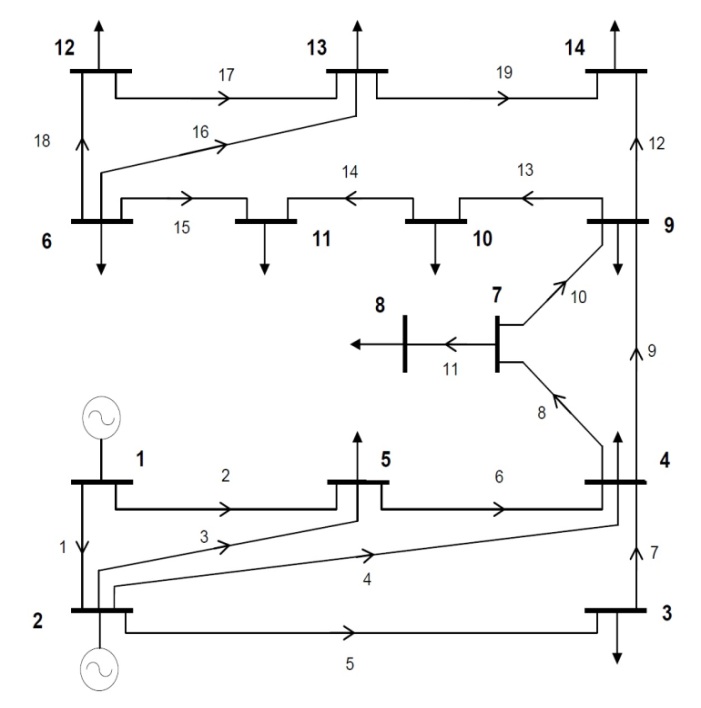 | Figure 1. IEEE 14 Bus System |
3. Multistage Placement of PMUs
The algorithm presented in the previous section provides the minimum number of PMUs to be installed to ensure complete observability of the system. However if due to some constraints all the 7 PMUs required cannot be installed in a single stage, the PMU placement shall be carried out over multiple stages. The multistage placement scheme should be devised in such a way that the benefit derived at intermediate stages is maximized and the total number of PMUs at the end of the last stage should be equal to the minimum number of PMUs determined for observability.Now in order to install these seven PMUs in multiple stages some criterion should be devised. In the present work ‘Branch Vulnerability Index (BVI)’ is proposed as the criterion for multistage phasing of branch PMUs.When there is an increase in the load on a power system, some transmission lines may have to bear higher loads which may exceed their maximum limit. Branch vulnerability is an indicator of severity of load on a particular branch. If this index is high for some branches, these branches are more sensitive to a disturbance. A higher value of BVI implies that these branches should be monitored on priority basis in order to keep a watch on the system dynamics and to ward off the possibility of disturbance cascading into a blackout.The branch vulnerability analysis can be carried out both off-line and on-line. In the off-line analysis the load flow data of the system is utilized. The on-line analysis, on the other hand, is performed on the results of state estimation to find out the sensitivity of network branches. An expression for off-line branch vulnerability may be written as[15]: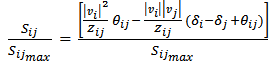 where
where is the power flow on the branch i-j
 is the maximum flow suffered by the branch i-j
 is the phase angle of
 is the admittance of i-j
 is the voltage phasor on bus i
 is the voltage phasor on bus j
 is the impedance of branch i-j
 is the angle of voltage at bus i
 is the angle of voltage at bus jThe seven candidate branches of the IEEE 14 bus system to be monitored by the PMUs are listed in table 2 in decreasing order of BVI. For multistage placement of PMUs, the branches having higher BVI may be identified for PMU placement in the initial stages.
Table 2. Ranking of Candidate Branches for PMU Placement for IEEE 14 Bus System
 |
| |
|
It is assumed that the 7 PMUs have to be installed in three phases and the phasing scheme is 3-2-2. Then based on BVI, in the first phase the PMUs should be installed to monitor branches (2, 18, and 5), while in the second and third stage the PMUs shall monitor branches (9, 14) and (19, 11) respectively.
4. Case Study in the Indian Grid
In order to show the utility of the proposed multistage PMU placement scheme for a larger practical system, a case study has been performed on a 75 bus network in the Northern region of Indian power grid[15]. The northern grid is the largest power network among five regional grids of India. The considered network consists of 75 buses and 97 branches as shown in fig. 2. The branches to be monitored by an optimal number of PMUs for complete system observability were first determined using the algorithm presented in section 2 and the results are tabulated in table 3.Table 3. Branches to be Monitored by PMUs for 75 Bus System of Indian Grid
 |
| |
|
In order to develop a multistage phasing scheme for these 34 PMUs, the candidate branches were ranked based on BVI as given in table 4.It is assumed that the required 34 PMUs have to be placed in 3 stages of 12-12-10. The branches to be monitored by PMUs may be prioritized using their ranking based on BVI. Accordingly the 12 branches which should be monitored in first stage are listed in table V.Table 4. Ranking of Candidate Branches to be Monitored by PMUs for 75 Bus System
 |
| |
|
Table 5. Selected Branches of 75 Bus System for Monitoring in First Stage
 |
| |
|
Similarly the branches may be selected for second and third stages respectively as given in tables 6 and 7.Table 6. Selected Branches of 75 Bus System for Monitoring in Second Stage
 |
| |
|
Table 7. Selected Branches of 75 Bus System for Monitoring in Third Stage
 |
| |
|
In this way the installation of a minimum number of PMUs may be carried out in three stages. The methodology is generic and it may be divided into more number of stages also. At every stage the branches with a high vulnerability index were chosen to be monitored by the PMUs to improve dynamic monitoring of the system. The total number of PMUs installed at the end of the last stage is equal to the minimum number required for observability and hence at the end of last stage the system will be completely observable facilitating PMU based real time dynamic state measurement system.
5. Conclusions
In order to make the power grid more aware of its operating state, a unified real time dynamic measurement system has to be implemented by installing a large number of PMUs in the power grid. However due to financial and economical constraints, it may not be feasible to install all the PMUs in one stage. This paper has presented an optimal scheme for multistage phasing of PMUs in the power grid. The earlier work on phasing of PMUs considered an infinite number of channels in the available PMUs. However in practice the PMUs commercially manufactured have a limited number of channels. This factor has been taken into consideration to present a practical and realistic solution for optimal phasing of PMUs in the grid. An optimal placement was first derived for complete system observability using binary integer linear programming. Then the multistage phasing of PMUs was proposed by prioritizing the selected branches on the basis of branch vulnerability index. The algorithm was applied on IEEE 14 bus system and a part of the Indian grid and the optimal locations for placement of PMUs have been determined. The present approach resulted in a more uniform distribution of PMUs as compared to the earlier reported multistage placement schemes. Future work will utilize the on-line branch vulnerability analysis to determine ranking of the branches.
APPENDIX
Nomenclature
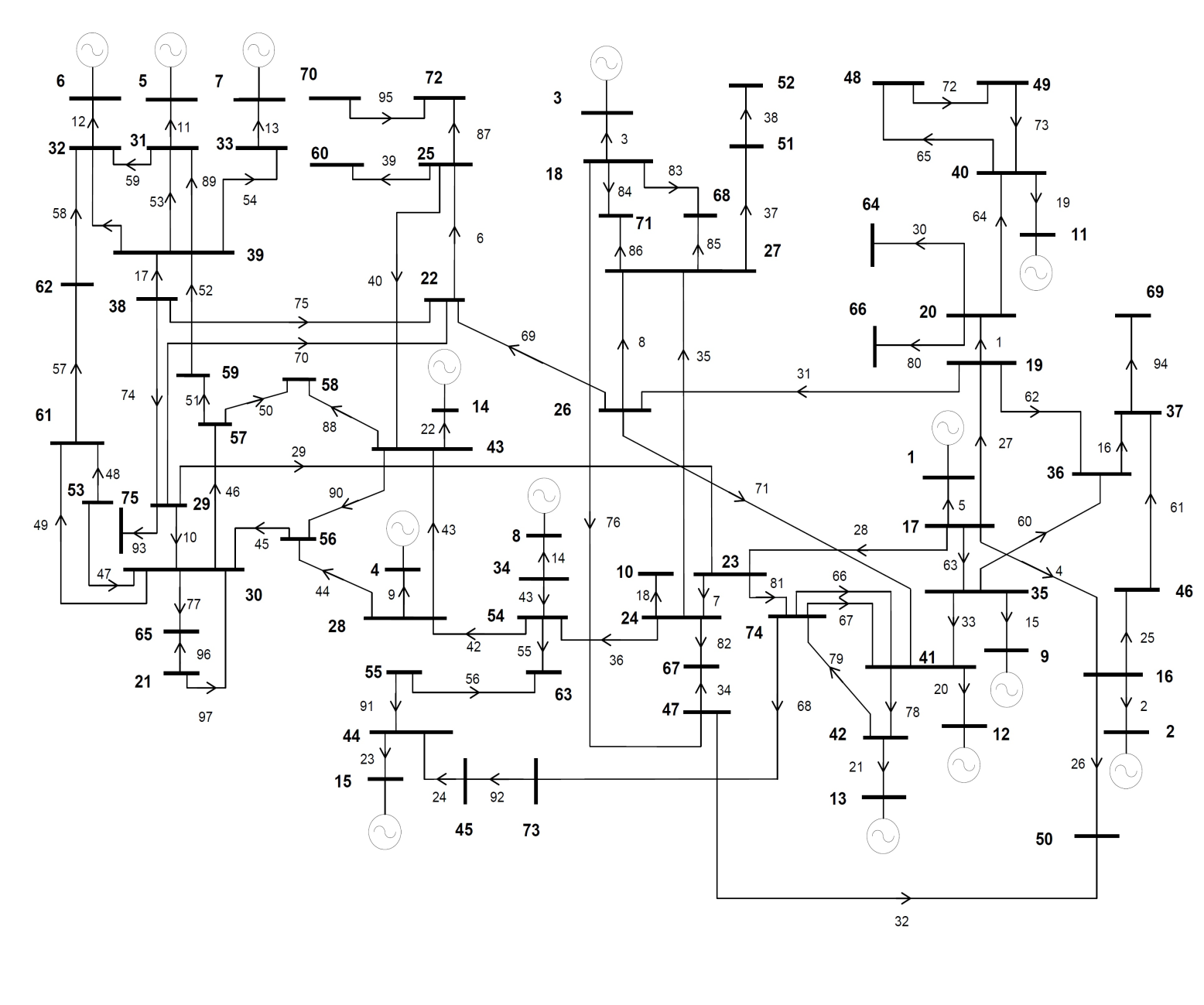 | Figure 2. 75 Bus System of North Indian Grid |
References
| [1] | L. Peretto, “The role of measurements in the smart grid era” IEEE Trans Instrumentation and Meas., vol. 13, pp. 22-25. Sep. 2010 |
| [2] | A. Bose, “Smart transmission grid applications and their supporting infrastructure”, IEEE Trans. Smart Grid, vol. 1, pp. 11-19, Mar. 2010. |
| [3] | J. D. L. Ree, V. Centeno, J. S. Thorp and A. G. Phadke, “Synchronized phasor measurement applications in power systems” IEEE Trans. Smart Grid, vol. 1, pp. 20-26, Mar. 2010 |
| [4] | PGCIL report on “Unified Real Time Dynamic State Measurement (URTDM)”[Online]Available:www.cea.nic.in/reports/powersystems/sppa/scm/allindia/.../1st.pd |
| [5] | M. N. Manousakis, G. N. Korres and Pavlos S. Georgilakis, “Taxonomy of PMU placement methodologies”, IEEE Trans. Power Syst., vol. 27, pp. 1070-1077, May 2012. |
| [6] | R. F. Nuqui and A. G. Phadke, “Phasor measurement unit placement techniques for complete and incomplete observability, IEEE Trans. Power Del., vol. 20, pp. 2381-2388, Oct. 2005. |
| [7] | D. Dua, S. Dambhare, R. K. Gajbhiye and S. A. Soman, “Optimal multistage scheduling of PMU placement: An ILP approach”, IEEE Trans. Power Del., vol. 23, pp. 1812-1820, October 2008. |
| [8] | R. Sodhi, S. C. Srivastva and S. N. Singh, “Multi-criterion decision making approach for multi-stage optimal placement of phasor measurement units” IET Gen Trans Dist., vol. 5, pp. 181-190, Feb. 2011. |
| [9] | B. K. R. Saha, A. K. Sinha and A. K. Pradhan, “An optimal PMU placement technique for power system observability” Electrical Power and Energy syst., vol. 42 pp. 71-77, 2012. |
| [10] | F. Aminifar, M. Fotuhi-Firuzabad, M. Shahidehpour and A. Khodaei, “Probabilistic multistage PMU placement in electric power system”, IEEE Trans Power Del., vol. 26, pp. 841-849, Jun. 2011. |
| [11] | M. Korkali and A. Abur, “Placement of PMUs with channel limits” Proc. Power and Energy Society General Meeting, Boston, USA, 26-30 Jul. 2009, pp. 1-4. |
| [12] | Z. Milijanic, I. Djurovic and I. Vujosevic, “Multiple channel PMU placement considering communication constraints”, Int J Energy Syst. 2012[Online]. |
| [13] | R. Emami and A. Abur, “Robust measurement design by placing synchronized phasor measurements on the network branches” IEEE Transactions on Power Systems vol. 25, pp. 38-43, Mar. 2010. |
| [14] | T. L. Baldwin, “Power system observability with minimal phasor measurement placement”, IEEE Transactions on Power Systems, vol. 8, pp. 707-715, Jun. 1993. |
| [15] | Zheng Zhao, “Sensitivity constrained PMU placement utilizing multiple methods” M. Sc. Thesis Graduate School, Clemson University,Available:etd.lib.clemson.edu/documents/.../Zhao_clemson_0050M_10617.pdf. |
| [16] | D. K. Chaturvedi, Soft computing techniques and its applications in electrical engineering. Berlin Heidelberg: Springer-Verlag, 2008, app. G. |

 Abstract
 Reference
 Full-Text PDF
 Full-text HTML