-
Paper Information
- Paper Submission
-
Journal Information
- About This Journal
- Editorial Board
- Current Issue
- Archive
- Author Guidelines
- Contact Us
Education
p-ISSN: 2162-9463 e-ISSN: 2162-8467
2026; 16(1): 13-16
doi:10.5923/j.edu.20261601.03
Received: Sep. 17; Accepted: Oct. 3, 2026; Published: Oct. 9, 2026

Self-Study of a Fluid Mechanics Course
 Abstract
 Reference
 Full-Text PDF
 Full-text HTML
Shuxin Huang
Unaffiliated, Shanghai, 200240, China
Correspondence to: Shuxin Huang, Unaffiliated, Shanghai, 200240, China.
| Email: |  |
Copyright © 2026 The Author(s). Published by Scientific & Academic Publishing.
This work is licensed under the Creative Commons Attribution International License (CC BY).
http://creativecommons.org/licenses/by/4.0/

This paper investigates the effects of a student studying an engineering fluid mechanics course independently without the help of teaching. A student with an interest in fluid mechanics and a detailed outline of the fluid mechanics course spent twelve weeks studying the course independently and then took part in an exam without a textbook in the 14th weeks. The student achieved a score of 51, which is far lower than the average score of 71 obtained by students who were actively taught. One reason for this significantly lower score is that the student did not master the knowledge covered in the homework assignments.
Keywords: Self-study, Fluid mechanics, Undergraduate, Exam, Homework
Cite this paper: Shuxin Huang, Self-Study of a Fluid Mechanics Course, Education, Vol. 16 No. 1, 2026, pp. 13-16. doi: 10.5923/j.edu.20261601.03.
Article Outline
1. Introduction
- The author of the paper has conducted some research on the teaching of a fluid mechanics course over the last 10 years, e.g., the gradually varying flow between gradually contracting plates [1,2], the Stokes second problem and its inverse [3-5], the difference between artificial and commercial pipes in the transition zone [6], the differential momentum equation and its extended Navier–Stokes (NS) equation [7,8], and Moody chart errors [9]. The works can help improve the teaching of such a course. For example, the author could tell students that the error of the loss factor read from the Moody chart is usually less than 3% [9], which can enhance the confidence of students in using the chart in their homework. The Participation in Research Program (PRP) is a project for promoting the study of undergraduate students at Shanghai Jiao Tong University. Most research is carried out half of a year. The author of the paper has included five groups of students in the PRP with an assessment based on the construction of an Access database and a C++ program for the study of fluid mechanics. In a PRP session, which began in June, 2023, a student showed interest in both studying fluid mechanics and making a database. Thus, the question of how to study the fluid mechanics course arose because the course started in the spring term and ended in June. Previous participants usually selected a simple or familiar chapter to study and then made a database, but the student wanted to study all of the contents of the course. The student was the first to attempt self-study of the course in 17 years of teaching by the author of the paper.The aim of the work is to examine the study of the fluid mechanics course without teaching, an unplanned exploratory study. Teaching approaches have diversified recently in the fluid physics community and others, e.g., through the deduction of analytical solutions for the Phan-Thien-Tanner fluid model [10], the use of a five-step teaching method for fluid mechanics classes [11], the application of problem-based learning (PBL) in the teaching of diseases encoding [12], the inclusion of real-world problems in teaching [13], and the inquiry-based activities in astronomy teaching [14]. These changes further validate the usefulness of this trial. The study result is not good, but the study experience in the present work is actually meaningful for many individuals who want to learn the knowledge of fluid mechanics or other subjects by self-study.
2. Participants
- The author of the work was a fluid mechanics teacher with 17 years teaching experiences, whose role is an instructor in the self-study process.The student in the activity was a freshman in the university, who almost finished the calculus course, but did not study the theoretical mechanics course. Both, especially calculus, are the basis of fluid mechanics. The student had no knowledge of fluid mechanics, but aimed to master much fluid mechanics knowledge in the self-study.
3. Methods
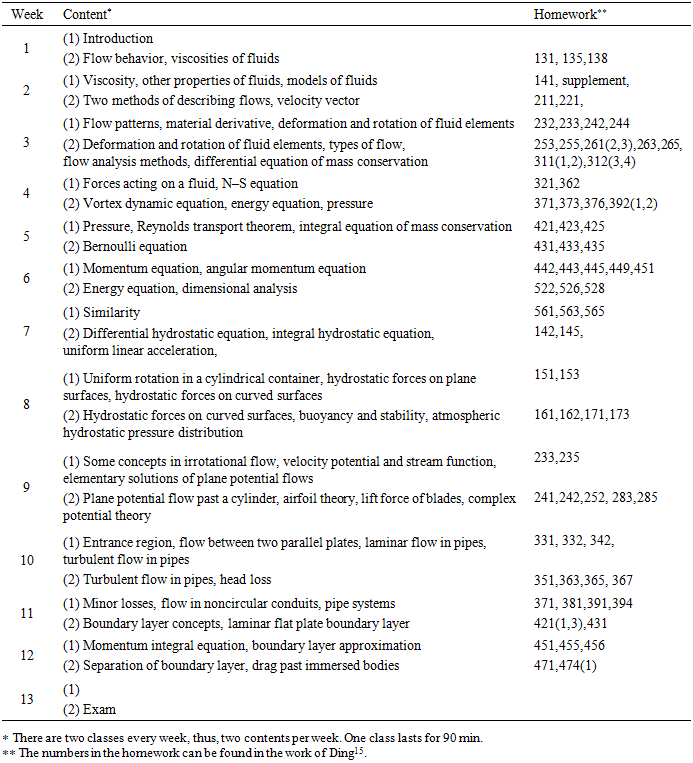
- In practice, traditional teaching in a classroom is the general method of studying fluid mechanics. However, in this case, the full teaching plan of the engineering fluid mechanics course was given to the student, who could follow it when studying. The teaching plan can be found in the supplemental material. Ding’s textbooks [15] were employed in the study. Moreover, the student was permitted to freely email questions to the author. Twelve weeks are needed for the course, and the student had just twelve weeks from June 19 to September 10 to study. This period was mainly in the summer holidays. At the beginning of the autumn term, i.e., in the thirteenth week of the study, an exam without a textbook would be conducted to examine the effect of the study. The student was allowed to take a pen, calculator, and identification card into the exam as those in a formal exam. When the course is formally taught, there are two exams, a midterm and a final exam. The student was asked to choose one of these, and in the twelfth week, the student selected the final exam in 2023.An unexpected obstacle occurred when the student forgot the exam time and the exam was postponed to the fourteenth week. The exam was therefore held on September 23.
4. Results
- The student achieved a score of 51, which is far less than the average score of 71 of the final exam in 2023 obtained by students who took part in the teaching of the course.The student explained that theoretical mechanics was not studied before studying the course. The student was a freshman when studying the course, and so had indeed not covered theoretical mechanics previously. Theoretical mechanics provides a foundation for the fluid mechanics course, which could influence the studying process and the student’s result. There indeed was a question of 5 points related to the moment balance equation of theoretical mechanics in the exam, and the student obtained 2 points because of knowing the equation.The second reason is that the student knew there would be an exam in the thirteenth week at the beginning of the study process, but did not know that textbooks would not be permitted in the exam until the twelfth week. The use of a textbook would reduce the amount of knowledge the student had to remember. However, textbooks have never been allowed in the exam since the author started teaching the course about 17 years ago.The third reason for the low score was that the student did not master the homework-related knowledge. This is likely the critical factor in the low grade achieved by the student. As an example, there were 20 points for the boundary layer problem in the exam, and the student only obtained eight, which means that the student did not remember either the equations or the solution method for this problem. This problem was taken from the homework, with the only difference being in the numerical values of the problem. The original homework used a 1/6 power law for the velocity profile, and the exam used a 1/5 power law. The slight difference between the two powers does not change the turbulent essential on the plate, but the latter provides a new chance for exercise. Therefore, failure to complete the homework seems like a likely reason for the loss of points in the exam.The final reason for the low score could be the motivation of the student. Naturally, a student will spend a great deal of time studying a taught course, because a good result is needed to pass. However, in this case, the student did not need a high score, so the result was lower than average, although the student was interested in the course.The aim of the fluid mechanics course is for undergraduate students to master the basic concepts, theories, calculation methods, and experimental techniques of fluid mechanics [16]. The result indicates that the student did not master this basic theory.
5. Conclusions
- In this work, an examination of the self-study of a fluid mechanics course has demonstrated the importance of fully mastering homework-related knowledge, and that motivation is not the only factor affecting the study result. Several other reasons for the failure of the self-study process have also been given. The work provides some helpful results regarding the self-study of fluid mechanics.Self-study is a common learning process usually for an adult with both the capability of studying some knowledge and the special need. The difference between the present self-study and the common one is that the present has a detailed teaching plan and an instructor providing reliable knowledge to questions besides textbook usually for the common. Therefore, the self-study here includes certain teaching intervention.
Data Availability
- Source data are provided with this paper.
ACKNOWLEDGEMENTS
- SH acknowledges support from the Participation in Research Program (PRP) at Shanghai Jiao Tong University (grant no. T010PRP44049) and an English grammar service from both Beijing Increscence Technology (BIT) Company Limited and the Chinese Society of Theoretical and Applied Mechanics (CSTAM).
Competing Interests
- The authors declare no competing interests.
Supplemental Material
|