
-
Paper Information
- Paper Submission
-
Journal Information
- About This Journal
- Editorial Board
- Current Issue
- Archive
- Author Guidelines
- Contact Us
Education
p-ISSN: 2162-9463 e-ISSN: 2162-8467
2026; 16(1): 7-12
doi:10.5923/j.edu.20261601.02
Received: Jan. 30, 2026; Accepted: Feb. 23, 2026; Published: Mar. 4, 2026

Gender Disparity in Bangladesh’s NCTB (National Curriculum and Textbook Board) Textbooks: Female Authors and Characters from Classes 6 to 10
 Abstract
 Reference
 Full-Text PDF
 Full-text HTML
1Professor, Institute of Education & Research, University of Chittagong, Chittagong, Bangladesh
2Associate Professor, Institute of Education & Research, University of Chittagong, Chittagong, Bangladesh
Correspondence to: Uditi Das, Professor, Institute of Education & Research, University of Chittagong, Chittagong, Bangladesh.
| Email: |  |
Copyright © 2026 The Author(s). Published by Scientific & Academic Publishing.
This work is licensed under the Creative Commons Attribution International License (CC BY).
http://creativecommons.org/licenses/by/4.0/

The following study investigates the representation of gender in the National Curriculum and Textbook Board’s (NCTB) Bengali Literature textbooks named “Anandapath” for classes 6 to 10 in Bangladesh. Via the usage of qualitative analysis as informed by feminist literary criticism, all the poems and proses have been analyzed in the scope to assess gender of author, importance of female characters, and the narrative significance assigned to them. These findings have shown us strong evidence of the dominance of male authors across all grades alongside a consistent marginalization of female characters. Who are frequently displayed in rather peripheral, symbolic or passive roles. Instead of being a narrative driving force, these findings also align with previous studies regarding textbooks in Bangladesh as well as South Asia which have identified a persistent stereotyping of gender despite improvements in female enrolments and policy commitments towards gender equality [4] [11]. By focusing exclusively on the Secondary level Bengali literary texts, this study will extend all current research regarding this topic beyond single grades and nonliterary subjects. The results clearly showcase the visible gap between the policy objectives of the curriculum and contents of textbooks, undermining the need for gender responsive literary selection, requiring the integration of critical literacy approaches towards secondary education.
Keywords: NCTB Anandapath, Gender representation, Feminist criticism, Textbook bias, Female marginalization
Cite this paper: Uditi Das, Nasima Perveen, Gender Disparity in Bangladesh’s NCTB (National Curriculum and Textbook Board) Textbooks: Female Authors and Characters from Classes 6 to 10, Education, Vol. 16 No. 1, 2026, pp. 7-12. doi: 10.5923/j.edu.20261601.02.
Article Outline
1. Introduction
- Representation of gender in school textbooks is a key component in the shaping of students’ understanding of social roles, authority and identity. Textbooks in Bangladesh are approved by the National Curriculum and Textbook Board (NCTB) which are used across the nation. Therefore, they function not only as a mere educational tool but also hold great importance in influential cultural texts. Whereas national and international framework policy have prioritized importance of gender equality in education. Yet the concerns remain on the topic of the extent to how much these textbooks influence such objectives in practiceBy the recent few decades Bangladesh has progressively developed in the path towards reducing gender inequalities in school enrolment, both in primary and secondary schools. Curriculum frameworks and other such policy documents have also highlighted inclusivity, gender awareness and equity as fundamental educational objectives [5] [11]. Although current research suggests that numerical parity in terms of enrollment does not really translate that the curricular content is gender balanced. And in fact, studies across South Asia have continuously discovered that textbook content frequently tends to heighten male roles and perspectives, while keeping the women in limited and stereotypical roles [4]. This biased representation carries the risk of reinforcing traditional gender norms, whilst education systems formally endorse gender equality.In Bangladesh, several research on gender bias based on textbooks have been carried out mainly on English language textbooks, social studies or primary level content. And throughout these studies a consistent pattern has shown us findings that describe a high underrepresentation of female authors as well as a frequent tendency in limiting women to passive and domestic roles [4] [2]. In contrast very little attention has been given to the secondary level Bengali Literature Textbooks. Especially across multiple grades. Literary texts hold a central position in Bengali curriculum which are presented as expositions of moral and cultural values. Which is why authors carry a significant responsibility in upholding gender equality in the propagation of Bengali literature education through the way prose texts and poems represent women and the way to which female voices are included as authors.This study aims to address the gap which is investigated by analyzing the gender representation in NCTB prescribed “Anandapath” textbooks from classes 6 to 10. By the guidance of the feminist literary criticism, this study focuses on both the numerical presence of women but also the narrative importance and agendas assigned to female characters. The following questions provide as the structure to the analysis:1. What are distributions of male and female authors throughout the Anandapath textbooks from class 6 to 10?2. How frequently and prominently are female characters presented throughout the poems and prose texts in Anandapath textbooks from class 6 to 10?3. What are the types of narrative roles that are assigned to female characters and what degree of significance do they hold in the mentioned Anandapath textbooks from class 6 to 10?4. Do these representations correspond with the NCTB’s stated goals on gender equality and awareness?
2. Literature Review
- In formal schooling textbooks are considered foundational to the socialization process, this in addition with growing bodies of research have further provided proof where curricular materials have more than often reproduced gendered norms even though there were improvements in enrolment parity. Across South Asian documents, comparative content analyses have shown a persistent pro male bias in the educational textbooks; Islam and Asadullah’s multinational study has also examined that. Malaysia and Indonesia however show a relative numerical balance, however that is not the case with Bangladesh and Pakistan as they still underrepresent female characters and give female domestic roles or passive roles [4].Nationally focused research papers also tell the same story and reinforce the same pattern. Notably the qualitative investigation of Haq & Alam’s into Bangladeshi textbooks which feature a meagre presence of female visibility in textbook contents, alongside stereotyped language and insignificant participation in authorship or editorial roles by females, are the findings which identify and echo these problems in cross national work [3]. Quite similarly a study by BRAC institute has provided findings that Bengali textbooks even at the primary level present girls and boys in the traditional gender roles [2]. This study finds that even after more girls are enrolled in a school the textbooks and examples do not really reflect such a change. This also gives the opportunity for a practical coding method for identifying gender roles and occupations, adapted for poems and prose.Recent thesis reports and local studies have further extended this line of research by examining newer classroom textbooks. For example, Rimpu’s 2024 MA thesis [10] on English textbooks in Bangladesh presents that male and female characters in equal numbers, however they do not get showcased equally. In comparison to male characters, female characters are limited to specific occupations. This is essential since it shows that counting characters alone isn’t justifiable enough. And it supports the main theme of the study where the focus is not on only counting characters but to examine whether female characters are included and if they function narratively in the story as an active role and whether they are directed by an agenda, make important decisions and play central roles in the plot.On the contrary policy documents present a normative counterpoint where National Curriculum Framework [5] [11] as well as recent UNFPA reviews assert gender responsive education as an exclusive curriculum objective, together with inclusive information and integration of life skills, However external evaluations of policy implementation including World Bank and UN reports [12] direct towards a persistent gap between the mismatch of the policy rhetoric and on the ground textbook representations. A gap that requires critical, empirical investigation on disciplines such as Bengali.The study presented is guided by feminist literary criticism and critical literacy, taking significant ideas from gyno criticism and representation alongside narrative agency that help give a solid to the main evaluation categories that are used in the study: visibility, voice and agency. These categories have been used to examine the female characters whether they are poorly developed, limited to passive or domestic roles. Furthermore, feminist pedagogy and education research theses support this approach via the viewing of textbooks as spaces where social ideas are made as well as meaningful education can be shown.These sources summed up together reinforce the need for a multi grade analysis of Anandapath book series. Earlier studies also identify the problem of a male bias in textbooks. Policy documents on the other hand have set expectations for gender sensitive curricula. In previous content analysis, methodological work presents coding strategies that are useful in the pursuit of combining counts of authors and characters with qualitative analysis of their roles. Building on this work, the current study helps in applying these methods to Bengali poems and prose texts from Classes 6 to 10, combined. Addressing a documented gap in the subject specific, multi grade analysis.
3. Methodology
- The following study utilizes qualitative content analysis anchored by quantitative description to examine the gender representation in National Curriculum and Textbook Board (NCTB) Bengali literature textbooks. Content analysis is widely established as an appropriate method for the assessment of the representation patterns in textbooks and curricular materials, since it allows the systematic identification of authorship trends, character visibility and assignment of narrative role across a defined corpus [4] [3]. This approach is furthermore supported by prior Bangladesh focused textbook studies that make use of frequency counts with qualitative role interpretation with the aim of assessing gender bias [2].This corpus consists of NCTB prescribed Bengali literature textbooks “Anandapath” for Classes 6, 7, 8, and the combined Class 9 to 10 volume. NCTB prescribed books are used across Bangladesh which provide a thorough foundation for a strong curriculum level analysis [5]. The study also includes all the literary units which are categorized as poems, prose narratives and stories. Excluding the literary materials such as exercises, grammar sections, and glossaries. Here each poem or prose text selection is treated as a single unit of analysis. Where both the text narratives and illustrations that contain human figures are examined.The study’s analytical framework exclusively draws on the feminist literary criticism in addition to the prior comparative textbook research. On a broad scale, textbook studies point out that gender representation should be investigated not only through mere numerical presence but also through the significance and quality of narrative roles and the agendas that are assigned to female figures [4]. Feminist educational theory likewise emphasizes the presence of visibility, voice, and most importantly narrative agency as core criteria for representation analysis [1].Finally, the coding process follows multiple structured stages which are explained. First, all the selected texts are verified using the tables of contents and chapter headings of each book. Furthermore, Author names are recorded of each text, alongside author genders are also identified using the already established biographical information present. Each text is then scrutinized closely and carefully to identify named characters appearing in either the textual narrative or illustration present in the chapters. Characters who do not have a distinctive narrative identity are excluded from the counts. Female character representation is then examined according to their narrative centrality and agency. Additionally, characters are then coded as central when they influence plot development significantly, when they are only present without any plot driving influence then they are coded as peripheral and symbolic only when they function as moral or topical figures without the ability of decision making. Consequently, a female character is then coded as poorly plotted when she lacks development or agency, or direct narrative influence. In addition, the female character appears mainly in passive, domestic, or roles of suffering. All the coded variables and data are registered into a structured dataset in grade wide manners and then ultimately joined together into a master dataset for a cross-grade comparison. The coding rules are pre-defined in advance and implemented consistently to support transparency [4] [2] [11].
4. Results
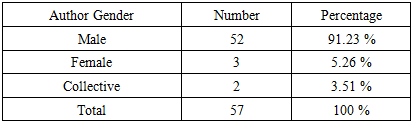
- This part of the section represents the numerical and categorical results of the content analysis that has been executed on “Anandapath” Bengali Literature Textbooks ranging from Classes 6 to Classes 10. The results have also been tidily organized based on the first three research questions, which are drawing data from coding of author gender, presence of female characters and categories of their narrative role significance to the plots. In addition, there are summary tables and charts which help to showcase patterns of distribution and thematic roles.Author Gender DistributionFor each poem and prose selection in the corpus, author gender was identified. The full breakdown is displayed in Table 1. Analysis observations among 58 literary texts have shown that 52 of them were written by male authors while only 3 were written by female authors, while the rest 2 were written in a collective manner. Translating in percentages, that amounts to a sheer (91.23%) male authorship while only a meagre (5.26%) female authorship in the following dataset. Such a difference was constantly detected across all grade levels rather than being limited to a single textbook.
|
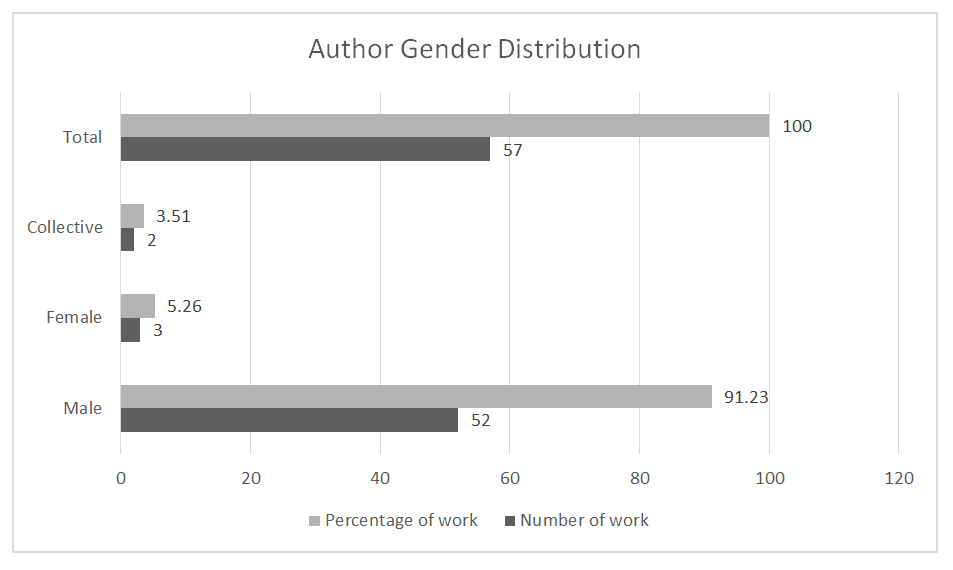 | Figure 1. Author gender distribution (Bar chart): Male = 52, Female = 3, Collective = 2 |
|
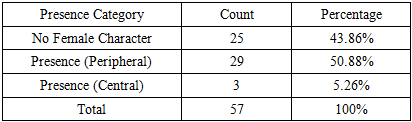
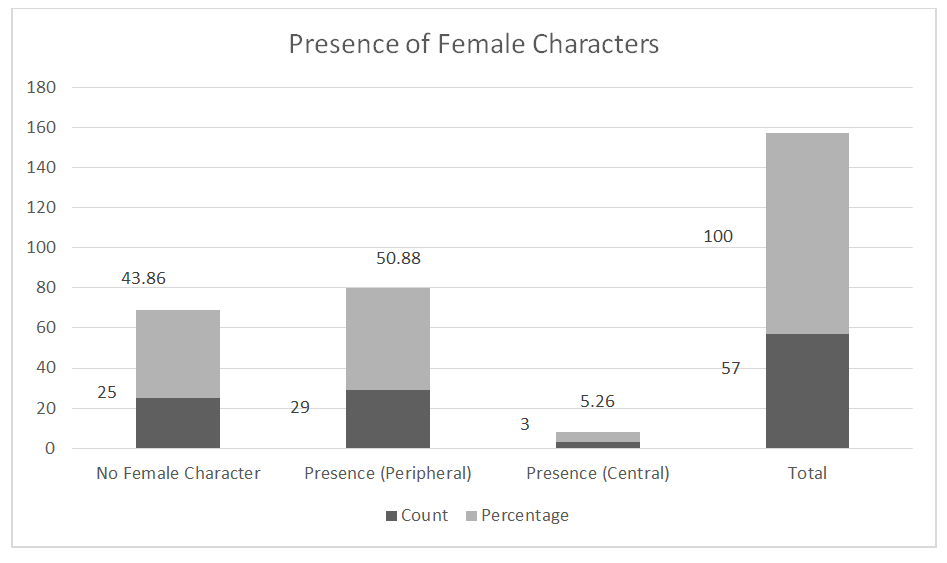 | Figure 2. Female Character Presence by their prominence (Column chart): No Female Character = 25, Presence (Peripheral) = 29, Presence (Central) = 3, Total = 57 |
|
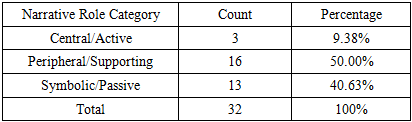
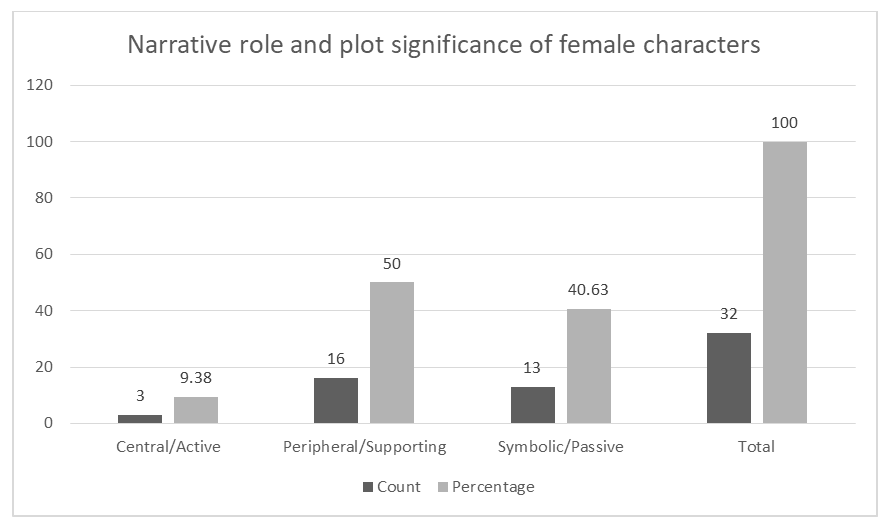 | Figure 3. Narrative Role Assigned to Female Characters (Column chart): Central = 3, Peripheral = 16, Symbolic/Passive = 13, Total = 32 |
5. Discussion
- The results direct towards a visible pattern of abnormally high gender imbalance across the analyzed “Anandapath” textbooks for Classes 6 to 10. More than 90% of the recognized authors are male and female authors made up only a small share. At the very base in the character level it is observable that female figures are generally missing from many texts and when they are included they are seldom positioned in a more central, active decision making role. Majority of the time they are categorized as a peripheral/symbolic, or a passive role instead of genuine plot driving. Thus taken together, the low level of female authorship alongside limited narrative influence of female characters indicate that viewpoints of women and their experiences receive restrictive structural representation in this corpus.Not only that, but also from the perspective of representation, narrative positioning is just as important as simple frequency. Feminist literary criticism has listed agency, voice, and decision authority as the key factors of substantial representation. And in this dataset it is discerned that female characters are often placed in suffering, or background support roles. Such repeated patterns of the kind can lead to familiar or more primitive gender scripts where male characters are often portrayed as the authority to act and choose while female characters are shown to endure or stand for supportive values. In the context of classrooms such continued exposure to story structures such as these may subconsciously reinforce unequal expectations regarding roles of gender even without the need of explicit messaging.These discoveries also align in general terms with much earlier textbook research in South Asia that reports ongoing gender stereotyping even though formal policies have committed towards equality. In spite of the fact that curriculum frameworks and policy statements have promoted gender sensitivity as well as education inclusive to all children. The literary selections that were reviewed here do not coincide with those goals in neither author diversity nor distribution of narrative roles and character significance.Such an implication is not intended to disparage literary merits of the selected texts, instead the balance in selection and instructional approach should be given more importance. Diversifying and expanding the number of female authors and adding more accounts of poems and prose texts with active female protagonists and ultimately promoting self reflective and critical discussion of character roles can heavily improve and strengthen gender responsive teaching. Reading tasks should be guided in such a manner that it highlights equal representation and trains students and identifies and challenges stereotypes rather than accepting them at face value. Combining diverse content with practice of critical literacy is a practical method to bring textbooks closer to the curriculum in accomplishing its mission in real classes.
6. Conclusions
- Concluding this study which was analyzed for gender representation in the “Anandapath” Bengali literature textbooks for Classes 6 to 10 by the use of content analysis of authorship together with evaluation of character roles significance. The findings further prove that male authors have dominated the aforementioned selected texts and that female characters are more than often absent or placed in passive and background roles. The following pattern is very consistent throughout earlier textbook studies that have also reported continued gender imbalance in curricular materials even though there were mentions of policy attention to equality [4]. Which additionally pointed towards partial misalignment with what national curriculum goals have expressed to achieve which is the emphasizing of gender awareness and inclusion [5].Textbook selection committees should determine the inclusion of more female authors and also more texts with authoritative female protagonists who impact the plot of their stories. Teachers should also incorporate harmony or balance by the implementation of critical discussion regarding character roles and stereotypes. The limits of this study are it focuses only on a singular textbook series and uses role coding that uses qualitative judgment. However, future research has the opportunity to expand to other subjects and include a broader, multi coded evaluation to strengthen reliability and ultimately bring much needed equality that NCTB has promised to do.