
-
Paper Information
- Paper Submission
-
Journal Information
- About This Journal
- Editorial Board
- Current Issue
- Archive
- Author Guidelines
- Contact Us
Education
p-ISSN: 2162-9463 e-ISSN: 2162-8467
2014; 4(3): 53-66
doi:10.5923/j.edu.20140403.01
Situating Psychosocial and Motivational Factors in Learning Contexts
 Abstract
 Reference
 Full-Text PDF
 Full-text HTML
Huy P. Phan
School of Education, The University of New England, Armidale NSW 2351, Australia
Correspondence to: Huy P. Phan, School of Education, The University of New England, Armidale NSW 2351, Australia.
| Email: |  |
Copyright © 2014 Scientific & Academic Publishing. All Rights Reserved.
Student learning in achievement contexts is an important inquiry that has been researched extensively, utilizing different theoretical orientations. The present investigation, contributing to the study of motivation, entails an amalgamation of four major constructs: school belonging, academic engagement, future time perspective, and personal self-efficacy. Based on existing empirical evidence, and using causal modeling procedures, we hypothesized a number of structural relations (e.g., the impact of future time perspective on course-specific self-efficacy) with school belonging serving as an antecedent of motivational and noncognitive outcomes. Upper secondary school students (N = 304) provided self-reports of their future time perspectives, self-efficacy beliefs, and engagement. Statistical analyses yielded some notable findings, such as the direct impact of school belonging on academic achievement, and the direct positive effects of future time perspective and vigor, a component of academic engagement, on global-specific self-efficacy.
Keywords: Academic engagement, Future time perspective, Personal Self-efficacy, Perceived Sense of School Belonging
Cite this paper: Huy P. Phan, Situating Psychosocial and Motivational Factors in Learning Contexts, Education, Vol. 4 No. 3, 2014, pp. 53-66. doi: 10.5923/j.edu.20140403.01.
Article Outline
1. Introduction
- The enhancement of quality learning in achievement contexts is an important research inquiry in student motivation. A number of theoretical orientations have been researched and empirical evidence yielded, in this instance, has highlighted the important impacts of both psychosocial (e.g., school environment) and motivational (e.g., perceived self-efficacy) factors on individuals’ academic achievements and long-term achievement-related outcomes (e.g., aspiration). Educationally, of course, such findings provide a basis for the design and structuring of educational-social programs that may enhance positive outcomes, academically and non-academically [1-4]. There is credence then, from our point of view, for educators to consider advancing conceptualized complex psychosocial-motivational models for examination. The present study explores, quantitatively, the interrelations between both psychosocial and motivational factors and their potential impacts on academic achievement outcome. Specifically, based on existing theoretical tenets and empirical findings, we posit that a perceived sense of school belonging [5, 6], as an exogenous variable, would serve as a predictor of psychological and adaptive outcomes (e.g., personal self-efficacy). For example, for examination and statistical testing, we postulate that a perceived sense of school belonging would make a contribution to the prediction of future time perspective, and in turn, relates positively to contextualized self-efficacy beliefs (global, course, task) and academic engagement. Furthermore, from a theoretical point of view, we acknowledge the importance of motivation-related attributes that define and reflect students’ academic engagement, in this case, as: absorption, dedication, and vigor [7]. This research investigation, overall, is of significance, indicating the complexity in relations between processes of academic learning.
2. Theoretical Overview of Constructs
- The focus of the present study, presented in Figure 1, depicts the importance of an exogenous construct as an antecedent: perceived sense of school belonging. This theoretical construct, we contend, is of significance, contributing to the prediction of educational outcomes. A perceived sense of school belonging is defined as the extent to which students “feel personally accepted, respected, included, and supported in the school environment” [8]. This definition connotes the potency of the school social milieu [9, 10], and its espousing on a number of related attributes on individuals. There is substantial research, over the past two decades, which has attested to the impact and significance of perceptions of school belonging. Students often ponder about their school surroundings, and whether there is sense of ‘identity’ and ‘belonging’. We contend in our postulation for examination that this perception [e.g., "People at this school are friendly to me": 5] could, in fact, serve as an antecedent of psychological and educational outcomes. In this section of the article, we synthesize and review the current literature for further development.
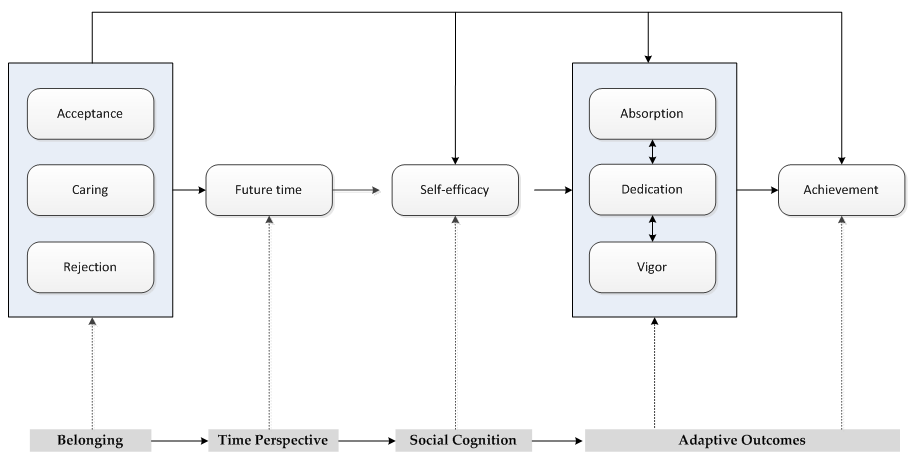 | Figure 1. Conceptual Model for Investigation: School Belongingness, Academic Engagement, Future Time Perspective, Personal Self-efficacy, and Academic Achievement |
2.1. Perceived Sense of School Belonging: Its Potency
- A perceived sense of school belonging, according to some researchers, may situate as an important source of information for comprehension and usage in the learning process [8]. There is extensive research, which has yielded some notable findings regarding the positive impact of a perceived sense of school belonging [9]. Quantitatively, regarding this psychosocial facet, the work of Goodenow [e.g., 6, 11] has been somewhat prominent, producing an inventory that enables researchers and educators to measure and assess individuals’ perceptions of school belonging. Other researchers have, similarly, explored the impact of a perceived sense of school belonging on both adaptive outcomes and maladaptive practices [12]. Positively, for example, a perceived sense of school belonging predicts educational and schooling outcomes (e.g., academic achievement in a subject discipline) [8]. Students who perceive their school environments as being friendly, helpful, and/or conductive, academically, are more likely to succeed in their learning and achievements [e.g., 'People at this school are friendly to me': 5]. In contrast, of course, a negative perceived sense of school belonging [e.g., 'It is hard for people like me to be accepted here': 5] negates learning and lead to a number of detrimental consequences – for example: student dropout [13-15] and participation in antisocial activities and violence [8]. Peer rejection, for example, experienced by some students, may result in a weakening in academic interest, alienation, and social-emotional upheaval. Goodenow’s (1993b) conceptualization and subsequently, the development of the 18-item Psychological Sense of School Membership Scale (PSSMS), is notable for its emphasis on three related attributes of school belonging [16]: caring relationship (e.g., ‘Most teachers at this school are interested in me’), rejection (e.g., ‘It is hard for people like me to be accepted here’), and acceptance (e.g., ‘I am included in lots activities at this school’). This multifaceted perspective of a perceived sense of school belonging is of significance, enabling us to extend previous research investigations [e.g., 16, 17-23] and explore the differential effects of caring relationship, rejection, etc. A perceived sense of school belonging, as a predictor of educational and psychological outcomes, has important merits for theoretical contributions and applied practices. The question for consideration, drawing on from previous emphases [9, 14, 15, 24, 25], is to what extent a perceived sense of school belonging would directly predict future time perspective and personal self-efficacy beliefs. The fostering of positive school-related attributes (e.g., imparting students with enriched values for learning) within a school social milieu may, in this instance, encourage persistence, effort expenditure, and motivation for learning [6, 11, 24, 26, 27]. The cultivation of social support and peer relationships, similarly, may instill confidence and promote proactive engagement in schooling [28-30]. We query then, on this basis, as to whether positive perceptions of school belonging would motivate and orientate students towards positive future perspectives. We chose future time perspective (FTP) as a psychological outcome of a perceived sense of school belonging, given its nature and characteristics [31-34]. The study of time perspectives has spanned over the course of six decades, with substantial evidence attesting to their featuring in human development. Time perspective, defined historically as “the totality of the individual’s views of his/her psychological future and psychological past existing at a given time” [35], functions dynamically in individuals’ self-judgments, actions, and decision making [36]. Lewin’s (1951) time-filled life space tenet, according to Zimbardo and Boyd (1999), serves as a foundation for other conceptualized orientations [31, 37, 38], whereby one’s perception of time is believed to play a fundamental role in his/her cognition, emotion, and motivation. Time perspective, in this sense, emphasizes the cognitive appraisal in reconstruction of past events (e.g., recalling something that was nostalgic or traumatic) and the anticipations and expectations of a future based on current timeframes. The tenets of time perspective indicate that this theoretical construct espouses different temporal timeframes (e.g., past, present, future) [36]. Individuals have differential biases in their preference for a particular temporal frame, which then becomes stable dispositional tendencies. Temporal bias, of course, may involve the habitual overuse or underuse of one or more of these temporal frames [36]. Zimbardo and Boy’s (1999) conceptualization consists of five major factors: (1) Past-Negative factor that reflects a negative, aversive view of the past, (2) Present-Hedonistic factor emphasizes one’s hedonistic, risk-taking attitude towards time and life, (3) Future factor that reflects a general future orientation, (4) Past-Positive factor emphasizes an attitude towards the past that is warm and sentimental, and (5) Present-Fatalistic factor emphasizes a fatalistic, helpless, and hopeless attitude towards the future and life [36]. We chose the future temporal timeframe for examination, given that existing research studies have attested to its potency and relevance in educational and life contexts [e.g., 39, 40-43]. The work of Horstmanshof and Zimitat (2007), for example, detailed the impact of the future time perspective component on meaningful approaches to learning and the amount of hours that students spent on learning. The characteristics of future time perspective [36, 42-45], in particular, indicate its potentials as a positive outcome of school belonging. Students who perceive a sense of belonging (e.g., ‘Everyone here at this school is friendly and helps me when I’m in need of assistance’), in this case, are more likely to experience enjoyment, satisfaction, and feelings of serenity and acceptance. This ‘positivity’ (e.g., acceptance at school), in turn, may instill and espouse students with positive outlooks about schooling and their trajectories in life (e.g., career pathway). On this basis, as a possible association, we expect to find that a perceived sense of school belonging (e.g., treatment of respect) could motivate students to consider anticipations of future goals (e.g., ‘What do I want to do next after Year 12?’). Acceptance, the feelings of comfort, and experiences of belonging and identity may, in this analysis, establish a sound basis for positive well-being and students’ flourishing. Dissatisfaction and perceptions of alienation, in contrast, are more likely to result in pessimism and present-fatalistic thinking [e.g., 'Since whatever will be will be, it doesn’t really matter what I do': 36]. We contend that a perceived sense of school belonging, based on previous research [6, 8, 11, 12], would also contribute to the prediction of academic engagement. Academic engagement, emphasized extensively in the contexts of motivation, is defined as “the extent to which students identify with and value schooling outcomes, and participate in academic and non-academic school activities” [9]. Academic engagement, as a theoretical construct, according to researchers, is multifaceted and relatively diverse in scope and coverage [7, 46-49]. Over the past 70 years, for example, the engagement premise has evolved to encompass different theoretical facets, such as the importance of quality of effort [50], student involvement [51], social and academic integration [52, 53], good practices in undergraduate education [54], etc. Engagement, since then, entails student engagement [55, 56] and encompasses a variety of attributes, such as quality of effort and involvement in productive learning activities [48]. The development of the National Survey of Student Engagement (NSSE) and the Community College Survey of Student Engagement (CCSSE) [57-59] has provided information regarding the measure of student engagement, and how this construct serves as an indicator of learning, personal development, and institutional performance [48, 60]. The College Student Report, in the NSSE, asks students to report the frequency with which they partake in activities that reflect good educational practice (e.g., utilizing institution’s human resources; curricular programs; the amount of reading and writing students did during the year; the number of hours per week one devotes to schoolwork, etc.). This measure, significantly, accentuates the complexities of academic engagement, as an educational construct. The work of Schaufeli, et al. (2002), likewise, is of significance, postulating the importance of: (i) effort expenditure, resilience, and persistence in the face of obstacles (vigor), (ii) enthusiasm, inspiration, and pride in academic learning (dedication), and (iii) engrossment in learning activities and tasks (absorption). Academic absorption, dedication and vigor, collectively, reflect a sense of motivation and proactivity with schoolwork and other school-related activities. There have been extensive interests from researchers to accept engagement as a multifaceted construct [7, 46, 59]. Schaufeli, et al.’s (2002) theoretical tenets have, however, received modest attention in terms of examination and empirical validation. We believe there is credence, though, to lend support for Schaufeli, et al.’s (2002) conceptualization, given the mentioned attributes (e.g., absorption) reflect a motivational approach to our understanding of students’ engagement in academia. This emphasis, we believe, may extend Kuh’s previous research [55, 56, 59] and provide an alternative account to students’ engagement. From a psychological perspective, then, it is important for us to explore Schaufeli, et al.’s (2002) conceptualization of academic engagement as an adaptive outcome of a perceived sense of school belonging. In a similar vein, for consideration in terms of examination, is the potential impact of academic engagement, defined by absorption, dedication, and vigor [7], on achievement outcome. This aspect of the present investigation, given its limited focus at present, is exploratory and such findings ascertained, would support previous research studies pertaining to the potency of academic engagement [e.g., 49, 50, 57, 61-68]. We posit that students’ absorption in learning tasks and activities, for example, would assist and enhance subsequent performances in the subject matter. Manifestation of disengagement-related attributes (e.g., lack of persistence and expending very little effort in learning), in contrast, would likely lead to low, quality learning in achievement contexts [4, 69-72]. Offord and Waters’ (1983) original research found that adolescents who manifested behavioral problems (e.g., participating in anti-social and criminal activities) tended to experience disconnectedness and disengagement from school. Henry, et al.’s (2012) research involving youths reported the negative impact of academic disengagement on student dropout and other serious behavioral problems.
2.2. Interrelations between Internal Processes: Future Time Perspective, Self-efficacy, and Engagement
- Situated within the framework of motivation, we stipulate centrally the potential interrelations between FTP, perceived self-efficacy, and academic engagement. Specifically, in accordance with existing theoretical tenets, we posit the triarchic associations between the three mentioned constructs, whereby FTP would influence both self-efficacy and the three motivation-related attributes of engagement [7]. Self-efficacy, similarly, consistent with Bandura’s (1986, 1997) social cognitive theory, would relate positively to the three attributes of engagement. This conceptualization, overall, has important contributions in terms of continuing theorization and applied practices for educators and researchers, alike. Personal self-efficacy, situated within Bandura’s (1986, 1997) social cognitive theory, is an important noncognitive construct that has been researched extensively in educational and non-educational settings [73, 74]. Personal self-efficacy, defined as “beliefs in one’s capabilities to organize and execute the courses of action required to produce given attainments” [74], features prominently in human agency. Self-efficacy for academic learning may, for example, make a direct contribution towards the prediction of performance outcome, and similarly, indirectly via other cognitive-motivational processes [1, 4, 75-80]. A heightened sense of academic self-efficacy, in this case, mobilizes positive affective response, persistence, and effort expenditure, resulting in improvement in learning and academic performance outcome [73, 74]. Weakened self-efficacy beliefs, in contrast, are likely to dampen academic achievements and other forms of dysfunctioning. Evidence obtained from prior research investigations seems to indicate that heightened self-efficacy beliefs for academic learning would relate positively to absorption, dedication, and vigor. Self-efficacious students, in this analysis, are more likely to experience engrossment in their learning and, subsequently, expend more effort in the learning activities, at hand. Such self-efficacy beliefs may also inspire students to approach their learning and schooling with a sense of enthusiasm, pride, and curiosity. Inefficacy, in contrast, would have a more negative impact, compelling students to avoid learning and disengage from schooling, altogether. We would expect, in relation to Schaufeli, et al.’s (2002) conceptualization, to find inverse associations between self-efficacy and the three motivation-related attributes. This component of the investigation is exploratory, given the limited research that exists at present. FTP, as we have indicated previously, serves as an important predictor of achievement-related outcomes [36, 42, 43]. Present anticipation of future goals, in this analysis, enhances a number of optimal educational outcomes [43]. For example, quantitatively, prior research studies have yielded consistent findings, which indicates the positive impact of FTP on the use of cognitive study strategies [39], time management, academic performance outcome [36], and proactive engagement in schoolwork [81]. This evidence, collectively, provides empirical support regarding the potential influence of FTP on self-efficacy beliefs for academic learning. We contend that future-oriented students, in this case, would feel more motivated and efficacious to explore the different courses of action available. Students who are less inclined towards consideration and/or anticipation of future goals, in contrast, may experience a sense of inefficacy and avoid in-depth learning, altogether. The Present StudyThe present study is of significance for its amalgamation of four major theoretical orientations within one conceptual framework. Specifically, in accordance with existing research [5, 6, 8-10], we posit school belonging as a potent antecedent of educational and psychological outcomes. This conceptualization emphasizes a paradigm shift, whereby using Goodenow’s (1993b) PSSMS, we stipulate three major facets of a perceived sense of school belonging: caring relationship, rejection, and acceptance [12, 16]. There are important gaps in the literature, at present, regarding the potential impact of these three psychosocial facets. We use Schaufeli, et al.’s (2002) conceptualization, similarly, to depict student engagement for academic learning. This theoretical approach supports previous research emphases [46, 48, 49], and details the multifaceted structure of academic engagement from a motivational perspective. Our postulation, in particular, emphasizes the differentiation of academic engagement into aspects that reflect different attributes of motivation (e.g. effort expenditure). The inclusion of Schaufeli, et al.’s (2002) theoretical orientation, from our point of view, is of significance, given that there is limited research, at present, regarding its potency. How do absorption, dedication, and vigor interrelate to influence academic achievement? The negative impact of rejection on pride (i.e., dedication), for example, may provide relevant information in relation to school ethos, pastoral care programs, etc. The positive impact of acceptance on, say, self-efficacy may, similarly, inform educators of aspects that are deemed appropriate for nurturing. In summary, as depicted in Figure 1, there are two main aims to the present study: (1) it seeks to extend previous research [e.g., 12, 16, 17, 23] by exploring the potential role of acceptance, caring, and rejection, reflective of school belonging, as antecedents of adaptive and motivational outcomes, (2) it seeks to explore the interrelations between FTP, self-efficacy, and the three motivation-related attributes of academic engagement, centrally situated between the three facets of school belonging and academic achievement. In total, based on existing empirical evidence, we outline four major hypotheses for investigation: HP1: The acceptance and caring aspects of school belonging will exert positive effects on FTP, personal self-efficacy, and the three motivation-related attributes of academic engagement. HP2: The rejection aspect of school belonging, in contrast, will exert negative effects on FTP, personal self-efficacy, and three motivation-related attributes of academic engagement. HP3: FTP will exert positive effects on self-efficacy, the three motivation-related attributes of academic engagement, and academic achievement. HP4: Personal self-efficacy will exert positive effects on the three motivation-related attributes of academic engagement, and academic achievement. HP5: The three motivation-related attributes of academic engagement will influence academic achievement.
3. Methods
3.1. Sample
- Participants in the present study were 304 (151 boys, 153 girls) 12th grade secondary school students from three government schools, NSW Australia. Participation by the students was voluntary and no remuneration was provided. Students were also explained and instructed to write down their names for the purpose of collecting the end-of-term results. Students were assured of anonymity and that their responses would only be seen by the researchers involved in the study. Finally, in relation to answering the questionnaires, we asked the students to situate their responses within the context of mathematics learning, as this subject is an important prerequisite for many university courses.
3.2. Instruments
- Academic Engagement. There are a number of inventories, which measure and assess students’ academic engagement [7, 82, 83]. We chose to use Schaufeli, et al.’s (2002) Engagement Scales, Student Version, as these have been found to demonstrate good construct validity, relevance, and applicability to classroom learning. The 17 items, answered on a 7-point rating scale (1 (Strongly disagree) to 7 (Strongly agree)), defined three distinct dimensions: Vigor (e.g., “When I get up in the morning, I feel like going to class [for mathematics]”), Dedication (e.g., “To me, my studies are challenging”), and Absorption (e.g., “When I am studying, I forget everything around me”). Academic Self-Efficacy. We used 8 items of the self-efficacy subscale of the Motivated Strategies for Learning Questionnaire (MSLQ) [84] to measure self-efficacy beliefs for mathematics learning. Rated on a 7-point rating scale (1 (Not at all true of me) to 7 (Very true of me)), the items included, for example: ‘I believe I will receive an excellent grade in this class’ and ‘I’m confident I can learn the basic concepts taught in this unit’. A Perceived Sense of School Belonging. We used the Psychological Sense of School Membership Scale (PSSMS) [5] to measure students’ sense of belonging. The PSSMS, as we have discussed previously, contains 18 items that differentiate into three subscales [12, 16]: caring relationship (Item, for example: ‘Most teachers at this school are interested in me’), rejection (Item, for example: ‘It is hard for people like me to be accepted here’), and acceptance (Item, for example: ‘I am included in lots activities at this school’). The items were rated on a 7-point rating scale: 1 (Not at all true) to 7 (Complete true).Future Time Perspective. We used the Zimbardo Time Perspective Inventory (ZTPI) [36] to measure future time perspective. The future time perspective subscale contains 13 items, rated as 1 (Very uncharacteristic of me) to 7 (Very characteristic of me), and included, for example: “Meeting tomorrow’s deadline and doing other necessary work comes before tonight’s play” and “I am able to resist temptations when I know that there is work to be done” (Future). Academic Achievement. Academic achievement in mathematics was measured by collating students’ unit mark at the end of the school term. This end-of-term result for each student constitutes two components: (i) Course mark that is made up of periodic quizzes and assessment tasks, and (ii) End-of-term examination.
4. Results
- The conceptual model detailed in Figure 1 was analyzed using path analytical procedures [85-87] with the statistical software package, LISREL 9.1. Path analytical procedures are more advantageous in enabling researchers to test and compare competing a priori models. Decomposition of effects, similarly, provides clarity into the direct and indirect interrelations between variables. A synthesis of the literature has shown that a number of researchers have also used causal modelling procedures to explore and discern relations between FTP, personal self-efficacy, and academic achievement [e.g., 1, 2, 80, 88].Following the protocols established previously [86, 87, 89], we used covariance matrices and maximum likelihood solutions. Correlational matrix analysis, for example, has been known to entail some major problems, such as producing incorrect goodness-of-fit index values and standard errors [90, 91]. Maximum likelihood procedure, similarly, has been noted to perform reasonably well when data are normally distributed [92]. In relation to the goodness-of-fit index values, we chose to use the following: (i) the Chi-square statistics (χ2) and degree of freedom (d), (ii) the Comparative Fit Index (CFI)(CFI value ≥ .90), (iii) the Non-normed Fit Index (NNFI)(NNFI value ≥ .90), and (iv) the Root Mean Square Error of Approximation (RMSEA)(RMSEA value ≤ .080).
4.1. Structural Relations between the Variables
- In the first stage of the statistical analyses, we performed an initial screening to ensure that the data was normally distributed [90, 93]. This examination included, for example, the values of skewness and kurtosis, needing to situate between +/- 2.00 [93]. The skewness values for the variables, in this case, ranged from 1.32 to .50, whereas the kurtosis values ranged from -1.01 to 1.32. Cronbach’s alpha values and descriptive statistics, involving the means and standard deviations for the total sample and individual groups (boys versus girls) are presented in Table 1. Table 2 shows, similarly, the bivariate correlations of the variables under statistical testing.
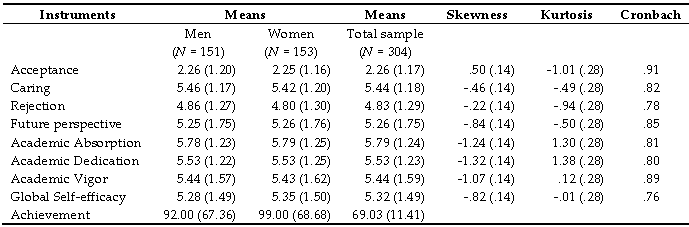 | Table 1. Descripptive Statistics and Cronbach’s Alpha Values |
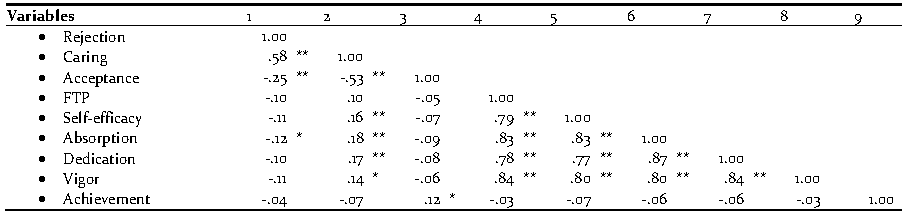 | Table 2. Bivariate Correlations |
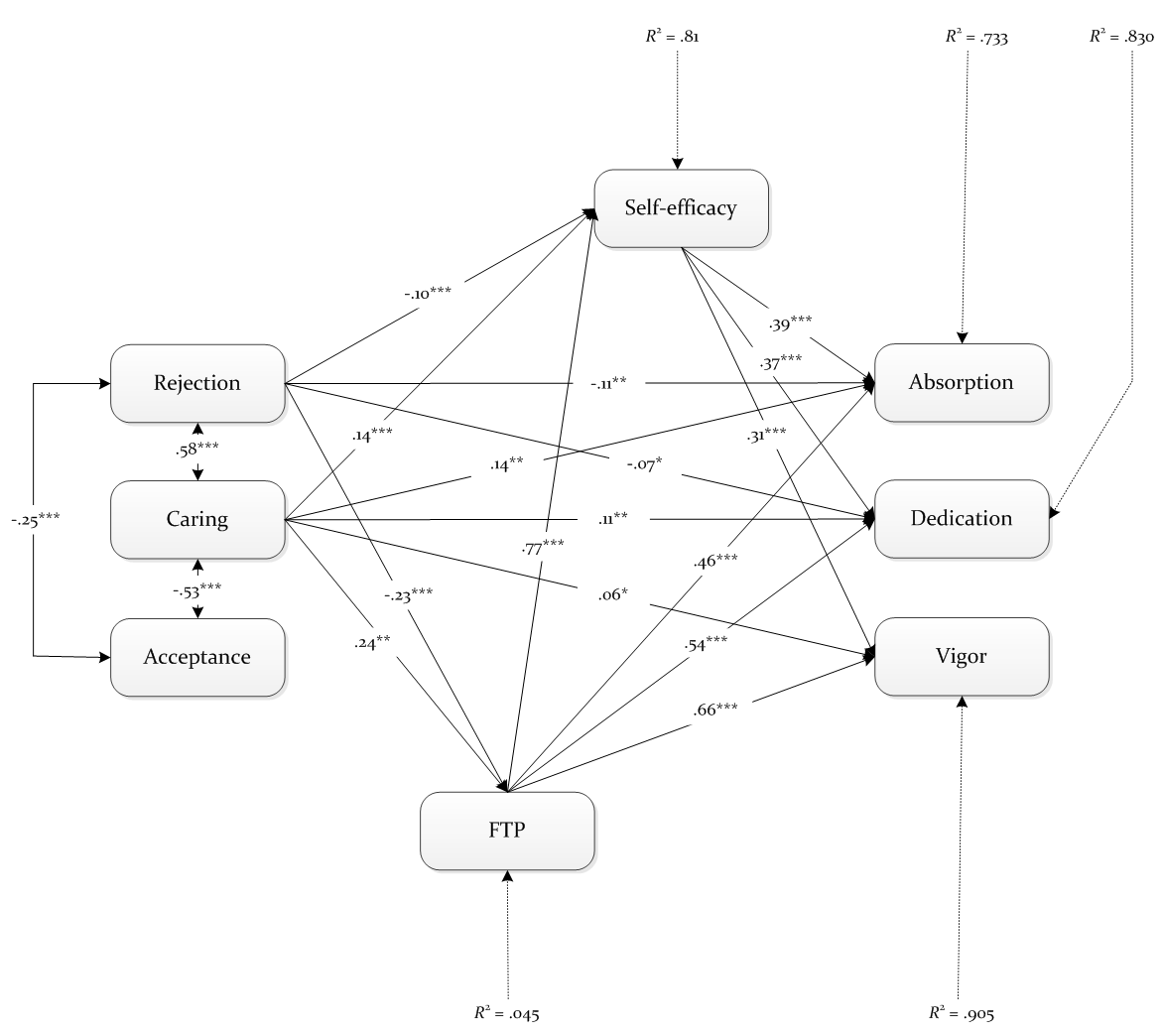 | Figure 2. Fical Solution for Proposed Theoretical-Conceptual Model. Note: Non-statistical significant paths have been omitted for clarity. * p < .05, ** p < .01, *** p < .001 |
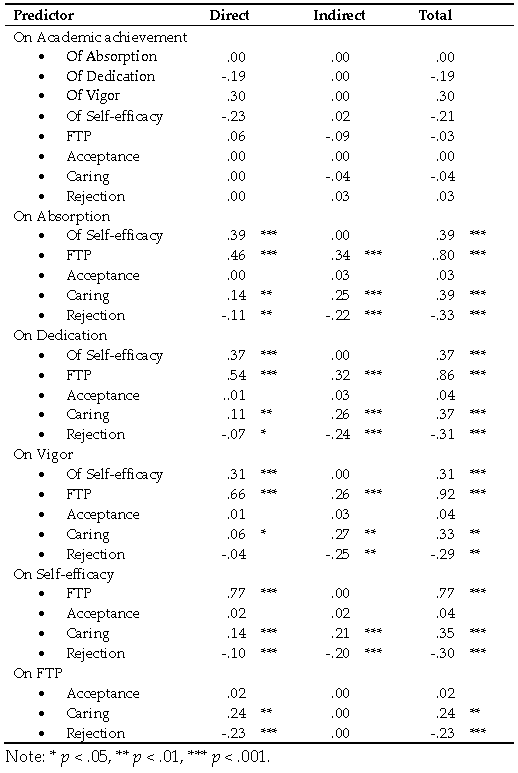 | Table 3. Decomposition of Effects: Direct, Indirect, and Total |
4.2. Direct and Indirect Effects
- Table 3 seems to indicate that alongside the direct effects of caring, rejection, and FTP on the three motivation-related attributes of academic engagement, their effects are also mediated by personal self-efficacy. This indication would support previous theoretical contentions and empirical evidence [74, 79]. The indirect effects, as shown, are statistically significant. Additional tests of mediation are conducted using Baron and Kenny’s (1986) suggested requirements, whereby the following significant relationships are proposed: (i) caring, rejection, and FTP and the three motivation-related attributes of academic engagement (Test 1), (ii) personal self-efficacy and the three motivation-related attributes of academic engagement (Test 2), (iii) caring, rejection, and FTP and personal self-efficacy (Test 3), and (iv) the direct paths between caring, rejection, and FTP and the three motivation-related attributes (e.g., caring → absorption) are shown to be non-significant with the introduction of personal self-efficacy as a mediating variable (Test 4). Test 1, emphasizing the direct relations between caring, rejection, and FTP and the three motivation-related attributes of academic engagement yielded statistical significant effects for the following: (i) caring to absorption (β = .20, p < .001), dedication (β = .17, p < .001), and vigor (β = .10, p < .001), (ii) rejection to absorption (β = -.15, p < .001), dedication (β = -.11, p < .001), and vigor (β = -.08, p < .01), and (iii) FTP to absorption (β = .71, p < .001), dedication (β = .78, p < .001), and vigor (β = .84, p < .001). Test 2, which emphasized the direct relations between personal self-efficacy and the three motivation-related attributes of academic engagement, yielded statistical significant effects for absorption (β = .83, p < .001), dedication (β = .78, p < .001), and vigor (β = .80, p < .001). Test 3, which emphasized the direct relations between caring, rejection, and FTP and personal self-efficacy, yielded statistical significant effects for caring (β = .15, p < .001), rejection (β = -.11, p < .001), and FTP (β = .79, p < .001). Test 4, in total, indicated a reduction in the following structural paths with the introduction of personal self-efficacy as a mediating variable: caring to absorption from .20 (p < .001) to .14 (p < .01), caring to dedication from .17 (p < .001) to .11 (p < .01), and caring to vigor from .10 (p < .001) to .06 (p < .05); rejection to absorption from -.15 (p < .001) to -.11 (p < .01), rejection to dedication -.11 (p < .001) to -.07 (p < .05), and rejection to vigor from -.08 (p < . 01) to -.043 (n.s); and FTP to absorption from .71 (p < .001) to .46 (p < .001), FTP to dedication .78 (p < .001) to .54 (p < .001), and vigor fro, .84 (p < .001) to .66 (p < .001). Based on these results, there is support to indicate that personal self-efficacy plays a mediating role in the process.
5. Discussion
- The study of student learning in educational settings is an important focus of inquiry, which has to date, included a number of theoretical tenets for consideration. Advancing the scope of this research inquiry, we amalgamated different strands of inquiries within one theoretical-conceptual model for statistical testing and examination. Previous research studies have produced evidence, which supports our hypotheses regarding the interrelations between a perceived sense of school belonging, FTP, personal self-efficacy, and adaptive outcomes. We used path analytical procedures [85, 86, 90] to analyze the data collected, involving secondary school students in the learning context of mathematics. In this section of the article, we discuss in detail some of the illuminated outcomes that may have relevance and educational implications for applied practices.
5.1. School Belonging: A Potential Antecedent of Adaptive Outcomes
- The work of Goodenow (1993a, 1993b) emphasizes the importance of attributes that relate to acceptance, caring relationship, and rejection [12, 16]. This emphasis, we contend, reflects Finn’s (1989) participation-identification theoretical orientation introduced in the late 1980s, which suggests a dialectic association between students and their school surrounding. The tenet of Finn’s (1989) conceptualization, for example, details perceptions of school belonging as being related to students’ to identify with their schools (e.g., I feel really valued in this school). A perceived sense of school belonging, similarly, may espouse other facets (e.g., acceptance) that, in turn, predict effective educational processes and schooling outcomes (e.g., active participation in extracurricular activities) [e.g., 8, 9, 11]. Our conceptualization for empirical validation, in particular, entailed the potential impacts of differential facets of school belonging on psychological and educational outcomes. The use of the PSSMS [5], in this case, has generated findings that provide theoretical insights into the operational nature of the inventory. With the exception of acceptance, we note that caring relationship and rejection exerted both positive and negative effects on FTP (e.g., caring → FTP, β = .24, p < .01), personal self-efficacy (e.g., rejection → self-efficacy, β = -.10, p < .001), and the three motivation-related attributes of academic engagement (e.g., caring → absorption, β = .14, p < .01). Rejection, as expected, is shown to relate negatively to FTP (β = -.23, p < .001), self-efficacy (β = -.10, p < .001), and two of the three motivation-related attributes of academic engagement (e.g., rejection → dedication, β = -.07, p < .05). Personal experiences of attributes (e.g., inclusion of students from diverse backgrounds) that emphasize acceptance, perceived liking, inclusion, respect, etc., are likely to result in proactive engagement and achievement outcome in schooling, via means of absorption, dedication, and vigor [7]. The present findings signify the importance of various facets of school belonging. Our structural validation of the PSSMS [5], similarly, has resulted in findings that attest to the differentiation of various psychosocial attributes of individuals’ perceived sense of belonging [12, 16]. From an educational perspective, this evidence yields some notable implications for applied and instructional practices. Establishing a premise that fosters a sense of caring [e.g., 'Most teachers at this school are interested in me': 5], for example, as shown in this case, may instil and heighten students’ self-efficacy beliefs for academic learning. In a similar vein, with the negative impact of rejection, it would make logical sense for educators and school administrators to consider school values, ethos, and philosophies that de-emphasize rejection and bullying practices. Many schools nowadays have extracurricular activities and school events that promote multiculturalism and acceptance for others. The influences of caring and rejection on personal self-efficacy are of theoretical relevance, contributing to the study of social cognition [73, 74]. Bandura’s (1986, 1997) theoretical tenets emphasize the potency of different informational sources (e.g., enactive learning experiences) used to formulate self-efficacy beliefs. These informational sources, as verified by previous research studies [e.g., 94, 95-97], have been noted to contribute to the formation of academic self-efficacy. The use of the PSSMS [5], in this case, has produced similar evidence, attesting to the positive impact of caring relationship on self-efficacy beliefs for academic learning. Perceptions of rejection, in contrast, serve to deter students from formulating heightened and positive self-efficacy beliefs. It is interesting to note that of the three facets of school belonging, according to Goodenow’s (1993b) PSSMS, only acceptance did not make a statistical significant contribution. This lack of associations, however, does not change the fact that this facet of school belonging [e.g., 'I am included in lots activities at this school’: 5] makes meaningful contributions and account for students’ learning. Descriptions of some of the acceptance items (e.g., ‘Other students here like me the way I am’) may, in this case, connote positive associations with other educational outcomes (e.g., peer relationship). Researchers may wish to extend our conceptualization, and include other academic and non-academic outcomes for examination. Perceptions of acceptance, for example, may motivate students towards inclination and willingness to work cooperatively with others.
5.2. Future Time Perspective, Personal Self-efficacy, and Academic Engagement
- A key finding arising from the present investigation is the validation of the triarchic associations between FTP, personal self-efficacy, and motivation-related attributes of academic engagement. Both FTP and self-efficacy, based on existing theoretical tenets [34, 42, 74, 98, 99], were hypothesized to act as central predictors of engagement-related and academic outcomes. FTP, in this case, consistent with prior research findings [36, 39, 81], is shown to exert positive effects on self-efficacy (β = -.77, p < .001) and the three motivation-related attributes of academic engagement (β values ranging from .46 - .66, p < .001). This finding, apart from theoretical contributions, is of significance, especially in terms of educational implications for consideration. Future-oriented students who periodically anticipate and plan future goals are more likely, in this analysis, to experience more efficacy beliefs in their learning. At the same time, setting goals for the near or distant future may also stimulate students’ interests, enthusiasm, and instill a sense of resilience and persistence. Personal self-efficacy, as shown, is related positively to the three motivation-related attributes of academic engagement. This evidence (e.g., self-efficacy → absorption, β = .39, p < .001) is consistent with previous research findings [e.g., 1, 2, 75, 79, 100], and illustrates the positive predictive role of self-efficacy in educational contexts. Interestingly, and consonant with existing theoretical tenets and empirical research [73, 74, 79], our a posteriori analyzes emphasized the central role of self-efficacy – that is, caring relationship, rejection, and FTP influenced the three motivation-related attributes of academic engagement indirectly, via self-efficacy. The specific patterns for self-efficacy, as shown in Figure 2, emphasize a number of educational implications for implementation. Notably, of course, is the heightening of academic self-efficacy that then facilitates and enhances student learning. Students’ engagement in academia involving effort expenditure, say, may involve their self-judgments of perceived competence to learn and execute various tasks and activities. Emphasis, in this case, may entail the fostering of self-efficacy beliefs via different means – for example, structuring a school social milieu that encourages and espouses ethos, values, and practices of caring and positive social relationships. Positive attitudes and encouraging feedbacks (e.g., ‘You’re working very hard, Alison; good work…. keep trying’), similarly, may instill confidence and strengthen students’ self-efficacy beliefs for academic learning.
5.3. The Impact on Academic Achievement
- Interestingly, unlike some previous research studies, we found that academic achievement in mathematics did not relate as an adaptive outcome. This finding, especially in relation to the area of personal self-efficacy and academic achievement [e.g., 75, 100, 101], is somewhat surprising, given previous studies have reported a positive association between the two constructs. We contend that this lack in statistical significance may have derived from the importance of constructive alignment [73, 74], requiring a close alignment between self-efficacy items and the tasks, at hand. Achievement indexes with criteria that differ largely from self-efficacy do not necessarily elicit a meaningful contribution. In a similar vein, the stipulation of contextualized self-efficacy beliefs in classroom settings provides different forms of adaptive outcomes for educators to consider. The inclusion of academic self-efficacy at different levels of specificity, similar to previous studies [102, 103], yields relevant information pertaining to their explanatory and predictive powers. Atomistic self-efficacy beliefs (e.g., I’m confident that I can solve this Algebra problem: x3 + 2x – 3 = 0), alone, do not necessarily function as an effective mediator and predictor of achievement-related outcomes. The positive association between FTP and global self-efficacy (β = .35, p < .001), in this case, highlights the prominence of more non-microanalytical self-efficacy measures. Investigations into the structural validity of the Engagement Scales [7] and the PSSMS [5] are modest, at present, and require further research development and advancement. We are mindful of the non-statistical significance in associations with academic achievement (e.g., absorption → academic achievement), and contend the possibility that other achievement-related outcomes could also relate instead to facets of school belonging and motivation-related attributes of academic engagement. One avenue of inquiry, in this case, may entail the inclusion of non-academic, adaptive outcomes and practices, such as students’ long-term well-being and relationships with others. Other achievement indexes may also serve as positive outcomes of one’s perceptions of school belonging. For example, the notion of acceptance, from our point of view, may predict one’s proactive engagement in social relationships with peers.
5.4. Alternative Pathways towards Adaptive Outcomes
- An inspection of the final solution, depicted in Figure 2, illustrates a number of significant structural paths that lead to positive achievement-related outcomes. In totality, decomposing the direct, indirect, and total effects of Figure 2, it can be seen that students’ engagements in mathematics do not exist in isolation, but rather embed within a larger system of change, involving a number of psychosocial processes. These constructs, in turn, act in tandem as a disposition towards quality learning. We identify a number of structural paths that originate from facets of school belonging, and consequently shape and predict various motivation-related attributes of engagement (e.g., caring relationship → FTP → personal self-efficacy → absorption). On this basis, from our point of view, there are a myriad of research and educational implications worth considering.
6. Conclusions
- The present study has produced a number of key findings, which support the hypothesized view regarding the notion of a perceived sense of school belonging [6, 24] as an antecedent of future achievement-related outcomes. Structural validation, based on Likert-scale responses, has established a pattern in associations between psychosocial and motivational variables in educational contexts. Theoretically, in particular, the final solution detailed in our investigation has provided grounding for continuing advancement and research development in motivation in secondary school contexts. First, a cross-sectional design was used and this methodological approach, consequently, limited us from making causal inference [104, 105]. We query, for example, the extent to which personal self-efficacy beliefs for academic learning could assist students to integrate and cognitively transform their personal experiences into successful anticipations for distant future. Personal self-efficacy, as Bandura (1977) theorizes, mobilizes effort expenditure and enables individuals to persist in the face of obstacles and setbacks. A heightened sense of self-efficacy may, in this instance, instill decisive resolve and enable students to contemplate realistic short-term and long-term goals. On this basis, from a methodological point of view, the use of longitudinal data may provide a stronger premise for researchers to explore the varying patterns in relations between the proposed variables (e.g., Time 1 self-efficacy → Time 2 FTP → Time 3 self-efficacy). Second, the sample size of this study was relatively modest and limited us from exploring, comparatively, differences in relationships (e.g., facets of school belonging → FTP) between countries, communities, and schools. Multi-level analyses of data [106-109] may provide more detailed information pertaining to interactive effects, situated within different layers of society. In a similar vein, as a possible line of inquiry, researchers could also explore the developmental trajectories of future time perspectives, utilizing data that are analyzed within the framework of latent growth modeling (LGM) procedures [110-112]. The inclusion of other achievement-related outcomes, such as a college major or a career pathway may allow us to study the impact of both short and long future time perspectives. Third, the logistics of the present study limited us from exploring other academic subject domains. The upper secondary school years in Australia are hectic with schools, teachers, and students having to prepare for statewide examinations and other achievement-related activities. Schooling, of course, entails engagement in a myriad of academic subjects, learning tasks, and extracurricular activities. Researchers may wish to situate facets of school belonging, FTPs, etc., within other subject domains. There is credence, similarly, for us to explore the impact of, say, FTPs on proactive behaviors and other achievement-related outcomes, such as communal service and civic citizenship. Fourth, as a point of examination, we focused on the impact of school belonging. It is important to recognize, however, that the social milieu encompasses much more than just the school, at large. Students also spend a portion of time in other social surroundings, and consequently, there is an emphasis for researchers to consider the inclusion of the family and community, in general. How does a particular community assist an adolescent in his/her time perspectives? What impact does a single-parent family have on an adolescent’ FTP? Finally, in relation to school, we note that this ‘context-person’ inquiry is rather complex, and cannot be observed realistically by the use of Likert-scale inventories, alone.