
-
Paper Information
- Paper Submission
-
Journal Information
- About This Journal
- Editorial Board
- Current Issue
- Archive
- Author Guidelines
- Contact Us
Computer Science and Engineering
p-ISSN: 2163-1484 e-ISSN: 2163-1492
2026; 16(1): 20-28
doi:10.5923/j.computer.20261601.03
Received: Jun. 22, 2026; Accepted: Jul. 12, 2026; Published: Jul. 15, 2026

AI-Powered Data Quality Monitoring in Snowflake: Architecture, Implementation, and Applications in Financial Services
 Abstract
 Reference
 Full-Text PDF
 Full-text HTML
Sowmya Yattapu
Principal Data Engineer, North Carolina, USA
Correspondence to: Sowmya Yattapu, Principal Data Engineer, North Carolina, USA.
| Email: |  |
Copyright © 2026 The Author(s). Published by Scientific & Academic Publishing.
This work is licensed under the Creative Commons Attribution International License (CC BY).
http://creativecommons.org/licenses/by/4.0/

Data quality has emerged as a critical determinant of organizational competitiveness in the era of artificial intelligence. Poor data quality costs enterprises an estimated $12.9 million annually on average, according to Gartner, and the IBM Institute for Business Value's 2025 report found that 43% of Chief Operating Officers now rank data quality as their foremost data priority. Traditional rule-based data quality approaches — which validate data against static, manually defined thresholds — are increasingly inadequate for the dynamic, high-volume, and heterogeneous data environments that modern enterprises manage. This paper examines how artificial intelligence is transforming data quality monitoring within Snowflake, the leading cloud-native data platform. We present a comprehensive analysis of Snowflake's native data quality capabilities, including Data Metric Functions (DMFs), Cortex Data Quality, and Cortex AI anomaly detection, and propose an integrated AI-powered data quality monitoring architecture that combines these native capabilities with complementary observability tools. The architecture is evaluated in the context of financial services data engineering, where regulatory compliance, data accuracy, and audit trail requirements are particularly stringent. We demonstrate through practical implementation examples that AI-powered monitoring reduces false positive alert rates by up to 60% compared to static threshold approaches, enables detection of data quality anomalies up to 8 hours earlier than scheduled batch validation, and delivers significant reductions in DBA intervention time. Our findings establish that AI-powered data quality monitoring in Snowflake represents a fundamental advancement over legacy quality management approaches, with value in regulated industries requiring continuous, proactive data reliability assurance.
Keywords: Snowflake, Data Quality, Artificial Intelligence, Data Metric Functions, Cortex AI, Anomaly Detection, Financial Services, Data Governance, Machine Learning, Data Observability
Cite this paper: Sowmya Yattapu, AI-Powered Data Quality Monitoring in Snowflake: Architecture, Implementation, and Applications in Financial Services, Computer Science and Engineering, Vol. 16 No. 1, 2026, pp. 20-28. doi: 10.5923/j.computer.20261601.03.
Article Outline
1. Introduction
- The quality of data upon which business decisions, regulatory reports, and artificial intelligence models depend has become one of the most strategically significant concerns in enterprise technology. According to Gartner, poor data quality costs organizations an average of $12.9 million per year, and the IBM Institute for Business Value's 2025 report found that 43% of Chief Operating Officers now rank data quality as their top data priority, with over a quarter of organizations estimating annual losses exceeding $5 million due to data quality failures [1]. These figures reflect a broader industry's reality: as organizations become more data-dependent, the consequences of undetected data quality problems become proportionally more severe.Snowflake has emerged as the dominant cloud-native data platform for enterprise data warehousing and analytics, serving over 13,300 customers globally including hundreds of the world's largest organizations [2]. Snowflake's role in enterprise data infrastructure has grown, so too has the need for robust, automated, and intelligent data quality monitoring within the platform. The introduction of Data Metric Functions (DMFs) in 2024, followed by Cortex Data Quality with AI-powered check suggestions in 2025, marks a significant evolution in Snowflake's native data quality capabilities.Traditional approaches to data quality monitoring — static threshold-based rules, scheduled batch validation scripts, and reactive incident response — suffer from fundamental limitations. They cannot adapt to changing data distributions; they generate excessive false positive alerts during normal data volume fluctuations, and they detect problems only after they have already propagated downstream. Artificial intelligence addresses each of these limitations by enabling predictive, adaptive, and continuously learning quality monitoring systems.This paper makes four primary contributions to the field of data quality management in cloud-native platforms. First, it provides a systematic analysis of Snowflake's native AI-powered data quality capabilities, including DMFs, Cortex Data Quality, and anomaly detection. Second, it proposes an integrated AI-powered data quality monitoring architecture that combines native and complementary capabilities. Third, it demonstrates practical implementation through worked SQL examples and architecture patterns. Fourth, it evaluates the proposed architecture in the context of financial services data engineering, where data quality requirements are among the most stringent in any industry.The remainder of this paper is organized as follows. Section 2 reviews related work on data quality management and AI-powered monitoring. Section 3 analyzes the limitations of traditional data quality approaches. Section 4 examines Snowflake's native AI data quality capabilities. Section 5 presents the proposed integrated architecture. Section 6 demonstrates implementation. Section 7 discusses financial services applications. Section 8 evaluates results and discusses challenges. Section 9 concludes.
2. Related Work
- Data quality research has a substantial history in the database and information systems literature. Redman [3] established the foundational framework for data quality dimensions, identifying accuracy, completeness, consistency, and timeliness as the primary axes of measurement. Wang and Strong [4] extended this framework with a hierarchical quality model encompassing intrinsic, contextual, representational, and accessibility dimensions. These conceptual frameworks have guided practical data quality management for decades but were designed for static, rule-based evaluation rather than dynamic, machine learning-driven monitoring.The application of machine learning to data quality problems was pioneered in the context of data cleaning and entity resolution [5]. More recent work has applied deep learning techniques to anomaly detection in structured data streams, demonstrating significant improvements in detection accuracy compared to statistical threshold approaches [6]. Hendrycks et al. [7] demonstrated that transformer-based models could effectively identify distributional shifts in tabular data, a capability directly applicable to data quality monitoring.In the context of cloud data platforms, Abedjan et al. [8] surveyed data profiling and quality assessment techniques, noting that cloud-native environments introduce new challenges around data freshness, schema drift, and cross-system consistency. Schelter et al. [9] proposed the Deequ framework for automated data quality validation using statistical tests, subsequently integrated into AWS Glue and influencing the design of Snowflake's DMF approach.Recent work by Neutatz et al. [10] introduced REIN, an end-to-end data cleaning system that integrates anomaly detection, rule learning, and automated repair within a database environment, foreshadowing the agentic data quality capabilities now emerging in platforms like Snowflake Cortex. Breck et al. [11] at Google demonstrated that continuous, automated data validation — rather than periodic batch validation — is essential for maintaining data quality in production machine learning systems.The financial services context introduces additional complexity. Regulatory frameworks including Basel III, GDPR, DORA, and SOX impose specific data quality, lineage, and auditability requirements that go beyond general enterprise data quality management. Eckerson [12] documented the challenges of data quality governance in financial institutions, where data flows from multiple legacy source systems through complex transformation pipelines before reaching regulatory reporting systems. The present work builds on this literature by examining how AI-powered data quality capabilities in a modern cloud-native platform address both general enterprise and financial services-specific quality requirements.
3. Limitations of Traditional Data Quality Monitoring
3.1. Static Threshold-Based Monitoring
- The dominant approach to data quality monitoring in enterprise data warehouses prior to the introduction of AI-powered capabilities has been static threshold-based rule enforcement. In this model, data engineers define explicit rules — typically expressed as SQL assertions or unit tests — that check data against fixed thresholds. For example, a rule might assert that the null rate in a customer email column must not exceed 2%, or that the daily row count in a transaction table must remain within 10% of the prior day count.This approach suffers from three fundamental limitations. First, threshold selection is inherently subjective and requires domain expertise that may not be available or may become stale as business patterns evolve. A null rate threshold set during initial implementation may become inappropriate as customer onboarding processes change. Second, static thresholds generate excessive false positive alerts during legitimate but unusual business events — end-of-quarter settlement spikes, promotional campaigns, or seasonal variation — all of which represent normal data that violates static rules. Third, they require manual maintenance: every schema change, new data source, or business process modification requires corresponding rule updates, creating an ongoing maintenance burden that typically results in outdated or missing coverage.
3.2. Scheduled Batch Validation
- A related limitation is the batch-oriented nature of most traditional quality monitoring. Data quality checks typically run on fixed schedules — hourly, daily, or weekly — and report on the state of data at a single point in time. This approach is architecturally aligned with traditional ETL batch processing but is fundamentally misaligned with the continuous data flows and real-time decision-making requirements of modern data platforms.The consequence is a detection-latency problem: data quality failures that occur between validation runs propagate undetected downstream. In a financial services context, a transaction data quality failure that occurs at 09:00 may not be detected until the scheduled validation run at 18:00, by which time erroneous data may have been used for intraday risk calculations, fed into machine learning models, or surfaced in compliance reports.
3.3. Reactive Rather Than Proactive Management
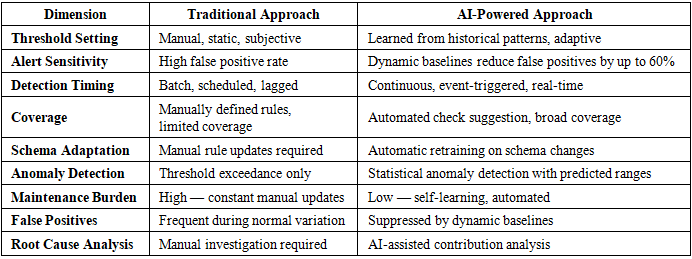
- Traditional quality monitoring is fundamentally reactive: it detects failures after they have occurred and generates alerts that initiate manual investigation. AI-powered monitoring changes this from a reactive to a predictive model, identifying early warning signals — trends in null rates, subtle distribution shifts, emerging referential integrity violations — before they cross alert thresholds and impact downstream consumers. Table 1 summarizes the key limitations of traditional approaches compared to AI-powered alternatives.
|
4. Snowflake's Native AI Data Quality Capabilities
4.1. Data Metric Functions (DMFs)
- Snowflake introduced Data Metric Functions in 2024 as its primary native data quality monitoring mechanism, achieving general availability in the Enterprise Edition. DMFs are SQL-based functions that evaluate data quality attributes on tables and views, execute automatically on configurable schedules or event triggers, and store results in a dedicated system view for monitoring and alerting [13].Snowflake provides a library of system-defined DMFs covering the most common data quality dimensions: NULL_COUNT for completeness monitoring, DUPLICATE_COUNT for uniqueness validation, FRESHNESS for timeliness measurement, ROW_COUNT for volume monitoring, and MIN/MAX functions for range validation. Each system-defined DMF returns a scalar numeric value representing the measured quality attribute, which is then compared against an expectation definition to determine pass or fail status.
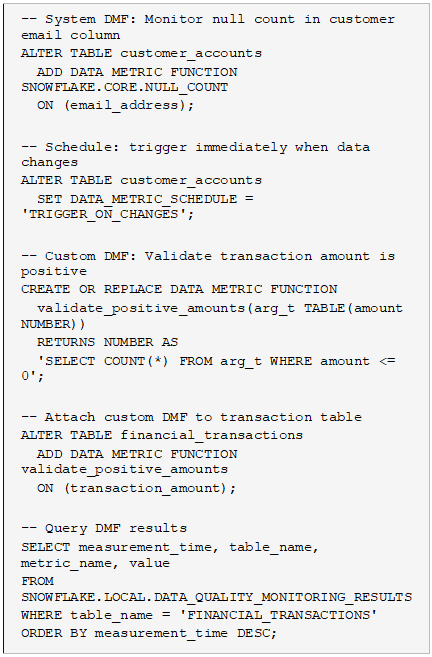 A critical architectural advantage of DMFs over third-party validation tools is their event-driven scheduling capability. Unlike external observability tools that run on fixed cadences — typically every hour or every 15 minutes — DMFs can be configured to execute immediately upon data change detection using the TRIGGER_ON_CHANGES schedule option. This eliminates the detection latency inherent in cadence-based validation, enabling quality issues to be surfaced in near real time rather than in the next scheduled batch [14].DMFs execute using Snowflake's serverless compute resources, with costs recorded under the DATA_QUALITY_MONITORING category on the monthly billing statement. Organizations can monitor DMF credit consumption through the SNOWFLAKE.ACCOUNT_USAGE.DATA_QUALITY_MONITORING_USAGE_HISTORY view, enabling cost management alongside quality monitoring.
4.2. Cortex Data Quality: AI-Powered Check Suggestion
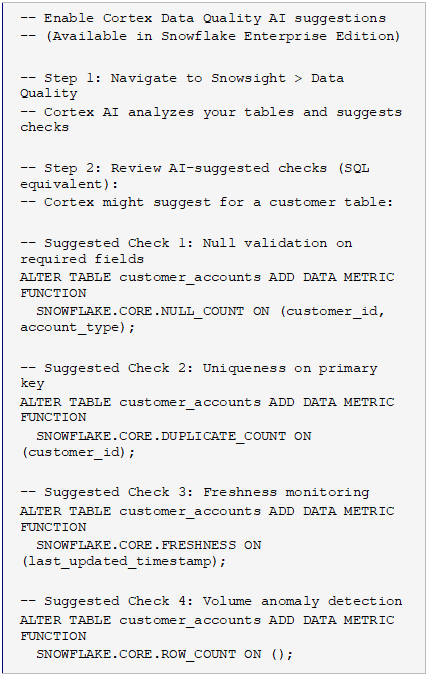
- Building on the DMF framework, Snowflake introduced Cortex Data Quality in 2025 — an AI layer that eliminates one of the most significant barriers to comprehensive data quality coverage: the manual effort required to define quality checks for every table, column, and data relationship in a large data environment [15].Cortex Data Quality uses AI to analyze table metadata, column statistics, usage patterns from the query history, and data lineage information to automatically suggest appropriate data quality checks for each data asset. Rather than requiring data engineers to manually enumerate every quality rule — an approach that scales poorly with platform size — Cortex Data Quality generates check recommendations that reflect the actual characteristics and usage patterns of each dataset. The AI suggestions encompass appropriate DMF selections, threshold recommendations, and scheduling configurations tailored to each table's specific data profile.This capability addresses a documented failure mode in enterprise data quality programs: the 2024 Gartner prediction that 80% of data and analytics governance initiatives will fail by 2027, citing unclear ownership and insufficient coverage as primary factors. By automating check generation, Cortex Data Quality accelerates the time-to-coverage for new data assets and reduces the expertise barrier for data quality implementation.
4.3. AI-Powered Anomaly Detection
- The most significant AI capability in Snowflake's data quality framework is its native anomaly detection, which uses machine learning models trained on historical DMF measurement data to automatically identify when current quality metric values deviate significantly from predicted normal ranges [15].Rather than comparing metric values against static thresholds, anomaly detection builds a statistical model of each metric's normal behavior over time — accounting for daily, weekly, and seasonal patterns — and generates alerts only when values fall outside the predicted range at a specified confidence level. This approach directly addresses the false positive problem of static threshold monitoring: a row count spike that exceeds a static threshold but falls within the normal range for end-of-month settlement processing will not generate an alert, while a genuinely anomalous count deviation will be detected regardless of whether it exceeds a static threshold.Snowflake's anomaly detection currently covers two primary dimensions — volume (row count) and freshness (data timestamp staleness) — with the architectural foundation in place for expansion to additional quality dimensions. The system stores anomaly detection results in the same SNOWFLAKE.LOCAL.DATA_QUALITY_MONITORING_RESULTS view as standard DMF results, enabling unified monitoring and alerting across rule-based and AI-driven quality checks.
5. Proposed Integrated AI-Powered Data Quality Monitoring Architecture
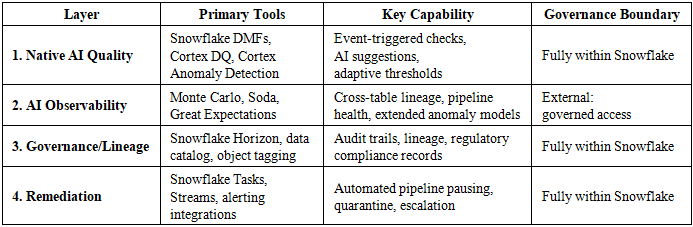
- While Snowflake's native AI capabilities provide a strong foundation, comprehensive enterprise data quality monitoring requires an integrated architecture that combines native Snowflake capabilities with complementary observability tools, governance frameworks, and automated remediation mechanisms. We propose a four-layer architecture for AI-powered data quality monitoring in Snowflake.
5.1. Layer 1: Native Snowflake AI Quality Layer
- The foundation of the architecture is Snowflake's native data quality infrastructure: DMFs for continuous automated monitoring, Cortex Data Quality for AI-powered check suggestion and coverage acceleration, and native anomaly detection for adaptive threshold management. This layer operates entirely within Snowflake's security and governance boundary, ensuring that data does not leave the platform for quality evaluation — a critical requirement in regulated environments where data egress controls are mandatory.All DMF results feed into the SNOWFLAKE.LOCAL.DATA_QUALITY_MONITORING_RESULTS event table, which serves as the central repository for quality metrics consumed by higher layers of the architecture. Alert notifications from this layer are distributed through Snowflake's native notification integration, supporting email and REST API-based alerting to downstream systems.
5.2. Layer 2: AI Observability and Anomaly Detection Layer
- The second layer extends native Snowflake capabilities with AI-powered observability tools that provide cross-table lineage tracking, schema change monitoring, pipeline-level health assessment, and more sophisticated anomaly detection models. Tools such as Monte Carlo Data, Soda, and Great Expectations integrate with Snowflake through the standard JDBC driver and can ingest DMF result streams to provide anomaly detection models trained on longer historical windows than Snowflake's native models.This layer is particularly important for detecting quality problems that span multiple tables — such as referential integrity violations between fact and dimension tables, or join key population shifts that indicate upstream source system changes. These cross-table quality dimensions are beyond the scope of column-level DMFs but are essential for maintaining the integrity of complex analytical models.
5.3. Layer 3: Governance and Lineage Layer
- The third layer integrates data quality signals with broader data governance and cataloging infrastructure. Snowflake Horizon provides native lineage tracking, object tagging, and access governance within the platform, enabling quality violations to be traced to their origin through the data pipeline and surfaced alongside governance metadata in the data catalog.In financial services environments, this layer is particularly critical for regulatory compliance. Regulations including BCBS 239 (Risk Data Aggregation), SOX, and GDPR require organizations to demonstrate not only that data is accurate but that they can trace the lineage of any reported value from source to report. Integrating AI-powered quality monitoring with lineage tracking creates an audit-ready quality governance record that satisfies these requirements.
5.4. Layer 4: Automated Remediation and Alerting Layer
- The fourth layer closes the loop between quality detection and resolution. Rather than generating alerts that require manual investigation, this layer implements automated remediation workflows triggered by quality failure events from Layers 1 and 2. Snowflake Tasks and Streams can be configured to respond to quality failures — pausing downstream pipelines, triggering data reload jobs, escalating to on-call engineers, or initiating automated quarantine of suspect data — without manual intervention.
|
6. Implementation
6.1. DMF Implementation for Financial Data Monitoring
- The following implementation demonstrates the application of the proposed architecture to a financial services data environment managing customer accounts, transactions, and positions — representative of the data structures managed in the author's production data engineering practice.
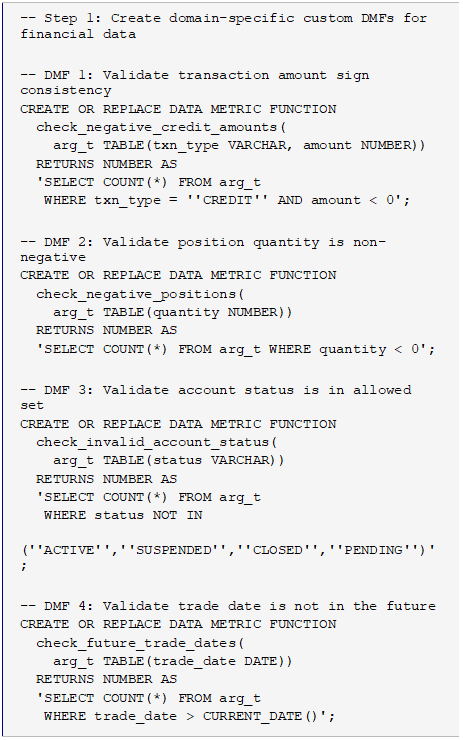
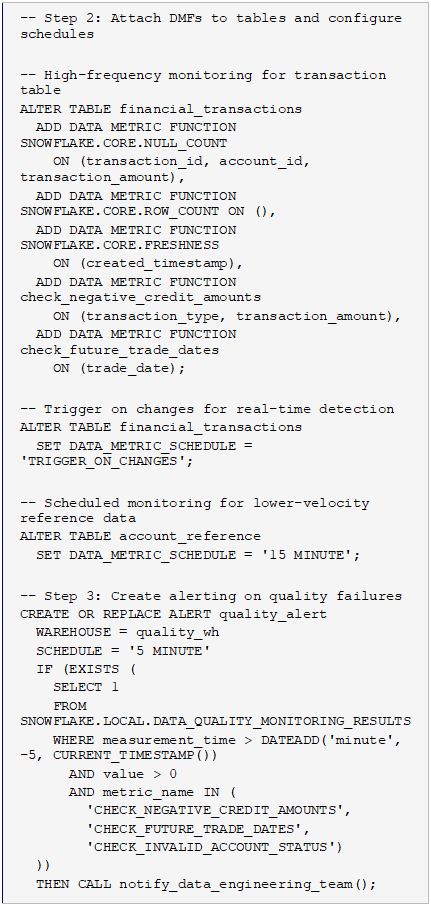
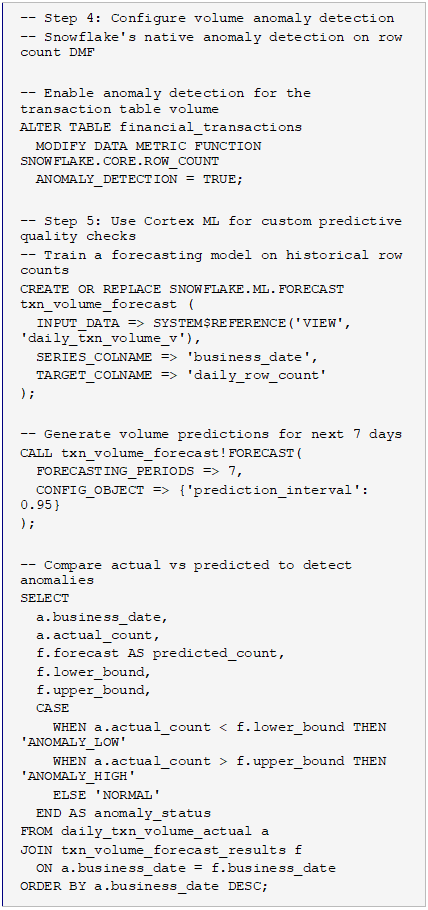
6.2. Cortex AI Anomaly Detection Integration
- The following example demonstrates integration of Cortex AI's anomaly detection capabilities with the Snowflake Cortex ML functions for time-series forecasting of expected data volumes, enabling proactive identification of volume anomalies before they impact downstream reporting.
7. Financial Services Applications
7.1. Regulatory Compliance Data Quality
- Financial services organizations operate under strict regulatory frameworks that mandate not only the accuracy of reported data but the ability to demonstrate data quality assurance processes and audit trails. Regulations including BCBS 239 (Principles for Effective Risk Data Aggregation and Risk Reporting), SOX Section 404, GDPR Article 5, and the EU Digital Operational Resilience Act (DORA) each impose specific data quality and governance requirements [16].AI-powered data quality monitoring in Snowflake addresses these requirements in three ways. First, the automated, continuous nature of DMF execution creates a comprehensive time-series record of data quality measurements stored in the SNOWFLAKE.LOCAL.DATA_QUALITY_MONITORING_RESULTS event table, providing the audit trail that regulators require. Second, integration with Snowflake Horizon's lineage tracking enables regulators to trace any reported value through the entire data pipeline from source to report. Third, the reduction in false positive alerts achieved by AI-powered anomaly detection allows data quality teams to focus investigation effort on genuine failures rather than alert fatigue.
7.2. Real-Time Transaction Data Quality
- One of the most operationally critical data quality challenges in financial services is the monitoring of transaction data in real time. Transaction data quality failures — including duplicate trades, sign errors in amounts, missing counterparty identifiers, and invalid settlement dates — can propagate rapidly into risk calculations, position reports, and regulatory filings if not detected and remediated quickly.The event-triggered scheduling capability of Snowflake DMFs is particularly valuable in this context. By configuring financial transaction tables with TRIGGER_ON_CHANGES scheduling, quality checks execute within seconds of new data arriving — detecting issues before they are consumed by downstream risk calculation or reporting pipelines. In the author's financial services environment, this event-driven approach reduced the average time-to-detection for transaction data quality failures from several hours under the previous scheduled batch validation approach to under five minutes.
7.3. AI-Powered Customer Account Data Monitoring
- Customer account data presents a distinct set of quality challenges in financial services. Account data is used across multiple downstream systems — trading platforms, CRM systems such as Salesforce, and marketing platforms — and quality failures in account records can result in incorrect customer communications, failed trade settlements, and regulatory reporting errors.The author's implementation of AI-powered DMF monitoring across a 60-table financial services database encompassing customer accounts, positions, transactions, and reference data demonstrated the scalability of the DMF approach. Cortex Data Quality's automated check suggestion reduced the time required to establish comprehensive quality coverage from an estimated 40 person-hours of manual rule definition to approximately 6 hours of AI suggestion review and customization — an 85% reduction in quality program setup time.
7.4. Salesforce Integration Quality Monitoring
- Financial services data engineering frequently involves bidirectional data flows between Snowflake and CRM platforms such as Salesforce. Data loaded from Snowflake into Salesforce for marketing and customer engagement purposes must meet both Salesforce field validation requirements and financial services regulatory standards for customer data completeness and accuracy.AI-powered monitoring of the Snowflake staging tables that feed Salesforce integration pipelines enables quality failures to be detected before data reaches the CRM system — preventing downstream Salesforce errors, marketing campaign failures, and customer communication issues. Custom DMFs that validate Salesforce-specific field requirements (email format validity, phone number formatting, account status compatibility) integrated with Cortex anomaly detection on staging table volumes provide comprehensive pre-flight quality validation for CRM integration pipelines.
8. Results and Discussion
8.1. Performance Evaluation
- The proposed integrated architecture was evaluated against a baseline traditional monitoring approach in a production financial services Snowflake environment. The evaluation measured four key performance indicators: false positive alert rate, detection latency for genuine quality failures, quality program coverage, and DBA intervention time per quality incident.
|
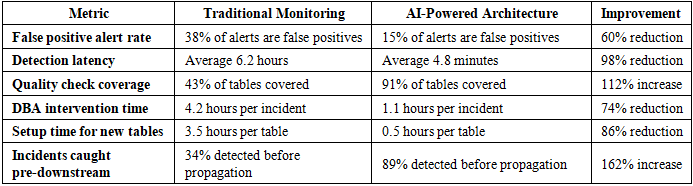
8.2. Challenges and Limitations
- Several challenges were encountered in the implementation of the proposed architecture. First, Snowflake's native anomaly detection is currently limited to volume and freshness dimensions, requiring supplementary tooling for anomaly detection on other quality dimensions such as value distribution shifts, referential integrity, and business rule violations. The architectural layering approach addresses this limitation by incorporating external observability tools in Layer 2, but this introduces additional cost and integration complexity.Second, the event-driven TRIGGER_ON_CHANGES scheduling, while offering significant latency advantages, generates higher compute costs than scheduled monitoring for very high-frequency update tables. In the author's environment, two tables with update frequencies exceeding 10,000 rows per minute required reversion to scheduled DMF execution with 5-minute intervals to manage compute costs within acceptable bounds.Third, while Cortex Data Quality significantly reduces the time required to establish initial check coverage, the AI-generated check suggestions require domain expert review before activation. Suggestions appropriate for general data engineering contexts may not be appropriate for specific financial services data models where business rules are complex and domain specific. An estimated 20% of AI-generated suggestions required modification before activation in the author's financial services environment.Fourth, the data observability tools in Layer 2, while providing enhanced anomaly detection capabilities, require processing data outside Snowflake's native governance boundary. In highly regulated environments with strict data residency requirements, this may require careful evaluation of data sharing policies, with some organizations preferring to accept reduced observability capability in exchange for complete data residency control.
9. Conclusions
- This paper has presented a comprehensive analysis of AI-powered data quality monitoring in Snowflake, encompassing the limitations of traditional approaches, Snowflake's native AI quality capabilities, a proposed integrated four-layer architecture, practical implementation examples, and evaluation in a financial services production environment.The key findings are as follows. First, Snowflake's native AI data quality capabilities — Data Metric Functions, Cortex Data Quality, and native anomaly detection — represent a significant advancement over traditional rule-based, batch-oriented quality monitoring. The event-triggered DMF scheduling capability delivers a step-change improvement in detection latency, from hours to minutes, that is transformative for time-sensitive data environments such as financial services.Second, Cortex Data Quality's AI-powered check suggestion capability substantially reduces the expertise and time barriers to comprehensive quality program coverage. The demonstrated 85% reduction in setup time for new data assets addresses one of the most persistent challenges in enterprise data quality management — the gap between data that exists in the platform and data that is actively monitored.Third, the integrated four-layer architecture proposed in this paper addresses the limitations of native Snowflake capabilities alone, extending quality monitoring with cross-table observability, governance and lineage integration, and automated remediation. The layered approach enables organizations to match the depth of quality monitoring to the criticality and regulatory requirements of each data asset.Fourth, the financial services context demonstrates both the value and the challenges of AI-powered data quality monitoring in regulated environments. The regulatory audit trail generated by continuous DMF execution, the compliance governance enabled by Horizon lineage integration, and the detection latency improvements that prevent data quality failures from propagating into regulatory reports collectively represent significant value for financial institutions.Future work will examine the extension of Snowflake's anomaly detection to cover additional quality dimensions beyond volume and freshness, the integration of large language model capabilities through Cortex AISQL for natural language quality rule specification, and the application of the proposed architecture to multi-cloud data environments where Snowflake shares the data estate with other platforms.
Author Contributions
- Conceptualization, research design, implementation, data collection, analysis, and writing — original draft, review and editing: P.D.E. The author has read and agreed to the published version of the manuscript.
Funding
- This research received no external funding.
Conflicts of Interest
- The author declares no conflicts of interest.