
-
Paper Information
- Paper Submission
-
Journal Information
- About This Journal
- Editorial Board
- Current Issue
- Archive
- Author Guidelines
- Contact Us
Computer Science and Engineering
p-ISSN: 2163-1484 e-ISSN: 2163-1492
2026; 16(1): 13-19
doi:10.5923/j.computer.20261601.02
Received: Jan. 19, 2026; Accepted: Feb. 3, 2026; Published: Feb. 9, 2026

Operationalizing Data Subject Rights in the AI Era: An SRE-Inspired, Socio-Technical Framework for Ethical Reliability
 Abstract
 Reference
 Full-Text PDF
 Full-text HTML
Prabal Pathak1, Dr. Ranjit Rajak2
1Principal PM Architect, Microsoft, Apex, NC, USA
2Assistant Professor, Department of Computer Science and Application, Dr. Hari Singh Gour Central University Sagar, MP, India
Correspondence to: Prabal Pathak, Principal PM Architect, Microsoft, Apex, NC, USA.
| Email: |  |
Copyright © 2026 The Author(s). Published by Scientific & Academic Publishing.
This work is licensed under the Creative Commons Attribution International License (CC BY).
http://creativecommons.org/licenses/by/4.0/

Data subject rights (access, rectification, erasure) are central to modern privacy law, but in AI-intensive enterprises they are often fulfilled via workflows that do not reliably cover derived artifacts such as features, embeddings, logs, and model-related outputs. This gap turns formally granted rights into inconsistently delivered outcomes and undermines trust. We propose a socio-technical framework that treats data subject rights request response (DSRR) as a reliability problem analogous to production services. The framework introduces a control plane that maintains canonical request state, scope decisions, and evidence, and a data plane that executes collection, deletion, and correction across heterogeneous data stores and AI pipelines using lineage and policy. We define service-level indicators and objectives for timeliness, coverage, and response accuracy, and show how error budgets and continuous improvement practices from Site Reliability Engineering can be applied to rights operations. A limited simulated evaluation illustrates phased adoption effects on AI-system coverage and timeliness while preserving accuracy. We also discuss AI-specific erasure challenges, including machine unlearning and partial erasure, and outline directions for empirical validation and governance.
Keywords: Data subject rights, DSAR, AI governance, Privacy engineering, Site Reliability Engineering, Data lineage, Service levels, Autonomy, Accountability
Cite this paper: Prabal Pathak, Dr. Ranjit Rajak, Operationalizing Data Subject Rights in the AI Era: An SRE-Inspired, Socio-Technical Framework for Ethical Reliability, Computer Science and Engineering, Vol. 16 No. 1, 2026, pp. 13-19. doi: 10.5923/j.computer.20261601.02.
Article Outline
1. Introduction
- Over the last decade, privacy regulations such as the EU General Data Protection Regulation (GDPR), the California Consumer Privacy Act as amended by the CPRA (CCPA/CPRA), and the Indian Digital Personal Data Protection Act (DPDPA) have expanded individuals’ rights to access, correct, delete, restrict, and obtain copies of their personal data. [1–3]Meanwhile, enterprise systems have become AI-intensive and highly distributed: personal data is replicated and transformed across transactional backends and CRMs, clickstream/event logs, data lakes and warehouses, feature stores and vector databases, model training pipelines and registries, and online inference and monitoring stacks.In this setting, a single data subject rights request (DSRR)—for example, “delete my data” or “show me what you know about me”—touches raw records as well as derived artifacts (features, embeddings, audit logs, and model-related outputs). Meeting the intent of the right therefore requires both correct scoping and reliable execution across a dependency graph of systems.However, many organisations still fulfil DSRRs through ticket-driven, non-scalable workflows (shared mailboxes, case tools, ad hoc queries, and per-system escalation). These processes may pass compliance checks at low volumes, but they degrade as the data stack grows and response deadlines tighten—especially when AI pipelines and telemetry are in scope.This operational gap has ethical consequences: when infrastructure cannot reliably deliver outcomes, formally granted rights can fail to become lived rights in practice (Section 2.4).We therefore frame DSRR fulfilment as a reliability property of AI and data infrastructure—analogous to availability or latency—and draw on Site Reliability Engineering (SRE) to operationalise the idea with explicit metrics, targets, and continuous improvement mechanisms. [8]Our contributions are threefold. (1) We define “rights reliability” and motivate it as ethical infrastructure for AI-era DSRR. (2) We propose a socio-technical control-plane/data-plane architecture that integrates lineage for dynamic scoping and evidence. (3) We formalise service-level indicators and objectives for timeliness, coverage, and response accuracy, and illustrate their behaviour via a small simulated evaluation that models phased adoption. We also extend the discussion to AI-specific erasure challenges, including machine unlearning and partial erasure of derived artifacts.
2. Background: Regulation, Practice and Ethics
2.1. Data Subject Rights and AI
- GDPR and similar frameworks articulate a rich set of rights: access, rectification, erasure, restriction, portability and objection. Although their doctrinal details differ, they share a common ambition: individuals should not be entirely at the mercy of opaque data and AI systems. They should be able to see, contest and reshape how their data is used. However, these rights were largely drafted with traditional data processing in mind: well-bounded databases, clear controllers and processors, and relatively static pipelines. AI practice has moved towards continuous training cycles, large-scale logging and telemetry, complex feature engineering and global, multi-tenant cloud infrastructures.
2.2. DSAR Tooling and Operational Gaps
- A commercial ecosystem of Data Subject Access Request (DSAR) and privacy management tools supports intake portals, case management, templated communications, and connectors to common systems of record. These platforms reduce coordination friction, but many assume a relatively static system inventory and provide limited integration with data lineage or AI-specific artifacts (feature stores, embeddings, model checkpoints, and inference logs). As a result, they often manage the paperwork of rights better than the infrastructure of rights. [4–7]
2.3. SRE and Reliability Beyond Availability
- Site Reliability Engineering (SRE) emerged in large-scale Internet companies as a way to make reliability measurable and manageable. Rather than treating reliability as an abstract desideratum, SRE practices define service level indicators (SLIs), service level objectives (SLOs) and error budgets. Our contribution is to extend this idea to data subject rights: to treat the ability to fulfil DSRRs in AI systems as a reliability property with its own SLIs, SLOs and error budgets. [8]
2.4. Ethical Stakes: From Formal Rights to Lived Rights
- From an ethical perspective, the decisive question is not whether rights exist in law, but whether people can meaningfully exercise them. In AI-era systems, weak scoping, incomplete system coverage, and delays can turn rights into symbolic assurances. We use the term formal rights to refer to doctrinal entitlements and lived rights to refer to the delivered outcomes shaped by infrastructure and practice. The remainder of the paper treats timeliness, coverage, and response accuracy as measurable levers that narrow (or widen) the gap between formal and lived rights. [13]
3. Conceptual Framework: DSRR Reliability as Ethical Infrastructure
- We propose to understand the technical fulfilment of DSRRs as a form of ethical infrastructure: a set of systems, processes and metrics whose reliability directly affects people’s ability to exercise their rights. In many organisations, DSRR fulfilment is not treated as an explicit system property. It is handled through ad hoc processes: a privacy team receives requests, files tickets to engineering teams, and hopes that the relevant systems respond within regulatory deadlines. This approach may work when the number of systems and requests is small, but it does not scale gracefully. [11,12]By contrast, treating DSRRs as a reliability property means asking what it means for an organisation to be reliable in respecting data subject rights, how that reliability can be measured over time and how infrastructure should be designed so that reliability improves rather than degrades as AI systems grow. We argue that this amounts to defining a new class of non-functional requirement for AI systems: rights reliability.We operationalise rights reliability along three dimensions—timeliness, coverage, and response accuracy—because each directly affects whether a right is practically exercisable in AI-intensive environments. Section 5 provides formal definitions and example service level objectives, and Section 7 discusses ethical risks such as metric gaming and rights-washing.
4. Socio-Technical Architecture for AI-Era DSRR
- To support reliable DSRR fulfilment in AI systems, we propose a two-plane architecture that explicitly connects legal rights, organisational processes and technical infrastructure. The control plane aggregates the capabilities needed to handle DSRRs end to end: an intake and API layer, case management and workflow, a policy engine, an orchestrator and an evidence store. The data plane encompasses the heterogeneous systems where personal and derived data reside: relational databases, data lakes and warehouses, SaaS platforms, feature stores and vector databases, model registries and observability platforms.Figure 1 illustrates the proposed two-plane architecture for AI-era DSRR operations. The control plane encapsulates the logical capabilities required to handle DSRRs end to end: a DSRR intake and API layer acting as the single entry point for portals and programmatic calls, case management and workflow that coordinate privacy, legal and engineering stakeholders, a policy engine that evaluates regulatory and contractual requirements, an orchestrator that decomposes each DSRR into per-system tasks and an evidence store that captures immutable audit traces. The data plane groups the systems where personal and derived data actually reside, including connectors to databases and SaaS systems, data lakes and warehouses, feature stores and vector databases, logs and telemetry platforms and ML models/model registries.
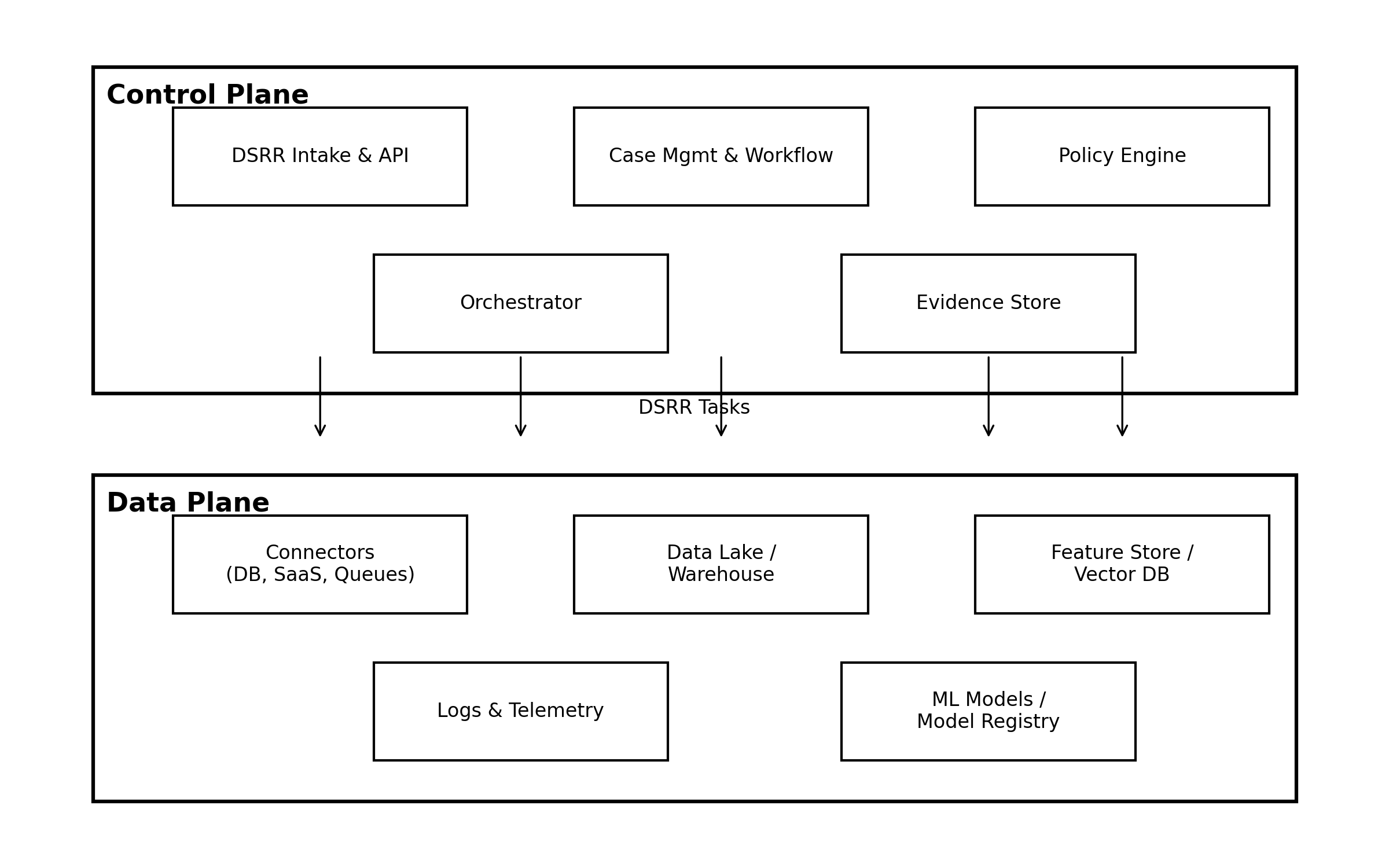 | Figure 1. High-level DSRR control-plane and data-plane architecture |
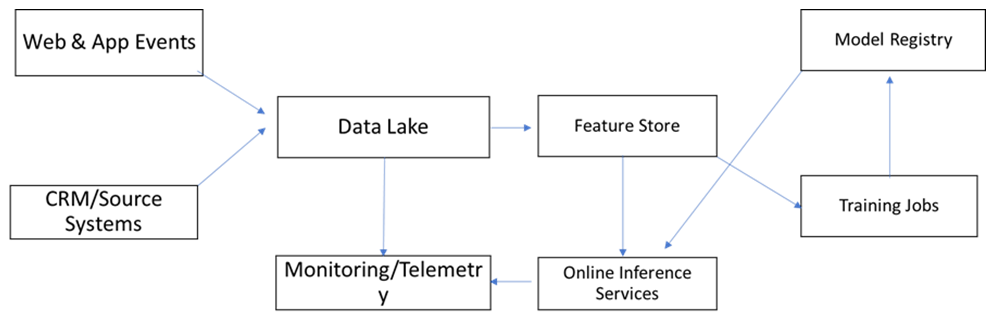 | Figure 2. Simplified data-lineage graph linking source systems, data lake, feature store, model registry and online inference services |
4.1. AI-Specific Erasure: Machine Unlearning and Partial Erasure
- AI-era erasure introduces a qualitative difference: the subject’s data may persist as influence rather than as an identifiable record. In addition to deleting rows in source systems, organisations must account for derived artifacts such as feature vectors, embeddings, materialised aggregates, model checkpoints, cached prompts/responses, and monitoring traces that can retain or reintroduce personal information.Machine unlearning provides a spectrum of techniques to reduce or remove a subject’s influence on a trained model without always retraining from scratch. Operationally, organisations may choose among: (i) exact retraining from data-excluded corpora when feasible; (ii) approximate unlearning techniques that target specific examples or users while preserving model utility; and (iii) containment and mitigation controls, such as model version pinning, gated inference, and subject-level suppression rules that prevent the subject’s data from being reintroduced into future training or downstream features, even while legacy checkpoints are being phased out.Because perfect erasure from learned parameters may not be technically or economically achievable in all settings, we treat partial erasure as an explicit operational state that must be declared, justified, and governed. The DSRR control plane should record: which artifacts were deleted (tables, logs, feature stores), which were regenerated (features, aggregates), which models were retrained or replaced (including model version identifiers and the selected erasure approach), and what residual risk remains (e.g., potential memorisation in legacy checkpoints or third-party replicas), along with the controls that reduce that residual risk.From a rights-reliability perspective, partial erasure primarily impacts coverage (completeness of affected systems/artifacts) and response accuracy (truthfulness of the claim that erasure has been effected). Accordingly, the evidence ledger should attach verifiable signals—deletion receipts, pipeline run identifiers, model lineage links, and approved policy waivers—to each DSRR, enabling internal audit and, where appropriate, regulator-facing transparency.Finally, we recommend a risk-tiered policy for AI-specific erasure. For higher-risk contexts (e.g., sensitive attributes, vulnerable populations, high memorisation risk), organisations should prioritise stronger guarantees (retraining or approved unlearning methods) and tighter error budgets. For lower-risk contexts, staged remediation with clear data-subject communication may be acceptable, but only if residual risk, scope, and remediation timelines are documented and monitored.
5. Formalizing Reliability Metrics for DSRR
- To move from architectural principles to actionable governance, we define a set of service level indicators (SLIs) and associated service level objectives (SLOs) for DSRR operations. Consider an evaluation window with N DSRRs. For each request we observe its completion time, the set of in-scope systems, the subset that responded successfully and whether a confirmed issue was later identified.We define three SLIs. The timeliness SLI measures the fraction of DSRRs completed within a target deadline T days. The coverage SLI measures, on average, what fraction of in-scope systems responded per request. The accuracy SLI measures the fraction of DSRRs that did not require rework due to incorrect or incomplete data. Each SLI has an ethical interpretation: timeliness relates to the idea that a right delayed is a right denied; coverage relates to equality and non-discrimination; and accuracy relates to truthfulness and harm avoidance.
6. Simulated Evaluation
|

|
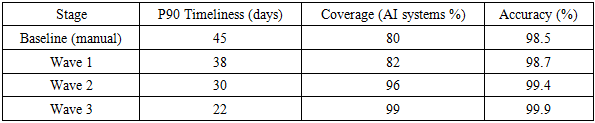
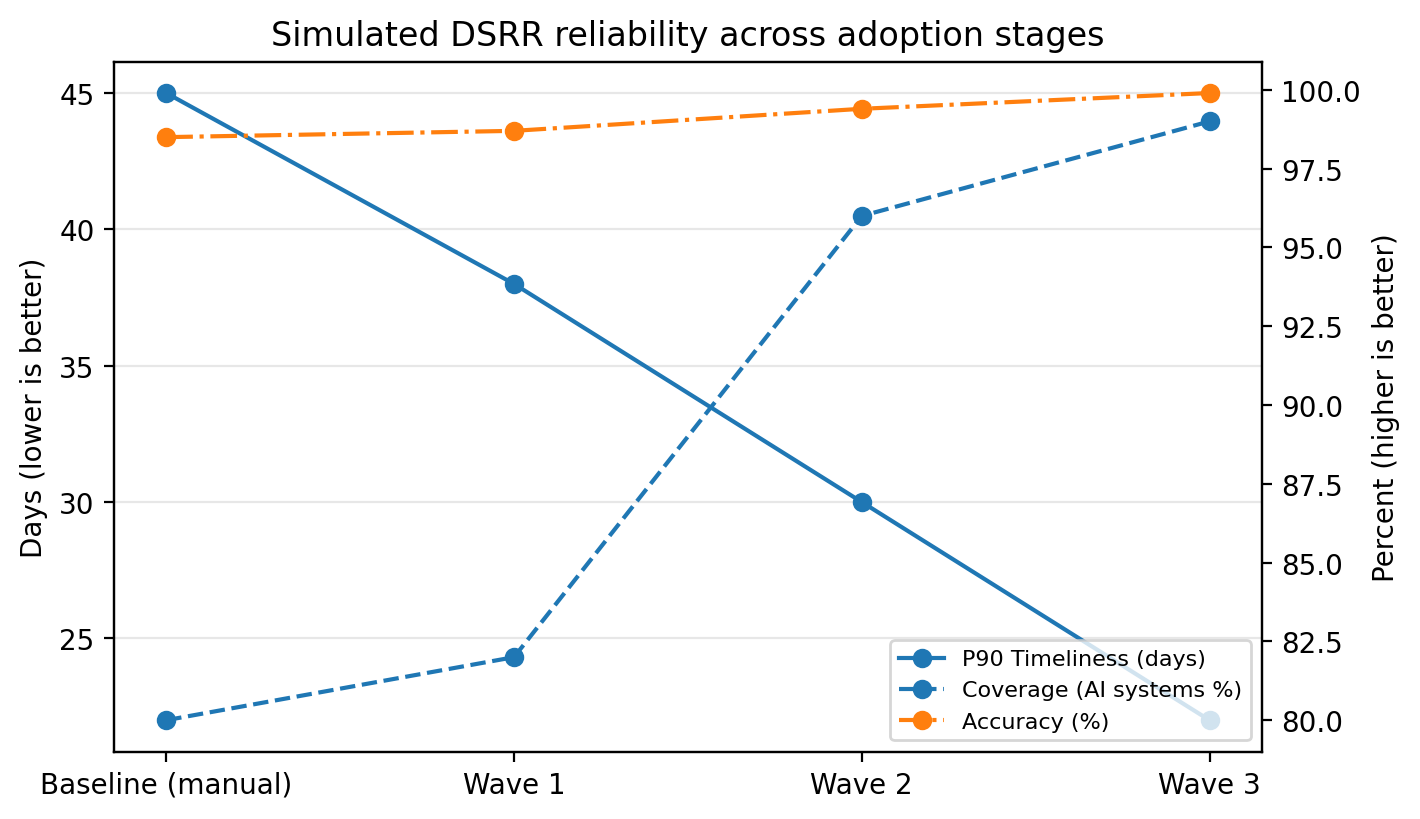 | Figure 3. Simulated DSRR reliability metrics across adoption stages (timeliness, coverage, accuracy) |
6.1. Limitations and Threats to Validity
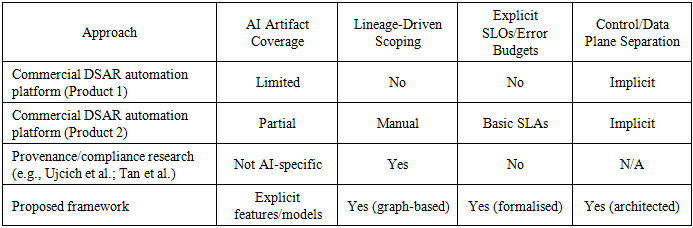
- This evaluation is intentionally modest. It is a simulation over a stylised topology rather than a longitudinal field deployment, and it abstracts away organisational factors such as staffing models, legal-review variability, and vendor dependencies. The main threat to validity is that real systems may exhibit different failure correlations (e.g., shared downstream bottlenecks) and different scoping ambiguity (e.g., identity resolution). Future work should therefore pair this framework with (i) pilot deployments in one or two production environments, (ii) open evaluation datasets for DSRR task completion traces, and (iii) comparative studies across organisations and sectors.Table 3 provides a concise comparison between representative DSAR automation platforms, prior provenance/compliance research, and the proposed framework. To avoid duplication, we use the table as the primary artefact and highlight only the key differentiators: explicit AI artifact coverage, operationalised lineage-driven scoping, and the use of SLIs/SLOs and error budgets as governance mechanisms.
|
7. Ethical Analysis and Discussion
- The framework has normative implications beyond technical efficiency. By making DSRR performance measurable and reviewable—using the same operational discipline applied to production reliability—organisations create internal incentives to invest in rights delivery rather than treating it as an afterthought.As discussed in Section 2.4, this supports a shift from formal rights (doctrinal entitlements) to lived rights (delivered outcomes). However, the shift is not automatic: metrics and dashboards can either surface gaps or be used to obscure them.A primary risk is metricisation: teams may optimise for favourable numbers while undermining the underlying right (e.g., closing cases prematurely, narrowing scope definitions, or privileging easy-to-serve systems). Another is rights-washing, where internal SLO attainment is presented as ethical adequacy without meaningful external accountability. Mitigations include independent audits, explicit reporting of scope exceptions, and evidence-backed claims about derived artifacts and model influence (Section 4.1).Finally, rights reliability reconfigures organisational decision-making. When error budgets constrain launches that increase DSRR debt, product and engineering teams become accountable for downstream rights impacts. To avoid concentrating power, oversight should include privacy, legal, and risk stakeholders, and—where feasible—public transparency reporting on aggregate reliability metrics.
8. Conclusions and Future Work
- This article argues that in AI-intensive environments, the ability to honour data subject rights should be treated as a reliability property of socio-technical systems, not merely as a legal obligation executed through manual workflows. We propose an SRE-inspired framing with explicit indicators, objectives, and error budgets, implemented via a control-plane/data-plane architecture integrated with data lineage and evidence.A limited simulated evaluation illustrates the directional benefits of this framing: coordination improves timeliness, lineage-driven scoping improves coverage for AI systems, and SLO/error-budget governance improves both timeliness and accuracy by prioritising remediation of dominant failure modes.Future work should focus on empirical validation in operational settings, including pilot deployments and cross-organisation studies. It should also deepen the integration with AI-era erasure techniques, including machine unlearning and partial erasure of embeddings, caches, and telemetry, and develop reporting standards that distinguish what was erased, what was retained under lawful exceptions, and what remains as model influence. [14–16]
Declarations
- AI tool usage statement: The author used an AI-assisted writing tool to support language polishing and restructuring. All outputs were reviewed and edited by the author, who takes full responsibility for the content.Competing interests: The author is employed by an organization that performs data subject rights request processing. The views expressed are the author’s own and do not necessarily represent those of the employer. No proprietary or confidential information was used. The author declares no competing interests beyond this employment relationship.Data availability: No new datasets were created or analysed in this study.