
-
Paper Information
- Paper Submission
-
Journal Information
- About This Journal
- Editorial Board
- Current Issue
- Archive
- Author Guidelines
- Contact Us
Clinical Medicine and Diagnostics
p-ISSN: 2163-1433 e-ISSN: 2163-1441
2014; 4(3): 33-41
doi:10.5923/j.cmd.20140403.01
Serum Adipokines in Hypertensive Male Patients with Metabolic Syndrome and Risk of Left Ventricular Hypertrophy
 Abstract
 Reference
 Full-Text PDF
 Full-text HTML
Bothina I. Saleh1, Salwa R. Ali2, Ghada F. El-Mahaseb2, Iman K. Ramadan3, 4, Basma K. Ramadan5, Amani M. Tawfik6
1Clinical Pathology Department, Faculty of Medicine (for girls), Al-Azhar University, Egypt
2Internal Medicine Department, Faculty of Medicine (for girls), Al-Azhar University, Egypt
3Community Department, Faculty of Medicine, King Abdulaziz University, Jeddah, Saudi Arabia
4Community Department, Faculty of Medicine (for girls), Al-Azhar University, Egypt
5Physiology Department, Faculty of Medicine (for girls), Al-Azhar University, Egypt
6Microbiology Department, Faculty of Medicine (for girls), Al-Azhar University, Egypt
Correspondence to: Bothina I. Saleh, Clinical Pathology Department, Faculty of Medicine (for girls), Al-Azhar University, Egypt.
| Email: |  |
Copyright © 2014 Scientific & Academic Publishing. All Rights Reserved.
Background:Adipokines had been suggested for their potential use in tracking the clinical progress in subjects with metabolic syndrome (MS). Retinol binding protein 4 (RBP4), an adipokine, that had been reported to induce insulin resistance and to play a role in the pathogenesis and severity of essential hypertension (EH), while adiponectin was known to have anti-inflammatory and anti-atherogenic activities. Objective: to investigate the relationship between serum RBP4, adiponectin with insulin resistance in hypertensive (HTN) male patients and its role in the severity of hypertension and risk of left ventricular hypertrophy (LVH). Subjects and Methods:This study included twenty five HTN male patients with mean age 48.84 ± 2.59 years and fifteen normal subjects with mean age 50.53 ± 1.96 years as a control (group III).The patients were divided into two groups; Group I, representing HTN patients with MS and Group II representing HTN patients without MS. All included males underwent history taking, physical examination including determination of BMI, waist circumference, blood pressure and the following laboratory investigations: measurement of levels of serum adiponectin, RBP4, lipid profile, uric acid, blood glucose, creatinine, high sensitivity C-reactive protein (hs-CRP) and, insulin together with calculation of homeostasis model assessment-insulin resistance (HOMA-IR).Assays of serum RBP4 and adiponectin were carried out using an enzyme-linked immunosorbent assay (ELISA) technique. Results: patients in Group I were found to have significant higher values of RBP4, BMI, waist circumference, HOMA-IR, uric acids and triglycerides with low adiponectin levels together with high prevalence of LVH compared to patient group II. Serum RBP4 was found to be positively correlated with HOMA-IR, hs-CRP, uric acid, systolic and diastolic blood pressure and negatively correlated with adiponectin and HDL. The area under the ROC curve (AUC) for adiponectin was 0.894 with cut-off value ≤10.75 μg/mL, while the AUC for RBP4 was 0.962 with cut-off value > 101 ng/mL. Conclusion: increased serum RBP4 and HOMA-IR with decreased adiponectin levels have a predictive value for the severity of hypertension and associated risk of LVH in HTN patients with MS.
Keywords: Retinol binding protein 4, Adiponectin, Essential hypertension, Metabolic syndrome, Insulin resistance
Cite this paper: Bothina I. Saleh, Salwa R. Ali, Ghada F. El-Mahaseb, Iman K. Ramadan, Basma K. Ramadan, Amani M. Tawfik, Serum Adipokines in Hypertensive Male Patients with Metabolic Syndrome and Risk of Left Ventricular Hypertrophy, Clinical Medicine and Diagnostics, Vol. 4 No. 3, 2014, pp. 33-41. doi: 10.5923/j.cmd.20140403.01.
Article Outline
1. Introduction
- Metabolic syndrome (MS) is defined by a constellation of interconnected physiological, biochemical, clinical, and metabolic factors that directly increases the risk of cardiovascular disease (CVD), type 2 diabetes mellitus, and all cause mortality. Insulin resistance (IR), visceral adiposity, atherogenic dyslipidemia with decreased high-density lipoprotein cholesterol (HDL-C) level and increased serum triglycerides (TG) concentration, endothelial dysfunction, genetic susceptibility, elevated blood pressure )BP), hypercoagulable state, and chronic stress are the several factors which constitute the syndrome. Chronic inflammation is known to be associated with visceral obesity and IR which is characterized by production of abnormal adipocytokines such as tumor necrosis factor α, interleukin-1 (IL-1), IL-6, leptin, and retinol-binding protein 4 (RBP4). Abdominal obesity and IR play a crucial role in pathogenesis of MS [1, 2].Worldwide prevalence of MS ranges from <10% to as much as 84%, depending on the region, urban or rural environment, composition (sex, age, race, and ethnicity) of the population studied, and the definition of the syndrome used. However, in Egypt the prevalence of MS was 7.4% among obese adolescents [3].Essential hypertension (EH) is a major public health problem of worldwide distribution [4]. Accumulating evidence suggested that IR plays an important role in the development of EH [5].Obesity is a risk factor for various CVD including hypertension, atherosclerosis, and myocardial infarction [6]. Adiponectin is a hormone that is derived from adipose tissue and is reduced in obesity-linked diseases including IR, type 2 diabetes and atherosclerosis. Adiponectin exerts its effects by binding to adiponectin receptors, two of which, AdipoR1 (skeletal muscle) and AdipoR2 (liver), had been cloned [7]. In addition, Adiponectin inhibits macrophage-to-foam cell transformation and reduces intracellular cholesteryl ester content in human macrophages by suppressing expression of class A scavenger receptor [8].RBP4, mainly secreted by adipocytes and the liver, was originally known as the specific carrier of retinol in circulation. Recent studies demonstrated that RBP4 levels were increased in obese and IR humans and mouse models. Many studies showed strong correlations of serum RBP4 levels with the severity of IR and obesity and with certain components of MS, including hypertension [9].In skeletal muscle, RBP4 reduces insulin sensitivity by inhibiting both insulin receptor substrate–1 phosphorylation and phosphatidylinositol 3-kinase activation, while increasing the rate of hepatic glucose production by increasing the activity of the gluconeogenic enzyme phosphoenolpyruvate carboxykinase [10].Left ventricular hypertrophy (LVH), one of the complications of EH is characterized by an increase in chamber mass produced largely by an increase in the size of cardiomyocytes [11] and it is, in turn an important risk factor for myocardial infarction, heart failure, stroke, and sudden cardiac death [12]. The determinants of LVH include age, elevated BP, obesity, and IR [11].The global comorbidity of MS, obesity and associated IR, insure the need to identify the key predictive factors for early diagnosis and intervention in order to prevent cardiovascular complications.The aim of this study is to assess serum levels of adiponectin and RBP4 in hypertensive (HTN) male patients with MS and to investigate their correlations with IR and possible role in severity of hypertension and risk of LVH.
2. Subjects and Methods
- A case control study was carried out during August 2013 and February 2014. Twenty fife HTN male patients with mean age 48.84 ± 2.59 (age range between 45 - 55 years) were randomly recruited from the Internal Medicine Department of Al –Zahraa University Hospital, Cairo, Egypt. Fifteen, age and sex matched, apparently healthy individuals were randomly chosen as a control group. Consent was obtained from all subjects before being participated in the study. The patients were divided into two groups; Group I, (n=13); representing HTN patients with MS and Group II, (n=12); representing HTN patients without MS, while control group was defined as group III. Choice of HTN patients was done according to Joint National Committee (JNC 7) guidelines [13], where EH was defined as BP ≥140/90 mmHg or use of antihypertensive treatment at the time of enrollment in the study with absence of clinical signs suggestive of secondary HTN. HTN patients were further classified into 2 stages; stage I with BP range 140-159/90-99 mmHg and stage II with BP ≥160/100 mmHg [14].MS was diagnosed based on the Third Report of the National Cholesterol Education Program’s Adult Treatment Panel [15], if at least three of the following conditions were met: high BP (systolic and/or diastolic BP ≥130/85 mmHg or patients receiving anti-hypertensive drugs), hyperglycemia (fasting plasma glucose ≥110 mg/dL or patients receiving oral hypoglycemic agents), hypertriglyceridemia (fasting plasma triglycerides ≥150 mg/dL), low high-density lipoprotein cholesterol (HDL-C) (fasting HDL-C < 40 mg/dL for men), or central obesity (waist circumference of ≥ 90 cm for men).All participants were subjected to the following:
2.1. Full History and Complete Clinical Examination
- i) Blood pressure measurement; any patient was considered HTN if he is already on antihypertensive medication or ≥ 140 /90 according to criteria of Joint National Committee (JNC 7) guidelines [13].ii) Body mass index (BMI) was calculated as the ratio of the weight to the height squared (kg/m2). Waist circumference was taken with a tape measure horizontally at the umbilicus, midpoint between the lower rib margin and the iliac crest while subjects were in the standing position after normal expiration [16].
2.2. Imaging Study
- All HTN patients had been subjected to transthoracic echocardiography for diagnosis of LVH. Left ventricular dimensions were measured by echocardiography (Powervision 6000, Toshiba, probe frequency 2.5 MHz) following the American Society of Echocardiography recommendations [17]. For each patient the following measurements were taken: end-diastolic and end-systolic interventricular septum thickness (IVSD and IVSS, respectively), posterior wall thickness (PWD and PWS, respectively), and left ventricular diameters (LVDD and LVDS, respectively); left atrial diameter (LAD). LVM was calculated (M-mode tracings under two-dimensional control, left parasternal short axis view, mean of three cardiac cycles) by using the Devereux’s formula and indexed by height2.7 (LVM/ h2.7) [18]. LVH was defined on the basis of the LVH/h2.7, using ≥ 49.2 g/m2.7 in men as partition values [19].
2.3. Laboratory Investigations
- After 12 hrs overnight fasting, venous blood samples were obtained from all subjects by venipuncture under aseptic condition. The samples were transferred into clean, plain tubes and centrifuged within 30 minutes of collection for 10 minutes; part of the sera was stored at – 20℃ until it was assayed for RBP4 and adiponectin. The remaining part was used for measurement of the following parameters: • Lipid profile was measured photometrically using Cobas C-311 autoanalyzer. Reagents were supplied by Roche diagnostics (F. Hoffmann-La Roch Ltd., Basel, Switzerland). Low density lipoprotein cholesterol (LDL-C) was calculated using the Friedewald formula [20].• Serum uric acid, creatinine, and blood glucose levels were measured by enzymatic colorimetric assay, using Cobas C-311 autoanalyzer. Reagents were supplied by Roche diagnostics.• hs-CRP was done by ELISA using a complete set of ELISA reader model SLT Spectra 216687. The Kits was supplied by Monobind Inc. CA, USA. (Product code 3125-300).• Insulin level was measured by chemiluminescent immunoassay using an Immulite 2000 analyzer (Siemens Healthcare Diagnostics Inc., West Sacramento, Calif., USA). HOMA-IR is an estimate of IR derived from fasting glucose and insulin levels, with higher levels representing greater degrees of IR [21]. HOMA-IR was calculated using the following equation: HOMA-IR = fasting insulin (µU/L) × fasting glucose (mmol/L)/22.5 [10]. IR was defined if HOMA-IR ≥ 2.5 according to the Japanese guideline for the treatment of diabetes [22].• Serum RBP4 level was measured by ELISA using a complete set of ELISA reader model SLT Spectra 216687 with Quantikine® Human RBP4 ELISA Kit supplied by R&D Systems, Inc. Minneapolis, MN, USA (Cat. No. DRB400).This assay employs the quantitative sandwich enzyme immunoassay technique. A monoclonal antibody specific for RBP4 had been pre-coated onto a microplate. Standards and samples were pipetted into the wells and any RBP4 present is bound by the immobilized antibody. After washing away any unbound substances, an enzyme-linked monoclonal antibody specific for RBP4 is added to the wells. Following a wash to remove any unbound antibody-enzyme reagent, a substrate solution was added to the wells and colour develops in proportion to the amount of RBP4 bounded in the initial step. The colour development is stopped and the intensity of the colour is measured at 450 nm.• Serum adiponectin was assessed by ELISA using a complete set of ELISA reader model SLT Spectra 216687 with Quantikine human adiponectin / Acrp30 Immunoassay Kit supplied by R&D Systems, Inc. Minneapolis, MN, USA (Cat. No. DRB300).This assay also, employs the quantitative sandwich enzyme immunoassay technique. A monoclonal antibody specific for adiponectin had been pre-coated onto a micro-plate. Standards and samples (diluted 100 – fold by calibrator diluent RD6 – 39), were pipetted into the wells and any adiponectin present is bounded by the immobilized antibody. After washing away any unbound substances, an enzyme-linked monoclonal antibody specific for adiponectin was added to the wells. Following a wash to remove any unbound antibody-enzyme reagent, a substrate solution was added to the wells and colour develops in proportion to the amount of adiponectin bounded in the initial step. The colour development is stopped and the intensity of the colour is measured at 450 nm.
3. Statistics
- All statistical analyses were performed using a commercially available statistical package for social science (SPSS) version 17. Categorical data were presented as frequency and percentages while numerical data were presented in terms of range, mean ± standard deviation. Association between determinants of metabolic syndrome and hypertension was tested using chi square for categorical variables and independent t test for numerical variables; for parametric variables and Wilcoxon Rank Sum test for non parametric variables. Correlation between RBP4 and adiponectin with clinical and biochemical variables was tested using Pearson correlation coefficient for parametric variables and Spearman’s correlation was used for nonparametric ones. Receiver operating characteristics (ROC) curve analysis was performed to determine a threshold concentration of serological biomarkers predicting the development of MS. All p values were two sided and considered significant at ≤ 0.05.
4. Results
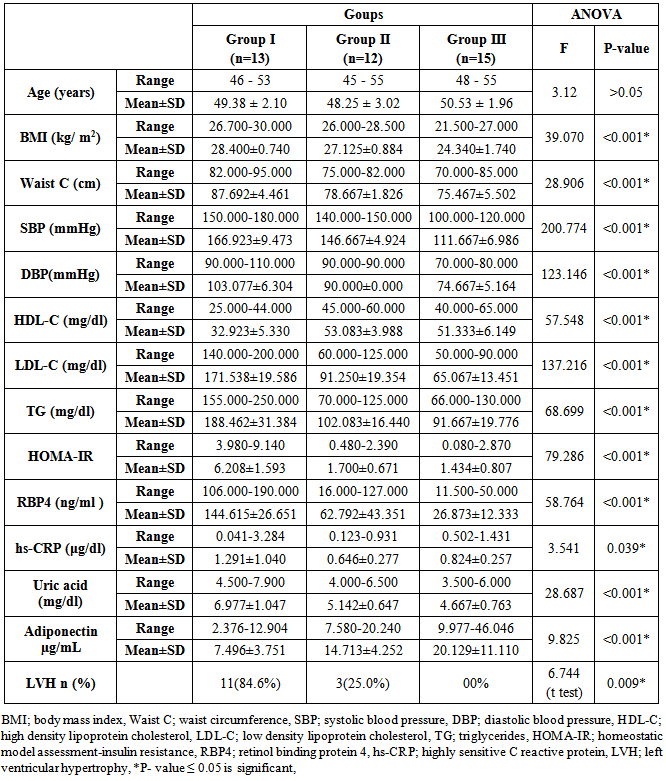
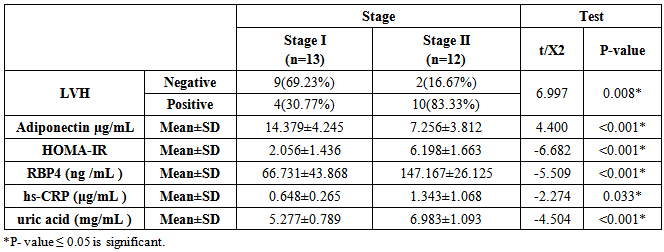
- Forty male subjects were included in this study; 15 healthy individuals and 25 HTN patients. Thirteen patients were met the NCEP criteria for MS (Group I) and the rest 12 patients were categorized as HTN without MS (Group II). According to BP level, HTN patients were reclassified into 2 groups; stage I (n=13) with BP range 140-159/90-99 mmHg and stage II (n=12) with BP ≥160/100 mmHg. The control group was represented as group III (n=15).HTN patients with MS had significantly higher values of BMI, waist circumference, systolic and diastolic BP, HOMA-IR index, serum RBP4, hs-CRP, uric acid, TG, LDL-C, with significantly lower values of adiponectin and HDL-C compared to HTN without MS and control groups. Also, LVH was noticed to be statistically significantly higher among HTN MS patients compared to the other groups (table 1).
|
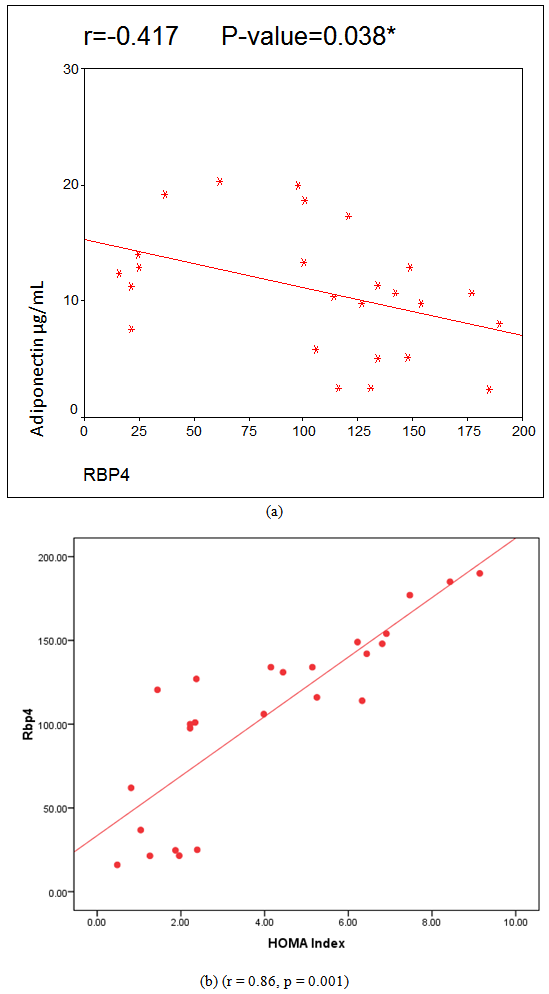 | Figure 1. Linear relationship between the level of serum RBP4 and (a) adiponectin (negative correlation); (b) HOMA-IR (positive correlation) |
|
|
|
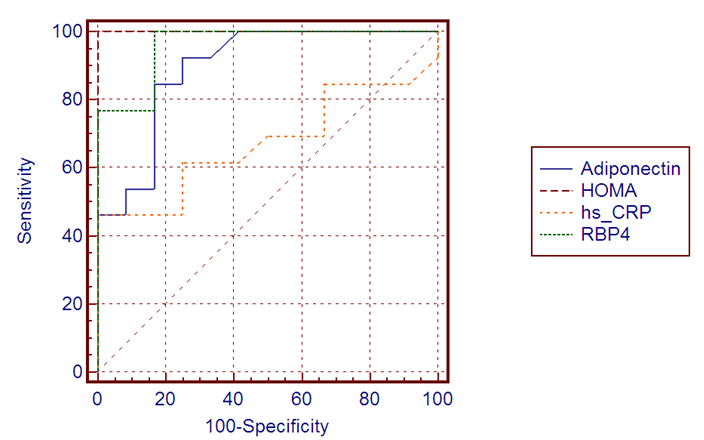 | Figure 2. ROC curve of serum biomarkers for prediction of development of metabolic syndrome |
5. Discussion
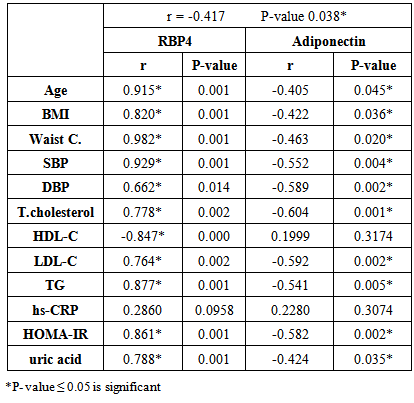
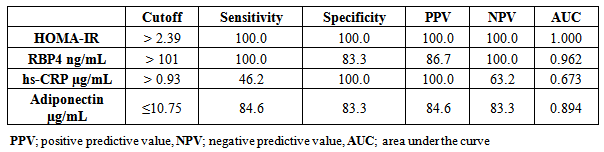
- In our study, comparing HTN patients with MS to those without MS and to control group had revealed that there was a significant increase in BMI, waist circumference, systolic and diastolic BP, HOMA-IR, serum RBP4, hs-CRP, uric acid, LDL-C, and TG, with significant decrease in serum adiponectin and HDL-C levels. There was a statistically significant increase in the prevalence of LVH among HTN MS patients compared to HTN without MS and control groups.These results were in consistent with Lin et al. [23] and Park et al. [24] who found that, BMI and waist circumference were significantly higher in the HTN with MS group than in HTN patients without MS. TG levels were elevated and HDL-C levels were significantly reduced in the HTN with MS group. The observed association between RBP4 and TG may be due to the lipid-modulating activities of retinoids and retinol-binding proteins. Hypertriglyceridemia, led by hyperinsulinemia, may subsequently provoke the synthesis and secretion of RBP4 from the liver or ectopic fat [25, 26].In HTN patients of our study, RBP4 was found to be significantly correlated with BMI, waist circumference, SBP, DBP, HOMA index, and TG, but negatively correlated with HDL-C. Conversely, significant negative correlations were found between adiponectin and BMI, DBP, TG and HOMA-IR with no significant correlations with HDL-C, and hs-CRP. Our results coincides with Lin et al. [23], Chiba et al. [27], Awad et al. [28] and Suh et al. [10] who reported that serum RBP4 concentrations were positively correlated with age, DBP, and HOMA-IR. Mostafaie et al. [25] also reported that, BMI, insulin concentrations and HOMA-IR were correlated significantly with RBP4 concentrations. However, he found that there was no significant association between RBP4 and BP. Berg and Scherer, [29] and Mathieu et al. [30] had demonstrated that the serum levels of adiponectin, are significantly low in patients with visceral obesity a-nd IR. Ryo et al. [31] demonstrated that adiponectin concentration correlated negatively with TG, systolic BP, diastolic BP, fasting glucose, and fasting insulin, and positively with HDL-C.Other studies, on the other hand, had reported contradictory findings regarding the association of RBP4 with IR and other metabolic parameters. Studies by Shim et al. [32] and Takashima et al. [33] revealed that, there were no significant differences in blood pressure, total cholesterol, LDL-C, hs-CRP and metabolic parameters among non diabetic HTN patients with and without MS. Also, they found that there was no significant correlation of RBP4 with waist circumference, HDL-C, and the HOMA-IR.This controversy may be explained by that; raised RBP4 is associated with an elevation of liver fat but not visceral fat (abdominal obesity) in humans [34]. Also, HOMA-IR may not be an ideal measurement of insulin sensitivity, especially in subjects with impaired fasting glucose or impaired glucose tolerance [35]. There may be some other factors, perhaps the difference in results may be attributed to a difference in ethnicity, degree of obesity, and subset of the patients analysed.Hyperuricemia was related to an increased incidence of high BMI, high BP and high TG [24]. It was also found to be associated with the development of end-organ damage such as increased carotid intimal media thickness and it is regarded as a cardiovascular risk factor and a determinant of MS [36]. In the present study, uric acid was found to be significantly elevated in HTN with MS group, negatively correlated with adiponectin and positively correlated with RBP4. This was in agreeing with a study conducted by Park et al. [24]. Adiponectin is known to have anti-inflammatory and anti-atherogenic properties. Low adiponectin levels were found to be significantly correlated with various indices of MS [24]. RBP4 is regarded as a novel cardiometabolic risk factor that is upregulated in insulin resistant states associated with obesity [37]. Large adipocytes, found in obese subjects, produce lower levels of adiponectin but higher levels of pro-inflammatory adipocytokines [8].In our study, stage II HTN patients were found to have significantly higher RBP4 and significantly lower adiponectin in comparison to stage I group indicating the possible role of these biomarkers in the severity of HTN. Also, we found that there was an increase in the prevalence of LVH in patients group I (84.6% vs. 25.0% in patients group II) with significant increase in the percent of LVH in patients group of stage II HTN (83.33 vs. 30.77% in stage I HTN patients). LVH represents an independent risk factor for cardiovascular morbidity and mortality in EH [38]. Insulin stimulates protein synthesis and inhibits protein breakdown in the heart, and clinical studies had found that elevated plasma insulin is associated with LVH [39].Our results were in concordance with de Simone et al. [40] and Guerra et al. [12]. Specifically, RBP4 levels had been shown to be positively correlated with the echocardiographically measured left ventricular wall thickness and carotid intima-media thickness [37].Berg and Scherer, [29] stated that the low levels of adiponectin were associated with the presence of CVD and appear to be a risk factor for CVD. Ryo et al. [31] had reported that subjects with plasma adiponectin concentration <4.0 μg/ml had a 2-fold increase in the incidence of CVD.A good screening test requires high sensitivity and high to moderate specificity. In the present study, determination of the cutoff values of each biomarker had revealed that when a cutoff value of HOMA-IR >2.39 was used; HOMA-IR predicted the presence of MS with a sensitivity of 100% and 100% specificity, while RBP4 at cutoff value >101 ng/mL showed 100% sensitivity and 83.3% specificity then adiponectin at a cutoff value ≤10.75 μg/mL the sensitivity and specificity were 84.6% and 83.3%, respectively. This might indicates that IR may be at the core of the cluster of metabolic abnormalities that characterizes MS. Despite this, these results may need more confirmation due to the small size population of our study.Study by Basheer et al. [41] had revealed that the best diagnostic cutoff value of RBP4 was 140 ng/mL (diagnostic sensitivity 72%, specificity 55%, PPV value 67%, NPV 61%), however this study was conducted over diabetic patients. Singh et al. [42] had reported HOMA-IR cutoff value of 2.5 had a sensitivity of >70% and specificity of >60% for prediction of MS, while Jover et al. [43] had reported adiponectin cutoff of 8 μg/mL had a PPV of 32% and a NPV value of 90% for the severity of CVD.
6. Conclusions
- High levels of serum RBP4 and HOMA-IR index with low serum adiponectin were found to be strongly associated with MS in HTN patients (especially those with stage II HTN) together with increased prevalence of LVH. Changes in the levels of these biomarkers above the cutoff values might considered as a potential MS predicting markers that can be used to assess the severity of hypertension and the risk of LVH in HTN patients. Future prospective studies with greater numbers of patients are recommended to establish a direct relationship between serum adiponectin and RBP4 concentrations and HOMA-IR in HTN patients with MS.