
-
Paper Information
- Paper Submission
-
Journal Information
- About This Journal
- Editorial Board
- Current Issue
- Archive
- Author Guidelines
- Contact Us
Clinical Medicine and Diagnostics
p-ISSN: 2163-1433 e-ISSN: 2163-1441
2013; 3(5): 111-114
doi:10.5923/j.cmd.20130305.03
The Correlation between the Abnormal Hormonal Assay and Infertility among Saudi Males
 Abstract
 Reference
 Full-Text PDF
 Full-text HTML
Wesam Khan1, 2, Anmar Nassir3, 4, Abdulaziz Baazeem5, 6, Fatmah Alsolami7, 8
1Department of Urology, Publique des Hospitaux de Paris, Paris, France
2Faculty of Medicine, University of Tabuk, Saudi Arabia
3Faculty of Medicine, Umm Al-Qura University, Saudi Arabia
4King Abdullah Medical City, Saudi Arabia
5Faculty of Medicine, Umm Al-Qura University, Department of Urology
6King Faisal Specialist Hospital, Saudi Arabia
7Faculty of Health, Queensland University of Technology, Brisbane, Australia
8College of Applied Medical Science, Nursing School, Umm Al-Qura University, Saudi Arabia
Correspondence to: Wesam Khan, Department of Urology, Publique des Hospitaux de Paris, Paris, France.
| Email: |  |
Copyright © 2012 Scientific & Academic Publishing. All Rights Reserved.
Semen analysis and hormonal evaluations are prerequisite in the assessment of infertile men. The objective of this study is to evaluate the hormonal parameters of infertile men in Saudi Arabia, results from one centre. Materials and methods included clinical data and laboratory work from a sample of 235 infertile Saudi men were reviewed. Results showed that hormonal evaluation revealed high level of FSH (57.4 %), normal level of LH (61%), testosterone (67.7%) and prolactin (83%) in the study population. To conclude, further studies are required in order to determine causes of high prevalence of endocrine abnormalities in infertile men in Saudi Arabia.
Keywords: Infertile Men, Semen Analysis, Hormone Evaluation, Saudi Arabia
Cite this paper: Wesam Khan, Anmar Nassir, Abdulaziz Baazeem, Fatmah Alsolami, The Correlation between the Abnormal Hormonal Assay and Infertility among Saudi Males, Clinical Medicine and Diagnostics, Vol. 3 No. 5, 2013, pp. 111-114. doi: 10.5923/j.cmd.20130305.03.
1. Introduction
- Infertility is defined as a failure of adult couples to conceive after one year of regular, unprotected sexual intercourse. It is classified as primary or secondary according to the previous occurrence of pregnancy. Primary infertility accounts for 15% of couples[1] and is defined as no previous pregnancy having occurred. Approximately 10% of couples experience secondary infertility, which happens after one or more pregnancies[1]. Fifty percent of all infertility cases involve a male partner factor. According to the World Health Organization (WHO), factors associated with male infertility include urogenital tract infections, increased scrotal temperature, congenital or acquired urogenital abnormalities, immunological factors, genetic abnormalities and endocrine disturbances[2] Hormonal abnormalities can be detected in as many as 92% of infertile men[3].The assessment of infertility in males includes hormonal evaluation and semen analysis[1]. Vitality, morphology, motility, sperm concentration, pH and volume are important characteristics of seminal fluid. When the ejaculate reveals a sperm concentration below <15, million/ml, <5 million/ml or absence of spermatozoa, these are defined as oligozoospermia, severe oligozoospermia or azoospermia respectively[1]. However, in clinical practice endocrine evaluation usually performed for infertile men with severe oligozoospermia and azoospermia[4]. Abnormal hormone production is an important underlying etiology of infertile male. It can sometimes be corrected by hormonal replacement therapy[5]. The evaluation of essential hormones may include testosterone, prolactin, luteinising hormone (LH) and follicle-stimulating hormone (FSH)[3]. The aim of this study was to evaluate the hormonal parameters of Saudi males diagnosed with infertility at our centre in order to determine the correlation between abnormal hormonal profile and infertility among Saudi men.
2. Materials and Methods
- This is a retrospective study of men who were investigated for infertility at the King Faisal Specialist Hospital and Research Center in Jeddah (KFSH). All the data and lab work of infertile patients over a nine-year period (2000 – 2009) was collected, reviewed and analyzed. The demographical profile, including age and the hormonal levels, was reviewed. Hormonal assessment was requested according to abnormal sperm counts of azoospermia or severe oligozoospermia. Patient age, diagnosis and detailed semen parameters were collected from their files and also from laboratory records. The seminal fluid analysis was measured according to the WHO criteria[2]. A minimum of two separate samples were required before the diagnosis of abnormal semen analysis was made. Hormonal levels were determined using a non-competitive (sandwich) ELISA, with Microwell Strip Reader (Model EL 301, Awareness Technology Inc, Palm City, FL, USA). The analyzed hormones were: FSH, LH, testosterone and prolactin. Hypogonadotropic hypogonadism was diagnosed when both the gonadotropins (FSH and LH) and testosterone levels were low. The diagnosis was hypergonadotropic hypogonadism when gonadotropins were elevated and testosterone was low. Partial androgen resistance was diagnosed when LH and testosterone levels were elevated, and the diagnosis was germinal epithelial failure when only FSH was elevated[2]. The information obtained was collected and plotted onto a form already designed for the study. This was then entered into a database system for analysis using the Statistical Package for Social Sciences version 11.0 (SPSS Inc, Chicago, IL, USA).
3. Results
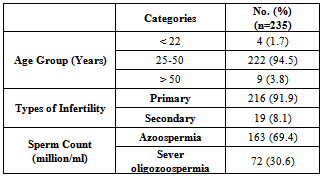
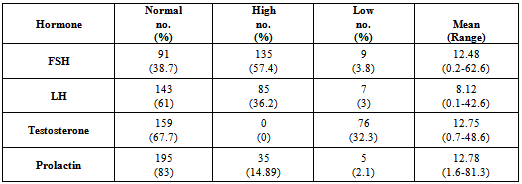
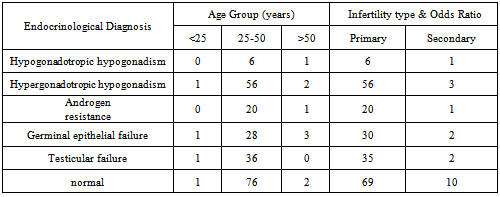
- A total of 2,001 men were evaluated for infertility during the study period, out of which 235 had hormonal assessments done for azoospermia or severe oligospermia workup. Out of these 235 patients, 216 (91.1%) had primary infertility and the remaining 19 (8%) reported secondary infertility. The mean age was 37.03 years (range 23-70). The majority of patients were azoospermic. The details of age groups, types of infertility, and sperm count are shown in Table 1. The hormonal levels of the study population are shown in Table 2. Seven patients (3%) had a hormonal profile in keeping with hypogonadotropic hypogonadism, while the endocrinological diagnosis in 59 patients (25.10%) was hypergonadotropic hypogonadism. Correlation of the endocrinological diagnosis between the various age groups and the type of infertility is shown in Table 3.
|
|
|
4. Discussion
- The prevalence of endocrine abnormalities found in infertile Saudi men included in this study from one centre in Saudi Arabia is 10.8%. To our knowledge there is no other comparable results from the same population however these results are considered higher than the results presented by a Nigerian study which showed 7.3%[3]. The majority of infertile men in our study have been reported to have azoospermia 69.4%. This is due to the selected sample in this study which included results for infertile men with azoospermia and severe oligozoospermia. However, the reasons for this high percentage are not clear and require further investigation.In the present study, 57.4% (135) of the study population had a high serum FSH (Table 2). These findings are higher to those noted in a study of one centre in Nigeria which reported that 13.3% of infertile men have abnormalities in FSH level[6]. However, when men with azoospermia are observed with a high serum FSH, there could still be capacity for fertility, including the possibility of obstruction[7]. Patients might display azoospermia when their reproductive tract is obstructed (obstructive azoospermia) or when their production of spermatozoa is inadequate (non-obstructive azoospermia)[8, 9]. Non-obstructive azoospermia can also be due to germinal epithelial damage[10, 11] or genetic abnormalities[12]. The vast majority of azoospermic and severely oligozoospermic infertile Saudi men included in this study had normal levels of LH (61%), testosterone (67.7%) and prolactin (83%) (Table 2). Infertile patients with Sertoli-cell only syndrome have been suggested to have a higher LH level[10]. Also, high prolactin levels, low testosterone, abnormal FSH levels and other hormonal abnormalities can be associated with abnormal levels of LH[10].Mean testosterone levels have been reported to be lower in patients with oligozoospermia or azoospermia[10, 11]. However, these results are not supported by the data presented in this study. We found that 67.7% of the infertile males have a normal testosterone level (Table 2). Therefore, further studies are needed to describe serum testosterone levels in the infertile male population with azoospermia or severe oligozoospermia as well as to investigate the relation of different variations of prolactin, testosterone and FSH in infertile men. In this study the number of males with primary infertility occurred as 6 with hypogondaotopic hypogonadism, 56 with hypergondaotropic hypogonadism, 20 with androgen resistance, 30 with germinal epithelial failure and 35 testicular failure cases and these numbers of primary type infertility were found to be higher when compared to men with secondary type of infertility (Table 3). There were 59 infertile men in this study that were found to have hypergonadotropic hypogonadism and this result might suggest damage to the seminiferous tubules and the Leydig cells and is therefore significant. There may be success for these patients from sperm retrieval and invitro fertilisation (IVF) using intracytoplasmic sperm injection[3]. This condition is thought to be caused by genetic factors, infections or trauma, and is associated with azoospermia or impaired spermatogenesis[13]. These characteristics of primary testicular dysfunction were confirmed by the hormonal levels in the study sample. However, for Saudi infertile men, the underlying etiology of testicular dysfunction and hypergonadotropic hypogonadism requires further evaluation. This emphasizes the need to investigate for other underlying etiologies of male infertility.
5. Conclusions
- Most azoospermic and severely oligozoospermic patients (69.4% and 30.6% respectively) referred to our centre had an endicronological picture consistent with hypergonadotropic hypogonadism and testicular failure. These subgroups of patients are notorious for being among the most challenging male infertility patients to treat. Dedicated studies need to be performed in order to determine the cause of this high prevalence of patients with poor prognosis in the Saudi population.