
-
Paper Information
- Paper Submission
-
Journal Information
- About This Journal
- Editorial Board
- Current Issue
- Archive
- Author Guidelines
- Contact Us
American Journal of Chemistry
p-ISSN: 2165-8749 e-ISSN: 2165-8781
2026; 16(2): 48-54
doi:10.5923/j.chemistry.20261602.03
Received: Aug. 28, 2026; Accepted: Sep. 21, 2026; Published: Oct. 9, 2026

Type Chemical Composition of Estragole-Linalool-Type Ocimum basilicum Essential Oil and Oxidative Stability of Multioil Margarine Prototypes
 Abstract
 Reference
 Full-Text PDF
 Full-text HTML
Anicet Frédéric Binaki1, 2, Eliane Thérèse Biassala1, Jeantia Matoko Badila1, Koukel-Jemero Loemba-Mouely1, Mignon Prince Exaucé Taty1, Célestine Kiminou Ngounga1, 2, Bob Wilfrid Loumouamou1, 2, Hubert Makomo3
1Food Chemistry and Technology Laboratory & Faculty of Science and Technology, Marien Ngouabi University, Brazzaville, Republic of the Congo
2Process Engineering Laboratory & UNESCO-ENSP Chair, Marien Ngouabi University, Brazzaville, Republic of the Congo
3Plant and Life Chemistry Unit & Faculty of Science and Technology, Marien Ngouabi University, Brazzaville, Republic of the Congo
Correspondence to: Bob Wilfrid Loumouamou, Food Chemistry and Technology Laboratory & Faculty of Science and Technology, Marien Ngouabi University, Brazzaville, Republic of the Congo.
| Email: |  |
Copyright © 2026 The Author(s). Published by Scientific & Academic Publishing.
This work is licensed under the Creative Commons Attribution International License (CC BY).
http://creativecommons.org/licenses/by/4.0/

This study characterized the leaf essential oil of Ocimum basilicum and examined its effect on the storage stability of multioil margarine prototypes prepared with either water or watermelon-seed milk as the aqueous phase. The essential oil was analysed by gas chromatography with flame-ionization detection and gas chromatography–mass spectrometry. Six prototypes containing Irvingia gabonensis (24.14%), Moringa oleifera (43.83%) and Citrullus lanatus (13.05%) oils were prepared without added antioxidant, with O. basilicum essential oil (0.02%), or with ascorbic acid (0.02%), and monitored for 49 days at ambient laboratory conditions. Forty-two volatile constituents accounted for 99.998% of the chromatographic profile. Estragole (40.665%), linalool (36.079%) and 1,8-cineole (12.757%) were predominant and together represented 89.501% of the oil. At day 49, peroxide values were 35, 25 and 15 meq O₂ kg⁻¹ in the water-based control, essential-oil and ascorbic-acid prototypes, respectively, compared with 42, 35 and 18 meq O₂ kg⁻¹ in the corresponding seed-milk prototypes. Essential-oil addition reduced the final peroxide value by 28.6% in the water system and 16.7% in the seed-milk system relative to their controls, whereas ascorbic acid produced a 57.1% reduction in both matrices. The essential oil did not lower the final acid value in the water system and produced only a 5.6% reduction in the seed-milk system. The results identify an estragole–linalool chemotype and show a modest, matrix-dependent protection against primary oxidation at 0.02%, inferior to that of ascorbic acid under the tested conditions. Because the oil was estragole-rich, food application requires chemotype selection and compositional control.
Keywords: Ocimum basilicum, Estragole, Linalool, Essential oil, Lipid oxidation, Margarine
Cite this paper: Anicet Frédéric Binaki, Eliane Thérèse Biassala, Jeantia Matoko Badila, Koukel-Jemero Loemba-Mouely, Mignon Prince Exaucé Taty, Célestine Kiminou Ngounga, Bob Wilfrid Loumouamou, Hubert Makomo, Type Chemical Composition of Estragole-Linalool-Type Ocimum basilicum Essential Oil and Oxidative Stability of Multioil Margarine Prototypes, American Journal of Chemistry, Vol. 16 No. 2, 2026, pp. 48-54. doi: 10.5923/j.chemistry.20261602.03.
Article Outline
1. Introduction
- Margarines and related water-in-oil emulsions are susceptible to oxidative deterioration during processing and storage. Lipid oxidation generates hydroperoxides and subsequently volatile products that impair flavour, nutritive quality and shelf life. The interfacial organization of emulsions, the distribution of pro- and antioxidants, and interactions with the aqueous phase can make oxidation behaviour differ substantially from that of bulk oils. [1,2,3,4]Underutilized tropical oilseeds provide complementary lipid resources for formulated fats. Watermelon (Citrullus lanatus), moringa (Moringa oleifera) and African bush mango (Irvingia gabonensis) yield oils with distinct physicochemical and fatty-acid characteristics, while watermelon seeds may also be processed into a milk-like aqueous dispersion. [6,23,24,25,30]Plant essential oils and botanical extracts are investigated as natural sources of compounds capable of slowing lipid oxidation. Basil (Ocimum basilicum) essential oil is chemically variable, and its activity therefore depends on chemotype, concentration and food matrix. Linalool, estragole, 1,8-cineole and other terpenoids commonly contribute to its profile, but their relative abundance varies with origin and growing conditions. [5,7,8,9,10,11,12,13,14]The present work aimed (i) to establish the GC-FID and GC–MS profile of basil leaf essential oil obtained in Brazzaville, Republic of the Congo, and (ii) to compare the peroxide- and acid-value trajectories of multioil margarine prototypes made with water or watermelon-seed milk and containing no antioxidant, 0.02% basil essential oil, or 0.02% ascorbic acid.
2. Experimental
2.1. Raw Materials
- Watermelon (C. lanatus) seeds originating from Madingou (Bouenza Department) were purchased at Total Market in Bacongo, Brazzaville. Moringa (M. oleifera) seeds were obtained in Brazzaville, and African bush mango (I. gabonensis) kernels originating from Ouesso (Sangha Department) were purchased at Ouenzé Market. Fresh basil (O. basilicum) leaves were collected at Nzaba in the Madibou district of Brazzaville.
2.2. Preparation of Oils, Watermelon-Seed Milk and Essential Oil
- The three lipid materials were obtained by mechanical pressing and filtered through muslin. The I. gabonensis kernel paste was gently warmed before pressing; the M. oleifera and C. lanatus seeds were pressed directly. For the aqueous dispersion, 300 g of watermelon seeds were soaked for 16 h, heated at 100–110 °C for 10 min, ground with 1 L of water and filtered through muslin.Fresh basil leaves were sorted, washed, drained and hydrodistilled. The distillate was extracted with diethyl ether; the organic phase was dried over anhydrous sodium sulfate, filtered and stored in an amber container until analysis.
2.3. GC-FID Analysis
- Fresh basil leaves were sorted, washed, drained and hydrodistilled.Quantitative profiling was performed on an Agilent 6890 gas chromatograph fitted with a DB-5 capillary column (20 m × 0.18 mm i.d.; film thickness, 0.18 μm) and a flame-ionization detector. The oven was held at 50 °C for 3.2 min and then programmed to 300 °C at 10 °C min⁻¹. The injector temperature was 280 °C. Hydrogen was used as the carrier gas at 1 mL min⁻¹; detector gas flows were 40 mL min⁻¹ hydrogen and 450 mL min⁻¹ air. Relative percentages were obtained by peak-area normalization. Two injections were performed.
2.4. GC–MS Analysis and Compound Identification
- Qualitative analysis was performed with an Agilent 7890 gas chromatograph coupled to an Agilent 5975 mass spectrometer and equipped with a DB-5 column of the same dimensions. The oven was held at 50 °C for 3.2 min and then programmed to 300 °C at 8 °C min⁻¹; the injector was maintained at 280 °C. Electron-impact ionization was operated at 70 eV and helium carrier gas at 0.9 mL min⁻¹. Components were assigned by comparing mass spectra and reported retention indices with Adams, NIST 2008, MassFinder and the LEXVA Analytique laboratory databases. [18,19,20,21,22]
2.5. Initial Physicochemical Measurements
- Peroxide value (PV) and acid value (AV) of the pressed oils were determined by standardized titrimetric procedures and expressed as meq O₂ kg⁻¹ and mg KOH g⁻¹, respectively. The measurements were performed in triplicate. The pH and titratable acidity of the watermelon-seed milk were also measured; titratable acidity was expressed in Dornic degrees (°D). [15,16,17]
2.6. Margarine Formulation and Storage
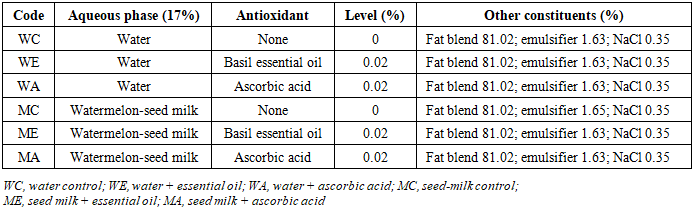
- The fat blend contained 24.14% I. gabonensis oil, 43.83% M. oleifera oil and 13.05% C. lanatus oil (81.02% total). The aqueous phase was water or watermelon-seed milk (17%). Egg-yolk-derived emulsifier was included at 1.63–1.65%, sodium chloride at 0.35%, and antioxidant treatment at 0, 0.02% basil essential oil or 0.02% ascorbic acid. The six formulations are summarized in Table 1.
|
2.7. Data Treatment
- Physicochemical measurements are reported as mean ± standard deviation (n = 3). Essential-oil percentages are the mean of two GC-FID injections. Weekly storage values are presented descriptively because independent batch replication was not documented in the dataset. Final-day percentage changes were calculated against the corresponding antioxidant-free matrix control. No inferential statistics were applied to the storage series.
3. Results and Discussion
3.1. Initial Characteristics of the Lipid and Aqueous Ingredients
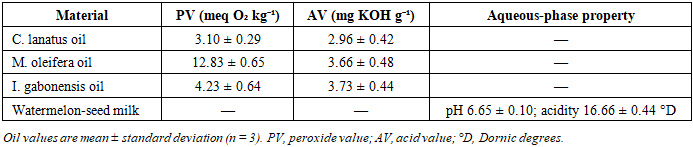
- The pressed oils differed in their initial oxidation state (Table 2). C. lanatus oil had the lowest PV (3.10 ± 0.29 meq O₂ kg⁻¹), whereas M. oleifera oil had a PV of 12.83 ± 0.65 meq O₂ kg⁻¹. AV varied less, from 2.96 ± 0.42 to 3.73 ± 0.44 mg KOH g⁻¹. These values describe the materials before blending and therefore provide the relevant baseline for interpreting the formulated system.
|
3.2. Essential-Oil Composition and Chemotype
- The GC-FID profile comprised 42 constituents and represented 99.998% of the detected peak area (Table 3). Estragole (40.665%), linalool (36.079%) and 1,8-cineole (12.757%) dominated and together accounted for 89.501%. The next most abundant constituents were camphor (1.566%), limonene (0.989%), trans-α-bergamotene (0.931%), β-pinene (0.859%) and epi-α-cadinol (0.757%) (Figure 1).
|

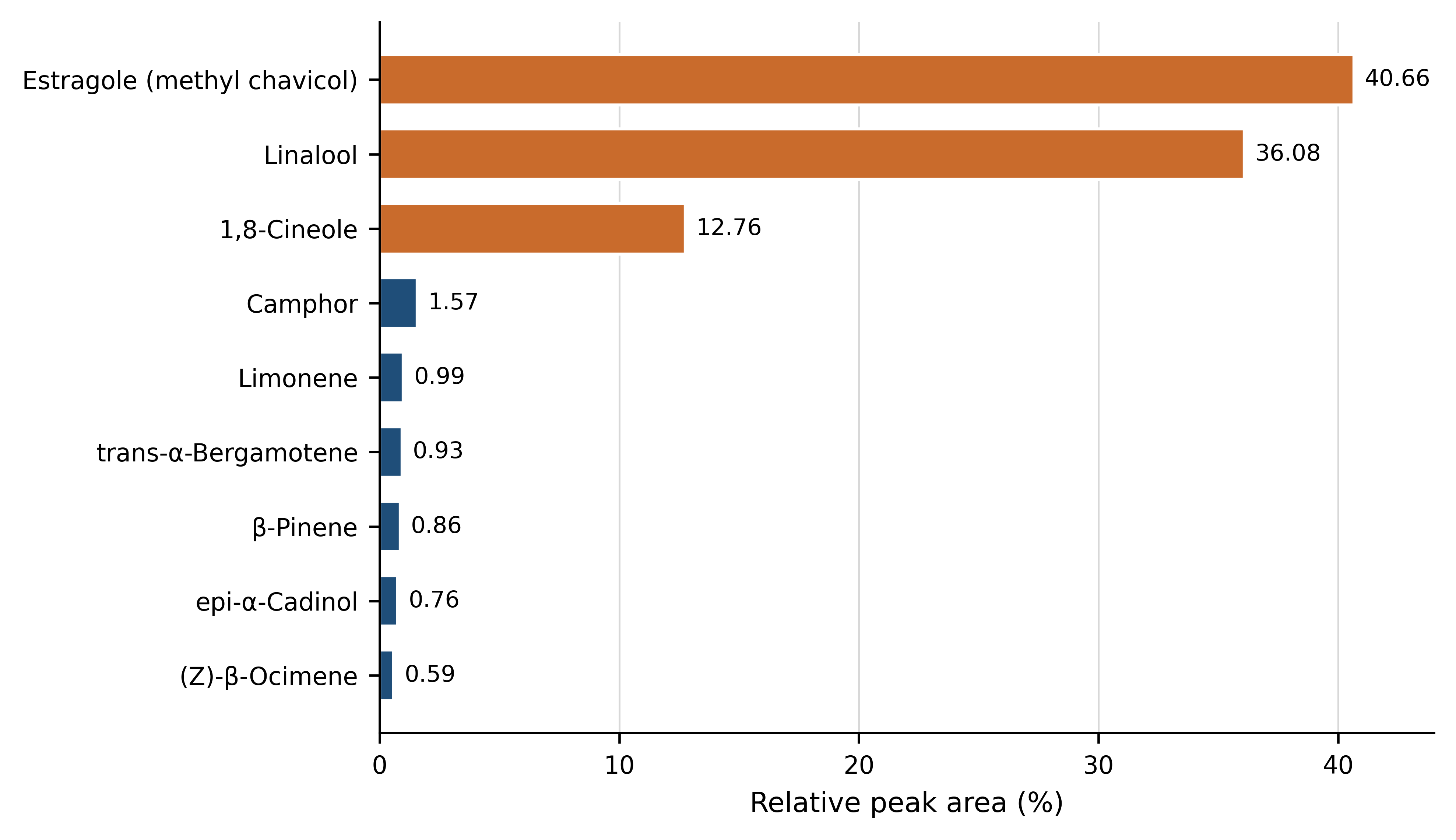 | Figure 1. Major constituents (≥0.50%) of O. basilicum leaf essential oil. Values are mean relative peak areas from two GC-FID injections |
3.3. Development of Peroxide Value During Storage
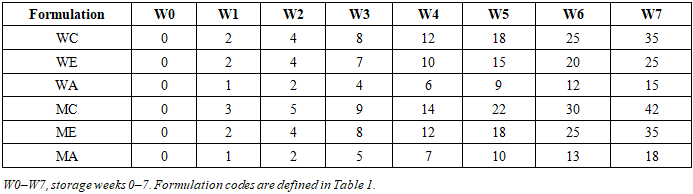
- PV increased throughout storage in every formulation (Table 4 and Figure 2A). At day 49, the water-based control reached 35 meq O₂ kg⁻¹, compared with 25 meq O₂ kg⁻¹ for the essential-oil treatment and 15 meq O₂ kg⁻¹ for the ascorbic-acid treatment. Thus, relative to the water-based control, basil essential oil and ascorbic acid reduced the final PV by 28.6% and 57.1%, respectively.
|
3.4. Development of Acid Value During Storage
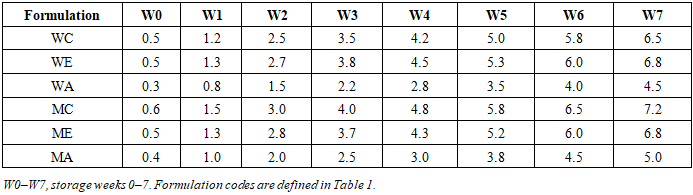
- AV also increased progressively (Table 5 and Figure 2B), but the essential oil did not reproduce its PV effect. In the water system, the day-49 AV was 6.5 mg KOH g⁻¹ for the control and 6.8 mg KOH g⁻¹ with essential oil, a 4.6% increase rather than a reduction. In the seed-milk system, essential oil lowered the final AV only from 7.2 to 6.8 mg KOH g⁻¹ (5.6%). Ascorbic acid produced lower final values of 4.5 and 5.0 mg KOH g⁻¹, reductions of 30.8% and 30.6% relative to the corresponding controls.
|
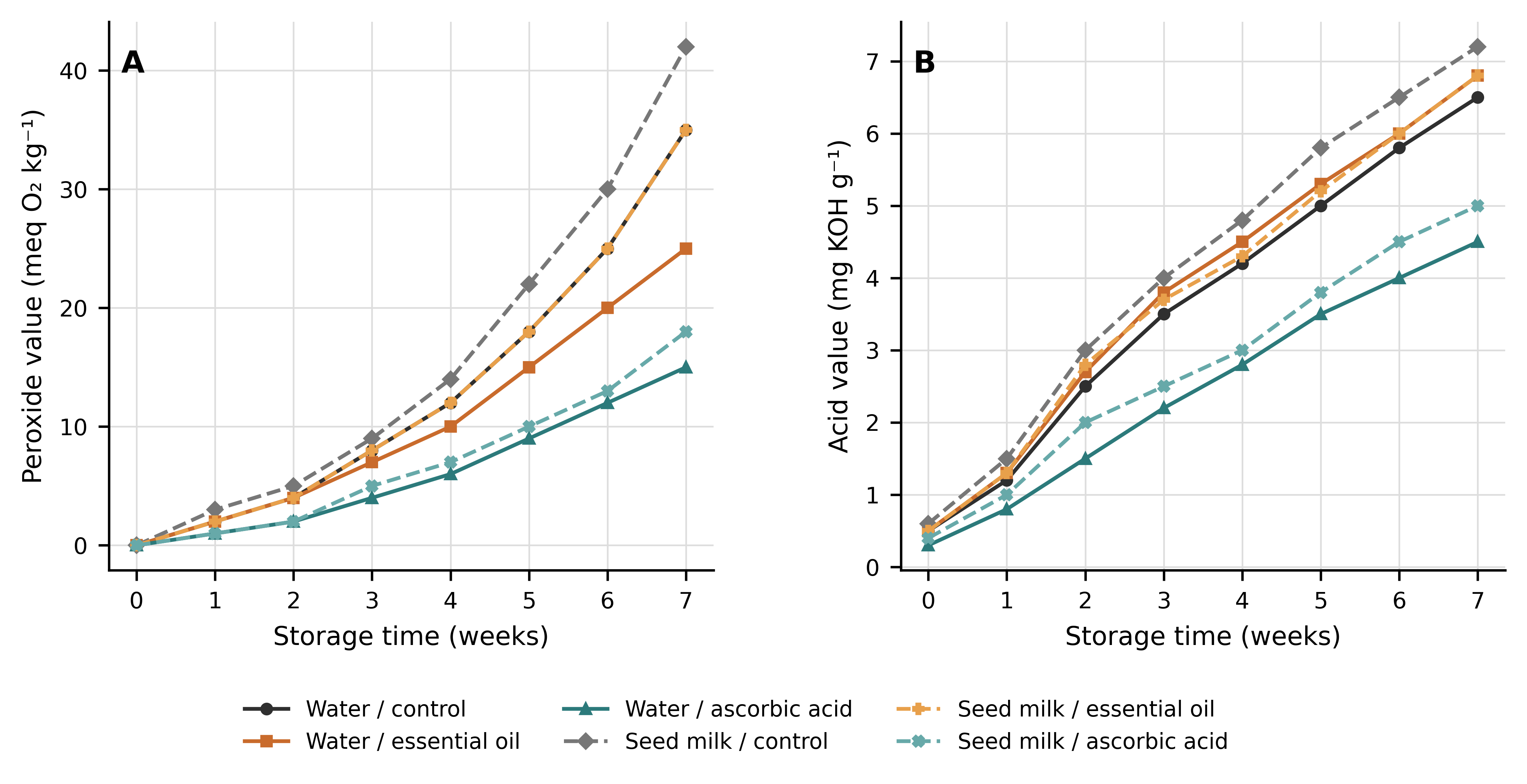 | Figure 2. Peroxide-value (A) and acid-value (B) profiles of water- and watermelon-seed-milk margarine prototypes during storage. Lines connect the observed weekly values; no inferential error bars are shown because independent batch replication was not documented |
3.5. Performance and Food-Use Considerations
- The tested essential oil provided partial protection against primary oxidation, whereas ascorbic acid consistently provided greater protection at the same nominal inclusion level. Oxygenated monoterpenes represented 52.037% of the essential oil, with linalool accounting for 36.079%; their abundance may have contributed to radical-scavenging and/or synergistic effects. However, the present compositional data do not allow the observed antioxidant response to be attributed to any single constituent. [13,14]The 0.02% essential-oil formulation, combined with the measured estragole proportion of 40.665%, corresponds to a nominal estragole input of approximately 81 mg kg⁻¹ before processing and storage losses. This value is a formulation estimate and should not be interpreted as the residual estragole concentration in the finished product. Because estragole has raised genotoxicity and carcinogenicity concerns, and European evaluations recommend minimizing exposure where practical, further food development should prioritize low-estragole basil chemotypes, quantify residual estragole after processing and storage, and establish product-specific safety before any commercialization claim is made. [28,29]The present data establish composition and descriptive storage trajectories but do not document independent formulation batches, sensory acceptance, microbiological stability or volatile retention after processing. These endpoints, together with replicated storage trials, are required to define technological relevance and shelf life.
4. Conclusions
- Basil leaf essential oil from Brazzaville was characterized as an estragole–linalool chemotype, dominated by estragole (40.665%), linalool (36.079%), and 1,8-cineole (12.757%). At 0.02%, the oil reduced the day-49 peroxide value (PV) by 28.6% in the water-based prototype and by 16.7% in the watermelon-seed-milk prototype, whereas ascorbic acid produced a 57.1% reduction in both matrices. In contrast, the essential oil did not reduce the final acid value (AV) in the water system and lowered it by only 5.6% in the seed-milk system, indicating a greater effect on primary oxidation than on hydrolytic deterioration. The weaker protection observed in the seed-milk matrix suggests that antioxidant efficacy was influenced by matrix-dependent partitioning at the oil–water interface and by possible pro-oxidant interactions with aqueous-phase constituents. These results demonstrate modest, matrix-dependent antioxidant activity at 0.02% and indicate that efficacy observed in one emulsion matrix should not be directly extrapolated to another. Because the essential oil was rich in estragole, further food applications should prioritize low-estragole chemotypes and include verification of residual estragole levels in the finished product before any safety or commercialization claims are made.
ACKNOWLEDGEMENT
- The authors acknowledge LEXVA Analytique for chromatographic support and access to its reference database.
Funding
- No external funding was reported for this study.
Conflict of Interest
- The authors declare no conflict of interest.
Data Availability
- All data used in this study are included in the article.