
-
Paper Information
- Paper Submission
-
Journal Information
- About This Journal
- Editorial Board
- Current Issue
- Archive
- Author Guidelines
- Contact Us
American Journal of Chemistry
p-ISSN: 2165-8749 e-ISSN: 2165-8781
2026; 16(2): 40-47
doi:10.5923/j.chemistry.20261602.02
Received: Jun. 12, 2026; Accepted: Jun. 29, 2026; Published: Jul. 4, 2026

Equilibrium, Kinetic, and Thermodynamic Studies of Pb (II) ions Adsorption onto Modified Tamarind Fruit Pulp
 Abstract
 Reference
 Full-Text PDF
 Full-text HTML
Stellah Nelima Mukhalisi1, Francis Maingi1, Keno Kowanga2
1Department of Science Technology and Engineering, Kibabii University, Kenya
2Department of Chemistry, Maseno University, Kenya
Correspondence to: Stellah Nelima Mukhalisi, Department of Science Technology and Engineering, Kibabii University, Kenya.
| Email: |  |
Copyright © 2026 The Author(s). Published by Scientific & Academic Publishing.
This work is licensed under the Creative Commons Attribution International License (CC BY).
http://creativecommons.org/licenses/by/4.0/

The challenge of accessing clean drinking water in urban Kenya is compounded by contamination from heavy metals, leading to serious health risks such as kidney and brain damage. Industrialization and technological advancement have exacerbated the problem of increase of Pb (II) ions and other heavy metals in water ecosystem through industrial effluents. This study investigated the use of modified tamarind fruit pulp (MTFP) for the adsorption of (Pb II) ions from synthetic wastewater. Characterization techniques like XRF and FT-IR were utilized, and adsorption experiments were conducted by varying pH, contact time, temperature, dosage, and initial concentrations of the metals. The results were analysed statistically using ANOVA, with significant differences at P ≤ 0.05. The equilibrium studies indicated that the adsorption of Pb (II) ions was best represented by the Freundlich model, with adsorption capacities of 1.30 and 1.67 mg/g for unmodified tamarind fruit pulp (UTFP) and modified tamarind fruit pulp (MTFP), respectively. Thermodynamic study showed that the adsorption process was thermodynamically spontaneous and endothermic. Kinetic studies revealed that chemisorption was the rate limiting step in the adsorption of Pb (II) ions. This information revealed the enhanced capabilities of MTFP to effectively remove Pb (II) ions from wastewater, showcasing its potential as an eco-friendly adsorbent.
Keywords: Adsorption, Equilibrium, Kinetics, Tamarind fruit pulp, Thermodynamics
Cite this paper: Stellah Nelima Mukhalisi, Francis Maingi, Keno Kowanga, Equilibrium, Kinetic, and Thermodynamic Studies of Pb (II) ions Adsorption onto Modified Tamarind Fruit Pulp, American Journal of Chemistry, Vol. 16 No. 2, 2026, pp. 40-47. doi: 10.5923/j.chemistry.20261602.02.
Article Outline
1. Introduction
- The pervasiveness of heavy metals in wastewater has risen concurrently with the increase of industrial and human activities. Lead is a fundamental component in many important manufacturing industries, such as the battery and paint industries. These industries discharge effluents with a high amount of Pb (II) ions into the water ecosystem. These non-biodegradable metals have potential carcinogenic properties, highlighting the risk of critical health issues when present in water at high concentrations [1]. Traditional wastewater treatment methods like biological (activated sludge), chemical (coagulation), and physical (filtration) effectively remove pollutants but present challenges such as high costs, land requirements, and difficulties in managing emerging contaminants [2]. Concerns over heavy metal contamination have prompted exploration of eco-friendly solutions, such as using tamarind fruit pulp for the remediation of cadmium and lead in wastewater, which shows promise in effectively adsorbing these contaminants while being cost-efficient and environmentally friendly.
2. Materials and Methods
2.1. Chemical and Reagents
- The sodium hydroxide and Hydrochloric acid used in modification of the tamarind fruit pulp and adjustment of pH while lead (II) nitrate was used in batch adsorption studies. The reagents were of analytical grade.
2.2. Modification of Tamarind Fruit Pulp
- The tamarind fruit pulp was cleaned thoroughly with distilled water, then dried in an oven at a temperature of 60°C for 24 hours. After drying, the pulps were then grounded into a powder and stored. 170 mL of 3.5 M NaOH was measured and placed in a 250 mL Erlenmeyer flask. 25 g of powdered dried tamarind fruit pulp was weighed and added to the content in the Erlenmeyer flask, and the mixture was placed in a Teflon autoclave at 100°C for 24 hours. The mixture was then filtered, and the residue was washed with distilled water until a pH of 10 in the filtrate was achieved. Then, it was oven-dried at about 60°C and coded as (MTFP) for characterization and adsorption application.
2.3. Characterization of the Adsorbents
- The characterization of adsorbents is a crucial initial step in adsorption studies, connecting material structure to performance. This process explores retention mechanisms, particularly the interaction between adsorbent surfaces and target pollutants, by assessing key physical and chemical properties. The XRF was used for chemical composition analysis while the FT-IR was used to assess the functional groups present in both the unmodified and modified tamarind fruit pulp.
2.4. Preparation of Pb (II) Ions Sorbates for Adsorption Studies
- Stock solutions for adsorption studies were prepared using lead (II) nitrate, which was of analytical grade. Lead (II) ions solution was prepared by dissolving an accurate quantity of 1.559 g of lead (II) nitrate in 600 mL of distilled water and diluting to 1000 mL [3]. The solution was coded as 1000 ppm of Pb (II) ions. The stock solutions were serially diluted to yield working solutions.
2.5. Batch Experiments
- Batch adsorption experiments are key laboratory methods used to evaluate an adsorbent's efficiency in removing pollutants like heavy metals, dyes, or pharmaceuticals from wastewater. The process entails mixing a set volume of the adsorbate solution with a specific quantity of adsorbent, followed by agitation until equilibrium is achieved. The effects of various parameters on adsorption of Pb (II) ions from synthetic wastewater using unmodified and modified tamarind fruit pulp were evaluated.
2.5.1. Effect of pH on Adsorption of Pb (II) Ions
- The batch experiments involved varying the pH from 2 to 6 to study the adsorption of Pb (II) ions. Solutions of 100 mg/L concentration were placed in stoppered bottles, with unmodified and modified tamarind fruit pulp added. The mixtures were shaken at 120 rpm for one hour at room temperature, then filtered. The residual metal ion concentrations were analyzed using AAS, and mean values were computed.
2.5.2. Effect of Initial Concentration on Adsorption of Pb (II) Ions
- The study explored the adsorption of Pb (II) ions on modified and unmodified tamarind fruit pulp, adapting methods from Maingi et al. [4]. Initial metal ion concentrations ranged from 20 to 200 mg/L. A precise 0.10 g of the adsorbent was added to 100 mL bottles, followed by 50 mL of metal ion solutions. The mixtures were shaken at 120 rpm for one hour, with three replicates for accuracy. After filtering, the supernatant metal ions were analyzed using AAS.
2.5.3. Effect of Adsorbent Dose on Adsorption of Pb (II) Ions
- The effect of adsorbent dose was carried by varying the adsorbent dose. 50 mL of 100 mg/L of metal ion solutions was put in stoppered bottles containing varying doses (0.1- 0.5g) of unmodified and modified tamarind fruit pulp samples. The suspensions were then shaken at room temperature using an electric shaker that was programmed to operate for an hour at 120 rpm. Prior to analysis, each sample was filtered to minimize the impact of the adsorbent particles on the assay [5].
2.5.4. Effect of Contact Time on Adsorption of Pb (II) Ions
- The effect of contact time was investigated by varying time from 10 to 100 minutes. In each of a series of adsorption bottles, 0.10 g of the adsorbents UTFP and MTFP were placed. 50 mL of 100 mg/L metal ion solutions was then added to each bottle. The mixtures were shaken using a thermostatic electric shaker set to run at 120 rpm at room temperature. The mixtures were removed from the shaker based on their coded contact time. The mixtures were filtered and residual metal ion concentration determined using AAS.
2.5.5. Effect of Temperature on Adsorption of Pb (II) Ions
- The equilibrium temperature for the adsorption of Pb (II) ions was evaluated using the temperature range of 293 K to 328 K. 50 mL of the known concentration of aqueous solution at an ideal pH of 5.0 was added to stoppered plastic bottles containing 0.10 g of the adsorbent for every experimental run. The bottles were put in a thermostatic electric shaker set to a specific temperature and shaken continuously at 120 rpm for an hour. After filtering, the remaining metal ions in the filtrate were examined.
2.6. Adsorption Isotherms
- Adsorption data of Pb (II) ions were fitted in both Freundlich and Langmuir isotherms to assess the adsorption capacities of UTFP and MTFP [6]. The residual metal ion concentrations were analysed using AAS, with the equilibrium adsorption
 amount calculated using Equation 1 [7].
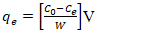 | (1) |
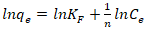 | (2) |
 = adsorption at equilibrium, 1/n= Heterogeneity index associated with adsorption intensity, Ce = concentration of the adsorbate in solution at equilibrium. Equation 3 shows the linearized Langmuir adsorption isotherm [4].
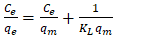 | (3) |
 is the amount of Pb (II) ions adsorbed (mg/g);
  is the adsorption capacities (mg/g);
  is the isotherm constant (dm3 /mg).
2.7. Thermodynamic Study of Adsorption of Pb (II) Ions
- The study investigated the effect of temperature on thermodynamic parameters using batch experiments across a range of temperatures: 20, 30, 40, 50, and 55 °C. Each experiment involved combining 0.2 g of adsorbent with 50 mL of 100 mg/L metal ion solutions at solution pH 4.0. After one hour, the mixture was filtered, and the residual metal ions concentration in the filtrate analyzed using AAS. The standard entropy and enthalpy changes were calculated using Equations 4 and 5 respectively.
 | (4) |
 | (5) |
2.8. Kinetic Studies
- The influence of time on sorption was used to analysed the kinetic behaviour of sorbates on adsorbents. Pseudo-first order and Pseudo-second order were used to study the transient behaviour of the adsorption process. Equation 6 was used in calculating of
 .
.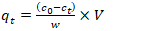 | (6) |
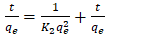
 against t for pseudo-first order and
  against t for Pseudo-second order using the collected data allowed for the determination of kinetic parameters using Equations 7 and 8, respectively.
 | (7) |
 | (8) |
3. Results and Discussions
3.1. XRF Analysis of the Adsorbents
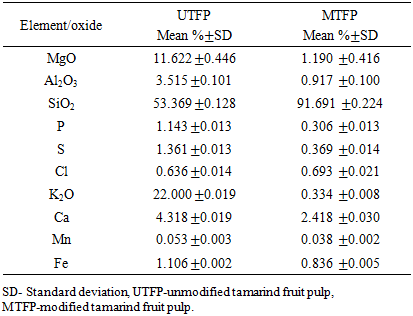
- The X-ray Fluorescence spectrometer (model S1 Titan) was used to determine the chemical composition of the Tamarind fruit pulp and modified tamarind fruit pulp. Table 1 shows chemical composition of both the modified and unmodified Tamarind fruit pulp.
|
3.2. FT-IR Analysis of UTFP and MTFP
- Fourier Transform Infrared (FT-IR) analysis was performed using a Shimadzu-119 instrument, calibrated after warming for 30 minutes with inactive potassium bromide. About 1mg of each powdered sample was mixed with potassium bromide in a 1:50 ratio, ground for homogeneity, and compressed into a translucent pellet. This pellet was then placed in the FT-IR machine for analysis, and the FT-IR spectrum was generated to interpret various peaks of interest. The spectrum for transmittance against wavelength for UTFP is illustrated in Figure 1.
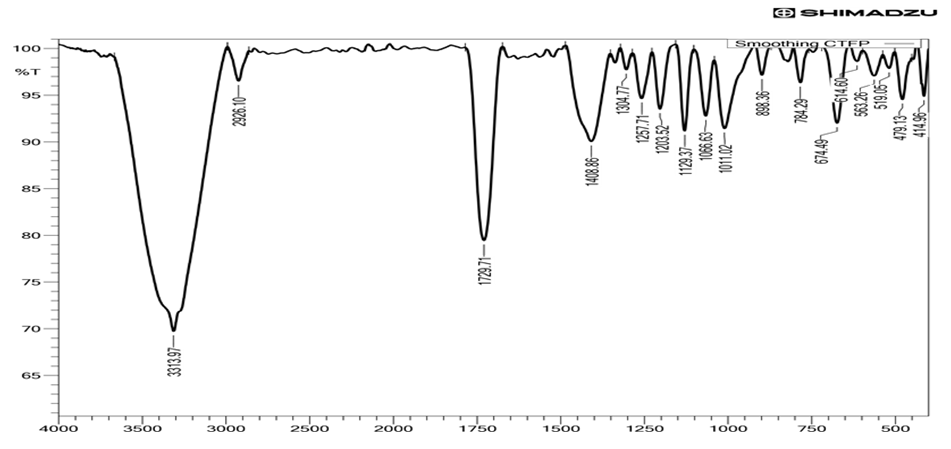 | Figure 1. FT-IR spectrum for UTFP |
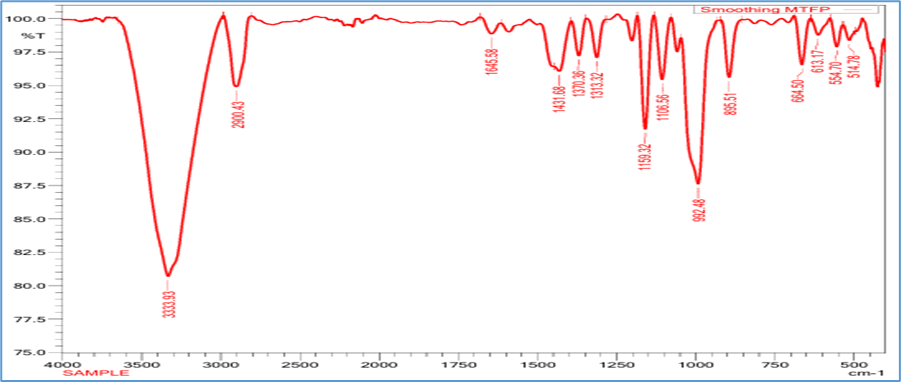 | Figure 2. FT-IR spectrum for MTFP |
3.3. Effect of pH on Adsorption of Pb (II) Ions Using UTFP and MTFP
- The batch experiments varied the pH from 2 to 6, with results depicted in Figure 3, showing the adsorption of Pb (II) ions using UTFP and MTFP adsorbents.
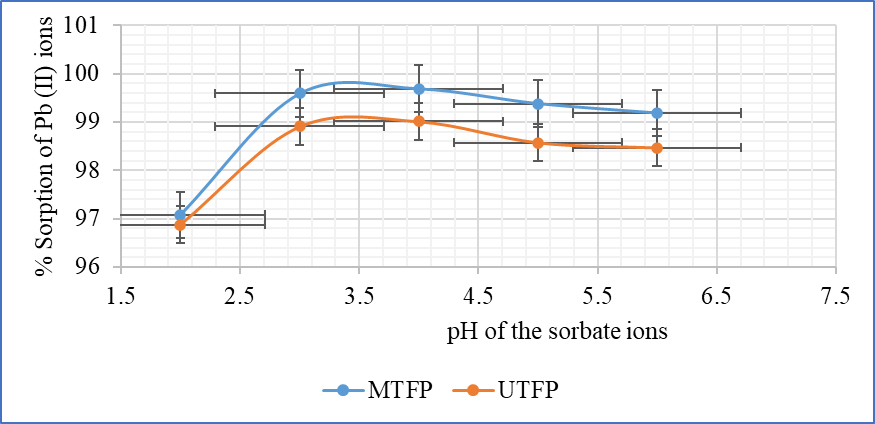 | Figure 3. Effect of pH on adsorption of Pb (II) ions on UTFP and MTFP |
3.4. Effect of Initial Concentration on Adsorption of Pb (II) Ions
- The study examined the impact of initial concentrations of Pb (II) ions on their removal efficiency, using an adsorbent dose of 0.1 g and a stirring rate of 120 rpm. Adsorption was analyzed at initial concentrations of 20, 50, 75, 100, 150, and 200 mg/L, with results illustrated in Figure 4.
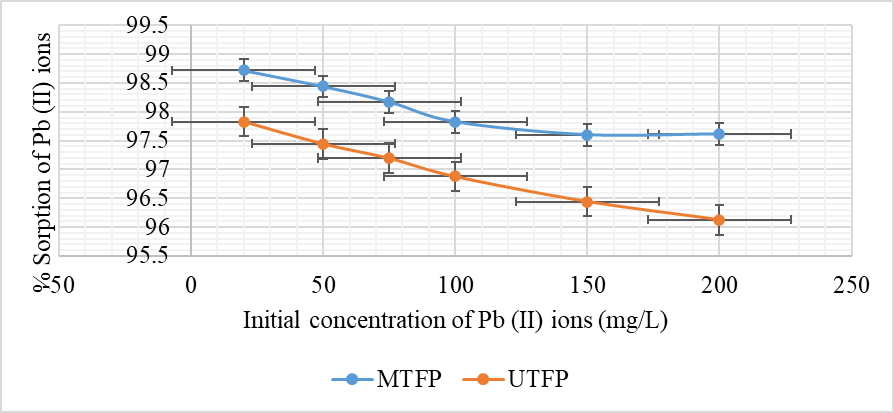 | Figure 4. Effect of initial concentration on Pb (II) ions uptake using UTFP and MTFP (Adsorbent dose=0.1g, shaking speed=120rpm, pH=4.0) |
3.5. The Effect of Adsorbent Dose on Adsorption Process
- The study investigated the removal efficiency of Pb (II) ions at various adsorbent doses under a shaking speed of 120 rpm, an initial concentration of 100 mg/L, and a pH of 4.0. Results are illustrated in Figure 5, highlighting the impact of adsorbent dose on the adsorption of Pb (II) ions.
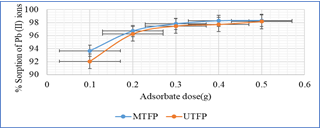 | Figure 5. Effect of adsorbent dose on Pb (II) ions uptake using MTFP and UTFP |
3.6. The Effect of Contact Time on Adsorption
- The study highlights the importance of determining the optimal time for the complete removal of target metal ions and characterizing the speed of heavy metal ion binding by UTFP and MTFP adsorbents. It specifically examines the effect of contact time on the percentage removal of Pb (II) ions at a starting concentration of 100 mg/L, using an adsorbent dose of 0.1 g/50 mL and a shaking speed of 120 rpm, with results illustrated in Figures 6.
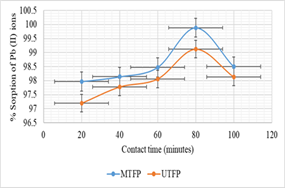 | Figure 6. Effect of contact time on Pb (II) ions uptake using MTFP and UTFP (Pb (II) ions |
3.7. The Effect of Temperature
- In adsorption reactions, temperature significantly affects adsorbate mobility and metal ion absorption into pores, enhancing adsorption rates. Higher temperatures alter adsorbate solubility and chemical interactions between the sorbate and the sorbent. This phenomenon is because an increase in temperature increases kinetic energy and shifts thermodynamic equilibriums, impacting the overall adsorption rate, as observed in the study of Pb (II) ion removal using UTFP and MTFP. Figure 7 illustrates the results obtained when temperature was varied from 293 to 328K.
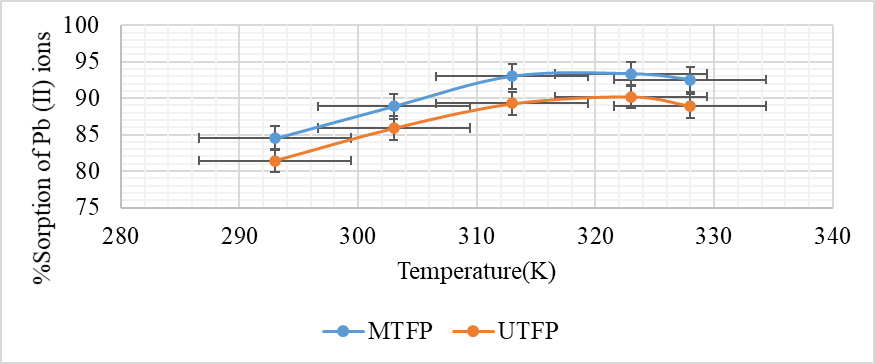 | Figure 7. Effect of temperature on Pb (II) ions uptake using MTFP and UTFP |
3.8. Adsorption Isotherms
- The adsorption data for Pb (II) ions on UTFP and MTFP adsorbents were analyzed using Langmuir and Freundlich isotherms, as detailed in Table 2, which presents the parameters for both isotherms.
|

3.9. Thermodynamics Studies of Adsorption of Pb (II) Ions onto UTFP and MTFP Adsorbents
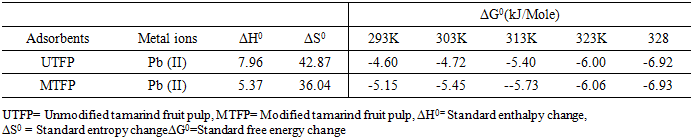
- The thermodynamic parameters for the adsorption of Pb (II)ions onto modified Tamarind fruit pulp adsorbents at various temperatures are outlined in Table 3.
|
3.10. Kinetic Modeling for Adsorption of Pb (II) Ions
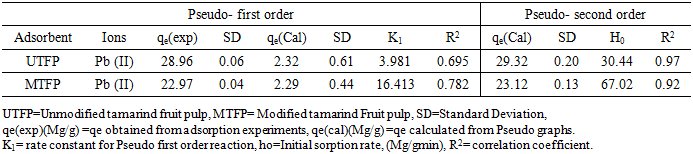
- The pseudo-first and pseudo-second order kinetic parameters calculated by linear regression for Pb (II) ions are summarized in Table 4.
|
4. Conclusions
- The FT-IR study showed that modification occurred. A blue shift of the peak at 3313.97 in UTFP to 3333.93 cm-1 in MTFP, after modification. This shows clearly that -OH was anchored on the surface of tamarind fruit pulp. Also, the red shift observed at the peak at 2926.10 cm-1 in UTFP spectrum to 2900 cm-1 in MTFP is an indicator of increased -OH on the surface of tamarind fruit pulp. The adsorption of Pb (II) ions onto the adsorbents were influenced by the parameters studied i.e., pH, adsorbent dose, contact time, initial metal ion concentration, and temperature. The mean percentage removal of Pb (II) ions were higher in MTFP than in UTFP clearly indicating that modification enhanced the heavy metal ions uptake. The adsorption data fitted best in Freundlich isotherm indicating that the adsorption process occurred on a heterogenous surface. The thermodynamic studies showed that the adsorption process was spontaneous. Chemisorption was the rate-limiting step in the adsorption of Pb (II) ions, according to kinetic studies.
Conflict of Interests
- The authors declare that they have no known competing financial interests or personal relationships that could appear to have influenced the work described in this paper.
ACKNOWLEDGEMENTS
- The authors express gratitude to Kibabii university’s science technology and engineering department for the assistance offered during the research period.