
-
Paper Information
- Paper Submission
-
Journal Information
- About This Journal
- Editorial Board
- Current Issue
- Archive
- Author Guidelines
- Contact Us
American Journal of Chemistry
p-ISSN: 2165-8749 e-ISSN: 2165-8781
2026; 16(2): 31-39
doi:10.5923/j.chemistry.20261602.01
Received: May 2, 2026; Accepted: May 23, 2026; Published: May 29, 2026

Detection of Oxacillin in Matrices Using Boron-Doped Diamond Electrode: A Voltammetry Study
 Abstract
 Reference
 Full-Text PDF
 Full-text HTML
Kone Souleymane1, Kone Siriki2, Kimou Kouakou Jocelin3, Koffi Konan Sylvestre1, Lassine Ouattara1
1Laboratory of Constitution and Reaction of Matter, UFR SSMT, Felix Houphouet Boigny University, Abidjan, Ivory Coast
2Department of Science and Technology, Alassane Ouattara University, Bouake, Ivory Coast
3Institute for Research on New Energies, Nangui Abrogoua University, Ivory Coast
Correspondence to: Kone Souleymane, Laboratory of Constitution and Reaction of Matter, UFR SSMT, Felix Houphouet Boigny University, Abidjan, Ivory Coast.
| Email: |  |
Copyright © 2026 The Author(s). Published by Scientific & Academic Publishing.
This work is licensed under the Creative Commons Attribution International License (CC BY).
http://creativecommons.org/licenses/by/4.0/

The release into the environment of persistent organic pollutants, such as oxacillin, is a source of environmental concern. The objective of this study is to propose an effective and less expensive method for determining the concentrations of this pollutant in the environment. In this work the detection and oxacillin were performed using cyclic voltammetry and square-wave voltammetry (SWV). The anode used is a boron-doped diamond electrode (BDD). The characterization of the BDD electrode surface by scanning electron microscopy and by the electrochemical method (cyclic voltammetry) showed the high quality of the electrode and its ability to quantify oxacillin. SWV method allowed to obtain the calibration curve for oxacillin concentrations ranging from 4 µM to 76.15 µM with detection limit of 1,705 µM in 0,1 M K2SO4. The suggested method was effectively implemented assess these analytes in real matrices such as vegetable juice with recovery rates ranging from 81.54% to 100.32%. Oxacillin was detected in an ionic media, and it found that interference was negligible during detection.
Keywords: Oxacillin, Detection, Square-wave voltammetry, Boron-doped diamond
Cite this paper: Kone Souleymane, Kone Siriki, Kimou Kouakou Jocelin, Koffi Konan Sylvestre, Lassine Ouattara, Detection of Oxacillin in Matrices Using Boron-Doped Diamond Electrode: A Voltammetry Study, American Journal of Chemistry, Vol. 16 No. 2, 2026, pp. 31-39. doi: 10.5923/j.chemistry.20261602.01.
Article Outline
1. Introduction
- Emergencing pollutants, including pharmaceuticals, represent worldwide public health concerns for several decades, mainly due to the constant emergence of new types of pharmaceutic products [1,2]. The considerable presence and accumulation of these substances in the aquatic environment is mainly due to the release of industrial effluents, notably pharmaceutical effluents, along with domestic and hospital wastewater [3,4]. This leads to the development of antibiotic-resistant bacteria, rendering these products ineffective in treatment infections [5]. Among the pharmaceutical products is oxacillin (OXA), a substance in the penicillin family used widely in the treatment of infections [6]. Oxacillin, a semisynthetic antibiotic from the β-lactam class, is a molecule that is not biodegradable [7] and can be metabolized or not by the human body. It is almost entirely excreted in the faeces or urine after administration. Its degradation by conventional wastewater treatment is incomplete, so OXA enters our waterways [8] at concentration levels reaching very large amounts and more precisely in surface water [9,10]. Their presence in nature perturbs aquatic ecosystems. Unfortunately, few studies have been conducted on the detection of oxacillin in the environment, and the most commonly used methods for detecting and quantifying this pharmaceutical product are mass spectrometry coupled with direct injection liquid chromatography (HPLC) and capillary electrophoresis (CE) [10]. These approaches require complex equipment and sufficient financial resources. Hence, the electrochemical detection of this pharmaceutical compound is of interest, due to the fact that this method allows for the detection of low concentrations while ensuring high sensitivity and selectivity. Several electrochemical sensors have proven effective in the detection and quantification of pharmaceuticals, notably the platinum electrode [11,12], the carbon electrode [13,14], and boron-doped diamond (BDD) [15,16], using analytical methods such as cyclic voltammetry (CV), square-wave voltammetry (SWV), or differential pulse voltammetry (DPV). The BDD electrode is an electrode with interesting electrochemical properties, including high thermal conductivity, high hardness, very high stability, chemical inertness, and a wide electrochemical potential window in both aqueous and non-aqueous media [17]. Using a BDD electrode allowed us to find a very good detection limit [18-20].In this study, using a BDD electrode, the aim is to detect OXA in a synthetic solution (0.1 M K2SO4) and to prove the effectiveness of this approach by detecting this substance in a real media such as vegetable juices.
2. Materials and Methods
2.1 Electrode Preparation
- Boron doped diamond (BDD) electrodes were fabricated by hot-filament chemical vapor deposition (HF-CVD) on low resistivity (1-3 mΩ.cm) p-Si wafers. The wafers, which came from siltronix, were each 10 cm in diameter and a thickness of 0.5 mm). Trimethylboron was then introduced into the process gas consisting of 1 % CH4 in H2 to allow boron doping. Film growth was carried out at a rate of 0.24 μm.h-1. The film thickness was approximately 1 μm which made it uniformly coated on the whole surface of the wafer.
2.2. Measurement Methods
- An Autolab PGStat 20 (Ecochemie) linked to a potentiostat equipped with USB electrochemical interface was used to conduct voltammetric measurements on the BDD electrode in a three-electrode electrochemical cell: a working electrode, a counter electrode (CE), a reference electrode (RE). A platinum wire served as the counter electrode. A saturated calomel electrode (SCE) was used as the reference electrode. The working electrode was a BDD electrode with a geometrical contact area of 1 cm2. To overcome the potential ohmic drop, the reference electrode was placed in a luggin capillary close to working electrode. The equipment is connected a data processing and storage computer equipped with GPES 4 software to start and record the voltammograms.Prior to the experiments, the BDD electrode was electrochemically pretreated in a 0.5 M H2SO4 solution. For this pre-treatment, an anodic pre-treatment (+2V, 15 s) is followed by a cathodic pre-treatment (-2 V, 90 s). In this way, the BDD surface was first cleaned of all impurities and then rendered mainly hydrogen [21].
2.3. Chemicals
- Oxacillin [(2S,5R,6R)-5-hydroxy-3,3-dimethyl-6- {[(5-methyl-3-phenyl-1,2-oxazol-4-yl) carbonyl] amino}-4-thia-1-azabicyclo [3.2.0] heptane-2-carboxylic acid] with the empirical formula C19H21N3O5S was purchased from pharmacies in Abidjan. It was prepared by dissolving an accurate mass of the drug in an appropriate solution of 0.1 M of potassium sulfate K2SO4 (Panreac) used for the supporting electrolyte. Ultrapure distilled water was used to prepare the supporting electrolyte. Following a specific procedure, the vegetable juices employed in this project were obtained. Initially, each of these market-purchased vegetables was thoroughly cleaned with tap water and then with distilled water. After that, each vegetable was pulverized one at a time in a spotless blender using a precisely measured amount of 0.1 M of sodium sulfate K2SO4. After that, the juice was repeatedly filtered using regular filter paper (Filter-LaB) to produce a homogenous juice. The 100 ml stock of juice utilized as a supporting electrolyte was finally obtained by dissolving 1 ml of this filtrate in a volumetric flask filled with 0.1 M K2SO4.The β-lactam ring of the oxacillin molecule is often susceptible to hydrolytic and photolytic degradation. Therefore, working solutions were prepared on the day of use, stored away from direct light, and discarded after 24 hours, so that the recorded response corresponded to intact oxacillin and was not distorted, if possible, by other products.
3. Results and Discussion
3.1. Physical Characterization of the Electrode
- The scanning electron microscope (SEM) image of the BBD electrode is displayed in Figure 1. The image shows randomly oriented crystals measuring a few micrometers (between 0.3 and 0.6 µm). These crystals, which have different crystal faces, are strongly bonded to one another. This image indicates that BDD has a polycrystalline structure [22]. Indeed, in chemical vapor deposition (CVD): diamond crystallites develop independently from numerous nucleation sites on the silicon wafer, each growing in its own crystallographic direction until reaching its neighbors. The final film thus appears as a mosaic of grains, bounded by crystalline faces and visible grain boundaries, rather than as a continuous monocrystalline lattice. Furthermore, some crystal faces are darker than others. This contrast is thought to be due to a higher boron content [23].
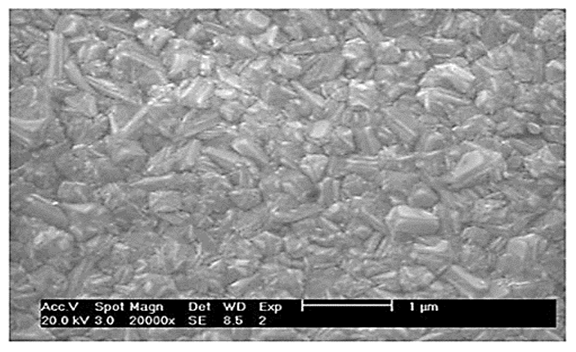 | Figure 1. SEM image of BDD electrode surface |
3.2. Electrochemical Characterization of the Electrode
- The electrochemical characterization of the BDD electrode was performed in a 0.1 M K2SO4 over a potential range of –1.5 V/SCE to 2.2 V/SCE. The measurements were performed under a potential scan rate of 50 mV/s The results are shown in Figure 2. The voltammogram obtained shows three regions.
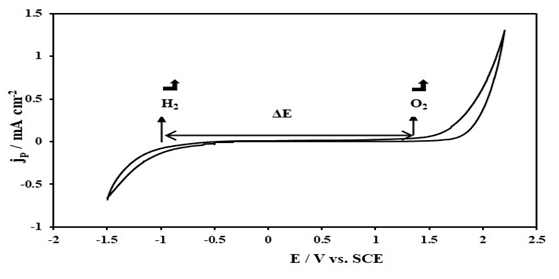 | Figure 2. Voltammetric curve of BDD in K2SO4 (0.1M) at 50 mV/s |
3.3. Electrochemical Behavior of the Electrode
- Figure 3A shows the voltammetric measurements in the presence of various concentrations of OXA in K2SO4 (0.1 M). The current density of the oxidation peaks increases with the OXA concentration. After adding OXA, an anodic peak appears at 1.6 V/SCE. This indicates oxidation of OXA on the BDD [24]. The curve of the oxidation peak current versus the OXA concentration are shown in Figure 3B. The straight line obtained with a coefficient of determination (R2 = 0,9949) close to 1, indicates that OXA present in the medium is responsible for the changes observed in the voltammogram. Oxidation peak is related to the OXA oxidation. The absence of peaks in the reverse direction would imply irreversibility of the process. These results suggest that the BDD electrode could be useful for the quantitative determination of OXA.
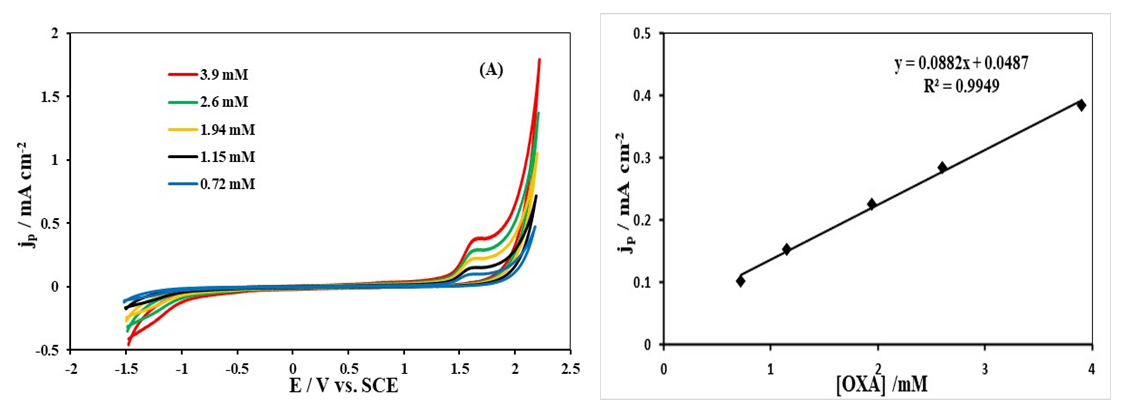 | Figure 3. (A) Cyclic voltammogram of different OXA concentrations in K2SO4 (0.1M) at 50 mV/s; (B): plot of JP = f ([OXA] |
3.4. Square-Wave Voltammetries
3.4.1. Measurement Conditions
- In the interest of more efficient voltammetric detection of the pharmaceutical substance, certain VOC parameters were optimized. These parameters include frequency, amplitude, and potential step. The optimization was intended to improve sensitivity, signal resolution, and measurement reproducibility.To determine the frequency, square-wave voltammetric (SWV) analyses were performed by varying the frequency (f) in 5 Hz increments from 15 Hz to 35 Hz. At 25 Hz, the voltammogram is smooth and clear, with a more distinct peak and less background noise. In contrast, the curves for the other frequencies were not sufficiently clear and smooth. These observations may have been due to interference between the system and the external environment. However, since the experiment was not conducted in a Faraday cage to limit such interference, the optimal frequency selected is 25 Hz. Using this frequency, each parameter was then varied while keeping the others constant. The obtained results are shown in the Figure 4. The effect of amplitude (AM) was investigated. An increase in peak oxidation current with amplitude was observed (Figure 4A). Furthermore, we also observe a shift of the peak potentials to the left and a slightly broader shape of the voltammograms below an amplitude of 0.05 V. Above 0.05 V, starting at a potential of 0.06 V/SCE, the shape of the voltammogram changes. To avoid these risks of selectivity in the oxacillin oxidation peak, it is preferable not to choose amplitude values that are too high. In this regard, 0.05 V (50 mV) was used as the amplitude.For the remainder of this study. The amplitude and frequency were adjusted to 50 mV and 25 Hz, respectively. The measurements were carried out in the potential range from 1 mV/ECS to 10 mV/ECS. In Figure 4B, an increase in peak currents with the potential step (∆Estep) is noted up to 5 mV, where a small plateau is apparent, indicating saturation of the electrode surface at this value. Thus, the value of 5 mV was chosen as the potential step in this analytical method.
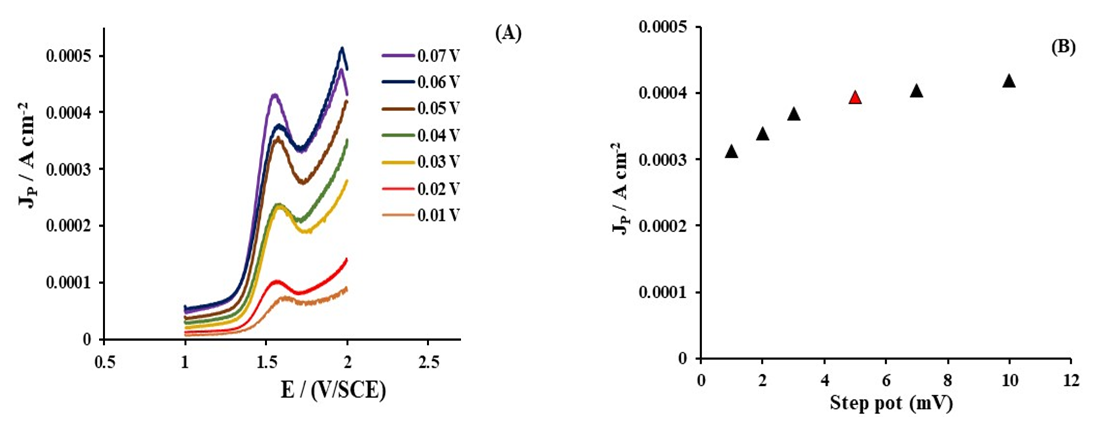 | Figure 4. (A) Square-wave voltammograms as a function of amplitude; (B) Variations in the peak oxidation current densities as a function of potential step; 0.5 mM OXA in 0.1 M K2SO4 |
3.4.2. Detection and Quantification of Oxacillin by SWV Method
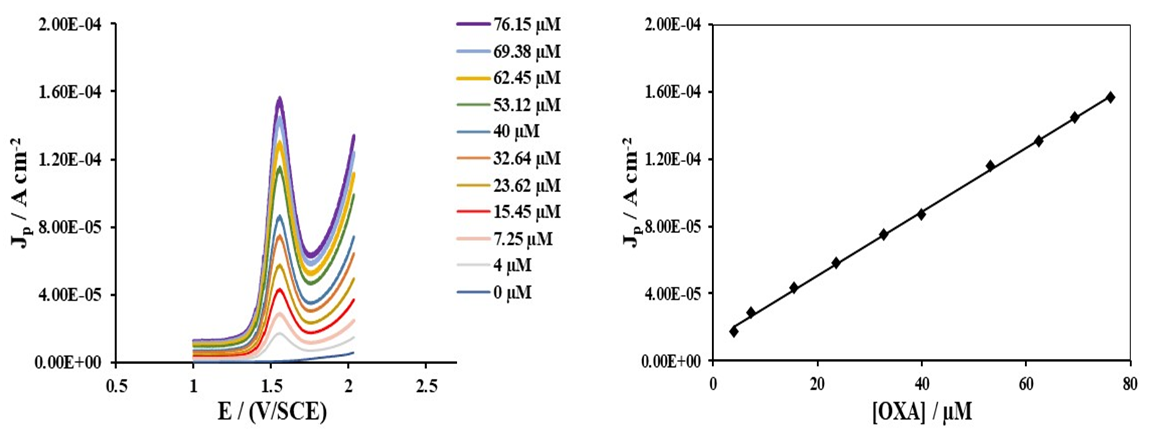
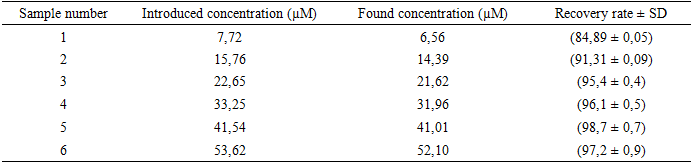
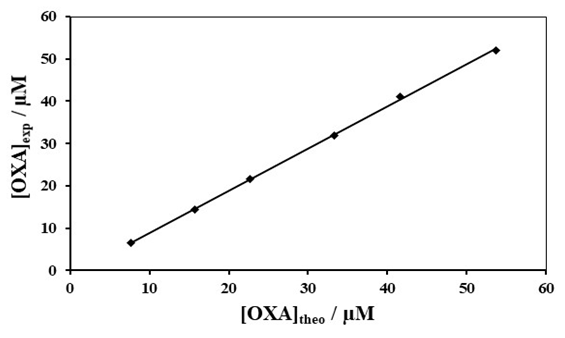
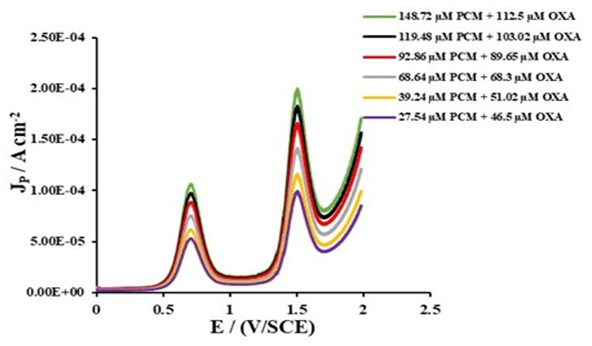
- In order to validate this analysis method for determining OXA in pharmaceutical and environmental applications, OXA signals at various concentrations were recorded on the BDD electrode in potassium sulfate medium (0,1 M K2SO4). Figure 5A presents recorded voltammetric response curves of the oxidation peaks for each OXA concentration ranging from 0 µM to 76.15 µM. These voltammograms were obtained under optimal conditions: AM = 50 mV/SCE, f = 25 Hz, and ∆Estep = 5 mV/ECS. The oxidation peaks for each OXA concentration within the selected concentration range are observed for a potential of around 1.6 V/ECS. This relatively positive oxidation potential corresponds to an electron transfer involving the oxidizable group of the oxacillin molecule, and its detection for analytical purposes is facilitated by the exceptionally wide anodic window of the DDB electrode (ΔE = 2.38 V, Section 3.2), on which solvent discharge is strongly repelled. On conventional electrodes such as platinum or glassy carbon, this peak would instead be masked by oxygen evolution. It is also apparent that peak current density increases with OXA concentration.The dependence of the peak oxidation current density and the OXA concentration in the electrolyte allows the calibration curve to be plotted over the concentration range from 4 µM to 76.15 µM. The curve obtained is a straight line with a determination coefficient R² = 0.999, which is close to 1 follows the Equation (1).
 | (1) |
 | (2) |
 | (3) |
 | Figure 5. (A) Square-wave voltammetries (SWV) of OXA (0 µM to 76.15 µM); (B) JP curve versus OXA concentration |
 | (4) |
|
 | Figure 6. Plot of experimental concentration versus theoretical concentration |
 | Figure 7. Square-wave voltammograms of BDD with different OXA and PCM concentrations |
3.4.3. Interferences Studies
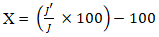
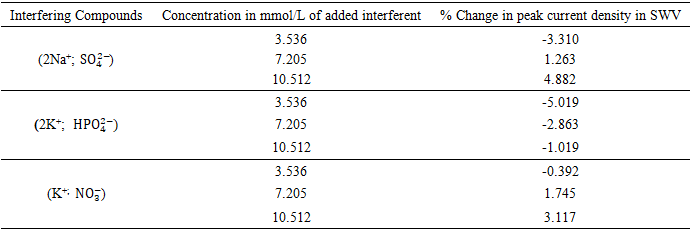
- Inorganic ions are widely present in the environment, and the effect of some of them on oxacillin detection was investigated. The interfering species of interest were potassium nitrate (K⁺; NO₃⁻), sodium sulfate (2Na⁺; SO₄²⁻), and potassium hydrogen phosphate (2K⁺; HPO₄^(2−)). Thus, concentrations of each interfering compound (3.536, 7.205, and 10.512 mM) were added to K₂SO₄ (0.1 M) media containing 25 µM OXA. Based on the square wave voltammetric curves recorded, the peak current densities of OXA were determined for each concentration of the interfering species. The interference (X, in %) of each compound on the OXA signal is calculated using the formula (Equation (5))
 | (5) |
 and
and  which are more concentrated than oxacillin, produce a negligible effect on the current density of the OXA oxidation peak in a 0.1 M K2SO4 media. For the OXA signal (SWV), the relative uncertainty registered is approximately ±5%, which corresponds to the acceptable tolerance limit for a maximum concentration of added substances or interfering substances [30]. It is therefore significant that there was no interference from the ions mentioned above on the oxidation of OXA in a neutral medium. Thus, this pharmaceutical organic compound can be detected and quantified by a BDD electrode even in charged ion media such as wastewater using SWV.
|
3.4.4. Application to Detection of OXA
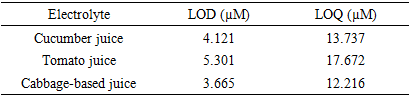
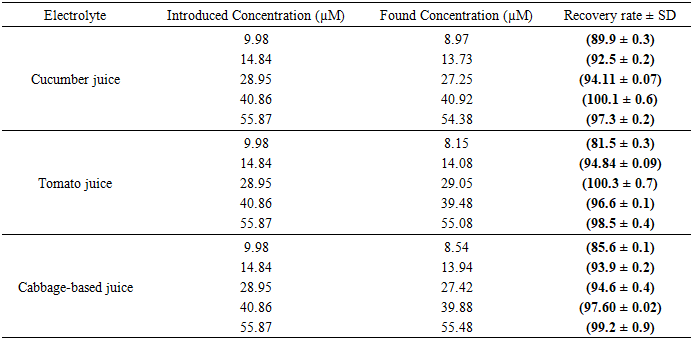
- To assess the applicability of the proposed method, OXA was detected in complex media such as cucumber, tomato, and cabbage-based juices. These complex media were used as electrolyte carriers as described in the experimental section. The OXA content varied by adding measured amounts to each support. The voltammetric curves obtained from this analysis, as well as the relationship the peak oxidation current density as a function OXA concentration, are plotted in Figure 8. These different figures reveal that the voltammograms exhibit the same peak oxidation potential (1.6 V/SCE), and the peak current densities are of the same order of quantity depending on the amount of OXA added to the measurement cell. Indeed, in each medium, the peak currents increase with the OXA concentration, which reflects the direct proportionality between the diffusion-controlled faradic current and the amount of electroactive oxacillin reaching the electrode surface. The calibration curves provide good linearity (R² close to 1). This information demonstrates that the method used is selective and also that OXA can be analyzed equally well in a potassium sulfate media as in complex media. The limits of detection and quantification in the concentration range selected, as obtained for the various matrices, are indicated in Table 3. They are all of the same size order. The proposed electrochemical method allows for the detection of oxacillin.
|
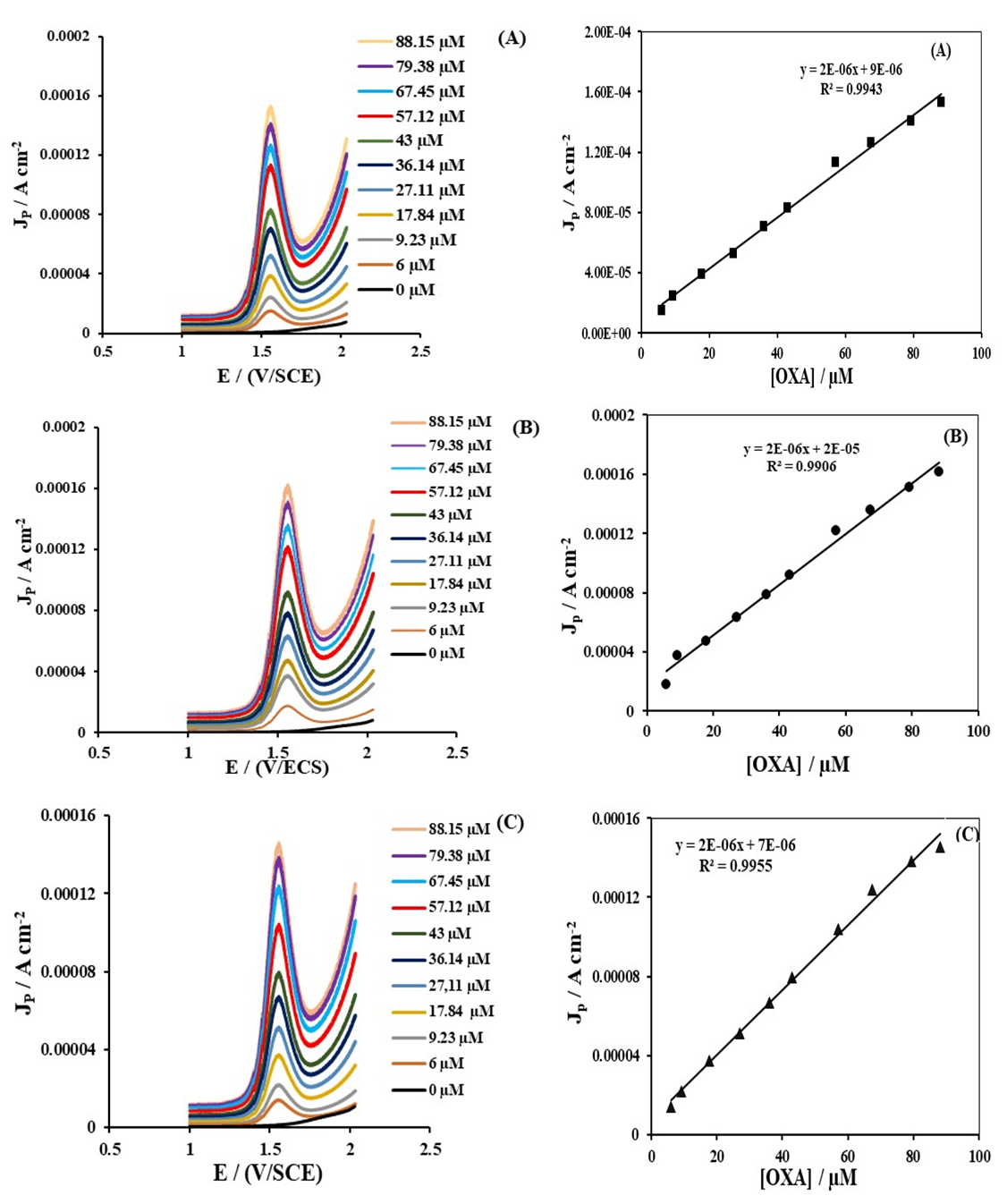 | Figure 8. Square-wave voltammograms on the BDD electrode of different OXA concentrations in (A) cucumber juice, (B) tomato juice, and (C) cabbage-based juice, along with their calibration curves |
|
4. Conclusions
- The work carried out proves that boron-doped diamond is appropriate for the individual voltammetric detection of OXA, even in the presence of other organic and inorganic molecules. The data analysis indicates that square-wave voltammetry (SWV) can serve as a valuable tool for the quantitative and qualitative identification of the pharmaceutical compound alone or in combination, as commonly found in pharmaceutical formulations, wastewater, or potentially in certain fruit and vegetable juices. The high sensitivity of the electrode, primarily attributable to its excellent physicochemical properties, allowed us to obtain clearly defined, distinct oxidation peaks in SWV. The high recovery rates achieved in various complex environments attest to the practical analytical utility of the sensor and the effectiveness of the method employed.
ACKNOWLEDGEMENTS
- We are thankful to the Swiss National Funds for its financial support. They funded the project (IZ01Z0_146919) which durability helped this work to be undertaken.
Conflicts of Interest
- The authors declare no conflicts of interest.