
-
Paper Information
- Paper Submission
-
Journal Information
- About This Journal
- Editorial Board
- Current Issue
- Archive
- Author Guidelines
- Contact Us
American Journal of Chemistry
p-ISSN: 2165-8749 e-ISSN: 2165-8781
2026; 16(1): 26-30
doi:10.5923/j.chemistry.20261601.03
Received: Jan. 2, 2026; Accepted: Jan. 28, 2026; Published: May 15, 2026

Synthesis of Some Amides: Reaction Between Cinnamic Acid Derivatives and Aniline as a Nitrogen Source Catalyzed by Zirconium
 Abstract
 Reference
 Full-Text PDF
 Full-text HTML
Tony Wheellyam Pouambeka1, 2, Obaya Nicaise Narcisse1, Hubert Makomo1, Ghislain Kende1, Timoléon Andzi Barhé3
1Equipe de Chimie Organique et Analytique des Substances Bioactives, Faculté des Sciences et Techniques, Université Marien Ngouabi, Brazzaville, République du Congo BP 69
2Jilin Province Key Laboratory of Organic Functional Molecular Design & Synthesis, Faculty of Chemistry, Northeast Normal University, Changchun 130024, China
3Laboratoire de Recherche en Chimie Appliquée, Ecole Normale Supérieure, Université Marien Ngouabi, Brazzaville, République du Congo BP 69
Correspondence to: Tony Wheellyam Pouambeka, Equipe de Chimie Organique et Analytique des Substances Bioactives, Faculté des Sciences et Techniques, Université Marien Ngouabi, Brazzaville, République du Congo BP 69.
| Email: |  |
Copyright © 2026 The Author(s). Published by Scientific & Academic Publishing.
This work is licensed under the Creative Commons Attribution International License (CC BY).
http://creativecommons.org/licenses/by/4.0/

A simple and efficient method for the synthesis of amides by a reaction between cinnamic acid derivatives and aniline as a nitrogen source, in the presence of zirconium as a catalyst has been described. The results of this reaction allowed obtaining some acetanilide derivatives, recognized in the literature to have analgesic and anti-inflammatory properties. The reaction was monitored by thin layer chromatography (TLC), the products obtained were purified by column chromatography and then characterized by nuclear magnetic resonance (NMR) and infrared spectroscopy (IR). A semblance of mechanism has been proposed to shed light on the reaction. 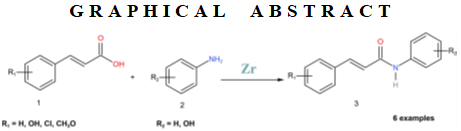
Keywords: Amides, Cinnamic acids derivatives, Aniline, Catalyzed by zirconium, Nitrogen source
Cite this paper: Tony Wheellyam Pouambeka, Obaya Nicaise Narcisse, Hubert Makomo, Ghislain Kende, Timoléon Andzi Barhé, Synthesis of Some Amides: Reaction Between Cinnamic Acid Derivatives and Aniline as a Nitrogen Source Catalyzed by Zirconium, American Journal of Chemistry, Vol. 16 No. 1, 2026, pp. 26-30. doi: 10.5923/j.chemistry.20261601.03.
Article Outline
1. Introduction
- The amide motif is widely present in most natural and synthetic compounds such as proteins, textiles, fertilizers, insecticides, and plastics [1-2]. For a long time, amides have played an important role in pharmacology and medicinal chemistry, particularly in the production of drugs with significant therapeutic value [3-4]. The best-known example is the paracetamol molecule, an important analgesic that contains the amide motif [5-6]. A classic technique for synthesizing molecules containing the amide function is the Schotten-Baumann reaction, which involves reacting amines with acyl chlorides [7]. Although this reaction produces amides, it has significant drawbacks, such as the formation of acid as a by-product. HCl in some cases and a carboxylic acid in others. In both cases, a base is required to carry out this transformation. These conditions are the cause of the increased cost of this reaction. Several modern techniques can lead to the synthesis of amides [8-10]. Most of these techniques involve the use of reagents such as esters, aldehydes, alcohols, nitriles, and even oximes in the presence of expensive metal catalysts such as rhodium, ruthenium, iridium, and palladium [11-15]. Zirconium, a less expensive metal like copper, iron, titanium and hafnium, has recently been the subject of several studies [16]. Zirconium, due to its properties, has become an important means of accelerating numerous reactions in organic chemistry as a catalyst. Thus, in 2011 Allen and Williams proposed a Metal-catalyzed approaches to amide bond formation [17], but the use of carbon monoxide in the transition metal-catalyzed coupling of amines gives this reaction a complex character. Patricia Marcé and colleagues reported in 2016, a simple, mild and general procedure for the hydration of nitriles to amides using copper as catalyst and promoted by N,N-diethylhydroxylamine [18]. Adolfsson and all also reported in 2012 a direct catalytic formation of trimary and Tertiary amides from non-activated carboxylic acids, Employing Carbamates as a nitrogen source (scheme 1a) [19]. This reaction was catalyzed by titanium tetrachloride TiCl4 or zirconium tetrachloride ZrCl4 and was found to be limited due to high temperatures. In 2014, Adolfsson's research group also proposed the formation of amides via an unactivated carboxylic acid and amines (scheme 1b) [20]. But this method uses homogeneous, heterogeneous catalysts called biocatalysts and Lewis acid catalysts based on boron and metals. These catalysts mentioned above require a very high cost for their synthesis, making the method proposed for the formation of amides complex. Recently, Patricia Marcé and all demonstrated a new method for the direct synthesis of primary and secondary amides from carboxylic acids using Mg(NO3)2•6H2O or imidazole as a low-cost and readily available catalyst (scheme 1c) [21], but this reaction is slow, achievable over a fairly long period of time at high temperatures. It is in this perspective that we describe here a simple and efficient reaction between cinnamic acid derivatives and aniline as a nitrogen source catalyzed by zirconium for the production of amides (scheme 1d).
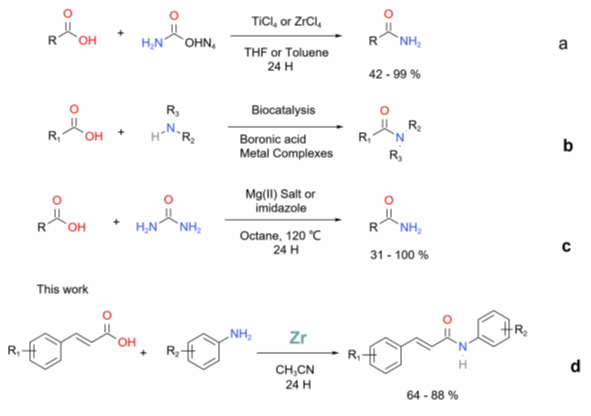 | Scheme 1. Formation of amide |
2. Experimental Procedures
2.1. Materials
- All chemicals and solvents were purchased from commercial source and used as received. All reactions were carried out under air atmosphere and monitored by Analytical thin-layer chromatography (TLC) with Machery-Nagel 0.20 mm silica gel 60 plates. Flash column chromatography was carried out using 300-400 mesh silica gel. 1H NMR spectra were recorded at ambient temperature on a Varian 400 MHz, 13C NMR spectra were recorded at ambient temperature on a Varian 125 MHz and TMS as internal standard. Melting points were obtained with a micro melting point XT4A Beijing Keyi. Chemical shifts for 1H NMR were described in parts per million. High resolution mass spectra were recorded on Bruck microtof. Coupling Constants (J) were then expressed in Hz. The signals have been described according to the following rule: s = singlet, d = doublet, t = triplet, q = quartet, m = multiplet, br = broad.
2.2. General Procedure for the Synthesis of Compounds
- Cinnamic acid 1a (29.6 mg, 0.2 mmol), aniline (126 mg, 0.4 mmol) and Zirconocene dichloride Cp₂ZrCl₂ (5.8 mg, 0.02 mmol) were placed in a Schlenk-tube containing a magnetic stirrer under nitrogen atmosphere. l’acétonitrile CH3CN (2 mL) was added as a solvent. This mixture was stirred for 24 hours at 80 °C and gradually monitored by thin layer chromatography (TLC). After 24 hours of stirring under nitrogen pressure, the reaction mixture is brought back to room temperature, 10 mL of ethyl acetate and 10 mL of HCl are then added. The result of mixture was extracted with dichloromethane (3 × 10 mL). Then, the organic phase was dried with anhydrous Na2SO4. After evaporation of the solvent, the residue was purified by column chromatography using silica gel as the solid phase and (acétate d’éthyle / cyclohexane (6 /4) to give a black powder 3a with a yield of 80% (35.60 mg).
2.3. Characterization Data of Compound 3
- (E)-N-phenylcinnamamide (3a)Black solid (35.60 mg, 80%); mp: 189 – 200 °C; 1H NMR (400 MHz, DMSO-d6): δ: 9.51 (s, 1H, N-H); 7.0 – 7.5 (m, 5H, N-Ar-H); 7.1 – 7.7 (m, 5H, H-Ar-C=); 7.7 (d, J = 15 Hz, 1H, Ar-CH=); 6.8 (d, J = 15 Hz, 1H, C=CH-CO). 13C NMR (125 MHz, DMSO-d6): δ: 166.5; 145.0; 144.2; 135.7; 135.9; 135.1; 130.3; 128.4 (2C); 126.3 (2C); 125.0; 122.7 (2C); 118.7. HRMS (ESI-TOF) calcd for C15H13NNaO, [M+Na]+ 246.0895 Found 246.0910.(E)-3-(2-chlorophenyl)-N-(4-hydroxyphenyl)acrylamide (3b)Black solid (39.41 mg, 72%); mp: 350 – 356 °C; 1H NMR (500 MHz, DMSO-d6): δ: 10.25 (s, 1H, NH); 9,75 (s, 1H, OH); 7,85 (d, 1H, J = 15 Hz, 1H, Ar-CH=);); 7,75 (s, 1H, H); 7,5 (d, 1H, J = 15 Hz, 1H, C=CH-CO); 7,45 (d, J = 8.5 Hz, 2H, H); 7,25 (s, 2H, H); 6,75 (s, 1H, H); 2,5 (d, J = 8.5 Hz, 2H). 13C NMR (125 MHz, DMSO-d6): δ:164,01 C; 154,40 C; 136,36 C; 134, 37 C; 133,19 C; 132,23 C; 131,28 C; 130,90 C; 128,72 C; 128,65 C; 125,62 (2C); 122,43 C; 116,25 (2C). HRMS (ESI-TOF) calcd for C15H12ClNNaO2, [M+Na]+ 296.0454 Found 296.0457.(E)-N-(4-hydroxyphenyl)cinnamamide (3c)Black solid (42.06 mg, 88%); mp: 309 – 315 °C; 1H NMR (400 MHz, DMSO-d6): δ: 10.25 (s, 1H, N-H); 9.70 (s, 1H, OH); 7.73 (d, J = 16 Hz, 1H, Ar-CH=); 7.34 (d, J = 8.5 Hz, 2H, Ar-H in meta position of OH); 6.96 (d, J = 8.5 Hz, 2H, Ar-H in ortho position of OH); 7.21 – 7.42 (m, 5H, Ar-H); 6.84 (d, J = 16 Hz, 1H, =CH-CO). 13C NMR (125 MHz, DMSO-d6): δ: 166.4; 153.8; 143.9; 136.1; 128.8 (2C); 128.4; 128.0; 126.5 (2C); 123.7 (2C); 118.8; 116.7 (2C). HRMS (ESI-TOF) calcd for C15H13NNaO2, [M+Na]+ 262.0844 Found 262.0839.(E)-3-(3,4-dihydroxyphenyl)-N-(4-hydroxyphenyl)acrylamide (3d)Black solid (44.48 mg, 82%); mp: 530 – 536 °C; 1H NMR (400 MHz, DMSO-d6): δ: 9,84 (s, 1H, NH); 7,67 (d, 1H, J = 15 Hz, 1H, Ar-CH=);); 7,47 (d, J = 8.5 Hz, 2H, H); 6,77 (d, 1H, J = 15 Hz, 1H, C=CH-CO); 6,71 (d, J = 8.5 Hz, 2H, H); 6,52 (d, J = 8 Hz, 1H); 6,49 (d, J = 8 Hz, 1H); 6,28 (s, 1H); 4,16 (s, 3H, 3OH). 13C NMR (125 MHz, DMSO-d6): δ: 163,89 (C carboxyle); 153,71 C; 148,11 C; 146,12 C; 140,42 C; 131,66 C; 126,73 C; 121,22 (2C); 121,10 C; 119,13 C; 116,26 C; 115,58 (2C); 114,32 C. HRMS (ESI-TOF) calcd for C15H13NNaO4, [M+Na]+ 294.0742 Found 294.0746.(E)-3-(4-hydroxyphenyl)-N-phenylacrylamide (3e)Black solid (35.41 mg, 74%); mp: 131 – 133 °C; 1H NMR (400 MHz, DMSO-d6): δ: 10.31 (s, 1H, N-H); 9.62 (s, 1H, OH); 7.90 (d, J = 16 Hz, 1H, Ar-CH=); 7.22 – 7.54 (m, 5H, Ar-H); 7.30 (d, J = 8.5 Hz, 2H, Ar-H in meta position of OH); 6.90 (d, J = 8.5 Hz, 2H, Ar-H in ortho position of OH); 6.81 (d, J = 16 Hz, 1H, =CH-CO). 13C NMR (125 MHz, DMSO-d6): δ: 167.8; 152.2; 149.1; 143.0; 137.9; 132.0 (2C); 128.1 (2C); 152.8; 123.2 (2C); 115.9 (2C). HRMS (ESI-TOF) calcd for C15H13NNaO2, [M+Na]+ 262.0844 Found 262.0849.(E)-3-(4-hydroxy-3,5-dimethoxyphenyl)-N-(1H-1,2,4-triazol-3-yl)acrylamide (3f)Black solid (31.34 mg, 54%); mp: 600 – 620 °C; 1H NMR (500 MHz, DMSO): δ: 9,5 (s, 1H, HN); 8,3 (s, 1H, Ar-H); 8 (s, 1H, NH); 7,57 (d, J = 16 Hz, 1H, Ar-CH=); 7,5 (s, 1H, Ar-H); 7,37 (d, J = 16 Hz, 1H, =CH-CO); 7,29 (s, 1H, OH); 3,82 (s, 6H, 2OCH3). 13C NMR (125 MHz, DMSO): δ: 165,77 (C=O); 157,89 C; 151,39 C; 148,55 (2C); 139,89 (C=C), 124,71 C; 124,20 C;119,21 C; 113,45 C, 107,07 C; 56,59 (2C). HRMS (ESI-TOF) calcd for C15H14N4NaO4, [M+Na]+ 313.0913 Found 313.0910.
3. Resultats et Discusion
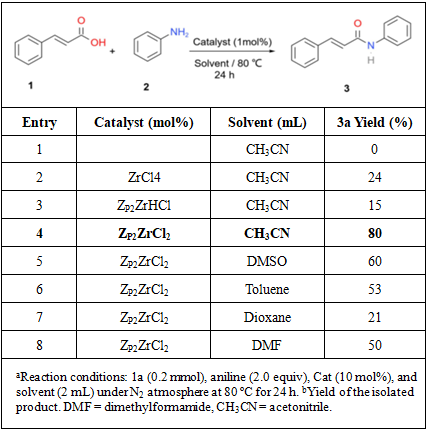
- We started this study by reacting cinnamic acid 1a with aniline 2a under different conditions. In the absence of the catalyst (Table 1 entry 1), no product was observed. When we used zirconium tetrachloride ZrCl4 as a catalyst in the presence of acetonitrile as a solvent (Table 1, entry 2), the desired product 3a was obtained in a yield of 24%. Using ZP2ZrHCl as catalyst under the same conditions (Table 1, entry 3), allowed to observe the product 3a with a low yield of 15%. When we first used ZP2ZrCl2 as a catalyst (Table 1 entry 4), the amidation product 3a was obtained with a yield up to 80%. Several solvents such as DMSO, toluene, dioxane and DMF were used in this transformation (Table 1, entry 5-8). Thus, the desired product 3a was observed in a yield of 60% for DMSO, 53% for toluene, 21% for dioxane and 50% for DMF.
|
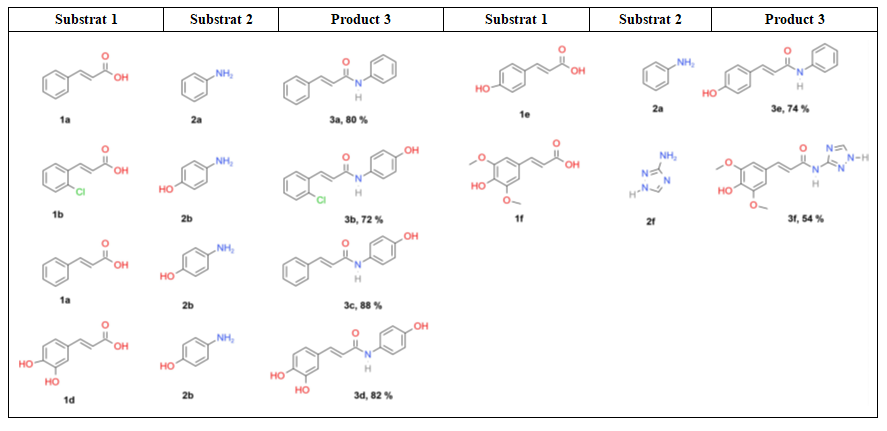 | Table 2. Scope of réaction |
4. 1H and 13C Spectra of Some Compounds
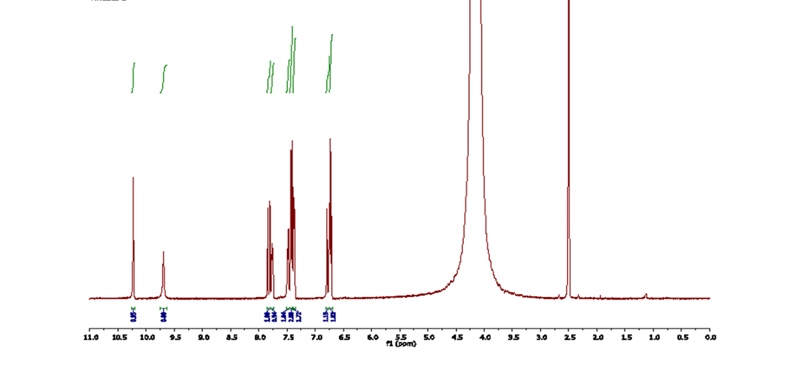 | Figure 1. 1H NMR spectrum of compound 3b |
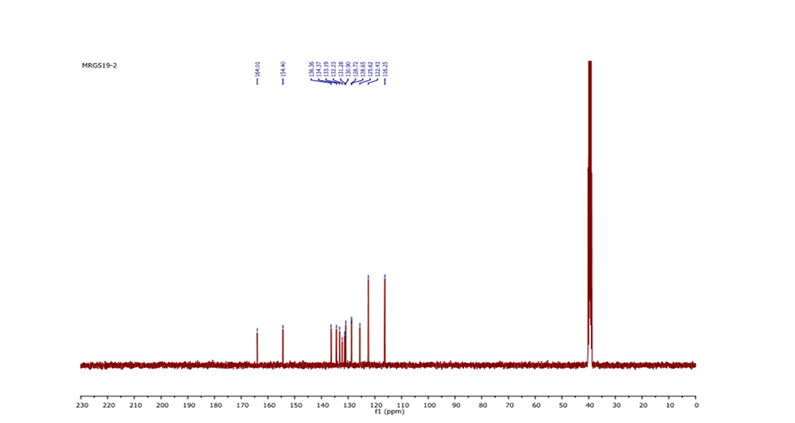 | Figure 2. 13CNMR spectrum of compound 3b |
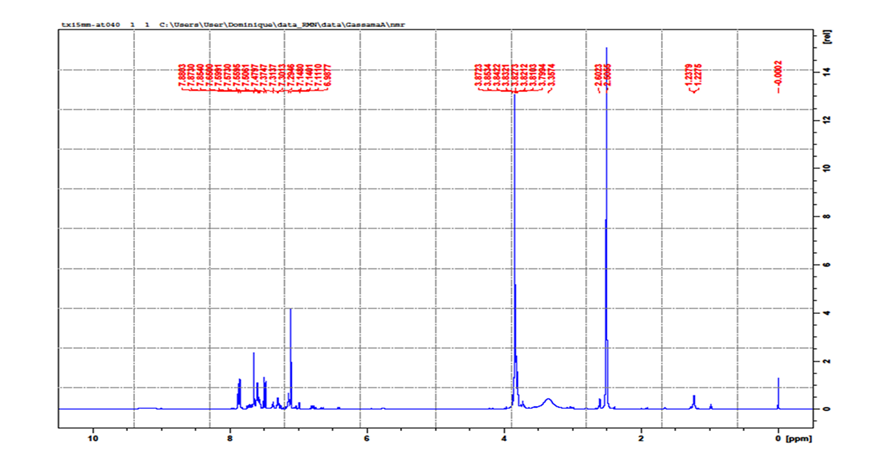 | Figure 3. 1H NMR spectrum of compound 3f |
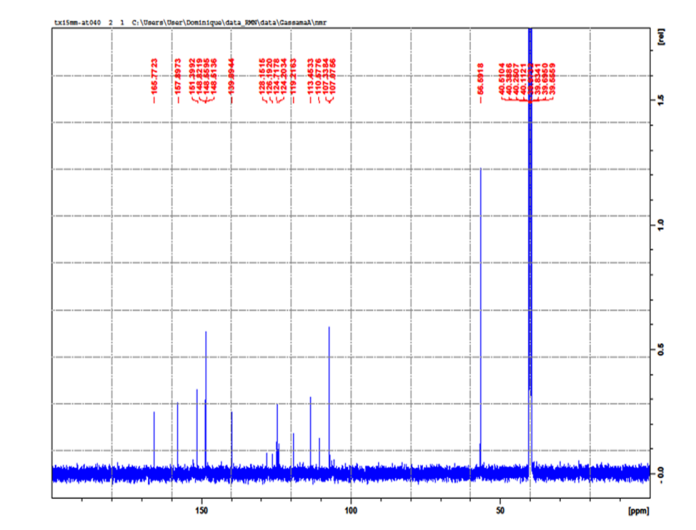 | Figure 4. 13CNMR spectrum of compound 3f |
5. Conclusions
- Our research was based on the formation of the amide function, which represents a great interest in health sciences and, above all, plays an important role as a reaction intermediate in organic synthesis.In summary, the intermolecular formal amidation between cinnamic acid derivatives and some aniline-type amines as nitrogen source was achieved by zirconium-based catalysis in acetonitrile as solvent. The introduced method offers a wide application scope for both coupling partners and excellent tolerance to functional groups producing amides with acceptable yields. 1H and 13C NMR spectra were described to characterize the new products. Notably, the generality of this method could be extended to other cinnamic acid derivatives and possibly other derivatives. The amidation products resulting from this transformation should be of interest to organic and industrial chemists.
ACKNOWLEDGEMENTS
- We thank Marien Ngouabi and Northeast Normal University.