
-
Paper Information
- Paper Submission
-
Journal Information
- About This Journal
- Editorial Board
- Current Issue
- Archive
- Author Guidelines
- Contact Us
International Journal of Arts
p-ISSN: 2168-4995 e-ISSN: 2168-5002
2026; 13(1): 16-35
doi:10.5923/j.arts.20261301.02
Received: Aug. 9, 2026; Accepted: Aug. 26, 2026; Published: Aug. 31, 2026

Why and How to Set Ancient Chinese Metered Poetry as Lyrics to Western Classical Music to Create New Art Songs (or Folk Songs)
 Abstract
 Reference
 Full-Text PDF
 Full-text HTML
Liu Kedian
New Tech Institute, China
Correspondence to: Liu Kedian, New Tech Institute, China.
| Email: |  |
Copyright © 2026 The Author(s). Published by Scientific & Academic Publishing.
This work is licensed under the Creative Commons Attribution International License (CC BY).
http://creativecommons.org/licenses/by/4.0/

This article aims to present the author's research findings on why and how to set ancient Chinese metered poetry to Western classical music to create new songs. This is an analysis and summary of the idea, thinking methods and approaches adopted by the author in his previous and current creative work on this subject. It also provides a set of general methods and theories for such creative works. The first half of this article mainly answers the question of why to set ancient Chinese poetry as lyrics to classical music. The second half part of this article presents 6 unpublished new songs created based on this approach as typical examples, aims to explain the actual application process of the aforementioned ideas and methods in the creative practice. The 6 examples are analyzed and explained in more detail, mainly answers the question of how to set ancient Chinese poetry as lyrics to classical music, and therefore allowing readers to appreciate and examine the practical application effects of these approaches and thinking mode.
Keywords: Song, Folk song, Art song, Chinese classical Poetry, Chinese Metered Poetry, Classical Music
Cite this paper: Liu Kedian, Why and How to Set Ancient Chinese Metered Poetry as Lyrics to Western Classical Music to Create New Art Songs (or Folk Songs), International Journal of Arts, Vol. 13 No. 1, 2026, pp. 16-35. doi: 10.5923/j.arts.20261301.02.
Article Outline
Foreword
- This article does not involve and explore complex and elaborate musical theories, and that is not the author's area of expertise. To set ancient traditional Chinese poetry to classical music is an unprecedented and unique new research project; it does not have a universal or general theoretical basis. The author of this paper merely conducted research and development from a practical perspective and with practical outcomes in mind. He repeatedly studied, understands, and completes the creation of new songs from both the composer's standpoint and that of the listeners and performers. He also considered the issues and key points that should be taken into account in composing the new songs. In summary, whether it is the theoretical basis or the creative practice, the author is based on the actual situation and realities of the enthusiasts of ancient Chinese poetry, classical music and songs to complete the works. Limited by time, the author has only promptly scanned fewer relevant research materials. The author felt that although the previous poetry, music and songs related research could not directly guide the current work, at least it could exam whether the research in this paper was conformed to some of the previous valuable research conclusions and assertions. The author believes that if referring to as more relevant research materials as possible, then can significantly enhance the academic value in future research and creative work.
1. Why to Set Chinese Classical Poetry to Western Classical Music
1.1. Why Combine Poetry with Classical Music to Create New Art Song or Folk Song
- (Music and literature review 1: Briefing poetry – music relationships and intermediality)Classical music emerged in the Middle Ages and has evolved since, traversing distinct stylistic periods. Throughout the 10th to 13th century the musical form began to take shape through the development of staff notation, the rise of early polyphony, and the systematic teaching of music theory, marking a shift from oral chant traditions to a written and more complex musical art form. During the Baroque era (1600–1750) Classical music became more elaborate and expressive, marked by the rise of opera, the use of ornamentation, the development of major and minor tonalities, and the creation of complex instrumental forms such as the concerto, sonata, and fugue. The Classical period (1750–1820) emphasized clarity and proportion, with the rise of the symphony and string quartet and elevation of the sonata; works of composers such as Haydn, Mozart, and early Beethoven began to shape the foundations of modern Western music. Classical music expanded in emotional expression and scale in the Romantic era (19th century), featuring larger orchestras and richer harmonies, with Beethoven and other composers, such as Chopin and Tchaikovsky, pushing music toward greater individuality and dramatic intensity.Ancient Chinese poetry encompasses verse composed in the Classical Chinese language from the earliest anthology, the Book of Songs, dating to the 11th–7th centuries BCE, through evolving forms across dynasties up to the Song era (960–1279 CE), distinguished by its tonal prosody, parallelism, and concise evocation of human experience via natural imagery and historical allusion. Originating in oral traditions later compiled as ritual and folk expressions, it developed regulated structures like the lyric poetry in five- or seven-character lines during the Han (206 BCE – 220 CE) and Tang (618–907 CE) dynasties, reaching a pinnacle in the latter with masters such as Li Bai and Du Fu, whose works integrated personal introspection, political commentary, and Daoist-Buddhist themes amid imperial patronage and civil service examinations that prized poetic skill. The genre's influence persisted into the Song with Lyric Poetry (Ci) tuned to musical patterns, emphasizing emotional subtlety over Tang-era grandeur, while its stylistic evolution reflected shifts in cosmology, governance, and aesthetics. The Tang's estimated 48,900 surviving poems, which canonized parallelism and antithesis as hallmarks of maturity, fosters a cultural emphasis on moral edification through indirect expression rather than explicit narrative. Poetry and music possess a natural inherent affinity of intermediality.Poetry and music share a profound connection, a harmonious dance of rhythm, emotion, and imagination. This correspondence transcends mere surface similarities, delving into the core essence of both art forms. They are deeply intertwined, using similar tools to evoke feelings and tell stories. Poetry often utilizes musical devices to create a sonic experience, mirroring the structure and impact of music. A concise definition of the relationship between poetry and music is that they are complementary art forms that use shared elements like rhythm, meter, and rhyme to create a unified aesthetic experience [6].Humans need music also need poetry, and more importantly, need songs that are the combination of the two. Humans love, preference and enjoyment for music, poetry, and songs are the natural and inherent needs of intelligent life in both living and working activities; this love and need is universal across all times, regardless of race or nationality, regardless of poverty or wealth, regardless of nobility or commoners, it is a spontaneous existence for people of all social strata. Creating and appreciating poetry, music, and songs is the nature and instinct of intelligent life.Music, poetry and songs share the commonalities that are the creations and specific description of the feelings, thoughts and activities about human living and working. It is the most basic and universal tools, methods, and approaches for human emotions to be released, to be expressed and to be vented. Poetry and music both come from the folk, and it doesn't matter how long their existence can be traced back, whether it is hundreds or thousands or even tens of thousands of years, nor does it matter which ethnic group's works or heritage is more ancient and more exquisite. They are all human spiritual wealth, spiritual nourishment, spiritual snacks, and resonance of the soul.In certain historical periods, music was more often created and served for the court, officials, and nobles, while poetry never belonged exclusively to the upper class. Both poetry and music possess universality and abstraction, while also having relatively specific objects of expression. Of course, the objects and contents depicted in poetry are more concrete, but the contents and connotations that are always appreciated and savored in poetry and music are often similar elements that combine typical and specific emotions.Musicians and composers need their own works, but they create them both for themselves and for others. Audiences, normal people need the works of composers, even their own works or simple tunes and songs. Poets, writers need to express emotions and therefore need their own works, but they create them both for themselves and for others. Readers need the poems of poets, even their own short poems, rhymes, and small works.Once written and circulated, poetry and music are the application of various similar emotional expressions. Due to the vast differences in each individual's experiences, cultural backgrounds, etc., each person inevitably completes an indescribable transplantation understanding, even an intangible re-creation in their heart. This is its inherent nature, and perhaps the original author could not have foreseen or been helpless to interfere further.However, music needs to be played with instruments, even the most primitive and humble instruments made by ourselves. For example, a whistle is a temporary instrument made with the human mouth. The scene of "Bridge over the River Kwai" in the British film, the British prisoners of war, in a neat line, played the Colonel Bogey March while returning from work in the evening. This scene even touched the Japanese fascist officers in the prisoner camp.Music can also reverberate internally in heart and mind in silence without instruments, or hum in a low voice to enjoy oneself.Poetry can be recited and memorized by all literate people, even those who are illiterate can imitate and chant it. However, reading aloud is too solemn and serious, and consumes too much attention; while chanting poetry in the form of songs is more fluid, and requires less attention. When a person reads aloud poetry while walking, even if they are reciting their familiar poems, they might accidentally fall into a ditch of the roadside. However, chanting poetry in the form of singing is more relax and requires less attention. The listener will not be stumble or trip, and even the delicate work at hand will not be delayed.Reading and reciting poetry requires concentration and a specific tone. Even so, most people are not satisfied with their own recitation performance. When one feels self-satisfied, while the audiences or listeners may be felt indifferent, even disgust. If poetry is set to an elegant and matched music of the same mood to create a song, it becomes another form of “reading” or “recitation” that is singing, with the tone rising and falling with the music melody, thus it is a standard “recitation”, no need ostentatious or a specific tone.When poetry is combined with music and integrated into the corresponding emotional atmosphere, forming a song, the two mutually express, it is intermediary modulating to creat a harmonic transition in coupling. Songs have both the functional characteristics of music and poetry, never being limited to the upper social group. The combination of music and poetry gives rise to songs, achieving the optimization of art and practice, generating rich and diverse implicit and explicit effects. Poetry needs music to carry and convey, and music needs poetry to interpret and promote. Practice integrates the performance of music and the recitation of poetry. The combination of poetry and music makes the song like the colorful clouds illuminated by the bright moon, mountains accompanying rivers, red flowers and green leaves, complementing each other. Set poetry to classical music is like cooking a delicious fast food with two ingredients. Just like McDonald's hamburgers and meat patties, when you eat the bread and meat patty separately, the taste is far less delicious than making a sandwich. The reason why Chinese meat-filled steamed buns fast food becomes a delicacy is also because of this: if you eat the meat and steamed buns separately, the taste is far less appealing than eating meat-filled steamed buns together.Poetry is music without melody, while music is a wordless poem, and songs are poetry and music inseparably linked happy couple.Poetry can convey and interpret the implication emotional depth of music through using oral language to make it concrete expression, thereby enriching the music; conversely, when lyrics and melody are combined, music also modulate poetry to enhance and evoke the emotional resonance of poetry. Classical poetry and classical music have some features that cannot be fully expressed in words, and are more intuitive and perceptible in common aesthetic feelings. The fusion of these two art forms can mutually enhance their expressiveness, combining the depth of reality and the flexibility of art, thereby enhancing the overall appeal. Moreover, this fusion also has lasting artistic value. It is a typical excellent result of the synergy of intermediality.
1.2. Why Ancient Chinese Metered Poetry Should be Set to Western Classical Music
- (Music art and literature review 2: Briefing the intercultural communication) Traditional Chinese poetry, especially metered lyrics (verses), originally had musical scores that could be sung directly. However, why did these singing melodies not spread widely and why were many of them lost over time? One reason is that their musical forms lack emotional tension and the appeal of melody, making it difficult to resonate with the general public. Additionally, they are often uniform and fail to fully and accurately express the rich, delicate artistic individualistic conception and subtle distinctive emotions contained in each poem.For instance, the most typical and widely-known example is that there is a well-loved poem "Breaking Through the Enemy Line" by the Northern Song Dynasty lyrics poet Yan Shu and the Southern Song Dynasty poet Xin Qiji respectively, whose imagery and description of the subject are vastly different, completely distinct. The former is sweet life of the village girl living in the countryside, the cheerful and playful conversations on the way home in the early noon and under the green grass in the countryside's bamboo grove, and the later is emotional expression in the starry night during the break in the military camp's battle, the heroic and ambitious fighting spirit and aspirations on the battlefield that spanned thousands of miles, how could they be expressed with the same melody? !In modern times, there have been many excellent re-creations of contemporary works. However, from my perspective, the expression methods, melodies, and ideas are all constrained by individual limits and the trends of the times. Its music fails to adequately convey the meaning of its poetry (lyrics). Thus cannot become popular and widely acclaimed.Since the 18th century, China has gradually fallen behind the West in terms of music theory, instrument development, and performance techniques.Another issue is that the East Asians commonly uses the pentatonic scale, consisting of C (Do), D (Re), E (Mi), G (Sol), A (La), namely 1, 2, 3, 5, 6. However, there is less sensitivity towards F (Fa) and B (Si), the 4th and 7th notes, which are rarely used.Therefore, attempting to create new pieces using the existing Chinese music framework or forcing those who are not good at composition to compose for classical poetry is impractical. Fundamentally, Chinese composers lack the ability to effectively achieve this goal.Over the past century, many musicians and scholars have attempted to integrate Chinese classical poetry into the realm of classical music and art songs. But why have most of these efforts failed to achieve lasting results? The fundamental reason is that these people often lack a profound understanding of poetry or music. Some people even completely fail to grasp the essence of poetry expression, while others have difficulty capturing the emotional tone of a musical piece, and some have no musical knowledge at all. Therefore, it is almost impossible for them to perceive the common characteristics shared by a specific poem and the corresponding musical fragment or work.If a music professional is asked to compose music for a large number of poems and verses, first of all, his understanding of these poems may not be accurate; secondly, in a hurry, it is difficult to accumulate creative inspiration, melodic materials, and musical themes. Currently, no accessible works have been produced. Their music scores cannot adequately convey and express the meaning of the poetry. For examples, recent years, on the display platform of China Music Publishing House, many pieces of new songs composed by some musicians by using some ancient poems as lyrics are showcasing. However, most of these pieces have similar repetitive melodies, being monotonous and boring, many syllables to express a word, deliberately prolonging the singing tone for an excessive length of time. Some musicians composed choral works by using ancient poems as lyrics, a four-line ancient poem was even repeated in a song 8 times and the melody was completely unappealing. Such works are tiresome with no users, remaining merely on the shelves of libraries. In an eastern big country, such phenomena are not isolated. Classical music has a complete and comprehensive theory, systematic instruments, creative works span more than four hundred years. There are countless outstanding, excellent works, too numerous to count. Glorious and beautiful works abound. It is sufficient to cover and express the connotations, moods and emotions of the most famous ancient Chinese metered poetry works.Classical music is one of most significant symbol and entity of typical Western culture. Poetry is one of the most important portions of typical entities of ancient Chinese culture. In terms of cultural communication and exchange, the research comparing ancient Chinese poetry with other languages' ancient poems has a long history. The comparative study of Chinese music and Western music is also not lacking. Only by combining ancient Chinese poetry with Western classical music can a creative and pioneering new research field be formed, which is bound to yield wonderful, brilliant and fruitful results. This is precisely the absent idea and project at present.Therefore, by carefully selecting from the treasure trove of human music works over hundreds of years and combining with most famous ancient Chinese metered poetry, thus the brilliant light of the rich spiritual wealth accumulated over thousands of years by human being can be carried forward for next generations and maintain its charm forever. This project is a great practice and experiment of intercultural communication. This is a reasonable design that achieves complementary synergy through a strong intercultural alliance and unprecedented fruits of win-win situation.
1.3. Why Western Classical Music is Better Being Set by Ancient Chinese Poetry
- (Briefing artistic/cultural translation1)In term of cultural translation, translating poetry to other languages can be done; however, while the metaphors and charm of the poem are difficult to be accurately translated.When classical music is confined to the specific descriptive objects and historical context of the great composer, its artistic charm and appeal may be suppressed and limited.Instead, we try to use classical ancient Chinese poetry to translate, interpret classical music, will break the constraint. It serves as means and ways of inspiration and enlightenment in understanding the commonality, implicit expressions and common meanings of poetry and music.Ancient Chinese metered poetry is not primarily intended to expound philosophical ideas or lofty moral principles. It not only conveys specific content clearly, but also embodies abstract and generalized artistic concepts as well as subtle rational insights. Similarly, music is both universal and abstract, and has a relatively clear range of expression. Ancient Chinese regulated verse has a history of 3,000 years. Its quantity is vast and extensive. It has reached the peak in terms of humanistic, scenic and emotional descriptions.The creation of music score is not mainly intended to convey philosophical or moral ideas. To be honest, music cannot express philosophy, nor is it born and exists for the sake of philosophy. While the classic poems of Europe often contain or imply philosophy, or are written for the sake of philosophy, some of this philosophy seems hastily generalized. Therefore, most of the classic poetry of Europe may be slightly not suitable for being turned into songs.The basic expression structure of Chinese ancient poetry is very similar to that of a symphony, which usually adopts a four-movement structure. Chinese poetry has obvious advantages in musicality: each Chinese character consists of one vowel and one consonant, allowing each character to correspond to a single musical note. And each character only expresses a specific meaning. Chinese poetry is suitable for both chorus and solo singing.Ancient Chinese poetry must rhyme, while it is difficult for other languages to achieve this. This factor is extremely smooth in terms of thinking and pronunciation when singing. Audiences can also immerse themselves more deeply when enjoying the artistry and appeal.In terms of the depth and breadth of content, the ancient Chinese metered poetry and lyric poetry can be said to be on par with classical music in terms of its richness.Therefore, pairing Chinese traditional poetry with classical music fully demonstrates the compatibility between language and music, and has important aesthetic and practical value. Western classical music paired with Chinese classical poetry has greater advantages compared to pairing with the poetry of other ethnic languages.This inter-artistic forms and intercultural translation opens up one new way to create a new form of living cultural.
1.4. Ancient Chinese Metered Poetry and Western Classical Music are Linguistically and Grammatically Matched
- (Briefing artistic/cultural translation2)Any language is composed of longer and shorter sentence structures because when people think and engage in mental activities, they need to pause when complete each assertion or statement. And to make a logical reasoning and draw conclusions, make large or small (sometimes major or minor) reasoning or reaching conclusion, they need a pause. And the mind supported by the heart and lungs system also needs to take breath repeatedly and periodically. The most common sentence structures in ancient Chinese poetry are five-character and seven-character poems. Each line of a five-character poem consists of five words, and each line of a seven-character poem consists of seven words, these forms or structures are the reflection of such nature physical and mental pause.Classical music and any music are also a form of human language, and thus a form of thinking and consciousness activity. Therefore, music is also composed of syllables, sentences (or lines) and movements or sections. A syllable or a note is similar to a word or a phrase in oral language. Several notes or syllables form a musical sentence or line, and several sentences form a movement or a section. This is determined by the principles of human musical physiology, musical psychology, musical consciousness, and musical thinking. This is the same no matter they are composers, or a performers, even listeners or audience. Although sometimes people's mental activities require very calm and composed states, they also must pause and breathe. Any musical work has syllables and sentences or lines of similar length throughout or in a same continuous manner.This makes classical music and Chinese metered five-character and seven-character poetry have the characteristic of being a well match to classical music, and it is irreplaceable.For example, Johann Sebastian Bach's G Major Minuet and Luigi Boccherini's Minuet and some waltzes are very suitable to be paired with Chinese five-character poems. Marches, and some waltzes are more easily paired with Chinese seven-character poems. Serenades can match more different and wider range forms of poetry and regulated lyrics than waltzes and marches, it can be paired with Tang dynasty poetry and Song dynasty regulated lyrics depends upon the musical structure of the serenade itself.The interwoven between these two languages of poetry and music score is like dance partners; in most compositions of the new songs of ancient Chinese metered poetry being set to classical music scores, they are led mutually, musical meters and poetry meters will govern mutually, just following up each others. A well paired new song, when the poetry resonates in one’s mind or brain, the melodies of the coupled music will also automatically resonate in one’s mind or brain simultaneously, and vice versa.In term of artistic/cultural translation, these two art forms share such obvious similarities, yet they do not communicate with each other, do not dance together, nor do they talk to each other. Before this, there was no one or method for translating these two art and cultural forms into each other, no one to act as a mediator or build bridge to bring them together. From this perspective, the research project of this article is very reasonable and timely.
2. How to Set Ancient Chinese Metered Poetry to Western Classical Music
2.1. Selection of Materials, Subjects and Objects
- The history of Chinese poetry spanning over two thousand years has produced millions of poems. The works are like a vast sea, but only tens of thousands of them are read by readers. Among them, the best ones are several thousand, the most popular ones are several hundred, and the ones that can be sung are hundreds. Various types of poems have diverse themes, different techniques, varying lengths, and cover all aspects of content. Classical music has a history of several hundred years, and there are tens of thousands of songs and musical pieces. Good ones are several thousand, excellent ones are several hundred, and those that can be sung are hundreds. By comparing and selecting among these two, we can find the best matching classical music works for different themes. However, such an optimal selection result will not be abundant in quantity.If a work is not classic, not singable or not profound in meaning, not passionate, not forceful, and not poetic, it may not be necessary to combine it with music. It would be a futile attempt to add unnecessary elements. Forced combination, arranged marriage. Therefore, a masterpiece lies in its quality rather than quantity. It is not that the more you do, the better it is.If the quality of the poetry or music itself is poor, combining them will have the opposite effect, reducing the artistic value of both. However, when both have high quality, they can complement each other perfectly and enhance each other's beauty. Therefore, when choosing to pair them, a comprehensive list should be made and each pair should be carefully selected; it is better to avoid any poor choices.
2.2. Poetry and Music Correspond and Compare each Other, Try to Match, Sorting, Filtering Selecting
- - Both Poetry and music need to be evaluated for their singability; that is, whether they can be transformed into lyrics and the melody, scores or sheet music of the song. One can say that all poems can be sung, but whether a specific poem needs to be sung and whether it is emotionally touching and beautiful when being sung is another matter. Not every poem is suitable for being written into a song! The same goes for music. Not all pleasant and beautiful musical works are suitable for being transformed into song scores.- You can use a poem that you like and that seems singable as the subject, to search for and filter the matching classical music works (the object).- Or, with a classical music piece that you like and that can be sung as the subject, to search for and filter the partner poetry.- If the title or name (or content implicated title) of the music score and the title or name (or content implicated title) of poem are the same or similar, the possibility of their matching is relatively high.- Judging this poem matches that classical music piece, intuition (the first impression) is very important, and this is difficult to describe. If we at first glancing, the poetry seems resonate the music score or the music score seems resonate the poetry simultaneously in our mind or brain, or a poem to be selected as a lyric is felt well in our mouth as we try to sing it according to a music score, especially the first respective lines, then it is the favorable opportunity for a good match.- The expression sequence of music and poetry is similar. Usually, the main melody can be sensed in the first few syllables or first one or two lines. The corresponding part is likely to revolve around this main melody throughout the entire piece. This is often the mood of the music and poetry, or the emotions and thoughts to be expressed. If you feel that the poem and the music are consistent in overall emotion, then you can further examine their performance techniques and whether the presentation methods are similar or consistent. If the two are largely consistent, then the meticulous work of aligning the notes of the music with the words (verses) of the poem is necessary to continue. So, if the first few syllables of the music are matched with the first few sentences or lines of the poetry, it is approximately worth to continue testing and examining.- If the tone and intonation of the music match those of the poetry, words or verses of poetry. Words of poetry when need soaring, they should align on high notes of music. When the lyrics require to be sung in a low voice, they should correspond to the low notes of the music. Thus doing will be more likely to be a good match. If the natural emphasis in each word or verse of the poetry is lining up with the notes that are emphasized by the melody, then, it will be a good match.- When comparing poetry and music, one may discover that both have sentence or lines structures. They always have either long or short sentence or lines patterns. When pairing them, it is important that the sentence structures or lines of both can correspond neatly or align neatly, or at least align approximately, i.e. line-by-line syllable count match up from verse to verse. If so, then the pairing is better.- Even if the selected poem and the piece are very well-matched from beginning to end, they may not be un-replaceable. When you find a more appropriate option, you can replace the older by the new one then try to pair and exam further again.
2.3. Taking Examples to Explain How to Set Poetry to Classical Music to Compose New Songs
2.3.1. Song No 1
2.3.1.1. Title and Text of the Poem
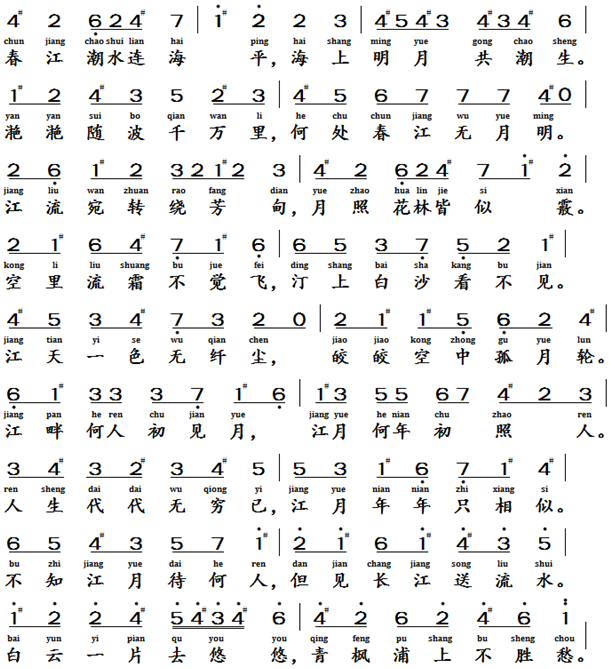
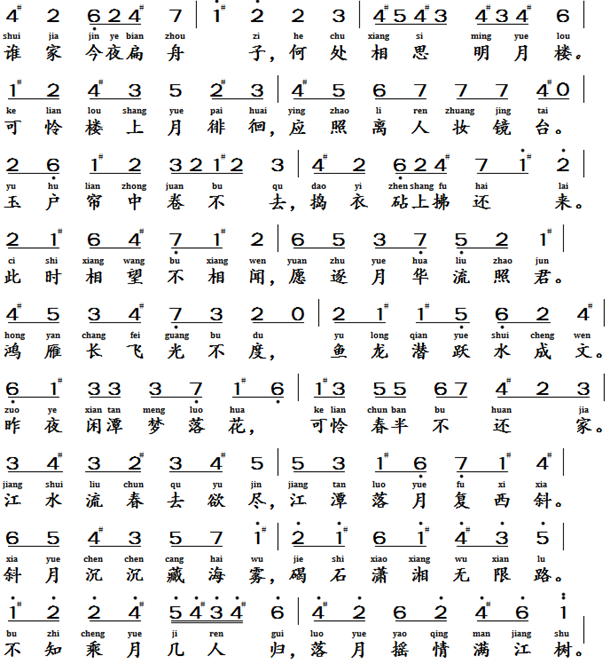
- 春江花月夜[3] 唐 张若虚(660 – 740)Spring River in the Moonlight Night Tang Dynasty, Zhang Ruo Xu (660 -720 AD) Text and Translation of the Lyric (poem) 春江花月夜[3] Spring River in the Moonlight Night春江潮水连海平,海上明月共潮生。滟滟随波千万里,何处春江无月明。江流宛转绕芳甸,月照花林皆似霰。空里流霜不觉飞,汀上白沙看不见。江天一色无纤尘,皎皎空中孤月轮。江畔何人初见月,江月何年初照人。人生代代无穷已,江月年年望相似。不知江月待何人,但见长江送流水。白云一片去悠悠,青枫浦上不胜愁。谁家今夜扁舟子,何处相思明月楼。可怜楼上月裴回,应照离人妆镜台。玉户帘中卷不去,捣衣砧上拂还来。此时相望不相闻,愿逐月华流照君。鸿雁长飞光不度,鱼龙潜跃水成文。昨夜闲潭梦落花,可怜春半不还家。江水流春去欲尽,江潭落月复西斜。斜月沉沉藏海雾,碣石潇湘无限路。不知乘月几人归,落月摇情满江树。The spring river's tide emerged with the sea level, while the luminous moon rises over the ocean with the tide waves. The rippling waves stretch for thousands of miles, where is the spring river without the moonlight.The river winds around the beautiful meadow, and the moon illuminates the flower forest, the river meanders gracefully through verdant meadows, and its light bathes the flower-laden groves, all like snowflakes. Frost-like clouds drift imperceptibly across the heavens, and the white sands of the islet vanish from view beneath the ethereal glow.The sky and the river have the same color, with no trace of dust. The bright solitary moon hangs resplendent in the sky alone. Who saw the moon first at the riverbank, When did the moon first shine upon humankind. Generations of people continue endlessly, and look at the moon each year remains the same. I wonder whom the moon is waiting for, but see only the river farewell the flowing water year after year. A single white cloud floats away, and the green willow island cannot bear our sorrow. Who is the boatman tonight on the river? Where are the places that people are longing in a pavilion of bright moonlight?The moon lingers long above, casting its gentle luminescence upon the dressing table of the parting lover. The curtains of jade window cannot roll it away, the rhythmic of the laundry mallet echoes persistently coming back cannot be sweep away.At this moment, we reflect at each other but cannot communicate. We wish to be carried by the moonlight to flow to and illuminate you. The wild geese fly far away but cannot carry the moonlight cross the long distance, and the fish and dragons leap in the water forming words.Last night, I dreamed of blossoms falling in the calm pond, how sad that the half of spring season has passed but my lover still does not back home. The flowing water of the river carries the spring away to be end, while the setting moon in the lake keeps waning towards the west.The westward moon hides in the sea mist, and the marked milestone and dripping raining Xiang river have an endless distance. I wonder how many people return under the moonlight. As the moon descends, its fading light suffuses the riverside trees with quiet, lingering emotion.
2.3.1.2. Key Points of Setting the Poems to the Music Score
- The selected score (sheet music) is derived (excerpted) from the (pieces) of the Jules Massenet’s Meditation,1) The emotional expression of the musical score and the narrative of the poetry are all gentle and smooth, making both being quite singable. Both the music score and the poetry manifest one kind of serenade mood of narration, discussion and reflection.2) The title of the music score is meditation, and the title of the poem is “Spring River in the Moonlight Night”. The content implicated title of this poem is actually and factually also a meditation. Standing on the riverbank, the poet is moved by the scenery, shedding tears in the wind and longing for home while gazing the moon. Following the thread of people and the river moon gazing at each other from a thousand miles away, the poet embeds emotions into the scenery for those traveling far from home and families missing them. Filled with profound emotions, the poet hopes the river and moon will convey these feelings, offering blessings and prayers for the travelers and those separated from their loved ones. For this, the poet also expresses their own complex and boundless emotions.The poems (lyrics) began at the spring night of rivers, the tide of sea, and rising bright moon from sea level, looking back at the graceful full of flowers scenery of upstream, thoughts began to focus on the wandering traveler still on the journey in spring, and the continuous tender feelings between the young wife at home and husband. Perhaps, at this moment, the traveler and the parting lover who are sailing on the boat under the moonlight to return home are all conveying their deep longing through the moonlit river and the scenery.In the music, the composer weaves a melodic spell that seems to transport listeners to a higher emotional plane. The author of the paper thought the music is expressing a deep and complex emotion, quite similar to the poem.The poem is a contemplative piece that generates emotions from the scenery, then thoughts from emotions, and then sighs from thoughts. Therefore, it seems like a God made natural combination.3) This poem matches the classical music piece intuitively. The first impression is that they could be well matched. For example, the emotional expression of the first line of the musical score is very similar to that of the first line of the poem.
 The first sentence of the poetry: “The spring river's tide emerged with the sea level,” With just one sentence, it presents a panoramic view of the vast ocean and the surging tides. The notes of the first syllables of the score is from smooth, through low, gradually goes high, the tone is same with the poetry.The second sentence of the poetry: “while the luminous moon rise over the ocean with the tide waves.” The notes of the following syllables of the score are starting off low, through smoothly fluctuate, ends by high. The words “moon rise” soar on high note 6 (la) exactly. The tone of the music is same with the poetry.4) The expression sequence of music and poetry is similar. The moods of the music and poetry, or the emotions and thoughts of the music and poetry are consistent in overall emotion.5) Both the poetry and music have similar sentence or lines structures to express each other.
 2.3.1.3. Sheet Music with Lyrics Marked in Chinese Pinyin without Tones
- This score (sheet music) is derived (excerpted) from the (pieces) of the Jules Massenet’s Meditation, and has undergone minor modifications to ensure a better alignment between the musical arrangement and the lyrics (poem).

2.3.2. Song No 2
2.3.2.1. Title of the Poem
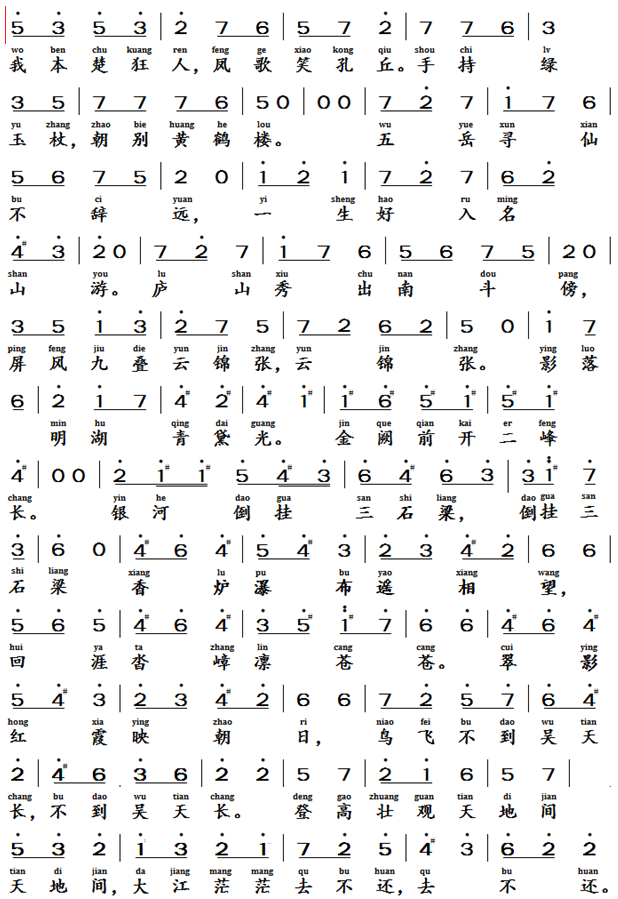
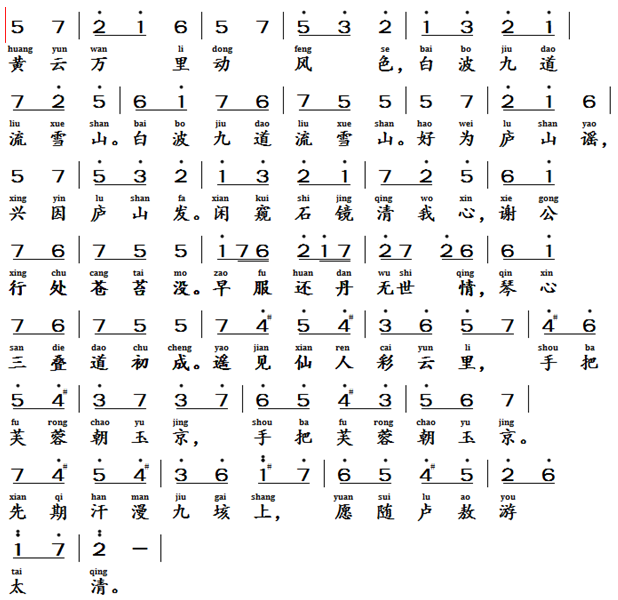
- 庐山谣寄卢侍御虚舟[1], 唐, 李白 (701 – 762)。Song of Lu Mountain Sent to Lu Emperor Server, “Virtual Boat”, Tang Dynasty Li Bai (701 – 762 AD)Text and Translation of the Lyric (poem) 我本楚狂人,凤歌笑孔丘。手持绿玉杖,朝别黄鹤楼。五岳寻仙不辞远,一生好入名山游。庐山秀出南斗傍,屏风九叠云锦张。影落明湖青黛光,金阙前开二峰长,银河倒挂三石梁。香炉瀑布遥相望,回崖沓嶂凌苍苍。翠影红霞映朝日,鸟飞不到吴天长。登高壮观天地间,大江茫茫去不还。黄云万里动风色,白波九道流雪山。好为庐山谣,兴因庐山发。闲窥石镜清我心,谢公行处苍苔没。早服还丹无世情,琴心三叠道初成。遥见仙人彩云里,手把芙蓉朝玉京。先期汗漫九垓上,愿接卢敖游太清。I am originally a wild man from Chu region, ridicule Confucius with my song. I hold a green jade stick and bid farewell to the Yellow Crane Tower in the morning.I do never shrink from distant journeys in search of immortals among the Five Great Mountains; and I always enjoy visiting famous mountains. The mountain of Lu soars and shines above the south celestial pole, its nine-tiered cloud screens unfurled like brocade.Its reflection falls into the clear lake, radiating an azure-green luminescence. Two towering peaks stand before the Golden Palace; three stone arches seem suspended from the Milky Way.The incense burner shaped peak and waterfall cascades looking at each other from afar; the receding cliffs and ridges tower high into the blue sky. Emerald and crimson colors clouds blend with the rising sun; even birds cannot reach the distant skies of Wu. Scale higher up, I admire the vastness of the universe between ground and sky. The great river flows ever onward, never to return. Yellow clouds drift with the wind; and the white waves flow like snow capped mountains.I shall compose a poem in praise of Mount Lu inspired wholly by its majesty. I secretly examine the Stone Mirror to purify my heart; Mr. Xie’s footprints lie long obscured beneath moss. I ingested the elixir at morning and withdrew from worldly affairs. In my heart the soul’s three notes of celestial music now begin to resonate.I saw celestial beings amid radiant clouds, holding lotus blossoms as they ascended toward the Jade Palace. I shall journey ahead to the remote realm of the celestial wanderers, aspiring to join fairy Lu Ao in the supreme, transcendent sphere of heaven.
2.3.2.2. Key Points of Setting the Poems to the Music Score
- The selected score (sheet music) is derived (excerpted) from the (pieces) of the Jonny Henkens’s Serenade.1) The intuition (the first impression) over the poem and the music score inspire that they share the same artistic charm, and will be incredible perfect match.2) Any serenade, in my view, is singable. The music score has a lively, smooth, relaxing and natural melody and rhythm, of course quite singable. This poem, when depicting the poet's thoughts, emotions, behaviors, and natural scenery, is free and unrestrained, with a lively, smooth, relaxed and natural rhythm, is itself originally and actually a lyric song. The title of the poem was originally called “Lushan Mountain Song” or “Song of Lushan Mountain”. The poet Li Bai was born with a wild, unbridled, and chivalrous temperament, living a life of unrestrained freedom and uninhibited passion mountains and rivers. His poetic talent, philosophical depth, and conduct were akin to those of an immortal, hence people called him the "Exiled Immortal." The poet's sentiments were in the rugged, unique, and brilliantly diverse landscapes, and his thoughts and actions were seamlessly integrated with them. His poetry was a reflection of his character. Reading his poems is like the man himself. Amidst these famous mountains and great rivers, the poet embraced the scenery; he became the scenery, and the scenery became him. How could his poems not be one of himself?!This poem fully captures the beauty of Lushan Mountain sceneries and a blissful journey of exploring and enjoying sceneries of waterfall and peaks of the mountains and seeking immortality. It vividly depicts the magnificent and spectacular scenery of Lushan Mountain, expressing the poet's unrestrained personality and the romanticist atmosphere of yearning for the beauty of nature. It also reveals the poet's state of mind of breaking free from the shackles of the mundane world and entering the ethereal and illusory realm of the fairyland.Come to the music score, regardless of the composer’s political orientation or attitude, this serenade conveys a sweet, saccharine, comfortable, cheerful, optimistic, unrestrained and detached from reality mood that would be appropriate for any era. The combination of poems and music is absolutely wonderful and perfect.Whether you are strolling through the lush forest, or dancing to the music, or enjoying the serene atmosphere of the courtyard, or savoring the fine champagne wine, melody of this music score seems to follow you everywhere, gently soothing your emotions, spirits and nerves. In one word, the poem and music is a well match in many manifestations.3) The expression sequence of music and poetry is similar. Both have similar sentence structures or divisions.4) Both the form and the spirit of the emotional expression of the first several lines of music and poem are incredible similar. For example, the first 4 lines,
 The first two lines of the poem simply lightly describe with a touch of self-mockery and humor: “I am originally a wild man from Chu region, ridicule Confucius with my song.”The lines 3and 4 of the poem simply self-described the peculiar and unique starting point of himself: “I hold a green jade stick and bid farewell to the Yellow Crane Tower in the morning.”Both the verses and the music were simply go pass over with a smile without over emphasis. The few lines in the middle also well fit.
 “I shall compose a poem in praise of Mount Lu inspired wholly by its majesty”.The poem pauses here for a tea break or a breath by using shorter sentences (5 characters a line), and then mentions the source of the poet's inspiration, i.e. the Lushan Mountain with two shorter sentences (5 characters each line instead of 7 characters each line of the poetry meter). The music syllables here are also slow in the 2-3 syllables.The poetry and the melodies of the music verses by syllables, sentence by line, sections by movements are matched up well.
2.3.2.3. Sheet music with Lyrics Marked in Chinese Pinyin without Tones
- This score (sheet music) is derived (excerpted) from the (pieces) of the Jonny Henkens’s Serenade, and has undergone minor modifications to ensure a better alignment between the musical arrangement and the lyrics (poem). Jonny Heykens (24 September 1884 – 28 June 1945) was a Dutch composer of light classical music.

2.3.3. Song No 3
2.3.3.1. Title of the Poem
- 寄韩谏议[1],唐,杜甫 (712-770)。To Han Jian yi (the Minister of Advice), Tang Dynasty, Du Fu (712-770 AD)Text and Translation of the Lyric (poem) 今我不乐思岳阳,身欲奋飞病在床。美人娟娟隔秋水,濯足洞庭望八荒。鸿飞冥冥日月白,青枫叶赤天雨霜。玉京群帝集北斗,或骑麒麟翳凤凰。芙蓉旌旗烟雾落,影动倒景摇潇湘。星宫之君醉琼浆,羽人稀少不在旁。似闻昨者赤松子,恐是汉代韩张良。昔随刘氏定长安,帷幄未改神惨伤。国家成败吾岂敢,色难腥腐餐枫香。周南留滞古所惜,南极老人应寿昌。美人胡为隔秋水,焉得置之贡玉堂。 Today I am not happy, to think of Yueyang city; though my spirit yearns to soar, illness confines me to my bed. The gentlemen are separated by the autumn waters; washing feet in Dongting Lake and looks towards the vast wilderness.The darker color swan gooses fly with the brighten sun and moon; the leaves of the cypress trees is becoming red, season begin to freeze frost. Celestial sovereigns gather at the North Star; some ride dragons and phoenixes in procession.Lotus banners and banners shimmer veiled in mist and haze; their shadows tremble and shift across Xiangxiang. Within the celestial palace, the sovereigns drink deeply of the elixir; the immortals are few and not nearby.Perhaps I heard yesterday of the Red Pine Hermit, he might be the Han Dynasty's Han Zhang Liang. In the past, he followed Emperor Liu Bang to take control of Chang'an; though generals’ tents remained unchanged, grief lingers painfully. I do not have quality to comment the nation’s rise and fall; nor would I dislike and avoid decayed food to take fragrant maple leaves tasting food. The Zhou Nan stagnation was regretful from ancient time; the old man in the South Pole should be enjoying longevity.Why is the gentlemen separated by the autumn waters, how can be set in the palace of jade.
2.3.3.2. Key Points of Setting the Poems to the Music Score
- The selected score (sheet music) is derived (excerpted) from the (pieces) of J S Bach’s Air on the G string.1) Both of the poetry and the music score are presented in calmly smoothly telling manner. Just like lamentation, like longing, like sighing, like pleading. Their singabilities are obvious; there is nothing more to say. 2) The title of the music score is aria, and the content implicated title of the poem is telling and sighing with regrets and great expectation.3) The intuition (the first impression) is that they are matched and no doubt can be paired. 4) The expression sequence of music and poetry is similar. The mood of the music and poetry, or the emotions and thoughts to be expressed are felt similar. 5) The expression of the poetry and music, the sentence or lines structures and as a whole of both is paired and matched without exception. Both of them proceed calmly and unhurriedly, express in a gentle and tactful manner, and come to end at the proper time.“Air on the G String” encapsulates many of the qualities that make Bach’s music so special: beauty, depth, and a profound understanding of the human experience. Its serene and contemplative nature makes it a popular choice for moments that require a sense of calm and beauty.This poem is vastly different from the consistent poetic style of the poet Du Fu; it is a unique work of the author that contains both romantic sentiments and is with melancholy, contemplation, lamentation, prospection and expectation. Considering Du Fu's entire body of poetry works throughout his life, they are all renowned for their melancholy. Aside from this piece, is difficult to find chapters with romantic sentiments. Therefore, its singability and the necessity of its performance are rare. However, finding a dance partner of her in classical music can be said to difficult.This poem expresses both lamentation and anticipation. It is romantic yet reserved, profound yet revealing. By comparing the past and the celestial realm to the present, it metaphorically represents the virtuous individuals (such as Han Minister of State Counselor Han) and with the poetic speaker.Deep thoughts are tinged with the romanticized illusion and aspirations within the realm of fantasy. Thereby, it is functioning simultaneously as an ethical self-portrait and an implicit confession to its readers. It represents the highest expression of the author's ideals and fantasies. In brief, to combine the poems and the music to compose a new song will be perfect.
2.3.3.3. Sheet Music with Lyrics Marked in Chinese Pinyin without Tones
- This score (sheet music) is derived (excerpted) from the (pieces) of J S Bach’s Air on the G string, and has undergone minor modifications to ensure a better alignment between the musical arrangement and the lyrics (poem).

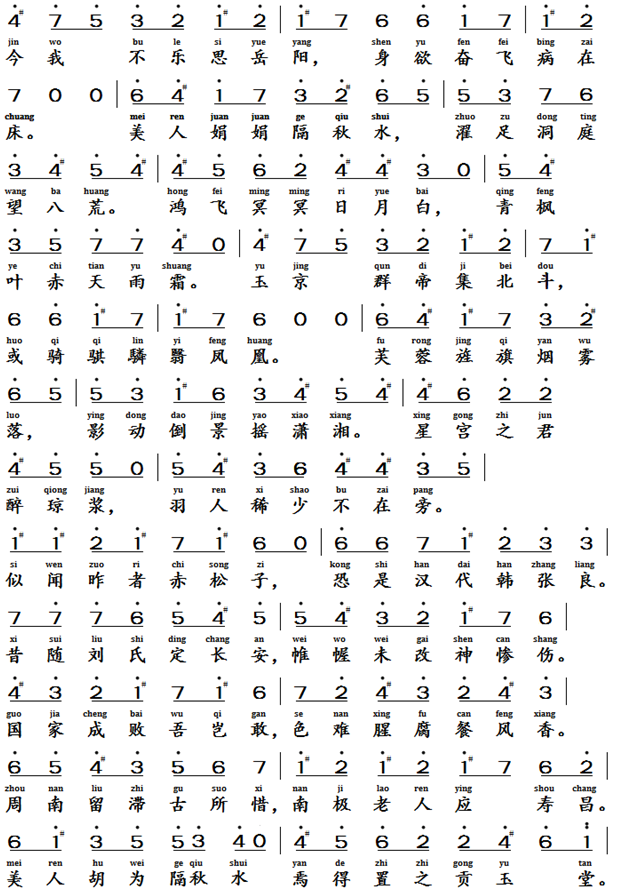
2.3.4. Song No 4
2.3.4.1. Title of the Poem
- 宣州谢脁楼饯别校书叔云[1], 唐, 李白 (701 -762)。Xuanzhou Xie Tang Tower Farewell to the Chief Librarian Yun, Tang Dynasty, li Bai (701-762 AD)Text and Translation of the Lyric (poem) 弃我去者,昨日之日不可留。乱我心者,今日之日多烦忧。长风万里送秋雁,对此可以酣高楼。蓬莱文章建安骨,中间小谢又清发。俱怀逸兴壮思飞,欲上青天揽明月。抽刀断水水更流,举杯消愁愁更愁。人生在世不称意,明朝散发弄扁舟。Those left me yesterday cannot be held back.Those who disturb my heart today bring profound disquiet. A mighty wind carries autumn geese across the vast land, face the scenery, we could ascend this lofty tower to savor its grandeur.The refined literary legacy of antiquity and the robust spirit of the Jian’an era endure; among them, the young scholar Xie Tiao exemplifies freshness and elegance. Both of us have extraordinary aspirations and vigorous thoughts soaring; we want to ascend to the blue sky to grasp the bright moon.To stop the flowing water with a sword only makes it flow faster; drinking a cup of wine to relieve sorrow brings more sorrow. Life affords no lasting contentment; tomorrow, I shall cast off my robes and drift away in a small boat.
2.3.4.2. Key Points of Setting the Poems to the Music Score
- This selected score (sheet music) is derived (excerpted) from the (pieces) of W A Mozart’s Menuet Divermento no 17, k334/320b [4].1) The melodies of the music score are smooth and lyrical, like humorous self-mockery, like yearning, like pleading, quite singable.2) The intuition upon first impression of them is that the music score and the poem are matched and can be paired easily. 3) The expression sequence of music and poetry is similar.4) The music and the poem in sentence structures or lines and as a whole are similar. The music was probably for commemorating the graduation of a close friend of Mozart.The music could be understood in this way, that life and everything are complex and full of twists and turns. There are times when things don't go as expected, but one needs to remain optimistic and not give up easily, then it is also possible to achieve some success.This piece of Mozart has a rather humorous flavor. In my view, Dvořák's Humoresque bears traces of some imitation of the piece.This poem has a strong sense of humor and wit, with a slightly cynical and self-willed tone. It is not a lamentation of self-pity or a bitter complaint against heaven and man. Rather, it is the poet unreserved outpouring to his confidants of past and present during a period of frustration, and an outpouring akin to playful banter. Although it carries a hint of cynicism, it also an allegorical and humorous expression, it is gentle yet firm, and substantial within the void.This poem by Li Bai exudes a strong sense of spirit and sentiment. It laments own circumstances and the illustrious literary talents of the ancients. However, it is not just despair but rather a retreat to wait for an opportunity.Whatever, with the help of this musical melody, the artistic stream of consciousness of this poem of Li Bai can be properly expressed.5) The first two lines naturally emphasis in each word to line up with the notes that are emphasised by the melody’s metre.
 “Those left me yesterday cannot be held back。”
 “Those who disturb my heart today bring profound disquiet.” 6) At the final several lines of the poem, the poet's emotions suddenly dropped and keep the emotional verses to end. Just at this point, the music also shifted to a lower octave and then come to end with low notes.
 “To stop the flowing water with a sword only makes it flow faster; drinking a cup of wine to relieve sorrow brings more sorrow.”If music and poetry are viewed or regarded as a pair of complex mathematics function curves, then their fluctuations are exactly the same. Using the terminology of high mathematics, their functions of derivatives are also the same.
2.3.4.3. Sheet Music with Lyrics Marked in Chinese Pinyin without Tones
- This score (sheet music) is derived (excerpted) from the (pieces) of W A Mozart’s Menuet Divermento no 17, k334/320b [4], and has undergone minor modifications to ensure a better alignment between the musical arrangement and the lyrics (poem).

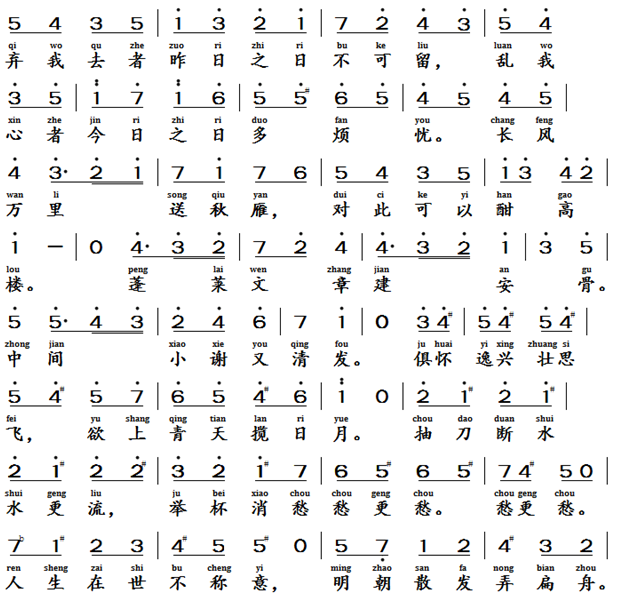
2.3.5. Song No 5
2.3.5.1. Title of the Poem
- 雨过山村 [4], 唐, 王建 (768-835)After the Rain in a Mountain Village, Tang Dynasty, Wang Jian (768-835 AD)田家 [4], 南宋 范成大(1126 - 1193)Farming Family, Southern Song Dynasty, Fan Cheng Da(1126 – 1193 AD)Text and Translation of the lyrics 雨过山村 After the Rain in a Mountain Village 雨里鸡鸣一两家,竹溪村路板桥斜。妇姑相呼浴蚕去,闲着中庭栀子花。The mountain village lies hushed after the rain; within the lingering drizzle, only cock crows can be heard from one or two houses. The bamboo lined village stream path winds gently over the linking to the obliquely built plate bridge. Housewife and her sister in law call each other to wash their silkworm. In the central courtyard, jasmine blooms at a quietly loose alone. 田家 Farming Family昼出耘田夜绩麻,村庄儿女各当家。童孙未解供耕织,也傍桑阴学种瓜。The farmers work in the fields during the day and spin ramie at night. The villager sons and daughters all take charge of their own households respectively.Although the grandson is too young to understand to do farming or weaving, also would like to learn to plant melons in the shade of the mulberry trees.
2.3.5.2. Key Points of Setting the Poems to the Music Score
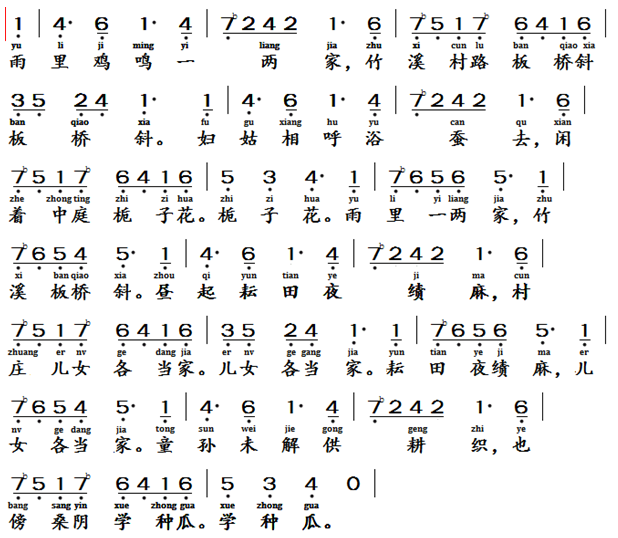
- The selected score (sheet music) is derived (excerpted) from the (pieces) of the piano sheet music of Schumann’s The happy farmer.1) The music seems a children song or dancing song for children. The poems depict the joyful and idyllic rural rural agricultural and farming life scenes with a light-hearted, vivid and joyful narrative. Therefore, both the poetry and music are singable naturally. Composing a children's group dance according to the melody of this music is as easy as a piece of cake!2) The title of the music score and the title of the poems are almost same or similar, they are highly matched of course. The poems vividly depict rural life scenes, blending the visual quiet and slow short video. They offer both a richly detailed and thematically cohesive portrayal of an idealized, almost fairy tale like countryside. Perhaps there is no more better rural pastoral poetry than the above selected two pieces in the Tang and Song dynasties that can pair this music. Generally, the extremely arduous and repetitive endless labor is monotonous and boring, seems a chronic form of killing. After such labor, there are still residual fatigue, depression and despair. Instead, if the labor is not particularly arduous and repetitive, it is not boring. After the labor is over, one will feel relaxed and happy. The reason why agricultural labor is enjoyable is that it can bring results and fruits, such as spring blossoms and autumn harvests, spring sowing and autumn reaping. Agricultural labor is an activity that directly interacts with the natural world. During and after the labor, there is a sense of contentment and acceptance, being content with one's lot.3) The intuition (the first impression) is that the music and the poems can be paired easily.4) The expression sequence of music and poetry is similar. They are seems to be have a same way of singing and dancing.5) To describe the people's exuberant joyous mood and their activities, The Joy of the Parisians in Offenbach's Orpheus in Hell, and Strauss's Waltz: The stories of the Vienna Woods, all seems bearing traces of imitating Schumann’s The happy farmer. Initially, the author chooses the Strauss's waltz "The Story of the Vienna Woods" to be paired with the poems, later the author finds that Schumann’s The happy farmer is more suitable than Strauss's Waltz: The stories of the Vienna Woods, Therefore, the author chose the currently used one.Below is the initial solution: (Current composition is in 2.05.2 as following.)

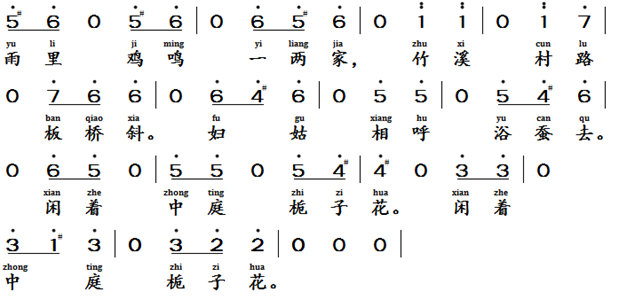
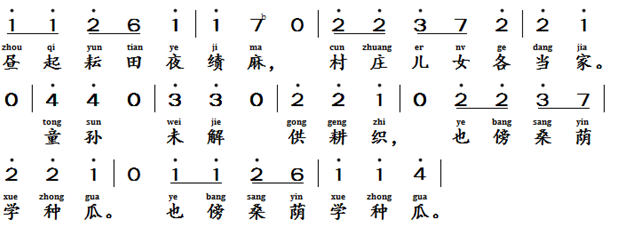
2.3.5.3. Sheet Music with Lyrics Marked in Chinese Pinyin without Tones
- This score (sheet music) is derived (excerpted) from the (pieces) of the Schumann’s The happy farmer and has undergone minor modifications to ensure a better alignment between the musical arrangement and the lyrics (poem).

2.3.6 Song No 6
2.3.6.1 Title of the Poem
- 枫桥夜泊 唐 张继(715 – 779 AD)A night-mooring near Maple Bridge. Zhang Ji. Tang Dynasty夜雨寄北 唐 李商隐(813 – 858 AD)Raining night Sent to the North. Li Shang Yin Tang DynastyText and Translation of the lyrics 枫桥夜泊 A night-mooring near Maple Bridge月落乌啼霜满天,江枫渔火对愁眠。姑苏城外寒山寺,夜半钟声到客船。The moon sets, crows cry, frost covers the sky, The maple trees by the riverbank and the fishing fire (lanterns) keep me company as I fall in sleep with home-sick sorrow.In the midnight, bell ringging of the Cold Mountain Temple outside Gusu City reaches the boat of the traveler. 夜雨寄北 Raining night Sent to the North君问归期未有期,巴山夜雨涨秋池。何当共剪西窗烛,却话巴山夜雨时。You ask about my coming back date but there is no definite date. In the night of Bashan, the rain fills the autumn pond.When shall we once again sit together by the western window, sharing the soft glow of candlelight? Let us look forward to reminiscing about this rainy night in the Bashan mountain region.
2.3.6.2. Key Points of Setting the Poems to the Music Score
- The selected score (sheet music) is derived (excerpted) from the (pieces) of the Mozart's String Serenade in G Major, Second Movement.1) As music score serenade is definitely singable. The poems are smooth, peaceful and profound narration of the inner monologue of emotions and situations on the midnight, suitable singing in a low and soft voice, anything else is being it except serenade?!2) The title of the music score and the title of the poems are the same or similar, they are heart-to-heart talking, with lyrical conversations on calm midnight, share the same word of “night”. 3) The intuition (the first impression) to combine the music and poems is well. Especially the first two sentences:
 The first line of the poetry: The moon sets, crows cry, frost covers the sky. To Pay attention to the frosty mist of the high sky: The “frost covers the sky,” verse high sky just soar on high notes:
  The second line: The maple trees by the riverbank and the fishing fire (lanterns) keep me company as I fall in sleep with home-sick sorrow.To watch the high and big maple trees, the poet should look up towards the higher place. So the maple trees by the riverbank is soaring on highest notes:
  Then the fishing fire (lanterns) is viewed at a same level. The second line “fall in sleep with home-sick sorrow.” verses gradually fall in a low and soft whisper: sleeping, precisely corresponding to the going lower notes of the music:
 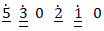 comparing to the highest notes:
  The poetry and music are naturally and perfectly harmonious with each other.4) The expression sequence of music and poetry is similar, with 4 sentences to complete a statements or narrative.
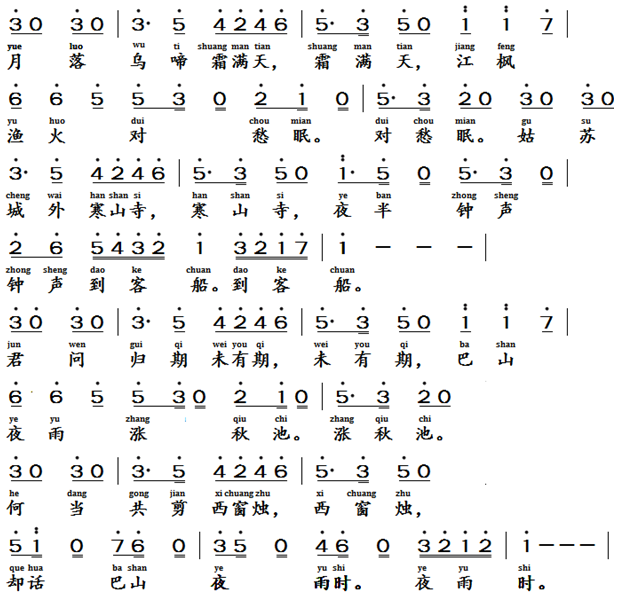
2.3.6.3. Sheet Music with Lyrics Marked in Chinese Pinyin without Tones
- This score (sheet music) is derived (excerpted) from the (pieces) of the Mozart's String Serenade in G Major, Second Movement, and has undergone minor modifications to ensure a better alignment between the musical arrangement and the lyrics (poem).

3. Conclusions
- When combine the ancient Chinese metered poetry with classical music to create the unified art form i.e. the new song, the profound affinities between poetry and music and their respective unique artistic charm, will ignite and burst out the sparks of aesthetic resonance. The commonalities between poetry and music can be experienced, synthesized and be ingeniously explored through the practice of their combination that will be more effective and fruitful. From this, we can understand and study why and how to set ancient Chinese metered poetry to classical music theoretically and practically.