
-
Paper Information
- Paper Submission
-
Journal Information
- About This Journal
- Editorial Board
- Current Issue
- Archive
- Author Guidelines
- Contact Us
International Journal of Arts
p-ISSN: 2168-4995 e-ISSN: 2168-5002
2026; 13(1): 1-15
doi:10.5923/j.arts.20261301.01
Received: Mar. 22, 2026; Accepted: Apr. 12, 2026; Published: Apr. 18, 2026

Perfectly Combining Ancient Metered Chinese Poetry with Classical Music and Worldwide Renowned Music - Research on the Commonalities between the Ancient Metered Chinese Poems and Classical Music
 Abstract
 Reference
 Full-Text PDF
 Full-text HTML
Liu Kedian
Engineering Master Degree, Retired Senior Engineer of Precision Instrument, Current Research Covers Multiple Disciplinary Fields
Correspondence to: Liu Kedian, Engineering Master Degree, Retired Senior Engineer of Precision Instrument, Current Research Covers Multiple Disciplinary Fields.
| Email: |  |
Copyright © 2026 The Author(s). Published by Scientific & Academic Publishing.
This work is licensed under the Creative Commons Attribution International License (CC BY).
http://creativecommons.org/licenses/by/4.0/

This article aims to present the up to date research results on the combination of ancient Chinese metered (rhymed) poetry and world classic (renown) music. Both music and poetry are forms of emotions expressing, so the solid foundation for the combination of these two artistic forms lies in their scientific and practicable commonality. Before this article, the author has already published a monograph, which provides 54 songs [1] created based on this idea. Reflecting further theoretical research and practice, this article presents 12 new excellent songs that have not yet been published.
Keywords: Song, Music, Poem, Metered Poems, Classical Music, Art
Cite this paper: Liu Kedian, Perfectly Combining Ancient Metered Chinese Poetry with Classical Music and Worldwide Renowned Music - Research on the Commonalities between the Ancient Metered Chinese Poems and Classical Music, International Journal of Arts, Vol. 13 No. 1, 2026, pp. 1-15. doi: 10.5923/j.arts.20261301.01.
Article Outline
1. Introduction
- Classical music reached its zenith prior to the 20th century. By the early 1900s, classical music had achieved its final brilliance, after which it gradually ceased to evolve.Ancient Chinese traditional poems are a rich art treasure, as well as a vast, deep, and gorgeous world. However, Chinese traditional poetry reached its peak during the Tang Dynasty (618 - 907 AD), continued to be developed during the Song Dynasty (960 - 1279 AD), began to decline during the Ming Dynasty, and has never recovered since.Therefore, whether referring to classical music or Chinese classical poetry, the most outstanding works are akin to naturally formed gems, unparalleled, irreplaceable, and un-replicable.Music may be regarded as poetry without words, and poetry as music without score. Both share profound aesthetic and expressive affinities, rooted in rhythm, structure, and emotional resonance, whose convergence in artistic practice often yields works of exceptional unity and transcendence.There are both practical reasons and theoretical foundations for these two artistic paradigms to be preserved and passed down through generations, by complementing each other harmoniously and forming a perfect combination. Theoretical research is important, whilst producing good song works according to the idea are the best proof of this novel creative concept. There are more master pieces of unpublished new songs based on this idea, expect them could be published to readers in near future.
2. Research
2.1. Music and Poetry should be Thoughtfully Integrated to Enhance and Complement Each Other's Expressive Qualities
- Poetry represents a refined form of linguistic art, while music embodies a refined form of universal auditory expressions. Ancient Chinese metered poetry is not primarily intended to expound philosophical doctrines or grand moral principles, it is not only conveys specific content clearly but also implies abstract and generalized artistic conceptions, as well as subtle rational insights. Similarly, music possesses both generality and abstraction, along with a relatively defined expressive scope. Music, too, is not created for the purpose of conveying philosophical or moral ideas.Poetry can enrich music by interpreting its emotional depth through lyrical expression. Conversely, music can also enhance the emotional resonance of poetry when lyrics and melody are combined. Metered poetry and classical music share certain characteristics that are more intuitive than verbal as well as common aesthetic sensibilities that can be perceived.The integration of these two art forms can mutually enhance their expressive power, combining documentary depth with artistic flexibility, thereby amplifying their overall appeal. Moreover, this synthesis possesses enduring artistic value.Therefore, if either the poetry or the music is of inferior quality, the combination will be counterproductive and diminish the artistic value of both. However, when both are of high quality, they can complement each other beautifully, like dragons and phoenixes soaring together, enhancing each other’s brilliance. The result is a refreshing and delightful experience, almost akin to being in a celestial paradise.
2.2. The Spiritual Essence and Material Structure of Music and Lyrics should be Mutually Expressed
- The basic expressive structures in poetry include introduction, development, transition, and conclusion. Symphonies typically follow a four-movement structure. Therefore, the structural forms of traditional Chinese poetry and prose are highly comparable to those of Western classical music.Chinese poetry has a distinct advantage in terms of musicality: each character is composed of a single vowel and consonant, allowing each character to correspond to a single musical note. While this may not offer the same melodic flexibility as Italian opera, however, it proves advantageous for group singing, solo chanting, and small ensemble performances. Thus, setting classical poetry to classical music fully exploits this linguistic-musical compatibility, offering significant aesthetic and practical value.Classical poetry, especially metrical words (verse), originally had musical forms that could be sung immediately. However, why were these songs not widely disseminated, and why were many of them ultimately lost? One reason is that their musical forms lacked emotional intensity and melodic fluidity, failing to resonate with the general public. Additionally, they often failed to fully and accurately express the rich, nuanced artistic conceptions and subtle emotional layers embedded in the poetry.The musical talent of ancient Chinese people was by no means inferior. Compared with their Western counterparts of the same era, Chinese musicians were centuries ahead. However, from the 18th century onward, China lagged behind the West in terms of music theory, instrument development, and performance practices.Another controversial issue is the East Asian emphasis on the pentatonic scale, it is comprising the notes C (Do), D (Re), E (Mi), G (Sol), and A (La), or 1, 2, 3, 5, and 6, while showing little sensitivity to F (Fa) and B (Si), or 4 and 7, which are rarely used. For example, the traditional Chinese string instrument Guzheng, is based on the pentatonic scale.Throughout East Asian history, many of the most famous songs have been composed in the pentatonic mode. For instance, several renowned Japanese folk songs and Korean and North Korean traditional melodies, and even Chinese songs from the past century are pentatonic scale music (song).Therefore, it is impractical to attempt to compose new music using existing Chinese musical frameworks or to compel unskilled composers to create music for classical poetry. Chinese composers, whether temporarily or fundamentally, lack the necessary ability to achieve this effectively. If a music professional is asked to compose music for many poems and verses, first, his or her understanding of the poems and verses may not be accurate. Second, in a rush, there will be no accumulation of creative inspiration, melodic sources and musical melody pieces. At this time, no touching works will be produced.Therefore, only by selecting the treasure of human musical works over hundreds of years and combining it with the traditional Chinese poetry, the spiritual wealth accumulated over thousands of years, then a dazzling brilliance can be presented.
2.3. Scientific Nature of the Job
- As previously mentioned, the structure of poetry typically follows the pattern of introduction, development, transition, and conclusion. Similarly, a symphony often consists of four movements, with the first movement’s three-part structure resembling the poetic structure.Most classical symphonies adhere to a four - movement structure.1. The First Movement: Sonata-Allegro FormThis form consists of three main sections:– Exposition: The composer introduces the main themes of the movement.– Development: The themes introduced in the exposition are explored, expanded, and transformed.– Recapitulation: The original themes return, and a coda is added to provide a final sense of closure.2. The Second Movement: Slow and LyricalThe second movement offers a contrast to the energetic first movement, providing a slow and lyrical respite. In theme-and-variations, a theme is presented and followed by a series of variations that alter the theme in creative ways.3. The Third Movement: Dance FormsThe third movement is typically a dance, often in the form of a minuet and trio or a scherzo. The scherzo is similar in structure but faster and more playful, adding a burst of energy to the symphony.4. The Fourth Movement: FinaleThe finale brings the symphony to a rousing conclusion. The finale aims to provide a satisfying sense of closure, leave the listener with a feeling of exhilaration.Overall, symphonic form closely parallels the structure of poetry. The author believes that the structure of songs and other musical compositions also shares this similarity.Therefore, the approach adopted in this book is grounded in the methodological principles of scientific. It is unrealistic to expect that the artistic conception conveyed by the musical composition will perfectly match that of the original poetry. The goal is to achieve a degree of similarity or closeness. Perfect may not be approached but as more as perfect is attainable.
2.4. It is Some People’s Interests [1]
- It is common practice to rewrite the poem (lyrics) of existing songs or music composition. There are many examples, such as:“Dreaming of Home and Mother” is a song originally composed by the American composer John P. Ordway before the Civil War. The lyrics express a deep nostalgia for childhood and the comfort of home and mother. The song reflects themes of longing and the sweetness of memories associated with family and home life. It has been translated into various languages and remains popular for its emotional resonance: Japanese adaptation “Travel Sorrow” and its Chinese adaptation “Farewell” are typical examples. Chinese musician and poety Li Shutong's (李叔同) Chinese version of “Farewell” has continued to be sung as a school song since 1920s until today.“Summer Boating on the Sea” or “Over the summer sea,” is a light hearted and rhythmic triple-meter song adapted from Verdi's opera “Rigoletto,” characterized by a strong sense of motion. The lyrics were arranged by Ferris, based on Verdi's original composition “woman is fickle”.Therefore, it is many people’s interests to rewrite new poems (lyrics) for renowned songs and incorporate lyrics into renowned music composition. This book will reasonably benefit these people.
3. Examples of the Newly Composed Songs
- All the text and the musical score of the sheet music in this paper have been noted with the sources of literatures or websites (Please refer to list of references).
3.1. Song No 01
3.1.1. Title of the Poem
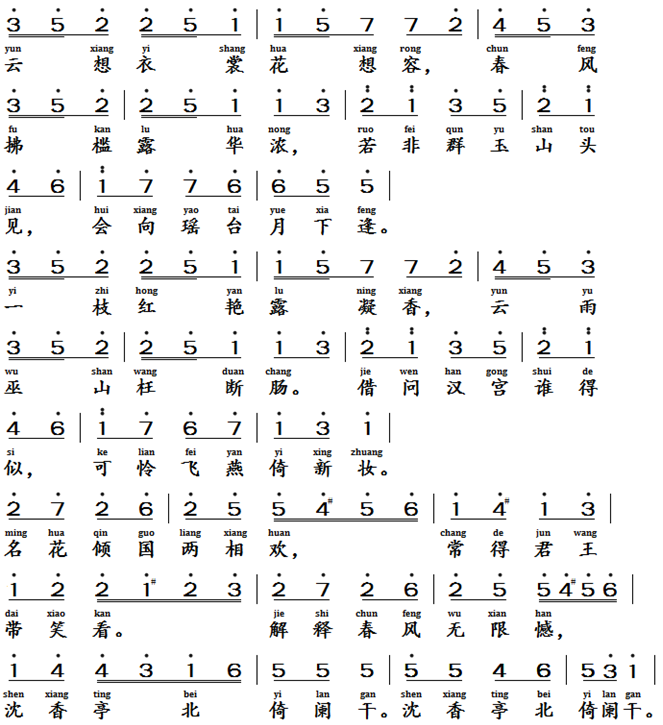
- 清平乐三首, 唐代, 李白 (701-762)Mellow and peaceful Song, Tang Dynasty, Li Bai (701-762 AD)Text of the lyrics清平乐三首 [2]云想衣裳花想容,春风拂槛露华浓。若非群玉山头见,会向瑶台月下逢。一枝红艳露凝香,云雨巫山枉断肠。借问汉宫谁得似,可怜飞燕倚新妆。名花倾国两相欢,长得君王带笑看。解释春风无限恨,沉香亭北倚阑干。 Translation of the Lyric (poem) Mellow and peaceful Song Her thoughts drift like clouds her beauty, like blossoms in full bloom. Spring breezes brush the balustrade; dew lies thick and fragrant upon the petals. Had she not first appeared upon the Jade Immortals’ Mountain, she surely would have graced the moonlit Jade Terrace. One branch, crimson and fragrant, bears condensed dew—clouds and rain made manifest. In the Wu mountain, such clouds and rain proved fleeting, leaving only heartache. Who in the Han Palace could rival her grace? Pitifully, she leans upon her freshly applied makeup. Famous flowers and fair land harmonize perfectly, ever capable of drawing a smile from the emperor.To express the boundless sorrow stirred by the spring breeze, one must turn to the Chilly Fragrant Pavilion, leaning silently upon its railing.
3.1.2. Sheet Music with Lyrics Marked in Chinese Pinyin without Tones
- This score (sheet music) is derived (excerpted) from the (pieces) of Strauss' Anna Polka [6], and has undergone minor modifications to ensure a better alignment between the musical arrangement and the lyrics (poem).

3.2. Song No 02
3.2.1. Title of the Poem
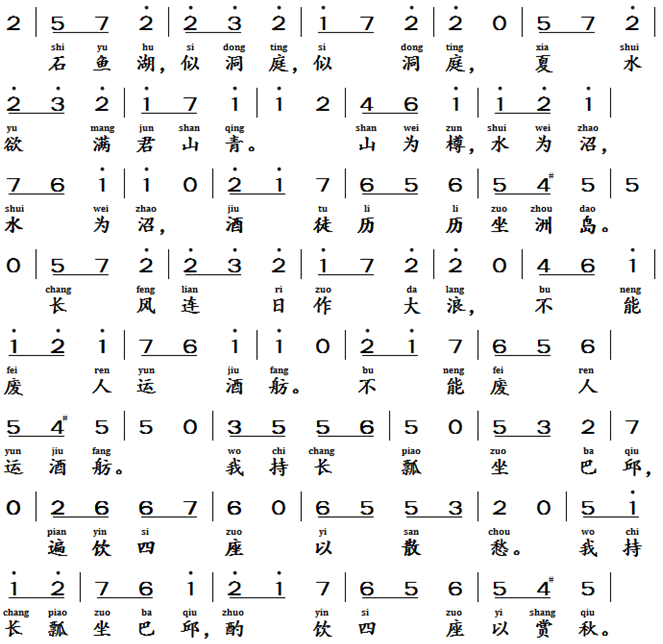
- 石鱼湖上醉歌, 唐代, 元结 (719 -772)Drinking Song at Shiyu Lake, Tang Dynasty, Yuan Jie (719-772 AD)Text of the lyrics石鱼湖上醉歌 [2]石鱼湖,似洞庭, 夏水欲满君山青。山为樽,水为沼, 酒徒历历坐洲岛。长风连日作大浪, 不能废人运酒舫。我持长瓢坐巴丘, 酌饮四坐以散愁。遍饮四坐同赏秋。Translation of the lyricsDrinking Song at Shiyu Lake Shiyu Lake is like Dongting Lake. In summer, when the water was about to overflow, the mountains turned green. The mountains were like wine cups, the water was like a pond. The wine drinkers sat in rows on the islands and islands of the lake.The strong wind blew for several days, causing huge waves. But no one was able to stop the boat carrying the wine. I sat on a harden hillock and held a long wine jug. I poured the wine for all the people sitting around to relieve their worries.We drank and enjoyed the autumn scenery together.
3.2.2. Sheet Music with Lyrics Marked in Chinese Pinyin without Tones
- This score (sheet music) is derived (excerpted) from the (pieces) of the Italy song Isle of Capri (Island of Capri) [7] and has undergone minor modifications to ensure a better alignment between the musical arrangement and the lyrics (poem).

3.3. Song No 03
3.3.1. Title of the Poem
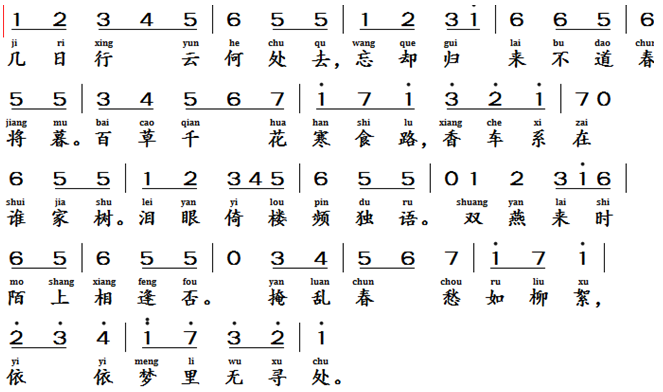
- 鹊桥枝, 南唐, 冯延巳 (903-960)The Magpie Bridge Twig, Southern Tang Dynasty, Feng Yan Si (903-960 AD)Text of the lyrics鹊桥枝 [4]几日行云何处去, 忘却归来,不道春将暮。百草千花寒食路,香车系在谁家树。泪眼倚楼频独语,双燕飞来,陌上相逢否。撩乱春愁如柳絮,悠悠梦里无寻处。Translation of the Lyric (poem) The Magpie Bridge Twig How far has the cloud drifted in these few days? Where the floating clouds in these few days have gone? I forget to return unaware that spring is ending,On the chill of the Qingming Festival, flowers and grass line the roadside. To which tree is the ornate carriage tethered? Leaning upon the tower, I often speak through tears. Two swallows fly coming to my, I guess we ever met on the country roads.Spring sorrow stirs as chaotically as willow catkins; in endless dreams, there is no place to be found.
3.3.2. Sheet Music with Lyrics Marked in Chinese Pinyin without Tones
- This score (sheet music) is derived (excerpted) from the (pieces) of Charles Gounod’s Song: Spring [9], and has undergone minor modifications to ensure a better alignment between the musical arrangement and the lyrics (poem).

3.4. Song No 04
3.4.1. Title of the Poem
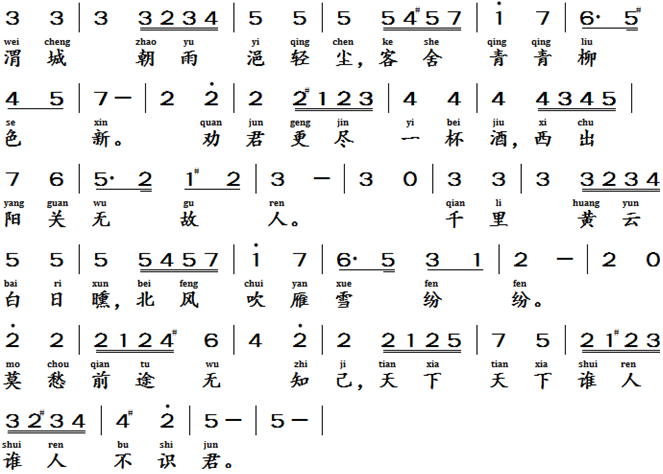
- 别董大, 唐代, 高适 (700 - 765)Farewell oldest brother Dong, Tang Dynasty, Gao Shi (700 -765 AD)送元二使安西, 唐代, 王维 (701 - 761)Farewell Yuan 2nd brother to Anxi, Tang Dynasty, Wang Wei (701-761 AD) Text of the lyrics别董大 [4]千里黄云白日曛,北风吹雁雪纷纷。莫愁前路无知己,天下谁人不识君。送元二使安西 [2]渭城朝雨浥轻尘,客舍青青柳色新。劝君更尽一杯酒,西出阳关无故人Translation of the Lyric (poem) Farewell eldest brother DongBeneath the sun’s fading glow, yellow clouds stretch ten thousand miles, the north wind blowing the flight geese rises, geese take flight, snow swirling in their wake. Fear not the unknown friends ahead, don’t say that there will be no close friends ahead, who in this world does not know you.Farewell Yuan 2nd brother to AnxiAt dawn in Wei City, light rain moistens the dust; the inn gleams fresh, willows wear a vivid green. I invite you Sir to drink one more cup of wine together, beyond Yang Guan Pass, no old friends you can meet.
3.4.2. Sheet Music with Lyrics Marked in Chinese Pinyin without Tones
- This score (sheet music) is derived (excerpted) from the (pieces) of Carl Teike’s Old Friends (Alte Kameraden) March [6], and has undergone minor modifications to ensure a better alignment between the musical arrangement and the lyrics (poem).

3.5. Song No 05
3.5.1. Title of the Poem
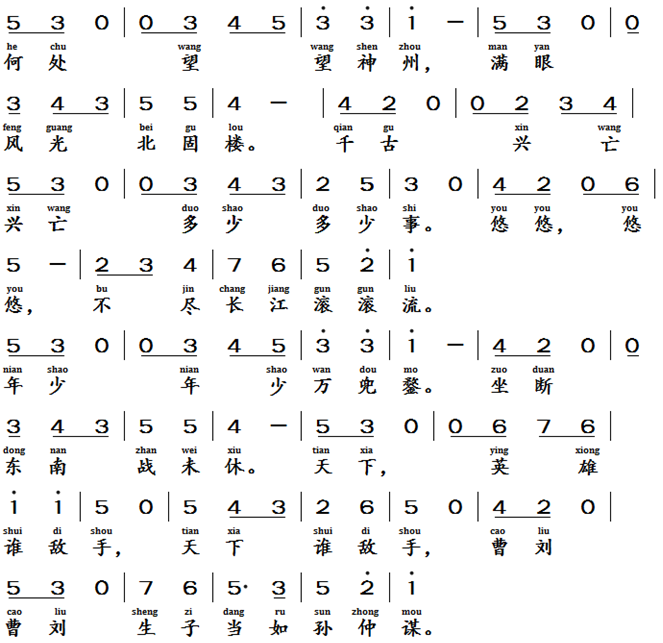
- 南乡子, 登京口北固亭有怀, 南宋, 辛弃疾 (1140-1207)People from the southern countryside, Southern Song Dynasty, Xin Qi Ji (1140-1207 AD)Text of the lyrics南乡子 登京口北固亭有怀 [4]何处望神州,满眼风光北固楼。千古兴亡多少事,悠悠,不尽长江滚滚流。年少万兜鍪,坐断东南战未休。天下英雄谁敌手,曹刘,生子当如孙仲谋。Translation of the Lyric (poem)Guys of northern countryside, On Visiting the Northern Fort of Jingkou with Thoughts of the Past Where can I see the land of China, the beautiful scenery of Bei Gu Tower. How many things have happened throughout the ages endlessly. The river flows on and on.At a young age, he commanded an army of tens of thousands. He dominated the southeast and never stopped fighting. Who is the enemy in the world? Cao and Liu. Expecting if you have son then who will be better similar to Sun Zhongmou.
3.5.2. Sheet Music with Lyrics Marked in Chinese Pinyin without Tones
- This score (sheet music) is derived (excerpted) from the (pieces) of the Colonel Bogey March [6], which is a British march composed in 1914 by Lieutenant Kenneth J Alford (1881–1945), and has undergone minor modifications to ensure a better alignment between the musical arrangement and the lyrics (poem).

3.6. Song No 06
3.6.1. Title of the Poem
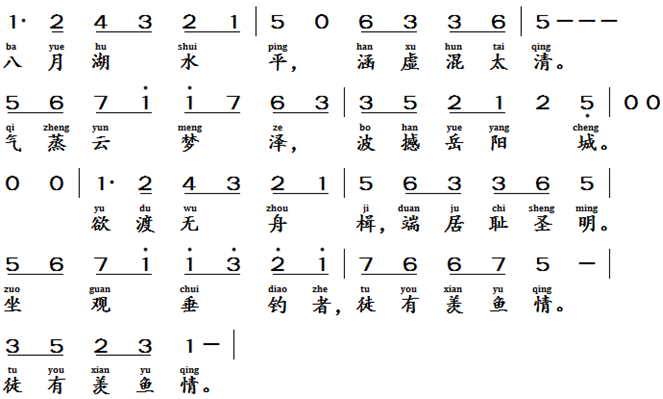
- 临洞庭湖赠张丞相, 唐代, 孟浩然 (689-740)Presented to Mr. Zhang, an Official of the Imperial Court, on a Visit to Dongting Lake, Tang Dynasty, Meng Hao Ran (689-740 AD)Text of the lyrics临洞庭湖赠张丞相 [2]八月湖水平,涵虚混太清。气蒸云梦泽,波撼岳阳城。欲济无舟楫,端居耻圣明。坐观垂钓者,徒有羡鱼情。Translation of the Lyric (poem)Presented to Mr. Zhang, an Official of the Imperial Court, on a Visit to Dongting LakeIn August, the lake is at its fullest, blending with the vast emptiness of the sky. The air in the Yunmeng marsh is steaming, and the waves shake the city of Yueyang.To cross the lake is impossible without a boat; to remain idle in such times is to be ashamed of the enlightened age.I sit and watch the fishermen, but all I can do is envy their success.
3.6.2. Sheet Music with Lyrics Marked in Chinese Pinyin without Tones
- This score (sheet music) is derived (excerpted) from the (pieces) of the Carmen (Georges Bizet) Intermezzo / Interlude [6], and has undergone minor modifications to ensure a better alignment between the musical arrangement and the lyrics (poem).

3.7. Song No 07
3.7.1. Title of the Poem
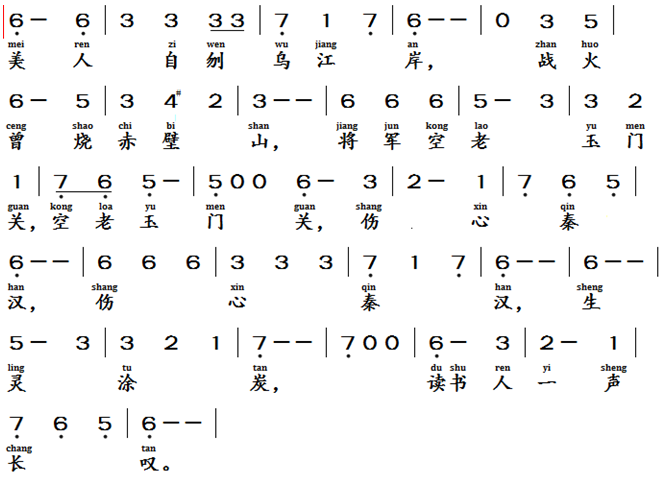
- 卖花声, 怀古, 元代, 张可久 (1270-1348)The sound of selling flowers, Reminiscence, Yuan Dynasty, Zhang Ke Jiu (1270-1348 AD)Text of the lyrics卖花声 怀古 [4]美人自刎乌江岸,战火曾烧赤壁山,将军空老玉门关。伤心秦汉,生民涂炭,读书人一声长叹。Translation of the Lyric (poem)The sound of selling flowers, ReminiscenceThe beautiful concubine Yu committed suicide on the shore of the Yangtze River, the war once burned the mountain of Chibi, the general get aged without military exploits at the Yumen Pass.Sorrowful Qin and Han dynasties, the people suffered greatly, it is only a long sigh of scholars of later generations.
3.7.2. Sheet Music with Lyrics Marked in Chinese Pinyin without Tones
- This score (sheet music) is derived (excerpted) from the (pieces) of the Song of the Scarborough Fair [7], a traditional English folk song that dates back to the 14th century, and has undergone minor modifications to ensure a better alignment between the musical arrangement and the lyrics (poem).

3.8. Song No 08
3.8.1. Title of the Poem
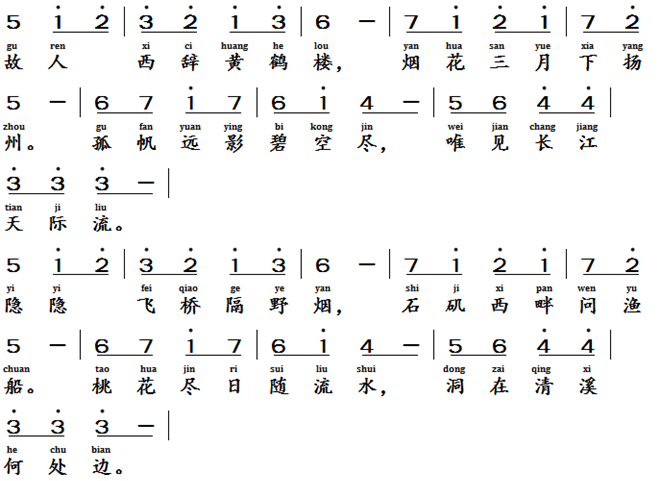
- 黄鹤楼送孟浩然之广陵, 唐代, 李白 (701-762)Farewell Meng Haoran to Guangling city on the Yellow Crane Tower, Tang Dynasty, Li Bai (701-762 AD)桃花溪, 唐, 张旭 (675 - 750)The Peach Blossom Stream, Tang Dynasty, Zhang Xu (675-750 AD)Text of the lyrics黄鹤楼送孟浩然之广陵 [2]故人西辞黄鹤楼,烟花三月下扬州。孤帆远影碧空尽,唯见长江天际流。桃花溪 [2]隐隐飞桥隔野烟,石矶西畔问渔船。桃花尽日随流水,洞在清溪何处边。Translation of the Lyric (poem)Farewell Meng Haoran to Guangling city on the Yellow Crane TowerMy old friend departs westward from the Yellow Crane Tower, in the fulfilled flowers and mist third month of spring, he sails for Yangzhou. His solitary sail recedes into the boundless azure sky, only the Yangtze River flows unceasingly toward the horizon line of the river and sky. The Peach Blossom StreamFar off, a bridge seems suspended above mist-shrouded fields, at the western end of the rocky pier, I ask the fisherman’s boat. Peach blossoms drift all day following the current, in this limpid stream, where lies the fabled cave.
3.8.2. Sheet Music with Lyrics Marked in Chinese Pinyin without Tones
- This score (sheet music) is derived (excerpted) from the (pieces) of the Italy Giovanni Marradi’s song of The Homecoming [8], and has undergone minor modifications to ensure a better alignment between the musical arrangement and the lyrics (poem).

3.9. Song No 09
3.9.1. Title of the Poem
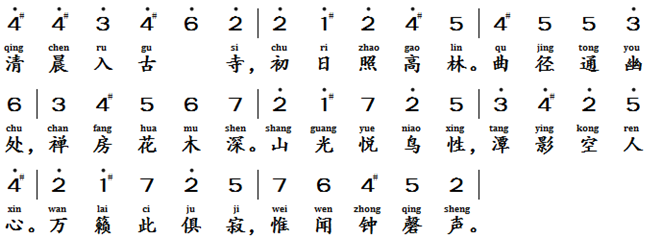
- 题破山寺后禅院, 唐代, 常建 (708-765) A Poem for the Rear Temple of Baishan Mountain, Tang Dynasty, Chang Jian (708-765 AD)Text of the lyrics题破山寺后禅院 [2]清晨入古寺,初日照高林。曲径通幽处,禅房花木深。山光悦鸟性,潭影空人心。万籁此都寂,但余钟磬音。Translation of the Lyric (poem)A Poem for the Rear Temple of Baishan MountainAt dawn, I enter the ancient temple; First sunlight gilds the towering trees. A winding path leads to seclusion place. The meditation hall nestles amid luxuriant blooms and verdant groves. Mountain light delights the birds’ nature, the pool’s reflection purifies the heart’s dust. All is hushed save the resonant chime of bronze gongs and bells.
3.9.2. Sheet Music with Lyrics Marked in Chinese Pinyin without Tones
- This score (sheet music) is derived (excerpted) from the (pieces) of the music Faylinn by David Hicken [9], and has undergone minor modifications to ensure a better alignment between the musical arrangement and the lyrics (poem).

3.10. Song No 10
3.10.1. Title of the Poem
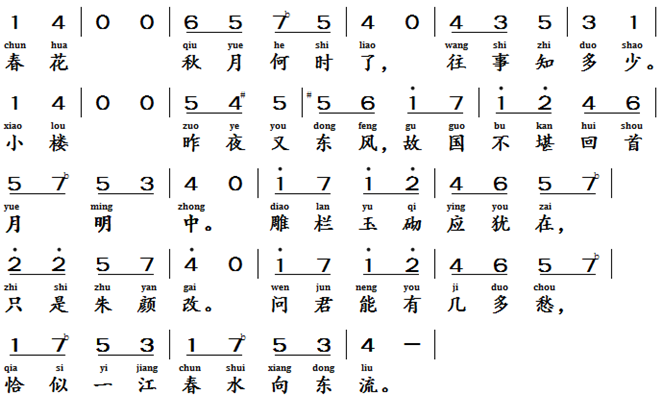
- 虞美人, 南唐, 李煜 (901-962 ) Beautiful concubine Yu, Southern Tang Dynasty, Li Yu (901-962 AD)Text of the lyrics虞美人 [4]春花秋月何时了,往事知多少。小楼昨夜又东风,故国不堪回首月明中。雕栏玉砌应犹在,只是朱颜改。问君能有几多愁,恰似一江春水向东流。Translation of the Lyric (poem)Beautiful concubine YuWhen will spring flowers and autumn moons cease. How many bygone events can one recall? Last night, the east wind blew again upon the small tower,in the bright moonlight of yore, I could not bear to think of my lost homeland! Marble balustrades and jade pillars surely remain,but youthful beauty has long since faded. How much sorrow can one person bear, just like a river flowing eastward, unceasing, year after year.
3.10.2. Sheet Music with Lyrics Marked in Chinese Pinyin without Tones
- This score (sheet music) is derived (excerpted) from the (pieces) of the music Beethoven’s Romance in F Major [10], and has undergone minor modifications to ensure a better alignment between the musical arrangement and the lyrics (poem).

3.11. Song No 11
3.11.1. Title of the Poem
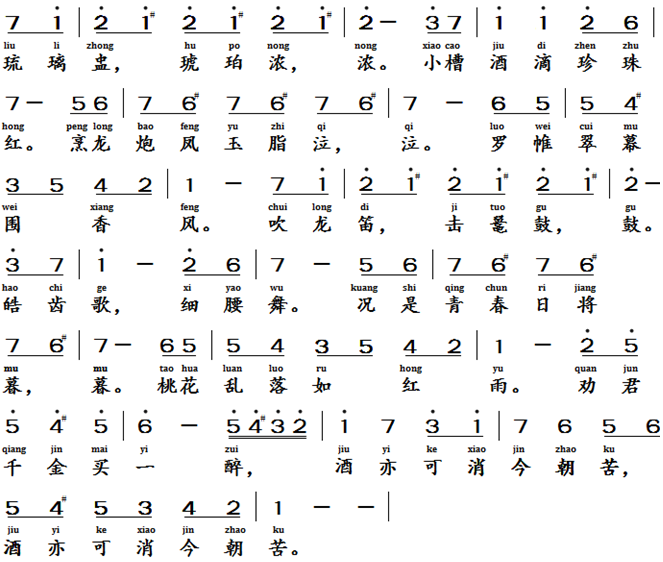
- 将进酒, 唐代, 李贺 (791-817) Let's Drink, Tang Dynasty, Li He (791 - 817 AD)Text of the lyrics将进酒 李贺 [5]琉璃钟,琥珀浓,小槽酒滴真珠红。烹龙炮凤玉脂泣,罗帏绣幕围香风。吹龙笛,击鼍鼓,皓齿歌,细腰舞。况是青春日将暮,桃花乱落如红雨。劝君终日酩酊醉,酒也能消平日苦。Translation of the Lyric (poem)Let's Drink Crystal goblets, amber wine, droplets of true Pearl color red dripping from the spout; Dragon and phoenix delicacies make jade-like fat weep.Brocaded curtains and embroidered screens encircle fragrant breezes. Blow the dragon flute, strike the turtle-shell drum, with pearly teeth, sing softly dance with grace. Youth fades swiftly; red blossoms fall like rain. I urge you to spend your money on just one drink, for the wine can also ease your current sorrow.
3.11.2. Sheet Music with Lyrics Marked in Chinese Pinyin without Tones
- This score (sheet music) is derived (excerpted) from the (pieces) of Beethoven’s Minuet in G major [7] [11], and has undergone minor modifications to ensure a better alignment between the musical arrangement and the lyrics (poem).

3.12. Song No 12
3.12.1. Title of the Poem
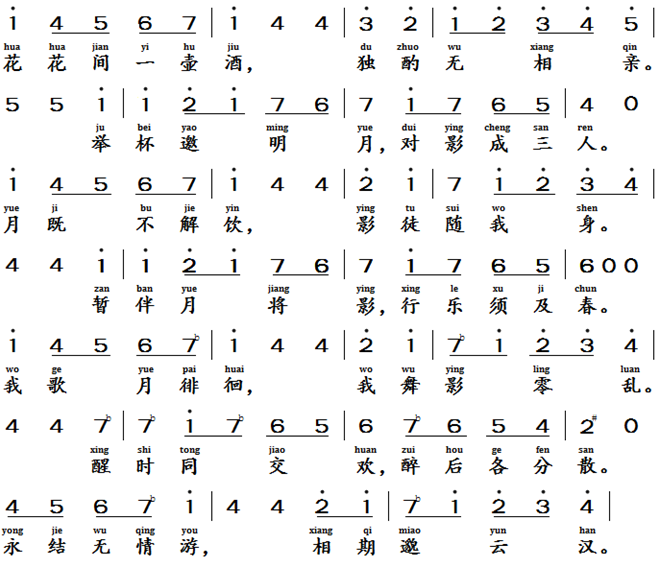
- 月下独酌, 唐代, 李白 (701-762) Drinking Alone Under the Moonlight, Tang Dynasty, Li Bai (701-762 AD)Text of the lyrics月下独酌 [2]花间一壶酒,独酌无相亲。举杯邀明月,对影成三人。月既不解饮,影徒随我身。暂伴月将影,行乐须及春。我歌月徘徊,我舞影零乱。醒时相交欢,醉后各分散。永结无情游,相期邈云汉。Translation of the Lyric (poem)Drinking Alone Under the MoonlightIn the midst of the flower garden, I pour a cup of wine and drink alone, without any companion. I raise my cup to invite the bright moon, and my shadow forms a trio with me. The moon doesn't understand drinking and my shadow merely follows me. I accompany the moon and my shadow for a while. Real enjoyment should be waited until the coming spring season. I sing to the moon, and it wanders; I dance, and my shadow becomes chaotic. When I wake up, we are happy together; when we are drunk, we part apart. We will forever have an unfeeling friendship, and we will make an appointment with the distant heavens.
3.12.2. Sheet Music with Lyrics Marked in Chinese Pinyin without Tones
- This score (sheet music) is derived (excerpted) from the (pieces) of Johann S Bach’ Minuet in G major [6], and has undergone minor modifications to ensure a better alignment between the musical arrangement and the lyrics (poem).

4. Literature Review
- Classical metered Chinese poetry has a long and rich history spanning over two millennia. Ancient Chinese poetry is known for its strict adherence to formal rules and its use of complex imagery and symbolism. Each type of poetry has its own unique characteristics and themes, but all are highly valued for their beauty and cultural significance.Its earliest known examples are found in the Book of Songs (Shi Jing), a collection of over 300 poems and songs from the Western Zhou Dynasty (11th-7th centuries BCE).During the Tang Dynasty (618 – 907AD), poetry flourished and reached its peak, with poets like Li Bai (author of poem 02, 08 and 12 of this paper) and Meng Haoran (author of poem 06 of this paper), whom producing some of the most celebrated works in Chinese literature. Many of the Tang poems are known for their lyrical quality and vivid imagery, and they often explore themes of nature, love, and Buddhist philosophy. Tang Shi San Bai Shou (300 Tang Poems) is a compilation of poems from this period made around 1763 by Sun Zhu. It has been used for centuries since to teach elementary students to read and write, and also in cultivating character.The Song Dynasty (960-1279 AD), saw the emergence of a new type of poetry known as ci (verse), which was characterized by its use of set melodic patterns and strict tonal requirements. Ci poetry often drew on themes of nature, love, and morality, and was often set to music and performed in public. Poets like Xin Qi Ji (author of 05 of this paper) producing some of the most celebrated works that full of passionate patriotic spirit and determination in Chinese literature.Let have a brief of some typical poems in this paper:Li Bai01: Peaceful and serene joy is a poem describing Empress Yang, the favorite concubine of Emperor Tang and its tone is slightly sarcastic. Yuan Jie02: Drunk Song at Shiyu Lake, Introduction of the author: On the northern bank of the river, there is a solitary stone floating in the water, resembling a swimming fish. In the hollow part of the fish, it can be used to store wine. Around the water's edge, there are many inclined stones connected together. On the stones, people can sit. The water can float small boats to carry wine, Thus, the lake was named "Stone Fish Lake". A plaque was engraved on the lake to inform visitors. Xin Qi Ji05: People from northern countryside, On Visiting the Northern Fort of Jingkou with Thoughts of the Past. This poetry expresses the sentiments of an ambitious general after a brief visit to famous mountains. Through praising the ancient heroic figures, it conveys the author's ardent aspiration to be like the ancient heroes, wielding weapons and horses to reclaim the old territory and serve the country. It is filled with a deep sense of patriotism. If the readers can understand Chinese would be better, so that he or she can feel the spiritual essence the poem and sing along with the songs in the text.
5. Conclusions
- The profound affinities between poetry and music become most evident and their artistic potential fully realized, when integrated into the unified art form of song, wherein each retains its distinct expressive identity while engaging in dynamic aesthetic resonance. The commonalities between poetry and music can be synthesized through the practice of their combination that will be more effective.(This conclusion is always verified whenever reveal to any readers.)
6. Postscript
- Every nation possesses outstanding poets whose works have made significant contributions to literary heritage of the human being. Selecting several of their exemplary poems and pairing them with thematically resonant classical compositions could yield a refined, interdisciplinary artistic endeavor of international significance. This approach is appealing to those viewers, audiences and readers who have a deep love for both literature and music. Why not do we practice the enthusiastic, bold and decisive approach to accomplish this great initiative.