
-
Paper Information
- Paper Submission
-
Journal Information
- About This Journal
- Editorial Board
- Current Issue
- Archive
- Author Guidelines
- Contact Us
Architecture Research
p-ISSN: 2168-507X e-ISSN: 2168-5088
2014; 4(2): 35-42
doi:10.5923/j.arch.20140402.01
Development of a Dwelling Unit in Cyprus
 Abstract
 Reference
 Full-Text PDF
 Full-text HTML
Turkoz Kolozali
Faculty of Architecture, Near East University, Nicosia, North Cyprus via Mersin, 10 Turkey
Correspondence to: Turkoz Kolozali, Faculty of Architecture, Near East University, Nicosia, North Cyprus via Mersin, 10 Turkey.
| Email: |  |
Copyright © 2014 Scientific & Academic Publishing. All Rights Reserved.
Dwelling units have been the most important aspect for people during all parts of evolution. People work and spend most of their savings on creating a suitable shelter for themselves. At present the greater part of the population still possess the problems to building dwelling units. Cooperatives and private dwelling designs try to solve the problem by adopting a series of social mass dwellings as the housing problems are aggravated.The problems of building dwelling units can be solved in accordance with the dynamics of the structure of a family. In a construction of a dwelling for a young family; it is essential to take into account the dynamics of its demographic structure (change of the numerical composition and structure of a family through the ties of relationship) as well as financial resources for purchasing the dwelling.Upon making the comparative analysis of an economic status of the low-income and medium-income strata of the population, we can say that the opportunities for a young family to purchase the dwelling which meets the modern requirements are rather limited and depend only on the present state of the family. Over a period of time the quantitative composition of a family increases and its financial status is improved. Thus, regarding to these factors the necessity arises to develop the dwelling unit. Proceeding from the actual economic opportunities of the population and its state, as well as from striving to live in future in composite families, growing of a dwelling unit is offered. It should be taken into account that any (nuclear or composite) type of a family, is a stage in its continuous development and is not its constant characteristic and the dwelling area can be used by the first, second and further possibly third generation. The stage-by-stage development of a “growing dwelling unit” is change in parallel with the dynamics of a family structure. The “growing dwelling units” should be considered in the advances it provides in economic and rural situations especially to overcome the chaotic development of future settlement areas. Designing dwelling units in parallel with the dynamics of a family structure gives us minimum modification during development of a dwelling unit, better condition of load bearing structure system and enables faster building. Designing, in consideration of stages the development of a dwelling unit also has advantage for general architectural composition. “GROWING DWELLING UNITS” are especially advantageous in earthquake regions as an economic solution for people in need. Building of the first stage with minimum comforts is better than temporary buildings and has the advantage to increase its volume in future.To obtain maximum advantages in the “GROWING DWELLING UNITS” with the least amount of modifications, a simple and basic construction element should be chosen which are functional and account for natural climatic factors and express the esthetic of the whole architectural ensemble.
Keywords: Residential design, Evolution of design, Building for cypriot families
Cite this paper: Turkoz Kolozali, Development of a Dwelling Unit in Cyprus, Architecture Research, Vol. 4 No. 2, 2014, pp. 35-42. doi: 10.5923/j.arch.20140402.01.
Article Outline
1. Introduction
- The performed analysis of the main factors and conditions on the island of Cyprus is the exertion of an influence to the dwelling of architecture. Firstly, the necessity of taking into consideration the national features of the layout of an apartment, the conditions that improve the microclimate and permittivity of the function for a house or apartment for a long time along with taking into consideration the possible future changes of the family incomes and the dynamics of its social - demographic structure. Secondly, the list for the types of dwelling houses and methods of formation of the residential development for the different climatic -construction areas of the island must be determined. Thirdly, the revelation of the means of general formation of the dwelling houses for the different regions of Cyprus on the basis of taking into account the national traditions in architecture, natural-climatic conditions and local materials.The increased density of residential development in the towns of Cyprus is designed for the medium-income and low-income of the population, due to a series of circumstances: demographic (composite structures of families, great percentage of young families), economic (high cost of land and construction), national traditions (living in composite families), and the tendency of family-by-family blocking (blocking of two-four houses, inhabited by kindred families, round a court). In the construction of a dwelling for a young family it is required to take into account the dynamics of its demographic structure (change of the numerical composition and structure of a family by ties of relationship) as well as financial resources for purchasing the dwelling. Upon making the comparative analysis of an economic status of the low-income and medium-income of the population, it can be said that the opportunities of a young family for purchasing a dwelling which meets the modern requirements are rather limited and depend only on the present state of the family. This can be a one or two-room block apartment. Upon the expiration of certain small period the quantitative composition of a family increases and its financial status is improved and regarding to these factors the necessity to develop the dwelling unit arises. Proceeding from the actual economic opportunities of the population and state as well as from the strife to live in future in composite families, the method of the stage-by-stage development of a dwelling unit is offered.It should be taken into account that any (nuclear or composite) type of a family is a stage in its continuous development and is not its constant characteristic, and moreover the dwelling area can be used by the first, second and possibly further third generation.
2. Stages of Development
- At the different stages of development the dwelling units differ in terms of the volume and numerical composition of the families. This is determined by the requirements of a particular present group of the population, for which the constructed residential cluster or region are intended by its economic opportunities for prospective development, as well as by the dimensions of a plot of land allotted for the construction of a "growing" dwelling unit.The stage-by-stage development of a dwelling unit in parallel with the dynamics of a family structure consists in the following (Fig.1).
 | Figure 1. Development of the structure of block apartments |
3. Versions of Development Compositions
- In connection with a factor that the layout of an apartment and the peculiarities of arrangement of separate functional zones exert a substantial influence on the configuration of a block apartment and its location on the plot results in the compositional arrangement of the blocked housing. The possible compositional version of the development of the block apartment structure (Fig. 2) are as follows: 1 - Frontal development (parallel to the street) 2 – development in depth (perpendicular to the street); 3 – combination of the methods of frontal development in depth or ring development of the plot of land; 4 – vertical development (on account of increasing the number of storeys); 5 – cascade development (on account of the terrain relief).
 | Figure 2. Development of the structure of block apartments |
 | Figure 3. Stage by stage Development of blocked houses, elaborated by the author |
3.1. The Development in Depth
- The development of a dwelling structure in depth, perpendicular to the street and similar to the line or carpet development is used with the skylight courts and small utility courts (Fig.3). The comparably long intra apartment communications (corridors) are the drawback which is compensated on account of the small frontage of the dwelling unit along the street and high density of housing. In the event of the development in depth the distinct zoning of an apartment is attained and the partially isolated dwelling block (Fig.5) is obtained. In this case both in the frontal development and in the in-depth development the construction is limited by two or three stages, since the development is one sided.
3.2. The Frontal Development
- The combination of the methods of both the frontal and in-depth development, forming the carpet development (Fig. 2), is the most ideal version for the “growing of a dwelling unit”. At this point two stages of development can be envisaged, at which the isolated dwelling blocks and the cozy inner court meets all requirements to the layout of an apartment for large families (of up to 11 members) can be obtained.
3.3. The Vertical Development
- The vertical development of a block apartment is the most cost efficient method, since first of all the economy of land and the building expenses (for construction of foundation, roof, engineering, networks) occurs. The positive qualities of such housing are also its compactness and high density (Fig.4). Here the methods of three-stage construction can be used. With arrangement of the block apartment in several levels the distinct storey-by-storey zoning of the block apartment is attained with obtaining the partially isolated dwelling apartment in the upper storeys (Fig.4).
 | Figure 4. Stage by stage Development of blocked houses, elaborated by the author |
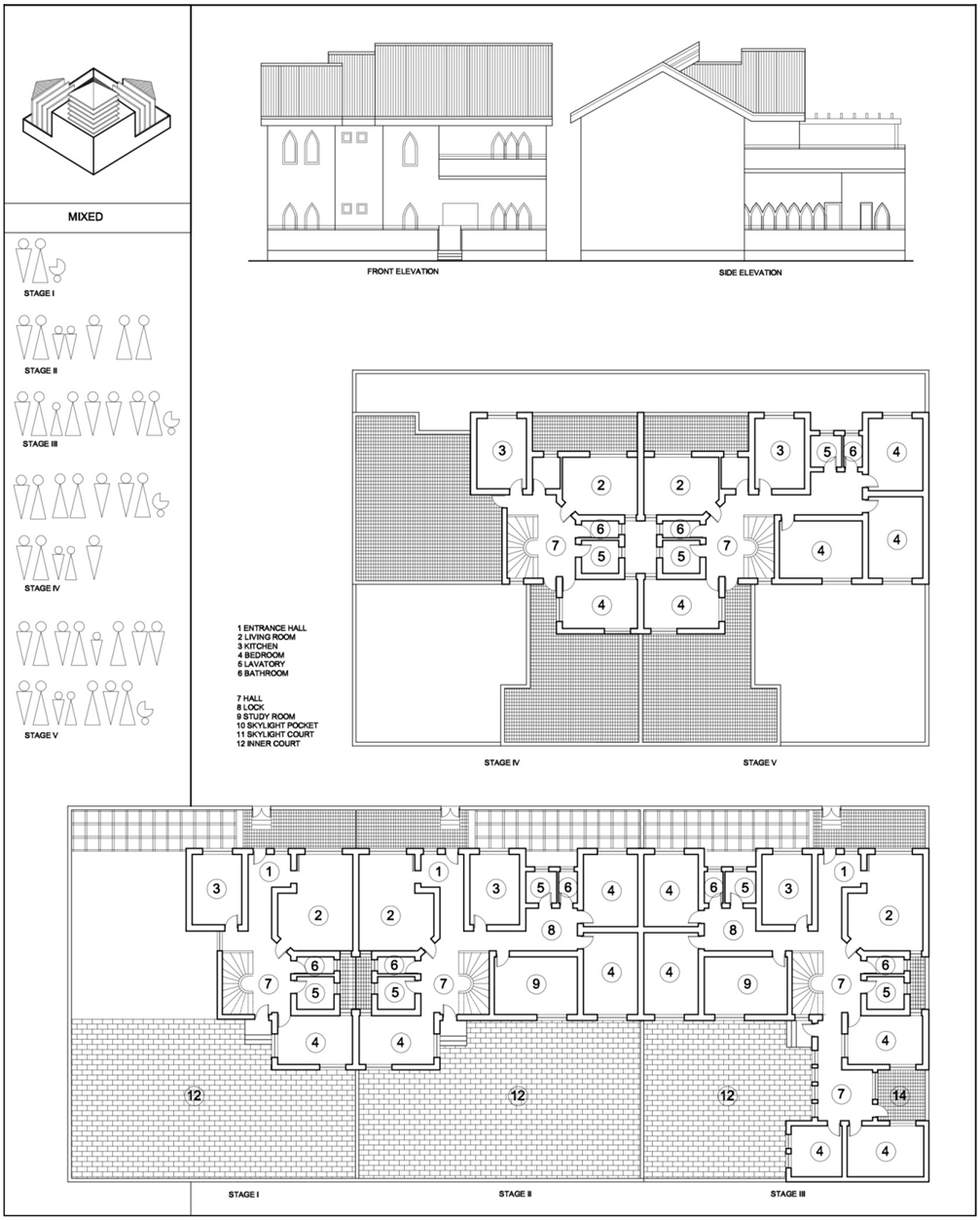 | Figure 5. Stage by stage Development of blocked houses, elaborated by the author |
3.4. The Cascade Version of Development
- In addition, the cascade version of development of a block apartment is possible which is convenient for mountain areas with different slopes of relief, where the “house growth” is accomplished step-by-step or vertically. It reflects the development of a dwelling unit in three and more stages, at which the partially isolated dwelling blocks with skylight courts are obtained. The experimental project of a block apartment with a cascade version of development of the inner space is shown in Fig.4. The lighting of the rooms via the skylight courts, used in the present project, enables to design the compact block apartments of unlimited orientation.The organization of courts and their communication with summer rooms play an important role in the structures of block apartments. The layout of rooms in the structure of block apartment and the comfort in living depend on the organization of the courts. Inclusion of the courts and summer rooms in the main volume of a block apartment (Figs 4) enables to improve the bio-hygienic qualities of block apartments (airing, insolation, lighting, protection from the negative factors of environmental effects, etc.), rationally the design of the structure which is of no small importance from the point of view of the natural-climatic conditions of Cyprus.
3.5. The Mixed
- All offered types of block apartments possess the three-sided blocking which is an important prerequisite for a dense housing with small number of storeys in creation of the high density. Upon completion of each stage of construction the block apartment must have a finished appearance both in the layout design and in the elevation composition. (Fig. 5)Thus, in the creation of the developing dwelling units the basis of the offered principles, are namely: arrangement of an apartment round an inner court, taking into account the dynamics of a social-demographic structure of a family and its reflection in the layout of the apartment. These principles will help to address several important problems:a) Retain the traditions of the Cypriot people, namely, living in the families consisting of several generations that strengthens the kindred relations, brings up the respect to the older generation and ensures the care of elders from younger generations and vice versa;b) Provide a young family with an individual dwelling as well as reduce the expenses for the upkeep of the family.But the most important task is the solving of the dwelling problem for the families of different composition with the aid of the dynamic layout system for a long-time period (for two or more stages of development of a family).
4. Conclusions
- In the multi apartment houses there is no opportunity for organizing inner courts, therefore the compulsory layout elements arranged in the common zone of an apartment are connected to the entrance room, salon, and kitchen.The recommended connection of the terraces to the salon and kitchen is functionally substantiated: the terrace is a place for the common resting zone for a family, play zone for children, sleeping, cooking and consumption of meals, and fulfilment of some domestic jobs.Since the dwellings in the multi apartment houses cannot be “growing” on the basis of taking into account the dynamics of a family structure and the age of family members it is required to: 1) select from a great number of layout versions of the apartments for mass construction which meet the requirements of a family for the longest period of time. These are the apartments with an integral utility-domestic zone in the common zone of an apartment, not less than two individual zones. Apartments in two levels with arrangement of the main zones in different storeys must be designed with the laundry room and the general-purpose room provided with daylight in the first level. It is also possible to have in both levels the individual zones or the minimal sanitary-kitchen block with a kitchenette additionally to the main one 2) Design the apartments in the storey plan so that, if necessary, the opportunity would be provided for the union of two neighbouring apartments and converting of them into a single organism with two autonomous or semiautonomous zone.