
-
Paper Information
- Paper Submission
-
Journal Information
- About This Journal
- Editorial Board
- Current Issue
- Archive
- Author Guidelines
- Contact Us
Architecture Research
p-ISSN: 2168-507X e-ISSN: 2168-5088
2013; 3(3): 21-25
doi:10.5923/j.arch.20130303.01
An Appraisal of House Security Measures in Lagos, Nigeria
 Abstract
 Reference
 Full-Text PDF
 Full-text HTML
Odunjo Oluronke Omolola1, Odunola Olutayo Olaitan2
1Department of Architecture, Ladoke Akintola University of Technology, Ogbomoso, 234, Nigeria
2Department of Urban And Regional Planning, Ladoke Akintola University of Technology, Ogbomoso, 234, Nigeria
Correspondence to: Odunjo Oluronke Omolola, Department of Architecture, Ladoke Akintola University of Technology, Ogbomoso, 234, Nigeria.
| Email: |  |
Copyright © 2012 Scientific & Academic Publishing. All Rights Reserved.
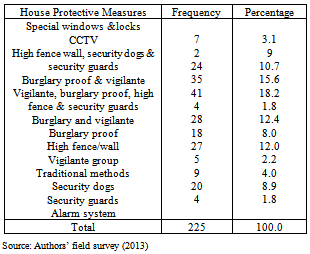
Against the background of increasing crimes in the society, this paper appraises the different House Security Measures being used by People in Nigeria towards the prevention of Housing insecurity. It uses Amuwo- Odofin local government area as a case study and makes use of both primary and secondary data. Two methods of data collection were adopted for this study. These are stratified sampling technique that was used to stratify the Local Government Area into wards while random sampling technique was used to select two hundred and twenty five respondents from the stratified areas for the study. The data obtained were analyzed using frequency counts and percentage. The study showed that in order to combat Housing insecurity, everybody had to put up one security measure or the other. The various House protective measures used by people range from conventional to non-conventional methods; and despite these, some people still feel unsafe and would need other forms of security which ranges from Nigerian Police Force, Odua Peoples’ Congress to Vigilante groups. The study concludes by providing sustainable solutions towards curbing the problem in our society.
Keywords: Crime, Housing Insecurity, Security Measures
Cite this paper: Odunjo Oluronke Omolola, Odunola Olutayo Olaitan, An Appraisal of House Security Measures in Lagos, Nigeria, Architecture Research, Vol. 3 No. 3, 2013, pp. 21-25. doi: 10.5923/j.arch.20130303.01.
Article Outline
1. Introduction
- Throughout the world, across the continents, a uniform battle is fought, the task of curbing crime. According to Zone Reality television in 2008, at least every ten years, 83.3% of those living in the cities with 900,000 or more inhabitants are victims of one form of crime or the other. This is true, not only in areas that are highly urbanized such as in Europe, North America, Asia, South America but also in Africa, where the urban population is low when compared to the rural population[1]. These crimes which sometimes differ from place to place are mostly found in the cities. The structural spatial inequalities often found in the cities and the growth of urban slums and underemployed subculture provide the environment for the proliferation of violence, particularly against the existence of relatively high levels of opulence.Unfortunately, in Nigeria, violence and criminal activities are assuming dangerous tendencies as they threaten lives, properties, the national sense of well being, peace, security, and social order and are eventually reducing the citizens’ quality of life.[2]. Segregation often found in the cities residential neighborhoods caused by difference in income, employment and education standard often lead to criminal tendencies, majorly of which are petty theft, rape, prostitution, murder, grievous wounding, burglary and so on. Coupled with this is the issue of Boko-Haram which at present is threatening the security of the Country. Increase in modernization in the country in the use of the internet among young school leavers have also, greatly accentuated the wave of crime in recent times.The implication of all these is that crime has spatial and temporal distribution and whatever the distribution is in the city, the immediate response of people to this social malaise is fear. This is shown in the relative manner of securing their houses by constructing high fence wall, using special doors and locks, hiring private security outfits and agencies. Government, corporate bodies and individuals do divert resources that could have been put to more productive use in order to stop crime.Crime in Nigeria, for example, rose in the mid – 1990s as a result of unemployment, economic decline and social inequality and brings about disorder in the environment. More than half of the offences are thefts, burglaries and break-ins, although, armed robberies are rampant. The alarming increase in the rate of crime in the Country has therefore, brought threat to lives and properties. The abundant development of some areas coupled with high number of unemployment and increase in poverty level are practically the major causes of crime and all sorts of abnormal behavior[3].Thus, in Nigeria today, people sleep with one eye opened and tend to live one day at a time with great doubt as hazardously armed bandits rampage houses with reckless abandon. The problem of crime one of the negative consequences of urbanization cannot be overlooked as it is a worldwide problem. Because job opportunities in cities have not kept pace with population growth, the rates of unemployment in urban areas often exceed 50 percent, and most jobless peo0ple are young and uneducated male. These people earn incomes from informal occupations such as selling newspapers and magazine, shining shoes, running errands, cleaning and collecting trash. Begging, prostitution and theft are also common ways of making a living. The alarming increase in the rate of crime in Nigeria therefore has not only brought about disorder but threat to lives and properties, housing inclusive. When one talks of housing, it is no more secured which is contrary to the definition of the term”. According to[4], housing is more than shelter, the mere physical dwelling while the United Nations Ad – Hoc group of experts on Housing and Urban Development defined it” as the physical environment in which a family, the basic unit in the society must develop. They further contended that housing is not shelter or household facilities alone, it comprises a number of facilities, services and utilities which link individuals and his family to the community in which it evolves. Hence, from the above, one could discern that housing is not just a community it could be described as a bundle of goods and services that facilitate and enhance good living. It is also a key to neighborhood quality and preservation. Consequently, environmental amenities such as waste disposal, water supply, neighborhood roads and locational services implied by the special links between necessary economic and social infrastructure (such as education, health and recreation) are all parts of the package of services designated as housing. Thus, housing insecurity in cities calls for concern as crime the main cause is a social problem which threatens lives and property and eventually, reduces quality of life. Crime is not only a social problem but also, the most serious of all social problems. Crimes also, are compound, organized and could be summarized in three main categories; these are economic factors/ poverty, social environment and family structure and the resultant effect is that people devised means of protecting themselves through different means among which is prevention through Design and Strategies. It is against this background therefore, that the paper evaluates the effects of using House Security measures by people in Nigeria towards the prevention of Housing insecurity. It uses Amuwo – Odofin local government area of Lagos State as a case study and at the end, proffers sustainable solutions that are targeted at solving insecurity in the different houses as well as reducing crime for the progress of the country.
1.1. Theoretical Framework of the Research
- The main theoretical frameworks used for the research are Routine Activity Theory (RAT) which gives an insight into the causes of crime and Rational Choice Theory which gives the reason why crimes are being committed.
1.1.1. Routine Activity Theory (RAT)
- Routine Activity Theory (RAT) is one of the main theories of “Environmental Criminology” developed by Lawrence Cohen and Marcus Felson who worked for many years on Crime Prevention Theory. The theory states that, for crime to occur, three elements must be present: v An existing and suitable target;v A likely motivated offenders andv Lack of a capable guardian or authority figure to prevent the crime from happening.The theory also incorporates the crime triangle, sometimes referred to as the Problem Analysis Triangle (PAT). RAT also provides a simple and powerful insight into the causes of crime problems. At its heart is the idea that in the absence of effective controls, offenders will prey upon attractive targets. To have a crime, an aggravate offender must come to the same place as an attractive target. For property crimes, the target is a thing or object; for personal crimes, the target is a person. If an attractive target is never seen at the same place as a motivated offender, the target will not be taken, damaged, or assaulted. Also, there are guardians whose presence can prevent crime. If the guardians are absent, or present but powerless, crime is possible.
1.1.2. Rational Choice Theory
- Through Rational Choice Theory, crime is described as an event that occurs when an offender decides to risk breaching the law after considering his or her own need for money, personal values or learning experiences and how well a target is protected, how affluent the neighborhood is or how efficient the local police are. Before committing a crime, the reasoning criminal weighs the chances of getting caught, the severity of the expected penalty, the value to be gained by committing the act, and his or her immediate need for that value. The intention is to increase the perceived effort; necessary to commit a crime, or increase the perceived risks of apprehension, or reduce the anticipated rewards of a crime, or remove the excuses to compliance with the law. The intention would be to design out crime, i.e. to make the disincentives to the commission of crime consistently outweigh the potential benefits. This would involve concerted efforts by the manufacturers of standard equipment prone to theft, to design in better security systems so that stolen goods cannot be used without a PIN or can be tracked. It also involves the adoption of surveillance technology to tag goods in stores electronically, install camera systems to monitor behavior, improve street lighting, have more police officers on patrol, assist householders to improve the home security, etc. A co-ordinated strategy would potentially prevent more crime and to be more cost – effective than imprisoning the few offenders that are currently apprehended.This theory is predicated on the assumption that humans have sets of hierarchically ordered preferences, or utilities. By reducing the opportunities for the commission of crimes and “target hardening”, i.e. making it more difficult to break into houses or to steal from shops, and encouraging more authority figures to assume responsibility, potential offenders will be deterred. There is some criticism that better protected area will simply displace crime into a less well protected area but the evidence is as yet equivocal on whether displacement does occur. However, the main problem is in re – ordering political priorities away from a penal – oriented strategy towards a crime prevention strategy. At present, many states have invested heavily in the former and see no immediate need to change their policies.
2. Methodology
2.1. Types and Sources of Data
- Two major types of data are used for the study. These include primary and secondary data. Primary data is the data collected by the Researcher from the field and were collected in the area through reconnaissance survey, questionnaire survey and administration, direct field observation, oral interview as well as participant observation. Secondary data on the other hand includes data collected by other person other than the researcher and thus, not the original work of the researcher. These were collected from books and journals, magazines as well as the net for the purpose of carrying out the research.
2.2. Method of Data Collection
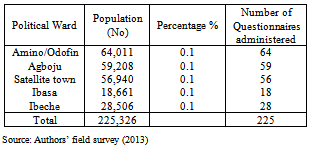
- Amuwo – Odofin Local Government Area is one of the local government areas in Lagos State and it is very close to the border. It provides shelter for various backgrounds, races and ethnic cleavages and stand as a form of new town fully developed. The local government consists of 5 wards and residential estates fully developed into 3 housing density types that provide shelters and other forms of land use.Thus, two types of sampling techniques were adopted in the collection of data for the research. These are stratified sampling and random sampling. Stratified sampling technique was adopted to identify the whole local government area into wards and knowing the population size of each ward in order to arrive at the sample size for the research.
|
2.3. Analysis
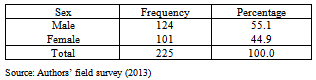
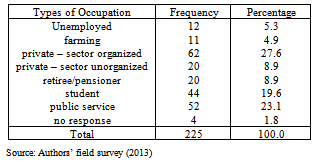
- Table 2 below shows that out of the respondents interviewed, 124 are males accounting for 55.1% while the number of females is 101 (44.9%).The implication of this is that the two genders are well represented and thus, one could expect a high level of information dissemination in the process of carrying out the research relating to crimes and the effects of using Security measures. However, in terms of Occupational distribution, a larger percentage of the respondents falls under private sector organized jobs (27.6%). These include bankers, company workers and owners of large scale enterprises.
|
|
|
|
3. Conclusions
- This paper has shown that crime is increasing in the cities of Nigeria daily and people are living in fear. It constitutes a serious problem which needs to be tackled and everybody should be involved. There is the need therefore, for planners and urban designers to be security conscious in the planning and design of residential neighborhoods while keeping the general health of inhabitants and accessibility in view. Thus, every house should be designed with total security gadgets such as burglary proof windows, doors etc in order to combat the effect of crime in the society. However, Majority of the respondents believe that the provision of employment will stop crime. If people are able to secure employment or engaged in useful ventures, there is the tendency that the rate of crime will reduce in the country. Government should therefore, endeavor to provide more jobs .Also; government should try to look into how to solve the problem of Boko Haram and Jos crisis in the country. These two crises have caused a lot of loss for the country in terms of economic loss, lives and properties. Some hoodlums even used the opportunity to vandalize the properties of people and even break homes. A roundtable meeting should be held with the various factions and thus, a solution should be proffered based on the current high level of insecurity in the homes and the country in general.Furthermore, government should direct the ways services are provided. For example, street lights should be provided at strategic points in order to reduce crime. Once hoodlums know that the environments of houses are not dark whenever there is no light and there is possibility of being seen by people, they would be afraid to break houses.Though, some of the respondents desire to have Police protection in addition to House security measures, the influence of the police in reducing crime in the country is currently minimal. There is a need to provide them with more equipment, such as patrol vans, uniforms, arms and ammunition as well as increasing their salaries in order to aid their performance.